







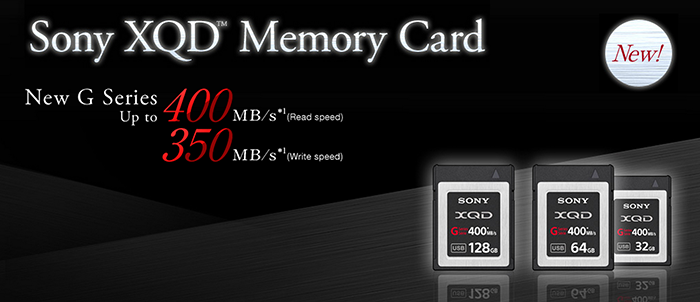
Sony finally disclosed the full details of the new XQD 4K ready cards. The new E-mount FS7 cam uses that kind of cards. You can preorder them already here:
Sony 128GB XQD Memory Card G Series 400MB/s at Adorama (Click here) and BHphoto (Click here).
Sony 64GB XQD Memory Card G Series 400MB/s at Adorama (Click here) and BHphoto (Click here).
Sony 32GB XQD Memory Card G Series 400MB/s at Adorama (Click here) and BHphoto (Click here).
That new XQD G card line is has a max read speed of 400MB/s, a max write speed of 350MB/s, and up to 128GB of storage. Those speeds make them three times faster than the “N” cards that came before them, and more than two times faster than the second-generation “S” series (Source: Petapixel).
And here is the full press text by Sony.net:
The new G Series is compliant to XQD Format Version 2, both PCI Express Gen.2 and USB3.0 interface are supported on a newly-developed controller for high performance.
The G Series delivers increased read 400MB/s*1 and write 350MB/s*1 speeds, which is three times the speed of the previous N Series cards.
Sony’s unique media technology enables these G Series cards to provide efficient data writing, dependable recording of 4K video while avoiding speed degradation.
The larger capacity 128GB model expands the line-up allowing up to 40 minutes of 4K XAVC Intra 422 60p (600Mbps) recording with Sony’s 4K video cameras. 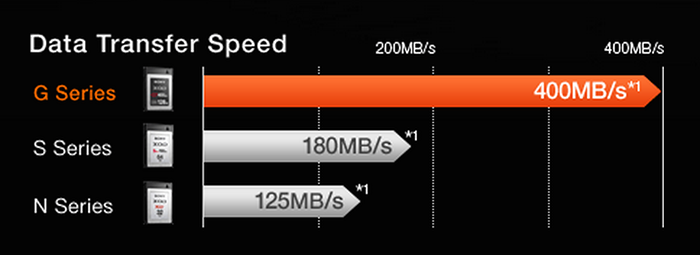
<Main recording modes and recording time>
| Product | Resolution | Codec | Wrapper | Frame Rate | Bit Rate | Recording Time(64GB)*3 | ||
|---|---|---|---|---|---|---|---|---|
| G Series | S Series | N Series | ||||||
| PMW-FS7 | QFHD | XAVC-I | MXF | 60P | 600Mbps | 10min | 10min | – |
| HD | XAVC-I | MXF | 60P | 222Mbps | 10min | 10min | – | |
| PMW-Z100 | 4K | XAVC-I | MXF | 60P | 600Mbps | 10min | 10min | – |
| HD | XAVC-I | MXF | 60P | 223Mbps | 30min | 30min | – | |
| FDR-AX1 | QFHD | XAVC S | MP4 | 60P | 125Mbps | 50min | 50min | 50min |
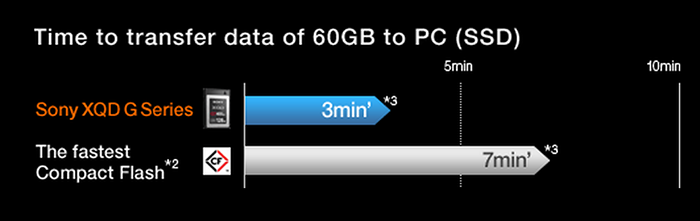
- The G Series is supplied with a dedicated USB 3.0 adapter, which offers convenience and efficiency for professional workflows. It dramatically reduce ingest time by less than half compared to the fastest Compact Flash card*2 even for large quantities of RAW images or data-intensive 4K video files.
Beyond extreme XQD™ memory card
The Sony XQD Memory Card S – Speed Performance Test
Sony 128GB XQD Memory Card G Series 400MB/s at Adorama (Click here) and BHphoto (Click here).
Sony 64GB XQD Memory Card G Series 400MB/s at Adorama (Click here) and BHphoto (Click here).
Sony 32GB XQD Memory Card G Series 400MB/s at Adorama (Click here) and BHphoto (Click here).
Found via PetaPixel and Nikonrumors.
0 Responses
SD cards? I thought XQD was from the CF association?
It is. The use of SD in the headline is wrong.
Fixed! Sorry!
Wow they use Nikon Camera on the Sony site to show the performance of this card!!!! What about a Sony A7r by the way ?
XQD is developed by Sandisk, Sony and Nikon.
A7r can’t read xqd cards, admins fault to call it SD
@admin please correct!
XQD is a professional high performance card format. No Sony still camera uses it, but Sony video cameras do.
XQD != SD. Fix it!
Admin’s way to get people’s attention, just like 24-700mm lens
Nope. Plain copy and paste error. Sorry.
You are forgiven. Aha.
Click bait…mate
That’s an astonishing price. For the price of the 128GB card you can almost get 4 x Crucial MX100 512GB SSD drives…
(nb. I know this is more compact, but even so – there smaller form factor SSDs as well, albeit not this small).
Because there’s a 1400Mbps codec for 4K video??!! Raw perhaps? 4096×2160, 14bits per channel, would be… um… 371Mbps. So, no idea why these need to be so fast. Anyone?
Ooops! That’s only one frame, so at 24fps raw would be.. 1486Mbps. Ahh ok makes sense now.
In other news, I clearly cant add up. At all.
Your calculations assume that there are 3 colour channels per pixel. However, that’s not generally the case. If you take the A7S as an example, there are (roughly) 8 million pixels per frame. At 14 bit depth, that yields about 14MBps as there’s only one colour channel per pixel location (still raws are the same, apart from where Foveon sensors are used).
At 24fps, that means 420MBps. However, I don’t see raw formats being used on video without some compression. Still RAW compression with minimal loss halves file sizes, and there are more options for RAW video. I believe that RED cameras perform frame-to-frame compression, and there is a patent lawsuit against SOny on that very subject.
Of course, if/when sensors come out which allow for full colour sampling, then the pre-compression bandwidths will be similar to your calculations.
Not a bad price, if they come with a free DSLR.
SanDisk 512GB Extreme Pro UHS-I U3 SDXC Memory Card (Class 10) $729.00
Sony 128GB G Series XQD Format Version 2 Memory Card $799.95
I tink SanDisk wins this round =)
No, Sony wins, the XQD G is 4 times faster.
Actually Sandisk still wins. What matters is the write speed. And this faster speed would be helpless if the device cannot submit data fast enough for, or in synchronous with, the write speed of the card.
Thus in reality Sandisk still is the better choice in terms of investment and optimum balance of devices and cards.
Bumfuzzled much?
The S series cards have been tested and work with 4K high frame rate (60p) on FS7. It’s not a requirement to buy these G series cards for 4K high speed shooting.
The max bitrate on FS7 is 600 Mbs, which is only around 75 MB/s — easily done by S series card that are cheaper.
I am not in the market for something like this, but I’m SO HAPPY to see memory card transfer speeds continuing to be pushed further for future generations of cameras to utilize.
At this rate memory cards might surpass solid state hard drives!
By definition, memory card is an SSD( plug-and-play storage device that contains no moving parts).
they will never surpass. they are ssd drives. it’s just another form factor. and you already have those speeds in memory cards. that’s why XDQ sucks.
CFast 2.0 cards already have +500mb/s read and +350mb/s write speeds.
not sure why it does make you so hysterical. they have been around for some time.