







Note for US readers: The new 70-200mm FE lens is now shipping at BestBuy!
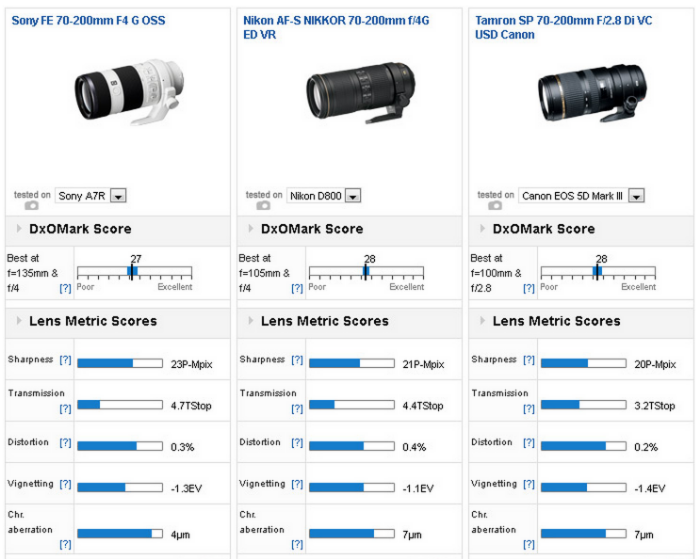
DxOmark (Click here) tested the new Sony 70-200mm f/4.0 FE lens and writes:
The Sony’s performance is very good and sharpness levels are very high, and even though it can’t quite match the best in class – the Nikkor 70-200mm f4 – at 200mm, it’s still unlikely to disappoint. Coming bundled with a tripod collar, the Sony even slightly undercuts the rival Nikkor model, making the FE 70-200mm f4G OSS look good value without compromising on quality or practical features.
You can preorder the lens in USA at Amazon, Adorama, BHphoto, BestBuy and SonyStore. In Europe at Sony DE, UK, FR, IT, ES, NL, BE, CH, AT, SE, FI, NO, PT.
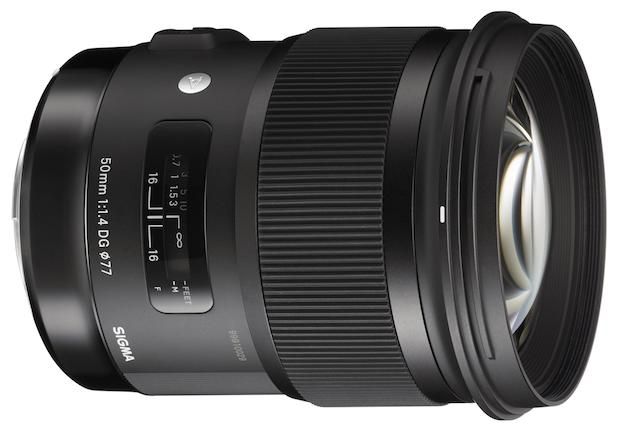
SLRgear (Click here) is the first worldwide site who reviewed the new Sigma 50mm f/1.4 ART lens. They tested it on a Canon 5DMarkIII but as you know the lens will be available for A-mount too. And this is their test conclusion:
The Sigma 50mm f/1.4 Art is the most exciting lens we’re likely to review this year. All competing lenses from Canon and Nikon fell short when compared to the resolving power of the 50mm Art. We haven’t (yet) tested the very best from Zeiss (Otus), but we are confident Sigma will trounce it in one key area: price.
Amazing! Now please Sigma, gives us an A-mount pricing and preorder option soon!
0 Responses
wow 70-2000? That must be a pretty heavy lens…
2000mm F4 would be bigger than Bigma 200-500
Andrea your title is wrong. One extra zero
Otherwise the Sigma 50/1.4 is surely great lens but does not seem this far ahead of Sony 55/1.8. For A mount users that should have some appeal but for E mount the FE 55 is a legend on its own
it is well ahead of the Sony at every matched aperture especially in the critical faster than F4 zone . At F2.8 the Sigma is better corner to corner than the Sony at its F5.6 peak. The following graphs show the difference between the two at F2 and at f2.8 on the Sigma compared to F5.6 on the Sony.
don’t forget, the numbers don’t translate to the D800E sensor
Why wouldn’t they mike ? The D800e and A7r sensors are all but identical.
http://www.dxomark.com/Cameras/Compare/Side-by-side/Sony-A7-versus-Nikon-D800E___916_814
When the same lenses are tested on the D800e vs 5D mkIII the
only significant change is the extra resolution of the higher mp sensor , no surprises there.
http://www.dxomark.com/Lenses/Compare/Side-by-side/Sigma-35mm-F14-DG-HSM-A-Nikon-versus-Sigma-35mm-F14-DG-HSM-A-Canon___1057_0_1056_0
It looks very impressive. However, those figures are relative sharpness curves. I would wait for the DXOMark scores for the D800, before comparing with the FE 55mm. The Sigma looks very impressive though, but at more than 3 times the weight than the FE 55mm, it is no alternative to the truly incredible FE 55mm
DxO tests won’t tell us 5% of how these lenses actually behave vs. shooting actual subjects with both lenses.
Agreed, but DXOMark is still a great objective comparison tool disclosing sharpness levels vs aperture etc. I love the Sonnar look anyway, so it will not matter to me, but the comparison is still interesting 🙂
Well we could listen to forum blowhards with zero scientific information , or we could look at the data tested & provided by one of worlds best producers of lens correction software { take a miniute to actually understand the tests and study the ample detail given .Wonder which choice will give the best data
Really? Did you somehow solder a 36MP sensor in to 5d mk3? The results of the two lenses are roughly equivalent sorry to spoil your day.
so are you saying the the 55 is better than the sigma 50 because I am willing to sell my 55 for the sigma since I spent that much on a 55mm, something never thought I would ever do. I might as well have the best 50 ish lens I can get. I don’t mind the size.
I would not do this given that the only test of the Sigma shows it is not any better than the 55mm lens. Also the 55mm can focus with areas across the sensor is much smaller and so on and so on…
Still everyone has right of choice and you may like the Sigma better.
I am sorry to disillusion you Kiril but the Sigma is clearly better .The only difference when the Sigma lens gets mounted on a 36mp sensor is that it will have higher resolution. Corner to corner sharpness, transmission ,distortion ,Chr. aberration Vignetting will remain pretty constant. There is no need for Nikon D800/e users to mess about with adapters. The topic is about the Sigma being a better lens not how convenient it will be to use on an A7 or A7r
Here is a test between the Nikon 85mm F1.4g on the D800 and on the D610 the only difference is in the mp count which will increase resolution all other components of the test remain . By the time it comes out on A mount there could well be a higher mp A mount body but whatever you are completely wrong.
It is not disillusion I do not mind if the Sigma is a good lens. For now there is not reason to believe so. You can may be read what tests mean. You cannot extrapolate low res i.e. 22MP results to 36MP. If you look at DxO, their tests for lenses are on different res bodies and the result do vary quite a bit. Some people think DxO do not know what they do but reality is 36 without AA filter does not equal 22 It si much more. So the results of the sony from above are same or better than the Sigma.
The only “significant ” difference between a lens tested on a 22/24mp body and on a 36mp body will be an increase in resolution. All other aspects of the lens will remain reasonably constant, so the Sigma will still have better corner to corner performance. it will still be a faster lens and when on a 36mp sensor the Sigma will do better. I do not see your problem
Here is the Sigma 35mm F1.4 test results on a 24mp vs 36mp body, other than the increased resolution of the 36mp sensor all other measurements are within testing tolerances near identical.
http://www.dxomark.com/Lenses/Compare/Side-by-side/Sigma-35mm-F14-DG-HSM-A-Nikon-versus-Sigma-35mm-F14-DG-HSM-A-Canon___1057_0_1056_0
there is NO performance issue with corners on the 55mm. Even in the test pointed out wide open the sigma has softer corners… The Sony lens is really really good! It is bordering on amazing on 24MP A7. I hope too we have more good lenses to choose from at decent price but I would not go as far as extrapolating results from another lens and a different res sensor to make possibly wrong conclusions….the differences even if we assume the 5d mk3 and A7r are same resolution which they are not are so close that the whole debate is hair splitting. Given that Sigma results will be somewhat softer on 36MP I really fail to see the reason for the enthusiasm.
“Given that Sigma results will be somewhat softer on 36MP”
That is exactly the opposite of what happens in reality, a higher MP sensor delivers better result from every lens mounted on it .
Here again is a direct comparison using the excellent Sigma 35mm F1.4 one on the Canon 5dmk3 and one on the D800 , the sharpness{ resolution } is significantly higher on the D800 while all other factors are are pretty similar
http://www.dxomark.com/Lenses/Compare/Side-by-side/Sigma-35mm-F14-DG-HSM-A-Canon-versus-Sigma-35mm-F14-DG-HSM-A-Nikon___1056_0_1057_0
No ,matter how much often you repeat it the Sigma is clearly and demonstrably a better performer than the Sony . { I am an A7R user and the 55mm is by far my favorite lens on it } At every matched aperture { you did notice that the Sigma is an F1.4 lens ! }the sigma is better. Personally i prefer the convenience of AF and not having to use an adapter etc so I would not buy the Sigm fro my A7r , i will however buy it for my D800e
what ???? 2000…. lol
He’s in a rush to put out too many posts so no longer checks.
I want one- the 70-2000mm zoom. Throw away prices too! 🙂
Or.. should I wait for the 7-2000 zoom? 🙂
The transmission is a little disappointing at 4.7 t-stop. The lens is a bit dark. The Sony 70-200 2.8 (1st gen) has a transmission of 3.2. So even if both are set to identical apertures, when using the FE one will need a higher ISO or slower shutter to achieve the same exposure.
Transmission is often an overlooked spec.
What’s the transmission value of the Sony 70-200/2.8 at f/4? Comparing to the Nikkor f/4, it is very similar. I don’t think the difference is that much when they’re all set at the same f/stop value.
Generally, the transmission improves a bit as you stop down. If shooting at f/4 – a f/2.8 lens is usually closer to t:4.0 than an f/4 lens is. (If you follow that).
You might be talking about a 1/3 stop actual difference. Maybe half stop.
Well, the difference between f/4 and f/4.7 (or t/4 and t/4.7) is only 1/3 stop. So that would be the maximum difference you would get. I don’t see how that would wildly affect anything.
Doesn’t transmission also vary at the different focal lengths?
So is it T/4.7 at the worst?
I just looked into Dxo’s measurements, and if I’m reading them correctly this lens is about T/4.7 throughout the focal range.
I wouldn’t draw that conclusion from the DxO data – but it may still be the case.
Transmission is a tricky stat. Is this only the center? Does it account for vignetting? An average transmission across the field?
It’s fair to say that, at worst you’re getting something like an f/4.7 lens. I wouldn’t expect serious deviations that would be perceptible (unless there is a vignetting change at various focal lengths)
I don’t personally put much stock in DxO’s measurements. I find the methods they use for testing, and therefor the results, inconsistent.
That said, I still try to take into consideration their findings (DxO’s), as well as “real world” testing from other reviewers… and then throw in some user reviews.
All of this to try and make the best decision possible based on my specific needs.
I (unfortunately) find myself shooting with a canon 24-105 f4 weekly. I also use a canon 24-70 2.8 (always preferred) and a canon 16-35 2. The transmission for the 24-105 is a terrible 5.3. I did a quick test of the canons at f 4 at 30mm – the exposures were much brighter on the 24-70 and 16-35. When I use the 24-105 I have to go a stop higher on the ISO.
Yeah, 70-2000 would be classy. 🙂 Actually, Pentax could have made the equivalent for Q. 😉
I think there are quite a few people who care more about distortion and CA than vignetting and transmission. Looks like a nice lens.
70-2000mm.
Wow..where do I get one?
Here’s DxO again. Nikon: Lower sharpness score, nearly double the CAs, 25% more distortion (ok so both are almost zero) – – – Higher DxO score. This whole fake system is so lame.
At least we can be pretty confident Sony couldn’t possibly screw up a 70-200 f/4. I’m sure it’s a great lens.
There scores are a joke.
They test a lens with one camera and then get lot of scores for lot of combinations. A 55mm 1.4 Otus tested on a Canon 20D? lol what a joke.
Considering that DXO have tested every major digital camera in the last decade .And ,one of their core businesses is lens correction software.Honestly how hard do you think it is to provide an accurate model to extrapolate results between cameras using a specific lens .when they have every bit of relevant data for the camera concerned
Given that many of these comparisons use differing cameras, the whole thing is a bit of a mess.
Nikon has higher transmission and less vignetting
Check again – the Nikon is sharper:
http://www.dxomark.com/var/ezwebin_site/storage/images/media/images/comp-2-sharpness/102271-1-eng-US/Comp-2-sharpness.jpg
This is an example why you shouldn’t pay attention to these charts. First – they are a cooked up stat “acutance” – something they made up. Their “global sharpness” number is higher for the Sony. (Of course only they know what that actually means.) Here, you’re showing one instance – in one focal length, at one aperture of % acutance. And there’s a 20% range to play with on the green end. IS the Sony better in the center? We don’t know. Green is simply a range of this proprietary acutance.
Even with this, these charts aren’t an actual representation of the field. It’s why using these DxO charts really sucks.
To show this and just say “The nikon is sharper” is really off the mark.
Acutance is not made up, the formula for computing acutance can be found here: http://en.wikipedia.org/wiki/Acutance
Richard,You are wasting your time on Bart , scientific data will only confuse him. DXO are certainly not perfect nonetheless they are a world leading designer of lens correction and testing software with a constant and consistent unbiased testing methodology.
Perhaps Bart could provide us with his qualifications in optics so that we may judge the worth of his posts. Just about every single criticism of DXO i have read is from someone who has had a favorite toy judged less than they wished
The specs say 23mp max.
Unfortunately this makes people believe that nonsence.
The lens is tested on a 24 mp camera therefore the test results cannot exceed that.
This is why so many people think lenses cannot outresolve todays cameras..not true.
What? The 70-200 was tested on the A7r…
Nikon has higher transmission and less vignetting
A7r is 36MP with no AA filter if I am not mistaken…
36mp bayersensor is 18mpg, 9mpr, 9mpb.
It is interpolated to a 9mp color file in blocks ob 4 pixels from an arbitrary position. This is then repeated from a total of 4 positions.
It does not actually resolve anywhere near 36mp.
This is Demosaicing.
The point is that lenses often resolve far more than the tests are capable of showing because of the limitations of the testing system..not the limitations of the lens being tested.
BestBuy.com already sold out
Its a great lens, its available since March20 in Japan.
Its a sharp lens overall, just a bit soft at 200mm, even when stopped down. At 70mm is a beast, really sharp at 5.6.
The build quality is really good, no other E mount lens come close. Its a bit heavy for the a7, but thats ok, not that hard to get used.
Thanks.. good information..
In your opinion, is the continuous autofocus on the A7 sufficiently fast/accurate to shoot sports using the longer end of the zoom range?
I’ve used a lot of bigger Tele lenses and for me it’s not heavy, it’s too light. I think the sharpness is amazing, don’t believe these charts too much. I’ve tested on my nex with 200mm wide open and is freaking sharp. It’s such an amazing quick, light, quiet and compact Tele zoom which I can use for holidays without the need for heavy gear.
The Nikon and Sony results aren’t comparable because the Sony lens was tested on the AA-less A7r wheres the Nikon was tested on a D800 which has an AA filter. To give you an idea of how this impacts DxO’s results, here are P-Mpix ratings for one of the few lenses DxO has tested on both the D800 and D800E:
Tamron SP AF 70-200mm F/2.8 Di LD (IF) MACRO
D800: 15 P-Mpix
D800E: 21 P-Mpix
Sound like the 50mm Art might trump the Zeiss 50mm 1.4- maybe. I still rather have the Zeiss in terms of Sony compatibility and Zeiss IQ. I think we’re splitting hairs here anyway, but the cost of the Zeiss is hard to swallow now.
I have the zeiss 50 SSM. I love the build quality but IQ wise i don’t think it’s worth the price. Maybe this sigma will have better IQ for lower price.
IQ is subjective. I used a friends Sigma 85mm f1.4. Its a very sharp lens and measures very well but the bokeh and character put me off completely.
Even the Minolta 35mm f1.4 G which people bitch about as it is not terribly sharp has a beautiful rendering. I compared it with the Sigma 35mm f1.4 and I dropped the idea of buying the Sigma. Simply didn’t like the overall look.
Don’t get me wrong I am not a Sigma hater. I use the 10-20mm and I love that lens colour and rendering. One of my most used lesnes.
So sometimes overall IQ cannot be measured by charts and graphs alone.
Can we just say that FE/E mount users and Nikon users should be happy? I am sure that the minutiae of every lens test is of great import, but what the test says to me is that you can get good pictures out of these lenses.
Just found the Sigma 50mm Art will weigh in at a monstrous 815g! Who tf shall carry around such a monster of 50mm lens??
The Boss is right. DXO is all fabrications. They have ridiculous
ratings for the FE Zony 55mm on the A7r vs NEX7 and now here’s a lens
with higher sharpness, less distortion and less CA and it’s somehow
rated lower. It’s all fantasy kids. Just like the Bible.
Meh. I think it’s not a mystery how these values are calculated you just didn’t have the time to look it up and understand it so you somehow tie the bible into this also which has no explanation behind it unlike dxomark.
The numbers are calculated based on the images that are produced out of the sensor. You have to compare the numbers in relation to their sensors. For the same lens, there’s no doubt A7r will score a much higher score than the NEX7. Therefore, when comparing lenses, it’s better to use them on the same camera or camera with similar sensors like the a7r and the D800e
Go live in your fantasy
Perfect argument ! 🙂
You should be a lawyer !!! So smart !!! 😀