







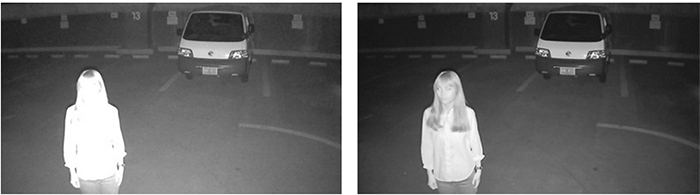
An image taken by the newly-developed camera using infrared light in the dark (right) and an image taken by an existing camera (source: Sony)
Nikkei reports that Sony will announce a new BSI sensor 10 times as sensitive than the previous generation. The sensor suits perfectly for security cameras and capable of shooting subjects in an environment with an illuminance of zero lux! Another interesting feature that we may see in photography cameras is that one:
Moreover, the cameras synthesize two images taken at different shutter speeds for the same frame and, therefore, can take images by preventing blown out highlights and crushed blacks.
Sounds damn good!
found via Image Sensor World.
0 Responses
1st blood! mean if BSI so good, NX1 from samsung will be true as world most flagship APSC compact mirrorless in term of all performance, ISO and IQ.
The thing is, so far most of the information on BSI states that small sensor cameras benefit the most from this tech rather than the larger sensor ones.
Samsung’s version of BSI is slightly different and more akin to maximizing light gathering in smaller spaces than back illumination per se.
That being said, “x10” sensitivity (if referring to the simple ISO) is not what we see in that picture, but rather dynamic range. x10 sensitivity could rather show a very dark photo and a well exposed photo. But what I really see in that photo is good highlight recovery with a darker exposed image (since the inside of the van is dark now and the walls are also darker)
I would say I can achieve that with my current camera in lightroom by reducing exposure by 1/2 stop and then bring highlights down.
Maybe we can get a clarification of what “x10” really means since otherwise we would be seeing a measurement in either db or in stops.
Yes! So awesome and bestest ever! I like your name! You cool! I love man with Sony camera! First blood you say? So hot!!!! And somebody needs to do something about Cannon and Nikkon! They must not be allowed to make good stuff for other lame photographers! Their stuff must suck much! Sony shooters are so cool and potent like our bestest cameras and longest and fattest lens!
This technology will eventually be standard for all Sony sensors, and then Canon, and Nikon’s high ISO bragging rights will be gone.
I’ll be nice to see future incarnations of the A77 that are able to take noise free photos up to ISO 12,800
Cool: HDR over IR,
btw why only two images ?
Since a photosensor is a linear device, two images will be enough for most HDR consepts.
Comments at Image sensor World (original link) are far more refreshing. 🙂
That test image is not creepy at all… :/
Already feel bad that bought my Sony A7s yesterday.. hope they won’t release a A7s crusher at IBC next week 🙁
A7sssX10 (super special sensitivity x10)
ISO 100 -> 1,600,000
Left Image has blown highlights, right image has blackened shadow areas. Not sure what the point of the exercise is when images are exposed differently.
You combine the two.
My bad, I thought we were comparing different sensors. Next time I’ll take the time to read the caption below…
Considering this is a sensor that catches infrared light bundled with an HDR algorithm, this probably won’t make it’s way to photography (not in the foreseeable future, at least). Could be great for CCTV cameras though. Also, are you sure it can take photos at 0 (zero) lux illumination? Because at 0,00 lux there’s simply no light, so it’s physically impossible to catch light there. May this mean 0,1 lux rather than 0?
Since such cameras can use (for the human eye invisible) infrared light to illuminate the scene it appears to be be completely dark
BSI is an untapped technology.
Highly usefull for high res the exmor r in current cybershots would exceed 200mp if scaled up to full frame.
That “interesting feature” is normal in-camera HDR with 2 exposures. What’s so special about this?
i think keyword is single frame, currently HDR is made of 2 or more frames.
And so is this. Notice the word “synthesize”. And: bad example in the photo, because the dark areas are in fact darker. This “news” may have no relevance to photography at all.
The different exposures used in normal HDR aren’t taken at different shutter speeds. That’s an important difference.
Yeah, they absolutely are taken at different shutter speeds. Usually for HDR you keep the aperture and ISO constant and just use different shutter speeds.
10 more days until Photokina and still no A99 II or other Amount news.
With the anouncement of the new Sigma 150-600 for Canon and Nikon mount, and no anouncment of a new Sony high resolution camera…if canon does anounce a high res camera…..?
This lens would be permenantly attached to whatever new high resolution camera I get.
because FF is gona be shown in February, shipped in April, as always
That actually sounds about right. They’ll give us enough time to convince ourselves to buy it, so can ready our finances before it’s launch.
The new sony curved sensor is Back Illuminated..BSI..exmor r
It is possibe that rumors of
Curved ff sensor with 35mm lens
10x more light sensitivity
And 50 ish mp camera
Are all talking about the same camera.
You forgot to mention the three layers Barry
There is no way this camera would have 3 layers.
Obs! 10x sensitivity is NOT relative to our camera image sensors.
It is relative to the now existing small sensors made for security cameras, and perhaps for the automotive industry.
And 10x applies to infrared lights. There is NO information what so ever about the sensitivity in visible light. In case it would have been sensational, we can be sure they would have yelled about it! Therefore, there are NO reasons at all to believe that these sensors would be more sensitive in visible light than those we already have. Perhaps not even as good as that.
So, don’t get too worked up yet…
.
Absolutely right.
I wonder if these security cameras could benefit from lytro type spot focus. They are usually so blurry that it is very hard to see distinguishing features.
back were the days with handycam with infra light sensor….. i wonder if some of the new handycam/cybershot will have an infrared sensor.. hmmm for low lights
NO, please SONY dont overcharge this crap addon in next Alpha line,
WHose taking photo on zero lux condition anyway?
It’s for security cameras and automotive cameras.
That doesn’t appear to be a shot taken in infrared at zero lux. That is, it is not illuminated by the heat of the subject. Note windshield is darker than the wall and her hair has highlights. It’s unclear what this is. Perhaps the camera is using a bright infrared light source?
The two frame approach is exactly what HDR does. And that is available already in today’s cameras.
Yeah, so what ?
In other words: no news.
This is awesome! Now I can use my lens cap as a neutral density filter.
PLEASE SEND ONE TO PARIS HILTON IMMEDIATELY!
Am I misunderstanding this, these two images are not a fair comparison. The ‘new’ camera is exposed differently, there is less blown highlights on the lady but also less detail inside the van?
BSI is nothing more than
Back-illuminated sensor
So there is nothing “new” here.
The “new” part is “The lowest illuminance of a subject is 0.05 lux comparing with 0.5 lux in the previous generation of Sony BSI sensors.”, what may be different than what you are used to is that a couple of shots are taken of the same Scene which are then combined to produce an HDR Frame.
HDR, alone, is not new.
Essentially, this Camera has an “HDR Video” Mode; as of a year and a half ago that _was_ “new”. It is the extent of the “Computation Photography” that is applied to the Image BEFORE it is saved that is a “new” Factor, not so long ago Cameras did not pre-Photoshop your Images.
These Images are often also stabilized and denoised to further reduce Bandwidth and enhance visibility (for ‘Security Purposes’, not to take pretty Family Photos). It is the ‘Computer’ between the Sensor and the SD Card that alters the Image; that is the ‘new thing’.
.
I have a Video of what Samsung (and Sony) are doing here:
https://www.youtube.com/watch?v=Uj5vPAkqABE&list=UUUH9y35fQqOKZQwmwOGYR0g