







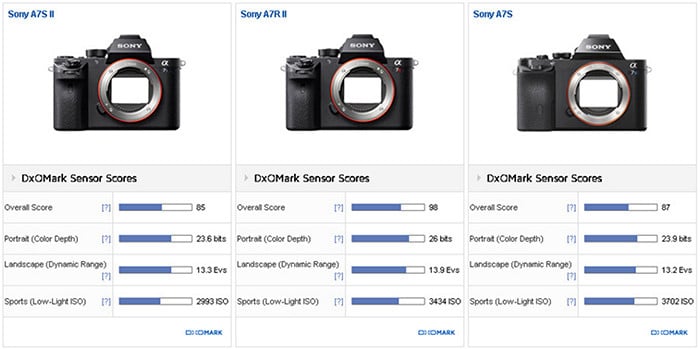
DxOmark (Click here) tested the new Sony A7sII. Unsurprisingly the performance of the new camera matches the previous model. But there are small changes and the A7sII has a negligible 2 points lower score:
Although the DxOMark score is slightly below the earlier A7S, the difference is pretty much negligible. The A7S II is slightly behind in color sensitivity, equating to just 0.3 bits color depth, which isn’t really perceivable in use. As for dynamic range, the new model is practically identical to its predecessor — and not just at base, but more or less throughout the ISO range. However there has been an improvement or refinement perhaps, between ISO3200 and 12800
Conclusion
Like its predecessor, the sensor in A7S II has impressive low-light performance — in fact, very impressive high ISO dynamic range, particularly between ISO3200 and 12800. But it comes at the expense of pixel count and the dynamics are not much of an improvement over the A7S, which (along with the $2999 price tag) we suspect will continue to limit the appeal to still photographers. As a camera intended primarily for videographers, however, that may not be much of an issue. Anyone that has invested in the A7 or A7R variants looking for a complementary video-centric model need look no further than the A7S II.
Of course what makes the A7sII standout compared to the predecessor is the 4K internal recording and the 5 axis stabilization. It’s a camera mainly made for film makers.
A7sII store list:
In USA at Amazon, BHphoto, FocusCamera, Adorama.
In Europe/Asia at ParkCameras, WexUK, Jessops and Digitalrev.
78 Responses
They say the A7S isn’t for stills photographers, but that’s why I bought it. The increased ISO that I can use at receptions, parties, etc. is phenomenal. Besides that, 12MP is much more usable than people like to think in today’s world of huge MP counts. People were printing large with no problem off 12MP for years before the latest generation(s) of cameras went 24, 36, 50, etc. Tell me the Nikon D700 photos weren’t usable for large prints…
Plenty of pro studio’s I’m reading still use D700’s for paying clients.
At my last visit in a pro stdio for passport pictures, I looked into a Rebel T5 (1200D). The studio was well lit and my pictures were 2mp out of camera jpegs…
Exactly my experience too. That’s why I find these this-is-real-pro-gear or what-real-pros-use discussions so entertaining.
I prefer an A7rii, since I can use it for high resolution work at low ISOs and downsized to 12MP for high ISO work, too. Two in one. The difference to the A7s/ii in S/N ratio is negligible according to measurements and reviews I saw.
Yeah, I suppose that’s true. With the S I can be lazy and avoid that extra step, though. 😉
That was exactly my thinking too and I’ve not found any reason to regret my decision.
It also allows much greater cropping, so effectively adds to reach (when there aren’t many long lenses!). Not the greatest advantage, I’ll grant you, but still another bonus.
With the exception of full frame 4K and perhaps smaller file sizes, I don’t really see any arguments for the A7Sii compared to the A7Rii.
Well 5D2 photos were better 🙂
Better than what (A7S, D700 …) and in what regard?
Well, depends on the application of the image.
I agree that for the majority of use cases 12MP is enough.
For prints it doesn’t matter anyway.
dpreview extreme test: low-light scene at 100 000 ISO:
on the well illuminated side of the scene, the A7Rii has a slight edge, but on the dark side, the S wins clearly… but even the winner is unusable.
I think as long you don’t go to the absolute extreme with more than 50 000 ISO in the dark, the R is the better stills camera.
Sports/Low light performance decreased from the mark 1?
The DxO ratings are nonsense, I’m not sure who’s taking their numbers seriously. Check this out: http://www.dxomark.com/Lenses/Compare/Side-by-side/EF85mm-f-1.2L-II-USM-on-Canon-EOS-5DS-R-versus-Canon-EF-85mm-F12L-USM-on-Canon-EOS-5DS-R__270_1009_940_1009. How in the world 7Mpx sharpness difference is possible if both lenses have 100% same optical design??? Clowns 🙂
Well, you must know that there are so many many many many many differences from one lens to another identical one in Canon. So.. identical design, but different approximation of error. You could compare two same lenses too. Same versione too. But u won’t get the same identical result. And Canon is well known for its high error approximation. And maybe was chanced from mkI and mkII. It’s not all about optical design, but about glass too.
Yes, according to LensRentals/TDP the variance of the 85mm f/1.2L II is 5.9 http://www.the-digital-picture.com/Reviews/MTF.aspx?Lens=397&FLI=0&API=0&LensComp=0&FLIComp=0&APIComp=0&CT=VAR which is not high, but higher than most of the E-mount lenses (except of the awesome 55 f/1.8) http://www.lensrentals.com/blog/2015/10/sony-e-mount-lens-sharpness-bench-tests, and even comparable to the Otus 55 (6.5). IMO anybody can get a bad lens, and if that’s the case – they at least should send it for repair and re-measure. They never say anything on how many lenses were measured.
How about this one? http://www.dxomark.com/Lenses/Compare/Side-by-side/Zeiss-Carl-Zeiss-Distagon-T-STAR-Otus-55mm-F14-ZE-Canon-on-Canon-EOS-5DS-R-versus-Zeiss-Carl-Zeiss-Distagon-T-STAR-Otus-55mm-F14-ZF2-Nikon-on-Nikon-D800E__1241_1009_1242_814
Why the same glass but different mount has -.2 transmission and +.2 vignetting? 🙂
The megapixel rating is utter nonsense. I think it’s a social experiment.
Ok, this sounds wrong, according to this test the a7sII has 20% worse low light performance and 15% worse low light performance then the mark 1? This is not what I heard anectodally as they mentioned some tweaks.
Does anyone have this camera and can speak to this?
A third of a stop is very likely within the margin of measurement error and hardware variation. But the bigger factor is that any definition of low light performance is arbitrary. Some people might compare IQ at ISO 1600 others might compare IQ at ISO 50’000. The same pair of cameras might compare quite differently depending on what you look at.
The low light score is not a linear scale.
Hilarious stuff… their high ISO difference between a7s and a7s II is 2993 vs 3702 and they say it’s “negligible”. Then why bother giving it a score at all… let alone to 4 digits!
Can’t understand why people still continue to take arbitrary ratings as gospel.
The difference is less than 1/3 of a stop, so negligible is a good term to use. Why do the measurement? people like numbers. I would be nice If DXO had the resources to do tests on 10 or 20 copies of a given camera or lens, give you a better idea of the true abilities.
A third of a stop would be something like 3000 vs. 3360. Not 3000 vs. 3700. How did you calculate it? The point was why show 4 digits when 3000 is the same as 3700. It’s ridiculous. They know people will smell a rat so they say it’s negligible while ignoring the elephant in the room.
People who follow astrology also like numbers. I’ve always sensed there’s a strong overlap between these two camps 🙂
I “love” astrology too, for the exact same reason. LOL
A full stop is 2x. A half stop is approx. 1.4x (precisely, square root of 2). So, half of a stop would be 3000 vs. 4200. Which puts 3000 vs. 3700 roughly in the 1/3 stop range. So, I guess, Fred is correct in this point.
But the thing is not the exact difference. The thing is that the DxO scores are not the exact representation of the IQ you can see in the photos, which is what matters.
How do you explain that the A7II which i bought looks worse at high ISO than my 6D(i shoot raw and process in lightroom). Yet DXO gives the 6D a lower score?
Did DXO do some funky math calculations that went backwards and broke the space time continuum??
Yeah, I dunno either. Their ISO scores are from another universe.
A7Sii has lower score then A7Rii, but looks better
7Dii has lower score than 5Dii, but looks better
…
Nevermind, to answer my own question. The 6D has nearly a full stop of dynamic range more than the A7II beyond ISO 800. So in post, if you try to lift any shadows at all, the 6D will be less noisy at high ISO.
The difference in practical low-light performance between the A7S and any other camera with top low-light performance, including the mighty A7Rii, is significant.
So, it was always clear that you couldn’t take the DXO scores literally. The above test (comparing two siblings with the exact same sensor) shows this just in a much more drastic manner.
Maybe because people don’t look at the numerical ratings when they refer to DxO (as you seem to do)?
Bizarre results. Also worth noting that the difference between the A7 II and the A7S II is very slightly smaller than the difference between the A7S II and the A7S. The A7S II is showing only a half stop advantage at high ISO vs. the A7 II…and is at slightly worse than a half stop vs. the A7s. That’s not a deal breaker, but considering the A7 II also has 1.3 bits higher color depth and a 1/3 stop advantage in dynamic range, it seems odd to have the A7S II priced so high compared to its 24 megapixel brother: seems to only really be worth it if you’re big into 4K video.
Those results clearly shows there is something weird going on with DxO. How come they say “the difference is pretty much negligible” when you see a wopping difference of 20-something percent on their scale? Their test results cannot be trusted that way.
According to DxO their DxO One camera is as good as the A7S-II.
It also blows the 5dm3 out of the water http://www.dxomark.com/Cameras/Compare/Side-by-side/Sony-A7S-II-versus-DxO-ONE-SuperRAW-Plus-versus-Canon-EOS-5D-Mark-III___1047_1030_795 85 vs 85 vs 81. LOL!
Look always at measurement curves not at arbitrary condensed numbers meant for the masses. It is not possible to condense all the various subtleties into one single number.
Well, it has super raw, so, of course. 🙂
LOL
The DxO one has a RX100 mk3 or 4 sensor…
The combined DXOMark score is a joke. The individual measurements are somewhat useful though. It is the way they use the individual values to find the ‘score’ that makes absolutely no sense 🙂
Clickbait alarm!
*WHY* do I get to a Amazon page when I click on an image clearly showing a DXOMark page?! I expected to see the DXOMark page or an enlarged image of of the DXOMark result.
Oh wait. Forgot this is NOT a rumor site but a advertising fun house….
dont mess with the admin. Even when it is like is it, it’s the way he can keep alive this rumor site. This is not just a rumor site, is a centre of information. A reference of very important resources. Thankyou admin. put any banners as you like. Keep it running. Sometimes I think we all want to buy some sony stuff… am I right? 😀
See my answer to above.
I look forward to your website, that you’ll pay for out of your own pocket because trying to cover your costs is somehow wrong.
I got no problem with “normal” levels of advertising.
But since the image is from DXOMark at least it should direct you to the site it came from – and not Amazon. That is why it IS clickbaiting.
Regarding my own sites: No advertising whatsover, all expenses paid for solely by myself.
It was almost certainly an erroneous link.
As for your own sites, that’s your choice. As to whether it’s relevant, it would really depend on what type of sites they are, as you don’t even link to them in your bio.
Yes, because people should just give you news for free. They should put in hours upon hours of work coming up with material and articles, making contacts with industry insiders etc……
While you sit at home eating chips and expecting everything for free.
Why DxO ISO score fell so much, when it is the same sensor? Just shows how unreliable and not repeatable their tests are.
The sensor is now seated on a 5 axis gimbal, the resulting electronics cannot be cooled better than a larger circuit board, which doesn’t move. All else being equal. Perhaps someone smarter can chime in.
It can be argued that moving the sensor around dissipates heat better like the rotary radials.
The real reason is DxO’s tests are flawed. The only thing that seems reasonable from their numbers is the portrait/depth measurements. The rest aren’t indicative.
DXO ISO calculation is very flawed. I’m not sure how they come up with their low light ISO score, but my 6D that i took thousands of photos with in the last 2 years certainly looks cleaner than my A7II i got last month. Yet the A7II scores higher??
Unfortunately, their ISO score is not simply noise level at higher ISOs, or some function of it. It is the highest ISO at which their measurement of the picture satisfies 3 different arbitrarily set parameters (DR, Color depth and noise level at 18%), first 2 of which themselves are arbitrarily defined.
Raw files are cooked to some degree, and it varies between cameras.
Happy to have V1 … 🙂
Seriously – I think the A7s is the best package of the Mark1 A7’s – the perfect “alwayswithyounomatterwhathapens” camera. Less care about low light, good with old lenses, compact & light with small lenses, perfect HD Video, sturdy (mount), silent mode ….
And as an oposite the A7RII – for more “serious” work. Perfect pair.
The a7r2 is at least equals but generally better than the a7s2 with older lenses. I tried the two with my 1930s 35mm Biogon which has significant corner issues with digitals.
Good to know – thanks!
I like the A7r from the my 1 series however it shutter is much too clunky and noisy…
I don’t get the DXO-rating. According to it any landscape shooter should use a D810 due to it having a DR that’s a full stop better then the A7r II.
The DR measurement can be fooled by cooking the raws. Nikon has been doing it since the D3 days.
Does not make any sense. Same sensor, but tweaked for better and improved low light performance, yet garnered a lower score than the 1st version. Improved AF performance with more points (Sports) and yet earned a lower score. Does not makes sense at all!
After reading the spec of A7Sii when it was announced, I was really disappointed. The A7Rii was a big improvement in all areas. The S only got the expected IBIS and the expected internal 4K, newer codec – nothing else. No new sensor tech. No OSPDAF. Still disgusting 5 fps for only 12 mp. And the price tag is almost on A7Rii range… not worth the money.
For this money the R-version is definitely better choice: Way better for stills and 4K low-light video can be done in S35 mode with adapted lenses and a speedbooster.
The price must be high because of low numbers. I’m sure you know this from the same debate involving the D800 and D800E.
Yes, it might be a step up if they use a7r2’s tech in a 12MP. But if they do, I still wouldn’t care. A 39.3MP that can bin to 4K would be far superior to both in terms of resolution and it can pass itself off as being 8K as well.
In case of D800E it was identical hard, only low-pass filter was ‘left away’. It’ s the same as with cars:
If you buy a convertible, you pay a higher price because the roof was left away 😀
A car roof is structural so leaving it away leads to significant structural re-design of the chassis so that it remains rigid on a convertible. Re-inforcements must be fitted, a soft top frame and hood designed and fabricated, etc… This all adds to the manufacturing costs…
The D800 vs. D800E is not the same as regular vs. convertible.
A convertible needs extra work to design and manufacture a completely new thing and to ensure that it doesn’t leak. That’s without taking additional structural reinforcement necessary in the chassis and maybe redesign of doors.
The D800E had a simpler component than the D800 but was expensive because of low volume… or just cos Nikon fanboys were happy to pay up 😀
Why anybody would buy the new S over the new R is beyond me.
120fps shooting in 1080p, much better full-frame video quality and lower video noise at ISOs higher than 6400. If you don’t need those features, the R seems a better choice, but I guess some people do.
Then you are not informed well… 12 MP means: much less to process (event photographers!!), clearer image in video, better in highISO, S-log3, LUTs in live display, no 4K overheating… Still wondering, why in some(!) cases the A7s-II clearly is the better camera?
in some cases, yes. in most cases, no.
The A7S has significantly better IQ in tungsten lit low-light situations.
Why do you need 42mp when you’re a videographer??? The A7SII kicks but in low light video and photos but at least a full stop or 2 of light.
Same here but it may well be that the S and S mk2 see better in pitch dark…
The ISO score depends on multiple factors. The color sensitivity in high ISOs is one of them and from their tests the A7SII is worse than A7S. Many people focus on the noise levels when comparing cameras but they forget that color sensitivity and dynamic range are also very important.
DxO’s DR measurement can be fooled easily. The colour depth measurement is the only half decent thing they have.
Hm.
Honestly – I like going out shooting more than sitting on the sofa and comparing empty charts.
From what I see here, the A7 II is still the most sensible purchase of the bunch. Especially after the recent firmware upgrade for blazing fast AF.
Is it as fast as A7RII – did anybody compare the two after the update?
DXO replied to me on this and they told me they would not repeat the tests for the A7r mk2 after the firmware update… I would assume this applies to other cameras too. If many people ask for it perhaps they could change their mind… Who knows ?
“… the difference is pretty much negligible…”
The ISO score is significantly lower! Lower than the A7Rii and Nikon D3s. Almost equal to a Nikon D610! What the actual f*ck these guys are talking about?
The ISO score contradicts every other review I have seen so far. Let alone they call it “negligible” when the absolute king of low-light drops below any other top low-light camera (in the range of 3000+ ISO score) in this key area.
What are their scores worth? What is their verbal judgement worth? The statement below the graphs totally ignores what their scores say.
Or am I too stupid to correctly read their review?
Their reviews were always stupid. I finished looking at their scores on time when I have used A350 and A700 simultaneously. The A350 gave really good raw picture quality up to ISO 400, the A700 up to ISO 1600. But… DXO said they have equivalent low light quality.
The need to sell the old A7S image sensor to nikon or better pentax with IBIS to put into a DSLR body. That way you can have an actual focus system that works for photographs in low light, like concerts, night clubs and such.
It is easy to explain…..post-processing in lossy RAW with much noise-reduction than real-uncompressed RAW. The performance only from hardware isn’t really such overwhelming without lossy-raw