







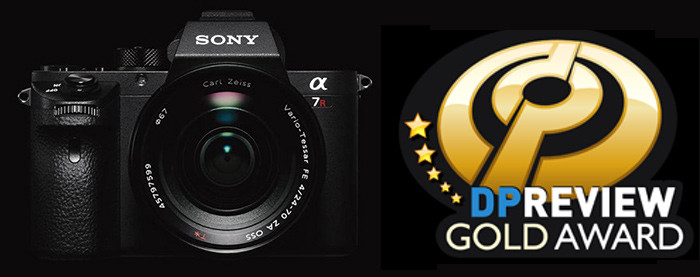
Dpreview (Click here) published the full Sony A7rII review. The camera got an impressive overall score of 90%:
The a7R II pushes the boundaries of not just mirrorless, but also cameras in general. It has many new features that photographers of the future will wonder how they ever lived without. And while skimping on simple common-sense core features like direct AF point selection or touch-based AF is bordering on inexcusable at this point, much like some aspects of the ergonomics, the a7R II garners our top award – and one of our highest ever scores – for its sheer photography-accelerating technical prowess.
Surprised? Me not 🙂
Small note: $400 off on two A7rIi Open Box at Samys: [shoplink 42553 ebay]ebay 1[/shoplink] and [shoplink 42552 ebay]ebay 2[/shoplink].
A7rII store list:
In USA: at Amazon, BHphoto, Adorama, SonyStore US, FocusCamera, Uniquephoto.
In Europe at Amazon DE, Amazon UK, Wex UK and ParkCameras.
In Asia at Digitalrev, CameraPro.
154 Responses
“It is over 9000~!!!”
But some will say it is a Sony-paid review… =(
I understand your pain buddy! Rough times for the CaniKon fanboys!!
I understand your pain buddy! Rough times for the Canikon fanboys!!
“Rough times for the Canikon fanboys!!”
Why? This a comparison between A7RII and D800E. A 3 year old technology. Decide for yourself instead of following the bloggers like a sheep.
Not surprising that the Sony A7R sensor matches well against the Sony A7RII sensor. How did the Canon of that era do?
Well, D800 is a fantastic camera. So is 5DIII. Also, Pentax, Panasonic, Fuji, Leica etc, has some fantastic cameras as well.
Why not praise where it’s due?
“Why not praise where it’s due?”
Say that to yourself.
You’re the one who said, “Rough times for the Canikon fanboys!!”
Would be interesting to see the D810. If they ever do it.
I have never said D800/810 is a bad camera! Or, any other cameras!!
It is rough times for some who can’t accept that one particulate company is making good cameras, thus, the negative replies…shouldn’t a photographer appreciate a better camera regardless which company is making it?
“shouldn’t a photographer appreciate a better camera regardless which company is making it?”
Totally. We when at the end.
Yes, photographers will certainly recognize good gear but they will also consider what they are used to and habits die hard. They’ll also consider their glass and accessories collection…
So seeing another company making a better camera may upset some with the prospect of changes… It’s all human.
He said fanboys not fans which is why his sentence makes sense
You’d be hard pressed to find garbage cameras made and released on the market within the last 3-4 years. They are all good to excellent even though they are different and destined to different types of users.
Compare with an up-to-date camera. Even if it is not the best of Nikon since D810 isn’t tested yet…
I picked D800E because I already own it 🙂
Some photographers still can’t tell the difference between a tool and a religion.
Probably because for some tools are their religion.
Who cares? Every review is kind of paid (in provision of the camera and lenses) and of course DPReview is owned by Amazon who have a great benefit in selling more products. In that light, pointing out that it is paid by some company is a non-argument.
The thing is, everyone needs to do their own research and can use various sources to do so. It is important not to make your decision based on one source only, albeit a good source like DPR. That’s why I value the personal reviews of actual buyers with a similar shooting envelope as me.
Since DPReview is owned by Amazon, I really can’t expect an unbiased review from them. Not that the A7R II is bad of course, or doesn’t deserve a high review.
well – the customer reviews in Amazon are also faked ^^:O
What?! You mean I won’t be able to see the Death Star with the Sigma 200-500 f/2.8 that I ordered?
http://petapixel.com/2011/09/20/hilarious-customer-reviews-for-the-sigma-200-500mm-lens-on-amazon/
When and if you ever actually own an A7RMKII, go back and read the review after 30 days of shooting with it. You see that Rishi is Spot On with just about every aspect of his reveiw. Amazon has owned DPReview for quite a while now and through many A7 roll-outs – they have not gone easy on the shortcomings of the previous iterations.
I have the A7RII – and I had Canon 5D3.before that. And the review is *spot on*. Very precise and very unbiased!
…and Amazon are biased towards Sony, right?
Not necessarily towards Sony, but biased towards making sales don’t you think?
Just to make this clear I’m not saying anything bad about the 7R II but seriously a review site owned by Amazon?
No, not really.
I think dpreview do a pretty good job, and they will create a stink if there are problems with a camera, i.e. lossy raw files. They’re not the actions of a review site looking to maximise sales for Amazon.
But Sony is not the only brand of camera they sell.
They sell all cameras.
If you logic is true, than all reviews should be 90% and gold award to make them all look good.
They’ve never given a “bronze” award, and most everything is > 75%
Would you be OK with JD Power, KBB, Edmunds being owned by like Ford? Of course not, cameras aren’t special in this regard
Again that is wrong logic.
Ford is a direct manufacturer of their own vehicles, hence it would be wrong for them to own such review sites.
Your logic would be true IFF Sony owned Dpreview.
Amazon make money either they sell Sony, Canon, Nikon or etc.
Yes it’s slightly different, and yes Amazon makes money off all. That also means Amazon “might” be a little more biased to making things look good to get sales
I’m not throwing up the pitchforks here, but don’t you think it’s even just a little skeptical they’ve never given a “bad” review, and everything is silver or gold?
I guess DPreview is guilty of having no harsh reviews with devestating judgements because all their reviews should offer some comfort for possible buyers of any of their tested cameras. But the reviews have a solid basis in measurements, a good comparison tool and are on the detailed end of review extends.
Like with DXOmark and other platforms that try to reduce a camera to a single number, color or sentence you have to digg a little in the full review to figure out if a well rated camera really fits your story.
Why should reviews offer comfort for possible buyers if there was no other agenda? This doesn’t follow with other sites at least that I can think of.
PC review sites, gadget review sites, restaurant review sites, car review sites, etc…. all give some PCs, some restaurants, cars, terrible reviews saying never buy this, never eat here, so on. This is more in line with reality, because there are terrible PCs, terrible cars, and food.
To me at least, the fact there are no bad reviews, no bronze reviews, and hardly anything in 5-years under 70-75% rating raises the question the validity of all reviews by them
I think the question might be – what percentage of what’s out there on the market HASN’T been reviewed.
Their method of “dinging” a terrible product might simply be to not bother wasting time/resources on it.
Most things in the $1000+ range are pretty much not horrible – if your product is horrible in this range, you don’t survive.
Most of the horrible stuff in the industry is in the sub-$400 range and I think they simply don’t review a lot of things down here.
In reality, their review scale is 75% – 90%, since that’s the range of scores they give out. If you actually read their reviews, you’ll see that they do point out very valid negatives about products. Their conclusion page is usually pretty good and better reflects their view of a product than their overall score.
The 70-75% ratings mean that the industry knows how to design and build cameras. Getting points above this would provide what would make the difference between average, good and excellent.
Are there any companies today producing cameras you’d mark with a 10% ?
In any case, reviews are all a guide, reviews don’t buy your gear for you so at the end of the day you may read as many reviews as you wish, some may be biased whilst some may not then you may be able to make your own decision.
That would make sense if the products they were reviewing sucked but they still gave everything high ratings. The thing is everything they have said has been said before 1,000s of times, with some people even rating the camera higher while others rating it slightly lower.
It would actually be hurtful to their reputation to highly rate and recommend products that everyone else thought was not that great or deserving of such praise.
So you can scale from 75% being weakest up to 90%. Having a total scale of 16 values. But comparing the weakest camera to the best camera with its 75 still tells you, that even the weakest can take useable pictures.
Maybe because the camera manufacturers don’t make bad products…
Owned by Amazon? Yes. Biased? Maybe. Amazon isn’t exactly selling high end gear themselves (Marketplace more likely) but more popular (and somewhat affordable) hardware.
The founder of DPReview has left in 2010 and isn’t involved with DPReview reviews anymore, so… 🙁
I would always compare the reviews from DPReview with other reviews but usually, their reviews are quite right.
In my country, a cinema chain publishes a magazine with reviews of all/most movies released in their theatres. According to those reviews, every movie is great. Which makes these reviews almost useless in terms of judging the quality of a movie (they are still useful to learn what the movie is about but there are many other sources for that and I find that once I have read a positive review of a movie, it leaves a positive association in my brain that influences my decisions, and since I cannot read multiple reviews of all movies released, a even single positive review can leave a big impression).
If DPreview would praise all products similarly, then it would loose its usefulness. But as long as they have clear favourites and point out different positive aspects with different products and also point out weaknesses of the products, they remain a valuable institution.
Why would the review be biased ? What would be in for DP Review, Amazon or the reviewers to publish a biased review ?
I’d like anyone to explain as I feel that I have lost the plot…
Sony may release the best technology today, who knows, perhaps it will be others’ turn tomorrow ? But then will the new kit review be biased too ?
You do realize that Amazon has Canon and Nikon cameras too!
I doubt Amazon has anything to do with this. It’s all 100% marketing, and this time seems like Sony was quite generous to the bloggers and reviewers unlike the greedy Canon. Wondering how much did Sony spend on the a7r2 campaign…
It’s always amusing, although not unexpected, to see the fanboys for other brands come out in force to opine in a negative way. Sigh–I suppose its just a normal thing these days. Instead of looking at this camera, as one should with all cameras, as tools to get the image, these guys treat their respective brands like their personal cameras are made by their wheelchair-bound grandmothers and blessed with a toothless kiss. Seriously, small minded thinking and I’m always embarrassed for the authors of such articles as they take abuse that is in no way quantified. In any case, I have an A7rii and can see plainly that is one heck of a machine. Yes, there are some things I wish were different, or improved. But, overall, it’s the best camera I’ve owned.
the man speaks the truth. someone give him a cookie~!!!
Since I’m from Maui, a white chocolate, macadamia nut one please. 🙂
One white chocolate macadamia nut on the way~!!!
You are right about “fanboys”. Unfortunately, our society in general has turned into having a “fantasy sports team” mentality. In politics, “it does not matter what actual track record is…we just want our guy to win”.
There are no perfect camera’s.
Like glass is half empty rather than half full!!!?
There are no perfect man
Whilst we are at it with grammar, should it not be:
There is no perfect man
Or
There are no perfect men
Camera’s or cameras?
Camera’s
? Care to elaborate?
Edit: don’t
I would say cameras.
In English to write “there are no perfect cameras” makes sense and is grammatically correct.
To write “there are no perfect camera’s” makes no sense at all. The apostrophe s is used to express the possessive case which does not apply here unless Esstee can explain us a new rule from the English grammar he would have discovered…
I like my women toothless.
But will she kiss your lens?
The cameras are nothing, the lenses are everything. Especially considering the new “a camera every 6 months” Sony’s strategy. Today it’s the A7r2, tomorrow it’s something else. My only hope they won’t be changing mounts every couple of years.
“The cameras are nothing, the lenses are everything” – this slogan comes from analog times and it is plain nonsense nowadays, but still everybody repeat it like a mantra. Digital bodies are at least same important as lenses. Sensor is important, readout, prozessor, AF algorithms and and… Put great lens on crap digital body and you get crap, at least in technical points of view. In analog times you did care about the film you put in the body, about developing prozess – it is nothing different today with the digital instruments
I have to disagree. The lenses give you the actual picture: the rendering, the bokeh, the sharpness. The lenses are the real investment. You can put a great lens on crappy 10 y.o. camera and have beautiful images. If you put a crappy lens on no matter what super duper body – the images will look like garbage. Sad, but true…
At the end of the day its all about photographer skill to bring about the best possible result with the equipment he/she has. I still think one would be better off (if they intend to take their photography to another level and invest for the long term) with a Rebel level camera and purchasing L-Glass vs general glass and 5Ds level camera. Assuming they cannot do both at the start.
Put a great lens on a crappy 10 y.o. camera and go take nice pictures (technically) in low light, or just go above 400 ISO, try to catch the AF-accuracy of modern hybrid systems, try to compose or to focus manually your motif with the first EVF trials, try to… no-no, sorry man – but you complain about too frequent release of bodys which is actually just reflecting the speed of the technological evolution. It goes fast and faster in every segment of our life – get up with it. I am happy if SONY release every innovation quickly and don’t exploit old bodies, old technologies till nobody buy them any longer. You can surely get mad about how fast it goes – it’s your choice, but it is your choice as well to keep your 10 y.o. body – noone force you to buy every new piece of technology.
I can buy new bodies every day, but will it make me a better photographer? Sony wants to gain a market share that’s why they release lots of cameras. Most of people think only the cameras matter so the strategy may work out quite well. And it’s ok for them to make and sell lenses like the 24-70 f/4 with the Zeiss badge that can barely resolve over 10Mpx, people like you will buy and enjoy 😉
P.S. I shoot with the 5dsr and the a7r2, I have the best portrait lenses the money can buy: the Otus 85mm, the 135 f/2 APO, the Canon 200mm f/2L, etc… If my both cameras break and I won’t have money to buy a decent camera – I won’t sell my lenses, just buy a cheap whatever brand camera and will be happy with it. You probably never shot with a good glass, so you have no clue what are you talking about…
“I can buy new bodies every day, but will it make me a better photographer?”
> And the same goes for lenses.
“Sony wants to gain a market share that’s why they release lots of cameras”
> You don’t say!
“I have the best portrait lenses the money can buy”
> Your money, you mean.
“I won’t sell my lenses, just buy a cheap whatever brand camera and will be happy with it”
> So, you’ll use these high resolving lenses on a 12MP Rebel? What a waste!
“You probably never shot with a good glass, so you have no clue what are you talking about…”
> Of course, the obligatory disparaging.
“If you put a crappy lens on no matter what super duper body – the images will look like garbage.”
BS. I have yet to see a really crappy modern lens. Saying that a lens is crappy or that another is legendary doesn’t translate semantics into reality. Differences are often minor. I would like to see that photo which would be made crap by using the 15x times cheaper Sony 85mm 2.8 instead of your Otus.
Both lenses and camera are important, if you are after technical quality and flexibility in your shooting.
Many steps in the lense manufacturing processes are still done manually by humans.http://www.imaging-resource.com/news/2013/09/19/a-geeks-tour-of-sigmas-aizu-lens-factory-precision-production-from-the-insi
There are “L” lenses and “Cine” lenses for a reason.
I believe that releasing top camera bodies is great to make a dent in the market through disruption but it is not enough to sustainably gain market share beyond the first 2-3 years. The lenses offerings must also be consistent and their quality and price in par with the bodies these are meant to be mounted on.
Then the system accessories and after sales service / support comes into play for the longer term. I have the impression that these are not taken care of at this time.
Mh, the focus / autofocus matter is very much a photographer’s problem. If your camera does not autofocus, you can still do it manually, and in many cases that is the best option anyway. I would not confuse the theoretical possibility of doing any kind of pic fast and easy with an actual lack of quality, especially if we talk about IQ (and yes, we are talking about IQ). So, speaking about IQ: my old and sorely missed 6mp sensor Nikon D50 with an excellent piece of glass could take excellent pics in many conditions. Sure you couldn’t enlarge them as much as a modern 42mp sensor camera, nor the sensor had the latitude nor the flexibility of modern sensors (in low-light, DR, etc.), especially sensors without bayer filter (that have more acuity). Still, if you pick-up a bad lens (e.g. some kit zooms) and stick it in front of an excellent sensor, you’ll find it hard to get sharp results in any time of the day, anyway you focus on the target, whatever you do. That’s the problem: my D50 was quite shitty at iso 800, yes, but knowing that I could work around the problem. And excellent lenses help solving the problem, at least partially (or a tripod, in some cases). Sure, no pics of parties at night with people dancing in the darkness without flash. Sure, those were impossible. But landscape pics at night were 100% possible, tack sharp and beautiful, with the proper lenses and equipment. With a modern camera, you could take all that (night landscape and night party) in a much easier way, but with a bad lens the pics would be bad anyhow, if not for posting on facebook. So, even if I agree with you that cameras are actually important in defining the final IQ (more or less like the type and quality of film was important in film days) I’d say that 2015 sensors are generally so good that the real difference in quality is still made by the lens in front of the sensor, much more than the sensor per se.
“I’d say that 2015 sensors are generally so good that the real difference
in quality is still made by the lens in front of the sensor, much more
than the sensor per se”
in the same way I can tell you, that most of the modern lenses are generally so good that the difference in quality is marginal.
Hey, all this strange discussion did start with the phrase: “The cameras are nothing, the lenses are everything”. This sentence is wrong. You agree with that, Oleg actually as well. Nobody is so narrow-minded and can completely deny the importance of the hardware and software behind the glass. In your manner I can answer as well: I don’t need good glass to make good fotos. And I would be not so wrong with that. I don’t need any glass at all – I can take great images with a simple pinhole! Or did you ever hear about monocle-photography? In your argumentation you quote frequently “old masters” and “classicals of photography” – do you know which crap glass they used back in 19th century? You see this diskussion can be lead ad absurdum from both sides. Don’t be narrow-minded – enjoy the life and go out and take your best images with whatever you want.
Although I don’t agree with the statement that cameras are nothing and lenses are everything in modern photography, I get the point of such claim.
The idea that in the digital world the camera is more important than the lenses is lead by the industry (i.e.: this is what they want you to think, so you’ll keep upgrading costantly the only part of the system that gets old fast, i.e. the camera). The point of all this is: if I am going to work and have no plans to take pics, the best sensor/camera in my pocket, the better (just in case I see something nice / fun / interesting to shoot). But if I am planning a shoot-out of a given kind of subject, everything changes dramatically: for a “serious” macro shooting I’d rather have an Olympus em10 + macro lens than a Sony A7rII + kit lens. For a “serious” portrait shooting I’d rather have the same camera + a portrait lens than the Sony A7rII etc. etc.
The point of all this is: lenses in the FE system (and even more in the E system) are not yet a strong point. They have to be more, better, and if possible smaller.
The last point is also important for overall size: it’s quite pointless to have a small camera you can couple with big lenses only. At that point the less expensive DSRLs are more appealing, considering the wider selection of good (and cheaper) lenses.
As a potential buyer, I’d say that the FE system urgently need at least a couple of good / small primes, plus at least a couple of very fast (obviously not small) primes, for competing with the best DSLRs out there.
Sure, Sony is currently working on it, but (I must say) this is the third time this sentence is used in relation to Sony, first with the A, then the E mount, and so far those systems are not complete, yet (the E system in particular is very lacking, and no, I don’t consider adaptors and FE lenses a viable alternetive for a system whose main purpose is to be good but small).
You misinterpreted the phrase “cameras are nothing, the lenses are everything”.
The word “everything” refers to weighting and value and odds. Considering that the operator is skilled or is a master craftsman, the final results are still more likely to be better if one used good quality optical glass.
The manufacturing processes are not equal. The image sensors are manufactured entirely by an automated process. Not the lenses.
The process of manufacturing optical glass is not equal in every stage of manufacturing, and in many facilities steps are still done manually, like pollishing, by master craftsmen. Where are errors more likely to be introduced? Correct, where there are humans hands involved in the process. The lense processes. The coating and polishing process.
The odds of producing a better quality photograph increases substantially with better optics. This isn’t new information. We don’t have to reinvent the wheel here. Tour the camera and lense facilities
here’s a couple:
(Camera manufacturing facility, canon as example)
https://www.youtube.com/watch?v=Lkv0Sc2MxP8
(Lens manuafacturing facility)
http://www.imaging-resource.com/news/2013/09/19/a-geeks-tour-of-sigmas-aizu-lens-factory-precision-production-from-the-insi
I have not seen too many nice low light pictures. I have seen a lot of nice photographs taken with really ancient cameras. Your advice about the great lens is right. There are some really great vintage lenses to be had secondhand for small sums of money if you can do without AF, HSM, or IS. The good thing about the new Sony cameras is that they can all be adapted to them.
However, it is more likely that if one puts a great lense on an average camera body better results are more probable than an ” ok” lense on a magnificent body. With a good operator of course. There were photos taken before you were born that will probably stand the test of time as some of the greatest photos ever taken.
I didn’t say that this slogan didn’t work in analog time. All I wanted to note is, you can not transfer this judgment-alike words 1:1 in modern times. I can put wetplate in a cardboard box with a decent Petzval in front of it and get dreamy pictures – no question. But you can’t DIY a proper digital body. Thats all.
That’s the thing.
Whilst some bodies have better image quality than others, there are no really terrible bodies any more.
Some of my best and most profitable digital images were taken on a 20D.
An awful lot of it is the lenses.
You hit the nail on the head. Sony’s/Zeiss next step should be providing world class, fast E-mount lenses (especially zooms). Plus tighten up production to at least have copy to copy variance close to Nikon/Canon.
Agreed ! Tighten up production QA/QC should be a priority for Sony and Sony-Zeiss lenses as well as the after sales service in some areas of the world…
Don’t you find that it is great that in perhaps 6 months we may get an even better camera from Sony ? I find that Sony’s pace at innovations with the SLT, NEX, RX and A7 series cameras is simply awesome !
The next iteration may bring a few corrections to the A7r mk2 as well as a full frame BSI sensor with a stacked chip leading to faster everything including auto-focus…
a year from now, a new high score will be set by a9/a99ii as sony hopefully will address some issues on their future high end cameras.
Their detail on features and functions is great.
Their final ratings tend to be somewhat arbitrary, with points discussed as pluses and minuses not standardized against all similar models reviewed, hence the conclusions can be somewhat flexible and frustrating when used as a basis of comparison.
A review, in fact any review, cannot and will not be a substitute for individual testing and preferences some of which can be subjective.
So my advice to anyone would be go and test the gear for yourself to see if it suits you.
So the review in short:
– Great specification
– Bad ergonomics and usability
Verdict 90% – don’t get it at all.
Fuck – my 5 month old guess is 1 point wrong!
Same rating as D750. Maybe D810 gets the crown with 91% or more.
Too dated already and the traditional DSLR is never going to get real high results again.
Sony has two major weaknesses, too many bodies and not enough lenses. Based on Sony’s track record, the A7Rii will be obsolete in 12 months. Not only do they update their bodies too quickly but they create too similar models, thereby, denying their customers the best experience possible. For example, to distinguish the A7Sii, Sony deprives A7Rii owners of SLog3, 120 fps @ 1080p and live display luts.
More importantly, imo, Sony’s lack of lenses is its biggest weakness. To date they offer no professionally acceptable E-Mount zooms and too few primes.
Imagine an A7Rii with 120 fps @1080p, Slog3 and live display luts as well as native prime and zoom lenses equivalent to their excellent 35mm f/1.8 with the incredible autofocus it is capable of. Now that would be a camera deserving of DPreviews’ praise.
with a7r2 and as of today with a7m2 you have “professionally acceptable” zooms – ZA24-70/2.8II, ZA16-35/2.8II. these lenses are lightyears ahead of the 24-70/4. 70-200/4 is very very good and if not enough, there is the perfect 70-200/2.8II. they should work perfectly well, minus a bunch of features like lock on which as you can see form the review is not there anyway. yes you need an $200 adapter but there is no translucent mirror to stay in the way anymore and with a7r2 you have 399 pdaf points to work with.
Canikon have a lot more redundant cameras around, specially in APS-C. At least Sonys got really distinctive features in each model.
I made the comparison test at minute 24:
https://www.youtube.com/watch?v=QunFg5v7ftA
I was quite afraid about the results, cause I really like Canons colour and look of their JPGs. The result …
drumroll ….
I nearly got 100% to prefer the Sony over the 5Dr! Sometimes by far.
So I guess I really convertet now … or they really got something right with their JPG engine 🙂
8x Sony
4x Canon
Oops! 8x Canon, 4x Sony
That’s a really nice test. I actually got 6 preferences to A7Rii and 6 preferences to 5DSR. So it was technically a draw for me.
But Image 1, image 7 and Image 8, I very strong preference to the A7Rii, whereas in the shots where 5DSR “won”, I mostly had slight preference.
That means the Sony camera won for me in those 3 images that mattered the most and made all the difference.
wow I remember you. I use to watch your videos all the time and bought the tutorials for T2i. lol
Time flies! I hope you make videos for these A7 cameras too.
I wouldn’t use or choose either camera for professional sports. I need 10fps minimum. Maybe Junior HS sports. Professional sports, Not. In May 2016, before the Olympics, Sony may produce a camera with more fps and higher burst rate. For my sprint races, 100m and 110m hurdles, I need 10fps and a burst rate of 30, more with udma. Especially for those first 10 strides from the blocks. Neither of these cameras would be my choice. Not for world class sprinters. And I absoluted must have my athlete isolated. Stills only. I won’t be doing video.
The DPreview really doesn’t matter much now that Ming Thein has given us his holy review…
MT is a click bait fool.
I Couldn’t resist bringing TM’s bogus review up seeing it was so WRONG.
What was he wrong about, specifically?
What I found to be wrong about it was the incredible level of bias that he exuded towards his Nikon system. The whole piece about trouble cleaning the sensor was over the top. I’ve been using my camera for months now and I’ve only had one piece of dust on it as opposed to my D800E which is a dust magnet and much more difficult to clean than the Sony.
So not much then.
I do trust MT more than some “objective” camera reviewers…
Nothing like a pro that actually has to work with a camera to make money.
I don’t find him as much objective about the system as I do biased towards his.
It’s like someone in a wheelchair judging shoes
Poor taste, and just plain dumb.
Don’t get me wrong, the camera itself is fantastic.
So, do you mean that the DP Review Team is not able to perform such camera review ?
Further to what I saw and read their job was pretty thorough… so to me kudos to them for a good job.
Nikon names aren’t confusing??
How can Sony produce the best camera today but only offer it in an amatuar level body.
This is why they will fail to gain dominence over Canon unless they wisen up and offer the pro level details that the real camera makers provide.
It is so frustrating to want to believe in Sony yet continue to watch sony make such foolish mistakes over and over again.
Sony needs to offer a comsumer and pro level body version of thier higher end cameras, not just a consumer version.
Barry, I agree, Sony desperately needs to get the basics right first and much of this comes down to operational speed in all respects and ergonomics/UI/haptics. Fancy stuff is great ‘n all, but Sony are failing to make a camera for photographers. I’ve got a couple of Sony mirrorless cameras and although they’re interesting and different they’re simply not a joy filled alternative to shooting my DSLR bodies of a different brand . . . and this shows in the results!
It is frustrating, because Sony is near but yet so far and for the most fundamental of reasons.
well I total agree about being frustrated with that amazing sensor trapped in a small child sized body, yet, you can’t really blame sony from a business perspective. For a number of reasons they really hit the mark with casual shooters with the a7 line and they continue to sell like hotcakes.
Did they leave pro shooters with average sized hands hanging too long? Absolutely. I can tell you not a single one of the A7 design team has held an actual A7 in their hands for longer than 3 min.
Hopefully they are on the path to fixing that now.
Body is perfect with a vertical grip, Try it before you knock it.
I have the a7rii, in fact I was one of the ver first people to get one.
I also have the Mieke batterry grip and I have extensively used it both with and without the grip.
The body is a fully functional amature/consumer level body, and the grip introduces both some added functionality and some added hassles.
But the body is not by any stretch of the imagination pro level either with or without the grip.
The dual battery in the grip does not last double what a single battery does, and is more difficult to change than the bare camera.
I have stopped using my grip,
Unless a pro level body is offered Sony has absolutely zero chance of converting the Cannon market share….no matter how good the components they put inside.
You can put a sport car engine in an economy/family car body, but a sport car enthusiast will still not buy it.
I love my camera. Just go out and shoot. Quit complaining about it. I have had nothing but stellar images out of this camera. Its a great camera. So are Nikons and Canons. I get same image quality with action shots and focus as with D810. Camera feels great without feeling like a brick. I just don’t get this whole its not pro because its not a brick. Its daft. Camera is great this is the future. Maybe your just not ready?
“I just don’t get this”
Clearly not because every one of my posts says they should have 2 body styles….a consumer style like they now have , and a pro style because there is a need for thst too.
So you are the one that should be taking your” stellar images” rather than complaining about comments you are incapable of even reading.
Yup it isn’t a pro because it doesn’t weigh 800lbs. Give me a break. You wannabe pro are all the same. You cry over gear more than what the camera can actually produce. Why not use iPhone? It can kick the crap out of the 800lbs gorilla.
After having read the rather lukewarm review, I decided to wait for MKIII or IV.
Giving the camera one of the highest scores ever, and naming it “Camera of the Year” (as DPR did last month), is hardly lukewarm..
See the many cons and read this “…skimping on common-sense core features like direct AF point selection or touch-based AF is bordering on inexcusable at this point, much like some aspects of the ergonomics …”. I wonder how much Sony paid them for the award. Sorry, but for myself, the mission has not been accompished.
It must be a typo. I think it should read 09%.
Since when is a huge variety of bodies a bad thing? I’m looking forward to the day the MKIII arrives, by then the MKII will be more affordable.
Sony keeps selling the old versions, it’s a new sales strategy and it is working. Also, if you follow this site you probably realize that every month new lenses are released by someone even if you disregard that you could mount almost any lens on the new e-mount cameras and the converters themselves get upgraded all the time.
This guy quotes himself? You do get a gold award 🙂
Good summation. I’ll throw an idea out here, might sound outrageous. I wish Sony had bought Pentax instead of Ricoh. If the Sony team concentrated on the sensor, stabilisation and AF side and let the Pentax team make the rest, that would have worked.
Or they could’ve kept the Minolta team. The A700 (and I guess the A900 as well) was a joy to use.
There’s two parts to this. Science and art.
The science is all the specs and fancy gadgetry which Sony have. The art is putting all that in a package which makes you want to pick the thing up and go shooting with pleasure and ease for great results.
Sony have got the science bit right.
Absolutely! This is why they should’ve kept the Minolta folks who used to get the Art part right. Or buy Pentax because they also know how to make a camera!
Pentax really nail it on the UI/handling side, their only real issue is the need for updated lenses for digital (modern coatings and ELD elements for their FA Limiteds) and speeding up tracking AF a bit. Other than that they make a near perfect camera in my experience. We’ll see how the full frame turns out in the spring.
Sony could do with buying a used K-5IIs or K-3 off ebay and studying why these cameras are such a joy to use before attempting the Mk3 iterations of the A7 series. It’s not all about high resolution and fancy gadgetry, it’s whether the camera is so natural in use it becomes an extension of your own mind and body.
Or they could find a used A700 or A900 and give it a good look and remember why those were fantastic cameras to use, as well.
I’ve owned the A700 and own a Pentax K5. Both are great cameras, but the A700 gave me more joy to use (which is really personal, I know). Even though the K5 is a great, fantastic, amazing tool.
Either way, I agree that Sony’s been showing too much of their strengths and weaknesses; the sides of the same coin — being a tech company.
But if it had all the previous posts’ wishlist, it would have gotten 100%.
Come on Sony!!!! ! A grip!
I’m sorry but I’m having a hard time trying to understand your comments.
The lens quality is not about the resolution only, and yes, I won’t hesitate to put a 10 times more expensive lens on a cheap camera, and yes, I don’t see much sense in putting the plastic-fantastic Sony 85mm f/2.8 on the A7r2. Now speaking of the resolution and your math… According to http://www.dxomark.com/Lenses/Sony/85mm-F2.8-mounted-on-Sony-SLT-Alpha-99__831 the 85mm f/2.8 can resolve 12Mpx on the 24Mpx A99’s sensor. The Otus 85mm can resolve every single pixel on a similar sensor: http://www.dxomark.com/Lenses/Carl-Zeiss/Zeiss-Carl-Zeiss-Apo-Planar-T-Star-Otus-85mm-F14-ZF2-Nikon-mounted-on-Nikon-D750__975. The 24Mpx Sony sensor is not a “cutting edge” anymore, and the 2.8 lens barely resolves a half of the megapixels the old sensor offers. “What a waste” of megapixels! Why would you need a modern camera if your lenses can’t keep up?
The lenses are way more important than the cameras. The cameras come and go, the lenses stay for a while. Assuming if someone has a few grands camera and $20-30k in lenses, what would be easier to change – the camera or the lenses?
“I have yet to see a really crappy modern lens” depends on your personal definition of the word “crappy”. A lens that looks awesome for you may appear as a piece of junk for somebody else.
I thought it was clear. Hmm, my bad, I guess.
I meant that these are the best lenses your money can buy. Which is precisely the same issue as “depends on your personal definition of the word “crappy””. So, what is a “best” lens then? One that is more expensive? Resolves better? Has less flare? Is weather sealed? Smaller? Your DXO comparison doesn’t make any sense in our context. Resolution is just a single aspect of image quality (albeit important) and my point was entirely different – “I would like to see that photo which would be made crap by using the 15x cheaper Sony”. Well, it won’t “look like garbage”. It will be a perfectly enjoyable photo, even though it has less resolution.
Anyway, I was simply playing devil’s advocate because statements like “lenses are way more important than the cameras” do not make any sense to me.
Totally agree.
Well, sure, but not everyone has access to go out and do testing for every possible model. In fact, virtually no one has.
Consequently, people rely on reviews to make decisions. Which is why there are reviews and why people read them.
Reviews such as this are very useful in describing features and functions and details. The conclusions / summaries, and plus/minus list, are the section not standardized across all reviews, however.
Congrats Sony! Keep it going. Haters gonna hate.
Agree I love this camera
All cameras should have the little focus pointer nub that has been on high end Canons for years and even Leica recognized as ergonomic and integrated into the SL. Come on Sony – add touch screen and this one little piece of rubberized plastic into the “A9” and slam the door on these comments once and for all.
people are always going to find something to complain about, it’s what makes people people
visionaries suggests improvements, fanboys not
Totally agree. Coming from Panasonic I really cant imagine interacting with a camera without a touchscreen. Primarily why I never considered the LX100 as well.
On the one hand they call the camera hefty implying that the camera is too big and heavy but then they go on and on about all the different things that they wish were more like a DSLR which would make the camera even bigger and heftier. Which is it? Is the camera too big and heavy or should it be bigger and heavier? They seem to be in a debate with themselves in the review. I do agree that the dials of the original a7R are way easier to use, especially the rear dial.
Identity crisis is central to the problem of the A7 series. It can’t decide whether it’s an alternative to a rangefinder or a DSLR, it’s trying to be both as well as a high-end consumer grade video camera. At the moment it’s neither. It doesn’t have the performance and handling of a similarly priced DSLR and as the weight has increased neither is it a rangefinder.
The critical focal length zooms have been kept a stop slower to keep the weight down, which I can understand (I have the 70-200/4 G) but a trinity of f/2.8’s (14-24, 24-70, 70-200) is really the bread and butter of the DSLR shooter.
The faster primes are way too big and heavy to simulate a rangefinder, just look at the difference in size/weight of the Sony Zeiss 35/1.4ZA and the Leica Summilux 35/1.4. I have the 35/1.4ZA on an A7r and it simply doesn’t feel right at all, even with the grip attached.
Being in a small package the heat sink issue renders it not terrifically useful for videographers either.
I think/hope future models will likely be in a completely different body, more a DSLR/RX10 style with the focus being on fixing what Sony haven’t got right, which is speed/responsiveness and UI/ergonomics/haptics . . . and identity.
Trying to be all things to all users in a small package is an admirable ambition, but it’s got a way to go. Hope it gets there as I’m sure it will.
Haha – repeat the test tomorrow any the results can change.
When I did it some weeks ago, it was 9x Sony!
I think you’re confusing obsolete and updated. Updating a camera’s line does not diminish the abilities of the existing cameras at a quicker rate.
How a camera with so many flaws can earn a gold award?
It is mediocre at the most concerning handling, ergonomics, menu-system, build quality, performance, etc. – and for all that you have to pay 3’200 $ …
And how the review-team can explain the high rating for the viewfinder?
It is nervous, and tends to extreme moiré on regular structures …
There ist no excuse for bad ergonomics with a small body – my Lumix GH4 is far superior in this respect, what proves that it is possible to combine good ergonomics and handling in a small camera.
The A7 RII ist not a serious photographic tool in my eyes, it is an absurdly expensive toy …
Even a7R3 gets released, the a7R2 will still advanced than Canon bodies.
Well it just shows how much you know about the subject.
They’re a bunch that insisted that all professional cameras must be compared in JPEG. Seems like you’re new to the world of digital cameras.
There are a lot of best, superb, amazing, innovative about a7rll that makes it a wet dream of a lot hobbyists and amateurs. But saying that a7rll can take on demanding work 5Dmk3 can do with ease and even replace it is load of bull.
The thing is clunky and SLOW, the files are SLOW to load and edit. Anyone who shot both systems and works daily with 2-3k files will not be moved by the Sony’s offering one bit! Amateurs – YES! Sony knows it and exploits them every time))) they buy stupid adapters, suffer with 10 batteries, wreck their brains dealing with stupid menu decisions or button decisions and still buy a new 7 camera.
Taking 2-3k images a day? Over a million a year?!? I thought I took a lot at 5k p/month!
It depends on what you shoot. I’m also a full time photographer and shoot studio projects and Outdoor Adventure, mainly mountains UK,Alps & Andes etc.
I currently use a Fuji X-T1 & Sony A7rii. Where I feel Sony have let this camera down (for me anyway) is the lack of weather proofing. However, a full day out in the mountains and I rarely use more than one battery, 2 at the most and only weigh a few grams. I take on average about 4-500 shots while out. The number of batteries I carry with mirrorless is no different to the 5Dmkii I used to have.
Processing and storage isn’t an issue. As a business, I like to upgrade every 2nd to 3rd year and only use maxed out top of range Macbook Pros with 4k screens. Multiple NAS systems with up to 20 TB of storage backing up each other for security and space means the increase in file size is nothing really.
I don’t like Sony’s menu system, nor do I like the the fact they missed out a lot of settings from the custom setup options. But once set up, I rarely have to go into it. It isn’t perfect, but for my work it’s far better than the 5D it replaces as the reduction in weight plus increase in IQ is significant and the Battery Grip adds comfort and bulk while in the studio. Basically it is a more flexible system.
Your comments belittling Hobbyists and Amateurs don’t do you any favours. Making them out to be some lower sub class, not very professional.
Where can I buy a 4k Macbook Pro? Need it badly now.
The macbook pro isn’t 4k. I use 4k monitors and 27in Cintiq’s to work on files. The macbook pro will power several 4k screens and even 5k I think.
Didn’t mean to come off as arrogant, no need to take offense. It certainly works for your application. I too don’t like carrying heavy gear everywhere. A7 or a6000 works just fine for not demanding applications. But just like you said, the system is not meant or designed with tough or demanding applications in mind (low light, speed, long hours of operation, extreme weather, working with multiple or on camera flashes) but does leasure photography wonderfully and beats canon and Nikon at that hands down
I am an amateur but need great images for my business advertising and marketing. I’ve sent 2 sonys back and am really happy now with the Nikon I am using.
The disappointment in all this is, handling, ergonomics, menu-systems and build quality are fundamental to camera design and manufacture and have been pretty much perfected in other brands/models and these needn’t be issues for the A7’s either, none of this is anything new.
Some of Sony’s technology is borderline revolutionary but they just don’t seem to be able to bring it all together into a user friendly, all round capable package. I find any of the Sony mirrorless offerings so awkward in use to the point of finding any old excuse not to shoot at all.
Performance, I guess with present technology the body size would have to increase to accommodate a faster processor, larger buffer capacity and larger batteries. This would not be a bad thing in my opinion, the size and shape is not comfortable and feels unnatural.
Full agreement with your statements Mike!
But they make lot of sense to me… Availability of certain lenses in a system can be a key factor of a decision what system to buy. No sports shooters will buy a Sony for example. And that’s not because their cameras are too bad – they are amazing, but the system lacks fast telephoto glass… I got the A99 only because I liked the 135 f/1.8 so much. Some folks love the 135mm f/2.8 STF, and that lens is also quite unique and deserves a dedicated body. When I saw how sharp and small is the 55 f/1.8 I bought my first A7r. The A7r2 is great to shoot the MF Zeiss lenses like the Otus, way better than any “native” camera these lenses are made for since the r2 offers stabilization + EVF for precise focusing. I got the 5ds r for the awesome 70-200 f/2.8L IS II and the 200mm f/2L IS. I would never buy a camera if I had no idea what glass I’m going to put on it, and it seems very logical for me. I see that not everybody thinks the same, but I hope you understand my point. I would buy a camera only with a lens in mind 🙂