







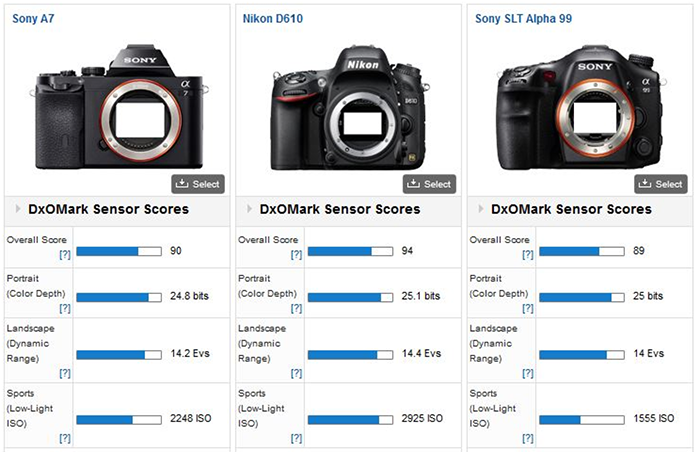
So how does the A7 compare with the A99 and Nikon D610? DxO (Click here) writes:
Unsurprisingly perhaps, compared with the Nikon D610 and the firm’s SLT A99, both using a similar full-frame 24-Mpix CMOS sensor, the results are very close. Color depth between the three is similar and the A7 sits between the two with regard to the dynamic range, just +0.2 Ev separates the Nikon. However, it’s the low light performance that divides the two Sony models. While the A7 has a + ½ stop advantage over the SLT-based A99, the Nikon has a +1/3 stop over the A7, presumably on account of the latter model’s modified sensor.
And Photogrpaphyblog (Click here) posted the full A7 review:
After shooting with both the A7 and the A7R side-by-side, we’d be hard-pushed to choose between them, as both are remarkable cameras in their own right. On paper at least the A7 should offer faster auto-focusing and less noise at high ISOs than the A7R, but in reality there’s not a big enough difference between the two cameras in either regard. Instead we’d choose the A7 instead of the A7R because it’s significantly cheaper, it produces more manageable file sizes, has a higher flash sync speed, slightly faster burst shooting and a quieter shutter release.
—————————–
Specs and Preorders in US and Canada:
Dedicated Sony announcement page at Amazon US (Click here).
Sony A7r body at Amazon, Adorama, BHphoto, SonystoreUS. TheCameraStore Canada.
Sony A7 body at Amazon, Adorama, BHphoto, SonystoreUS. TheCameraStore Canada.
Sony A7 with 28-70mm kit lens at Amazon, Adorama, BHphoto, SonystoreUS. TheCameraStore Canada.
Sony RX10 at Amazon, Adorama, BHphoto, SonystoreUS.
Zeiss 24-70mm at Amazon, Adorama, BHphoto, SonystoreUS.
Zeiss 35mm at Amazon, Adorama, BHphoto, SonystoreUS.
Zeiss 55mm at Amazon, Adorama, BHphoto, SonystoreUS.
70-200mm A-mount at Amazon, Adorama, BHphoto, SonystoreUS.
Sony A-Mount to E-Mount Lens Adapter at Amazon, Adorama, BHphoto.
Sony A to E adapter with mirror at Amazon, Adorama, BHphoto.
A7/A7r leather case at Amazon, Adorama, BHphoto, SonystoreUS.
A7/A7r vertical grip at Amazon, BHphoto, SonystoreUS.
Sony W Series Battery Charger at Amazon, BHphoto.
Sony FA-CS1M Off-Camera Shoe at BHphoto.
Semi-Hard LCD Screen Protector for A7-A7r at Amazon, BHphoto.
Specs and Preorders in Europe:
Sony A7r body at Sony DE, UK, FR, IT, ES, NL, BE, CH, AT, SE, FI, NO, PT, WexUK, WexDE.
Sony A7 body at Sony DE, UK, FR, IT, ES, NL, BE, CH, AT, SE, FI, NO, PT, WexUK, WexDE, Amazon UK, Amazon DE, Amazon FR.
Sony A7 with 28-70mm kit Sony DE, UK, FR, IT, ES, NL, BE, CH, AT, SE, FI, NO, PT, WexUK, WexDE, Amazon UK, Amazon DE, Amazon FR.
Sony RX10 at Sony DE, UK, FR, IT, ES, NL, BE, CH, AT, SE, FI, NO, PT, WexUK, WexDE.
Zeiss 35mm at Sony DE, UK, FR, IT, ES, NL, BE, CH, AT, SE, FI, NO, PT,
Zeiss 55mm at Sony DE, UK, FR, IT, ES, NL, BE, CH, AT, SE, FI, NO, PT
Zeiss 24-70mm at Sony DE, UK, FR, IT, ES, NL, BE, SE, PT
Sony G 28-70mm lens at Sony DE, FR, IT, ES, NL, BE, CH, AT, SE, FI, NO.
Asia:
A7r at Digitalrev.
A7 at Digitalrev, Amazon Cina.
A7 with 28-70mm lens at Digitalrev.
139 Responses
A good result overall.
The low light performance of the sensor combined with focus peaking and a real-time view of exposure adjustments makes for a great low light camera!
In comparing A7 with D610, 6D, and even A7R, disappointed to see A7 fall short in low light performance, especially since the Sony FF lens selection is not exactly fast.
A7 gets 100% of the light. No SLT mirror loss. Shouldnt supprise anybody.
I saw the results and the very polite DXOmark review, but the truth is that the low light performance is not good enough for a 2013 FF camera which is not a canon; moreover, the per pixel signal to noise is almost identical to the NEX-5N although it’s about 1.6 time bigger.
I would say this result is quite embarrassing!
Who cares what dxomark says? It’s just a BS number that’s probably based on a flawed testing methodoligy anyway. You can just make your own judgement based on the thousands of sample images that will be flooding the web in a few weeks time.
Perhaps DXOmark methodology is flawed, but then all results are equally changed.
I’m more concerned if the results aren’t biased… but I can’t say if they are or aren’t.
That’s not true. Being flawed doesn’t mean all the results are skewed in the same direction or flawed in the same way.
I’m not saying DXO is flawed, just that your comment is.
Low light performance is not good enough for a 2013 sensor? Wow, if it keeps progressing at this rate, by 2017 we would be able to use regular camera for a night vision related application. For every technology, there’ll be a time when progress is marginal. Initially, progress will be rapid, especially if demand is strong. When we hit this limit, it’s time to explore a new one. BSI and organic sensor are among those hot new techs.
That’s right! That’s why Canon are so annoyingly lagging behind; they all want to keep selling us the big expensive and not good enough DSLRs, so we will have to spend even more on fast lenses or stabilized or both of them, but wait, you can’t have it really fast and zoom (with the exception of Sigma 18-35/1.8 for APS-C, but they have nothing to loose is DSLR selling anyway).
Sony makes the same while selling fast and stabilized lenses for APS-C NEX cameras but not for the FF just in the sake of not selling a “too good” system(not to say that only SONY DSLR/SLT bodies are stabilized).
they try to stop progress but the smartphones are pushing it hard from the other direction and will not allow them finally.
You don’t even have a clue about how noise should be measured but you’re dragging in cameras that were never even comparable. The Sony 36MP sensor in the D800 and A7R is the best for high resolution stills and it does remarkably well in high ISOs but when it comes to crazy high ISOs the choice should be the 1D X. And 5D3 with ML is the hands down best for video in a DSLR. The 24MP FF sensor in various Sonys and Nikons smears most of the details out so in large enlargements or under heavy cropping things look bad sooner.
[That’s right! That’s why Canon are so annoyingly lagging behind; they all want to keep selling us the big expensive and not good enough DSLRs, so we will have to spend even more on fast lenses or stabilized or both of them]
I wonder if you’re into photography or just into camera’s. For years we were able to take pictures with only 400 asa film and a f/2 lens at maximum. Why on earth would a canon sensor (which goes to extreme iso’s already) not be enough to take pictures and do we need stabilization and fast lenses?
Do you really think a score from DxO is visible in print or on screen? My M9’s sensor has the lowest score of all the FF sensors DxO tested and yet it produces the nicest images on low iso’s (in my opinion) of all the FF camera’s.
The Phase One CCD digital backs also score low on DxO compared to dslr’s while in real life they blow every DSLR out of the water. Zeiss lenses scored average at maximum on DxO while everyone knows what these can produce.
Don’t go blind for these kind of reviews which try to approach photography as an science while it isn’t. Beside their tests aren’t representative most of the time to make a judgment.
The per pixel SNR should be the same between a ~15MP Aps-c and a 36MP FF because they have the same pixel pitch. If you want to compare things in a useful way, normalise the resolution
*facepalm*
Yes I’m be glad to hear some experts how Sony, the sensor’s market leader does’nt compete here with Nikon.
Is this because Sony’s sensor can’t compete? Any relation with the tinyness of the body? too shy battery?
Yes, the camera is too thin, so some of the light is going right through it.
+1 lol
lol too.
++++ LOL good one VLAD.
If Nikon made their own sensors they would have… What? One camera with a sensor?
There are multiple sensor fabricators only to happy to manufacture chips for whoever wants to pay them.The CX models are Nikon designed as is the sensor in the D7100/D5200/D5300 which just manages to outperform the best Sony sensors.Put it this way it would be easier for Nikon to find a fabricator to manufacture their designs than it would be for Sony to replace the lost business from not making them.
I think the main reason why Nikon cameras using Sony sensors delivery better results is simply down to better support electronics there is more than a base sensor to the image pipe.
I don’t think Nikon is in the sensor fabrication business anymore. Last I saw Toshiba made their latest DX sensors.
Hi Sorry ,I wasn’t suggesting Nikon wgere in the sensor making business I meant that there are plenty options for Nikon to get “their designs” manufactured by others be it aptina toshiba or whom ever
Maybe, but Sony is probably the best sensor maker right now. That’s a good thing right? buying from the best??
But Toshiba 41MP Sensor inside Nokia 808 is hell of a (phone) sensor.
Slightly outperform on paper, not accounting for their shadow banding at lower ISO’s, which the Sony sensors do not suffer from. Which in practise means that a D7000 (or any current APS-C C Sony camera) has quite a bit more usabe DR than the D7100.
Answer is simple, different processor.
It’s pretty simple, actually. The sensor is on all the time, this builds up minor latent charge along with the heat, it introduces a small amount of noise. The sensor is not on except during exposure in the D610. And the RX1 just dissipates heat slightly better than the A7.
No big deal, as the results are still very very good and produce, overall, better low light images than even the D4.
It’s one of the very top rated cameras on the DxO Bench, which is abnormally tough on all characteristics of the image not just noise. Noise is easily removed in post anyway.
I have been experimenting with 12,800 ISO shooting on my A7 and I have no trouble producing 8×12-worthy images with a little knowledge about how to work with software in post.
And now cue the whiners about how the SLT makes a camera unusable and how 1/3 of a stop is the end of the world.
Or are they going to be happy because they no longer lose a third of a stop now it’s a half of a stop. So they have gained 1/6 of a stop.
??? What??? One third is less than one half….
Maybe I should have put a ;). In reality the only ones that complain are people trolling.
DSLT? Sony discontinued it. No point in talking about another Sony abandonment.
It’s not bad, but expected better from low light scores closer to D800.
If you read and understand the testing methodology you will see that it can’t outperform the D800 since DXO scores are normalized to a fixed output size so higher megapixel cameras are pixel binned to a greater degree which has the effect of reduced noise measurements.
The difference between all these cameras (A7, 6D, 5DIII, A7r, D800, D600/610) is about 1/3 stop.
The a7r is right up there, scores almost identically with the D800’s. And this is impressive as these cameras take a hit in performance by keeping the sensor on all the time which builds up heat and that introduces some noise.
Well, I did expected A7 to go to past 2500 iso, damn, I see APS-C sensors and they are pretty tight, they fight really well to FF in DR and Color Depth, they are just 1 stop behind at ISO, that might not be too much for some
If and APS-C sensor has 12 Megapixel I don’t know any reson why i should be worse in High-ISO or anything else. The pixel just have the same size, so sensitivity should be the same or very very comparable.
If you go to the studio shot comparison tool on DP Review, you’ll see that all recent cameras (be it full frame, APS-C or MFT) are marginally different.
Sony always score poorer than Nikons on DXO. Which is surprising because Nikon uses Sony’s sensor. I guess Nikon know what they are doing, at least, to score the top scores at DXO. The low light score is disappointing, it is worse than all the Nikon full frames of late, and worse than Sony’s own RX1.
Phase Detction AF Pixels!
The phase detection is a poor explanation to such a dissapointing low light performance: when comparing the NEX-5N(contrast only) and the NEX-6(phase+contrast) there is about 6% advantage to the NEX-5N.
Theoretically, by adding this 6% to a contrast detection only A7, we would have gotten a result of only 2390 iso instead
Now this low performance of the A7 is unforgiveable especially when considering the fact that it’s AF performance isn’t impressive too…
It is weird but possibly the Nex-6 doesn’t suffer so much, because it has much fewer PDAF pixels. Both the A99 and a7 seem to take a huge hit in ISO performance, compared to what one would expect for a full frame (even taking the mirror into account in the case of A99).
Maybe they know how to score high on DxO test a.k.a cheating.. hahaha.. Just kidding Nikon.
You have to understand that high sensor temperature will increase the dark noise. As the EVF/LCD constantly reads the sensor during the Dx0-measurements, the temperature will get higher compared to OVF-cameras. It’s as simple as that…
Thanks! That makes a lot of sense and it’s probable these sensors are all identical. A99 loses to A7 due to SLT, while both lose to the Nikon because OVF doesn’t keeps the sensor cool.
+1
Ok, so what about measuring noise directly after turning the camera on? It looks like DXO can freely choose the result within a certain range by keeping the EVF on for a variable amount of time.
Time to re-test cameras in the freezer
Or Canada 🙂
While true Nikon is using a different processor. That’s where the main difference is.
In Nikon realm, d600 runs cooler than d800 (you can do 10 min. plus exposures with long exp. NR off with the former). What did Sony miss here??
The only concern about having A7 instead of A7R is that if sometimes you want to use NEX lenses the cropped A7 file migh be too small whereas A7R will produce a 16m file, same as NEX5,6.
I don’t know about Dxomark methodology or rating, but use of an SLT is clearly an engineering design choice, involving the obvious trade-off of light.
It would be nice if Sony made an option to this trade-off in native A-mount, or a flippable SLT implementation.
You accomplish exactly this with the LA-EA3 and 4 adapters on the a7/a7r. Put the LA-EA4 on and ta-da, you have the mirror and all its focusing benefits. Switch to the LA-EA3 and lose fast AF but get all the light.
Or just use native lenses and get a really great overall performance in between on AF but all the light (and frankly, better lens designs).
Zachery, exactly how is using different adapters equivalent to native A-mount?
Your post highlights really well my desire for a native A-mount system that is natively, or that can be operated, in mirrorless mode.
******************
In responding to your post, something came to mind: is it not increasingly more difficult to flatten a field for a given sensor size, as the registration distance decreases, without increasing other types of distortion?
Sony uses optically denser (colormetrically more accurate) Bayer colour filters. You can tell from the metamerism scores D610 (77/74) vs A7 (82/78) for CIE-D50 and CIE-A lighting conditions respectively. This information is buried in the color response data when you look at the cameras individually, not in the comparison view.
This pattern occurs pretty much across all the Nikon vs Sony cameras sharing the similar underlying sensors. It’s a design trade-off that one has to make when designing a Bayer CFA sensor. Do you prefer more accurate colours or do you want to let more light through to the silicon at the expense of worse colour rendering.
The difference between ISO2248 and ISO2925 (I laugh/despair at the 4 significant figure accuracy quoted by DXO) is about 1/3rd of a stop. Remember that the D3 is rated at ISO2290 (practically identical to the A7). If you able to take available darkness with the D3, you’ll be able to do the same with the A7 (but have twice as many pixels to play with/crop).
thanks for enlightment
Yes, you’re right, but the D3S is a low light king rated at 3252 iso !
Besides, if you like to have a good low light performance from a body + normal lens,
than the NEX-7(1EV worse)+ stabilized SEL35F18 (3EV better)- about 2 stops better for 1350$ including extras compared to A7 + the UNSTABILIZED Zeiss 55/1.8 for 2700$; half the price for double the performance, at least for static objects !
There is no evidence of “worse ” colour rendering from Nikon vs Sony cameras from the few sites that actually bother to measure such things.The few differences are typically down to minor { and usually easily adjustable / correctable} variations in saturation levels of different colours.
http://www.imaging-resource.com/PRODS/nikon-d600/nikon-d600A5.HTM
Well, I believe I have read somewhere that Nikon cameras have the worse performance at base ISO compared to other manufacturers but very good in low light situation(high ISO). It proves nothing (assumed that this claim is correct) but it is inline with the claim that Nikon uses thinner color filter. Thicker color filter block more light in high ISO situation, but in a good light, they shine.
True, this can be corrected in post processing, but that’s not the question here. The question is “Does Nikon use lighter color filter?”. I think they do. Does that matter? Probably not, but that explains why Nikon get better high ISO score.
I know that my D800 has terrible color.
Joel, I agree 100%!
Indeed, the color accuracy (SMI) of A7 is among the highest on the market, together with RX1, A99, NEX-7, bested by A-900 only. That was a great lesson Sony learned from Minolta–even at that time KM 7D was better in terms of colors than PhaseOne, for example. One of the reasons DxO never put SMI score up in their charts.
Wow, the camera is crippled compared to the A7R.
What did Sony do?
The A7 is the ultimate FF mirrorless camera for suckers .
It’s like insisting on having a Mercedes, but ending up with an A class LOL…
This number means nothing in reality, I care more about composition and focus. A better number is the number of camera’s currently being used.
If you see the ISO frequencies for all manufacturers on a chart, Sony will always be the darkest. Because of that they will always have the lowest score on dxomark. Dxomark really need a standardized ISO field as well that brings manufacturer to a level playing field. But since it’s different for each camera I guess it’s too much to ask of them.
ppl buy cameras to shoot pics. they buy a camera, then go home, shoot pics and go ” ah, i like it, ill keep it, or they don’t” they dont buy a camera based on what dxomark says. most ppl have never even heard of dxo, well, except camera geeks here who dont shoot but collect things.
@Slingers
The ISO Sensitivity scale shows how much a camera misreports its true ISO. Actually the a7 is not very bad in this respect; for example the A99 exaggerates its ISO by 1 full stop. DxO adjusts for this in its measurements: the performance is relative to “true ISO”, not the reported one, and that is indeed the correct thing to do.
No, there are 5 different ISO standards in reference to metering, none of which are used by DXOmark. Camera metering (and overstatement or understatement) is judged in reviews such as those found at Dpreview (see top of “noise” page).
DXO uses their own method of normalizing results between cameras: using the saturation point of the binary RAW data as a reference. This will not tell you whether cameras understate or overstate in practise. For example because jpeg engines both in camera and RAW converters, use digital gain too, also based on metadata that comes with the RAW file.
Simple example, the Fujifilm X100 used to show a complete flatliner (horizontal line) above ISO 100. Yet your visual exposure in jpegs and opened RAW files would still change at higher ISO’s. Explanation: digital gain after the fact, during RAW conversion (rather than in camera by digitally multiplying binary data or traditional analogue gain).
The A99 was the first SLT to be “smart” in the sense that it no longer applied digital (compensation for the mirror) gain in camera as described above, which throws away highlight headroom before writing the RAW file, but rather relies on compensation in the jpeg engines and converter after the fact. In the latter case, the user in theory still has access to that extra highlight headroom. The final output according to Dpreview is within 1/6th (margin of error) of a stop from the indicated ISO’s.
Typo: the X100 used to show a flatliner above ISO *1600*. I think they recently removed the data above ISO 1600 though.
the camera adjustment is not included in their published ISO test calculation http://www.dxomark.com/About/In-depth-measurements/Measurements/ISO-sensitivity
It relies more on a lens than a camera.
What do you mean? First, sensor scores and lens scores are completely separate in DxO. Here we’re talking about sensor scores.
The page you linked to explains how the true ISO sensitivity is defined empirically, as opposed to what the camera tells you: “As tests show, the ISO settings reported by camera manufacturers can differ significantly from measured ISO in RAW”.
This is the point I was trying to make: It doesn’t matter if the pictures look great at what the manufacturer claims to be ISO 6400, if in reality it’s only ISO 3200. Some cameras are worse offenders in this than others, and this can be seen exactly on the ISO Sensitivity curve.
But the DXO “ISO’s” are do not follow any existing ISO standard regarding metering. They are fine for normalizing measured output, not to determine which camera “overstates” or “understates” in practise. See my long post above (or their own explanation….).
@Zohee35
Yes, you have some interesting points there. There might be different methods to define ISO sensitivity. But here’s my point again: if Sony changed the way they report the ISO (such as not accounting for the mirror anymore), this is just a gimmick which cannot produce any real-world advantage for the user. What was ISO 1600 before is called ISO 2000 now — fine. So now we can be happy that the pictures look better at ISO 2000, but nothing really changed.
My second point is that the DxO “ISO score” is based on the “true ISO” (at least under some reasonable definition) rather than “reported ISO”. In fact, if the A99’s score of 1500 was based on reported ISO (which is 1 stop higher than the true ISO), then the sensor is actually 1 stop worse than we thought. But I don’t think that’s the case.
A) their method does not follow any official (there are 5) standard for ISO metering.
B) their method does not report the “true” ISO, as there is no such thing. Every camera from every manufacturer applies different amounts of gain under the hood
1) to calibrate for the desired exposure relative to the saturation point in general
2) to compensate for different sensor filters (CFA etc)
3) to calibrate for manufacturing tolerances
4) to compensate for T stops (every manufacturer applies extra gain at very large apertures, as sensors become less efficient there)
Etc. This is not trickery, this is to actually give output that reliably meets expectations based on metering standards. Which is not to say that there is no “cheating” going on when it comes to the latter. As Fujifilm cameras often do overstate the final exposure (metering, or camera ISO) relative to the most used ISO standard. That is áfter conversion.
@Zohee35 You are probably the most interesting person here in the comments when it comes to sensors.
@skeptical I got that link from their testing page that said see how we calculate our ISO sensitivity. What I didn’t say very well was that calculation on the link I posted can be influenced by incorrect lens calculations more than incorrect sensor calculations. I get they are trying to cancel out the lens issues like vignetting but a little error can influence the score. I suspect this was the case when the A99 first got its score then was adjusted higher.
Their tests are for the development of their software. That’s the end goal for them.
Whats wrong with you people complaining? Those are all great sensors! If you think that THAT differance will actually mean a lot to you in real life – just get the bloody a7r! DxO scoring has apparently turned the heads of the international enthusiast photo community inside out.
What convinces most ppl to buy something or not is not dxo or the sensor..it is the price.
Fully as expected based on this revision of the sensor (including >100 PD AF points).
Fake image. The D610 sensor looks to be in 16:9 format 🙂
That my friend is a mirror 😉
That is neither a sensor nor a mirror. It is a box of white pixels.
You always want to buy something that yields exceptional results and all of these cameras can do that. There could be a difference here or there which can be worked out in post. What really matters is the choice of style, ergonomics, function and fun-factor combined with the quality. For instance, I love the photo quality I get from my A99, but I also take pride on the speed and responsiveness of my A77. Last but not the least, I love the compactness of my NEX5. Happy Sony shooting.
Oh well, at least my outdated A99 is almost as good as the A7
I would have purchased the A7 not the /R if it had no AA Filter..
Outdated but still awesome.
outdated? is there a new model or is everything that exists longer than 6 months outdated?
The missing middle path: 24MP, no PDAF, no AA … ahhhhhhh…
DXO is weird. If you compare the a99 with the a900 on their site, the iso scores are 1431 for the 900 and 1555 for the 99. I have both and I can say for sure that the difference is far greater than this!
Not true. When Sony made the a900 they fully realized perfection. Thats why they never made another traditional OVF camera. Mans first perfect creation was obtained, immortalized and the blueprints cast in solid gold for the annauls of heaven.It was as if a demi-god had crafted himself into the shape of a dslr.
Even if the D610 and the A7 have exactly the same sensor, one should expect the A7 to have somewhat worse noise performance because, in order to generate either the live view on the rear LCD or in the EVF, the sensor is basically on all the time. So the A7 is generally going to run warmer and that means slightly noisier.
Yes, but the a7r should run hotter still because more IC concentration/area – which is why the d800 does not “score” significantly higher than d600. However, more divergence in the a7/r camp… why?
Heat has very little to do with it, as it’s mostly represented in read noise, while the scores discussed here mostly represent shot noise.
Besides that, it’s not unlikely that most recent cameras are tested in LV mode and the D800 and A7R also score well within (1/18th of a stop, some data points on the ISO scale are measured higher on the A7R) margin of error (1/3 of a stop).
The likely difference between the D610 and A7 comes from denser color filters (not the case for the A7R vs D800) and on sensor PDAF (which none of the other 3 cameras mentioned have and even according to the patents will sacrifice some light used for imaging).
They don’t have exactly the same sensor. The sensors are most likely not even cousins. The D610 doesn’t haven’t have on sensor PDAF.
Sony needs to dump the SLT tech for a true mirror-less design. I wish they’d bring back DSLR for at least one pro-camera.
a7R’s score is much better.
No surprise, the Sony Minolta always falls short of Canikon and the price is the same if not more. Sonyminolta will never learn..NEVER.
Pretty disappointing score, especially in tonal range and high iso performance. It is worse than RX1, and better color separation is not the reason of this: RX1 has better one in fact. Somehow A7 is just bad camera with mediocre sensor performance.
It’s really bad, I’m selling mine after a week of usage, I just hate to use this little DSLR. Yes, you are not mistaken, it’s DSLR. DSLR wannabe in fact, but I’m too frustrated with all these DSLR limitations in mirrorless camera.
No, it’s not a DSLR. Buy the a7R, it’s DXO score will be good enough for you.
No. I completely dislike the shooting experience. I’m too used to the touch screen and tiltable EVF. Lack of them is too annoying for me, making shooting experice too dslrish, plus I dislike the overcrowded back, lack of customization (nothing new since NEXes, but I expected better), idiotic shutter button placement and behaviour. And my leicas don’t play well with a7r. I’m not going to buy dof scale-less sony lenses (called zeisses for some mysterious reason).
And I don’t like what I see with a7r colors: only 77-73 metamerism index, while it is 85-80 for nexes and rx1.
…dont bother with the metamerism 🙂 make photos and you will feel the power of the A7 and will enjoy it. Very good camera , believe me 🙂
How on Earth can this be interpreted as bad numbers. It’s within the measurement error of the test for dynamic range and only 1/3 stop noisier which is very good given thatbthe sensor is on all the time which makes it run warmer. In the real world, you would never be able to see the difference between the D610 and the A7 based on the numbers from DXO.
Troll.
So, I’m a troll just because I dislike product crippling?
Not sure if that is the reason but I’m pretty sure the consensus here is that you are a troll.
The truth is you don’t like it when someone speaks their mind and the truth that happens to be opposite of what your opinion is. He’s no more a troll than you are a Sony-butt-kisser.
In these forums, a troll is simply someone who disagrees with me. Therefore, I get to call them a troll, because that in my mind dismisses any cognitive dissonance I may be experiencing, plus it shuts up anybody with whom I disagree. Consequently, ‘troll’ is an epithet is the equivalent of saying, “shut up, shut up, I don’t want to hear this!!!”
Yep, troll.
Got Trolled Bro?
Maybe its because you are clueless. DSLR stands for Digital Single Lens Reflex – with no mirror there is no reflex which makes you dead wrong. If you want a DSLR, buy a DSLR. It is absolutely not a bad camera as you have stated. There have been on the order of 100 reviews now by people that actually know what they are talking about. None of them have said it’s a bad camera. you may not like it which is totally fine and your prerogative but that doesn’t make it a bad camera.
This was the funniest thing I have read in a while. a7 is just a bad camera? What are you smoking?
Are you so big of a tech weenie that you have to rely on a DXOMark score to inform you that the A7, which still ranks in the top percentiles of their database, is a bad camera? Wow. Just wow.
Dude, I found camera usability to be pretty low. So -1 reason to keep it.
Plus, it’s quite mediocre FF performer among modern solutions. So -1.
Although #1 is enough, I just dislike it: I sold my old DSLR because I don’t like DSLR way of shooting. And I have just sold this crap because it is no more than a power hungry DSLR with EVF and slow AF. And lack of good mirrorless options that speed up and ease mirrorless way of shooting (tiltable EVF, touch screen).
Well, that is not clear what I said. Some points:
When shooting half length or full body portraits with wider lenses (from 50mm equivalent) you need to lower camera down to a chest or stomach level, otherwise you will end up with distorted large heads and tiny bottom. The latter can be funny but aesthetic.
With tiltable EVF you can angle it up and thus move camera down keep using EVF to some limit.
Or, if you need to move even lower, you can angle back LCD up and use touchscreen to choose magnification zone for precise focusing.
Both these options are missed in A7(r). I uses them extensively with my NEX-5n.
It turned to be very slow recently with A7 to shoot these style of portraits.
I am sure you have a point, but then, why don’t you go compact or M43 (which is the same)? Most “people” here should go compact and take their cams on their cheap cruises. Sony has never been about proper cams.
50/f2.8 (25/1.4) equivalent? I have Lux 50 ASPH
35/3.6 (17/1.8) equivalent? I have Lux 35 ASPH FLE.
These µ43 lenses are just not good enough. And, I did all of these with my NEX-5n, so this “more advanced” camera turned to be less usable.
A7 is not a bad camera but not as good as you think
-It has poor handling, half a grip and not big enough, not small enough.
-it’s fe kit zoom is as large as a plunger, biggest I seen for a 3.5-5.6 lens.
-its shutter is loud but it is sloooow. kkkaaa-eerrr-achunk!
-practically no lenses, unless you like paying for Zeiss
-most ppl look at it and see a sony point ans shoot camera for about 2 grand.
-the 29 customers who will buy this means it won’t sell well.
-there probably will be a big grip that makes it look like a tall ugly box..oh wait..there is.
no ovf, sorry, evf is not good enough, esp in continuous shooting.
-it has the backing of sony…which means in six months you could face the danger of having it obsoleted again, or worse, end up like a sony dslr and soon to be dslt or their hotshoe.
The kitlens is similar in size to the Canon equivalent (FOV) that… only covers APS-C format.
So what the A7 does not score higher than the D600/610 it’s still a great camera at a great price. As for A99 I love it and I just came over from Nikon. People put too much stock in numbers that really don’t mean anything in the real world. Get out and shoot and stop measurebating.
We’ll I’m quite convinced that Nikon sponsors dxomark.
If you look at the D600 and 6D, there is an even bigger difference, while in real life these cameras render equally good images. Nikon has either become a master at optimizing for dxo tests, or is just flat out paying them. Either way, the real-world implications are zilch.
Actually they don’t, take a high dynamic range scene with both. The Nikon will ahve useable data in the shadows and the Canon won’t. In other, lower contrast scenarios they are largely equal though.
Numbers are meaningless. What matters is how cool I loo, carrying around the caera. Do bitches find me hot or not with this slick A7R? Nuff said….
Does the A7R attract really hot women? Cause like thats the only real score in my opinion.
Not sure about the A7r but I was sporting the A7 at a show Tue night with an M-Rokkor 40mm and had a couple of conversations with some cuties that were very interested….in the camera.
The scores for a7 & a7r are both exceptional. They’re in the top 10 in the world according to DXO. Done.
+100000000000000000
Top 10 of the best in the world is not to shabby in my book. I hate when people measurebate. Do that in the privacy of your own home. 🙂
A7R is the camera to get people. I thought everyone knew this. 2 weeks ago.
I actually own the A7. I have owned the Nikon D800. I have shot thoroughly with the Nikon D3s. I owned the RX1. I have owned the NEX-7. I have owned the Nikon D7000 and D90. I have shot extensively with the Nikon 1 V1, and many other various cameras (including most of the NEX line, and RX100) that have one kind of reputation with high ISO shooting or another.
The bench measurements are accurate here, and it doesn’t even matter. The resulting files are extremely malleable and I have no problem producing printable images with the a7 at 12,800 ISO. 25.6 is pushing it, maybe I’d use that for a web sized image at most. The D800’s images look like garbage at full resolution at high ISO and I could rarely get a 12,800 ISO image to appear nicely in post as the noise seemed far more bunched up. But up to 6400 you could get great results on downsampled images.
The AF performance is EXCELLENT, contrary to what some crazy-ass bloggers have reported. The PDAF actually works in much lower light than it did on the NEX-6. I happily trade that 1/3rd stop ISO performance in for the better AF, effective actually-works AF-C mode. And this will only be more impressive when the 70-200/4 comes out which will have a more powerful AF motor.
So relax. The a7 and a7r are both excellent cameras with their own tradeoffs. They are both RIDICULOUSLY SMALL and light and if you can’t comprehend that as a factor in comparison then I pity your ability to make rational decisions in life.
The bottom line is, the a7 has no warts at all. It’s every bit a great camera and in no way is it falling short of what’s needed to be a useful modern full frame image-making machine. If it appeals to you, it’s cheap and available. Go buy it. I love mine.
Here’s a sample, taken at 12,800 ISO and processed in Lightroom 5.3 RC. The lighting in this situation was an extreme torture test, all colored lights, ambiently lighting the objects and no broad spectrum light source at all. I actually *ADDED* grain to this image as it didn’t look natural without it for such a dark scene. The file has been prepared for printing on matte paper at 8×12″ 300 PPI. Make sure you evaluate it at the appropriate size to get the correct impression. It’s unlikely your monitor is 300 PPI. More likely 100.
http://f.cl.ly/items/1M2c091r2X373p3M2N34/superlowlight12800as8x12.png
This came out of the Sony A7 and this was just a cursory effort to get an idea for how processable these images are. THIS IS 12800 ISO!! With such fantastic results, I can not possibly take people seriously who think there is a problem with this camera’s performance. It’s great! Amazingly great.
I have also had a few 12,800 shots that could go to print straight out of camera. And I’ve had a few that lost too much subtle detail in the bokeh. YMMV depending on the exact lighting and content of the scene. But this is 12,800. Get that through your head. In practice, with a proper fast lens on the camera, I rarely need over 1600 ISO, even in low light situations. This image pushed the ISO because there was basically no light on the subject. Others that I hit 12,800 on were because I wanted to expose shadowy, unlit areas as midrange tones and blow out highlights (such holiday decorations). But otherwise, even in low light indoor shooting with the 35mm f/2.8, I’m typically hitting 800-3200 ISO where this camera has zero troubles as you would expect.
So rest easy, if this super cheap super awesome camera was in your plans. There is a ton of uneducated image evaluation going on on this comment thread and it might be making your wary. It’s all nonsense and mostly comments made by people who don’t have the camera. This camera is great and the benchmarks actually support this fact.
My findings exactly. I haven’t used AF much yet though. I love to read an informed, and positive opinion.
Exactamundo! People read the DXO stuff while not having even the slightest clue about what the numbers actually mean, how they were derived, what the testing assumptions were, and what the error bars on the results are, and make a judgement. These are very good numbers actually and within the realm of not being able to actually see a difference between it and the D610. But because they are slightly lower (most within the test error) and all the sudden it’s a bad camera… Wow, this is crazy!
These results just give me more reasons not to buy an A99
A99 doesn’t offer much better low light performance than the best APS-C models.
People are saying the SLT only kills a third of a stop, but this proves it’s around half a stop as I’ve been saying for ages now.
Less performance should = lower price, but Sony insist on over charging for the A99.
Either go back to a reflex design so the mirror does not kill the performance, or get shot of it entirely and do off sensor phase detect. There just are not enough reasons for most APS-C A mount users to pick the A99, too expensive, not good enough in low light, all you get are the shallower DOF just over a stop, and the ability to use 35mm lenses as they were intended.
I wasn’t sold on the A99. I kept my A850. It’s build quality is better, and the IQ difference wasn’t large enough to drop 3k. Plus a 1/2 stop loss of light is just a really bad idea. I wish Sony would have released an updated A800/A900 with the new sensor, live-view, and a tilting touchscreen. I would have bought that. The A99 is $900 overpriced.
To Denis and BRWAT,
I used the A900 for about 3 years as a full time professional and now use the A99.
The latter is a much better camera in almost every respect.
The only exception would be if you prefer the optical viewfinder, which was lovely, but the extra information now is so much more useful.
If I could have both the appearance of optical and the performance of the EVF it would be great. As I can’t, give me the EVF every day of the week and twice on Sunday.
What you see through an optical finder looks nice, but it has no relevance to what the picture will be like and, with the poor screen, manual focussing was never easy.
I’m waiting for the rumoured mirror-less A-Mounts to make the move. I also held off the purchase to upgrade older Minolta lenses to newer Zeiss models, and a set of BRX-500s. I hope the new A-Mount IQ is as good or better than the A7r.
Again so much complaining by people who can’t afford an A99 or who cannot justify an A99.
How is the A850 build quality better? Did you use a hammer to test both models?
Its the typical Neanderthal comment – heavier means better. That used to apply to cavemen and their rocks and wooden clubs.
My local Sony shop had a stripped out A99 magnesium alloy exoskeleton frame chasis on demo and display. It is magnesium grey in colour and light as plastic but so strong it wouldn’t flex no matter how hard I pressed, twisted or put my body weight on it. That’s Material Sciences for you – its the 21st century for heaven’s sakes.
I hear whining about 1/2 a stop of light, which is again ridiculous. Most people can’t even tell when a picture is 1/2 stop over or under exposed. Even then its often subjective whether 1/2 a stop more or less might make a shot better.
However, the built-in image stabiliser in the A99 body gives 3-4.5 stops of extra light. That is MASSIVE! Imagine what I do on a daily basis with the CZ f2.8 lenses (16-35, 24-70, 70-200)? I can shoot at far lower ISO settings than any Canon/Nikon or A7/A7R full frame camera user in low light.
The whisper quiet shutter makes it unintrusive for street/theatre/drama work and the non-existent mirror slap (no moving mirror!) gains me sharpness in EVERY SHOT with EVERY LENS.
Most Canikon users aren’t even educated on the mirror slap deadzone. They don’t even realise that they should not be shooting handheld at shutter speeds from 1/60th to 1/10th, let alone rapid fire shots. That’s easily another 1-2 stops of light gained.
I just came from a night time cycling event where 1/15th to 1/30th shutter speeds were priceless in slow-sync flash panning shots.
& I shoot at 1/8th of a second handheld all the time up to 100mm with ANY of my lenses – zoom or prime. Imagine what shutter speeds I typically do with the Zeiss 135mm f1.8? In fact, I’m seriously considering the new generation Sigma prime lenses now. Top notch lens IQ with USB firmware upgradability with image stabilisation in the body.
Wake up. The A99 is better in EVERY ASPECT. There’s a reason why the A99 is the designated flagship and will still be. If you need to pontificate over it, you’re simply not in the same league.
Again absolute tosh. There is a massive difference between the A99 and any APS-C. Clearly you’ve never had one.
Having said that, the only thing holding me back is that if I buy the A7/A7R, I would want the L4 adapter for A-mount lenses but losing the image stabiliser in the body would be such a bummer.
The slimmer/lighter body alone just doesn’t seem to justifiable it as the A99 is already so light. But as a second body or spare on the job … …
I have been considering a switch to the A7 (probably and A7 and an A7r) from my A99s, but this still doesn’t swing it for me yet.
I think the 1/3 – 1/2 stop low light advantage is not actually that significant for most occasions, although I don’t deny it would be very useful. Indeed, one only has to look at the endless discussions over hugely enlarged images to realise just how slight is the difference.
However, the speed of operation, the battery life and having to change my entire lens line up to take advantage of the lighter weight bodies are far too significant for me to go down this route.
Getting an adapter would be singularly pointless as I’m sure it would put the sensor performance at a similar level, having to use an SLT mirror.
That said, if I change my style and go for primes, rather than zoom, once the lens line-up grows, I might reconsider, but I think my A99s will be long in the tooth and there will likely be an A8 by then!
I’m thinking the A7 series would be excellent for jobs that don’t need the heft of the A-Mounts. Just one body, and a couple of key lenses would be a decent addition to anyones kit. Plus the Zeiss lenses seem to be significantly cheaper, and are weather-sealed. Are any of them stabilized?
I like the tests and used to read them ( dpreview, dxo etc) but in practice the facts are the following to my eyes, on 30 inch graphical monitor pixelpeeping : )
The low light performance clearly the best at Canon 6d. Nikon d600 and sony A7 equal, there is NO visible difference. Sony RX-1 is between the Canon and d600/A7 in terms of the low light performance. So the test sites numbers show 6d as the worst but it has the best iso performance. The difference is that up to ISO 800 the dinamic range of sony sensors is better. But at iso 1600 and up, there is no difference between the canon and the others. I have opprtunity to use all of these cameras regularly so these observations based on long time test, ok A7 only one week : ) Final word is that all of them are very good ( but at 35mmm the RX-1 IQ is above all … of course 🙂 )