







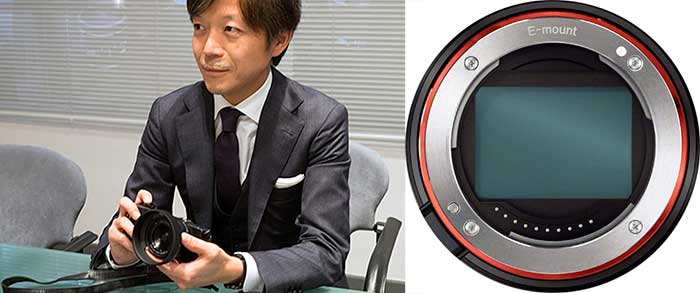
Sigma CEO Kazuto Yamaki released an interesting interview at DSLRmagazine (google translation here). Highlights of the interview can be read at MirrorlessRumors. Mr. Kazuto also gave an explanation why they do not plan yet to make lenses for the Full Frame E-mount system. He said the diameter is very small and makes it difficult to design high quality FF lenses. He is yet not sure about it but to him it almost looks like E-mount was designed for APS-C more than FF.
Also interesting: He is aware that Sony is working on three layer sensors and also said he expects big new PRO cameras to be announced at the CP+ show in Japan (February 2015).
0 Responses
Kazuto Yamaki is confusing the e-mount size with his penis.
Lol very good one… It seems both Sony and Zeiss have no problem designing quality glass for e mount / FF. But again, Sigma’s lens rely heavily on multiple correction elements / group which is exact the opposite of Leica. Which is probably why he find e mount too small for FF. Sigma is really for people who can’t afford German design.
Aha, Sony could come with a Feveon sensor !!!! what to expect from that if true ??
1,Lots of sensor read noise – about 10 times what it’s now, thus much lower dynamic range.
2.Lots of color conversion noise – even lower DR for color images.
3.Due to both above a bad low light performance.
4.Inaccurate color especially in mixed light and low light.
5.An expensive to manufacture sensor.
6.No color aliasing – that’s pretty much the only tanglible advantage.
There are reasons why no one else bought Foveon for pennies when it was for sale – see above reasons.
If at some point organic sensors enter the gama, it is possible that vertical color separation is reconsidered as #2 would not longer be an issue, nor would #4. #5 might also not be an issue. But if/when organics come, the first generation will have Bayer CFA.
a happy Barry on this Forum…
Oh for sure… The 55/1.8 is only a so-so and the 70-200/4 is truly a mockup – My God!
doesn’t mean the 55/1.8 is the widest and smallest FF lens ever
The small E-mount diameter is BS; E-mount: 46mm; F-mount 44mm; Seems he’s confusing mount diameter with back focus disance. And Sigma just hasn’t much experience with designing lenses with short back focus distance.
They can do like Samyang, add an extension tube to it, who cares as long as it mount on the camera in e-mount. A 55/1.8 is anyway nothing you put in a pocket. And as you state here, the Nikon F mount is even smaller.
It’s not BS, the diameter of the E-mount is a problem due to how close it is to the sensor, the F-mount is further away (and is not ideal in any case). If the E-mount were wider ti would make design of high quality, compact lenses easier. Kazuto Yamaki is dead right.
Sigma designed some very good lenses for the DP series plus the two e-mount lenses that are well regarded.
As an example against your first argument, the Leica M lenses are smaller compared to most FF DSLR lenses while sitting closer to the sensor and having a slightly smaller mount diameter. While he may be right that it is difficult to design high quality lenses, it seems that it is certainly possible to outperform DSLR lenses even with a similar mount diameter. And looking at the current FE lenses, Sony compensates for the short flange distance by placing the rear element further away compared to DSLR lenses.
9mm can make a huge difference when designing lenses. Leica M lenses have more flange distance than E-mount lenses to work out a design so I’m quite sure It’s not BS what Sigma says.
it’s BS. there’s always an option to extend lens tube by those 9 mm. In most Leica M lenses the rear element protrudes much from the mount, anyway
That’s silly. It just means the same lenses would work the same if 9mm longer and in addition, other lenses are possible.
Also, he talks about the mount diameter making it difficult. But E mount is larger diameter than F or M.
A lens it’s easier to design with longer flange distance. The reason I find why it’s easier is because with longer flange distance, you can make the lens smaller to project the whole image into the sensor without vignetting too much. With smaller distance, you have to provide means to project the whole image into the whole sensor in a small distance, and that means, now you have to worry more about lens design and lens size. That’s why you can find ultra small pancake lenses on SLRs (and are quite cheap even being fullframe) but on mirrorless those pancakes need more work and I doubt we will ever see a f2.8 pancake on fullframe.
Open question, Does Leica M provide many 1.4 lenses?
“Does Leica M provide many 1.4 lenses?”
They have several 1.4 lenses and even one 0.95.
Yes!
21/1.4, 24/1.4, (28/1.4), 35/1.4, 50/1.4, 75/1.4
Yes, for example: 21mm f1.4 (fastest UWA), 24 f1.4, 35mm f1.4, 50mm f1.4, 75 f1.4.
Different filter stack on the Leica bodies = totally different performance.
Look up some tests of Leica lenses on A7 bodies.
It is the other way round, it is easier on E-mount due to the shorter distance. Think about what you just said geometrically.
Leica and Zeiss have proven this time and again.
Sigma is just angry that they invested so much in legacy technology.
Sadly not, the shorter distance ought to enable very compact symmetrical wide angle lens designs, but the sensor coverglass causes significant astigmatism in the corners when using such designs. Just look at the numerous tests of rangefinder lenses on the A7R.
Leica get away with it by using a very thin coverglass and specialised microlenses and pixel structures, and even then it’s causes them big problems (IR transmission being one of them).
Sigma seem to be doing just fine at the moment, given the universal praise for their recent Art lenses.
I wonder how many lenses they are selling? Designing great lenses and selling a lot of them are two different things. I wish Sigma the best, because they are producing some nice products. Still, they could design a nice zoom for APS-C E mount and they have not done that either. I wonder why.
I don’t buy Sigma primes because they lack OSS. People say OSS degrades IQ and are not necessary for short primes, but I really appreciate OSS in my 10-18 ultrawide zoom.
You don’t need optical stabilization on a 10-18mm lens, you need to work on your shooting skills.
What an arrogant comment.
He is not quite right. The throat may make some (longer) designs a bit different from what usual, but that’s it. There is nothing in the F-mount E-mount can not do. And E-mount can do more.
It means you can’t design fast compact lenses longer than 50mm due to restrictions on the exit pupil, and you can’t design fast compact lenses shorter than 50mm due to ray angle issues.Thus it’s not a particularly attractive prospect for Sigma.
Some further reading on the subject:
http://www.fredmiranda.com/forum/topic/1248339/0&year=2013#11877288
Designing big SLR like lenses with tubes on the back is no harder, but I don’t think that’s what they were talking about.
As far as I can see there’s nothing about “compactness” in the Sigma statement. Also, Leica, Zeiss and Voigtlander have no problem designing excellent compact lenses for M-mount, adding 9mm to them won’t make them huge.
Compactness is implicit, anyone can make high [image] quality lenses if you’re prepared to put up with something absolutely huge.
Recent Leicas have a completely different sensor toppings optimised for short exit pupil distances. Sony’s FE mount cameras do not, thus the same designs can’t be used.
It is not necessarily implicit. Also, rangefinder lenses from normal and above work just fine on a7 cameras, leaving an issue only for wide angles and then not all of them. I’d like to see how that new Voigtlander 15mm will work.
why do they no make some APS-C ones, there is a big market in that matter in e-mount. Since FF e-mount exists, Sony forget that we exist. There 19 and 30 mm where good lenses, and I wait for a new pancake between 19 and 24mm
Poor form Sigma… I think Sigma need to work out their QA/QC department first of all, judging from the variation in quality of the Sigma Canon mount lenses I’ve tried.
Sorry Mr.Yamaki but you need to read more about what you are going to talk about before doing this interview.
I hate your lenses anyway
Do not be so hard with Mr. Yamaki jun.. He is still learning, how hard digicam-world is. Now, he is CEO and have to go further with the family manufactury! Give him time, not to much.
But he know, what consumer want and he has to be careful with his employees in Japan! It is not so easy to change quickly all old fashion way of the company, which his father has grown!
The big problem is Sony. They make a big mistake with two lens-mount!!! The a7 could be a little thicker and the a-mount would have his place on it! Maybe Sony has thought about it!
And that silly adapter is not a solution at all!
And let Zeiss do lenses for the a7!!! Why Sigma has to do it.
It is better Sigma go ahead with more ART-lenses FF and for APS-C!
no hard feelings , I was just amazed by how Sigma CEO could say this “He said the diameter is very small and makes it difficult to design high quality FF lenses”.
Sony FE 55mm is the best 55 AF lens ever (from SAR old post) , so if Sony can make such lens for FF E-mount and Sigma is admitting that they can’t do it , it’s like Sigma is saying Sony is better than us.
if Sony made the a7 a little thicker it won’t be the smallest FF interchangeable lens camera in the world, also they will need to do it exactly as thick as A99 so it will be HUGE not just a little thicker to make A-mount lenses work on the A7, at the end it will be a mirrorless camera in the size of DSLRs and it won’t interesting.
All I wanted to say that this statement from SIgma CEO is bad for Sigma not for Sony.
If E-Mount had truly been designed for APS-C only, it could or would have been made even smaller.
Does Mr Yamaki really believe Sony designers didn’t leave their options open for a FF sensor in the future? I doubt it very much.
They left their options open but I’m guessing they didn’t pre-plan heavily for full frame and what the implications would be for a mount designed for APSC
The E-mount is similar to Nikon and Leica, even 2mm larger, so all this diameter talk is nonsense.
But those have longer registration distances. Elpha requires longer lenses to compensate for the physics. Defeating the original vision for the mount, which was supposed to be compactness… obviously only possible with APS-C, which it does fulfill for that format… But NOT for FF.
I agree that the registration distance makes the mount smaller than what it is. Sony stacking up thick glass on top of the sensor and their liberal use of epoxy to bond that stack(s) does not help either. When they come up with decent (quiet) shutter, they can reduce the epoxy stuff quite a bit and also use thinner filters on the sensor. There is a lot a to improve to overcome the shortcomings of the camera registry.
if they use thinner filter, their existing SELS and Loxias will produce inferior images
They already do. 😉 It can’t get worse.
If you look at the NEX (currently called Alpha) filter stacks, not all have the same thickness.
To the date I have only disassembled NEX-5N. I have nowhere seen anyone actually reporting significantly different thickness.
If you measure the total thickness of the NEX-5N (cover glass + the UV/IR cut dust shaker) and compare it with that of a NEX-7, you will find the 7 having thicker (~2.5mm) stack, similar in line with the A7 stack thickness.
If you remove the stack from an A7, the results (with any lens old or FE) are readily noticeable (better).
AFAIK (in APS-C), only the NEX-5 and the 7 have ~2.5mm thick stack and also a separate AA component. Only recently (post NEX-6), Sony have introduced a better sensor gate. Some day in the future, they may even replace the plastic mount…
The 5N has thickness very close to 2.5 mm already – I saw it. Just the AA itself is about 1.5 mm thick.
FE lenses can’t get better from removing the glass stack because ALL SELs are calculated with it in mind (all patents obviously indicate this by featuring a flat element after the lens itself).
You need a better calipers to measure the thickness. Hint: take the plastic frame/gasket off to get the real glass.
NEX-5N: Dustshaker-UV-IR cut filter is 0.6mm thick. The cover glass (I took that off as well) is 0.7mm thick. This adds up to ~1.3mm.
sorry I was wrong
9mm will defeat compactness?
Want to see why E-mount was designed for APS-C only? Look at the VG900, A7, A7R and A7S mounts. See how Sony cut some corners to make space for the sensor???
No I don’t, you’ll have to show me.
So these supposed huge announcements will be 12-15 February… OK.
This is what I said from the beginning.
Lol @ the fanboys trying to criticise an expert from a global lens complany on his observations about an APS-C designed mount. Because you guys obviously know better…right?!
Anyway, this is probably why you haven’t got any f2.8 zooms yet lol.
Good luck trying to get that 70-200 f2.8 and 300mm F4 lens that people have been asking for!
Leica screw mount has 39mm throat. Leica M-mount also has smaller throat. If one bothers to look at empirical data of lens mounts one will notice that the E-mount doesn’t have a small diameter at all.
There is nothing which prevents high quality fast lenses. The location and size of the exit pupil is not fixed because of long focal length or aperture – there are always restrictions on what kind of design is possible for the elements between aperture and the sensor, but the limits are not dramatic at all in this case.
Leica also has longer registration distance which allows the lenses to be high quality AND compact. Can’t get there from here with E-Mount until adapters, tubes, or bigger lenses are made, thereby killing the original vision of a camera that was never designed to be what you want it to be.
The long registration distance is a complete irrelevance. All that’s required is a very slightly long lens body placing the lens elements the same distance away as they would be on M point. After all, that is essentially what an M-mount adapter does.
It can’t be said enough. A short lens registration distance is an enabler, not a restriction. No lens designer has to place the lens elements any closer to the sensor than on any other sort of camera. It’s just an option if the designer wants to produce a more compact lens.
Yes, there is one thing: the inability of Sony’s lens designers :-)! That’s why the need these excuses.
Leica R 70-180/2.8 APO is fully compatible with the M-mount’s throat and the body’s FF sensor. You just need more spacing via an adapter.
Reality contradicts your “expert”.
Ya think? Can’t even see the corners of the freaking sensor behind the plastic mount.
Geesh… Like Sigma knows anything about lenses. I wish they’d stop whining.
Never heard of perspective? The corners appear cut off when viewed from distance. It isn’t an issue for lenses when taking into account the short distance from rear element to sensor.
I’ve also never heard of a camera that’s had such problems getting wide angle lenses to perform properly for years now. Or a camera that promises compactness, but delivers IQ only in the size of regular DSLR’s plus adapters. My 55/1.8 is larger than Mino 50/1.4 with LAEA adapter.
E-Mount is so far away from it’s original vision that it’s cryable to think about it.
The problems with legacy WA lenses has nothing to do with the mount diameter.
Right, it has to do with physics. And the physics don’t add up to the promises that E-Mount was supposed to fulfill.
I await your explanation of this “physics” you speak off.
See four posts above this one. HQ is only possible with larger lenses. Far afield from the original vision for E-Mount. You think they planned for that?
Problems with legacy WA lenses is that sensor cover glass was not included into calculation. Zeiss Loxia remake of old Biogon solves this issue with microscopic changes in lens design.
I don’t know. The 10-18mm on APS-C works quite well. The new 16-35mm looks like it is going to be a very good lens. Stop over generalizing.
“HQ is only possible with larger lenses. Far afield from the original vision for E-Mount.”
That is true for almost any lens design on any mount. Smaller means compromises on quality – that isn’t a problem exclusive to E-mount.
E-mount can’t defy physics more than any other mount.
Regardless, you seems to be under the illusion that E-mount was always meant to be limited to small designs. No, it was designed to be flexible.
E=mc2 may be?
There’s only one “such other camera”, Leica, and they have the exact same problems.
I’m getting pissed more and more by the latest SAR posts. It looks like Admin just wants more traffic on his site. He recycles old news which created a lot of emotions and comments before. That is why I’ve just decided to stop reading this site for the next 30 days. I have better things to do.
Certainly, you should only pay attention to opinions which support your own, for the next 30 days at least.
It is called confirmation bias. This site is suffering from BS bias.
Yeah, right. That’s why Leica (44mm diameter) has so much trouble making decent lenses. And Zeiss. And Voigtländer…
Sigma is just kicking around because they misjudged the success of full frame mirrorless. They bet on Canikon DSLRs and they are losing.
Whatever Sigma. Those art lenses are too little too late. My mind is set on Loxia glass now.
I’m glad somebody else pointed that out. E-mount is no smaller than M-Mount (lens registration distance apart, which isn’t really relevant as that’s merely a spacing issue).
I suspect that Sigma are just used to making designs for SLRs and they simply aren’t used to producing optical designs more suited to large format mirrorless designs.
100 comments to arrive to the common sens.
I think he is trying to promote his unwieldy Quatro when he said that the E mount is small. A product with no imagination. Sigma needs a total rethink.
Maybe Samyang will beat them to it.
doesn’t seem to be a problem for zeiss, the 55mm 1.8 is the highest rated af lens at dxo mark.
not to mention the zeiss 24-70mm f4 and sony 70-200mm f4
In all honesty, the 24-70mm f4 it’s the worst zoom for FE lenses almost on par with the 28-70 f3.5-5.6.
In all honesty, the 4/24-70 is much better than what people on the internet make it out to be.
Says a person on the “internet”? I bought two copies and returned because I was not happy with either. If a good sample exists, it needs to be labelled as “special” to get my attention.
I strongly believe there will be a version II very soon.
Could by quality variability. After all, it is a Zeiss made in China :-)!
check phillip reeve review. He clearly outlines how the lens performs poor at f4 at the edges and you have to close it way past f8. It’s supposed to be a high end standard zoom!. And It’s F4, not F2.8 and performs quite bad. And at 70mm performs poorly. The 16-35mm f4 in the other hand. That’s a nice lens!
that is total BS and not worth giving a detailed reply.
Could you give on? I doubt it. I think you are full of BS yourself!
as i said from the start, its hard to take the comments from sigma to serious when the HIGHEST rated af lens ever made is the zeiss 55mm 1.8 (and its made in Thailand so that already shoots down any “oh zeiss is made in X or Y so its no good” arguments)
as for the two zooms both are also solid performers when paired with the a7r, in fact the 24-70 f4 (also made in Thailand) actually rates higher then the canon equivalent.
I’m taking the ratings from dxo mark, which I’ve personally always found to be a solid representative of camera/lens performance.
i also like to buy my equipment from bandh and give weight to the actual people who have bought and use the lens. according to those ppl the lens has a overall score of 4.5 out of 5.
so based on the solid result from dxo mark and customer reviews by photographers who actually use the lens on the bandh web-store i bought the lens and love it.
I’m not claiming its the worlds best lens champ but to dismiss the lens as “the worst zoom for fe” is absolute BS.
the lens is a solid performer when paired with the a7r.
“its hard to take the comments from sigma to serious when the HIGHEST rated af lens ever made is the zeiss 55mm 1.8 ”
But it is not. If you go by DxOMark ratings, highest rating belongs to Nikon 85/1.4G, 44. Then Nikon 85/1.8G, also 44. Then Zeiss 2/135, then Nikon 200/2G, then Sigma 35/1.4 at 43… Sony FE 55/1.8 is #19 on the list, #13 if you don’t count MF lenses in their list. And of course it is greatly propelled by high-res sensor in A7R.
Ok, it’s not the highest rated, but you are also so wrong it is not even funny. Some lenses appear several times in the overall ratings, so the Zeiss is more like #9 in the list, it is the most compact and there’s only one 50mm lens in front of it, the Otus which costs 4 times more and weighs 3 times more. And it is not “propelled” anywhere by a higher-res sensor.
The FE 55 (42) and Nikkor 85 (44) are well within their stated margin for measurement (error). Even the “huge vignetting” is within 1/3 EV of the 85 at f/2, despite the latter being a much longer FL.
$200-quality zoom for $1,200.
Stockholm syndrome anybody?
http://slrgear.com/reviews/showproduct.php/product/1654/cat/83
http://slrgear.com/reviews/zproducts/sony24-70f4zfe/ff/1blur-t.gif
http://slrgear.com/reviews/zproducts/sony24-70f4zfe/ff/1vignet-t.gif
Never, ever cite DXO mark for judging quality of lenses. Their tests are bollocks. They do very good job on testing sensors, but their lens tests are totally unreliable (that said though – 55 f1/.8 is a great lens).
Yes, well first they need to use more metal, which could be made thinner than plastic while maintaining strength.
This is going to sound weird coming from me, but in all fairness, Sigma hasn’t even released all their lenses for Alpha either. So I’m not too convinced at the validity of the statement.
But it cannot be denied, that E-Mount has no issues with APS-C lenses staying compact and high quality. FF E-Mount requires a tradeoff of compactness for quality. Lenses are as large as DSLR glass. Not part of the original vision.
Lenses are large is due to Sony, not mount. SEL24/1.8 is large, but Canon managed to make a compact and fast 22/2 with same FL of 18 mm.
He is probably right and look at Fuji, they have understood this and focus on prime lenses for APS-C.
Thank you Admin for posting critical stuff too.
Kazuto is absolutely right. E-mount IS designed for APS-C more than FF. Canon Eos M mount (aps-c) diameter is the same as E-mount.
Small diameter is one of the reasons why E-mount FF- lenses are so damn BIG.
BS. How making mount diameter large can make lenses smaller?
It can make them shorter (but fatter) due to being able to move the exit pupil. This can make them appear smaller, and balance better (and put less stress on the mount etc.)
Larger diameter of mount is needed for cases when exit pupil is very remote from the sensor. In most lenses it’s moderate
For the same optical properties, we’re talking about adding (to the lens) less than the difference of flange distance between E and for example Nikon F mount at max, because that’s actually >2mm smaller in diameter.
Not to mention the Leica M mount being smaller in diameter too and only adding <9 mm in flange distance over the E mount (which again, like SteveGJ pointed out too, nothing more than a spacing issue at worst).
In other words, two options:
– he's confused
– he's giving us marketing speak to hide financial (or lack of) motives
I'm opting for the latter.
Nikon F is not smaller: E-mount lens can fit into F-mount. F-mount has a slight advantage in usable diameter due to placement of electric contacts.
“Small diameter is one of the reasons why E-mount FF- lenses are so damn BIG.”
You were saying…
http://cdn3.digiphoto.techbang.com.tw/system/images/86903/original/38842eacf7073e92911c0c25b61e2244.jpg?1411440635
Internal Zoom Mechanism (Canon) vs Extending Barrel Zoom (Sony).
Even extended, it is still smaller and you still need the bigger camera for the Canon.
You guys do see that the EF16-35 f/4L depicted there has a Metabones EF-to-FE smart adapter on it, right?
Without that adapter (i.e. when that lens goes on its native Canon), the SEL1635Z is only slightly shorter.
So no, the SEL1635Z is NOT SMALL, despite the supposed size advantage that a short register distance could have potentially enabled in wide-angle lenses.
I didn’t say anything about it being small.
I was responding to the guy above who said FE lenses are “so damn BIG”.
The EOS M mount diameter is the same as E-mount because Canon also wants the option to release a full frame mirrorless in 2015. Sigma is just angry because they misjudged Canons future direction.
What next? The I-Mount for FF? What a shot in the foot! Or is he trying to tell us: For FF A-mount, for APS-C E-mount?
That is at odds with Sony. Which announced that they always intended to bring full frame to E-mount.. they designed the mount for that.
It certainly hasn’t stopped Sony and Zeiss producing excellent lenses so far! If it was easy everyone would be making FF compact interchangeable lens mirror-less cameras….
Extremely small register distance (18mm) == huge variance in angle of incidence
With a smaller APS-C sensor, the problem is much less pronounced. Now they’re adding special microlens arrays to the FF sensors to compensate for this design flaw… What a kludge! Mr Yamaki is obviously right, Sony designed the E-mount for a compact, mirrorless system using (quite large) APS-C sensors. At the time, they were still working on the A-mount system, so FF had its place in the Sony lineup. But then A-mount died and suddenly FF sensors needed a new home. High-end optics and small size is a contradiction. Whenever the performance of an optical systems needs to be improved with existing technology, the system is made larger, because the larger system produced with the same manufacturing technology (precision, tolerances, purity) will have better performance.
Yes, Sony proposed a design based on E-mount to the ESO for the new, best ever optical telescope, but the ESO still opted for the ELT design.
By the way: ELT stands for extremely large telescope.
It’s the fault of sensors that they have limited angular response… Samsung is soon releasing a camera with BSI APS-C sensor, which fixes is, and Sony will probably, too.
BSI doesn’t fix it.
Why? Because trolls need it to prove that E-mount is bad?
What does it have to deal with E-mount?! Samsung isn’t making an E-mount camera.
1.This proves that BSI at APS-C is commercially viable
2.Sony probably will be pressed to introduce BSI, too.
“1.This proves that BSI at APS-C is commercially viable”
Also proved that Sony were spreading lies about larger pixels not benefiting from BSI. They did search around.
I love what Samsung have done with their latest NX. If they beat Sony to the monochrome, I will get that and the latest NX.
No Sony was not spreading lies. Large pixel cameras (like APS cameras up to say 16MP) will not bennefitting from BSI, The gain in high ISO is very small. But now we get 24 and even 28 MP cameras, pixelsize is getting very small and sensors will start to bennefit from BSI. Question in the end will be: How much better is this 28MP sensor compared with other sensors? How much more detail will you realy get when the lenses are not good enough to outresolve the sensor? (A thing I realy question with the 24MP APS sensors too)
BS.
Yea, Sony spreads lies, totally.
Jesus, is that some “stupidity day” or what?!
BSI fixes vignetting but not color shift for color-filtered sensors.
This is nonsense. Flange distance is opportunity not obligation.
No, it’s simple trigonometry. Please take a couple of minutes to think about it. A system with a 18mm register distance will need a VERY large rear element to achieve the same incidence angles as a system with a 46.5mm register distance (F mount), which in turn will increase the size of and distances between the rest of the lens elements for the same optical performance. This “opportunity” approach has not been chosen by any FE lens designer so far. It would result in very large, heavy, expensive lenses. All the existing FE lenses accept the short register distance penalty.
Lies.
e.g. in SEL70200 the rear element is recessed, so it’s almost at same distance if it were SLR design
Indeed. Just got that lens last week and yes the rear element is recessed.
Then you find no problem getting bigger lenses with recessed elements deep inside the construction right? Good thing Sony decided to make the smallest camera bodies, so people can slap bigger lenses into it.
Yes. But the corners have already been cut in the Sony (FF) sensors.
And yet Sony/Zeiss are capable of making thebest lensees for this system.The thing you call a “problem” is a thing that is fixed in the lens. Is it easy? Maybe not, but it can be done.
The small registration distance has his (very strong) pros too. Look at this:
Cameras can be smaller
Cameras can adapt all FF lenses from the past
Only WA lenses have realy a problem with this. And it can be fixed when using the right lenses
Problem is also fixed by placing the microlenses on the sensor in a different way, problem solved.
For Sigma it is difficult to create a profit out lenses for just one camera system, all the lenses they create are for more then one system and so cost of design can spread over more sold lenses. The FE lenses are unique in the market, so no other brands they can use the same lenses, so more expensive lenses, so less profit in the end.
And lets face it: The FF mirrorless cameras are not selling as much as the FF DSLRs are…
It’s a good thing he said difficult, not impossible, to design full frame FE lenses. I wonder if the difficulty will somehow abate when there is enough of a market for third party FE lenses to be profitable? Not withstanding the technical difficulties involved with lens design, this pronouncement does not actually preclude the development of real products.
Japanese use ‘difficult’ 難しい as excuse all the time 😀
Total BS. How come all EF and A-mount lenses work fine including from Sigma. This is the most stupid excuse ever
Yes, because EF and A-mount lenses are designed for mirrorless bodies with an 18mm flange distance.
*Facepalm*
So what is the drawback would you care to enlighten us? My 1,8/135 works fantastic on a7 and 20 more lenses do just fine. Thinking about it Sigma boss admits they have not made a decent lens to date
Size. Size is the drawback. They want to design dedicated E-mount lenses.
In fact they don’t want to make dedicated lenses at all, for no brand. They want lenses they can easely adapt to other systems. They design one lens. put an other adapter and electroncs on it and sell the same lens to Canon, Nikon, Sigma, Sony and Pentax users. In that way they get more profit out of one design. This is impossible with the E-mount FE lenses. There is just one camera they can sell their lenses to. So it is difficult to make a healthy profit with them.
(look even the Sigma mirrorless lenses are available for more then one mount)
There’s not enough customers for 3rd party lens manufacturer like Sigma to make dedicated E-mount lenses. (Zeiss being obvious exception from this due to their contracts with Sony and price people are ready to pay for the brand)
Well, they can just slap E-mount end on their existing SLR lenses (like Samyang does)
just buy the normal SLR lenses and buy an adapter, that way you’re not limited to E-mount (and that extension barrel) and you can use it on several mirrorless.
Which is quite expensive given that they’d have to design them from the ground up for one platform. Their business model depends on spreading R&D costs over several mounts to maximise their market.
There’s no mention of size in the Sigma statement; just that they can’t make high quality lenses.
the fact the existing SLR lenses work without vignetting proves that E-mount diameter is enough.
A-mount got noticeably larger diameter than E-mount.
I don’t know why you guys are mad with this guy. It’s his company and he is taking the risk if his company is outperformed and got beat by other companies. If this guy won’t sell FE lenses, then others will and we can buy from the one who sells.
He’s talking nonsense.
Well he’s running a company. The company is on his hands. He won’t say this if it were completely nonsense.
What I meant is that he is simply giving a BS reason rather than the real one, by placing the blame on Sony. Hardly unseen in the business world and not the first time Sigma blames Sony for their own issues.
this has been posted before…
First, SLRs created a design difficulty by lenses having to be retrofocus, in order to allow space for the mirror, so mirrorless eliminates that problem.
Second, all of the A mount lenses work perfectly well with an adapter, without having any odd vignetting, so the argument is a nonsense.
Third and most importantly, Sigma have always dragged their feet when it comes to producing lenses with a Sony variant, so this mount will be no different. Certainly, in the past, they have announced lenses with an A mount, but they have often been months (if not years or never turning up at all) past supposed delivery dates.
I wish that, just once, a senior person would tell the truth, rather than this load of hokum.
There is no “problem” – just an obstacle that lens designers learnt to overcome dozens of times since the SLRs came on a market.
Secondly – they want to design dedicated mirrorless lenses, non adapted nonsense like Samyang does it.
Third – Sigma is “dragging their feet” for a reason. There is not enough demand for 3rd party E-mount lenses. They already explained it more than once. And their A and K mount lenses release policy is nothing unusual. First they tend to most profitable mounts and then secondary.
He is telling truth, you just refuse to accept it.
A ‘problem’ is an ‘obstacle’ and vice versa. The two are the same and just ask any lens designer whether he would prefer to have the mirror box or not!
Who mentioned Samyang? I thought the lenses produced by Sony and Zeiss are good enough examples to demonstrate.
You finally get to the real issue, which only demonstrates the real truth, when you say they don’t want to make these lenses until the market is there. The fact is that Sigma have ALWAYS seen their market as Canon and Nikon. Nothing has changed, but to use the nonsense about mount opening size as a justification is simply wrong.
As to ‘refusing to accept’ his ‘truth’, I couldn’t care less whether they make lenses or not, just whether he can be honest about it.
I already asked one, and the answer is simple: depends on a lens he is about to design.
Samyang is the one making A-mount lenses with integrated adapter for the E-mount. That’s why I mentioned it after you mentioned A-mount lenses and adapters.
Now you’re babbling like most of the people around. Conspiracies and nonsenses. Sigma is one of the best companies in supporting other companies than Canon and Nikon if not: THE best one out there. Just compare them with Tamron who is stripping down their lenses for A and K mounts while selling them for the same price as stabilized F and EOS lenses. They are very very far away from the nonsense you just said. They’re one of a few companies still taking a risks of releasing potentially unprofitable lenses to the other mounts than the big two and they cared a lot about their Pentax and Sony customers. But I guess it’s understandable – E-mount boys are so butthurt about Sigma skipping them for most of their lenses that they cannot see any logic.
“Now you’re babbling like most of the people around. Conspiracies and nonsenses”…the irony is extraordinary!
Also, I have no idea what the type of mount has to do with being ‘butthurt’ if you are referring to me. I have two A99 and a whole range of lenses, as well as two A7 with the 24-70 and 70-200.
The point is that this gentleman has stated the main reason for not supporting the E mount yet was the difficulty of design, whereas it is entirely clear to be an economic decision based on potential sales numbers.
I have no argument with the real reason (Sigma can do whatever they want), but I do find it annoying when people in his position aren’t genuine.
That’s almost certainly one of the big factors behind the decision, but the reason he gives is it’s difficult to design good FE lenses We all know that’s utter nonsense, as Sony and Zeiss are cranking out excellent primes.
And…. all of them were relatively dark, and all of them were made by very experienced designers capable of overcoming difficulties.
Sigma CEO NEVER said that it’s impossible to design excellent primes for the FE mount. He only said that it’s difficult.
I see reading comprehension is really lacking in commentators under this news.
So Sigma doesn’t have designers capable of overcoming difficulties? Is that the problem? It is your reading comprehension that is problematic, especially visible in your answer to Kelly.
Speaking about FF E mount…..any news on the Sony RX20? We are at the verge of PhotoPlus Expo and Sony is still quiet?
RX20 won’t have anything to deal with FF Emount
I know…I’m just trying to squeeze a totally different topic in..haha.
Bad excuse. Maybe they should start designing non-retrofocus wide angle rangefinder lenses instead of trying to recycle their DSLR wide angle retrofocus designs. Also they will need to implement linear AF motors instead of the ultra sonic ring type AF motors in order to support the hybrid AF systems in the mirrorless cameras, which most likely means a redesigning of the movable parts of their current USM lenses.
Zeiss just designed two beautiful lenses working beautifully with FF E-mount. The Sony FE primes are incredible, what is Sigmas problem exactly, apart from the fact that they should start joining the future by designing lenses that are also awesome for video?!
None of Sigma E-mount lenses were recycled retrofocus designs. You are babbling nonsense.
I am not saying that. The DN ART lenses (the 19mm, 30mm and 60mm) are designed for mirrorless, including their own DP cameras. These lenses are also compatible due to the AF motors suited for CDAF cameras and video work for that matter. Sigma need to do exactly this, create FE lenses from scratch. They should say that instead of designing lame excuses about small mounts etc., which is as far fetched as it gets.
Try to understand what is said instead of babbling nonsense yourself!
You are still babbling nonsesne. Read what the guy said. “It’s difficult”. That’s all. He never said Sigma won’t be designing new lenses for scratch, he never said it makes it impossible to design FE lenses.
Haha, you just joined the babbling boat? Who said that Sigma thinks it’s impossible?
The E-mout being “small” according to Sigma seems like a lame excuse for making people know it is difficult for them. Why not just say that it’s a matter of money and a worry of not getting their investment worth back? Being first movers (3rd party AF FE lenses) is always a risk.
I think that maybe the other brands (nikon, canon, etc) are paying them not to do so.
Sony A7 it’s one of the best sensors (dxomark) and zeiss FE55 one of the best lenses around.
Who cares if they didn’t planned an FF mount initially? What matters it’s that the camera and existing lenses are among the best things ever produced in photography. Regarding wide angle lenses, the zeiss FE16-35 it’s (again) great and they have a FE35 1.4 comming too. Big? A little bit compared to a FE35 but who cares if quality is top notch? It’s a pity sigma not joining the game. Maybe we could have less expensive lenses … Anyone has a doubt that sony is menacing canon and nikon? If you do, you are fooling yourself. I sold (almost) all my nikon gear, and I was a 25 years nikon user, only to use sony and fuji. But that’s just me!
Conspiracy theorist 101
LOL. :p
I think Sony is paying you to do so.
LOL. I’m nobody. That would be great if truth.
That’s a silly remark. Miguel is just not insanely tied to the “status quo” like many are! Sony definitely has the most advanced camera technology today and is bold enough to put it on the market!
It’s about as silly as saying that Nikon and Canon are paying Sigma to not make FE lenses.
Yes Al I was a little ironic on that! Otherwise just as silly as ” … the diameter is very small and makes it difficult to design high quality FF lenses.”
Mayby Sony is planning to change E-Mount to next ?-Mount, which can be used on FF ?
And thay say the e-mount is for amatour, a-mount for professional, and next-mount for everyone ?
Would be good. And totally expected from Sony.
Oh damn we have been fooled by Sony, the A7 and it’s lenses don’t actually work! It’s no real Full Frame, it’s not a camera, the lenses are not real and they are of course not FF as well. The mount doesn’t work at all, there is no light going through, picture quality is horribly, nobody can use Leica lenses on it, or Canon or Sigma, or Nikon or or or. …. oh wait
We don’t need a new mount because Sigma are obviously noobs
FE lenses, Loxia lenses all works great. E-mount is a modern design unlike the A-mount. A-mount protocol has its limitations and will not allow further technology development. A-mount is so dead.
Yea, modern must be better. Cause it’s modern. lol
Sigma never said it’s impossible to design lenses, they only said it’s difficult. Zeiss are masters of the lens design – they are the company behind some of most innovative lenses in the history, why the heck you think they wouldn’t be able to overcome these difficulties is beyond me.
Maybe it’s difficult to design for Sigma’s target market.
Zeiss can basically charge the earth and get away with it.
Apparently, Sony are masters of lens design too then.
Please name a couple of these A-mount limitations. Thank you!
Sony and Zeiss beg to differ. And there was me thinking it had something to do with FE not fitting into Sigma’s “bolt on a different mount” business model.
It doesn’t, lenses would need to be redesigned to suit mirrorless from scratch and they would be making those lenses for just one series of camera.
That’s actually a pretty scary thing to here. That would be a permanent cripple of the system. I wondered that when the A7 was being rumored, whether the full frame capability was a happy after thought. Let’s hope that’s just Sigma making excuses and not a long-term issue.
E-mount is perfectly capable for FF as Sony and Zeiss have proven. Sigma’s issue might have more to do that they want to do one design that fits all mounts. With their focus on high speed lenses that might prove difficult for some designs to fit with the E-mount. Sony and Zeiss can create high quality lenses by placing the last element relatively close to the sensor as they don’t need to worry about a mirror. Sigma could do the same but then they have one design for E-mount and another for Canikon. This is obviously not the case for all lens designs as Otus demonstrates but probably it would be easier for Sigma if the E-mount was bigger and / or had a larger flange distance. So I don’t think it is a technical limitation but more of a commercial issue.
Another reason it is hard to design one lens that works on both FE and all other FF cameras is that Sigma probably designs their lenses to cover a little extra area so they can be used with cameras that use IBIS. The FE mount is just barely large enough for FF so it would be hard to cover a larger image circle.
it’s not a problem for lens designer, since you can’t attach FE lens to any camera that has IBIS, it problem for those who want to use A-mount lenses on FE cameras
Neither Sony nor Zeiss have proven that they can make for FE the high-quality f/1.4 lenses like Sigma Art 35 and 50.
well, the 35 1.4 Zeiss is coming beginning next year, I doubt it will be worse than the Sigma. And 50 1.4? who cares about half a stop. Those 50 1.4 usually have a T1.8 transmission anyways, just like the FE 55 1.8. Faster is not always better and no, designing fast 35 or 50 is no matter of skills, it’s a matter of what makes sense. 1.8 lenses are a perfect compromise.
IMHO what you’re saying makes a lot of sense! Sigma lenses are becoming very high quality, although they still have one problem: too heavy when comparing to similar Sony G lenses, for example. Anyway, I hope they see the value in making FE lenses since their prices are very competitive!
Their current designs work perfectly fine adapted to E-Mount so the opening is plenty large enough..
As far as commercial choice, yes probably as there are no other FF systems that they could adapt a new lens design to, so they would be making it for one system only, which probably isn’t viable for Sigma.
However FE is a fairly Enthusiast system, one with a higher attachment rate than typical mirrorless or rebels, while ALSO being one crying out for lenses, if Sigma were smart about it they would strike whole the iron was hot so to speak, which in itself would help drive FE camera sales and therefore more Sigma sales.
Most FE users stay with the kit lens, D3300 and rebel users do it too.
Considering how bad/average (for the price) the 24-70 is… yeah.
The funny this is, that Sigma has released only one aps-c mirrorless lens (60/2.8 DN) which isn’t a copy of their DP Merill designs. is that due to mount diameter too?
It is because E-mount is too small for aps-c as well =p lol
And all those DN lenses nearly cover full frame anyway.
With the mount like this and a big high quality rear element, to avoid bad vignetting due to mount shading itself you have to bring the rear element close, but because Sony uses color filter on a sensor that large, rear element that close causes vignetting and color shifts in the corners. Lose-lose.
Specially designed lenses would have to have small rear element far from the sensor, complicating design and making the lens bigger.
BS, SEL55F18 has rear element even closer to sensor than SEL16F28 and has very good IQ.
55/1.8 has huge vignetting, although not even wide or very fast.
No big surprise, Sony itself talked about that in the past when they gave an excuse as for why they had not being able to produce more E-mount lenses – with high quality.
No matter, at least the mount isn’t made for a weeny toy sensor. Besides links or it didn’t happen, I know how you like to just make everything up.
I’m not sure what are you trying to imply but like I care if you think it didn’t happen or not, my gosh, how pretentious. LOL. Look up yourself, I read here on Sony Alpha Rumors anyway, I think it was 3 years ago. Good luck.
I don’t know what are you trying to imply but like I care if you think it did happen or it didn’t, how pretentious – and lazy -, look up yourself, I read here on Sony Alphe Rumors anyway, good luck.
And regardless it’s not the first time that this subject of the difficulties of getting high quality optics on the E-mount is mentioned, I don’t know what got you so defensively worked up.
No, they never said such a thing in relation to the mount diameter.
True, they were not specific about it but they did talked about having difficulties with the optics design, even more reflecting the size of the lens. I think they mentioned flange distance or back focus distance, I’m not sure.
In relation to keeping elements close to the sensor (mostly wide angle designs). But that’s a choice with a short flange distance, not a necessity. Basically the old compromise between lenses as compact as possible and IQ as high as possible given another dimension due to slightly differing expectations with smaller cameras (leaning towards the former combined with the latter).
I didn’t know that there were so many lens designers on this board, with all the postings that intimate great knowledge about mount and lens designs. Wow.
IMHO Emount was meant for just APS-C sensors and not FF. Its time for Sony to bring out a Hybrid mount which takes both A & E mount lenses and any other mount via the appropiate adaptor, add a shifting sensor which allows AF with any lens and you have a universal camera
Feb2015
Dear Sony,
Put a Nikon FX mount on your FF cameras and be done with it.
You have no lenses anyway.
Oh no! Of all the mounts! EOS mount, I can readily understand being large and versatile.
Nikon F will join Nikon S and Leica R soon. Defunct.
Nikon FX mount and cameras defunct ?! Dream on !
Mine are paperweights, I literally cannot even sell them. Did manage to pawn off my ‘excellent’ 24-70mm f2.8 AF-S on a poor sucker though, at least that’s something.
So why did you ever buy a big, heavy, low IQ zoom lens ?
Because he’s smart.
Because he isn’t a photographer.
You are right, photographers would never buy a standard f2.8 zoom, one of the supposed ‘professional standard’ lenses that make Nikon fanboys weak at the knees? Good one! It’s junk, my cr@p Zeiss 24-70 absolutely eats it for breakfast without even trying on two of the least demanding sensors around… but can’t WAIT for Sony to switch to F-Mount…
Sony makes the best image sensors around and supplies the world.
When the Sony EVF gets good enough you will see Sony image sensors and EVFs on high end mirrorless cameras offered by most top brands.
Thank you for that insight, not sure of the relevance but hey why not, it’s the internet!
If you are in to semantics and do not like “defunct”, it is irrelevant then. Either way, it is D E A D for all practical purposes.
Then we can bask in the many lenses, none of which are particularly good, but there are lots of them at least!
The very best FF lenses are only available for F-mount and EF-mount. Even if you had the money, you couldn’t buy them for your Sony cameras.
Tell that to Leica, which I can happily use with my Sony… not with a cr@ppy F mount though. Oh wait, but I CAN use all those cr@ppy F mounts with my Sony already… if I bothered to buy an adapter, which I won’t as it will be a waste of $10.
Works (more or less) for the Otus lenses, but on the super tele primes used for wildlife and sports, you really really need AF and IS.
I don’t shoot sports or wildlife so do t care.
Camera systems should always be judged based on what you do, right?
Yeah, right. Like the 135mm 1.8 Zeiss or the the 135mm STF?
Sorry to burst your bubble, but the Zeiss Apo Sonnar T* 2/135 is the best 135mm FF lens currently available. By far.
Depends what you define as ‘best’ but it certainly doesn’t require limiting my camera to F Mount in order to be able to use one with my Sony.
Except it is not AF. So, it depends on what is best. And I can easily quote more lenses, the two above are just a quick example.
Take a look at DxO lens ratings, filter it for Nikon FX mount, and see Zeiss and Nikon lenses on top of all the rest.
Ah cool, I will use the Internet to tell me all things, great! Too bad my ‘excellent’ Nikkors are barely mediocre, but the internet says they are great, so they must be! Pass.
You have no excellent Nikkor lenses. You have a computer and a keyboard.
As are you it seems, well done. And no you are right I don’t, I sold them, still trying to sell my boat anchor bodies though.
What other useful stuff that you are incapable of using are you trying to sell? Car? TV? Sneakers? Your thumb?
The best lenses are the 2 Otus lenses and the Nikon and Canon super tele primes. Unfortunately DxO can neither test long lenses nor have they a professional test bench. Their test bench is a 36MP consumer camera, which is a joke when lenses have 100MP+ resolution.
Very awkward move from the Sigma CEO and not very credible IMO. Also the fact that he reveals the business plans of a competitor is unseen. It almost feels like he wants people to stop buying A7 cameras. I suggest he concentrates most of focus on fixing the crappy Sigma software…
To be fair, do we really want to deal with Sigma’s hit and miss QC? For all their talk about going gold standard on their Art lenses, my 35/1.4 still needed a lot of micro adjustment (back focuses on 2 different bodies).
Sigma could fill some gaps in the lens lineup… Who else does that? (don´t say Sony 😉
Wha SLR lenses do not need micro adjustment? It’s the nature of PDAF on separate sensors…
It’s not that they don’t need micro adjustment, it’s that a lens that’s supposedly been through rigorous testing needs a -17 adjustment to focus properly.
Yes, because these issues plague E-Mount… oh wait only ‘perfect’ A-Mount and all the other dinosaur mounts.
Not very credible? Unlike the expertise of random clueless people in a comments or on the forums?
“Also the fact that he reveals the business plans of a competitor is unseen” – you must be new here.
” It almost feels like he wants people to stop buying A7 cameras” – stop reading stuff that he never said nor suggested.
“I suggest he concentrates most of focus on fixing the crappy Sigma software” – whatever makes you feel better.
They seem to have it fixed..
First you buy the new 120-300
Then you buy the special new teleconverter..that only works with new Global vision Sigma lenses.
Then you buy the special usb dock so you can update the firmare so your brand new lens works with your brand new tc
Then you load the software on your computer
Then you load the software update on your computer
Then you hook up your lens and update the firmware
If everything was done perfectly then you can use your brand new lens…enjoy.
If you do not want to do all this you can send your new lens back to Sigma and they will do it for you.
Argument from authority, while dismissing empirical evidence. And what expertise does he have?
Well he’s not exactly telling people to rush out and buy a full frame came that’s really just an apsc camera that somebody’s shoehorned a full frame sensor into, which its it’s all but impossible to design decent lenses for…
I think you may be right. Sigma’s sweet spot is long registration lenses, with some traction in short registration APS-C. They apparently don’t want to just tack on adapters to their lenses like Rokinon. They’re also not a charity and they don’t have unlimited resources, so, as long as the A7s are the main ILCs that don’t fit their model, it would make sense for them to encourage customers to switch from or avoid them.
Although there have been rumors for a long time about a FF Fuji MILC, I don’t think that would make much difference either, especially since Fuji buyers are pretty loyal to, and happy with, Fuji lenses.
If/when Canon and/or Nikon come out with short registration full frame ILCs, then Sigma will have to reevaluate their position, and, I expect, will coincidentally find a solution to designing good lenses for full frame E-mount.
I have been saying almost exactly the same thing ever since rumors first started talking about ff Nex.
The E mount was poorly thought out and too small in diameter for ff …which Sony managemrnt never planned ahead for.
Now Sony must forever work around a faulty mount or desighn a new one.
It is problematic for IBIS and apparently also for lens desighn.
When I have said this I have generated lots of negative comments because E mount fans want to believe in thier system and do not want to hear the believe anything negative.
Once again I say E mount system is a flawed system because Sony did not plan ahead.
When Canikon enter the competition they will have the advantage of seeing all Sony’s mistakes and learning from them.
Most importantly they will recognize the importance of maintaining thier current customers when they introduce a new system…Something Sony does not seem to care about.
I am sure canikon will move heaven and earth to be sure thier lenses can be adapted to thier new mirrorless system and still be FULLY FUNCTIONAL.
Sony is on very thin ice….they have fully alienated thier A mount userbase because they think they can be replaced with a new E mount userbase…but when the competition enters the picture..it will become crystal clear how flawed E mount is.
I generally say these things before people are ready for them…this does tend to bring out a lot of hostility and critisism…seldom when the truth of my comments becomes obvious do my critics return to the cimments they have been critisizing and realize Barry was right.
Most of my predictions have turned out to be correct…but so far after I predicted them that people forget.
A few of them have been wrong..and to this day all my critics seem to remenber is a single series if A77II predictions based on false information from Sony that at the time I believed was the truth…and worth sharing.
The high resolution multi layered sensors that have been the top topic of my comments since I have posted on SAR will soon be a reality…
Unfortunately Sony continues to make bad management choices that will have bad consequences for Sony miving forward.
I have also talked about a UNIVERSAK canera..fully compatable with lenses from Canikon and A mount..as well as anything else out there….
This is the only way I can see for Sony to get out of the hole they have dug for themselves…at this point a universally compatible option is Sony’s only option and that should be thier top priority along with the introduction of the new technology sensor.
^^^
Is this guy on medication??
He’s not or he keeps skipping them! This guy hears voices in his head and then he posts about his conversations that he had with Sony Execs that really only happened in his mind. He keeps repeating the same meaningless garbage over and over in almost every new SAR rumor post. It seems that he truly believes that he is developing the next generation of sensors…
Why do you love Barry?
No but I do love eating Berries
Please keep studying.
The Candiru is back.
He attached himself to me 2 years ago and I can’t get rid of him.
That’s not true, Barry. I will refer you back to the diagram.
Considering your identity is freely available online, I’m surprised you make a habit of both trolling and making libellous accusations.
Why is Lotus Eater so in love with animalsbybarry?
I’m sorry, you seem to be mixing up the concept of love with thinking somebody is a deluded fool.
It’s Barry who is in love with Barry, as clearly demonstrated by his post. Note the amount of times he says “I” then pats himself on the back. He even upvotes his own posts.
sony did plan, sony planned not to use ibis and use the better OSS. So just buy the new better E-mount lenses. Yes your A-mount collections are outdated.
Everyone seems to to be forgetting the interview Sony gave about e-mount’s unexpected success very early in the mount’s history. There was a post about it here on SAR. Sony said themselves that they had only expected e-mount to be a novelty product (mirrorless aps-c with smallest bodies and flange distance of any digital ILC) and were caught off guard by its popularity and success. It was only by luck and technological skill (microlenses) that Sony was able to squeeze a full frame sensor into the mount with decent results. E-mount was not originally designed to be a long-term system supporting full frame. Sony has done amazing things with this less than ideal mount and I doubt any other camera company could have taken the same mount as far. However, if Sony could remake e-mount today I’m sure it would be different, maybe with a larger mount and slightly longer flange distance making those smaller and faster lenses people have been asking for more feasible. While I somewhat doubt the competency of Canikon with now and innovative tech, if they release a mirrorless mounts originally designed with full frame and long term systems in mind then they will be able to be taken further with more technological ease than e-mount will ever be able to go. All that being said, the current e-mount cameras are groundbreaking technological marvels.
Barry, I am with you for 100%. Sony did not plan the E-mount ahead. The E-mount with FF is very flawed. it is close to impossible to create good lenses for this type of camera…
Wait…
News flash….
55 f1.8, best lens in its class… 35mm f2.8 best lens in its class, 70-200mm f4, best lens in its class,
And look it is possible to use IS on the E-mount: There are lenses that are stabilized (like the very good 70-200mm) So no problem there.
But you are right about Canon and Nikon, they planned ahead with their mirrorless systems. The Nikon 1 mount surely is capable of housing a FF sensor in it and the maintained their custommers with fully functional lenses… What do you say? No room for FF sensor in the Nikon 1 series? Their WA DSLR lenses are no WA anymore? what did they learn from Sony’s misstakes?
And Canon They did it right didn’t they? They waited and looked at the misstakes Sony made. One of the misstakes Sony made was that they had to few lenses at launch and in the year after launch. So Canon as now a full range of lenses (as 4 lenses are full range). And they maintained their custommers very well by sugesting that they might come with a new mount for their mirrorless system. And the EOS-M m2, can you buy it in the US allready? And the 11-22mm lens, is it available from the start in the states? Yes that is realy good custommer support,
How flawed can a camera be when people are taking breathtakingly beautifull pictures with it? Could it be that not the E-mount but you are flawed?
You know this as will as I do but you seem to need to read it again
Niether Nikon or Canon has yet launched a serious challenge to the market nich created by Nex and now called E mount.
Nikon one is competing for the M4/3 marked…and Canon has not yet launched a serious high end mirrorless.It is merely testing the mirrorlless market and few resources have been expended.
They have not lost the battle…they have not yet entered it…and they have not yet begun to fight.
There seems to be this very unfortunate pattern in Sony’s business execution:
They innovate like mad, get huge initial success – recall betamax, walkman, digitron tvs, etc. – and then the competition grows up and annihilates them.
Same is going to happen here because they cannot seem to respond to customer requests and suggestions fast enough. Or perhaps they become complacent and arrogant? Who knows?
I hope you are wrong but I have a feeling canon is just documenting all Sony mistakes and just like apple they will come out with a better product based on someone Else’s product. That is the bad part of going first, everyone can watch you and learn how to defeat you. I really hope they get it together.
I think i agree with you. Canon will be the next in the market with a FF mirrorless. Completely new mount maybe, however the eos-m mount diameter is much larger than e-mount.
http://camerasize.com/compact/#548,351,ha,f
E-mount and EOS-M mount are practically the same size.
Maybe you think about the EF(-S) mount?
No i ean the eos-m its mount diameter is 58m compared to sonys 46mm.
The eos-m is the ef-m mount and its 58mm diameter from the information i can find.
That is the outside diameter of the EF-M mount.
On Sony E mount it is 59mm.
Yes they watched and waited to see how E-Mount went and developed the glorious EOS-M after waiting and taking notes for four years, it certainly went well for them.
Yeah I know but canon can afford to make mistakes like that, sony not so much. The eos m did suck but did not take bad pictures. I think they figured since it had a canon label on it, it would sell well.
Yeah. That whole CD and DVD thing really didn’t pan out. And their broadcast cameras… hardly anybody uses them…
Because you expect a full lens lineup and 3 generations of bodies in just under a year? where exactly isn’t Sony listening? we customers should listen to Sony, the came out with an unexpected FF camera that hardly anybody thought was possible. Sony proved us wrong. and Sigma obviously still can’t believe how that was possible…
Well, we know that. Sony lens designers know that.. Everyone does, except people which could do something about that are not doing anything. 🙂 Great.
So basically Sigma is saying the got no skills? Why can Zeiss and Sony make high quality lenses for FF E-mount but not Sigma?
Their latest is the Quatro that the CEO has around his hands. You have to see it complete with its VF to understand why they think that Sony cams are too small. 🙂
These are the same people who came up with a >$9000 SD1 (and managed to sell 2 or 3 cameras!) claiming a sub APS-C sensor is equivalent to medium format.
They are well known for their 3rd rate zooms, now moonlighting to be a premier lens design house.
They have skills. They are very skilled at deluding themselves.
don’t forget to mention their crappy bokeh on the ART lenses. Sigma lens rendering sucks imho. I don’t miss any of their lenses on my A7.
I only shoot fisheye and crop in post.
Sorry Vivek, but you’re completely wrong here. X3 sensor based cameras are (up to ISO400) better than a7r. They are just slow, but that’s it.
(ISO800) – meant to say
Yep, exactly. He is calling Sony’s lenses “decent” and says that Sigma wants to do “good lenses” (at least according to Google translate), but that is difficult.
MMMMMmmmmm……..The people at Sony, Zeiss and Zhongyi are thinking otherwise and have already proven it. Maybe they are not that smart at Sigma.
sigma idiot, leica m lenses ff more small mount than e mount sony ff, and leica m lenses ff best lenses full frame and small mount, idiot sigma ceo
Yes! So more small and stuff! Awesome! My Sony HX400V has even more small mount and sensor and is 24-1200mm and best pro camera ever! In the univers! So cool and stellar. More small is less big! Think about it!!!!
And medium size sucked!
Is like more small than medium but bigger than really small, and less bigger but more small overall in fall for all.
leica idiot, sigma lens much small more then so small! When so design so idiot leica ceo more bigger then better small. Best sigma lens mount much more bigger then heavy small leica lenses. Not small. Big is small!
Bigger small much large but more small? I think so!
ROFLMAO
Yeah but the flange distance longer. The e mount issue is a combination of short flange distance and small mount diameter.
Add the 9mm in the lens.
Yeah well thats what sony zeiss are doing. Doesn’t make there compact system very compact though does it.
Looks smaller to me:
http://camerasize.com/compact/#487.395,486.399,ha,t
Choose the biggest 50mm in the world to win a argument. Here is the d610 that doesn’t claim to be a compact system camera with the Nikon 50mm f1.8 (the don’t have the f1.4 but its the same size) http://camerasize.com/compact/#487.395,486.353,ha,t
However you want to slice it, it is a fact that Sony do not have an attitude problem with denying a camera flaw like Nikon do. Nikon have several million $ funds set aside just to fulfill claims of refund/repairs/replacements for cameras with flaws. It is in fact the only camera maker to do so. They cheat their customers.
Whats Nikon got to do with it? I don’t care about Nikon, I used nikon because thats what you used in you comparison.
???
Sorry my last reply didn’t get through. i did it on my phone, i must have done something wrong.
Well Canons 50 f1.2 L is smaller and 2/3 stop faster. Sony hasn’t even managed a compact 50mm prime for the aps-c sensor yet never mind FF.
Vivek and Vlad where have you gone?
And you choose a crappier lens to win the argument. Same difference, the overall kit is still smaller and provides better IQ.
I chose the Sigma because that’s what the article is about.
I chose that lens because its nikons and you chose a Nikon camera to compare. Choose a 50mm from any brand at it will be comparable to the nikom in size. The Zeiss or any other fast 50mm lens will ever be compact on a emount.
You could choose the 58mm 1.4. Choose a 50 of very good IQ from any brand and let’s see if it is the same size.
What like canons f1.2 L which is 2/3 stop faster and smaller. Hell Sony hasn’t even maaged to make a compact 50mm for the apsc sensor never mind ff.
Can you show me one Sigma lens for the Leica M?
Why not, is it maybe to difficult for Sigma to make?
Yup. This has been clear for a while.
While you guys are fighting over E-mount, Sony is already hard at work on U-mount! It will be ***great*** for APS-C and ***great*** for FF, and when it launches in February, lucky Sony will find out that the cool new U-mount is just large enough for the new 44x33mm sensor! Lucky bastards! Yes it works! Sort of. Damn. Job for junior R&D group: what letter hasn’t been used for a lens mount yet?
Yes, Sony are certainly known for their many (2) mounts. For those keeping count that is a lot more than Nikon (2), Canon (3), Pentax (2), Olympus (2… one dead), Panasonic (2… one dead), Samsung (2… one abandoned), Fuji (2… one abandoned)…
Did I forget any one?
Oops that should be Samsung (3… one abandoned). now there a company that throws things at the wall to see what sticks and quickly terminates those that don’t, a bit like Panasonic (why that company gets any love I will never understand).
You need to count mounts per time period in the camera business.
Barry, they are talking about your sensor! Where are you??
You need to mention that it has to be at least 54 or better 250 Megapixel and it has to come to A-mount first. Hello??
I was wondering the same thing. He must be busy today and has not yet checked in with SAR. I’m confident we will hear from him. 🙂
Naa… Barry went to get tissues… he jizzed his pants…
Sigma CEO Kazuto Yamaki is good value. He’s refreshingly “no bullshit” for a Japanese CEO.
I love the way he admitted that the 18-35/1.8 was never meant to be be sharp, it would sell as a novelty; and when it turned out to be absolutely super sharp it was a big surprise to him.
Then there’s his “making cameras is a dream of my fathers”, which is code for “why are we pissing money away on cameras nobody wants when we have a more profitable lens business?”
Sony could use a realist like this right now. So long as he doesn’t close the consumer electronics division to concentrate on the far more profitable insurance, games, films and medical imaging…
The best mount is still Mount Everest.
But it has a long flange distance
Actually, Mauna Kea has the longest distance from base to peak (some say flange distance).
Yes technically Mauna Kea is the tallest mountain Earth and Everest is the highest point on Earth.
Mauna Kea is for people who like mounts to constantly change.
I resemble that remark 😀
so the best mount is the E-mount.
I’m going with Mount Olympus (Olympus Mons) on Mars as it’s the most badass mountain in the Solar System 🙂
Sigma please, give me a High Quality pinhole lens! Or the sky will fall!
Hmm… on the one hand we have proven results like the performances of the FE55 and 85mm Otus on the A7 series. On the other hand we have this.
Maybe something got lost in translation? Maybe he’s saying that they can’t make lenses as small as they would like for full frame E-mount? One thing to consider is that Sigma does not make any lenses for short registration full frame cameras. Voigtlander does, and they just came out with a lens specifically for the A7 series.
For all that Yamaki is saying E-mount is too narrow, I think part of his position is still that Sigma knows they sell a lot more lenses designed for 40-45mm registration full frame – which they design once and sell for three mounts (and the huge majority of the market share of ILCs). For mirroress APS-C, at least they can reuse the same design for Sony, Samsung, Fuji, m43, Canon-M, and maybe even their own cameras.
He said “difficult”, not “impossible”…
But he meant, “not as profitable.”
Sigma learned how to make good lenses that unlike loxia don’t need to be adjusted for each new sensor: they put exit pupil as far as possible–over 7cm for small 30 DX and at 15cm for 18-35 at wide end. This gives almost parallel rays and nice uniform quality over the sensor. The only drawback is they need lens throat as wide as the sensor, or wider. They feel pity they can’t port those lenses to FE without modifications, which means “difficult” in his terms.
If E-Mount were branded by Canon or Nikon, it would not be ‘difficult’ to produce. End of conversation.
Strange, I just looked and there was no Sigma lens for the Canon or for the Nikon mirrorless cameras.
We have to face it, Sigma only makes lenses when they can devide the development cost over more then one system The development of FE lenses can only be used on the Sony E-mount cameras, so they won’t make their lenses available for this system. When other FF mirorless camereas will come to the market they probably will do the development, so they can use the lenses on more systems and so spread the development cost
I’ve always found it stupid for companies to use technical reasons to defend their business decisions.
When market conditions change and they have to reverse their business decision their engineering credibility is seriously hit.
Apart from this:
– E-mount diameter is 46mm;
– Nikon F is smaller than E-mount at 44mm;
– Leica M diameter is also smaller at 44mm;
– The FF sensor diameter is even smaller at around 43mm = square root of (36*36 + 24*24);
Yes but none of there flange distances are as short. Its the combination of both that makes it a problem.
Leica M mount flange is pretty close being a range-finder camera.
Also since Sony are making the sensors if it is such a big problem the sensor width and height can only be reduced by about 1 mm (keeping the ratio) and the diameter will go down faster to about 41mm
Leica has had loads of issues too, they had little choice than keep the system. Sigma are basically says it will cost them to much money to develop lenses not that its impossible.
I’ve always found it stupid for people who don’t have a decades long career in optical engineering to assume they know more about optics than people at Sigma who do.
It’s not just the diameter, but the position of the opening (flange distance) that is problematic.
So do you have decades long career in optical engineering? From your last sentence I’ll assume you do, so please could you explain the reasons why a small diameter/short registration distance is problematic?
Then could you explain how Sony managed to get around the problems with its lenses, such as the superb FE 55mm f1.8?
I don’t but I know people who do. The exit pupil of the lens (where the light rays appear to originate) is narrower than the sensor diagonal, so if you’re going to have a narrow opening for the mount it’s better to be closer to the lens than the sensor.
Leicas don’t have this problem as they have an exit pupil that is close to the sensor (which is only possible due to a different filter stack to Sony), so a narrow throat/short flange distance combination isn’t a problem.
It’s not impossible to make high quality FF lenses for the E-mount, it’s just more difficult, which is why Sigma aren’t pursuing that goal right now. Perfectly reasonable stance to take, I don’t know why people are being so defensive of Sony/criticizing Sigma so much.
You obviously got quite confused here, Matt. Is I said it’s not wise to get into technicals if you are not strong there.
You said “narrow throat/short flange distance combination isn’t a problem”, its exactly the opposite!
Sony Flange distance (18mm) is shorter than Leica M (27mm).
Imagine a cone with its base being the sensor and narrowing towards the last lens element. the closer you put the restriction (mount) to the base the worse. However, the E mount is 2mm wider than Leica M so this pretty much compensates for having the restriction on E mount closer to the sensor.
Try reading the whole paragraph – narrow throat/[relatively]short flange distance isn’t a problem *for Leica* as many of the lenses have symmetrical designs with very short exit pupil distances.
It *is* a problem for Sony. The E mount / M mount comparison isn’t valid as different lens designs are required for each, due to the inability of the Sony sensor to handle steep ray angles.
That imaginary cone is exactly what I was referring to in my first paragraph. There is no confusion in what I wrote if you read it carefully.
Matt, it is definitely stupid to throw in bold statements (decades long career in optical engineering, yes, you probably have) when they are against facts.
Both Sony and Zeiss have proven excellent Full Frame lenses can be made for E-mount. Period.
I don’t have decades experience in optical design, but I have in engineering and I am against this practice for managers at the top to hide their business decisions behind technical reasons.
If he wanted to be honest with customers, he had to say:
“We can not adapt any of our existing lens designs easily (cheaply) and don’t want to invest in designing new lenses for this mount because current volume will not recover the investment”.
That’s it explained in business therms making perfect sense!
Well said and in addition, I believe the only reason he brought up the multi-layer sensors being developed by others is to bring legitimacy to their own multi-layer sensor. Everybody knows that other companies have patents for this sort of thing so he isn’t saying anything new there.
Some studios declined to develop games for the Playstation 3 due to the increased difficulty in developing high performance code for the unusual Cell processor architecture.
That doesn’t mean there weren’t many excellent titles for the PS3.
The same applies to Sigma, he never said it was impossible to design high quality lenses, so the existence of Sony and Zeiss designs proves exactly nothing.
The problem is he said “difficult” and NOT “expensive” or we don’t want to invest, he is a chief exec, not a kid trying to put together his first Lego toy and is not honest to customers here.
If he said “expensive” in three years time he can say thy reversed their decision because there are more FE cameras and it makes business sense! But is it going to be any easier to design these lenses?!?
what I said was Sigma shouldn’t hide behind technical reasons!!!
“Difficult” is synonymous with “expensive” in the business world, most people understand that so it doesn’t need to be stated explicitly that “it is difficult, and thus time consuming, and thus expensive to make high quality full frame lenses for the e-mount”.
I fail to see how the statement “we aren’t doing this because it is difficult” when it *is* difficult can be construed as being dishonest. Businesses make most decisions based on weighing up cost cost/profit so it should be obvious what he means by “difficult”.
No, not at all, the two statements make a completely different point.
Saying “E-mount small diameter makes it difficult to design high quality lenses” implies that due to the small diameter they have to find special solutions, go out of their way to design lenses.
The fact is they are not even trying to design lenses here, they simply want to get an existing FF lens for a different system, make the lens a bit longer to fit the flange distance, put E-mount at the end and a new chip and sell as an E-mount lens. If he was honest with customers, he should have said “the current volume of E-mount lenses does not make it profitable for us to design a new lens for this mount”!
The E-mount diameter (46mm) is not a restriction in any way to design a lens with imaging circle diameter of 43mm because the cone starting at the sensor is narrowing towards the last lens element and this element has quite a bit smaller diameter than the mount AND sensor!
The only thing it is restricting is to take a ready solution for other system and slap it on E-mount!
well actually he kind of said that.
Translated from my rusty spanish: “we know that Sony can make decent quality lenses. Sigma aim to make the highest quality lenses, and this diameter …”
1- for him the FE lenses are so-so.
2- the diameter of E-mount doesn’t allow Sigma (he is an exec. not an engineers) to make high quality lenses Which is kind of contradictory because in his statement he start by saying that E-mount posed the same diameter problem as the Nikon mount while they do their Art lenses for Nikon.
Sigma smash puny mount! Hulk out of work soon…
Lame excuse. Zeiss and samyang did it.
The Sigma guy is correct. (That’s right; I’m supporting Barry’s statements, don’t shoot.) Let me explain:
The diameter of the e-mount —> so close to the sensor <— (did you catch that?) does in fact make FF long focal length and/or low f/# lenses VERY difficult to design w/o vignetting in the corners. The exit pupil has to be pushed way back in the lens, which fights against image quality. If you can live with the vignetting compromise, that's fine. But, again he is correct; the e-mount was NOT designed with FF foresight.
– Bert
Have you tried and found vignetting with long FL lenses, Bert? What I see from my use tells me that you are wrong.
Did you even read berts comment? The fl flange distance 42mm about the same as most other FF flange distances.
I didn’t see Bert mention the registration distance at all, other than to say “so close to the sensor.” What is “fl flange distance”, and what’t the significance of 42mm?
FWIW, my FD55/1.2 and 85/1.2 lenses work just fine at 1.2 on my A7. There is certainly light fall off, but it’s no worse than on the original Canon film body these lenses were originally designed for.
I’ll try to run a few simulations to make a pictorial walk-through of the problem. Stay tuned… – Bert
When/if you do, take into consideration the actual size of the sensors in discussion (and at least with a 1mm thick cover glass) and do not go with a 24×36 film frame area!
Diameter and flange distance shouldn’t be the problem. Rangefinder’s specifically Leica m-mount have much smaller diameters and short flange distances compared to DSLRs, they Leica, Zeiss, Voigtlander can produce extremely fast 0.95, 1.1, 1.2 lenses for the system. Adding auto focus would increase barrel thickness but would not restrict optical design.
So that Barry Sensor is real after all the mocking we throw at him
Even if it is, rest assured that Barry ahd absolutely nothing to do with it even if in his mind he invented the concept
Of course Sony are working on three (or more) layer sensors, they have patents for them that have been discussed for years. Sony already mass produce other 3 sensor arrangements, have for years. Barry does nothing but throw this information around like he ‘knows’ something more, he doesn’t. The guy is off his meds.
Sony, Panasonic, Canon all have patents for various incarnations of a sensor that collects all three colors of light at a single pixel site. This is not new nor does animalsbybarry have even the slightest thing to do with it.
FORGET about in body stabilization for a sensor that has no extra room to move around inside the small mount. Ain’t gonna happen. They’ve committed to lens stabilization for a reason. Adapted Alpha lenses will NEVER be the same for E-Mount.
Most of my A-Mounts and you know, A-Mount itself was designed for film, so yes mine work exactly as intended.
Of coarse they can do it but only when the market for mirror less FF matures. Their third party, they can not afford to take the risks Sony does.
Sigma knows that E-Mount is short lived for CaNikonian adopters until their own brand offers the same and better with native function to their own lenses. Why develop for something that will go down in flames sooner than later? Does anyone not think that the competition is working hard on their own version of a7 series? Only a matter of time before all this E-Mount frenzy is done and dead with a tombstone next to Vectis.
Then Sony will be left with the Alpha loyalists they betrayed. Then they’ll be the ones forced to adapt.
They have a pretty good example of how to betray mount loyalists and keep market share from Canon. Hell, Canon didn’t even try to support FD when they introduced EF… they deliberately introduced a new mount that was backwards incompatible and (largely) non-adaptable.
If Sigma knows that, then sigma is wrong.
Perhaps you’re correct Ray. I take it you don’t believe CaNikon is working on their own version of a7? You don’t believe CaNikonians will prefer that instead of adopting to E-Mount?
If this is the case, then Sony can follow Canon’s example. They betrayed their FD/FL mount loyalists with EF. They didn’t even try to make them adaptable, but, instead, seem to have deliberately forced the obsolescence of the FD/FL lenses by making the new registration slightly longer. Canon did that and still managed to keep, or win back, their customer base.
But E-Mount doesn’t have a huge customer base to win back. They’re just getting CaNikonians and native Alpha users to adapt until the same style is provided by their brand.
AlphaTog was talking about Sony betraying A-mount “loyalists”, not E-mount users.
Dear God, emount is doomed. No really, I see your point.
I don’t see that at all. Sony’s original 2010 plan was to make the Alpha, a mirror-less system. Unfortunately the AF system got wrapped (wasn’t able to live up to expectations) around axle and it was a no go.
So for the time being SLT serves as the stopgap solution until on-sensor AF is up-to DSLR standards.
I see 2015 as the year the A-Mount can finally drop the dedicated PDAF, and translucent mirror once and for all. MILC A-Mount cameras will likely be launched by the end of next year.
If yesterday’s interview was remotely accurate, the possibility of this actually happening has actually increased significantly.
There is no proof of that anymore than there is proof Sony will continue A mount. Canon’s rep. when interviewed by DPreview recently stated their biggest draw is customer support. Well that’s fancy, because the competition is attempting to do the same exact thing. They may have the biggest range of lenses and accessories, but so many of them are outdated. They even admitted their focus was to upgrade lenses. And what after 4 years did they do with the 7D…come out with a mediocre upgrade. It’s outclassed in every way by practically anything on the market. I don’t think they have access to the best mirrorless technology right now. I think they’re going to pull a Kodak.
Yes you are right, when Canon comes with a mirrorles camera the Sony E-mount is dead, But wait, Canon did come with a mirrorless camera, and did Sigma made any lens for it (they only had to adapt the mirrorless lenses to the EOS-M mount)? No they did not as that mount was nearly dead at birth and sales are only higher now thanks to the low price, not thanks to the (lack of) support form Canon.
How do you think these users will feel when Canon comes with a new mirrorless mount? Will they jump to it, or will they go to Sony, Fuji, Samsung or M43 who realy served their custommers by keeping to one mount? (the FF E-mount is physicly the same as the APS E-mount, it can use the same lenses, but then in crop mode.
If he wanted to be honest with customers, he had to say:
“We can not adapt any of our existing lens designs easily (cheaply) and don’t want
to invest in designing new lenses for this mount because current volume
will not recover the investment”.
That’s it explained in business therms making perfect sense!
That is likely the real reason but still one that could impact what future lenses support the FE mount.
This. I was about to say that they don’t have existing designs that they can copy from to make a full frame e-mount. This is basically the reason why DSLR lenses including FF are cheaper than the newer mounts.
The Sony E-Mount is almost exactly the same inside diameter size as the Nikon mount. It is 7mm smaller than the Canon mount. If they can do ART lenses for Nikon then they can do ART lenses for Sony. There may be other reasons why he singled out Sony???
If you read the original interview, he says they also think the Nikon mount is a little too small.
but the flange distance is much shorter in E mount, that’s why it is difficult
short flange distance is better in fact. You have a freedom to design back lens element farther if that is a requirement. Short flange distance shouldn’t make any difference.
If Sigma wants to run with the big dogs they should stop whining and just do it.
Well, they do run with the big boys, but they don’t play with the toy boys.
Big boys? You mean those users that easily satisfied with olympus e-m1/5/10 zuiko lens because canon nikon sucks?
Mr Yamaki being Sigma’s chief exec, the word “difficult” should not exist in his vocabulary!
He should use “expensive”, e.g.
“E-mount diameter is small and it makes it expensive to design high quality FF lenses”.
What does “difficult” mean, everything can be difficult, for someone getting up before 9am may be difficult.
I guess he knows what he’s talking about, I can imagine that designing 18-35 f/1.8 lens wasn’t easy 😉
Its salesman vs engineer mentality.And Mr. Yamaki engineer type of mentality clearly shows off. With clearly stated goals and paths to success (keeping engineering talent in place ; people are the key to success; not some short term gains via outsourcing)
The Japanese word “difficult” 難しい is the business-speak equivalent for informal-speak “impossible” 無理.
And the word he had to use in English is ‘infeasible’ pronounced: /ɪnˈfiːzɪb(ə)l/
A while back Sony gave an interview about e-mount in which they admitted that they did not expect it to be a success. There was a post about it here on SAR. It was originally designed as a novelty camera/system: smallest body and flange distance aps-c. Mount size and flange distance are its limitations, this the increased need for microlenses in full frame, lack of room for in body stabilization, and difficulty producing native fast lenses and compact lenses. If Canikon creates a well thought out mirror less mount will full frame in mind it will be able to be taken farther with more technological ease than e-mount is capable of. That being said, I doubt Canikon’s competency with new and innovative tech. Even with their shortcomings, e-mount cameras are ground breaking
Yeah I recall reading Sony saying that about the e-mount as well, but I still don’t buy the notion that fast lenses can’t be made. The e-mount diameter far exceeds the size of the Leica M-mount, which also has a very short flange distance as compared to DSLRs. Yet Leica, Zeiss and Voigtlander make extremely fast lenses 0.95, 1.1, 1.2 etc for the system. Adding auto focus would increase the barrel thickness but shouldn’t affect optical design and mount size.
The flange distance is shorter on e-mount than Leica. Sony probably originally made it as short as possible as part of the originally intended novelty of the e-mount (maybe also to show off their technological skill). It is the combination of the mount size AND short flange distance that makes things “difficult”. If it was just one thing or the other it would not be a problem. Difficult = more money needed for R&D, more expensive designs, and possibly far less profit. If e-mount had the flange distance of Leica, or a slightly larger mount, it would have been an even greater success than it already has been, at least in terms of native lenses.
The shorter flange distance is actually a HUGE advantage!
It allows for all existing lenses designed for mounts with longer distance to be used with adapters!
Thats what turned the original NEX 3/5 into the most versatile cameras around, being able to adopt ANY existing lenses is big.
Even Leica M lenses can be used, this is why E-mount is even closer to the sensor than M mount.
It is a huge novelty, at least until such a time in which all Canikon lenses have full functionality on e-mount. Putting MF lenses on e-mount will not continue to bring in new customers forever. IF, and its a big IF, Canikon releases a well thought out mirror less mount that provides full functionality of their DSLR lenses, and allows for 3rd party manufacturers to easily adapt compact lenses (for lots of sales and high profits) then sony may eventually lose much of the ground it has gained. Not overnight, but once the ecosystem of native Canikon mirrorless lenses are filled out. Don’t get me wrong, I dislike Canikon for my photographic purposes and I seriously doubt Canikon’s ability to innovate with new tech.
How many mounts can Canon or Nikon release without pi$$ing their customers off? Neither can leave their first milc offer behind.
The shorter flange distance should make it easier on the optical design. Because the rear element is so much closer the image circle, the rest of the lens can be shorter and more compact. The RX1 has one of the smallest 35mm 1.4 lenses with auto focus, because of the shorter flange distance. Compare the size of that with the Sigma 35 1.4 and it’s astounding. I think Sigma is claiming is shifting the difficulty from the true issue, I believe it’s difficult for them to justify modifying or retooling their manufacturing to support a lens system not widely used. They can modify their art lenses to accommodate any DSLR system, but one optimized for the e-mount wouldn’t be financially smart at this point.
I could be wrong maybe it really is hard for them to do it, but Zeiss came out with the Loxia line pretty quickly. So I don’t think it’s an issue of hard as it is perhaps restrictive for cost/profit.
Cant they just build a “Flange distance” into the lens? The same way the LA-EA adapters work?
Yes, they can. The FE 70-200mm G is designed that way.
Oh, so the FE 70-200mm G lens “could” have worked for an Amount without a redesign of the optics, if they wanted it to?
If it was exactly the required distance, I suppose so, yes.
Bear in mind that the FE version is an OSS lens, which may change the design slightly.
Yes they do thats why it will never have any compact fast lenses. Compact camera yes, compact system camera no.
In what way does it matter if a needed distance is built into the lens or the body.
It is the lens DESIGN that determines the distance between sensor and 1st glass.
The lens design is surely not the fault of the body.
The flange distance determines the angle of the light moving out of the lens that is needed to reach the corners of the sensor. Complicate things by putting the mount slightly in the way… As per the original topic, this can make things “difficult”.
But the hole bigger than the sensor…
So the shorter the flange distance is the larger angles are allowed?
Or is the inner diameter not measured inside the mount brackets?
Yes, but then you get larger lenses. Also the corners of the full frame sensor closely behind that small mount are still an issue with a longer flange distance and provides a greater challenge in maintaining optical quality of compact lenses on the corners of full frame sensors. That is part of the reason for the micro lenses on the A7r.
How come there are no issues with A-mount lenses using LA-EA4? I haven’t heard of any problems, anyway.
As a side note eos-m inner diameter is 43mm. And most say it is not FF capable.
Could the release of eos-m and Nikon 1 be the real reason for A7 to emerge? Leaving the competitor stranded with nowhere to go?
I would do every in a heartbeat if I got the chance.
If so, please enjoy the show as Sony pushes FF hard. And have some understanding as to why Sony focuses on FF e-mount for the time being. – The two big ones just left the left flank without protection! 😉
Eosm mount is 58mm substantially bigger.
As far as i could find our, its inner diameter is 43mm (at Canon forums) and they also claim it won’t handle FF. So does dpreview also.
Bur any link to anything else is truly appreciated.
http://www.dpreview.com/previews/canon-eos-m
http://www.fdtimes.com/2012/07/25/canon-eos-m/
Dpreview says its 58m.
http://www.dpreview.com/previews/canon-eos-m
http://www.fdtimes.com/2012/07/25/canon-eos-m/
I’ve really tried to be clear that I talk about inner diameter.
http://www.dpreview.com/forums/thread/3716219?page=2
and search for “inner” in that page.
Or just Google for eos m inner diameter.
Anyways, dpreview seems to be right: The mount cannot handle FF.
I can not find any reliable info on inner diameter. However I find it hard to believe the eosm mount can be 12mm bigger yet have a smaller inner diameter.
Look here:
You can see clearly that the outer of the EOS-M mount is larger then the E-mount, but inside Sony did think ahead and made room for a FF sensor. as there is just more usable space.
Fair enough. Beliefs are hard to overcome. But just for the fun, try to find a more reliable info that states that the eos-m mount supports FF.
All the best!
i like that theory
Not at all sure I buy Sigma’s argument. E-mount has exactly the same flange diameter as Contax-G full frame 35mm lenses. Nikon F-mount (FX or DX) flange diameter is actually smaller.
Its a combination of both diameter and distance is the issue.
Yes. Envision the way the cone of light is projected out from the lens and on to the sensor. The lens mount is a potentially restrictive ring along the cone of light, at the base of the lens. The mount could be small if the flange distance is long, because the cone can be narrow coming out of the lens. If the flange distance is short then the cone must widen quickly to cover a large sensor, thus mount size can become a restrictive factor in addition to the angle of light near the edges of the sensor.
Well, maybe Sigma sees now what we´re used to see from Sony for so many years, an unprofessional, derranged behavior towards it´s Alpha system.
Sigma has always been shit and will always be shit.
It kinda sounds like the A9 maybe a MILC A-Mount. That was their original plan in 2010.
It’s a good thing Sony dumped the DSLR five years ago. Cameras like the A77, and A99 aren’t DSLRs, they only pose as DSLRs, and the only reason they retained a semi-translucent mirror was because on sensor PDAF wasn’t ready when they launched five years ago.
Well, its now more than ready. Sony needs to dump the SLT mirror NOW, and move the A-Mount to what it originally intended (A fully mirror-less A-Mount), and I’m pretty sure that it’ll allow price the new MILC A-Mount to be priced much lower than its competition.
After reading the article the Sigma dude dropped a hint that this is going to happen.
If a MILC A-Mount arrives I’m willing to buy it. I couldn’t care about what they’ll charge for it.
I agree. I think Sony should have taken the A-Mount mirror-less four years ago. Why they choose to waste everyone’s time with this transitionary SLT tech is beyond me.
What kind of AF would you have gotten 4 years ago? And what lenses are designed for contrast detect AF?
Yes. They could have gotten it right finally. But by then the attempt would already have been marked as a failure.
They took their lumps from 2009 to 2014 for introducing SLT. They went from 13% to less than 6% because of the ISO ordeal.
Five years later, and 90% of Sony’s sales staffs don’t even have a clue what SLT tech is.
So maybe the AF would have sucked, but they could have made up for it with decent ISO performance.
Ever heard of the Pentax K-01? That was a camera exactly what you are talking about, but then with the Petax mount. It was a huge failure as nobody wanted a camera with very low focussing speed, that was just a little bit smaller then a real DSLR.
Was the SLT a huge success? No, but it did better then the Pentax. The low light loss in the SLT cameras is very low and not the real reason this camera did not take over the market. The real reason is that people were not ready for a EVF, the AF in video was a bit limmited (but better then Canons or Nikons AF in video) and the biggest downsite: It had a Sony logo.
The A7 is doing better thanks to the bold new design, the high quality lenses and the good AF both in still as in video (not as quick as the SLT/DSLRs in the market, but it is not very slow either and lets not forget the crazy low price it came at.
Sony’s not back tracking, so we can only assume Sony’s going to advance the A-Mount to its next logical evolution which is MILC.
It’s a very sturdy mount well suited for large, and heavy lenses, and hopefully they can reduce it size, and price when they dump the mirror, and dedicated PDAF.
I’d like to see the return of a pop-up flash.
Couldn´t agree more with you Mad Maxxum.
The SLT identity crisis has robbed Sony of plenty of sales. In reality it’s a mirror-less camera with a silver coated filter inside to operate a PDAF.
Anyone confusing it with a SLR camera is stunned, or a moron.
Ok. I confess.
I hope you’re right but I doubt it. There are gnarly practical problems with A mount MILC.
All their existing mirrorless AF is essentially CDAF. Sometimes they use PDAF for the first approximation, but final focus is CDAF and they switch off PDAF in low light.
SLR lenses are not designed to work with CDAF. They communicate with the body at too low a frequency, and their motors are designed for a single big leap to focus position (PDAF) rather than a lot of small steps (CDAF). Sony have recently released 70-200 lenses for A and E, and they have completely different motor technology to work with the two AF systems.
And even if they get it to work, which I don’t expect, the A6000 hybrid AF (which is pretty good for mirrorless) would be 4th place in SLR world.
To make A mount mirrorless, they have to either (a) invent a completely new and truly PDAF on sensor AF system that doesn’t sacrifice image quality or (b) replace all the A mount lens line.
IMO, the company closest to getting MILC with SLR lenses are Canon, who have a true OSPDAF system (the split pixels in the D70).
Zeiss didn’t seem to have a problem with the 55mm 1.8 and 35 2.8. Amazing lenses.
How do you know they didnt have problems? Looking at the size of them and there price it looks like they had problems that need solving to me.
Did you compare it with th (just a little bit better) Otus lens? The 55mm f1.8 is super tiny in comparison with that giant…
And Zeiss did also make the 35mm f2,8 lens, that is a small FF AF lens don’t you think?
Quality and zise often goes hand in hand.
No I don’t think the 35mm is small for a f2.8. You but a 20mm f1.8 on a apsc and the ff has lost any advantage.
The otus is completely different ethos. It was designed to be the the best at any cost, size wasn’t a factor. The e mount lenses as small as possible.
Neither with Loxia lenses 35mm & 50 mm 2.0
I think they had problems with the 55mm, and they solved them by making it a 55mm instead of 50mm, and a sonnar (normally used for telephoto designs), and f/1.8, and twice the usual price of a 50/1.4.
The 35/2.8 would have been much easier because it’s a small front element and hence a narrow light path. But it’s not an “amazing” lens; it’s what you’d expect for a modern mid-price f/2.8 prime. The lens shade is neat, though.
The Loxias are both f/2, which makes life easier than f/1.4. The 50 performs well but no more than you’d expect for the price.
The upcoming 35/1.4 is big. They clearly had trouble with that, since they’d have made it smaller if they could have. It looks like they had to go for a SLR style retrofocus design to get around the mount issues.
If you read the actual interview, what Sigma say is that designing for FE is difficult and they’d have to do some research on it. That’s absolutely what I’d expect. I’d be worried about their competence if they said otherwise.
The interesting question, for me, is: will they do so? The A7 has done well, but it’s still a pretty small market compared to making one design for Canon and Nikon and A mount and Pentax. It’ll take years for that to change. I presume Sigma will start to work on FE for real when they think it’s worth the investment.
I was at my local camera store today- asked about A mount. First off, they don’t even have anymore on display. They use to have the A99 then they dropped it and they never even got the A77II for display. I am thoroughly convinced that even if Sony isn’t trying to kill the brand it’s happening and will continue.
I tried the D750 as well. So like, the build was ok and the grip was fantastic. But 2300.00 dollars it is certainly not worth. I was suprised by how loud the shutter was. Canon seems to do a much better job muting the sound. The screen was ok, but I don’t think I can go back to using something without focus peaking.
Anyway, my local store also stated that the A7 series was selling well but has fallen off quite a bit. I personally think a lot of people were curious about it and moved over to give it a try. Now that hype is over and I’m not sure Sony even with a new body can continue the momentum. To much expensive glass options with FE mount doesn’t get beginners in. No cheap native 50mm 1.4, 85mm 1.4…etc.
I am convinced that DSLR/SLT are on there way out, but who knows when. Certainly I find the cost ridiculous when you look at how fantastic smaller formats have become. I plan on just sitting it out and waiting for the dust to settle. If there was ever a time to do that I think it is now. I’d rather do that then be a guinea pig.
I got a friend in TO who works for a major camera store, and he’s claiming that he’s heard rumours that Sony is planing to drop SLT technology altogether.
Next year’s A-Mounts MILC are going to be smaller, and look like enlarged versions of the A7 Series, only because of the extra space required for SSS, and the flange distance. Apparently the new on-sensor AF is better than the A99’s dedicated one.
That’s what I’m hearing to, but its all rumour. Apparently Sony’s been waiting four years to drop SLT, and the tech wasn’t ready for the A77II launch.
I generally couldn’t care less these days so long as the new camera allows me to fully utilize my G-Series, and Zeiss lenses. It doesn’t matter if its mirror-less, DSLR, or SLT as long as the pictures turn out great.
I hope they do ditch SLT now rather than later.. As bad as it sounds, it’ll probably do more for them then having actually invented it. The simple idea of robbing light at a time when ISO became the byword for photographers is a serious market kill. If they had released an a900II instead of the A99 I gather it would have done no worse in sales. It doesn’t even matter…and you can rationalize it all day long…but people buy DXO numbers…not cameras.
After trying the D750 may I say that the A77II is such a better camera in ever regard. But again, it doesn’t matter. Sony needs to ditch the mirror, offer class leading noise performance and if they slim the body down to A7 “like” porportions it could create quite a buzz. It has to be an object of desire, not just a Sony techie toy.
This MILC A-Mount is going to be successful. Those who’ve jumped ship from Canon, or Nikon and have bought into the A7 MILC, and A900 users are going to buy this camera first.
It will probably outsell the A99 in the first week.
Yes, as neat of an idea as SLT is, it’s not going anywhere. I would expect the 77 II and the forthcoming 99 II to be the last. I know that’s not what a lot of the faithful on SAR want but I’m afraid that’s what market forces will dictate.
A MILC A-Mount is really the only way forward for the legacy Maxxum/Alpha users. Sony (multiple patents), Tamron, Sigma are dropping the hints, but most of the A-Mount seem to think Sony is either going to start DSLR production, or solve the deficiencies in SLT design, both of which are highly unlikely.
Come 2015 Sony is going to dump SLT and adopt for MILC for the A-Mount, whether we like it or not, cause that’s the way they roll.
Well, the recent DPreview with Sony exec. stated there main focus is AF. That is there one and only goal is to outclass every other manufacturer in terms of AF. The guy even made it clear that they’re currently trying to refine the A6000 AF to make it even faster and more accurate. Now that’s some serious dedication.
As great as this all sounds, Sony is confusing the market place right now. I won’t sell my glass for two reasons. There is no safe haven in any camp right now. DSLR’s will most certainly die. We don’t know what Canon and Nikons FF response to mirror less is yet. And finally, smaller systems (of which I own) are in many ways already out performing full frame cameras for a fraction of the cost. It’s not a matter of necessity to switch over to anything. ILC’s are just so freaking good these days it’s hard to buy a lemon.
Yes, but if you want to use legacy glass at “native” angle of view, you need full frame.
The A7 already is smaller and cheaper than high-end M4/3rds – and Sony is intent on pressing its FF mirrorless advantage with improved AF speed and more lenses. Sensors are improving to the point where, save for bragging rights, apertures wider than f4 will be VERY expensive niche-market. Loxia lenses show a major lens maker accepts that the Sony easy MF focusing is a game-changer.
Between the A6000 and the A7 ***SHOULD*** have the advanced amateur market locked up. That they don’t is a testimonial to its ignorance of modern marketing. They could crush Nikon and Canon with a better marketing campaign.
There’s no confusion. Both mounts are going to be MILC cameras by the end of next year. The A-Mount is better suited for the large and bulky lenses, so next year deciding between the two lines will be simple.
If you need large camera, body, and lenses, then A-Mount MILC will be the way to go.
However if you need something compact, and portable then e-mount will probably be a better choice.
Dude it’s a patent called “US 2013/0113982 A1”
The key take away points are that its AF is faster than the A99, and it has a 91 point AF system like the A77II, but on-sensor.
This camera is going to make the A99 look very amateurish, because it will have the sharpness of the A7r, the AF speed of the A77II, and allow current users the privilege of using some of the world’s finest lenses.
WTF is the extra dial gonna be used for?
My guess: a video oriented clickless dial for smooth focus/aperture/ISO adjustment while recording. Pretty much like the small clickless dial found near the lens mount on the A99.
I have no idea what I’m looking at.
It’s a MILC A-Mount design that has been patented, and the only solution to Sony’s SLT problem.
Sigma: This has nothing to do with difficulty….this has everything to do with $$$$$$$$$$$$$$$
Everything is difficult without $$$.
My Otus begs to differ with the pimp from Sigma
Well this is all very interesting I am sure but my FE 35mm and 55mm are up with my Leica lenses and I am waiting for the 35mm f1.4 which along with the 70-200mm and a future 24mm f1.4 (please Sony) will pretty much complete me for the range.
Seriously guys the lens development for FE has been so much faster then Nex and also in lens numbers then Fuji X.
The proof is in the pudding not the speculation from all the tin pot engineers out there !!!
I’m going to start saving some of the predictions from this thread to a text file, for future amusement…
Dear sonyalpharumors,
Since you censor and remove factual, technical contributions that do not favor your commercial interests, why do you not remove and discourage the use of profanities and accusations?
I don’t see how maintaining one of the most trashy photo-comment-sites on the net is going to help Sony sell anything.
“Trashy photo-comment-sites.” Not sure about that one…maybe we’re being a little dramatic. Have you been on DPreview?
It’s among other things meaningless babble like yours that I am referring to.
SRETrnjnrjgnksd4jhnhhlaaah!
hu·mor
ˈ(h)yo͞omər/
noun
1.
the quality of being amusing or comic, especially as expressed in literature or speech.
Well, the Leica M diameter is small as well and there are stellar lens for it. So maybe yes, it’s more difficult, but not impossible. The right word is “not profitable” – for Sigma.
It’s not just the diameter. The flange distance makes a big difference. See comments by Matt Grum.
Interesting discussion there:
http://www.dpreview.com/forums/thread/3561357?page=2
(Page one and two)
What do you think?
About what?
(1) Combination of flange distance and diameter on the e-mount does not seem to be an issue. Btw, Leica lenses work well on the a7 (some uwa lenses not but same behavior as on Leica digital body – they are corrected by the body on Leica digital system)
(2) telephoto design of the 55mm was maybe made on purpose to give exceptional quality to the lense
Don t know if all that is true but just wanted to know what you think in light of this additional information
Thanks
As you can see from discussions on DPreview these subjects can go quite deep. Discussing them with people who are not conversed in physics or optics is not likely to be very productive.
I am happy to give you the following basics:
1. The Sony A7 cameras are designed to produce a very compact camera and lens package.
2. To accomplish this Sony choose a very short flange distance.
3. This flange distance forces lenses for this camera to be designed with an acutely diverging ray pattern exiting the rear element of the lens.
4. This divergence compromises the light reception of the peripheral pixels on the image sensor.
5. To improve this situation Sony offsets the location of the pixel optics in proportion to the angle of divergence.
6. This makes the Sony a7 image sensor(s) with its pixel optics less suited to receive light from lenses designed for a different flange distance.
Example: The SonyA7R and the Nikon D800, D800E and D810 use similar 36 MP image sensors produced by Sony, but they are produced with quite different pixel optics.
The result is that the use of lenses designed for a longer flange distance leads to light loss in the pixel optics and associated compromise in image corner quality.
In extreme cases an adapter designed for the relatively small diameter of the Sony A7 flange mount can interfere with the periphery of the light beam coming from a lens designed for a longer flange distance, further degrading the quality of the corners of the image.
1. The Sony A7 cameras are designed to produce a very compact camera and lens package.
Probably true. (Not A7, but NEX which introduced the mount.)
2. To accomplish this Sony choose a very short flange distance.
Probably true.
3. This flange distance forces lenses for this camera to be designed with an acutely diverging ray pattern exiting the rear element of the lens.
No, You can still reuse all DSLR-style lens design, just put a tube at the end of the lens.
The only thing you get is more options.
4. This divergence compromises the light reception of the peripheral pixels on the image sensor.
? The throat is bigger than the sensor, so light can reach all parts of the sensor perpendicular to the sensor.
Whether or not you choose to design a lens that way is another matter.
5. To improve this situation Sony offsets the location of the pixel optics in proportion to the angle of divergence.
Yes, that helps for most DSLR style llenses.
6. This makes the Sony a7 image sensor(s) with its pixel optics less suited to receive light from lenses designed for a different flange distance.
Hmmm, Any examples? I don’t think all a7 models have offset to their microlenses, so there should be examples around?
But I’d think that there are more examples of the offset helping IQ.
“No, You can still reuse all DSLR-style lens design, just put a tube at the end of the lens.”
You are missing the whole point. Read it again!
Enlighten me …?
I have explained the consequences of the Sony A7 flange distance, flange diameter, divergent light path and image sensor pixel optics. If you still don’t understand the finer points I can not help you.
Now you come down on another sentence I wrote?
Ok.
Do you agree that:
– The throat on e-mount is bigger than the diagonal of the FF sensor?
– As long as the throat is bigger than the sensor, the freedom for light to hit the sensor from the different angles gets bigger as the flange distance decreases?
Do you agree that all existing lens designs can be reused by putting the lost flange distance on the other side of the mount, i.e in the lens?
What I meant with “perpendicular to the sensor” was in the context of the flange not being in the way, not that lenses should, need nor are designed that way.
Hi FormerlyE,
You ask three questions. Here are the answers:
1. NO.
Look at a picture of the Sony A7 taken from the front. The diameter of the e-mount opening is SMALLER than the diagonal of the image sensor. When you add an adapter the effective opening becomes even smaller.
2. NO.
As you decrease the flange distance, the light out of the rear lens element has to be made more divergent, hitting the image sensor at more acute angles.
3. If there was no pixel optics, YES.
However, Sony A7 pixel optics makes the image sensor sensitive to the angle of the light hitting each pixel. So the real answer is: NO, not if you want a high quality image.
1. The diagonal of the FF sensor is 43.3 mm and the throat diameter of the e-mount is 46mm. Not all glass you see on the sensor component is the actual sensor.
Your answer to 2 implies that the rear lens moves closer to the sensor as the flange distance is reduced. But that isn’t automatic, right?
That is a lens design choice.
It’s enabled to do that for sure, but in the end a choice by the lens designer. See it as an option being provided.
As for 3. All microlens designs will work better for some angles and less good for others. But that has nothing to do with flange&throat discussion.
Microlens design comes down to statistics; “What angles does work best for most lenses?” But I’m interested in what lenses that works bad on the A7 due to this.
You are repeatedly missing the point.
A camera with a short flange distance uses lenses with a strongly divergent ray path. The pixel optics are designed to match this ray path. Adapt to this camera a lens with a longer flange distance and a less divergent ray path, and you will upset the illumination across the image due to the wrong pixel optics.
Due this instead: Take apart your A7. Remove the Sony A7 image sensor. Install a Sony/Nikon D800E or D810 image sensor. Make yourself a smart Nikon F to Sony E adapter with autofocus.
You now have a nice camera with a wide choice of lenses.
Or simply wait for the Sony EVF to become good enough so that Nikon will build a high resolution, mirrorless, FF camera for you.
Bull*it. It’s almost the same as nikon f mount. Actualy You can mount nikon f lens on sony e – it wont’f fix, register would be wrong, but it will mount. As we know there’s no problem with HQ FF lenses forNikon…