







Sony just released their new Q1 financial report (files can be seen here). There are many good news:
1) Sony is recovering quickly from the big crisis and is making money again
2) Despite the collapse of the fixed lens compact camera market Sony is still doing money with the Imaging Segment
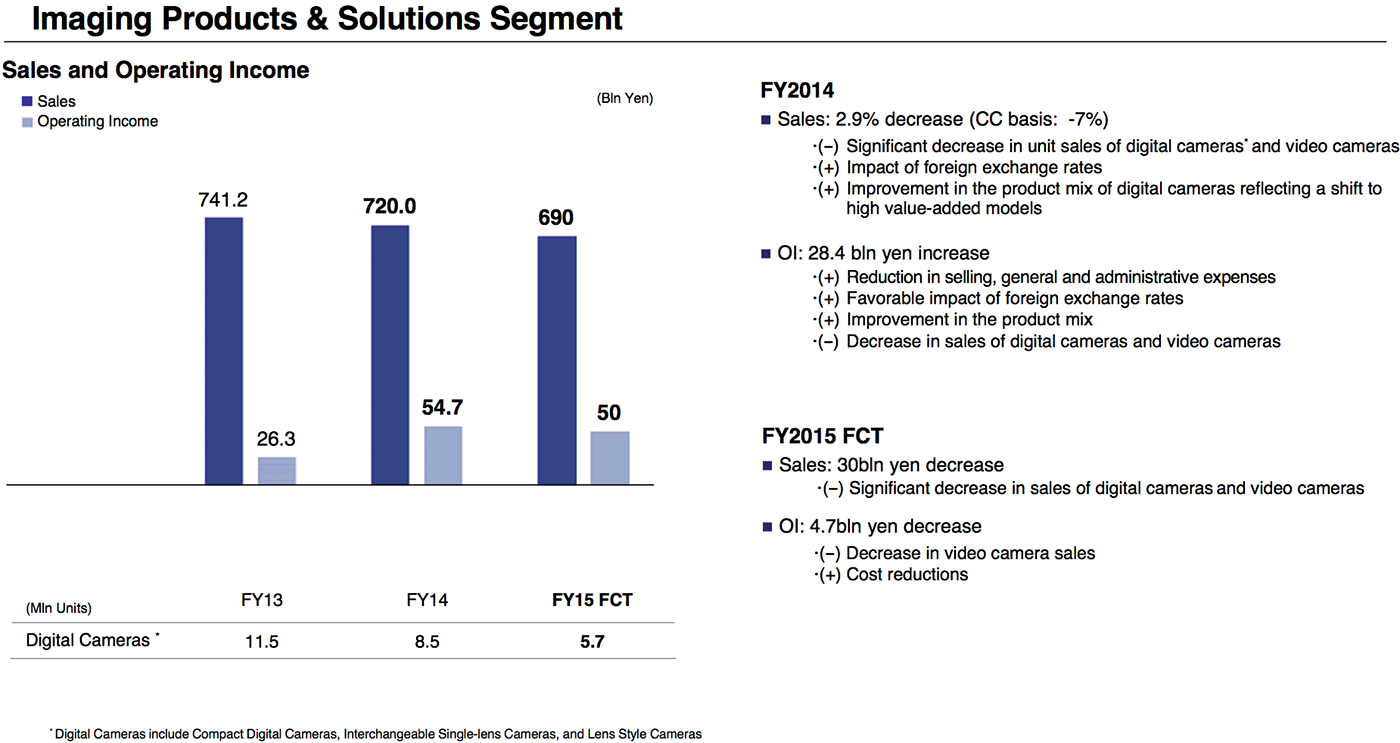
3) Sony is selling less fixed lens cameras and less video cameras. And the forecast is that it will sell less cameras the next months. But it’s shifting the focus on high value models and the strategy seems to work. Therefore they still expect to keep making profit with the business.
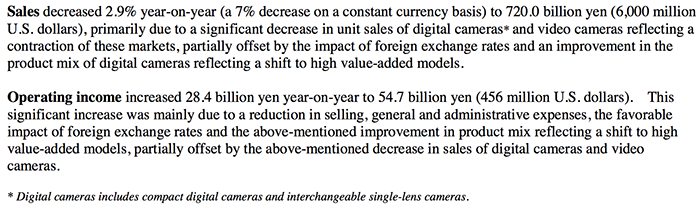
And this is what Sony writes
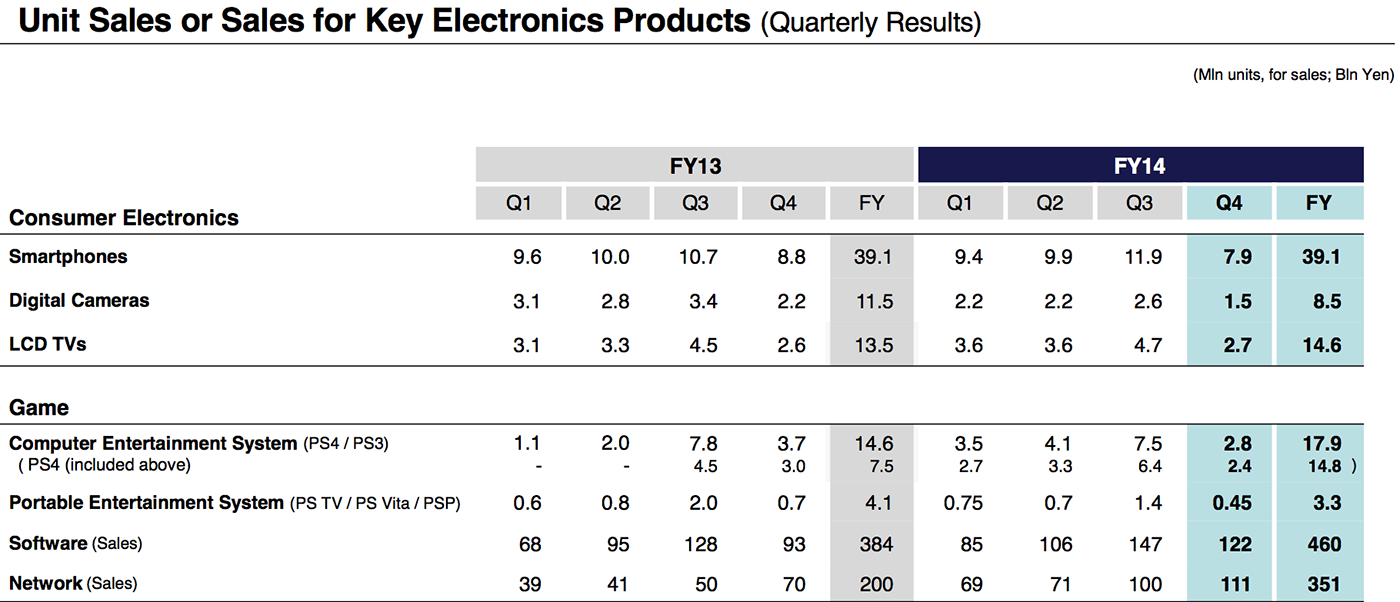
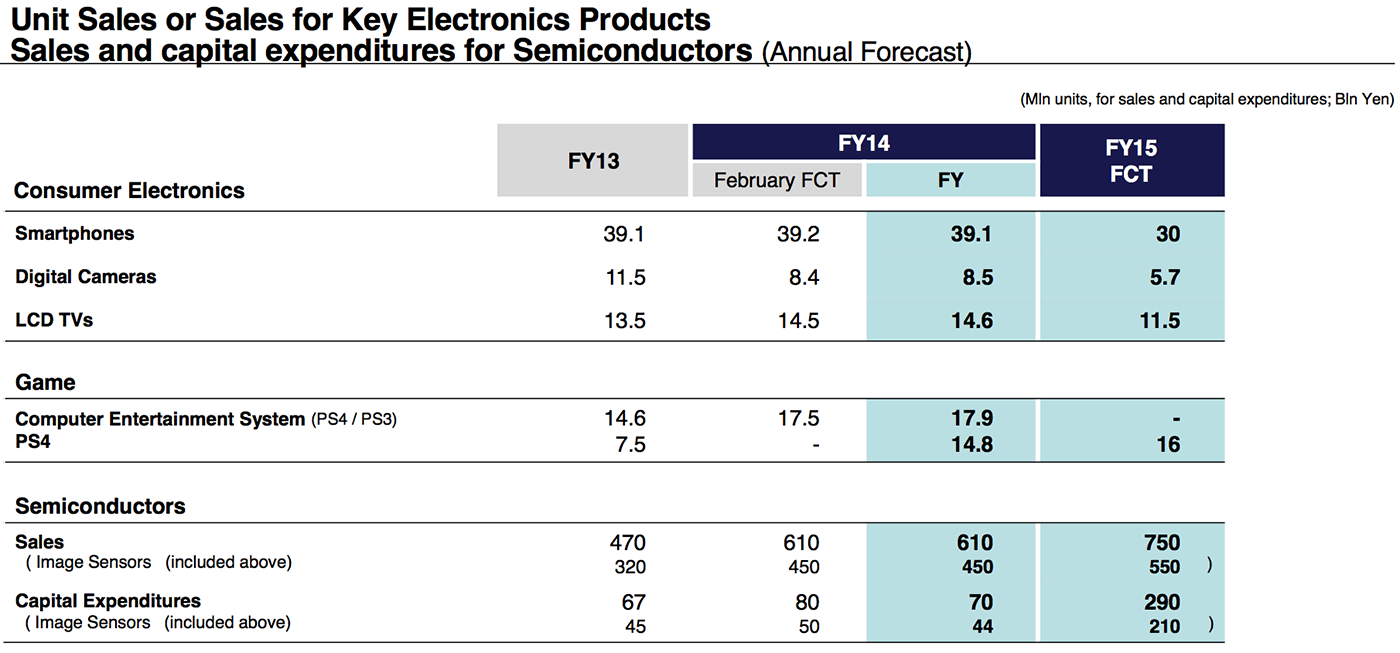
More graphs (Click on it to enlarge)
There is no info about a particular digital camera strategy or future products. But it’s good to hear Sony is one of the few companies still making money with cameras 🙂
35 Responses
Camera business is collapsing. Perhaps some of the smaller players will quit or will be acquired. Many people will loose their jobs.
The forecast included above is disastrous. They say “Significant decrease in sales” and “Cost Reductions”.Unit sales in 2015 are expected to halve relative to 2013!
I guess this also mean that we will now see less camera releases overall and longer product lifespans.
We’re already seeing that (longer cycles, less releases) but operating income has more than doubled and is forecasted to stay similar next year, despite further collapse of (lower value) compact and video cameras. Which means we can still expect to see more high value cameras.
Lets see, total cameras sold in 2013 = 11.5M, 2014 = 8.4M, and the forecast for 2015 = 5.7M. That’s an unmitigated disaster and “good income with high profit model” is an ostrich with it’s head in the sand comment. It is a 50% drop in 2 years. That’s hard to make up for in higher profit margin cameras. Meanwhile image sensors keeps going up. At what point does Sony just cut loose it’s camera divisions and focus on the sensor business….
It just means the low end is collapsing and replaced by smartphone, while the high end is still somewhat healthy. You can see Sony had massive increase in income from 2013 to 2014 despite similar collapse in sales. And the income is somewhat retained in the forecast.
I suspect the 2015 forecast is only negative because Sony knows the A6000 can only hold the line for so long. But it should be alright if it has a replacement that can do well.
Which suggests we’re looking at the interesting stuff coming in the 2016 financial year…
Somewhat retained = 4% lower sales, 9% lower profits.
Keep in mind those numbers are still absolutely fantastic compared to 2013 numbers. Any company would be ecstatic to go from 2013 numbers to 2015 numbers.
And any company would be un-enthused about going from those 2014 to 2015 numbers. Note that Sony themselves (sensor group) issued a report about how far they thought camera sales would go down in the coming years. So 2016 isn’t going to be better than 2015, I’d guess.
The good news is that there’s nothing particularly wrong with Sony’s Imaging numbers other than one thing: they show no real future growth.
That’s unit sales and doesn’t really tell us anything useful. We don’t know how many units are compacts, or more importantly how the higher end landscape has changed. Eg they are almost certainly selling significantly more fe bodies in 2015 than they were in 2013.
We can make some intelligent guesses. If Sony’s global ILC market share has indeed returned to 15% as many suggest, about 2.1m of the 2014’s 8.4m units are ILCs. If CIPA forecasts hold and Sony slightly increases market share, that implies about the same number of units in 2015.
The operative question is how much of their depreciation, capitalization, and infrastructure is centered around compacts. Because the way they’re cratering, I’d expect Sony to have to take a write-down at some point. It’s also unclear whether or not Sony is taking SG&A write-downs when they sell those A7’s at US$998, or whether that’s coming in the division numbers. I suspect the former.
So you’re saying A mount is a goner.
I have been saying for some time that I believe the A mount is on life support. There certainly are engineers still working on A mount updates. But it seems quite clear that Sony is not adding resources to and probably is removing them from that group.
The DSLR numbers for Sony are brutal. They went from a 15% or so market share in a growing market to a low single digit percentage in a fast declining market. Meanwhile, their mirrorless numbers are encouraging (compared to other mirrorless) and basically give them the same overall market share in all ILC as they once had in DLSRs. Yet mirrorless costs them far less to produce. You do the math.
I think we’ll continue to see A mount lens updates on a slow roll schedule. But it’s not likely we’ll see much if anything in the way of new lenses. I think we might see an A body update, maybe two eventually, but if they haven’t captured the upgraders with what’s already available, I’m not sure how they’ll manage to get them with something new unless it’s quite a bit better. That’s why a 36mp A99II makes some sense for them, but another A56 update doesn’t.
Note also that the E/FE mount is now standard across both Sony mirrorless and Sony pro video. That should also tell you something ;~).
The FS7 is really the only pro cam to have an E-mount, the rest of the pro line has PL and Bayonet mounts. And the only semi-pro E-mount lens is the $2500 28-135, which is a really odd FL for S35 cameras and focus by wire which makes decent focus pulls tough. The A7s is not a pro camera either, too much menu diving for vital functions while shooting. The other E-mount camcorders are plastic cams with no decent picture controls. Hopefully the existence of the 28-135 means another FF camcorder is coming – preferably with the A7s sensor and internal 4k.
Funny. Sony has reclassified my FS100U as a “pro camera.” ;~) Which means I have to get firmware updates from the pro division in a not so simple manner.
FS100 and FS700 before the FS7 are e-mount. The e-mount strategy for video makes sense – all ILC video cameras from the low to mid tiers are e-mount. The mid to high are PL / FZ. E-mount has brought interchangeable lens ability to cameras that would have otherwise been fixed lenses for the budget only 5 years ago. The shared costs and development resources are to thank for this.
I almost put that in my initial post but didn’t want to fan the flames too much. Personally I don’t see how A-mount survives for more than a couple more years.
I agree, sadly. There’s still a market for it but, short of a miracle, the a99ii will probably be the last hurrah…
Certainly we’d be looking at a very different picture if they hadn’t developed the e-mount… They’ve had the sense to diversify, which might be Canon and Nikon’s undoing.
Diversify isn’t the right word. Sony realized what I’ve been pointing out for awhile: DSLRs are still being built like 1980’s film SLRs, only with even more complexity. The camera makers never did truly take cost out of and modernize their products in a meaningful way. It’s one reason why I was so excited about the Nikon 1 (for a brief moment): here we had a camera with fewer than 300 parts. True modernization.
The Japanese camera makers were mostly acting like the American auto industry pre-adjustment: just iterating the same basic platforms and using price to move the metal, eventually undermining their financials. Olympus and Sony were the first to move off that (Panasonic never had a DSLR line, so they were always free to enter the ILC camera market in a more modern way.)
The problem for Nikon now, even if they have an FX mirrorless in the wings, is that it’s a huge risk for them to transition. Sony has a credible position they would need to unseat, all while not upsetting Nikon’s remaining FX DSLR line. For Sony it was easy: they had made no inroads in DSLRs against Canikon, so the risk of doing mirrorless early was minimal, indeed, it drove costs out and made the product distinctive, which they needed to do anyway. It was synergistic with their pro video changes, too. I’m very impressed with that transition.
Nikon, on the other hand, has nothing to synergize against, and could end up hurting their cash cow in the process of transitioning. Very risky.
Panasonic did make two Four Thirds DSLRs back in 2006/2007, the L1 and L10. Perhaps they made no great impact in the market, but still.
While I agree that it isn’t that useful from a profit standpoint, unit sales is meaningful from the standpoint of health of the camera industry as a whole which is in freefall.
They won’t cut loose their camera division, is my guess. The mirrorless stuff is too intertwined with the pro video gear now, so the lens overlap alone is useful to them. A bigger problem for them is Nikon. If Nikon starts collapsing, then big sensor costs are going to go up, not down.
To be fair, smartphones have decimated the mid and low end of compact sales. The real question is how long they can carry less profitable sections of their photography arm – I’m thinking qx, not a-mount, before people start flaming…
I love the QX range! I just feel it needs to be bluetooth rather than wifi.
The data rate & range of bluetooth is too low.
I am sure, you won’t want it to use bluetooth.
ahhh thats why?? thanks!!
But, it’s attached to the camera in normal use.
If they would just drop the A99II their profits would triple.
as much as I would love that to happen, the A99II doesn’t look like it will happen. Im giving up. If it does happen, I might buy 3 just to last me for the next several years.
IF the A99 successor come with A99R, A99S, A99II,
I will get one each 😛
Well that’s wildly optimistic. However an a99 successor is a guarantee, most likely by November. The revised a-mount zooms point heavily in favor of a successor. New a-mount bodies beyond it are questionable (or highly dependent on the success of he a77II and a99II. It is safe to say that entry and mid level a-mount camera bodies are a thing of the past.
As an a99 owner, I will not consider buying an a99II unless it has full frame AF coverage, faster /more accurate AF, a bigger buffer and no flash delay. Five axis IBIS and a new sensor would be nice with full readout for video but the other things are necessary for me to adequately rely on one professionally. Otherwise e-mount will suffice for non-professional, personal shoots or studio setting, slow paced work.
Sony is in a very good position as it’s risk is spread over so many businesses. Evening up any instability in one segment. Allowing time to analyse the changing trends in markets. Exactly what we see in Sony’s response to the camera industry. Showing how well managed Sony is under Kazou Hirai.
I just dug into Canon and Fuji financials and they look much worse than Sony. Sony is holding well with decreasing unit volumes as they introduced higher end products. Canon and Fuji are basically saying they will divest from photo and move on to other businesses. Canon will invest into office related businesses and Fuji has many other businesses including photo related but not cameras. This may well spell end of Fuji cameras though they say X line is doing ok (ok without any figures published – so what is ok relative to 40% decrease in overal volume)
Fuji has practically crashed with 40% decrease on electronic photo segment in Q1 of 2015 (Jan through March). Canon has about 25% decrease. Sony sees less than 10% decrease…so excellent job
Strategically – in a shrinking market there’s two things you must do to survive
1. Grow your share v competition
2. Refine your target market
Think Sony might be doing both successfully. Do you concur?
sales have next to nothing to do with sony making money again.
sales are still bad.. cost recuction is the important factor.