







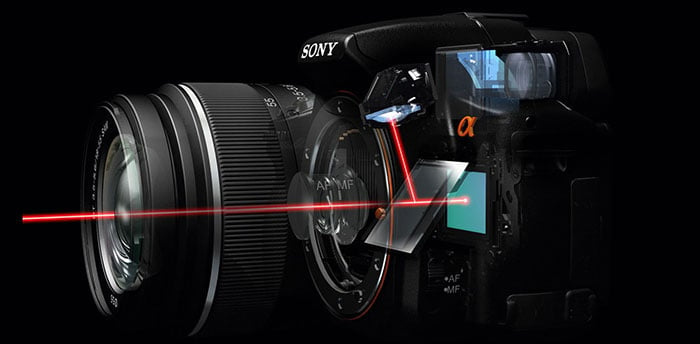
Lenstip (Click here) wrote a very detailed and so far best article I have ever read about the Sony SLT tech. The title of the post is: “Everything you always wanted to know about the semi-transparent mirror technology (but were afraid to ask)“.
You absolutely have to read it because it’s really showing on a scientific way how the Sony SLT system works. At the end those are their conclusions based on they tests they made:
A fixed film mirror has a lot of advantages over the classic solution:
- Burst mode can be faster
- Dirt won’t invade the interior of the camera so easily
- The camera might be more reliable
- The camera is physically lighter and can be potentially cheaper
- The camera might offer continuous preview (not necessarily if you deal with an electronic viewfinder, though)
- Phase-detection AF in the LV mode and during registering a movie
Of course there also many reasons why classic reflex cameras have been sold on the market up to now. Some of them are listed below:
- Bright optical viewfinder
- 1/3 more of light = faster speeds or lower ISO, an advantage in dynamic range and noise
- The mirror can be cleaned without any risk and it’s less prone to damage
- A damage of a film mirror influences the resolution of photos; a damage of an ordinary mirror won’t have such consequences.
What I write now is just my private opinion and not based on rumors: I think the SLT tech will not live long. The chance is high on sensor PDAF will become mainstream in the coming years and therefore semitransparent mirror (and even classic DSLR mirror) may become obsolete. Of course this doesnt mean A-mount has to go. It means A-mount becomes mirrorless just like E-mount and as Sony stated recently, they can use the “free space” to explore other new tech (Z-shift and so on).
170 Responses
I wonder about the timeliness of such an article, does this mean more SLT coming or maybe even coming from someone else?
Canon has patetented and has long been rumored to be developing thier own pellicle mirror rebel camera…it was rumured it would use a Sony sensor since they are already optimised for pellicle mirrors.
Of course with mirrorless tech advancing so rapidly it does not seem practical to get sidetracked now with a new pellicle mirror system.
There is no such thing as optimizing sensor for pellicle mirrors.
Not that I believe canon is doing that, but it could be mirror less and slt sensor implementation has to have some design considerations to always have to be always on (and deal with heat).
Canon stopped doing SLT a long time ago…
https://www.flickr.com/photos/yugus/5485949314/
In comparison also think it is much more likely, Canon pushes mirrorless instead, if ever.
I think that the SLT are indeed already DEATH, the future is the Mirrorless camera, also in the A-mount, so the new A-mount camera’s could have IBIS and some kind of mirrorless system adapted to A-mount lenses !!!! why not ?? you tell me, I think it’s the only way for Sony to be inventive for the DSLR’s systems for the future.
How would that be really any different to SLT cameras now?
Mirrorless A-mount system camera, with 5Axis IBIS and adapted to the A-mount lenses !! is a totally different system IMO.
How?
Ask Sony !!
Nope, I’m afraid A mount will probably outlast SLT tech but not by much. The real future for Sony is I’m the E mount. The E mount was designed for mirror less from the ground up. As with all legacy products, the A mount will eventually die off as well.
A-mount could live just fine if Sony would decide to offer a proper DSLR. It’d be a perfect alternative to live along with mirrorless. But they won’t, because it’s against their strategy of blindly promoting EVFs as be-all-end-all of viewfinders, which will never be accepted by a wide public.
By using stepper motors in the lenses.
This of course means that all lenses have to be modified – which is what sony and canon are already busy doing.
Perhaps nikon were wise and used steppers in their lenses from the start?
This means that A-mount users will have to decide if they want to buy new lenses to replace their old ones or simply switch to the E-Mount.
Tough choice.
“or simply switch to the E-Mount.”
Or Canon or Nikon. 🙂
Switching to Canon and Nikon is actually a nicer option in the end. Yes, interfaces are different, but other than that – you actually get a proper camera system with proper flashes (I’m still laughing hard at the latest change of a hotshoe from Sony which brought nothing more than f*** up the reason for which people use hotshoe: flashes) and… oh my god: that ocean of lenses to choose from. E-mount is a pathetic joke in comparison.
The only differences between an A-mount SLT and mirrorless is the big space left where the mirror was and the crappy autofocus speed on the mirrorless A-mount.
The DSLR type for the future is existing, A-3000 and 3200 system cameras, DSLR Body around a mirrorless camera with e-mount. This is suitable, uses same lenses and gives that stability you seek for certain type of photography. I am sure that there will be more of them coming, with better skills and better efv.
Has anyone an idea how good or bad old af lenses will work with PDAF?
Old AF lenses work perfectly fine with PDAF. They were designed to work with it. But they work very bad with OSPDAF (on-sensor PDAF) and CDAF (contrast detection).
1 more advantage of slt, or EVF: makes preview of IS workable under IBIS tech
and DoF preview is actually usable.
I absolutely agree with “Of course this doesn’t mean A-mount has to go”
As usual the body is just 10% of one’s investment in an DSLR system, so Sony shouldn’t focus only on E-mount in future as any reasonable A-mount user will not switch so easily (in terms of money) to the newer E-mount eco-system.
“As usual the body is just 10% of one’s investment in an DSLR system” – not when Sony is doing that. For Sony it’s all about bodies. Lenses are secondary matter, everything else they do only because people complain, but even then they tend not to do things.
“You absolutely have to read it because it’s really showing on a scientific way how the Sony SLT system works.”
The biggest problem with the SLT tech is that only Sony has managed to make it work…
Can someone explain to me why Sony doesn’t make a mirrorless camera with an A7s sensor that can fit legacy lenses? Isn’t it just the flange distance? So take out the mirror. The extra 1″ of depth doesn’t matter when I’m carrying around something with a 300mm lens.
There is a reason why people use the LA-EA 4 with a mirror. E-Mount lenses are optimized for PDAF, but legacy lenses are not. I have no idea if this is a general problem or if PDAF technology can be optimized further in this respect. One thing is sure, legacy lenses will not change there af systems ^^
I’m sure it can be. But I’m also sure that Sony wants to get away from that to sell new lenses. It’s a shame.
WEll, no matter what they do, since everything will eventually be mirrorless, we’ll all have to buy new lenses anyway because the old ones will just not work fast enough with their old motors or screw drive.
Frank, are you sure about that? I use a lot of A-mount lenses on my A77II some are SSM others are screw drive. The screw drive make more noise but I don’t notice them being any slower! There may be some theoretical speed advantage to having the motor built into the lens, but it’s not obvious to me. Unless I can see a significant difference in lens performance, I see no good reason to replace them.
constant AF with screw drive is less acurate, but ive heard the mk2 is better than the mk1 with them
Maybe that explains it.
It’s a lens problem.
Yes: People willing to buy new lenses can buy emount. The rest is not going to buy a PDAF A-Mount if AF os slow for these lenses, thats my point.
Then buy the a7S..you can use legacy lenses on it and when you carry a 300mm you usually do it with a monopod, tripod or sandbag.
I just might have to.
The distance from the lens mount to the sensor must be maintained at 17mm for e mount and 45mm for a mount. Removing the mirror in an a mount camera would not change this (if you want to be able to focus to infinity). Thus an adapter is necessary to at least act as a spacer.
It has been discussed that if the mirror is removed, it might be technically feasible to move the sensor forward in an a mount camera to accommodate e mount lenses to create the mythical hybrid mount. The compromises may not be worth it though sit the a mount lenses cannot be driven to focus fast enough without the mirror AF module.
Really…if Sony continues to evolve the adapter that might be more than sufficient given that e-mount IBIS is real.
If Only Sony had a fullframe A-mount camera that took advantage of the fixed mirror to compete against the 1DX with the added benefit of less vibration and more reliability…They got the tech to do it but it seems they simply don’t care about the pro market of sports and action photography and wants to focus mostly on casual shooters and wedding/party events…
Maybe they don’t care about photography in olympics and global sports events (as they have showed on FIFA Men’s Football World Cup 2014 (great video stuff but almost zero interest on taking photography seriously there)
ALL camera manufacturers are preparing for a mirrorless world.
The main issues are
1. Speed and sensitivity of on-sensor AF.
2. Lenses need to be updated to use contrast as well as phase detect AF.
If you don’t believe me, have a look at just how many new or updated lenses Canon is bringing out with STMs.
Sony have already updated [or are in the process of doing so] the main zoom lenses to enable contrast detect AF.
Sony is simply delaying any new A-Mount release until everything is in place so as to benefit from economy of scale. Why develop separate components for each mount when it’s possible to use exactly the same in both?
There is no “mirrorless world”.
“If you don’t believe me, have a look at just how many new or updated lenses Canon is bringing out with STMs” – they do it for video, not for mirrorless.
“Sony is simply delaying any new A-Mount release until everything is in place so as to benefit from economy of scale.” – very doubtful. They simply moved their resources first to E-mount and now to FE-family. Sony Imaging is simply unable to focus on two, yet alone 3 lines of cameras at the same time.
Sony has been managing to produce and sell way more yah two lines of cameras for decades (no FE is not a different “line” – the image circle merely needs to be slightly larger). The video division supports 3 to 4 different lens mounts.
a7x would suck for event photography, they got no wide-aperture lenses. Why people always talk about sports/wildlife? a7x aren’t well suited for many scenarios ATM.
Actually I came up with the idea how SLT technology could be used to the extreme: make the light transmittance of semi-transparent mirror base variable, eg. using electrically controlled polarizer. This way it is possible to construct beam splitter whose ratio may be changed on the fly: during focusing direct most light to the AF sensor, while taking picture direct all light to the imaging sensor, avoiding the light loss almost completely. So, during the focusing phase the AF sensor may get even more light that it is possible with traditional DSLRs (which also use semi-translucent beam splitters for AF operation) at the cost of little more EVF noise. The light intensity changes in the EVF may be easily compensated with appropriate gain boost. Sony, use this idea, I give it to you patent-free 😉
Yesterdays post said A mount sales are just enough to cover initial development costs.
There are 2 differrent ways to interpret that..
1..Sony will discontinue A mount because they dont believe they make enough money with it..
2….Sony is actually developing something for future A mount therefore spending all thier A mount income on that development.
If Sony can ever resolve the issues that currently make mirrorless not directly compatable with A mount lenses…AF issues….then mirrorless A mount could actually peacefully live alongside E mount.
As long as current A mount lenses will not autofocus on mirrorless cameras….a mirrorless A mount camera will never be…if that issue gets solved the A /E war can be resolved withought total annilation of either side.
So ..eventually all digital cameras will be mirrorless….eventually A mount will be mirrorless or die…unless full AF compatability with A mount lenses is developed there will be no mirrorless A mount.
“As long as current A mount lenses will not autofocus on mirrorless cameras”
It’s good to see that after months of trying to educate you on this matter you finally “get it” that A-mount lenses are not designed for use with OSPDAF.
I am and have been aware that the two systems have not been desighned to be compatable…but I continue to maintain that those differrences need to be resolved for both systems to continue to exist.
I have also always maintained that eventually all cameras will be mirroless…unless future mirrorless cameras can be made compatable with existing glass no current dslr mounts can survive….it would clearly not make sense to keep the old mount on mirrorless cameras if no existing lenses would work with it.
What I have never agreed with…and still do not… is that it cannot be done….only that it is difficult.
“compatible”, this word is spelled “compatible”
I don’t care.
My phone automatically changes everything I write and I am not concerned about catching every misspelling especially when it does not interfere with understanding the meaning.
When I fix spellings the phone often stubbornly keeps changing them back again.
Want a hammer? it’s the soul of all mechanics and resolves all problems.
Sony engineers continue adding a bunch of new features, camera bodies and lens developments to e-mount cameras. When someone asked them why they haven’t done much with a-mount lately, the engineers replied that they don’t care – every time they wrote their r&d plans autocorrect changed a to e so they just went with it.
You made that story up.
Now we both have made up stories revolving around sony engineers / management!
That’s F*cking awesome, bud. LOL!
You must be married…… 🙂
I thought A-mount lenses (at least SSM ones) worked fine with LA-EA3 on E-mount bodies and had fast focus?
They do not actually autofocus on the mirrorless system… the laea3 and laea4 are actually like an SLT camera and have thier own focusing system…so the adapter itself is doing the focusing, not the camera.
The adapter also limits light just like the SLT camera does.
They do focus I think… A bunch of people are using LA-EA3 with A-mount lenses (SSM-like at least) on A6000 successfully. To focus, the bodies don’t have to use the screw, only the contacts.
They can’t use the fast focus. Think LV focusing on Canikons
Why wouldn’t they focus fast (specially any G II)? The focus order is sent by the body, am I mistaken?
To utilize fast focus on mirrorless, they need to have stepper motors
You did not understand my comment…it is the ADAPTER that is doing the focusing, the camera is not…the cameras focus system is essentially bypassed and the LAEA3 or LAEA4 adapter uses its own SLT system to focus the lens
he is not of this world, please understand?
There no SLT mirror in the LA-EA3, I don’t know what you’re talking about. Have you tried it before saying it doesn’t work?
I mistook the LAEA3 with the LAEA2
See my response to blabla
Merely a band-aid for focus. The lenses all need to be modern internal focus designs to work effectively on a mirrorless body.
Mirrorless cameras are designed to push around small groups of lightweight optics to achieve focus (modern internal focus designs). Many old lenses are trying to push around large heavy groups of glass, try an 85L f/1.2 Canon lens on any Canon body, it’s slow to focus, its pushing around a huge lump of glass. Try the new Canon 24-70 and its zippy fast, its all internal focus.
Watch this https://www.youtube.com/watch?v=ceMwIA9wAHM
LA-EA4 is more or less an SLT, but LA-EA3 is not ( there is no glass inside), so I would believe that A-mount SSM and other HSM, PZ or what ever 3rd party lenses can already very well auto focus on E-mount (but slower), so why couldn’t they on an similar A-mount body without SLT mirror ?
I would even pretend that it is just a marketing question if Sony will offer same technology with both lines A- & E-mount
Oops
I mixed up the laea2 with the laea3.
My revised comment then is that on the laea3 some af capabilty is possible, but due to the differrent focus system / motor the speed of the autofocus will be much slower.
Its the same reason Nikon are doomed with their Ai mount, screw mount focusing on some, too much glass to move around for the focus motor etc.
No, that’s why the E mount is doomed. Talk about priorities…
There’s no such thing as evolution where the Ai mount is concerned…………….. G (that’s a hint).
From what I’ve read, focusing on the ea3 adapter is very slow.
Now if we could just educated Sony management about that, and they’d stop saying that these two systems are fully interchangeable – we might go somewhere.
I don’t understand what is so different about A-mount lenses that precludes them from autofocusing on a mirrorless body, with a simple non-mirror passive adapter?!? Why do A-mount lenses require a special (LA-EA3/LA-EA4) mirrored adaptor with the related loss of light and independent focusing system? Is it just the angle that the focused light strikes the sensor? It seems that this should be a simple thing to adjust for by Sony’s Engineers. My old A900 and my newer A77II are able to use my huge collection of A-mount lenses rather well. I’m not yet motivated to buy the current E-mount bodies that Sony has to offer. When they make a new body that will allow me to use my A-mount lenses without compromise, I’ll once again consider buying a new body, maybe even a lens.
Am I missing something? Please educate me.
Mirrorless ospdaf hunts in and out constantly to focus because it cannot determine direction..it reguires very fast stepper motors and very light focusing elements…because thes motors are not strong enough for heavier elements.
Slt can determine direction, goes directly to focus , does not require as fast a motor, and so can move jeavier focusing elements.
I too believe this can be resolved but apparently it is noy easy and has not yet been resolved…and of course you have the hordes of cant be dunners and never happenners.
Canon fixed it already…
Please explain your comment.
I am not aware of Canon solving that problem, and if so they can now make a mirrorless system capable of using existing Canon glass. That would abruptly end Sony mirrorless dominence
Yeah, he’s right.
Canon fixed it already.
Thank you for that explanation Barry. I guess it has to do with the different length light path the mirror provides. I have too much money invested in A-mount glass to change now, even if it means a gotta live with a half stop of light loss.
Does this mean that current mirrorless OSPDAF is intrinsically slower/inferior to the mirrored system? It sounds like Sony has found a work around solution by using lighter weight lenses and brute forcing the lens motion during focus. The mirrored system seems more elegant to me. Another reason to stick with my A-mount lenses. I wonder if the Canon OSPDAF mentioned by FYI also used brute force and flimsy glass? Thanks FYI for your input.
Sony 70-200mm f/2.8 G SSM II A-Mount Telephoto Lens
Carl Zeiss 24-70mm f/2.8 II A-Mount Standard Zoom Lens
Carl Zeiss 16-35mm f/2.8 II A-Mount Wide Zoom Lens
These 3 lenses have been updated so it will be compatible with the on-sensor Contrast and Phase Detect AF of the upcoming A9 E-mount PRO camera.
Get ready!
Why, do you have a wining Lotto ticket?
No but I’m excited and I will buy one 🙂 I have E-mount full frame cameras and I like everything about it and I already like the a9 even if it’s not out yet lol. Why do you ask?
Maybe that’s because he’s so poor and can afford new Zeiss lens only after winning a lotto, unlike most of us. New Zeiss lens is always big excitement!
“These 3 lenses have been updated so it will be compatible with the on-sensor Contrast and Phase Detect AF” – no, they haven’t. They work much better than previous generation, but they’re still nothing like a dedicated CDAF lenses.
A proctology camera?
“1/3 more of light” – 1/3 EV less light, not 1/3 of light! Big difference.
At last someone writes about the advantages of SLT… when Sony has effectively discontinued the whole system.
The article is correct. 1/3 Ev does equal 1/3 more light, exposure time being constant. The SLT pellicle mirror diverts 1/3 of the light to the AF sensor and the other 2/3 to the image sensor.
Neither of you are right and neither are Lenstip in the way they phrase it.
The SLT mirror diverts 30% (approx. 1/3) of the light to the PDAF module. That is approximately 0.5 stops (or 1/2 EV) less light to the sensor.
“1/3 EV less light, not 1/3 of light! Big difference.” – Yes, 1/3 less light – 30% less is approximately 1/3 less or 0.5EV. But Lenstip phrase it badly and they aren’t quite correct – if you get that lost 30% back to the sensor by using a traditional mirror, it’s 43% more light than SLT.
“The article is correct. 1/3 Ev does equal 1/3 more light, exposure time being constant.” – As above, it’s 43% more light when using a traditional mirror.
“The SLT pellicle mirror diverts 1/3 of the light to the AF sensor and the other 2/3 to the image sensor.” That IS correct.
This guy ^ is the master.
“No one is right. ‘Cept me!”
It is actually more like 26%, so 1/4 would be more precise.
Mirrorless A Mount would be interesting as lot of lenses but are these lenses modern enough or are they old noisy and slow? Also would Sony make more money just shifting all those resources to E mount? I wonder what they are thinking?
Mirrorless A-mount is a BS idea. Equally well you can get E-mount camera with an adapter.
Pros don’t want to work with adapters. It creates another point for potential failure.
Why do you think Sony has been progressively updating all of their lenses?
It’s pretty expectable that Sony will sooner or later release a high end camera in two technical identical versions: with E-Mount and in a classical A-Mount Body with integrated LAEAx adapter and the moment a majority of A-Mount users have switched to use their lenses adapted to an E-Mount camera to take benefit from the option to adapt nearly anything else Sony will give up on A-Mount, which I think will be a pretty smooth transition to continue nearly breakless with already bought A-Mount glass.
There are 2 primary reasons why I dislike the new mirrorless Sony cameras. 1) I have to buy and use an adapter to use the thousands of dollars worth of really good glass I already own and 2) frankly, for the way I work and the size of my hands, the current crop of mirrorless cameras are just too damn small. If Sony built a mirrorless version of the A900/99 I’d be very interested.
It’s very strange that so many SAR people have big hands and a problem with the A7 line!! I’m a 1.94 guy with hands that can hold a football in one hand. I love my A7r and s.
Do you have problems to write on your iPhone, handle the new remote control etc?
Or is the problem that you want everything american BIG just for the sake of it? Or have you actually not tried A line yet?
I borrowed a friend’s A7 for a week. Hated it from an ergonomic point of view. It feels too light as well. My A900 is perfect in my hand, just as my KM Maxxum 7D was and my KM Maxxum 7000 before that. I love the feel of the Nikon D4 and D3 as well. The A7, by comparison, feels like a toy. It is cramped and the controls are spaced too closely. The new grip on the A7 II will help a lot, but overall, especially with A-Mount lenses attached, it’s just too small for me. Finally, the EVF is markedly inferior to the pentaprism on my A900 except in dim lighting.
Did you use F2,8 70-200mm lens on your A7? Then took it on A900 and how did you feel?
I felt really good. Kinda like just after a puke.
Like an idiot.
If you liked film era cameras then try the A7 with a grip attached.
For me all this mount crap is totally useless. If all manufacturers would adopt one mirrorless mount, let’s say e-mount, and one mount for dslr’s that all cameras use, the problem with lenses is resolved. Al people buy lenses of all brands and can use them on their camera. Why the heck do manufacturers do everything so difficult.
Not that simple I am afraid. There’s more to a lens mount than the physical part. The communication protocol needs to be unified as well. And some brands have IBIS, while other use OSS. Some use CDAF, some PDAF, some OSPDAF and some use a mix. What might sound like a good solution would be a complete mess IRL. Tamron Adaptall has been the smartest solution so far, but it was only applicable on non-AF film cameras.
Adaptall with electronics integrated into the mount part…doesn’t seem like much of a problem to me.
Actually, the CDAF uses a version of OSPDAF that makes IRL and NKL both irrelevant for any IBIS integrated camera body. As the avian does it’s thing, the OSPDAF version is often upgraded mid-development to a new co-developed version of OSS, called OSPDAFOSSIBIS, or OSPDAFOSSIBI for short. It’s revolutionary.
“the problem with lenses is resolved” – there is no problem. Manufacturers want multiple lens mounts to exist because this gives them money and blocks people from jumping between different brands of bodies like crazy.
Yes, the camera manufacturers want the consumer lock in to be able to keep the margins at their own discretion. Needed would be some consumer protection laws that enforce a mount standard that would have to be following. Unfortunately nothing like this is in sight.
Thought we have the micro43 standard, which is a great thing. Buy Panasonic lens for an Olympus camera and vice versa, surely has helped to get them market share and quite a number of lens offerings in a short amount of time.
Then there is the open m-mount, M42, and M39. At least the m-mount is used by Zeiss and Voigtländer/Cosina as well.
For me, I couldn’t be happier with e-mount and free choice to adapt any manual lens on the planet to it.
Well then you’ll have to wait for some new mount, cause E-mount does not allow you to adapt any manual lens on a planet. It doesn’t even allow you to adapt any AF lens on a planet in the first place. (eg. EOS-M lenses)
Disqualifying statement as for me: “[in classic dslrs] The mirror can be cleaned without any risk”. It suggests the author has no idea what he is talking about.
Not to mention that cleaning SLT mirror is very similar to cleaning mirrorless camera sensor. Only with less risk and lower costs if something goes wrong.
“Only with less risk and lower costs if something goes wrong.”
Lower costs maybe but a partially silvered mirror is far more delicate than the glass on the top of the sensor stack.
It’s actually not. Tiny scratch on a sensor will be visible on a photos, while multiple scratches on mirror won’t affect anything. Besides – I cleaned my SLT mirror multiple times (I shoot a lot in very dusty and/or dirty environments) and never, ever had a problem with this supposed “delicate” mirror.
The author likely meant that if you completely screw up the cleaning and scratch the mirror, image quality is unaffected. You might introduce some annoying artifacts into the optical preview, but as long as you can live with that, you don’t have to go for a replacement mirror.
I also suggest that the traslucent mirror will become obsolete in the future…
But i’m still going to stick to A-Mount because mirrorless cameras are mostly to small for me to hold comfortable.
Maybe you should work on your fine motor skills.
I’m 2,04m (That’s a bit more than 6’8″ in old money) and my hands are not exactly small. I never had a problem holding small cameras. I shot with variety of cameras. Essentially anything from a Minox B up to a Linhof Master Technika. Right now I use a Sony RX1 most often which is considered uncomfortable to hold by quite a few people.
Sometimes it takes a bit of time to get used to a specific camera. But in the end it was never a problem.
Each on his own I guess. Some people consider vertical grip on a DSLR as a must to improve handling comfort, other people are fine with toy-sized cameras.
I guess it might be a matter of how much one has to compensate for… Certain insecurities.
With mirorless now having hybrid phase/contrast AF systems, is there a point when lenses with non stepping motors such as the A-mount line would work at the same speed they do on a SLT system ?
it makes me wonder why the Canon 70D can use its new sensor to autofocus the old canon lenses yet Sony can’t make the A-mount lenses do autofocusing on E-mount w/o the SLT adapter.
Canon uses a lens motor in all auto focus lenses, so it is possible for a sensor based system to focus them. Although only the newest ones are close to fast. Sony like Nikon has a mix of lens motors and body motors to focus lenses. If the lenses have motors they can focus on E-mount using the LA-EA1 or 3 using the sensor focus system. Some faster than others, the newest versions doing better. The only issue is the adaptor has to pass the signals from the body to the lens, some cheap adaptors do not do this. With an adaptor that can pass the electronic signal from Canon lenses the E-mount bodies can also focus Canon lenses.
I think there’s an algorithm problem, that’s why third party adapters focus so slowly: They have to translate between the body and lens with low power low cost run-of-the-mill processors. If an adapter company has the will and R&D to develop dedicated processors, with the right architecture, it…should drastically improve AF…I think.
1) algorithms (or rather: interfaces)
2) motor tech (stepping motors are much better for contrast detection and every on-sensor system uses contrast detection in low light and the last stage of focusing)
3) processing power (using main CPU for contrast detection like DSLRs do that is a horrible idea unless it’s designed from ground up with that in mind)
4) lens design (for CDAF or OSPDAF lenses you want to use small and light elements for focusing, for PDAF it doesn’t matter that much)
For CDAF (E-mount, or A-mount w/ the a580/560), why does the motor location (in lens or in body) matter? It’s a motor either way. I don’t see anything stopping them from putting a stepper motor or more accurate motor in the body. I think they just got lazy with the a580/560 – Nikon has CDAF that works with screw drive lenses.
Also, he’s probably referring to the 70D’s on-sensor PDAF, and how the 70D’s on-sensor PDAF works with all Canon AF lenses, while the a99’s on-sensor points only work with a small subset of Sony/Minolta AF lenses. I have no idea why.
Why are we talking about the 70D’s? Why not the 80D’s or 90D’s when Film cameras were at their maturity?
Canon 70D is not a pure mirrorless camera. It’s on-sensor AF works pretty much the same way as it does on A99, with a few small exceptions.
I actually like the idea of A-mount (the focus speed of a DSLR, and the benefits of mirrorless).
It’s too bad it wasn’t more well received by the Pro market.
I’d love to see both A and E mount continue, but alas I don’t think that will be the case (through no fault of Sony – it’s the consumer/market/$$$ that will ultimately decide the fate)
Is there enough consumer interest and spending on A-mount to drive further development and innovation of the system? Probably in the near term. But in the long term?? I don’t think even Sony knows.
1) Pellicle mirror is not a feature of A-mount or an invention of Sony. Other companies also had used this technology in the past (e.g. Canon, Nikon).
2) A-mount is historically an SLR system (since 1985). SLT is a feature added in 2010. And it seems it wasn’t a great move. Yes, SLT cameras offer high fps and few other adventages, but they aren’t as successful as Alpha DSLR before them (and nowhere near the Minolta times).
Yes, sorry – I shouldn’t use ‘A-mount’ to be synonymous with Sony’s SLT. I know there is a long and storied A-mount history/legacy and I’m a big fan of some of those older A (and Rokkor SR) mount lenses.
This phallical mirror…does that just mean it stands on end and doesnt move like an SLR mirror?
The WHAT?!?!
Yeah, pretty much. The Sony is hung at a 45 degree angle permanently, whereas on a Canon or Nikon, they can get it up all the way. Sony *could* make more SLR’s but it seems they dont have the balls anymore, so it would do little good. 😉
They got the balls to something new, different, not just the boring old system n and c do since 50 years *yawn*…
Looks like VHS may win the race again as far as A-Mount is concerned.
Who is Hey Seuse and why is he lovin so much?
HOOLK tell joke: So one day, I bought this A mount body…
You still exist?
Hopefully he will behave himself.
I think your profile picture is a photo of one of my paintings. Where did you get that?
My Avatars are my paintings, and I change them often.
Todays is a 16×20″ painting of a Green Tree Python.
My refferrence is an actual animal that I shot many photos of and several are used as refferrence.
Do you also paint animals?
Oh! I see it now! That’s so cool! At first I thought it was broccoli. I take macro pictures of vegetables and paint them.
If you can’t tell the difference between a snake and brocolli you better stay inside and have your groceries delivered .
On my phone the pic is very small but it does indeed look a few little buds of broccoli. Oops!
A snake isnt an animal, it’s a salamander. Duh.
HOOLK smash banhammer, just to com back and make happy, you!
I’m excited either way. I’ll take an A7 big boy body with an A mount.
…boy do I feel stupid. All this time I thought you were a girl.
I’m still not sure admin. is a dude or girl. Lots of rumors, but know one seems to be sure around here.
Maybe he / she isnt sure yet. Not that there’s anythingwrong with that. s
Only 2,187 A77II’s have been sold (whether body only, or with a version
of the 18-135 or 16-50 kit lens) total from Amazon, worldwide as of
today. During the same period, 23,839 Canon 7D (original version, 4+
years old) were sold. Just in the last 2 weeks, over 2,000 7DII’s have
been ordered.
If that’s not pathetic, I dont know what is.
A-Mount is not dying at all. It’s already dead.
A-mount; the mount Sony dropped on it’s head as a child.
It was over 20 years old when Sony acquired it from minolta.
That said, it’s hard not to think what could happen if Minolta kept it under control.
We would have 3 proper DSLR manufacturers at the moment – not 2 (I’m not counting Ricoh). Sony could still organize a joint venture and create technology for the cameras, but they would be implemented by people, who really understood photography…
Such a lost chance… , but obviously not the first one (Kodak, Kyocera etc)
It’s not really a lost chance…minolta was acquired by Konica and were failing. If Sony didn’t save them, a mount would be gone.
Sony did a lot more innovation than minolta ever did. Why do you talk minolta so holy o.O
You see… this is the issue.
You’re (like many people) concentrating on “innovation”. I’m talking about making proper cameras. Minolta created the A-mount system. It had one of the best 35mm lenses available. If had great bodies with fantastic ergonomics and built quality. Sony can’t. Their A-mount bodies are strongly based on Minolta designs and they are fairly good (although nowhere near Maxxums). But they had to make the A7 from scratch. And when a company puts the shutter button in the wrong place, you might start to loose hope.
As far as “innovation” goes… what important did Sony give us? 😮
Minolta and Konica introduced:
– first proper AF SLR,
– first mass produced AF compact,
– wireless flash control,
– modern speed dials,
– LCD inside the optical viewfinder (I’m not sure on this, though).
I could tolerate Sony’s indolence if they were just a consumer electronics’ manufacturer who tries luck in photography (like Samsung or Panasonic).
But they’ve taken over one of the biggest names in the business EVER. I expect more.
That’s a shame and very telling. 🙁
You can’t compare it to the original 7D — that’s ridiculous. A77II hasn’t even been out a year yet. Original 7D is going on 6 years.
Secondly, Canon SLRs have a much big user base and continue to control a healthy 40% of the U.S. market, and will outsell similar Sony cameras 10-1. For Sony’s 10% U.S. market share, 2,200 A77II sold from a single store is actually really good.
It’s not a world-wide sale. It’s sales in one US store.
Stop trolling.
Cool! I LOVE the idea of an “A-mount” and SLT design! I hope Sony actually makes this someday!!!
Where have you been hiding? Sony has been making SLT cameras for a few years now….
There’s a lot of BS being spread here:
“1/3 more of light = faster speeds or lower ISO, an advantage in dynamic range and noise”
It is actually more like 26%, so 1/4 would be more precise.
“The mirror can be cleaned without any risk and it’s less prone to damage”
Have you ever tried this? Moving mirrors are extremely volatile. Never touch it! You will regret it.
“A damage of a film mirror influences the resolution of photos; a damage of an ordinary mirror won’t have such consequences.It is actually more like 26%, so 1/4 would be more precise.”
Damaged and misaligned moving mirrors will greatly affect resolution and all other image quality because your AF will be useless. Chances are your mirror will not flip anymore (it will be fixed ironically) and you are not able to take any pictures anymore.
Bottomline: moving mirrors are prone to failure hugely.
I wet cleaned several SLT mirrors many time now already. With some care, not any problem.
Spend Thousands on an A77 and dream about firmware upgrade 1.08, SLT is dead, if it wasn’t then Sony would be supporting firmwares and we would have a buzzing and vibrant community the envy of other manufactures users/
What does firmware have to do with whether its dead!?
Maria, no.
transmission will depend on lens aperture and it varies form 65 to 73% to be accurate. Most of the time it’s around 70%. Read chart in the article please.
Moving mirror isn’t that fragile. If it were, it would be damaged after it hit bottom limiters just after first shot. Mirror gets dirty and it’s normal thing to clean it. One or few scratches don’t matter at all.
Pellicle mirror is elastic to some extend and its surface is hardened. Unless you’re careful, it’s perfectly safe to clean it as well. But if you use wrong tool for that or scratch it with a grain of sand, things will get complicated. Mirror can get punctured or tear. It’s just a thin, stressed foil.
If you damage moving mirror, you can go to MF or LV and take sharp pictures. If you damage SLT mirror you won’t get a single sharp picture.
Cheers!
Panie Marcinie, po tym komentarzu, domyślam się, że ten artykuł na lenstip to Pańska sprawka, gratuluję świetnej roboty 😉
Przyznaję się i dziękuję 😉
Your answer is very incomplete. If you get a moving mirror damaged, the repair is VERY costly, not worthwile unless it is a pricey camera.
However, you are able to exchange a damaged SLT mirror yourself in less than one minute. If I recall correctly, the cost for an APS-C SLT sparepart mirror is USD 52 on the Internet.
IF you damage a moving mirror, which require you to use force. This is what my post was about. It’s harder to damage moving mirror than pellicle mirror, but if you scratch it, you must replace pellicle mirror, not the other one.
Why am answering statement that wasn’t addressing my post? Please read with comprehension.