







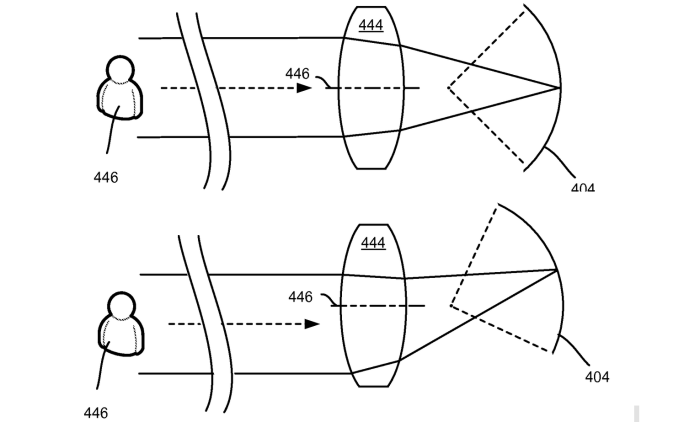
We all know Sony officially stated they have successfully developed a Full Frame curved sensor (article here). But if they will ever release a camera with it is written in the stars yet.
But if you ever wondered how a stabilization system could work on a curved sensor than watch this patent published by Microsoft (details here). Image sensor world reports that:
The main idea is that the curved sensor or lens need to be rotated with respect to each other, rather than shifted like in a regular flat sensor OIS
As simple as that 😉
And it is also possible to design zoom lenses for curved sensors. CA-based Optiz proposes a solution you can see at Image Sensor World.
30 Responses
WWWHATTTT? it’s absobloodely evident. No new knowledge.
You have only to think 20 seconds to figure out the “invention” and 2 hours to make a patent claim. Ridiculous.
If they were to offer a new IMPLEMENTATION — that would be a different story
The patent is all about theoretical principles without any hint of the technology required to put it into practice. The patent system is rife with vacuous stuff like this and I’m pretty sure lots of this will already have been patented by other companies.
Accurate. Also note two other things. Microsoft patents everything. The point is not to deny others, but to protect against lawsuits. Almost never do they try to enforce claims, they just don’t want to get sued or have to share ownership. The second point is, Microsoft does not do patent searches. Period. Employees are not allowed. That way, when they do infringe, they can credibly claim they didn’t know and avoid any punitive decisions. (I worked there for a long, long time. My name is on some parents applications. I don’t think any were granted since I never saw any bonuses.)
Broken patent system. Not exactly news.
If you read the abstract, there’s an awful lot more to it than that. For instance
3. The system of claim 1, further comprising:
a curved carrier material coupled to the sensor,
wherein the curved carrier material is configured to deform a planar
sensor into a desired curved shape.
or
5. The system of claim 1, further comprising:
a curved carrier material coupled to the sensor,
wherein the curved carrier material is configured to be translated in a
Z-direction relative to a lens of the camera to compensate for forward
and backward camera movement.
Patenting this sort of thing doesn’t mean it’s technically feasible. Item (3) above implies that the very shape of the sensor can be changed dynamically, and it’s not clear at all that they have a viable way of achieving it. Often companies patent ideas without the technology to back it up, and a lot of this reads that way.
https://www.google.com/patents/US20140301728
Nope, you just haven’t understood the descriptions correctly. Item 3 doesn’t imply dynamic shape change at all. It’s just describing “sticking an otherwise flat sensor onto a curved bit of metal”. Item 5 is just Z axis stabilisation which is standard in many IBIS implementations. Both are bloody obvious. Nothing novel here.
While on the roll, they should have also patented the manufacturing of curved sensors. Main protected idea: “well, just bend it!”
“But if…it is…yet” = does not make sense.
“But if they ever release….we don’t…yet” = makes more sense.
This is a patant APLICATION that hopefully will not be granted.
It is not for a specific device or system, but for the entire concept that a curved sensor will move in the direction it is curve rather than flat.
This would simply be patent extortion desighned to prevent anyone to develope stabilized curved sensors without violating thier patent.
Microsoft is most famous for blatently stealing Windows from Steve Jobs….and getting away with it….the concept of windows originally appeared as part of the Mac opperating system. Not only did he steal the concept of having windows as part of his operating system, but also had the nerve to call his operating system “Windows”
Microsoft does not make curved sensors, and this patent does not describe any specific or real product, but is instead merely an obstacle in the path of anyone legitimately developing curved sensors with image stabilization.
I think Steve Jobs borrowed the same GUI concept from Xerox…which did nothing with it.
Steve Jobs got the GUI concept from xerox who either gave it or sold it to him. He did not steal it.
Where did I use the word “steal?”
And Jobs did something with it.
The curved sensor patent describes a curved sensor that is very differrent from Sony’s and should provide some competition if the concept becomes popular.
The zoom lens for curved sensor is also a good step in curved sensors.
If curved sensors are ever to become usefull in interchangeable lens cameras however then some form of compatability with conventional lenses will be necessary.
Assuming that the technology ever get released, is successful and has benefits vs flat sensors, having no compatibility with conventional lenses would certainly be preferable as it would then provide an excellent opportunity to replace all conventional lenses for the curved sensor specific ones. This would provide some income for the camera companies which is always good since they need money to fund their R&D and release to market better cameras and lenses. A collateral benefit would be that conventional lenses would see a very significant drop in price / resale value which would be good for photographers willing to keep a flat sensor camera ! Now I imagine that some companies will work on adaptors which would not do much harm either.
Sony has already patented a zoom lens for a curved sensor.
Actually it’s not difficult to make a zoom lens for a curved sensor at all *UNLESS* you add requirement that it should have large reduction in size (which do primes for curved sensors show)
Microsoft sensor = Error 404, Image not Found.
That’s so ten years ago. Windows is much more stable than it used to be and far, far more stable than OSX or any version of Linux (except, perhaps some specialized ones.) I go, literally, weeks without rebooting. That’s 8 hours or more a day, doing development. I reboot my Linux several times a day. I gave up on OS X because of all the crashing.
WTF are you talking about? If you reboot your Linux several times a day, you should not use any kind of general purpose computer at all! Use a phone or an iPad, and ask someone for help in case you really need a general purpose computer.
I understand your perspective. What you probably don’t know is that my job involves more than checking email and shopping.
Ahh, I just read, according to your other comment below, that you are, or have been, a Microsoft employee. Mystery solved. No questions pending.
BubbaMike wrote:
“I go, literally, weeks without rebooting.” {Windows}
Me too with Windows, and that is FRUSTRATINGLY unstable. In earlier days I used the Atari ST 1040 computer. Provided I used stable software applications, it did run at least TWO YEARS before needing to reboot. And the reason for rebooting then was that I had done something silly, like putting in some unstable Public Domain program.
And rightly handled, those computers were completely immune against virus etc.
The personal computer technology of today has deteriorated substantially from that kind of stable platform.
I restart my Mac Pro about 1 to 2 times a month. It runs 24×7 – running print servers, cloud file management, and Lightroom, Photoshop, fcp & video compression software. I’ve never had a PC run so reliably.
Exactly the opposite for me. My OSX work laptop is nothing but a huge problem from day 1. My W7 gaming desktop is rock stable.
What does Joe’s comment has to see with Windows, OSX or Linux?
I restart Windows 7 every day, sometimes a few times per day, because it slows down, it becomes f*****g slow if we use hibernation instead. My former colleague with W7 laptop had the complaints.
I have a windows 7 gaming desktop, and go for 1-2 weeks without rebooting. My OSX work laptop is nothing but a 15.4″ bag of problems. An admin couldn’t give me admin rights for 3 days, because Apple servers were down. Why did it have to be done through apple is beyond me. Windows gpedit works both online and offline.
Don’t know about Linux though, but the memories from a few years ago about OpenSuse and Ubuntu are not that great
A patent only has to express an idea to prevent potential competitors from doing something (or pay licensing). A patent applicant does not actually have to prove it works or build anything.
“But if you ever wondered how a stabilization system could work on a curved sensor than watch this patent published by Microsoft”
Or attend level two geometry class in any elementary school!
Patent office fails us again. Because (on one hand) the MS patent fails to describe any kind of mechanics which can accomplish that kind of movements but (on the other hand) would cover every possible implementation of such image stabilization. And it is precisely the implementation, the hard part, which are at the moment not available – while the geometry of it is trivial.
Optical stabilization clearly isn’t the way to go here.