







Want to know more about the new RX1RII? Here is a new roundup:
Worldwide preorders will start on November 5 at 8am New York time (Source: Bhphoto, Amazon and Adorama)
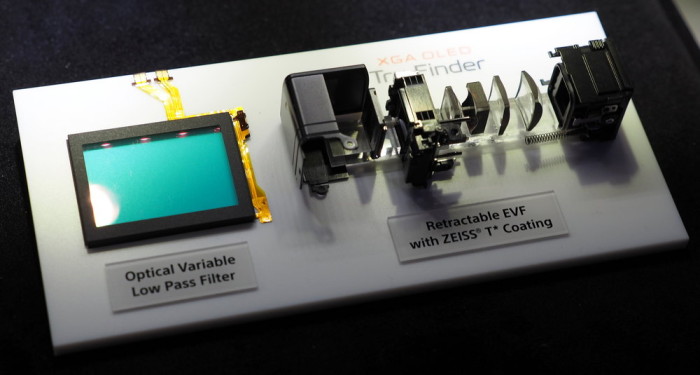
On top you can see the image showing the new optical variable low pass filter and the rectactable EVF construction (Image courtesy: ePhotozine).
Sony RX1R II: First Look Interview with Sony:
Hands-on by ThePhoBlographer.
The Phoblographer Demos the Sony RX1r Mk II (Youtube).
Sony A7s II and the NEW RX1r II – First Impressions – Plus Uncompressed RAW Firmware Update (Luminous Landscape).
62 Responses
I honestly don’t like this electronic ‘variable low pass filter’ feature.
I would have much preferred it without a low pass filter and $100-200 cheaper, or better with lens based stabilisation, even if slightly more expensive.
Looking at the picture of the ‘variable low pass filter’ it even gives a blue-ish cast. At least if they made it work as a variable ND filter as well.
I think either their marketing people insisted on adding it as a headline feature, or the combination of very sharp Zeiss lens and the 42Mp high res sensor was often resulting in noticeable moire.
Normally, the more the resolution, the less the moiré…
That’s what I thought as well, but I am wondering if it now it just started appearing on finer textures, than it would have before and no longer on rougher textures where it could be seen earlier.
I thought that you needed a much higher MP count camera + lens combo where diffraction acts as an Anti-Aliasing filter. I caanot find the article so its is possible I am talking nonsense
I believe this is just a test run for sony‘s latest liquid crystal technology.
I once saw sony had a micro liquid crystal patent originally applied on lens surface, it could adjust refractions with different angle, a better solution than Aspherical elements, but I guess making such lens is too expensive, so they put it above CMOS, correcting every lens attached above it.
But liquid crystal with variable refractions has way way more potentials than just low pass filer. Sony already managed to make them so tiny, which is one step ahead than other company, and boy they patented it. And if they managed to control every individual micro crystal with different refractions, or maybe they already did but just reserve it for future product, this could be a game changer, every beam of light purposely scattered to different colors and refract to the matched color pixel, so every pixel got accurate color information.
In simple words, this could make conventional mosaic pixel arrangement to have same performance as sigma foveon x3 but keep the advantage of high DR and ISO performance as its still single layer CMOS
I wonder what is the transmission factor of this filter? Hope not 2/3 again.
This also worries me as well.
Low-pass filters have existed for a long time, and people were never worried about that in the past.
Yes, but not with an LCD in the middle.
Look at the photo at the top of the article, does it look like the filter there transmits all light ?
It even gives a blue-ish cast.
Of course, this might be its ‘unpowered state’ and it may improve transmission when in front of the sensor and powered, but then is it going to consume battery juice at all times the camera is on.
It just seems like something totally unnecessary (a marketing feature) in between the perfect lens and sensor.
LCD? I don’t know enough about this technology yet to make such assumptions.
CMOS sensors always had blue colours depending on what kind of light you point at them and what angle to view them on.
Well I wasn’t completely accurate here, should have called it liquid crystal panel.
But Sony said that its two layers of glass with liquid crystal in between.
The lens already got the shutter, that might not be easy to implement OSS without redesigning the whole package.
They could easily just tinted the stuff so you don’t see just a piece of clear glass.
They already have and electric variable ND filter for the FS5, but that stuff is massive, and doesn’t go all clear (1/4 minimum), so you’ll always have to move out the way.
The blue color of the filter must be already compensated for in software post capture. Why would this be such an issue if the photos you get will not be blue?
In engineering when you hear the word ‘compensate’ you should already know that some information, accuracy or potential is already lost!
What does it mean to compensate for a blue filter – to reduce the blue component for every pixel in the frame in a ‘blanket’ fashion. As a result this will reduce the sensitivity to blue of the whole sensor since you will be reducing the ceiling for measuring the blue component of light for the whole sensor.
I just hope this thing is neutral when powered on.
Theoretically, it should be possible to avoid moire with completely randomized photosites. Fuji made a step into that direction… But I am curios how good Sony’s solution will turn out to be!
Do we know how many MP do we still have at 50mm if we crop? Anyone smart with the math?
29
I think its more like 20Mp, you have to divide by the factor twice.
50mm / 35mm = 1.43 factor
42Mp / 1.43 /1.43 = 20Mp
This one looks like he’s good with the math.
Thanks for sharing.
around 18-19mpixel. still pretty much enough for anything.
they need a crop setting on the camera that goes to APS-C, 1″ sensor…se we would have a 50mm, 75mm etc. The Rx1 streamed for this thought it would be a button on the RX2 but alas
You can crop afterwards, no biggie on doing it in cam.
They have 1.4x and 2x smart zoom, and also digital zoom settings.
This is the same thing as cropping.
Personally I would never use any digital zoom, but you are asking for it and it is already there.
You can customize a button for this, if you like. (I put it on wheel down.) Many people won’t like it, so it is ok not to waste a dedicated button on it.
honestly i doubt this camera is 7 times more worth than my a6000,
i see the additional value in a fullframe ILC like the A7R…. but not this one.
Well the original RX1 wasn’t cheap either, but then they released the A7 that is the cheapest FF to date.
They created new tech that will improve the whole line up too.
Maybe he could remove his kippa ?!?!
Why, do you get perverse pleasure from seeing that? weird
If a 35mm fixed lens camera meets your needs than this camera is as good as it gets.
I see the best uses for this with people that only shoot 35mm lens. and with people who want to carry multiple cameras with one permenently set up with a 35mm lens.
If the RX1rII would have had 4K, I could have seen myself going RX1r, A7rII+55mm and worked on video and stills with those two as a combo.
Since there is no 4K, I would still need to think of a video cam and a stills cam as separate tools.
The nice thing of the RX series is the leaf shutter. It allows me to shoot video AND be able to shoot stills without polluting noise. That ability has proved itself to be very, very useful.
Why don’t you mount your favorite 35mm lens on the a7r II, shoot FF 4K when you want that focal length, then use the APS-C crop to get a 52.5mm FOV. The quality of 4K in both FF and APS-C mode is so good that I wouldn’t fuss at all over the difference.
Mostly because there is no good 35mm lens for the A7. You have to decide between too heavy and too slow. The 35 f2 on the RX1 is perfect for me, and justifies
the price.
By “favorite” I was implying any 35mm lens. I’m not a big user of AF but there are a couple EF lenses that focus well on the a7rII, I think.
There simply is not any. You can get a decently sized 2.8 (too slow), or a 1.4 that is larger and heavier than the whole rx1. Everything else is MF.
Super35 (APS-C) 4K is what I would have used exclusively with the A7rII because it is much better than the FF 4K.
Also, I like the fact where I can shoot while filming. so, two cameras are still needed. Yes, I could do A7rII (x2) with a 35mm and a 55mm, but taking stills with A7rII is loud. That’s why I prefer to have an RX1 because of the leaf shutter and 2 RX1’s that could do 4K would mean I can film with one and shoot with the other.
So far the combo I would need would be A7rII + RX1rII
That got complicating. I’ve watched tests comparing the 4K FF and APS-C versions from the a7rII (on a 4K monitor using out of camera files) and you’ve got to be pretty darn picky to care, IMO. If what you shoot inst ending up sold as a high bit-rate DL or in theaters, there are other issues more worth you’re time. And if you are shooting a HQ film, why use the a7rII (or any pocket camera without proper audio support, etc., etc.)?
I shot with an a7rII last weekend and I didn’t think the shutter was loud at all. Seemed more than fine for a wedding in a small chapel. IDK. That’s just me I guess.
I got all the audio gear I need and yes, my end delivery is for theatrical release.
A GH2 can do that job with a good patch. Today, most cameras can do a great job for theatrical release. A7s, a7sII and a7rII in S35 can deliver outstanding quality video.
As for shutter. I work indoors and it is usually quiet enough to bounce the noise of a shutter. I can sometimes hear the RX1 when using headphones and there was a quiet moment, but it is rare and it would often be when the camera is near the mics.
I’m warming up to it. The price makes my heart go ice cold though.
I see some good deals on the RX1 now. To bad about that manual focusing issue though.
what MF issue?
It was in the comments yesterday and I read a few reviews on amazon. Something with the manual focus feature stops working.
On the original RX1? I have two of those. Never seen or experience any of that after 18K+ pictures.
I could attribute that to user error, or maybe a fall or hard bump on the focusing ring (it is the front-most ring) and that could be the reason it would not work.
With the introduction of this camera it is now highly unlikely Sony will introduce the ff curved sensor/35mm lens camera that they developed.
By utilizing the a7rii sensor production and development costs are reduced.
Since Sony sensor division is now seperate from Sony camera division it is far more difficilt to justify building a new curved sensor for use in just a single camera.
The sensor decision for the rx1 must have been made well before the re-structure only weeks ago. It might be that the yields were not feasible, the quality wasn’t there, they did not want to invest in developing a new lens to go along with the curved sensor and/or it simply would be too expensive to turn a profit. The RX1 pricing cannot be lowered as aggressively as ILC cameras because there are no lens sales to offset the body pricing.
Restructure does not just happen,..it takes years of planing….longer than a new camera takes to launch.
How long ago do you think the designers and execs decided to produce an rx1 successor and to produce the 42np sensor and deploy it in both the a7r2 and rx1r2?
I cannot give you the timetable you ask for.
I am quite certain a curved sensor camera with 35mm lens was developed…with a bsi sensor.
I also would guess that the a7rii sensor desighn also with bsi sensor was developed after the curved sensor, and at least partly as a response to what they believed Canon was doing.
The quality of the a7rii sensor was probably good enough to minimize the advantages of the curved sensor.
Meanwhile restructuring was going on and it would have been increasingly difficult to justify actual production of a sensor for use in a single Sony camera when most sensors have multiple uses.
While a camera company may be able to justify it, an image sensor company could not.
So I believe all those factors, as well as others I have not thought of , played a factor in the decision to use this sensor and lens rather than the curved sensor.
I do not expect we will ever see the curved sensor/35mm camera built as it would now be redundant.
The battery in this camera has 25% MORE CAPACITY than the a7rii battery.
Is it not using the same NP-BX1?
New higher capacity battery…np bx1/mp
Old…1020 mah
New…1240 mah
That’s what I said. NP-BX1 is a 1240mAh battery.
So, it’s the same battery as the original RX1. No difference.
It’s not a new battery.
I actually erroneously compared it to the a7rii battery, and have since corrected my post…it is actually a new battery of the same size, and fully compatable with the batteries in other rx cameras.
I thought you knew NP-BX1 was the battery for all RX, except RX10, since RX100 came out. I have RX100 and RX1 and they are all same mAh and same size and fit and I use the batteries in between the cameras and as far as I know the BP-BX1 is still used in all other RX100 iterations up till RX100m4.
I know this man. Had these cameras for years and they all use the same battery which always had the 1240mAh capacity.
It is better to speak with a full mouth than with an empty brain. mAh is only one factor in order to get the value for capacity: [Wh]
RX1: 1240 mAh * 3.6V = 4,5 Wh
A7: 1020 mAh * 7,4V = 7,5 Wh
On the other hand, that also means that any USB power bank would get you almost double of the nominal charge, so a 5000 mAh charger could give you close to 8-9 times full battery charge.
Wow, I wouldn’t want to have to talk to you for more than a minute.
I see room for a bag of M&M’s in there.
nonsense…
This feels more and more like the extra switches and options you used to get with new models of Hi-Fi back in the 70’s and 80’s 😉
I totally agree, it is not seven times better than the a6000, which is a very nice camera. In related news, a Porsche 911 is not seven times faster than a Honda Fit.
IMHO, there are a few things that you cannot do with an a6000, and for some people, that is worth paying an additional 2000$.
I somehow has a feeling a built-in ND would be more useful than that fancy AA filter.
I just wanted to point out something. In this video the Sony guy talks about the benefits of a fixed lens camera. WHOO HAAA….guess what that is ladies and gentlemen! No mounting surface therefore the lens can be optimized with the sensor.
Now think about that one! This is the same guy who talks about using adapters in every other video as a benefit…which introduces 4 mounting surfaces!!!!!!!!!!!!!!!!!!!!!!!!!!!!!
ARE YOU KIDDING ME!!!!!!!!!!!!!!!!!!!!!!!