







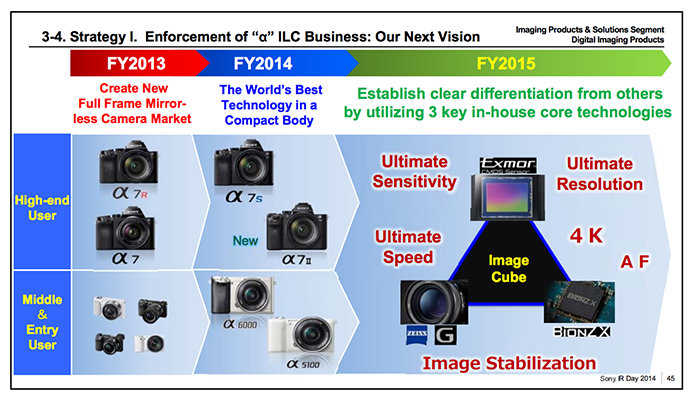
Sony’s goal for 2015.
Sony still has a long way to go to win the Full Frame battle against Nikon and Canon. And if Sony engineers are reading this they may check out these two articles to learn what should be done:
Sony, Fix These Things and Win (Diglloyd)
The SONY FE MIRRORLESS SYSTEM – Getting There For Professionals? (Soundimagesplus).
I agree on 99% of what these two guys wrote 🙂
151 Responses
The 99% is this? 🙂
“The heading at the top of this post is – The SONY FE MIRRORLESS SYSTEM –
Getting there for professionals? and the answer must be yes, it does
seem to be getting there.”
“Sony is unlikely to take this advice”
How about providing in-house wi-fi based flash system, with lithium batteries?
+1 Good one! It would be a top notch feature!
I got a lot of crap on this website for suggesting better batteries than AA ones, but it seems that Godox actually makes exactly such flashes.
http://www.godox.com/EN/Products_Camera_Flash_V860c.html
I still think that Wifi is a better technology to invest in than radio, so that you could, for example, configure remote flashes using an app on your camera or phone. Imagine that you have you are holding your A99II, impressing your client with the biggest and best camera around, but also have a discrete QX smart lens hidden somewhere for the wide shot or alternative angle, all using same flashes on the same wifi network.
I think the only problem is wifi have package loss…and sometimes it causes delays…you dont want your flash sync to delay…but that is just what I assume…maybe they can sort it out? great Idea btw =)
packet loss is really negligible, IMHO. It’s not as if radio doesn’t have interference issues.
lithium doesnt work as good as NiMH for flash capacitor.
Have you seen the Godox specs? I hear good things from their users
Lithium batteries are a very poor fit for high power flashes as they gave relatively high internal resistance. That means if you draw current very fast (as flash recycling does), then it will waste a lot of energy in heating the battery. Indeed, Li-Ion batteries generally have protection circuitry to shut them down if too much current is drawn as it can be dangerous.
That’s why for smaller flashguns Ni-Mh tends to be preferred as they have much lower internal resistance which means they can handle much higher peak currents.
This is not to say that Li-Ion batteries can’t be used for flashguns, but either the batteries have to be considerably larger than Ni-Mh or power has to be reduced. This is not for capacity reasons, but due to internal resistance.
(For those that get fed up with the high self-discharge rate of Ni-Mh, and I do, then I recommend using hybrid rechargeables, which are vastly better in that respect, albeit with slightly lower capacity).
AMAZING!!!!!!11
SONY SO INNOVATIVE!!!1!!!!!
CAN MAKE CUBE WITH ONLY 3 CORNERS OMGOMGOMG!!!!!11!!!!!
I slice through the corner of a cube would look like that.
I suppose the other point is that if there are (truly) three degrees of freedom in defining market characteristics then you would, indeed, a 3D cube to represent it. It’s just that diagram doesn’t show it.
A slice through the corner of a cube is a (trirectangular) tetrahedron.
A “slice through” is two dimensional in the context I used it, so can’t be a polyhedron.section if you prefer. A tetrahedron is effectively the corner that’s cut off the cube, and the slice I refer to would be one face of that tetrahedron that isn’t a right angle triangle.
nb. I wasn’t being serious. It’s clearly a silly way to describe a triangle.
Missing the Z-shift sensor. With this, Sony would rule the camera world.
It’s never going to happen. It means making a very deep body, it’s mechanically complex and with very little gain. OK, it will provide the option for AF (but with limits on accommodation) and it doesn’t eliminate the need for adapters which are needed for both mechanical and electrical interfaces.
In short, I see very little gain for an enormous increase in size and complexity.
It can solve AF issues with old A-mount lenses not adapted to small AF hunts
It can make AF with ultra-fast (e.g. f/0.9) lenses as practical as with small aperture ones.
It can make DOF stacking easier
It can make dedicated mount adapters smaller
It can be used for dual A-E mount camera
It is good for rear-mounted lens filters
It’s good for what E-mount is — gadget enthusiasm.
No doubt, but it still will not happen.
None of those are really sensible suggestions are they? Be honest?
Let’s do them one-by-one.
AF on old A-mount lenses works with the SLT adapter. Why do you need a new solution?
AF on f/0.9 lenses? Not exactly a big market is it? However CF would work with very shallow DF, should any mainstream manufacturer cares to produce an E-mount version (which they won’t).
If makes DOF stacking easier. Yes. But again, how big a market? In any event, it’s perfectly possible to automate it on any lens which supports distance encoding (which all modern lenses do). It would just be a firmware issue.
It would only make adapters smaller in direct proportion to making the body thicker. Hardly a net gain is it?
Dual E-A mount camera? Seriously? You want to add the complexity of some sort of weird mechanical adapter change to a sensor capable of Z-movement. It would be so much simpler than an adapter that takes 5 seconds to install. (Politely speaking, that’s called irony).
Good for rear mounted lens filters? That’s scraping the barrel. There’s not space on an E-Mount native lens, and for any DSLR mount there’s plenty of space should an adapter manufacturer want to do it. In any event, you can’t just move the sensor to make room for a filter. It would throw out the focus.
As for E-mount being for gadget enthusiasts? It’s a lens mount for heaven sake. It’s no more or less gadgety than any other modern mount. Quite simply, Z-axis adjustment for AF isn’t going to happen. It’s been tried on once, on a very expensive, AF camera and it was not a commercial success.
But then you already knew all that didn’t you. But being a contrarian is quite fun isn’t it?
what’s CF?
>Why do you need a new solution?
SLT mirror takes 30% of light and adapter AF points don’t over all the frame
>It would be so much simpler than an adapter that takes 5 seconds to install.
Dual mount camera can have it — zero seconds.
>Hardly a net gain is it?
If there are more than one adapter, there might be a net gain.
>It’s been tried on once, on a very expensive, AF camera
It was film SLR where entire viewfinder and film channel assembly moved, therefore AF was very slow, digital mirrorless won’t have this limitation.
At least you can look at one Camera that had it …
http://www.photographyreview.com/cat/cameras/film-cameras/35mm/contax/ax/prd_83354_3105crx.aspx
I wonder if Z-Shift might be better accomplished (with today’s better miniaturization) by using a Device that looks like a Speed Booster or a Lens Adapter, that could be used to provide AF for the Lenses that needed it. It could be bulky if it were removable.
Why? Another gimmick for some obscure manual-focusing glass? Right, THAT’s what would make Sony “rule the camera world”.
I like how some smart pants are telling these companies what to do, a good example Andrew Reid EOSHD.COM. Ok folks you want all these amazing features and performance but you will complain when it comes out…PRICE!! But when Apple IPhone comes out with mediocre specs and astronomical price these people will buy it in a heart beat and swear its the greatest phone and camera. Bull crab!
That’s one big crab!
Defend your greatest camera/phone you want.
A-mount is dead. A-mount lenses are dead.
Oh yeah mine suddenly died when it read this news…
Unfortunately this Battle crap is the most annoying aspect of being a Sony user. Sony E-Mount is unique already as the most adaptable system plus the most innovative – once you’re used to skipping one or a few models until new features really get you this flood of body releases is quite nice. I’m buying Sony E-Mount for photos & video and initially choose NEX for continuing using my old Canon FD lenses, while a battle is something for fan boys.
Sony user? Just go to any camera forum.
Add a lossless-compressed 15-bit file format. Absolutely mandatory if Pro battle field will be.
okay, but please also give us the option to get the compressed RAWs, everyone should be happy then
Just, pleace, give us a xt1 body design
Why are Sony Alpha Rumors giving any air-time to him? A mechanical (or EFCS) shutter has never been invented that displays zero vibration. I suppose morons have their place!
Diglloyd is a moron. He wants a Pentax 645Z in E-mount, which will probably cost as much and be as large. I mean 56 MP 15-bit sensor, what is that going to create, 2GB TIFFs? The processing and battery power needed for all that (especially 4 MP EVF) is “not difficult”? “Toy-grade build” is another good way to show he has zero credibility and just a nerdy attention-seeker.
The best part is his ridiculous sense of entitlement: “Fix this” – when what he is requesting is his wish list that no one in the market offers at the moment… that’s not something that’s “broken” to begin with, that’s him having a little wet dream.
He is not “requesting”, he is “advising”! 🙂
If Lloyd was a financial adviser he’d be a cheerleader for the Federal Reserve, his advice is infantile and based not from experience but merely anecdotal observation!
Sony has a plan in place and is working towards that goal without any input from Diglloyd. It’s much easier to imagine what you want then it is to engineer and design it, that takes some time. And you have to work within the current state of hardware (sensor, processor, shutter etc) development. 2015 should be an interesting year for camera technology.
A 15MP 15-bit sensor would generate 100MB RAW files, you’re about by a factor of 20.
Re-read and re-check your figures Matt……
Sure:
56MP = 56,000,000 pixels * 15 bits per pixel = 840,000,000 bits
840,000,000 / 8 (bits per Byte) = 10,500,000 bytes
10,500,000 / 1048576 (Bytes per MegaByte) = 100.14 MegaBytes
Out by a factor of 20, as I stated. Unless the original poster was referring to the size of a demosaiced TIFF saved from the RAW file (who does this in 2014?) then they’re only out by a factor of about 7!
He stated TIFF…………….
Most RAW files are in fact TIFFs… but anyway, assuming the original poster was referring to a 16 bit-per colour channel three colour TIFF file then they’re still out by a factor of about 7, and in any case why would criticise a camera for producing large files after you process the originals and then save them to a higher bit-depth format?
http://en.wikipedia.org/wiki/Tagged_Image_File_Format
http://en.wikipedia.org/wiki/TIFF/EP !
“One of the uses of TIFF/EP is as a raw image format”
“TIFF/EP provided a basis for the raw image formats of a number of cameras. One example is Nikon’s NEF raw file format, which uses the tag TIFF/EPStandardID (with value 1.0.0.0).[1] Adobe’s DNG (Digital Negative) raw file format was based on TIFF/EP”
So was the original OP’s post correct as it was written reference a SONY file?
Nikon D810 14-bit 36MP TIFFs are ~110MB… so 15-bit and 56MP has got to be orders of magnitude more…
KJJ, an order of magnitude is an increase by a factor of ten, orders of magnitude (plural) implies an increase by a factor of at least 100.
56MP is not an order of magnitude more than 36MP (it’s not even half as much again), thus TIFF files sizes wont be orders of magnitude greater.
STOP. You are no helping my credibility here with your poor command of digital science and NUMEROUS assumptions.
Calm down, I was just pointing out a piece of trivia that a RAW file can technically also be a TIFF. That’s incidental to my main point, that you wont get 2GB files from a 56MP sensor, no matter what format you use!
WRONG AGAIN, there you go with ASSUMPTIONS. Please, go take some remedial math classes! You are not helping your cause at all.
Wow, I’m actually shocked. Given your stated concerns of your credibility in the post above, how about instead of dealing out insults about my mathematical abilities being at a “remedial” level (and other ad hominem attacks) you would have attempted to explain how it is possible to generate 2 billion bytes of data from a sensor with 56 million pixels…
You were trying to point out nothing but merely simply trying to put-down the OP of this thread Mr Smart Alec……
Your behavior and temper are like EOSHD.COM ANDREW
56*2(bytes)*2(components/pixel for Bayer)~=219mb
for >8bit depth they usually use 2 bytes to save (set the rest of bits to 0)
for Bayer green color is at full res, and R and B at half res, so we have the factor of 2
~205mb if 15/8bytes is used
56 MP FF is the same pixel density as A5100 or Nikon D3300.
Diglloyd actually made some sensible suggestions, but Sony has long let go of the pro market for the gadget market.
Being non-photographers, and bad at maths to boot, gadget geeks do not understand / do not agree.
Advice to Sony: listen to your target market. This is going to beat Homer Simpson’s ideal car. Please, we all need a good laugh.
There’s an interesting A7ll review over on Luminous Landscape. Michael Reichmann has actually got credibility within the trade for anyone interested in a working photographers perspective.
http://www.luminous-landscape.com/reviews/cameras/sony_a7_mkii_hands_on.shtml
Nice! I like their way of reporting and writing about cameras! Preordered mine yesterday.
Plus they actually get out and shoot, work alongside industry professionals and have realistic expectations of what photographers need to complete everyday tasks. Never a complaint from LL about virtually non-existant issues, they run everyday software (as do real photographers) and don’t feel the need to pick things apart to make a point (or sell another subscription) by deconstructing files at the pixel level with obscure software and convoluted analysis.
Reichmann is a bonehead for claiming A & E mount menu systems were bad, but a7II menu is good… Idiot doesn’t realize E menu copies A menus now. A mount had great menu all along.
Agreed, he generally has the most balanced reviews out there and writes about aspects that actually matter.
Anyone can come up with a who _____ can win plan… You could replace the name Sony with Polaroid if you wanted and it would make as much sense. Reality isn’t as easy as simply saying we do X and Y we win… You have to look at the corporate culture of Sony and see if it is even possible for them to achieve X and Y…. and even if they can achieve those goals, what is the cost? If it costs them too much it wont matter if they have the best camera they can still lose… look at Betamax, it was superior to VHS but it lost…. reality is that people might say they want the best this or that, but when they factor in price it really come down to they want the cheapest thing that gives them satisfactory results.
Exactly and this is why people dont understand. People will go with mass and advertisement like currently with smartphones.
There are two ridiculous aspects with mirrorless Sony FF camera system and aiming it on Pro level. First one is fast lenses, that are geting bigger and lagger, where some look like monsters – e.g new 35/1.4 ZA – when mounted on such small cameras like A7, and they are as big and heavy as DSLR lenses. The ballance will not work and handing it will not work too. Second ridiculousness is centered EVF on such small body, which makes framing and fast shooting unconvince, with your nose flattened on LCD or jammed on right hand (if you are left eye shooter). With such small size body only RF styled design is a solution. Otherwise you will better buy small DSLR, like 6D or D750.
balance…
There is a camera in your hand that you hold on a grip. This grip is now about the same size on the A7Ii as on most other DSLR. The flange distance is shorter, that means the mount is closer to the axis you hold the body. Lenses will always be a bit smaller and lighter or at least the same as on DSLR. So the smaller distance creates less torque in your hand. >> Handling is better, simple physics.
DSLR hav the VF in the middle, too, so I don’t get your point there why one should better buy a DSLR. Because it’s the same stupid thing?
Yep. Just buy a mixer. Same as the camera, it has screws.
Balance works fine if you know how to hold a camera. It is your statement that is ridiculous. As to RF-positioned EVF, it has its issues too.
This is one of the reasons that Full-Frame is a LOSER. And one of the reasons that some Pros are switching to Fuji (APS-C) and M4/3. BIG Full-Frsme lenses are a real Pain-in-the-Back.
I held a Sony FE with a kit zoom, at Samys, and it was the most out of balance camera I’ve held in 40+ years. I can’t imagine that anyone will enjoy using a fast Zeiss.
Very true. This is one of many flaws in this toy system.
Sony needs to look at its strengths. And punish the competition with them.
They won’t be able to win the pro sports photography battle – for the moment –
they don’t have the bodies for that (AF system). But they are really good
with anything that doesn’t require super AF system (which is 90% of the rest of
photography). Also, they need to start thinking about bodies in the FE mount system that are not so small with tiny buttons. The Nikon D810 is a good example – I am sure Nikon could have made the body smaller –but it would not handle so well. I am not saying the A9
needs to be the size of the D810 – but definitely bigger than the A7.
They DO have a super AF system in A77-II
Super – like 7D mk II super? Real question – not sarcastic.
It’s actually a bit faster 10fps vs 12fps continuous shooting with autofocus.
And has a better sensor.
But thing is, is it accurate at 12fps (95% keeper rate, for example), not only for linear slow movement? I didn’t see a direct comparison, separate reviews indicate both to work well.
It’s not only fast and accurate, but has many focusing functions by virtue of the live view and digital processing that the 7DM2 with it’s antiquated focusing system could never have. And as digital processing improves so do the focusing functions, the 7DM2 barely equals the 77II in one area and totally lacks in several others. Overall the 77II has a much more sophisticated focusing system, able to accurately focus over a wider range of situations.
Rubbish. I always suggest people should try things themselves, so they avoid being conned by twts like you.
They do look at their strengths. That is precisely what the issues is sometimes – they don’t bother fixing any weaknesses – there you have the whole Sony strategy in one sentence.
what an idi*t this digiloyd guy is…. “bonus points for a medium format sensor”
sony does not even have all common FF format local lengths covered with their lens lineup.
and now they should introduce a medium format camera?
first point makes clear already the guy does not know sh*t.
sony has limited financial resources and is struggling in the electronic biz.
and now they shall develop a new line of medium format lenses and bodys?
utter nonsense…
Exactly, you nailed.
“Aggressively move the lens lineup forward, perhaps by paying Zeiss to extend the Loxia line quickly and with ultra high performance lens designs (Zeiss Otus grade, but half the price and near-perfect f/2.8 designs)….
None of this is particularly difficult, but it would yield tremendous credibility. ”
yeah and deliver them with a cute asian girlfriend so even a loner like him will get laid.
what does this m*r*n smoke?
my advice for sony… make a 600mm f4 with “ultra” perfomance for 1300 euro and many people will buy a sony FF. wanna bet?
what an idi*t…
Whats up with Asian? White are cute for him too.
EFC shutter? 15-bit file format? What is it I don’t even..
Sony needs to address two issues: 1. AF and 2. LENSES.
That’s it, pure and simple.
And they could have it already in A-Mount. They had most lenses and fast AF in A77-II, but took a big step back by switching to mirrorless.
“Sony needs to address two issues: 1. AF and 2. LENSES. ”
Not to mention fps and flashes.
What’s wrong with flashes? My HVL-58AM seems to be working fine
FPS seem to be decent too
Due to lack of support from 3rd party, they should introduce their own radio triggering system with full support for TTL, manual control over the air and so on…
No radio triggering is a bummer. The (relatively) new F60M is overheating.
F60 was a nightmare.
Delay, no pc sync, overheating shutdown, lack of third party wireless triggering makes first party radio triggering a missing necessity, unstable iISO adapter
Would be nice if Sony had a well conceived flash system remotely comparable to competition. Believe it or not, the “Pros” appreciate those things. Instead, Sony abandons the “Pros” who relied on the Minolta flash system.
Sony can’t even get all the new hot shoe accessories to work on all cameras. That kind of mess is the result of not having a single visionary guiding the process. Sony isn’t ready for the pro game. Will sit the bleachers until they figure that out.
Pro what hotshot? That is the least of the concerns, many pros just use strobes.
Least of the concerns for whom? I’m a “pro” (as in full time, 5+ days a week working full time photographer). The poor state of affairs for the Sony flash system is a big concern for me. I use flashes every day, on and off camera sometimes with monolights. I cannot mix & match Sony flashes with monolights because there is no PC sync port on the Sony flash. I cannot use my f20m flash as a simple trigger for moonlights because there is no way to disable pre-flash. I often cannot rely on my f60 flashes because they overhear and shutdown constantly. There is also a delay with the f60 flash, the moment is often gone when it triggers.
My Canon flashes have never shutdown, have standard ports and play well with others. Cameras do not distinguish photographers’ work from one another, but lighting does. Now that Sony has introduced pro repair services, the next gaping hole to fill is the flash system if they are to appeal to enthusiasts and professionals alike.
Strobes vs flashes? Enlighten us sweetheart. You obviously never used any, huh?
Frankly, Diglloyd’s article is just his wish list for Christmas. Most of his points make no sense whatsoever for Sony in the context of building market and mind share. To a lesser extent, the same goes for SndImg+, although I’d agree with “So unless they make some catastrophic mistakes, it seems they will get there.”
Absolutely right. If they were as easy as it says (save possibly the issue of RAW), then it would have been done. One or two are quite tricky, especially on very high resolution. If EFC shutter was easy to do on the A7R it would have been done. It’s not because at high resolution it hits throughput limits on clearing out sensor cell readings as fast as the second shutter traverses the sensor.
That’s the nice thing about the D810: although it is not as comfortably to use, EFCS is possible. Incredible results.
True, and I’m sure the A7R will have it. It may be that the sensor design was tweaked on the D810. Possibly they increased the clock rate a bit as there was a bit more power and cooling ability on the larger camera. It’s also possible to have a slower second curtain (but that will be bad for flash sync speed).
These things are always compromises. Progress is often evolutionary, not revolutionary. It’s difficult to see why Sony would have omitted EFCS on the A7R unless it would have been impossible, or compromised something else.
True. Shutter speed maximum decreases when using EFCS on D810 to 1/2000s, by the way. For macro work EFCS really makes a difference. Didn’t believe it at first, but files show near perfect per pixel sharpness (at lower ISO).
That makes sense. Whatever you see on a D810 would be worse on an A7 if only because there’s a lot less mass in the latter. Ideally physical shutters will become obsolete, but for now it’s all a matter of compromise.
It is always funny to have your opinion here, you are the perfect sample of non-photographing spec peeper. Desperately clueless and craving for attention, but harmless.
Unfortunately, photographers have very different needs and your sort might outnumber them, and the market might get polluted with more bad products.
As a consequence, I must ask you to shut up.
Know what’s never discussed, but which I consider huge? Make a sensor with the same MP counts we have now, but which handles highlights like colour negative film used to. I can’t believe no camera/sensor manufacturer has done something proper about this yet – it’s about the only area I still miss film for now.
It’s not possible to make a sensor that works like colour negative film as the physics is wholly different. If you want to make a comparison, digital sensors are more like slide film where, once a highlight is “blown”, it remained “blown”. It’s very much like a sensor photosite saturating. Once it’s full of electrons, any more are lost.
Focusing on product, which, important as it is, does not stand alone.
The support ecosystem is what is lacking. Localized professional support services, hot spares, quick fixes, parts depots, stablization of model proliferation…
Lens choice, including unique, specialized lenses, which may not reach break-even for a long long time. AND reasonable prices for same.
Treating the “PRO” market as though it were just a consumer market hasn’t worked so far.
Sony needs to pick a mount and move forward with it. They have multiple mounts – even for the same sensor size – WTF? Pick one and move forward. Yes, you will pi$$ some people off – but the resulting product catalog will be better. It seems to me the FE and E mounts is what they should move forward with for FF and aps-c, respectively. Or just FE for both sensor sizes. Then they can focus lens development on that mount.
FE and E are the same mount! Nikon have 2 mounts also… and Canon even 2.5 (you can’t put aps-c lens on a FF body)!
Yes, Nikon has 2 mounts – but one is for a 1″ sensor – which makes sense.
Nikon DX lenses are still F-mount. And, unlike Sony and their APS-C emount, Nikon still makes them and updates them.
There is no FE mount in Sony! Only A-mount and E-mount… just like in Nikon and Canon (DSLR and mirrorless)!
http://i.imgur.com/eYnaCCN.gif
I know that. However, Sony is no longer making emount for aps-c, just ff. Nikon still develops DX lenses in f mount.
When did Sony stop producing the a6000?
We’re talking lenses. There is no more development in APS-C e-mount lenses. I believe that there will be no more APS-C bodies developed.
There are only two mounts, and one is legacy. FE & E mounts are identical. The only difference is the image circle size, which is a feature of the optics, unlike Canon where an APS-C lens can’t be mounted to an FF body as there is a physical difference.
In any event, it’s clear that E-mount is the future. Where the balance is between APS-C and FF lenses is about what the market is.
Finally someone understands and have use them mounts.
A mount may be “legacy” but Sony is still producing new bodies and lenses in A mount. Yes, I know FE and E are the same mount. What I was getting at is that Sony has 2 mounts for the aps-c sensor – E and A. They need to drop A mount and just focus on E mount. There product catalog will thank them.
Now – if they want to have another mount for a drastically different sensor size – then fine – I am on board with that. But right now they have 2 mounts for essentially that same sensor size. A is dead – they need to go with the winner – E. The A77mkII is a fine body – but they need to make future high end aps-c in E mount.
Except the problem is that there is a large group of A-Mount lens owners who are not going to feel to good about the company if they find they are left without anywhere to go. Putting IBIS onto the A7 is a good start at providing a migration route, but at the moment the A7 series falls short of a functional replacement for the A-Mount bodies. The SLT bodies still have advantages over the A7 series in some aspects of ergonomics and AF performance (even with the adapter).
It will also take several years before Sony will have a full range of E-mount lenses to match those of A-Mount, especially in the area of longer and faster lenses.
So as a strategic aim, then the eventual consolidation onto E-Mount makes sense, but it’s a marathon, not a sprint. The direction is clear in that Sony are obviously putting most of their investment into E-Mount, but they will have to address other things too in order to provide an acceptable migration path, including a more substantial E-Mount body and better A-Mount lens integration. Maybe that will come with the A9.
In the meantime, they can’t leave a major part of a loyal customer base without support.
well, someone will eventually lose in all of this mount schizophrenia.
Haven’t you noticed? APS-C e-Mount is no more! They have no plans to make any more lenses, and my feeling is the APS-C camera bodies will cease to be updated as well. Even these articles said it: Sony is trying to capture the enthusiast/pro market, and that means full-frame. The A6000 is likely one of the last high-end APS-C cameras you will see. Nex 7s, just 18 months ago hailed as the best highend mirrorless camera, now sell for $330 used; 1/4 of their original price.
You’re an idiot. There have been plenty of Sony APS bodies in the last few months. No companies is dumb enough to trade volume to retreat into a niche voluntarily. A6000 and A5100 probably outsell all the A7s combined by 10:1. Why would you voluntarily give up market share when you are number 1?
And it’s never been worth a penny more, if you ask me.
>They have multiple mounts – even for the same sensor size – WTF?
So does Canon – EF-S and EF-M… WTF? And unlike Sony, EF-S isn’t compatible with EF??? HOLY WTF OMG BBQ!!!
Three distinct mounts (EF, EF-S, EF-M), all incompatible in Canon-land. Two in Sony-land (A and E) and each have 2 choice of sensor size behind it. So Canon is more complicated despite that they don’t even have a full frame mirrorless and their crop mirrorless is grade A horse shit.
“Make the camera larger (somewhat): the buttons are too small and fiddly compared to a Nikon D810. A7R with gloves (cold) means taking gloves off. No fun.” Really??????
There’s no way Sony can win this battle. If they are unable to fix A7 bugs and enable customization for A7 playback buttons for more than a full year – they’ve already lost this battle.
It’s not a new bodies that win pro-battle, it’s a respect to professionals and deep understanding of our needs. Sony lacks this part at all, they do not listen, they do not respect their customers at all. And they do not understand us at all.
They could start by learning basic geometry 🙂
Sony wants to capture more of the Pro market? They can start by not neglecting the A-mount. Most professionals still need something comparable to their Canon and Nikon DSLRS in terms of durability/ruggedness, focus speed, lens selection etc. for their day to day. The A900/A850 and A99 were great, but Sony needs to continue to refine these while the mirror-less market matures.
Mirrorless has brought nothing to the table so far… it’s generations behind Sony’s own SLT cameras in AF, it still has no lenses and Sony still decided to kill the only EVF-based DSLR line in favor of A7x.
A9 better be good…
There’re only so much owners of some obscure manual-focusing lenses that Sony can convert to their brand, while losing everybody else.
If by “brought nothing to the table” you mean the best FF sensors in the business coupled with Zeiss lenses and a version with 5-axis stabilization on a package that is half the size of anything out there, then yeah, they’ve brought nothing to the table.
+100!
>F sensors in the business coupled with Zeiss lenses and a version with 5-axis stabilization
What does any of that have to do with the mirrorless design?
>on a package that is half the size of anything out there
RIght, another guy who compares a 24-70 f/4 with a 24-70 f/2.8 and then goes “oh look, it’s smaller!”
What does that have to do with mirrorless? The fact that ALL of that IS in a mirrorless package, DUH! Some people will never be pleased…
So nothing. All of that could be just as easily incorporated into an A-Mount camera with proper AF and lens selection.
True, but if you have limited resources it is probably a better idea to master a segment where there isn’t much competition. Which is what Sony has done. I just wish they would invest more in A-mount. I loved that A900, but the kind of assignments I get now are better served by something more discreet and light weight.
You can use Zeiss lenses on Canon and Nikon (I do) and piss on the Sony plastic toys (I do).
You left out “Troll (I do).”
From the “Sony, Fix These Things and Win (Diglloyd)” article:
“Aggressively move the lens lineup forward, perhaps by paying Zeiss to extend the Loxia line quickly and with ultra high performance lens designs (Zeiss Otus grade, but half the price and near-perfect f/2.8 designs)”
Pay Zeiss, sell lenses at half price. Do you even Business?
do you even read? he wants 2.8 Otis like glass for around half the price of faster Otis designs.
Do u even read the reader read read the writer, reader? Ha!? Merry Christmas folks!
My guess: Before FE ever gets a chance to fully mature Sony will have abandoned it a long time ago for something “revolutionary new” but backwards incompatible. They do have a track record for doing things like this, don’t they?
If Sony wants to be really successful they need to build one thing in rock solid quality first – confidence. Otherwise no one will be ready to drop thousands of $/£/€ into a new camera system. That’s were Canikon are still leagues above them. A conservative approach like theirs emphasizing continuity along evolution may look more boring and lack the sex appeal of being at the cutting edge of today’s technology. But I bet no pro would like to put significant high five-digit figure investments at stake just for that warm, fuzzy avantgarde feeling.
Even as an amateur I’m just glad I didn’t buy into the then NEX E-mount for mirrorless as Sony seems to have stopped APS-C lens development for E-mount more or less completely. Which is an absolute pity considering their great and attractively priced APS-C mirrorless bodies. And no – clunky adapter solutions for third party glass with slow or no AF are not a solution for everything. BTW, that’s also true for FE-mount. And before anybody starts a flame war: I’ve just recently bought a used A7r. It’s a great camera in its own right, a nice landscape/architecture body (intend to use it with Canon’s stellar TS-E 17) but it definitely also has its quirks and a long way to maturity as a system. Maybe too long for Sony’s marketing department lusting for the next big thing…
Make A-Mount Bodies.
Yes please.
AF is all that is missing.
Improve AF response at DSLR levels and the battle is over. Sony wins.
NOT all Pros want/need/use Full Frame cameras. Abandoning the Crop E-mount cameras is a big mistake.
Standard magazine size is 8 3⁄8” x 10 7⁄8” scanned at 300 = 2513 x 3263 DPI. A 16 Megapixel M4/3 Olympus E-M1 is 4608 x 3456 pixels. Why do I need Full-Frame ?? I normally shot at F/8, so Paper-Thin DOF is not something I’m needing.
Panasonic has a hand-holdable 300mm f/4 (=600mm FF) coming early next year, pre-order at B&H http://www.bhphotovideo.com/c/product/1031587-REG/olympus_300mm_f4_0_pro_m.html This is what will make me abandon APS-C.
And yet, many people only talk about resolution, high ISO performance and small size (of camera bodies). Sony is good at that, we already know that but in the PRO sports market, what matters is that certain manufacturers offers good AF tracking performance and a great range of telephoto lenses along with robust camera bodies. And Sony is still reluctant to explore those key areas (by killing off A-mount development). And I really doubt we will ever see a 400mm f2.8 E-mount lens because that simply doesn’t make sense right now.
After watching TheCameraStore video comparing several mirrorless in action photography, the a6000 was quite good, but it can’t compare against the D4S yet. And when it comes to tracking (with subject coming towards the photographer), the a6000 still falls behind the already good a77mk2.
I know Sony is trying to get there, but it seems they aren’t interested on taking over the PRO sports market and that’s where Canon and Nikon will always be shinning unless Sony change their strategy.
Diglloyd seems to think professional photographer means landscape photographer. I care about almost nothing he mentions.
Do they really consider that those are the things lacking to make Sony FF E-mount system more appealing to the pros? Seriously?
The way I see this it is dead simple:
1) Dual card slots with capability to write to both. Are you willing to tell the bride that you lost all the pictures from the ceremony? So far none of my cards have failed, but I know photogs and videographers who have lost critical footage, using best cards available. Note that data recovery from flash chips (if card controller has failed), is likely to cost more than your contract;
2) Fast AF with decent tracking. Fast AF in low light. Something on A77II/D750/D810/5D3 level. I only need this for maybe 10% of the shots, but I am not willing to run second system for that. Not talking about sports kind of performance, just general events, receptions, fashion shows;
3) Ergonomics for comfortable grip and fast access to all critical controls, including AF point/area selection. A7II seems to be a move in the right direction, but it seems far from perfect;
4) Access to fast turn-around repair and gear rental. Sony Pro already launched in some countries is move in right direction, but right now it only covers US and Germany. This is even more important until more third party vendors provide Sony gear rental;
5) Some sort of communicated vision of where the system is going.
please sony if you want to pay attention for pro photographer please make off flash support system more reliable for strobist shooter in flash and mono light system for sony. so we can archive hyper sync speed, hot sync speed, HSS with any light system (PW, elinchrom, profoto, priorate, all) in sony camera.
I think the only way for Sony to compete in Pro market is turn back and continue A900 line. No other way.
Pro and sony sounds like pro and m43: empty marketing slogans.
The A900 was an interesting camera, but they sacrificed it for “innovation”. That was the beginning of the end for pro and Sony.
I think the devil Is in the details. Sony need to work on the big stuff like AF, sensors, lenses but it is equally if not more important to look at small things like ergonomics, like AutoISO , like minimum shutter speed,like aliasing in A7 video, like lack of some options on customizable buttons. There was huge progress from NEX-7 to a7 but Sony must not stop and should not hesitate to issue new FWK to address these minor points. a7 for example even as replaced by the newer model can still sell well if priced well and some firmware update is done to address the most glaring issues and small ones that is – minimum shutter speed, picture in picture magnification like x-t1, custom button to start video, option to single press a button to magnify view for focusing, xavc-s,aliasing in video….small things that prevent big sales
Hey man, stop right there, you have gone astray. The point here is gadgets, nothing else. Your posts will be ignored unless they contain a minimum of three acronyms and at least as many random numbers 🙂
LOL Sony and pro it’s as funny as M43 and pro. Wait, there may be an app to turn a camera into “pro”… LOL