







This is the very first short video showing the Nikon F to Sony E-mount electronic adapter at work. There is yet no info when the adapter will go for sale.
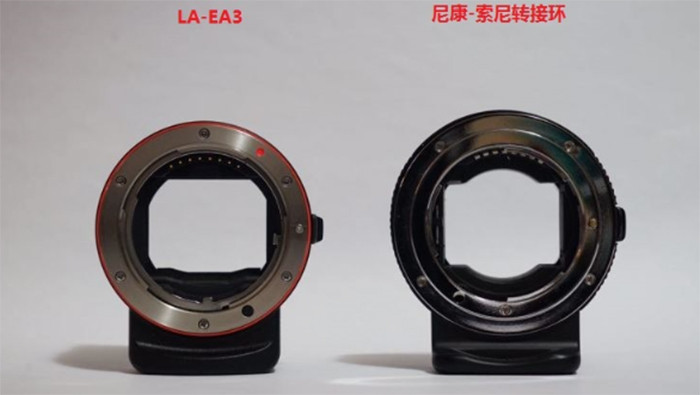
Current autofocus adapter available for other lens mounts:
Canon EF from Metabones (Click here) and [shoplink 37432 ebay]Kipon (Click here)[/shoplink].
Contax from [shoplink 37433 ebay]Techart (Click here)[/shoplink].
62 Responses
What are we supposed to see?
this was already in your last link.. nothing new here
I had hopes that it would do AF with non-G series lenses too (Like Minolta/Sony SAL lenses, screw driven) but in the video it does NOT do AF with them. It only controls the aperture.
Which is the trickier part to make work.
I hope it does not Af with D lenses. Af with D lenses means powerful motor that will shorten battery life and make the adapter bulky like EA4. There could be option to disable AF but the bulk will stay
I’d be happy to have two different adapters, one with AF-D support, one without. I also hope that a company comes up with a LA-EA4 like adapter without the mirror so that we can use the PDAF on sensor with the screw drive.
This will be the best option – Two adapters. I too hope for EA5 or alike with motor for lenses like 1.8/135
Also, none of the current LA-EA adapters support distance readout from SAL lenses, something SLR/SLT models can do, including very old ones such as Minolta 7. That results in improved flash and light metering and a smoother operation of the focus ring while focusing manually.
How much does the LA-EA4 shorten battery life?
Why would the in-adapter motor be significantly less efficient than the in-lens motor?
The motor in the DEO Tech Contax G adapter is pretty small.
In any case, I see something in the photo at the 7:30 position where Nikon’s screw drive is located. Maybe just a hole in the mount… hard to tell from that one photo.
Try it. It depends on the lens. For exmaple tracking horses minolta beercan does not produce many images at all.
The ‘D’ in the name doesn’t say anything about the type of autofocus. It just signals the ability to feed data on the focussing distance back to the camera (where it is used for light metering purposes).
Since all AF-S lenses incorporate this distance chip, the D is not included in the names of them. Therefore the inclusion of the ‘D’ in the lens name indicates the lack of a built-in AF motor. The opposite however is not true, ie, the lack of a ‘D’ in the name does not guarantee the presence of an AF motor. There are plenty of AF lenses without either an ‘S’ or a ‘D’ in their name that don’t have a built-in AF motor.
Calling screwdriver AF lenses ‘D’ lenses is thus a misnomer, as ‘D’ lenses only represent a subgroup within the screwdriver AF lenses.
Just a side note: ‘G’ stands for “no aperture ring” and has nothing to do with autofocus. ‘AF’ is the screwdriver autofocus and ‘AF-S’ is a lens with built-in AF-motor.
Ah, ok. I hate Nikon nomenclature.
a :14 second video with obtrusive music really tell you a lot.
I watched it twice and it didn’t look like it actually focused the lens. They may have cracked the code, but this video doesn’t demonstrate that.
The background music doesn’t help either…
Agreed, and the problem with the Nikon lens mount is that there have been many, many tweaks over the years. Some that even got Nikon cameras into serious issues (Dead Battery Syndrome was a result of a lens mount communication issue). Moreover, recently we’ve got another version of how the aperture is controlled via E lenses (e.g. 300mm f/4E).
My guess is that any lens adapter without sophisticated, programmable electronics in it will have an issue with some Nikkors, possibly many Nikkors, and that changes Nikon will likely make very soon to the mount again could prove problematic, too.
What changes will Nikon soon make very likely to the mount? Are you allowed to comment on this?
It’s mostly a guess on my part based upon some things I do know. The E type lenses are certainly going to continue, and they are controlled differently than the D and G lenses.
This is the second video, there is a first one where you can see the AF working
The new adapter shall be called Sonykon~!!!
The test is using old NEX camera so no chance of AF with old lenses like the 50/1.8 D
I see aperture control at work which is nice. This solves big issue with G lenses that lacked credible aperture control until this video.
Let’s hope there is AF with G lenses and new bodies like A7r II and may be A6000, A7 m2. They should work with A7r II to make it focus smoothly with G lenses.
PS I actually hope they do not put AF motor for D lenses. This will make the adapter bulky and not so friendly like EA4. Aperture support for old lenses + AF for G lenses seems enough. I hope stabilization also is figured out so we can use the lens or camera stabilization (specifically lets hope focal length is properly reported for zooms.)
PS Even if adapter only supports aperture control this will be useful as one can MF using open aperture and aperture will close down automatically when shot is taken. This works rather well
What does the age of the NEX camera used in the demo have to do with what lenses are likely to be supported for AF?
older cameras have less advanced focusing system. The only one that is known to be able to focus some DSLR lenses decently without translucent mirror is A7r ii.
The AF with DSLR lenses without mirror of older cameras is useless anyway. So weather the nikon adapter has it or no makes no difference. Focusing takes 5 seconds or more
Sounds like you haven’t actually used this. It takes up to 5 seconds, not 5 seconds or more, and it’s useful for some applications… just maybe not yours.
Regardless, that has nothing to do with what you said. If they can AF on a NEX, then can AF on a newer A7, A7RII, A6000, etc. And, whether they’re using a NEX or newer camera has nothing to do with whether AF with an older lens will work or not.
they will never enable A6000 to use OSPDAF with non-E lenses.
aperture control in the mirror
If emount had been really open source, we would have had working adapter few years ago.
It actually is almost that. If you are interested get in touch with Sony’s developer support folks.
Sony opened it when NEX-5 was first released.
Some vendors complained that the specs Sony make are not detailed enough ….
Problem with nikon adapter is that it is not only electronics. There is also mechanics involved and …
It is the opposite of open source. They explicitly say they don’t take questions from hobbyists.
but they do license the mount specs which is far batter than Canon and Nikon that keep close lid.
m43 to my knowledge too is not open source.
License means you can’t do things not allowed by Sony.
The difference with canikon is so small so it’s irrelevant
Sigma produces more lenses for “closed” canikon than for “open” sony.
You seem to be conflating two things. The reason why Sigma makes more lenses for Canikon is that it is a much larger potential market (at least 7x in size).
I don’t
Yes, you are. Sigma is merely following the market share. It doesn’t support your claim. Neither does the several years old Metabones adapter.
It proves factual difference between Sony and Canon in licensing is minor
the open source question is difficult for big companies. Especially with hardware like a mount system it gets very complicated. First there may be 3rd party IP that Sony license in the mount and they cannot make that open source. Second the legal process to open source new versions is huge for a big company. It is very difficult to keep all license stuff for closed releases (note that Sony keep open sources for any open source products they use) when you actually want to open source your code as a big company it gets almost impossible from legal stand point.
So Sony have done what seems of commercial importance they license the mount specs to 3rd parties. This is huge by itself as it is costing them a ton of effort already to be able to release the specs under some limited license.
Compared to E, m43 is much more open. Even 3rd party cameras exist.
Huh? They have to pay large licensing fees. Sony you have to apply, which you can’t be bothered to do so you are stating based on pure speculation.
it’s your licensing fees for m43 speculation?
Whatever man (or ladyboy).
Since when does “open source” mean “will take questions from hobbyists”?
Sony’s lens mount information is open to license. Nikon’s lens mount information is proprietary and not shared with third parties.
Outside of your marketer speak, there is very little difference.
I’m a writer. Words mean something. And it’s important to make sure that the reader understands what they mean. Your use of “Open Source” is a secondary meaning that’s not actually agreed upon by all dictionaries.
I believe the primary thing you’re asking for is that Sony make the mount specifications fully and freely available to anyone without license, and probably also without any limitations. That has implications for Sony if they were to do that. It would have a tendency to lock what they could do with the mount in the future, as the minute that the ecosystem starts including products that absolutely rely upon said “free” specifications, you’re not ever going to be able to make changes downstream.
In a license system, you know who is using your mount specifications, and can have a direct dialog with them. Thus, if you think you’re going to change or add to the specifications in the future, you can do so under the NDA of the license in advance of the change and better manage the possible disruption that occurs with the change.
BS. They have their own old 18-55 and NEX-3 cameras that they should keep compatability with
They don’t want people making CAMERAs with their mount. It isn’t that hard to be a developer it seems, but you have to agree to certain conditions.
these “certain conditions” are not published by Sony and are under NDAs, and there may be more restrictions which we don’t know
Because ‘hobbyists’ would have made one?
I wonder why E-Mount got EF adapters before any other mount. Or AF contax G…
Canon EF and Contax G are modern, electronic mounts.
Nikon F is an old, semi-mechanic mount.
I wasn’t talking in comparison to Nikon F, I was talking available for E before say m43’s etc.
OK.
The most possible reason for that is simply the demand.
Remember that these adapters are not simply made using some given specs. Companies like Metabones have to reverse engineer mount communications. That uses a lot of resources and has to pay off. 🙂
MFT is a system built to be small. And it has decent native lens choice. I don’t think many MFT users dream about mounting a Canon 24-70/2.8 to their tiny body.:)
That thing is HUGE and UGLY.
That’s what she said!
Does that really matter?
Well, yes, a great deal, to me.
weird but ok
Weird? If size and weight aren’t important, why bother with mirrorless in the first place? I would say that size and weight are the very factors that drive most people to mirrorless.
But Ola that isn’t something they have control over. All the dimensions are fixed by the requirements of the camera and of the lens systems that this unit is adapting. They can’t make it smaller or it wouldn’t work. The lenses that can be attached via this adapter were not designed for mirrorless cameras so they are big heavy things. If you are using an SLR lens you aren’t going to get the small light weight advantage of a mirrorless. If you are buying an adaptor for big SLR lenses it doesn’t make sense to complain that it is huge. It has to be.
I was more interested in that you found it ugly.
That’s true Alexander. I’m just expressing my own personal taste, nothing more. I would never buy a big chunky Nikon adapter. If I wanted to use Nikon SLR lenses, I would much rather use a dedicated Nikon camera. Legacy adapters, OTOH, I totally understand, because some legacy lenses only physically work with mirrorless. But to each their own of course.
I’m guessing they used a non AF-S lens because the AF component isn’t working yet.
I would be thrilled with in camera aperture control, VR stabilization, and Exif information.
AF would be icing on the cake, but those 3 would be 3 things current Nikon lens adapters cant do yet.
Well, I hope the AF speed is good… but I doubt it judging by canons adapters. Unless there is one I don’t know about.