







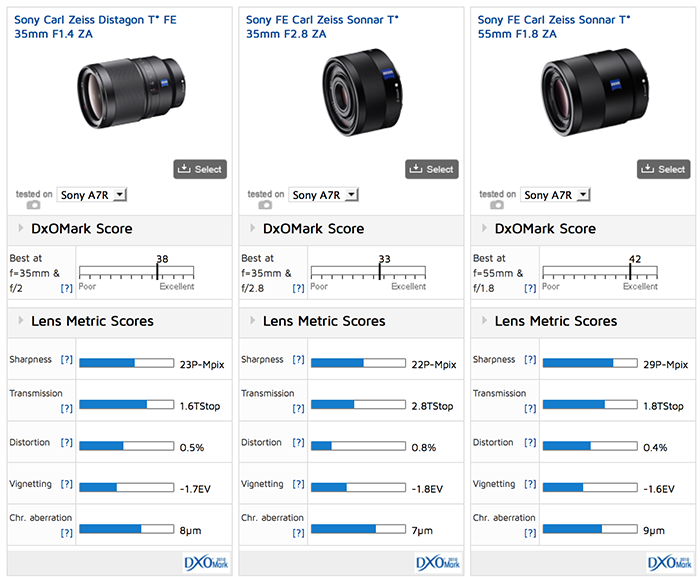
DxOmark (Click here) published the Zeiss 35mm f/1.4 Distagon FE lens test results and writes:
With excellent optical construction, including three aspherical elements, it’s a pretty hefty lens, however, that measures 112mm in length and weighs 630g. If you’re looking for top-quality low-light shooting, you’ll need all that heavy glass, however, and it helps the FE 35mm f1.4 deliver some excellent results.
Achieving a high DxOMark score of 38 points, the FE 35mm f1.4’s performance is excellent and ranks as the second best FE-mount lens we’ve tested. Sharpness and Transmission results are particularly strong, and with decent results in the other Lens Metric categories, it’s an impressive all-round excellent performance from the FE 35mm f1.4.[/shoplink]
The 55mm FE is still the king of sharpness. Looking at the score comparison I am actually surprised to see how good the much more compact FE 35mm f/2.8 lens is. A nice little (still bit overpriced) gem 🙂
The Zeiss 35mm f/1.4 Distagon FE is in Stock here:
in USA at Amazon, Adorama, BHphoto.
in Europe at Sony Germany, Sony UK, Sony FR, Sony IT, Sony ES, Sony NL, Sony BE, Sony AT, Sony CH, Sony SE, Sony FI, Sony NO, Sony PT.
in Asia/Australia at Digitalrev, Sony Australia.
89 Responses
Don’t they mean Japanese precision?
Carl Zeiss (German pronunciation: [ˌkaʁl ˈtsaɪs]) is a German manufacturer of optical systems, industrial measurements and medical devices, founded in Jena, Germany in 1846 by optician Carl Zeiss. ~wikipedia
Sony Corporation (ソニー株式会社 Sonī Kabushiki Gaisha?), commonly referred to as Sony, is a Japanese multinational conglomerate corporation headquartered in Kōnan Minato, Tokyo, Japan.[3] Its diversified business is primarily focused on the electronics (TV, gaming consoles, refrigerators), game, entertainment and financial services sectors
The article is about the lens though.
It’s a Sony-Zeiss lens, which doesn’t have much to do with Zeiss. It’s Sony designed and built in Sony factories. All Zeiss does is some approval and QA on the designs
Thanks for clearing it up, I do not have insights on these procedures.
The Zeiss Loxia and Batis lenses are truly 100% designed by Zeiss (still built in Japan though by Cosina).
I wonder if Sony had a hand in the electronics of the Batis (AF and OSS). The OLED screen seems very Sony-esque as well.
Great lenses though, both stellar in practical use, I’ve had far worse German Zeiss products over the years.
Totally, not knocking it. I even love my Sony Zeiss 24-70 f4
Totally get you, but if I were being totally honest, I’d have to say at 24mm I much preferred the look I got to the Canon 24-70 f/2.8ll over my FE 4/24-70.
I would hope so, that lens is $1900 🙂
I’d happily pay $1900 for the FE if it had that look wide-open @ 24mm. The Canon is, by contrast, a HUGE optic, the files produced from it have that Medium Format look.
The thing that amazes me about the little Sony FE 1.8/55, it too has that MF look, I’m leaning towards the conclusion that the Sony FE system is actually a prime lens system. I shoot 99.999% wide-open on these little cameras, that’s where they excel.
Have you considered the new 24-70 2.8 II for A-mount that’s coming out? It may very well be even better than the Canon. Huge lens also but would have even better AF via the EA4 adapter
The adaptor, it really puts me off. I shoot outside, often preferring poor weather, there are already “issues” that arise, especially on the A7R. I don’t want to add another layer of complexity to an already fickle (first gen.) camera.
I’m looking to the new Batis 25mm to replace the Canon @ 24mm, fingers crossed!!!
I’m also interested in the Batis however now that I have a Loxia 50 I really like the metal and true Zeiss build quality. It remains to be seen, the Batis kind of seems more like a Sony lens with plastic/OLED, etc…
A Loxia 21 or 25mm Biogon would be great
I rely heavily on rear button S A/F focus & recompose for my work. With the A7’s exceptionally accurate S A/F I can ping an eye with absolute confidence. Even beyond 10 feet on the FE 1.8/55 I’m shooting wide-open for the M/F look. My A7’s are always used with “setting effect ON” as I’m concerned with focus shift etc, so manual focus for me (especially with aging eyes under stressed conditions) could become problematic.
as far as i know, zeiss & sony has shared a joint-developed design-platform for optical design.
from the zeiss website:
“Sony and Carl Zeiss develop Lenses for Sonys digital cameras together. Then the manufacturing takes place in Sony facilities according to Carl Zeiss specifications. It’s a partnership that combines premium-quality electronics and sensor technology with the best-possible optics for film and video cameras.”
and from elsewhere “The days of one country’s manufacturing capability being superior to another is for the most part, history. Only a ‘snob’ will thumb their nose at a Zeiss lens made in Japan. If Zeiss has on their payroll in Germany, a chinese lens designer, does that make the lens inferior? I think not.”
its a non-issue.
Paper is patient, as they say, which goes just the more for the virtual paper of the ‘information age’. Leica always used to say the same for Panasonic-made, Leica-labelled lenses, which never were anything but developed, designed and manufactured by Panasonic employees, while just being approved by Leica at one point as somehow worthy of their name (which, by the way, might just as well be disputed in some cases, given the amount of post-correction some of them still do need).
Your post seems reasonable, I can give you that. But if you ever held and used a Loxia or Otus, it would be quite apparent that Sony never has and never will build solid lenses like that. There are bigger differences between the companies than you think.
True, but I think the Batis lenses will narrow the gap.
If you are trying to say that the Batis will show a little bit more Sony-ish build, with more plastics and electronics, you’re probably right. Let’s just hope that Zeiss don’t lower their quality standards too much.
Having used both, I can say the a-mount Sony zeiss zooms are among the best, most “solid” zooms currently available.
All the Zeiss does is marketing speech about it does some approval and QA on the Sony designs. We don’t know if germans really check them.
The 55/1.8 is entirely designed by Japanese. The Zeiss badge and corporate ID is branding, just like the red ring on Canon L lenses.
I’m sure Zeiss reserves the right to accept or decline branding a lens after testing it. And I’m sure Sony gets access to designs and patents from Zeiss. But in the end it they are just very good Sony lenses, and as the 55/1.8 has proven to everyone, that’s nothing to sneer at.
They should but DxO has proven they are not particularly precise. The company is based in France and thus lacks German precision.
You mean Japanese precision.
This one’s not Thailand precision like the other Zeiss?
disappointing…sigma is way better at 1.4-2.8… this sony 35mm is so average and heavy for what it does
http://www.dxomark.com/Lenses/Sony/Sony-FE-Carl-Zeiss-Distagon-T-STAR-35mm-F14-ZA—Measurements
http://www.dxomark.com/Lenses/Sigma/Sigma-35mm-F14-DG-HSM-A-Nikon—Measurements
German Zeiss and Sony Zeiss, real and fake, produced here or there, I know better than both Sony and Zeiss… Bullshit! Whatever you say, it is a Zeiss, designed and produced together with sony, being shit or a gem, like ot or not! Take it for what it is…
one stop more expensive than 35/2.8 for one stop.
Two stops.
Huh, quite a bit softer than the Sigma at f/1.4; a bit disappointing given the price. The OOF rendering though is good enough that it may still be preferable over the Sigma.
It is not:
http://www.dxomark.com/Lenses/Compare/Side-by-side/Sony-FE-Carl-Zeiss-Distagon-T-STAR-35mm-F14-ZA-versus-Sony-FE-Carl-Zeiss-Sonnar-T-STAR-55mm-F18-versus-Sigma-35mm-F14-DG-HSM-A-Nikon___1518_0_1252_0_1057_0
Try comparing against the D800E instead of the D800.
But D800 has a better sensor score than the A7r. So we should use the same sensor resolution if you want to compae the two lenses 🙂
D800E or D810 have no AA-filter, like A7r. They both show better performance with the Sigma Art. This doesn’t tell us s.th. of the rendering or wether these differences show up in real life.
DxO scores are dubious no matter what combination of sensor you choose. The concept of comparing lenses that aren’t mounted on the same camera/sensor is completely flawed from the start.
I strongly prefer http://www.lenscore.org who use a specialist 200 mpix sensor to compare all lenses on exactly the same system.
And even then flat test charts are a poor approximation of real life photography.
My opinion is that brands like Nikon, Olympus and Sigma spend too much time optimizing for DxO test charts that they lose focus on whats important.
This new Sony 35/1.4 achilles heel is not the sharpness (it is impressively sharp), the problem is the bulk, just like the Sigma. The Loxia 35/2 walks all over them if you ask me.
Nevertheless, measurements like this give an idea of the lens+camera performance. It is certainly not perfect. I like the optical bench testing of lensrentals, but as far as I know, they can’t test EF lenses with their device. As to lenscore, I know their site, but information is lacking as to how in detail the measurements are done. They only give a final sharpness score, without any information regarding the acuity distribution. The reference lens seems to be the Nikon 85/1.4g.
I usually distinguish between pro work and leisure when choosing lenses. For events, I have no problem using the Sigma 1.4. Results are great and weight is no concern for us so far. For travelling, the Loxia is indeed a great solution.
“I strongly prefer http://www.lenscore.org who use a specialist 200 mpix sensor to compare all lenses on exactly the same system.”
I really the concept of what they’re doing, but I honestly have trouble believing any of their results. There’s very little actual information on what they’re doing and they have quite a few results that just don’t make any sense (i.e. Canon 85 1.8 has the best control of LOCA of almost any lens in the EF lineup?!?) In addition, the fact that they don’t post anything other than DxO style single number results mean you can’t even attempt to interrogate their findings.
Sensor score doesn’t include resolution at all
Sensor score influences the lens results. Just try to compare the same lens performance on the D800 and D800E 🙂
These DxO figures just show how completely bogus they are, although even they do still hint that the Sigma might be better wide-open (“best at f/1.4”) than the Sony (“best at f/2”).
No f/1.4 lens, though, is or ever was “best at f/1.4” or even f/2, except if you count the fact of having that wide aperture in the first place into the score. Which just doesn’t make sense at all. We neither get to know how good a lens really is wide-open, nor how much better it really gets when stopped down, nor at which F-stop it has its real sweet spot. Which would be the only questions a serious photographer would want to know.
The DxO figures are the distorted measurements of professional pixel counters that do not relate to the real world of photographic practice, even if they sometimes may seem plausible, because after all good and fast lenses indeed do come out better than not-so-good ones, as long as they’re slower or just as fast.
Why? Look at the individual measurement profiles, on an AA-less body (D800 has AA-filter, A7r doesn’t). Quite useful to see how the acuity changes across the frame. The Sigma Art is measurably better wide open and prevails slightly over the rest of the f-numbers. But the Sony is a very good performer.
SAR_Admin has a valid point in saying to be fair sensors with the same sensor score would need to be compared; we don’t know whether the Sony lens might even come out better on a Nikon D800E/810 sensor. On the other hand, DxO’s sensor scores are just as bogus. What they measure as ISO is not ISO, and the score is calculated for 8 MP, which I find completely misleading.
I don’t understand this reasoning and disagree here. The sensor score is way different for AA-less and AA-filtered cameras. D810 and A7r have the same sensor according to many sources (I am not sure, however), so this should be the camera of choice (or D800E).
> which I find completely misleading
You better find what’s wrong with your math and engineering knowledge.
Ok, I’m always eager to learn! Can you give me a hint where I could go to find such knowledge? Knowledge that would help me find out that generating image-quality scores for 24 and 36 MP sensors by scaling them down to 8 MP would indeed be sensible, be it from a photographic or from a maths and engineering standpoint?
Engineering:
36Mp and 24Mp images cannot be compared directly since they have different dimensions. You can only compare same dimensions. Thus, different mp pics should be fitted into the same dimension first and since that comparison is possible. The fact measurements at 8Mp differs for different sensors shows this was a reasonable choice.
Raitionale for the previous point:
Consider 1d example: music record. Let’s first record is taken with 10Mhz sampling and the second at 20Mhz. Thus, if we took same amount of samples of each record the first one will reflect twice longer chunk. And so, how would you compare this _different_ chunks? They are different. You see in this sample you need to compare chunks reflecting the same period of time, not the same amount of samples. So take same same period chunks. What should we do know? Chunk from the second record is twice longer in samples. You either donwsample the second or upsample the first. It is fundamental limitation we lost some on downsampling second or enhance record noise on upsampling the first. The visual sampling case is the same, just in 2D.
Photography:
You don’t judge photographs pixel by pixel. First you observe it as a whole on some media. For practical reasons medias usually have the same size (A4, A3, A2, etc), and this is the equivalent for downsampling to the same dimension.
Thanks for your effort, but I think the problem still remains that the information a 36 MP image contains can never be completely preserved when reduced to 8 MP, so quite a lot of what the practical value of the sensor is about becomes lost, even if some differences between higher-megapixel sensors still show in the score.
It was a discretionary decision by DxO to choose 8 MP, led by the idea how large people will at most print their pictures. But if someone intelligently decides to buy a 36 MP camera, they do so because they either know that they do print their pictures larger than most people, or that they need more leeway for cropping than most people. That someone would need to know how that 36 MP camera compares at 36 MP, not at 8 MP.
DxO measures without correction as well. More correction for distortion = lesser IQ. I hate how people seem to not get that software correction isn’t without its drawbacks.
You’re not accounting that distortion doesn’t always need to be fixed. In many shots unless it’s extreme it doesn’t really matter
I am no DxO expert…. but it looks like sigma is obviously better based on DxO number
well, sigma is really hard to beat even for Canikon. The thing about the sigma is not so really great bokeh and i like to know how the comparison of micro contrast quality of sigma and this zeiss lenses .
the Zeiss lenses are nice, but from what we know right now they can’t compete 100% with the “real” Zeiss Batis/Loxia lenses (only price-wise). Since the Sigma lenses are at least as good as these Zeiss lenses but for 50% less money, I would prefer Sigma. Yes, they are larger, more heavy… but who cares, these are special lenses for special occasions. I wouldn’t consider taking a bunch of fast primes with me on vacation (maybe just a wide one for landscapes…). And at all other occasions, weight isn’t my major concern if I can have approx. 2 lenses from Sigma for the price of one Zeiss….
> they are larger
not the case with this Sony Distagon monster. It is huge and has about the same size as Sigma + adapter. Weight is equal too.
well.. you are right… so what’s the reason for the zeiss??? native e-mount; what else???
Zeiss Distagon rendering.
Same reason people spend $1900 on a Zeiss Distagon 35/1.4 ZF or ZE, a lens that is according to your logic inferior to the Sigma. Sure.
I have heard different opinions. Many people claim Sigma 35 gives more pronounced 3D pop than zeiss distagon 35, while the “3D pop” effect is a trademark for zeiss: it has never been a bokeh king. So, if you think the bokeh of sony distagon is nice, I should warn you: this _Sony_distagon_ rendering, not _zeiss_.
Epic fail for Sony, lazy lens designers making retrofocus crap. The 35/2.8 at least make some sense
Yep, a big fail… if you don’t ever look at photographs and base your opinion on some minute differences on test some charts.
I would like to see pairwise comparison to Sigma 35/1.4 but there are none.
I would like to see IRL any photographers using FE 35/1.4 but all photographers I see use CaNikon gear lol.
Eek, the FE 35/1.4 is more expensive and weights just about same as SLR 35/1.4 lenses
>ranks as the second best FE-mount lens we’ve tested.
out of FOUR FE primes lol
The difference in sharpness score compared to sigma (30 mpx vs. 23 mpx) is not minor, the price difference is major.
How does it compare to Canon and Nikon 35mm f1.4’s? I guess all those expert photographers are shooting crap as well because they aren’t better than the Sigma? I have the Sigma and would definitely prefer the Zeiss and will get it once prices settle a bit.
OLDER Canikon lenses are of course softer than the new Sigma, but the FE is newer than the Sigma, and Sony designers have had luxury to allow 12 mm backfocus instead of 38 mm as for SLR lenses.
The new Nikon 35/1.8 is sharper than FE.
Well those Canikon shooters won’t be fairing as well with their native lenses either. Epic fails too, right?
Yep, it weighs about the same (that’s obvious). Now compare the size weight of the FE 35/1.4 and Sigma 35/1.4 when they are attached to their respective cameras.
You’re talking as if coming second behind the FE 55/1.8 is some kind of disgrace.
Yes, the Sigma tests sharper (notably at wider apertures). If sharpness is the most important aspect of lens performance to you, you will be very happy with it. Some lenses sacrifice sharpness for other aspects of performance, such as bokeh quality, and maybe more importantly, the focus transitions. The Sigma cannot compete with the Sony Zeiss here.
Sigma bests this Sony zeiss labeled lens in every department they measured.
> such as bokeh quality, and maybe more importantly, the focus transitions.
pfff, sony is typically boring, what’s further?
Or is it just you that is bored?
I don’t even remember seeing a photog with 35/1.4, zooms and 50/1.2 are much more popular. With 70-200 it takes little difference in size of combos.
“I don’t even remember seeing a photog with 35/1.4, zooms and 50/1.2 are much more popular.”
Canikon is more popular? When did you get the results of that statistical revelation?
“With 70-200 it takes little difference in size of combos.”
I can only quote Fawlty Towers in response to that one… “Can’t we get you on Mastermind, Sybil? Next contestant – Sybil Fawlty from Torquay. Special subject – the bleedin’ obvious.”
Admittedly sharpness is a major character for any lens.
BUT not the one and only important feature.
In the end it is a matter of personal preference which lens you chose.
so what are the advantages of FE besides CDAF-able motor?
Dude, you are talking too much technically.
Gear is religion to many photographers. Don’t try to argue that away from them.
One buys a Mercedes SL AMG for 150k, the other one a Lamborghini for 300k. Yes, the Mercedes is the technically better car for half the price, but several guys are buying the Lamborghini. So what does the Lamborghini have, that makes it worth paying double the price? The aura of superiority. Some feel it, some not.
You are right
good morning guys 🙂 it’s a nice sunny day here 🙂
So many strange comments below…… Go out make photos instead of whining!
All testers praise the 35/1.4 – both the measurement guys and the “looking at photos” guys. (F.i. Admiringlight.). This 35mm lens is the best you can get.
One thing is now clear: Sony, Sony/Zeiss and Zeiss all results in great lenses! At different prices and size/weight. A “very wide” and a long tele is still missing. Would be nice with a Sigma/Tamron 150-600 with FE mount.
But Sigma 35 either bests it or match in every valuable parameter except AF speed on FE body: it is sharper at wide apertures (Sony Distagon catches it since f4), it has less CA, vignetting and barrel distortion, the size of Sigma + adapter is about equal to Sony and Sigma costs twice less. This is a fail.
Nonsense. Recent Sigma lenses are optimized for test charts. If you want a lens to measurebate about test figures, Sigma is the lens for you and great value at that.
Zeiss lenses, however, are optimized for taking photos. Even the Sony ones. I have yet to see a Sigma lens that renders images as nicely as the 55/1.8, 35/2.8 and 35/1.4.
The only failure is the size (and Sigma fails here as well). For 95% of the situations, the Loxia 35/2 is the better choice and bests all of them. For critical low light shots (i.e. events), the Distagon is a great addition. Or for people who are unable to focus manually of course.
> that renders images as nicely as the 55/1.8
This thing’s rendition is boring as hell. IMO the only two 50m latest lenses with OK rendition are APO Summicron 50 and Otus 55, others are overpriced for what they do (Sony Planar 50, Nikon 58), too nervous (Sigma 50) or faceless like Sony sonnar 55.
No FE mount = no interest.
https://youtu.be/LLsL7ymyHdg Information about your adaptors with examples, and he’s talking at a level you average trolls should be able to comprehend.
Lets see UK prices Sony 35mm F1.4 ART £626 Sony 35mm F1.4 FE £1400 and where it really matters resoloution the Sigma literally blows it away
Resolution is not necessarily where it really matters. The overall rendering, contrast and bokeh quality would be higher up on my list, especially with a fast prime when shot wide open. I could buy any 35mm prime and get sharp results stopped down.
I already have the 35/2.8. It isn’t pin sharp at f/2.8, but it can create wonderful images.
If I ever buy the 35/1.4, it won’t be for shooting brick walls at f/1.4.
Someone that gets it. Refreshing
DXo is a piece of the overall puzzle it’s not the finished puzzle. It’s all about rendering and how a image looks. Do we print or deliver a raw file to a client. Never we process it to be a final . Same with a lens it’s not always about sharpness and BTW I had two Sigma 35 art for both Nikon and Sony. Great lenses but very pedestrian in look. Big field curvature too. I have the Loxia 35 and it’s a little gem . Nice bokeh, rendering and feel to the images. I shoot art not science or math
Oops that was in response to Mike. Sorry messed that up
Of course.
The problem is, especially for Canikon systems, that I have neither the time to check all the lenses’ online samples about their “rendering” and “bokeh”, nor the money/time to buy/rent all the lenses. It’s also harder to find samples shot under the same conditions.
Scientific data are a good compromise in choosing lenses.
No, I meant [precisely] what I wrote- speaking to their perceptions and putting Germany on a pedestal apart.
The post is about DxO test, and we notice that sigma has a higher DxO mark compared to the FE. But then people argue DxO mark doesnt reflect the rendering and the real world performance of the lens. well… in the real world, after all the post processing and lightroom adjustment, the images come out of a sigma and a FE could look identity… so i guess there is really no point comparing these two lenses. Get what your budget allows.
Agree, except for possibility to equal the look of images after pp.
There are lens characteristics no software is able to copy.