







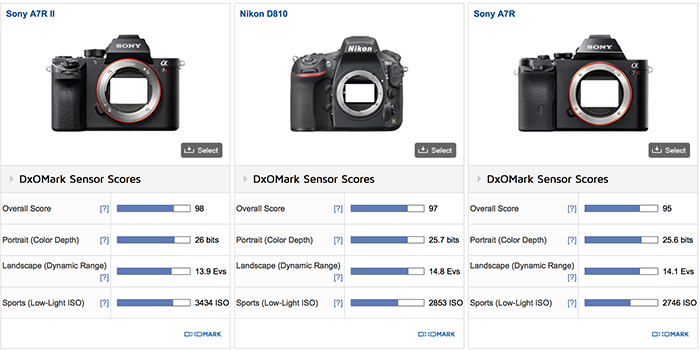
DxOmark (Click here) just posted the full Sony A7rII sensor results. And the A7rII scores the highest result of any Full Frame camera although it beats the Nikon D810 by 1 point only. So yes, we all expected the A7rII to be the best performing camera at DXO, but I guess we also all expected it to be really a couple of points better! And compared to the A7r the new camera has a 0.2 less point dynamic range. Not sure how this one can be correct. I hope other reviewers can check this out!
One more thing: Brian Smith reports that a large Stock of A7rII cameras will ship on September 2 at Bhphoto (get them here now). The camera is alrady in Stock at FocusCamera (Click here).
A7rII preorder list:
In USA: at Amazon, BHphoto, Adorama, SonyStore US, FocusCamera, Uniquephoto.
In Europe at Sony DE, UK, FR, IT, ES, NL, BE, CH, AT, SE, FI, NO, PT. Wex UK.
In Asia at Digitalrev, CameraPro.
A7rII case:
Gariz leather case in [shoplink 39113 ebay]Black (Click here)[/shoplink], [shoplink 39108 ebay]Camel (Click here)[/shoplink], [shoplink 39110 ebay]Orange (Click here)[/shoplink], [shoplink 39111 ebay]Brown (Click here)[/shoplink] and [shoplink 39112 ebay]Red (Click here)[/shoplink]. Also available on Amazon US (Click here).
Gariz Alcantara case in [shoplink 39094 ebay]Black (Click here)[/shoplink] and [shoplink 39095 ebay]Red (Click here)[/shoplink]. Also available on Amazon US (Click here).
Lim’s case in [shoplink 39107 ebay]Black (Click here)[/shoplink], [shoplink 39102 ebay]Brown (Click here)[/shoplink], [shoplink 39103 ebay]Red (Click here)[/shoplink], [shoplink 39104 ebay]Yellow (Click here)[/shoplink], [shoplink 39105 ebay]Navy Blue (Click here)[/shoplink] and [shoplink 39106 ebay]Khaki (Click here)[/shoplink]. Also available on Amazon US (Click here).
245 Responses
I cannot find the DXOmark website review for this camera. The link above just leads to http://www.dxomark.com/
It’s a rumor!
alpha rumor
Because they removed it. Don’t know why. Maybe they are now fixing their site?
maybe they got a call from Nikon, telling them they are wiring the “money” over, so change the score to 97 lol
link does not work nor is A72M2 on the site that I see.
is it a fake link? I just reposted it I hope it is not a fake
Probably preliminary information?
Curious to see the dynamic range at higher ISO. I guess it falls of slower compared to A7R and D810.
According to Bill Claffs Data we should expect an increase around ISO640 when the conversion gain changes (and 32000). Looks to be correct.
http://www.photonstophotos.net/Charts/PDR.htm, looks like at higher ISO the A7RII beats the Nikon D810.
I can’t find the link either (or the Sony A7R II on the site). However, it does have the ring of credibility in that tests have been reporting improvements in DR at higher ISOs, but not at base. Perhaps, compared to the D810, poorer base ISO DR could be put down to the full-time live view feed increasing noise levels due to heating and other effects.
I’ll feel happier when I can actually read the results though.
RAW compression? applying gamma curves that wipe out fine detail in the highlights? Does that ring a bell?
RAW compression has no impact on the DR as DXOmark measure it. They simply report the ratio between the EV that saturates the sensor and that which gets a 1:1 SNR. RAW compression does not impact DXOmark’s DR measurements.
hype.restart(now());
I know it’s not easy to take it…. 🙂
Please, for the sake of your sanity, don’t take it….just go forth to your happy place.
bitter.twisted=TRUE
Cue the haters….
A7rII reign as the king off FF will probably end when the Pentax FF camera is launched in early October. The camera is rumoured to use the same sensor as the A7rII have pixel shift and more importantly it shouldn’t have compressed or cooked raw files
That is like these discussion about Apple – some inexistent product will destroy everything some day in the future.
Could you just give a link on those tests instead of giving links on Amazon by many different ways huh????
I linked to the general DxO page. The review was online at 18:00 berlin time but now got removed. So this is not my fault Leonid!
Got it, at least this news seemed a bit strange without linking it to a certain article.
And you’ll just help to pay for the work that goes into maintaining this site?
Your sense of entitlement is overwhelming!
The dynamic range figure possibly relates to RAW compression!!!! Sony are applying a gamma curve to the RAW file to reduce size from 14 to 11 bits which has very little loss of data usually but not when you want to measure extreme extreme dynamic range. This compression now really affects the overall perception of the camera….Sony should really go and fix it if they want to play with the big boys.
PS I cannot see the results actually….this seems to be something preliminary or what?
I think it has more to do with how Nikon cooks their ISO 64 raw files (see Kasson’s recent blog posts) and how that interacts with DXO’s weird, secret, and proprietary testing methodology to give the D810 an edge low ISO performance. I’m not losing sleep over it. The drop from the A7R is surprising but it is very minor and other tests (with more transparent methodology) show that the D810 ISO advantage is only at ISO 64. Past that the A7R2 is better or equal.
The DR difference with the A7R is tiny. It could easily be the sort of thing you’d find in sample variance and is of precisely no practical importance.
It looks to me like Sony have tweaked things for slightly better performance at higher ISO and let the base much were it was. People should note the A7S is notably worse at base ISO due to the design compromises made at higher ISO (and the Nikon D4S for that matter). Maybe it’s just one of those trade-offs.
As I said Steve, it is very minor. Surprising, but very minor. Even taking DXO as gospel (not a great idea) it is impressive that they’ve improved high-ISO DR without dropping the base DR. Personally, from what I’ve seen I expected it to be very marginally over the A7R. But that’s splitting hairs.
Yup, at high ISO the A7RII has higher DR than the D810, take a look here http://www.photonstophotos.net/Charts/PDR.htm
It’s surprising enough that the Nikon has ISO 64 is the first place…
Raw compression has no impact on the dynamic range that can be captured over a whole image, and certainly not the way that DXO measure it. Any issues are with artefacts in the very small elements of the pictures that are individually compressed. Then you can get artefacts under certain circumstances. DXOmark simply doesn’t look at that. It’s purely the ratio between the EV at saturation level and that where the SNR is 1:1. Compression has no impact on that sort of measurement.
**edit**
explained here
http://photo.stackexchange.com/questions/61692/what-is-the-relationship-between-arw-delta-compression-and-dynamic-range
So can we stop this compressed RAW impacts camera DR? It does not. The issues that do exist are in artefacts in the small blocks used for compression.
Agree mostly but not entirely. Sony always apply the gamma curve reduction to 11 bits and that will cause the brightest 8 levels captured by the sensor to always be lost. Similarly in the very dark areas. So indeed this may lead to some very minor skew of measurement.
I’m not sure how that impacts things as DXO are only measuring saturation and a drop of the least 3 significant bits is trivial.
In any event, no single pixel in a digital camera image every contains 14 bits of real information in bright areas due to shot noise. The full well capacity of an A7R II site is not going to be more than about 60,000 electron charges. As shot noise is the square root of the signal level, then that means noise will be about 245 electron charges. So there are only about 8 bits of actual information. The 6 bits below that are digitising shot noise. Normally you want to digitise perhaps 2 bits of that noise to avoid some artefacts, but anything much more than that is a waste. So this idea that a 14 bit value is somehow capturing 2^14 levels of real information is erroneous. It doesn’t exist. If you do the mathematics on the D810 SNR level at 18% grey (about dB), and it’s known full well capacity, you get around 100:1 ratio (about 7 bits) worth of real levels. That equates to 40dB of SNR (as dB is measured by power, so you need to square signal level). Low and behold, DXOmark report 39.7dB SNR at 18% grey at base ISO on the D810. So there’s really only 7 bits of real information at that 18% grey level. Indeed all sensors of the same size of approximately similar QE and full well capacity per unit area give much the same result for SNR at 18% grey level at equalised output and ISO due to shot noise.
So a gamma curve makes perfect sense. Just set it so that it captures maybe 2-3 bits of noise at all levels to avoid artefacts.
Total image DR does, of course, contain a great deal more than that 9-10 bits of real data at the fully saturated level. That’s because there are much darker areas in an image with high DR and in those cases the least significant bits are the important ones as the SNR is no longer dominated by shot noise, but read noise. That’s where those least significant bits matter (the high order ones are all zero in any event).
So in measuring total DR those “lost” few bits in the bright areas of the image are not only mathematically insignificant (the difference between 16,384 and 16,368 is hardly going to change DXOmark calculations in any meaningful way when the signal level at the noise floor is of the order of 2-3. (Bear in mind that DXOmark equalise for an 8MP output size, so it’s best to use the “screen” measures for per-pixel results).
The issues with Sony’s compression are confined to artefacts in those small compression blocks with some extreme combinations. It has no effect on overall DR.
Some very good (and long standing stuff) on this site with a full mathematical treatment of the posterisation, noise levels, bit depth and dynamic range.
https://theory.uchicago.edu/~ejm/pix/20d/tests/noise/noise-p3.html
It doesn’t cause brightest 8 levels to be lost cause tonal curve is nonlinear in highlights (it’s linear however in shadows)
This probably has to do that A7 sensors are more optimized to higher throughput (for EVF and CDAF) and Nikons are not, and/or Nikon is simply better in RAW cooking.
It will get to be king again once Sony release uncompressed RAW. Added Pentax never showed exceptional IQ
Reality is when Nikon release D820 or wahtever uses this type of sensor that will be the new Number 1 by far.
Would be great if Fuji get their hands on it as they have track record of squeezing the most out of Sony sensors – the 12MP D300, A700 sensor did miracles in Fuji’s hands almost rivaling the 16MP sensor. Same repeats with the 16MP sensors. Unfortunately Fuji are not building full frames
And if we at NIKON actually gave a crap about what really matters going forward, MOTION, we’d be untouchable. But that’d take our (Kodakesk) senior management getting their heads out their collective sixes and release the new mount and mirrorless we’ve had in R&D like forever. Meanwhile, the weekend hobbyists are happy on their camera club outings, whilst our pros are defecting en mass over to Canon’s superb cinema line of cameras.
Actually, for years Pentax has been locked in a neck-and-neck competition with Nikon with regard to DXO Mark APS-C sensor scores. The Pentax K-5 spent most of a year as the (marginally) best-scored ASP-C camera, and the No. 5 camera in the overall rankings. Nikon has only been able to pull ahead slightly since they started using Toshiba sensors in their ASP-C bodies.
And it’s certainly true that for years both Pentax and Nikon were doing a lot better with Sony’s senors than was Sony itself.
“Pentax never showed exceptional IQ”
That is the second nonsense you wrote today.
I wonder what would Tony Northrup say now. Tony swears by DXO numbers. Low light number of A7RII is 500 points better than D810. Yet Tony in his video review said D810 was slightly better in low light. Tony, if you are not on the plane to Machu Pichu, care to respond?
probably no wifi at Machu Pichu (or cell phone service) lol
LOL, I was just wondering about this. Our tests definitely showed (very slightly) cleaner images from the D810 when scaled to the same resolution. However, the results aren’t actually posted on DxOMark, which is strange, because I don’t know how the SAR admin got the screenshot.
I’ll add that I called BS on the a7S noise score, too, because we also found that the D810 images were noticeably cleaner than the a7S images when scaled to the same resolution.
DXOMark uses an algorithm to calculate the noise scores–maybe their algorithm and the noise that’s visible to my eyes in real-world photos don’t completely match up.
Hey Tony, is that really you?
Yes, it’s me, though I suppose I would say the same thing if I were someone impersonating me.
so we probably need some way to verify that. mention my name in your next video that slaughters the A7RII 😛
LOL orico
OK, I dropped a slide in for you in today’s live show 🙂
Great! I’m setting up the VCR and telling my mom to see me live on TV 🙂
VCR? how old are you?
36 🙂
full name Ori Cohen 😛
I’m going to be famous!
Hey Tony! Nice to see you here 🙂
DxO is now showing the A7rII test again!
The last I checked DXO measured by downsampling every sensor to 8MP
DXO don’t down-sample and then measure the results. The take the full resolution results and then apply a statistical algorithm. In principle, this should produce the same result as if you downsize in PP, although that’s highly dependent on how the downsizing is actually done.
In fact the whole thing is based in information theory, so is best presented on that basis.
its HIM. https://youtu.be/twW6P4kbgWQ?t=59m23s
Greetings from Belgium Tony, I like your channel its trustworthy. Cheers
Tony admin says DXO pubished the scores at 6PM Berlin time, then for some reason removed it (maybe site maintenance)?
If you take a look at imaging-resource you will see that the A7RII has less noise than the D810, not much but less. And much better than a 5DS. That’s what my eyes see and DxOMark confirms that.
Tony needs to check his eye – the sooner the better 🙂
http://www.photonstophotos.net/Charts/PDR.htm#Nikon%20D810,Sony%20ILCE-7RII
I don’t use DxO that much but it’s not the only website which confirms a better high-ISO performance.
There is nothing wrong with dxomark. You don’t say the difference between ISO 3200 vs ISO 1600 is 1600 points but the difference between 400 and 200 is only 200 points. . You say the difference is ONE STOP. The OP idiotically see the difference as 500 points, but in reality the difference is only 0.2 stops.
Again stop with your insult. What makes you think i don’t understand what DXO means by its low light score?
>I’ll add that I called BS on the a7S noise score, too, because we also found that the D810 images were noticeably cleaner than the a7S images when scaled to the same resolution<
Our motion team are quite perplexed with your comments!
For once, just see the a7rII with your eye-glasses on, I am sure you would love the camera! 🙂
“low light number of A7RII is 500 points better than D810”
The difference between 3434 I and 2853 is only 0.2 stops. That’s really insignificant difference. Please understand how ISO works, dude. Otherwise you come across as in idiot if you just say the difference is 500 points without understanding it in stops.
I understand it fully and have always understood it. Don’t insult me. It is actually close to 600 points and I know what points mean – it is closer to 1/4 stop. The measurements are fully explained on DXO site.
If you think about it in stops there is no meaning to it, because if you normalize it to 8MP as DXO does it, most modern cameras will have a DXO low light score in between 800 and 3200. In fact top crop cameras will have a score in 1500. Most full frame cameras in the last 7 years had scores between 1800 and 3200. Meaning that it is so insignificant in terms of difference between full frame cameras in the last 7 years, that, if not for half-stops., you could not have even select the difference because your ISOs in cameras would go from ISO1600 to ISO3200 and most cameras had their score measured in between 1600 and 3200.
Then DXO should drop the low light score period because the real difference between cameras has been so little in so long, then why even bother with measure it????
in fact it’s slightly over a quarter of a stop. Just about 0.27 stops.
can I get a direct link to DxO for the a7R2’s scores? I don’t see it there, I’d like to see the charts.
it appears admin says DXO removed the review for some reason right now
okay, thanks… yeah I noticed that after I posted the comment.
http://www.dxomark.com/Cameras/Sony/A7R-II just found it.
Well done, now that they figured out the specs, the tech, maybe they could make a camera body inspiring, functional, responsive and ergonomic. I picked it up at the store and put my eye into that amazing EVF then scrolled aperture, shutter speed and when I saw that shitty display appear and saw how laggy it was I droped the camera back onto the counter and left.
For landscape and architecture its fine, you actually just need a box to record images. But for the rest forget it, this is not a camera its an amazing piece of technology in what feels like an amateur super compact camera.
Its video-centric, but if you’re cannot appreciate (or utilize this feature), well this isn’t a camera for you…..
The issue of dynamic range is probably due to that takes the iso 100 and not, inexplicably, ISO 50.
D810 vs. A7rii: http://www.dxomark.com/Cameras/Compare/Side-by-side/Sony-A7R-II-versus-Nikon-D810___1035_963
Edit: Expected most results after B. Claffs and J. Kassons reports, but not the strong increase in color sensitivity.
check this link out for normalization. http://www.dxomark.com/Reviews/Detailed-computation-of-DxOMark-Sensor-normalization
http://www.dxomark.com/Cameras/Ratings
the link is back http://www.dxomark.com/Cameras/Sony/A7R-II
So you say the EVF is both amazing and &hitty? Is the lag worse than SLT cameras?
5x magnification is useless. Damn it SONY!!!
On some adapted lenses, not on FE lenses and it’s fixable so stop crying.
EVF looks good enough, really, compared to the XT1 for example. Haven’t seen the Leica Q but Sony made a good job on this one.
The shitty thing is how the interface is designed and reacts to the commands.
I like it snappy. Dont judge me 🙂
Well, you have no problem judging all these people who like the camera, so what do you expect?
It doesn’t feel any different from my A77 II, just bigger.
I don’t think you’ve actually held the A7rII. The EVF has issues, but lag isn’t one of them.
Sorry if I didn’t express my though well enough, english is not my first language.
The interface was laggy, the info about the aperture and shutter speed come across on two lines, i mean it was terrible. Why would I lie about holding it? I am a pro photographer and I go in store each time a camera I find interesting gets out there.
Ok so I have an RII in my hands and there’s a display across the bottom with the usual exposure info. When I spin the dial, the shutter speed changes instantly – no notable lag and it tracks the detents nicely.
HOWEVER, it pops up the shutter speed or aperture /separately/ on another line in gigantic font, and this line shows you nearby settings and animates sliding between them. THIS display is a laggy piece of shit. That’s probably what you’re complaining about? Cause the actual shutter speed display in the corner of the screen is much quicker than that stupid animated bar. Would turn off the bar if I could find a way…
Sorry man, I only have what you wrote to go by, no offense intended. As mentioned below, there are different settings with what you see in the EVF, turning off the “Exposure Setting Guide” removes that bar so changes are shown in the little numbers on the bottom row – and the response is instantaneous.
Its a complex camera with lots of setup options, to say its shitty after a few minutes in a store when you clearly didn’t know what you’er doing is just silly and trolling.
Two lines for aperture and shutter speed ? On my A7r I have all exposure parameters at the bottom of the frame and that is one line… Another line of information can be found at the top of the fram: mode, how many pictures left (card capacity), frame ration, file size in MP, file type (RAW+J, a video thing ?, battery level. I found nothing dong there…
But as I mentioned earlier; each to their own: you don’t like it so why bother ? Don’t bother, look elsewhere and chill mate.
I guess I understand what you mean: On other cameras the aperture number would change instantly, but the Sony shows an animated scrolling bar, that takes half a second, until the scrolling animation shows a certain number. Well, I guess they wanted to make it more beautiful and it can be irritating, not the very best part. But to reject the whole system because of it is a big mistake.
“I am a pro photographer” suggest you should stop reading his comments 😀
—-yay its back online!!—–
You sound like you have some anger issues.
Yes I am really disappointed. I was hopping to switch systems. But I can’t, not with this body and interface design.
Concern troll.
Don’t worry and stay cool, there are many alternatives in the market.
Or perhaps mental issues.
True dat.
Worse for low light, worse in dynamic range… so, how did it beat D810?
Not at higher ISO. Normalized to the same resolution it beats the D810 http://www.dxomark.com/Cameras/Compare/Side-by-side/Sony-A7R-II-versus-Nikon-D810___1035_963.
even w/o normalization, it beats D810 at DR at higher ISOs
Why is it worse? The higher number is better.
It is not worse in low light. It’s considerably better in low light 3434 ISO vs 2853. In this case higher is better as it means it can achieve the same result at higher ISO (and hence lower light). The A7R II bests the D810 on 2 out of the 3 measures (losing out on DR at base ISO).
The 810 shows a slight advantage below ISO 100, the A7RII is slightly better starting at ISO 100 and beyond.
I don’t know why but base ISO of 100 should be used for the scores. dxo is using sub base ISO 50 or 32 for the score. The A7r dynamic range is reported higher than the A7r2 at ISO50 but the A7R2 has higher DR at ISO 100 and above.
The curve tells the whole story and shows the A7rII to be superior to the D810 (more area under the curve) especially from ISO 650 through 25600 where the advantage is more than a full stop tapering down slightly approaching ISO 25600 . Interestingly the 5DSR matches the D810 at ISO 400 and maintains a slight lead up to it’s max ISO of 12800. The A7rII takes another jump above ISO 25600 showing better than a full stop advantage. Overall a very good performance for this new sensor.
could you please post the exact link to that picture?
I wouldn’t call a full EV difference above ISO 640 a “slight” advantage though. That’s close to the difference between APS-C and FF, ceteris paribus.
It does not. This is what DxO wrote that how to normalize results to match the 36MP of D810. If you double resolution, then DR, TR and CS increased. So it’s safe to put N0=42 and N=36. Then you will see the comparable number.
http://www.dxomark.com/Reviews/Detailed-computation-of-DxOMark-Sensor-normalization
From same link: “For DxOMark Sensor Overall Score and Metrics, we chose a reference resolution equal to 8 Megapixels, which is a bit less than a 12″ x 8″ print with a 300dpi printer.”
All are already normalized to 8mpx in their scores. So don’t need to do this again.
They provided scores for both print and screen.
Attached is a document on how to normalize sensors to compare them on the same ground, provided by DxO.
http://www.dxomark.com/Reviews/Detailed-computation-of-DxOMark-Sensor-normalization
Bits per pixel: 14.
Enough said.
??
Point being, it means absolutely nothing because of how the manufacturer decides to process the RAW.
DxO applies same methods to all “supported” cameras so it is a fair ground for comparison.
“It means absolutley nothing” … to the person who never worked with those fantastic files.
You have to bloviate elsewhere, seriously.
If you compare between A7r and D810, you would notice A7 is not placing itself in the same league with Nikon “counterpart”.
Exactly, our D810 is stills-centric, it’ll wring out every last bit of pixel detail for you, but it washes its hands where video is concerned. Horses for course, some of the ignorant comments speak for themselves.
It can’t anyways, but there is a lot of mirrorless hysteria out there screaming the death of dslr and “canikon”. And the countless number of blogs and stories about “switch to sony or fuji…”, often sponsored by the brands themselves. Articles comparing sales, market growth, blablabla, you get me.
Just look at the title of the article we are comenting on.
At least it is great that you tested it, did not like it and left the dealer because that’s the way things should be. You should only buy what you like and certainly not feel forced to buy anything you don’t like for any reason. I think You had the right attitude. I will have my A7r2 in early September, it will replace my A7r but I believe that as a traveller amateur photographer these lighter and small form full frame cameras are more suited to myself than yourself. Thus far I had no issues whatsoever with the display, user interface, etc… and the image quality is great. In fact I am traveling through Vietnam taking pictures and enjoying it.
Stick to your guns mate, only buy what you feel is right and stay cool. That’s the way. There are plenty cameras on the market to choose from.
as an early adopter of a7rii, i agree with you. it’s a great camera if used for landscape or even portrait. but it’s not acceptable for sports or wildlife. for $3200 you would expect much better. love the IQ on my landscape shots, but disappointed at sony. only way sony can redeem itself is a new a-mount.
“it’s not acceptable for sports or wildlife”
So, it’s good for the majority of things then.
Barry would probably disagree with you…
grab some popcorn
Bracing my elves.
Man, just crazy. Well, set and score for A99II. Guaranteed domination.
If Sony makes a true mark II a99 and not a sensor drop then it will certainly have a fighting chance. If it has a new 24mp sensor (bsi) with lossless 14bit, a full frame AF system (80% coverage) with a77-2 speeds, large cache & top performing processor for a lag-free experience, 10+ fps, 5-axis IBIS and internal 4k recording at or below $3500 it should be a winner (with some marketing).
If it can’t be made to be a high speed, high frame rate, top AF camera then it will have little reason to exist.
Don’t dream Sony will be allowed to produce such a camera;)
There is a market for it and Sony can sell the AF SLT module as a new LA-EA SLT adapter to replace the 4 with it’s limited coverage area. Plus the a99/a7/rx1/d600 sensor is in need of a successor.
Basically I don’t care about lab comparison. But what I would like to know – what is the 0.9 EV disadvantage and the 600 points in the ISO over the D810 in real shooting conditions?
In real situation
1) D810 can pull off more details with less noise at the shadow, when both at base ISO.
2) A7r2’s high ISO will be cleaner compare to D810 WHEN YOU DOWNSIZE the 42MP file to 36MP.(NOT crop)
lab test isn’t isolated from the real world.
Downsizing from 42 to 36mp won’t make much difference.
It will give you 0.1EV of extra dynamic range.
But you are right, not too much difference, but I am trying to be precise to explain the lab test.
Contrary to popular armchair professional belief: it doesn’t matter….
Make sense, BSI sensor introduce more electronic noise which is obvious at low ISO, that’s why there is a drop in DR.
Everything has it’s advantage and disadvantage, no reason why new tech must be better in every way.
But, it’s a Pentax!
don’t be picky: deuce.
so…
And you tell me..
The funny thing is, 95% of Sony users don’t care about lossless RAW, so you’re barking up the wrong tree.
This one is really funny, how does if feel to be second or third best 🙁 . Jealousy will get you nowhere.
Oh, wow… what a camera.
Hey Chris. I think your dementia is kicking in. This is the third time you have posted the same diagram on this thread.
Am I posting them to the same person for the same question?
Dunno, but I noticed that in other posts you are talking several times about your memory fading ;-p
“BUYS A $120,000 MASERATI… DOESN’T HAVE SYNC GPS LIKE MY FORD FOCUS”
It’s really just so sad how far you have to reach to find something to piss on.
It looks like he should have gotten the student discount and paid $2800.
Turn off “Exposure setting guide” or whatever they call that display. That scrolling tab really is a bit laggy. If you turn it off you can see the changes instantly where it is displayed (lower edge). Feels way more fluid that way.
BIG thank you!!
I’m now off the Sony bandwagon. Bring on PENTAX
http://thenewcamera.com/pentax-full-frame-dslr-coming-on-october-6th-2015/
Wow, didn’t expect those specs. Talk about a buzz.
Pentax needs something like this to get back in the hunt.
Well, if it’s €2000, it makes a chance but at the same time I doubt it will be a satisfactory package. It looks similar to the 2008 Sony A900 and it will have its lovers, but the market for it will be very tight.
Yes, I agree. This will keep the Pentax fans happy but not likely to pull buyers from other brands because nothing really stands out. A possible exception is sensor based stabilization which Pentax has used previously.
Which the A7RII also haves so it’s not a USP.
Right; I was comparing it to other DSLR’s, it’s not likely to attract mirrorless buyers.
Maybe Pentax will produce an A-mount version with a Sony A99ii badge.
Anything is possible. LOL
Next we need Olympus to get back in the FF market
Olympus M43 has a strong following and an extensive lineup of lenses, so I just don’t see it happening.
BTW, 2000 Euro equals $2250 at today’s exchange rate. A competitive price.
I suspect, that if it is €2000, it will be priced at $2000 or cheaper. Going by my country (NL) the A7RII is €3499, while priced $3198 in the USA.
Sony has a no sensor sale policy of 6 months from their own release before a sensor is allowed to be sold in a camera by another manufacturer. It can be developed within that period but not sold, so this is not happening. Fuji is at a major delay because of this policy.
Link (other than rumours and speculation)?
Explain the D800.
Oh boy. Is this official, or something your read on a forum? Don’t bother replying, I already know the answer.
Lol 🙂
Sony doesn’t have enough A7Rii Sensors for themselves. So I really doubt they are underselling their brand new Sensor to Pentax so they can sell a camera body for 2000 Euro.
I find it most likely the Pentax is using the same sensor as the D750. Anything beyond this is just wishful thinking.
2000 euro sounds too good to be true if it indeed has the new 42 megapixel sensor. Pentax does have a good business relationship with Sony and uses Sony sensors in its great medium format camera. Perhaps the current 36 megapixel sensor would be doable at that price.
Yes they buy many of the readily available sensors from a sensor company, but the 42MP sensor is not one of them and probably won’t be for a little while.
In a shrinking market an additional FF Dslr, this time from Pentax, really surprised me. I can’t imagine this to be profitable in the long run. Building up a new lens line and costumer base. But who knows.
Announce on October 6th 2015, ship on October 6th 2016, I guess that could work out for everybody;)
Man, Pentax just went ballls deep in FF territory.
This shit camera has less DR than the APSC Nikon D7200. What a joke….
More seriously this is due to BSI sensor. A lot of reviews showed DR is less good than D810 already. You even published some of them Admin, do you forget already….
I’m not judging just looking for clarity. For many, mirrorless is not yet a proper replacement and that is fine. The world of photography will become less interesting if we all use the same type of cameras.
Something of note from the DXO review, the A7RII finder has a diopter adjustment range of -4 to +3. That’s unusually generous and a plus for eyeglass wearers.
Mr. Magoo
A hair as thick as my entire LEG!!! GO SONY!!!!
Its funny how people are arguing this. If Sony refused to sell Nikon sensors, the D810 would probably rate a DXO score of 86.
Hypothetical scenarios mean nothing. Your guess at a score means nothing. So what are you trying to say exactly?
To anyone arguing the Nikon is way better. It preforms that good because of the Sony sensor.
I wouldn’t write Nikon completely out of the equation. They consistently get better results out of similar chips, compared to Sony.
The parts in cameras come for many different manufacturers. Buying components from other manufacturers is normal. Sony do it too.
The younger generation don’t want to shoot with loafs of bread. They want hi tech light weight gear. Nikon and Canon better innovate.
Actually, the younger generation don’t want to shoot much with any cameras these days at all. Check out the consumer demographics, and trace that against the precipitous decline of all camera sales.
The reason for declining sales is because no one wants to carry a heavy azz loaf of bread. This is why mirrorless is going to be successful. Im in the trenches in Los Angeles game, I see whats going on. Sony is going in the right direction not only for their company being successful but to save the whole market, everyone else is too blind to see. Sony needs to stick to their guns and not give in to DSLR users asking to make it more like a DSLR. Its the younger generation they have to market to. These old DSLR users are stubborn and most are gonna go down the with ship because these old dogs refuse to learn new tricks. I personal changed over 10-20 photographers to Sony just from showing them my camera and the features, from pros to novices. They couldn’t be more excited about photography now. Sony is was more intuitive for the younger generation. The only people that are crying about menus are people that previously came from Nikon or Canon, which IMO have horrible menus. You can see your adjustments in the EVF, you can send photos to your phone over wifi, etc. Especially coming from Canon, its a whole new world. Honestly, if Canon was killing it id be over there, but their not.
Mirrorless won’t be successful too: dedicated photo gear is for pros only, smartphones are more than enough for masses.
Really? 5 years from now it will be almost all mirrorless with the exception of maybe a couple of DSLRs.
Nor will cell phones, my mom only makes a few phone calls a week, why would she pay for a mobile phone too, they have crappy reception, they’re hard to use, and too complicated……..
You guys pop up every decade or so mit useless predictions.
VIDEO….numb-nuts, its about the video!!!!!!!!
And the Sony camera performs that good because of the Sony sensor.
What’s your point?
Sony commercial component manufacturing division supports the two different consumer product lines.
Im just adding to the circle jerk. Literally ALL of this is just hypothetical anyways. All the numbers are meaningless at the end of the day! Its really about photos, which pretty much no one here realizes. Just because someone buys a Porsche GT3 RS doesn’t make them a good driver. And the same reason I didn’t buy the A7RII even though I get a 25% discount, because the A7R is still pretty damn good. That being said, my support goes to Sony for trying to move things in the right direction instead of milking a 10 year old product.
You know what, this is exactly the same defect in A7R and you can find it in A7Rii. They are moving in the right direction indeed, but that’s not about improving their photographic products. It’s about saving themselves from going bankrupt by earning easy and fast money.
Well, that can be said about every manufacturer. Also, nobody has a clue what you are showing.
None of that bothers me. I only shoot in very low light and print 40×60 inches and never had a problem. The photos look stunning.
They should earn as much money as possible and save themselves. They are making photography fun and exciting and they should stay around to continue it. Because if Canon and Nikon were left at the wheel the market would crash due to mobile phones being easier to shoot with rather than their loafs of bread.
I am not worry about Nikon or Canon being forced to leave the market earlier than Sony.
I still remember since last year a crowd was screaming “what a crap! Our FF cameras in the same size and similar price will kick every other brand out of the market!” The excitement grew and grew until A7Rii, a camera supposed to fulfill that goal, was released and problems started to show. Then folks’ rationality suddenly returned and started reasoning.
You know what, typically when Canon failed in comparison tests, Canon fans would just say, “Hey, take some photos in the real world”. I am waiting for that pattern to show here. Popcorn’s ready.
These cameras are “easy and fast” ways to make a profit. Sony’s strategy strikes me as the opposite. Are you that SONYvsNIKON guy?
I am just bashing Sony using the exact same method Sony fans used to bash Canon. However I chose Nikon for reliable performance and cheap lens, which Sony fails to offer so far. I started with Nex-5n, then A57, A77, Fuji, A7. Finally Nikon. So why I grew from loving Sony to the opposite? I must be out of my mind.
Right, you’re so happy with your Nikon that you spend endless posts repeating yourself here about what you don’t like about Sony. Good story. Someone happy with his tools would be out shooting, rather than wasting time arguing about what the competition is deemed to be doing wrong, especially in boards that are all about brands you don’t enjoy.
Well, your humor is a little to sophisticated for me, cowboy. All I gather is that you seem to have an axe to grind with Sony but instead you monitor this inconsequential site, trying to mug Sony lovers in the comments section.
We all get our kicks (revenge) in different ways, but I just don’t understand this “fanboy” mentality. I’ve owned more Sony products than Canon, and more Canon products than Nikon. But if I were to shoot as a pro, I’d use the D810, no question. I’d buy a Sony a7r II if I was a hobbyist/amateur artist (with a healthy budget)– and, well, Canon is difficult. If money simply weren’t an option, I’d buy the C300 II over the Sony FS7, even though it’s twice as much and maybe, just maybe built 5% to 10% better than the Sony.
So shoot with what makes you happy. I would be inclined to think that regularly engaging with fanboys would essentially make yourself one too. Maybe people enjoy that bitter entangling of unfounded pride and ignorance. Like juvenile rams butting heads. (That’s my kind of humor, there.) Either way, cameras, of all things, should be an enjoyable pursuit and interaction, I would think.
Yeah, it should be about the images ultimately, but this is a forum that discusses technology too. Fanboys will be fanboys.
I had to upvote this, for the circle jerk comment alone. 🙂
nikon designed the IMX094,and nikon designed all their flagship camera sensor, Sony is just nikon’s cheapest OEM option. there’s also renesas, aptina, toshiba,towerjazz to choose from if sony doesn’t exist.
and BTW, in terms of CMOS patent, nikon holds more than sony in conventional cmos design, and that they choose to share with sony, so if sony doesn’t exist, nikon will still achieve the same thing but a bit more expensive
What has Nikon done lately? Sony has done more in the last 4 years than Canon and Nikon has done in the last 10. It’ll be a wrap in the next 2 years. No one will be able to argue anything other than complain about menus. Sony will be a mile ahead. I even said this when I bought the Nex5n when it came out. I suggest you invest in Sony stock now while its cheap. You’ll be able to retire off it in 15 years. All in all at the end of the day. This whole debate stuff is for fun.
sony‘s most improvements are from phone sensor technologies, BSI and stacked etc, but keep in mind these are not for conventional design, they were meant for small sensors, and yes, it could make some improvements when apply to larger sensor, but not always reasonably suitable for larger sensor.
the companies really making ture improvement with a premise of large sensor when design it,are nikon and panasonic, yeah I know it sounds wired when you see panasonic just come from no where, but from the patents these two company registered, trust me they care more about full frame than sony.
its really two different method, sony is trying to make sensor more and more complicated so they could apply more functions to it, while nikon and pani keep the structure simple but trying to improve the hardware materials. but keep in mind sony’s method will lead to many side effects which become more problems for them to solve.
and also keep in mind, sony is a company crazy enough to put everything on production line, including those not yet refined stuff, nikon on the other hand is more thoughtful. for example the D810 and D800 looks like to have the same sensor since they were all 36mp, but the sensor in D810 was really a newly design, they did not increase the pixel amount because they were not confident enough to do so, But panasonic was a different story, they have the tech for sensor but not very many color theory management experience and digital formula solutions(I mean compare to top of the line tho) so they have good sensors on hand but still one step from good pictures.
so yeah you see sony’s taking the lead, and yes its a game changer. but does it mean their direction is always correct? I personally think its still to early to be sure about
I think there’s a little more Sony design in those 24mp and 36mp sensors than you portray. It’s true that Nikon was able to manipulate the sensor’s output in some impressive ways, but ultimately I think that’s all it is– the sensors have to work with Nikon’s own processing engines at some point. Sony isn’t going to build the whole camera for them, nor would Nikon want them to.
There’s no way Sony was *just* the lowest cost OEM manufacturer. These 24mp and 36mp chips are spec’d identically, and they perform almost exactly the same whether they’re in Sony cameras or Nikon. And those rating span more than 10 models and 3 years now.
Patents are often just ideas. You could sketch out an amazing electric car to compete with a Tesla, but building it is a universe apart.
Sony just raised $4 billion in (additional) funding to spend directly on their camera sensor business. I’m sure Canon is full of great ideas too, but clearly, bringing those ideas to life requires more than even Canikon is able to muster right now. I hope for the sake of competition that the sensor in the 5D mkIV is amazing. But *where* is it? Maybe Canon should call towerjazz.
first, nikon has the ability to make a sensor almost from head to toe except a factory to assemble it, because nikon is just a small company.
the imx094 was truly designed by nikon and they had the priority to use it on D800/E. and Sony choose to use that 36mp sensor only on their A7r, have you ever seen another sony designed sensor only used once in sony camera? except that 50mp medium format sensor
the 24mp sensors however, were all designed by sony, but theres many different versions of 24mp
the IMX128 and IMX094 has almost the same performance is exactly because what I said, around 2011, sony and nikon bought a patent together from a Israel company which is about a kind of algorithm and raw process logic.
the sensor on D4 as well as D4s and DF for example, was totally designed by nikon, but sony can’t make it, at least back in 2012, they can’t achieve that read out speed which nikon asked for.
the patent I mentioned about, were patents thats already in use in current products, if the patent owner doesn’t give authorization, others can’t apply it to their products. sony and nikon shared and even purchased many patents together.
one of the reason sony was so eager to apply BSI and stacked sensor so quickly to their camera was because its a good way to walk around nikons patents. but see the DR drop on A7rII compared to A7r, the base noise was too high on the new BSI sensor, because the BSI is just a front end tech, on the back end however, sony is not the best, and is very slow in this category, raw data transfer was kinda slow before they were processed in ADC, therefore caused higher base noise.
I agree with you that new patent are just ideas, still have a long way to go before we see them in products. panasonic is a good example, they could compete with sony but they just didn’t want to do it.
canon is far far behind, yes they patent many things, but most of them were not even relate to image quality improvements.
and remember that patent from israel i just mentioned about which now belong to sony nikon? thats the key why sony nikon has better dynamic range in shadow area than canon. so I wouldn’t expect any improvements from canon, not in the next 5 years.
This is the best, most interesting reply I’ve ever received on this site re: any of my comments. 🙂 Thanks.
Um. There are contractual relationships with commercial component suppliers, of which Sony is one. Sony cannot just “refuse” to sell them.
Now would they want to, they make a lot from sales to Nikon, and Nikon DSLRs are not direct competitors.
You know you can customise this right? A two second play in a store with the assumption that you use it like a DSLR is 100% guaranteed to disappoint.
Actually I didn’t but someone replied that it can be customized and now you confirm that. Nevertheless, I want it to perform like a DSLR.
I’d like to rent one if some store actually does here, but in many countries in Europe people pro studios or production company don’t rent Sony for stills, its medium format, canon or nikon.
Anyway Im excited by the tech stuff, but for me it just doesnt cut it yet as I need a camera that I like or at leat that feels rock solid on the design.
My Canon gear is just a tool, its nothing really nice to use (I shoot a lot of film camera from 4×5, 6×6, 645, 24×36 and they are really great cameras) but at least it is really well engineered, very reliable and i can count on it. I know when I pick up a camera and play with it for a while what it is really worth. This Sony can achieve incredible performance yet in my opinion its not a camera, its a photo and video recorder. The A7 series just don’t convice me on the body/feel/construction level, even if i’d like my camera to have the same specs!
-I’m speaking from a pro’s point of view who really wants to switch system but as you maybe know its a really difficult decision when it comes to glass, budget and most importantly professional service and support around the world-
To sum it up, What I want in my bag and what I need in my bag are two very different things.
Perhaps you should just wait for Canikon to adopt similar sensor technology in their DSLR so you’ll get a camera with the DSLR form factor, weight, bulkiness, ergonomic, looseless RAW files, pro-service, etc… Why switch if what you have / use already suits you ? I think this is the main question you should ask yourself. Even though I believe that Sony made fantastic cameras / tools with the A7 series, the Sony full frame mirrorless cameras are certainly not yet mature technology to the level of DSLR’s which were developed over many years.
One thing though, I wonder if when trying out the Sony A7 series cameras some DSLR people are not disconcerted by the Sony A7 series form factor vs DSLR which are much larger, heavier, bulkier… or built like a brick… Perhaps the bulk and weight reassure these people too. This could be understandable.
Does nobody care how Sony hit a home run with video with this sensor? Use an external drive, and the thing acts like a video cam costing double or triple the amount. How does that stack up with the D810, or 5DS/R??? This camera represents an extraordinary value. I can hardly wait to see what the guys at The Camera Story tv say about the a7rii – their videos on the RX100mIV and RXmkii are very very positive indeed.
DXO scores are a joke. What’s not a joke is the damn impressive graphs at higher ISOs. It slaughters the competition. A full stop more dynamic range THROUGHOUT the curve.
Not sure how to research DxO. When you say it slaughters the competition, does that also include the Df and D4s?
No. In terms of low light DR it’s convincingly ahead of cameras with similar pixel counts (D800, D810, 5Ds), it narrowly beats the Df, and pretty much ties with the D4s. But considering the D4s is 16 megapixels equaling (when normalised for resolution) it is really not bad.
Overall score is pretty meaningless to me. I prefer their graphs.
Except that you compared them at “sceen” tab, which basically compares pixels, rather than images. Normalized to the same output (“print” tab), things look a little different. For me the biggest takeaway (as also confirmed by Bclaff measurements), is much lower read noise in shadows at high ISO than any of the high resolution competitors. Which gives a benefit of 0.8 to 1.5 EV in terms of shadow noise at high ISO, which is significant.
Screen makes more sense to me. It’s like comparing the actual RAW, no?
I don’t print down to 8×12 and it would create another factor that isn’t equal into the mix; megapixels.
You should look at it in Print if you want to compare apples to apples (same size apples)
Is my memory fading?
Is my memory fading again?
http://www.sonyalpharumors.com/first-a7rii-vs-5dsr-comparison-sony-outperforms-the-canon-and-is-nothing-short-of-incredible/
Is it? I don’t know what those pictures refer to.
For once I do your homework for you. http://www.sonyalpharumors.com/dpreview-a7rii-has-posterization-artifacts-in-certain-conditions/
DR is higher than D810 at ISO 400 and up,. according to dxomark
when people get excited repeatedly in a short interval, they would loose sleep and cause short-term memory issue.
oh well, now dxo scores doesn’t matter but a few weeks ago, everyone was talking about how the Sony FE 90mm F2.8 G OSS Macro beat the Canon 100mm F2.8 L Macro lens (and ignoring how DXO Used a Canon 22Mpx camera against a Sony 36Mpx camera instead).
So, are we going to trust DXO scores or not? I would prefer looking at real world samples and studio scenes before buying something on the internet (or trying the camera first)…
DXO score are not that much of an issue. The real problem is how people read them and what importance they give to each score. What most here say is to look at the graphs and not at the scores.
those are two different measurement, DXO lenses measurement always been dodgy because they are using different bodies. But the sensor testing is pretty much legit, it’s using controlled situation, robust and validated.
DXO lens measurements aren’t “dodgy” because they use different bodies. DXO lens measurements are actually combined body/lens measurements which tells you how the two interact. That can be an advantage (for instance, how corner performance varies which can be sensor-specific).
It’s a mistake to use DXO lens measurements as absolute comparisons unless they use common bodies (or, at the least, common sensors). It’s people quoting out-of-context without the conditions that is the problem.
In addition, they actually implemented normalization.
People take a few snapshots on the street and call it the “real world sample”, meanwhile Landscape and astrophotographers need data on DR range and long exposure performance, portrait photographers want the colour depth and the ability to heavy edit without things looking out of place etc.
at least lab test tell you a lot more about these real world applications than “real world samples”, DXO scores means nothing I agree, but the breakdown measurements means a lot.
That was more my fault, and not so much “everyone”.
In my defense though I will say that I had intended to compare the Sony FE 90mm G with the Zeiss Otus, which were tested on more comparable bodies. The Canon lens got dragged into the argument by someone else, and we simply argued from what little data points there are.
Dxo scores are relevant! Methodology is well thought through. Just remember they state that, to är a real Differdange in photos, the Differdange has to be 5 points.
We have three excellent image quality cameras here!
The only differences are D810 has little bryter DR and A7rII has a little bryter ISO sensitivity.
DXO is useless.
“We also all expected it to be really a couple of points better”…?
Who is this ‘We’?
I think the expectation that sensors are going to continually improve on all counts by large margins is rather naive and I certainly wouldn’t include myself in this ‘we’.
I’m off the Pentax bandwagon, bring on the Leica FF mirrorless camera http://thenewcamera.com/leica-to-announce-new-series-of-full-frame-mirrorless-camera/
No wait…..$8000…………bring on the SONY
Does this mean, that DxO Optics will finally support the A7RII… I own the camera for 3 weeks now and have no possibility to convert from RAW to jpg. That’s a pity since Adobe and Capture One supports the 7rII for weeks now afaik ….
I’ve read somewhere that someone asked at DxO and they commited A7RII support for mid of october.
DR in good light is unrelated to sensor size so the comparison with APS-C is meaningless. The sensor has many other features the D7200 lacks.
I expected to see more improvement in SNR… A77 to A77II improvement is about 30% and yet it’s not even FSI to BSI transition.
Muahahaha…
Judging the camera is what i did.
Judging all these people who like the camera is what you think I did.