







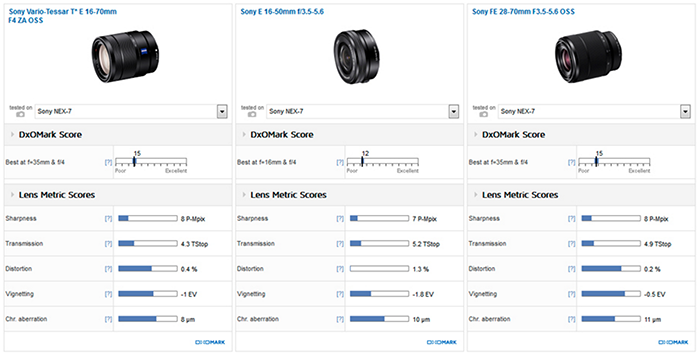
DxOmark (Click here) published the fulL Zeiss 16-70mmf /4.0 E-mount lens review:
Although the overall DxOMark score is perhaps a little discouraging for a $1,000 stabilized zoom, the Sony Zeiss E 16-70mm f4 OSS actually has a good balance of sharpness and uniformity. It has low chromatic aberration, and distortion at 16mm is very well corrected, even if it’s bordering on the difficult to correct complex type. It might not wow users at either end of the zoom range, but it does in fact have excellent performance at 35mm.
What makes the lens even more appealing is that you save $300 on the Hasselblad version at BHphoto (Click here)!
85 Responses
The result is just another nail in the coffin. Not worth the premium price tag.
I paid 650€ for mine (new) and at that price it’s okish. The real problem is the overall lack of good standard zooms for APS-C (and fullframe for that matter). So with no alternatives it’s still the best APS-C E-mount zoom out there.
This is where m43 has an advantage. They have two good quality f2.8 zooms to choose from.
Agree. I use both the Panasonic 12-35mm f2.8 and the Olympus 12-40mm f2.8 and are mainly why I use m43 instead of my NEX as my small compact camera system.
I’m with you there. Switched 6-8 months ago and now have the Oly 12-40/2.8, and the Lumix 35-100.2,8 along with a fist full of razor sharp, plum sized primes, all f1.8 or faster. Unfortunately, they are all attached to a camera with a m43 sensor. I’d love to get me some of that Sony 42mp goodness, but the lens situation has me looking to Fuji or Nikon. I’m retired and traveling, so I don’t need to be packing a bag full of $1599 Zeiss Batis and Loxia and Milvus primes (not that there’s anything wrong with that) but I do need a really good standard (24-120 range) zoom. I’ll wait until the illusive 8 new lenses appear and then decide who gets my money.
I do not think that it is fair to compare lens performance of many mFT lenses including the 12-40 and 12-35mm to lenses from other systems as they have very significant amounts of in camera corrections going on. mFT lenses are really a combination of lens + software corrections .
The “PRO” should really stand for processed.This is the 12-40mm without its corrections .This is not a bad thing per se especially if it keeps size and costs down , it does however make comparisons with other lenses that do not have such corrections unfair
All mirrorless lenses have corrections. Distortion and LoCA corrections are practically free.
Not to the extent of mFT lenses . mFT lenses notably so at the wide end are basically wider than the stated focal length which is then sacrificed to the various corrections. If you look at the uncorrected RAW results from lenses from various mirrorless mounts mFT is clearly adding a lot more software tweaks. I think that on mFT there may even be some NR going on.
That may be true with some m4/3 lenses like the Panasonic 12-35mm f/2.8 and olympus 12-40mm f/2.8 but the net effect is still that these two m43 lenses even with software adjustments are not as bad as the Zeiss 16-70mm once the price-performance (plus size and weight) aspect is considered.
Given the plethora of medium range zoom lens choices available for mirrorless cameras (specially in the m43 system), this Zeiss 16-70mm makes for a poor choice.
NR in raw is visible in DxO graphs as a step in SNR graph, and done by Pextax and recently Sony. Of course it is also “built-in” into X-Trans demosaicing. Hasn’t seen it on Olympus yet.
I’m guessing pretty much every modern lens, mirrorless or SLR have corrections applied in LR. For me, bottom line is what shows up on my monitor or in my prints. Whether “corrections” are made with glass in the lens or digits in the computer is pretty much irrelevant.
That might be true but I can’t use my FE lenses on MFT and the A6000 also has better AF tracking. So sadly that’s no alternative.
Yep, the Oly 12-40 Pro is fantastic and is even cheaper than this really very questionable 1670. Sadly, Sony has nothing for E-Mount to offer that comes even close… and probably never will.
The Olympus lens like many/most mFT lenses has massive in camera corrections going on, which are baked into the RAW files instructions for supported software such Adobe PS LR etc take a look at the RAW files in something like photo ninja etc and they are not pretty
Just like E-mount lenses. No corrections can fix low sharpness, and vignetting corrections are destructive, increasing noise and decreasing DR.
Despite that being true, once someone realizes the equivalent aperture and subsequent DOF compared to APS-C and FF, it just becomes another compromise. That is without the price in the equation.
I think APS and FF are both reasonable comprises, too. Sure, not like MF, but they are not as bad as you make them out to be.
Uniformly average?
One specific difference between Zeiss and other brands is, that they have no affordable line. The pricing of their average-quality lenses is the same as their high-quality ones.
Uniformly overpriced.
We get it, you don’t like Zeiss, but don’t confuse this lens with a “real” Zeiss. This lens was no doubt designed by Sony – not that that is automatically a bad thing.
I love and own Zeiss (and Leica) products. I just think they are overpriced for what they offer.
BTW, I say this for the 100th time.
Reviews like these aren’t helping users at all. Having a Zeiss badge should mean high quality. Not so-so or bad performance. The 16-70 should have only the Sony badge, not Zeiss nor G-series.
I agree, notice that the verdict remains overly polite when DXOmark test such an impressive lens with the holy Zeiss badge…
This one should have been the kit lens that comes with the A6xxx for the added 150$ LOL
I used the 1670 some years ago directly after its release on my former NEX7 on a trip to “Südtirol”.
The 1670 is a mixed bag, and although it is capable of producing high quality images (except for borders and corners) it is far from being worth the price.
It started with need to replace three times due to decentering, and for me it is quite cheeky to put the SN on a sticker, that gets lose after two weeks of usage.
Admittedly the corner softness is not a big issue if you use the lens as a travel zoom. However if you try to capture some landscapes on a tripod and you can’t get entirely sharp images even at f11 it starts to annoy one thinking of the price.
Distortion, vignetting and CAs were just average.
Zeiss-typical colors and fairly good contrast in the main part of the image does not suffize to justify its steep price tag (I paid 999 €).
Getting this lens will not be a good choice, even at a discounted price … and efforts to push readers to buy this lens is a disservice.
Lens manufacturers need to feel the results of the quality of their work and their pricing … or an absence thereof.
Meanwhile, that FE 28-70 can be had for under $200 on eBay, or $280 new whitebox on Amazon. For equal optical performance, I think I’ll forgo that little extra at the wide end and pocket the the ~$750 difference, thanks.
Oh well, those 4mm are exactly what I want more… 28mm is not a “good” focal length for me.
But you’re right, much better bang for the buck.
Well with the 28-70 you actually got a 42-105, instead of a 24-105. If you dont mind the complete lack of wide angle and the added weight and bulk, you might wanna go for it. I myself wouldnt consider it though.
Yeah, I mainly shoot portrait-type stuff, so I’d normally be using it at the long end anyway. I wish Sony would make a nice APS-C zoom with about a 45-135mm range. That would be about the same angle of view range as the FE 70-200 f/4, or Panasonic’s 35-100 f/2.8 for MFT. The closest lenses to that range are the 16-70 and the 18-105, but they’re both kinda meh. (Good lord that 18-105 has horrible distortion!)
But then again, it would be nice if Sony would make ANY new APS-C lenses… >_<
Yeah, I feel with you. At least I’m lucky enough to use my FE lenses on my A6000 as well. The 55 and the 70-200 make good portrait combos on APS-C.
Although you should try the 50mm Sony, that’s pretty good and not that expensive.
http://www.photozone.de/sony_nex/901-sony1670f4oss
Are we talking about this lens?
“At the end of the day, we want a standard zoom lens to be sharp but we are sorry to say it – this is where the Zeiss lens fails. Or to be precise: it is actually great if not outstanding in the image center but the outer image field is often disappointing. The quality is mediocre at 16mm, not so hot at 24mm @ f/4 and 40mm @ f/4 but beyond believe at 70mm really. Stopping down helps to improve the borders/corners but the 70mm setting remains miserable. In our disbelieve we send the lens to the local Sony service TWICE and they confirmed that it is within their factory specs. Since readers have been criticizing us for having used the Sony NEX 7 in the past, we also switched to the A6000 this time just to make sure that it is not the camera.”
What sucks is that I’d really like to get this lens for a good travel/landscape zoom, but just can’t throw down that kinda money for something that’s been rated so mediocre. I’ve been using my A-mount 16-50mm f/2.8 SSM via adapter on my a6000, though, and that’s a pretty stellar combo; though you then get the weight/bulk of the 2.8 and adapter setup.
One of the reasons I can’t switch to E-mount for APS-C format. There’s nothing that can touch the 16-50 f2.8 A-mount regarding image quality and price. IF the 16-70 would have been as sharp as the 16-50 f2.8, the longer range and lighter weight of the former would be a reasonable trade compared to the slower speed.
The 1670 is a fairly good travel zoom for sure. For landscapes you have to workaround the weak borders and corners (stop down 2x and take a larger part to be able to cut smeary corners).
There isn’t anything better – kit zoom, 1650PZ and the 18015 are even weaker.
The kit zoom 1650PZ is weaker, but only by a minimal margin. And when it comes to price and weight, then the 1650PZ blows the 1670 out of the water 😉
When using lenses like 1650PZ, what’s the point in 24mpix sensors? A couple of mpix will capture the same details. 🙂
Yes, if it would cost $300. But it costs $1k. I even think it is not worth the Zeiss name.
(Of course this depends on what you think the Zeiss name stands for. High quality or insane overpricing.)
Yep. Click on the sharpness tab on this page. DxO’s measurement matches what PhotoZone said: it’s quite poor at 70mm f/4, which is exactly where I’d want to use it most.
http://www.dxomark.com/Lenses/Sony/Zeiss-Carl-Zeiss-Vario-Tessar-T-STAR-E-16-70mm-F4-ZA-OSS-Sony-E-mounted-on-Sony-A6000—Measurements__942
wait what? I thought PZ was considered to be useless and biased against sony?
Really? Never saw anything against Sony there.
Now, now, there is a reason for anything, good or bad.
I wish I could have the a6000 with the excellent Samsung NX lenses (specifically the Samsung NX 16-50mm F2.0-2.8 S ED OIS).
It’s a shame there are no good options for Sony aps-c cameras.
Single digit sharpness scores…seriously?
Perceived megapixel scores. It’s a B.S. metric DXO made up. It’s just fine if your willing to drink the DXO kool-aid and adopt their style of measuring. I do the eye ball test. If it looks like shiiit I don’t buy it. If it produces images I like then it gets my holy shiiiit this is sharp award. Works for me.
Yep ,why trust the world’s leading lens correction software
maker with a comprehensive battery of lens and camera tests , when you have the opinion of a fanboy go figure
To each his own. I mentioned it’s fine if your willing to work with their own measurements. I do not believe they have a bad product per se- but the over reliance on single composite scores is a poor decision IMO. Consumers love to focus on all-in-one scores but it’s misleading. You have to look at the larger matrix of performance parameters.
The single overall score given to cameras is daft but all the detailed data is made available for all camera and lens tests if you care
to look for it,
It may not be perfect but you have data to compare on hundreds of lenses to maintain a constant measure-it’s applied philosophy of science and research design. It’s using a replicable standard on all lenses.
On 24mpix sensor no less. Ant that is only on 35mm, 16 and 70 and everything near are very bad.
“It might not wow users at either end of the zoom range, but it does in fact have excellent performance at 35mm.”
This is the DXO equivalent of describing a woman as “having a nice personality.”
ROFL
oh come on.. “having a nice smile.. “
I still own the old 18-55 kit lens. No need to spend this much money for a lens just a bit better.
I agree that this lens is not worth the price, but I owned the old 18-55 kit lens too. Mine was terrible in terms of IQ. Replaced it by the Zeiss 24mm/1.8 almost immediately, despite of the insane price and zero zoom range.
I own this lens and I am very happy with it. I do not understand all the fuss people are making. For pixel peepers there might some jaggy corners but actually, it produces wonderful images with great color and contrast. It is my every day lens.. Sure it costs a pretty penny but for me it is worth it. Sharpness is also ok, but should no the only reason to judge this lens.
It you are in for a great 24-105 lens with E-mount for APSC, get this one. I love it.
+1
The fuss is because:
1. It has a Zeiss badge, yet just as you said, it doesn’t give sharp corners even though it is an f4 lens, not f2.8 (and it is not ”might”, it just doesn’t perform well).
2. By having a Zeiss badge, they’re charging too much for something that doesn’t deserve it. That lens should have only a Sony badge (not even G series) and charge around 500USD for it. Even the Sony branded non-G-series A-mount 16-50 f2.8 SSM lens performs better and it is a f2.8, weathersealed, well constructed lens that is also way cheaper than the mediocre ZEISS-BRANDED 16-70 F4 lens.
“Even the Sony branded non-G-series A-mount 16-50 f2.8 SSM lens performs better and it is a f2.8”
What you mean “even the”? That’s an $800 lens, with less reach, weighs twice as much, and has a 72mm filter thread. Add the LA-EA3 and it’s a $1000 lens and double the size.
It doesn’t live up to the Zeiss branding though.
That 800USD lens performs better than a Zeiss branded lens between 16 and 50mm wide open at f2.8 (performs better at f4 too), is weathersealed, and does live up to expectations from a fast and pricey zoom. Sure, it’s 20mm short at the long end, but it’s all about trade offs and the SAL1650 is worth the price. Not the SEL1670Z.
Price and brand from that SEL1670 don’t fit. Should have had a lower MSRP and Zeiss brand removed.
“and the SAL1650 is worth the price”
For A-mount, maybe.
The 16-70mm F/4 comes in at £649 over a £100 more than the likes of the Canon 17-55mm F/2.8 IS! . APS lenses with a similar focal range and aperture come in £250 less than the Sony with better performance. It is grossly overpriced for an F/4 kit lens that offers nothing image quality wise over cheaper options from other makers .
50mm/2.8 cropped to 70mm gives the same amount of light as a 70/4. And the 16-50/2.8 is $600 in a kit or off kit new, and has to be bigger as it is made for SLR flange distance (and made properly too, without literally cutting corners so much that the corners have over 2 EV of vignetting at the freaking f/4 – so basically work like f/9 or so, except they are also blurry).
Just wondering, why are you here?
I own this lens too, and I’m also happy with it. BUT, I paid under US$500 for it.
The lens needs a redesign. Utility-wise it’s great. Good range, small, light, focuses fast, decent build. But they can’t build the bloody things to a consistent quality. That’s bad design, and they need to fix it.
Well, I owned 3 copies of that lens and don’t understand your happiness about it. Yes, its build and size is great, also its working range. But IQ, even on non-pixel-level is, frankly, very mediocre. I had huge issues with back-focus and decentering, and colors, contrast and overall rendering is not on a Zeiss-level – without considering the price tag.
I’d like to see a APS-C 16-50/2.8 with the size of the 16-70/4. It must be possible.
Try Leica X-Vario then try this lens on Sony’s best apsc sensor. Case closed.
I don’t know about this lens. Nikon 16-80 2.8-4 is about the same price. Sigma has a product that is faster in this zoom range and much cheaper.
Are you referring to the Sigma 18-35/1.8? This lens is not nearly the same zoom range.
No, sigma 17-70c.
Good balance equates to “Meh. Suppose it’s OK?”
Many people overlooked the fact that sony/zeiss adopted the Tessar design for this lens to achieve the compactness. That means certain compromise has to be made somewhere. It is just physics and you cannot have both worlds. Compare the dimension with the only other lens with a similar range the Pentax 17-70 f4 you will see. As for those who said that it is not worth the Zeiss badge. Well, that can go either way. Zeiss probably spent as much r&d dollar to make this one as those that perform better optically but without size constraint. So i dont see why this lens should be cheaper just based on a design decision. On the contrary, it is a rather unique lens.It comes down to whether you can accept certain compromise and has little to do with cost, in my opinion. I did buy it because I don’t like a bulky walk around lens.
I can’t fully agree. They could have designed it in such a way as to give themselves greater tolerances. Built it as an “APS-C and a little bit” lens, if you will. They have designed something that they can’t build with consistency.
Are you sure? I’m not an optical engineer, but as far as I know, the original Tessar was a design with four elements in three groups from 1902 AND was/is a brand name by Zeiss, which was reused for the much, much later Vario-Tessar.
I know, there is no guarantee that Wikipedia is right, but there you can also read that the newer designs use only the Tessar brand name.
https://en.wikipedia.org/wiki/Tessar#Vario-Tessar
But I’m eager to learn more about the Tessar-design related constraints within a modern 16 element zoom called “Vario-Tessar”. Can you provide some links? I couldn’t find anything useful that explains your thesis.
http://www.dyxum.com/images/Lenses/718/718_2.jpg
This ain’t a Tessar by any stretch of the imagination.
You may be right that Zeiss simply reuse the brand to indicate a design principle which is known for compactness. Still it is probably too much to ask for modern yet to achieve a perfect optics with size constraint or at any easonable cost.
The Pentax is made for much longer flange distance. Making a lens cover 17mm on 46mm flange is not the same as 16mm on 18mm flange.
Regarding “Zeiss probably spent as much r&d dollar to make this one as those that perform better optically but without size constraint.” I have news for you: Zeiss spent exactly $0 in R&D or anything else for this lens, Sony made it from beginning to the end and paid Zeiss a fee for using the badge.
proof that shorter flange distance equals smaller lens with perfect optics? That is a fantasy. Sony or Zony whoever made it have to recover the cost.
Covering much shorter FL than flange distance requires retrofocal designs (unless rear element can go deep into mount, like in EF-S), which are more expensive.
Imagine this as a full frame FE lens with the same quality as the Canon 16-35/4 and OSS for older A7 bodies. That would be the day. 😛
The Samsung NX 16-50mm F2.0-2.8 S ED OIS is a nice lens, but the most attractive part, the F2.0/16mm wide end, is pretty poor optically. Sharp in the canter but pretty poor corners. I tried it out shortly before I sold my NX300. I was wowed by the specs and the built/design, but not by IQ. So, not that much of a WOW lens for me.
Not remotely comparable to the Sigma 18-35/1.8 in terms of IQ.
Agreed on the last one. It’s a shame there are no good options for Sony APS-C cameras.
It is about as sharp at f/2 as this Sony at f/4, but by f/2.8 already very very good. And f/2 is useful pretty much only in low light when noise reduction will destroy details anyway. Big difference is vignetting, 1/4EV at f/2 on Samsung is not the same as 2+EV at f/4 on the Sony.
All of the Sony lenses with the exception of 55/1.8 are pretty bad. 16-50 and 28-70 kit lenses are just awful (please note that the 28-70 was tested on NEX-7 for some reason, but is unable to cover even APS-C crop with decent quality, especially at wide end). At least the 16-70 is somewhat closer to $50 kit lenses from other manufacturers, and fixed maximum aperture is convenient.
If you can’t even find the full frame tests of the 28-70, I doubt your ability to find knowledge anywhere.
I love these blanket statements. “The 16-50 and 28-70 are awful.” Is that from personal experience or reading internet comments? Try these…
http://www.thephoblographer.com/2015/11/13/review-sony-28-70mm-f3-5-5-6-oss-sony-fe/#.Vk9wp4SI4qY
http://www.photographyblog.com/reviews/sony_fe_28_70mm_f3_5_5_6_oss_review/conclusion/
And this from DXOmark. “One of the best all-round performers is the collapsible E-mount 16-50mm f3.5-5.6, which is often bundled as a kit lens. It’s sharper at the shorter end of the zoom range (like most models), and it requires stopping down a stop, but it’s very compact and lightweight.”
So we tend at times to pick and choose to find things that support our preconceived conclusions. How many people have wasted the extra $100 on the Zeiss 24-70/4 after reading comments like yours when the “lesser” lenses would have served just as well?
Reading objective tests. You should try some.