







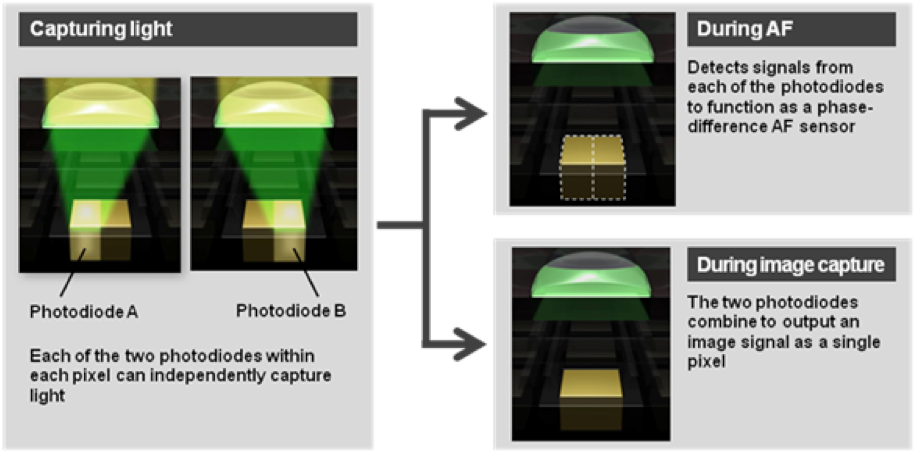
As you know Sony will get rid of the SLT tech on all future A-mount cameras. And that will be possible thanks to a new generation of Sony sensors with much improved Phase Detection system. But it looks like the whole world is now moving towards on Sensor Phase Detection autofocus. Today Canon announced their new 70D camera (specs and price at Amazon) having a Dual Pixel AF sensor. On paper this sounds like an incredible piece of tech. Basically every pixel on sensor can fulfill two tasks: Capture the light information for the actual image and be used at the same time to elaborate the phase detection signal. The main advantage of the tech is that you don’t have pixels that get waste for doing one job only. I am curious to see if Sony will have a similar solution or go a completely different route. One thing is sure, on sensor PDAF is what we will see on most future DSLR or Mirrorless cameras.
More about the new Canon AF tech at Dpreview.
111 Responses
Perhaps Sony was aware of this upcoming tech and realised that they needed to significantly improve their cameras in oder to compete. Hence new road map for A and E mounts.
+1
So does it mean that Canon now has a fast and accurate AF during live view and still has an OVF in its camera? This sounds really bad for others hehehehe…
You are also adding thermal noise, because the sensor pixels are on during focusing *and* capture.
Adding thermal noise? Perhaps you forgot that on Sony camera that the sensor IS always on anyways.
This is only on during live view, which is not going to happen often unless during video recording. 70D is still a traditional DSLR, thus the imager is not going to be turned on for very long very often.
No I haven’t forgotten about Sony live view – that’s actually where I got the info from: someone (Gary Friedman?) performed some tests on SLT technology re noise and concluded that there was more noise than expected from the SLT stoploss alone at high ISO, and the additional noise was sensor thermal noise caused by Live view.
Ouch, shamb got owned by Maniac.
Yeah, I’d really like to see that test.
Plus this whole thing kind of begs the question ‘why not just split the diodes in two to have a sensor with twice the resolution?’
There is only one sensible answer to that: only some diodes have this ability.
So all they really have here is a contrast detection sensor that can act as normal pixel during the shot. Whether or not this is really any good will depend on how many they use. The fact that they are not trumpeting that number suggests it is low, which means perhaps you don’t gain much over an interpolation method that just simulates the lost sensing pixels…
Yes, some of them. Canon said so themselves, only 80% of them can do that.
Maniac, that is not how I read what Canon said. They didn’t say that ALL dual diodes are active within this 80% area av the frame, so we don’t know that with certainty yet.
.
Why do you NEED all of them to be active at the same time? Are you trying to overload the processor or do you think Canon had managed to pack a supercomputer to do all the calculations of 40 mega pixels worth of focus information? (Or even 80% of them)
All the camera needs to know is:
1: Is the selected area in focus?
2: Is the target moving?
3: Is tracking enabled to track the moving target across the sensor area?
What else does it need to know to focus and track properly? doing full area phase detect is just going to slow the whole thing down for no benefit.
In light of the excellent Sony OLED EVF, keeping the OVF is a let down…! IMO Sony will bring in its new mirrorless A-mount cameras their in-sensor PDAF and an even more advanced EVF.
No worries…!
Ario
It’s the OVF that is bad!
Actually, the EVF needs to have about twice the resolution & dynamic range.
Even before SLT, Sony already has fast LV..remember A580?
Well, let’s wait and see. As much as I appreicate new approches, I am as sceptical as I would be for new Sony stuff. Canon writes “5 times faster than previous contrast AF”. Now the Canon contrast AF is very slow, I guess 5 times faster is still slower than the phase detection AF is.
Furthermore I am sure that you loose some light due to the different microlens structure. Maybe not much, but some.
Let’s wait for the tests.
The micro lens array isn’t masked in half. Theoretically, it should transmit the same amount of photons.
Wow, this sounds incredible. The nice thing about being invested in Sony gear is that we’re confident that they can at least stay in the forefront in sensor tech. As impressive as this sounds, I’m sure Sony has something just as good, or better, in the pipeline.
We need to wait for some comparisons vs NEX, MFT and so on.
Like Erik says, Canon may be just comparing to their own CDAF technology.
That being said, the phoblographer and imaging resource speak of a relatively fast AF experience so we really need to wait and see how well this new tech is.
I was king of disappointed by the NEX 6/5R AF performance compared to 5n/7 because I thought it would REALLY be speedier but it was not so dramatic…if even noticeable at all for me.
Anyone noticed considerably faster AF speed on the 6/5R compared to previous gen?
I do wonder, though, if Sony can really tweak their algorithm for CDAF for RX1 and NEX 7 and improve their speed even better. Now that would be a winner move.
Whaaa? Canon is actually doing something innovative?! The world has been turned on its head!
I’m sure Sony is ahead of the game on this one. I doubt that any company out there can be truely surprised by a competitor’s moves these days.
I think like DPreview’s preview said, perhaps they were working on this during the last three years or more and not much else, which is why we were seeing their not-so-great 18MP sensor being used everywhere.
It’s not actually a bad idea, look at 3dfx… They “improved” their current product, and put the future product on back burner, but the time the “future” product was done, it was too little too late.
3Dfx! Man, those were the good-auld-days…
What’s 3dfx? Something people used during the horseless carriage days? Haha, haven’t heard them for years.
Now you’re just making me feel old.
I’m thinking phase detection to get it close, quickly, and contrast detection to make it perfect.
+1
Yes a hybrid AF system of both PDAF CDAF will be the very best 🙂
does this mean it will have a 88 mp sensor? it must! plants dont hold still for me – i only have one shot at a photo
ROFL
LOL!
The good news: Based on dpreview’s early reviews, the technology seems to work. So if Sony is indeed doing something similar, it is very promising for a “mirrorless” Sony Alpha.
How will it affect Sony? This could become a reason for Sony to move up its timeline, if their production lines can handle it. Sony wants to be an innovation leader, not look months behind Canon.
The bad news: The last line of Dpreview’s early preview of the Canon 70D — Once you start putting this technology into mirrorless cameras, why would anyone want the bulk of dSLRs?
For now… I hate to say it, Canon *may* be conquering the best of all worlds even better than the Sony dSLT. The Canon model will retain the OVF, still favored by most traditionalists, while also offering a truly usable live-view. More importantly, Sony dSLTs can only focus with a wide open aperture, while the new Canon can *supposedly* use live-view focus stopped down to F11.
Makes me very excited to see the next generation of Sony product.. but also makes me impatient.
Adam,
Canon’s aim is not to conquer, but to hold on to what they’ve conquered.
That is never a strategy for surviving. To hold your ground you must always push for your opponents ground… failing to do so will only allow the opponents more time to calmly plan your destruction.
It would be interesting to see video AF comparison between this camera and a77/a99.
How the problem is is irrelevant,
How Well it is solved matters.
/E
@Adam: Regarding your ‘bad news’ – If the lens being used is not retrofocus then part of the advantage of the little body goes out of the window – I suspect long zooms will be more comfortable with an SLR-style form factor. One thing is always certain, change will happen.
It will be interesting to see how the Canon sensor does at high ISO – effectively this is a 40MP sensor on APS-C and separate photo sensors will need their own wiring… I’m assuming there must be some effect as the phase detect pixels go to the edge of the sensor although the ones around the border are not used – I suspect this would show a low-noise border if they used conventional pixels for the edges.
Having said that, high ISO is good these days so it may well be acceptable – but I can’t beleive there won’t be a cost somewhere.
No, Canon used the same split pixels in the outer 20% border. There will not be a “visible border”. Also, Canon is basically taking pixel binning & splitting it in half.
if anyone has tried the t5i or sl1 in live view before they will know what i mean. it takes these two cameras 3-5 seconds to get autofocus lock. while my nex takes a fraction of a second to do so. looking at the 70d hands on video. it looks like it takes the 70d 1-1.5 seconds to lock on.sony really has nothing to worry about since this is realllllly slow compared to everyone else.
why arent my comments posting?
Um, looks like they’re posting now 🙂
The competition moves forward while sony waits.
Sonys last important inovation was the a77/a65/nex7 release (no i do not consider the a99 as an inovation.)
The next rumored sony inovation if true will not be until at least 2014.
Yhats a long innovation gap.
It will take quite an inovation for sony to surpass what the competition will in alll that time.
One kf sonys new patents describes a 2layer sensor
Yellow and cyan (blue and red absorbing) pixels on the top layer and green pixels only on the second.
The y and c are arranged in a checkerbaord pattern.
If these pixels were to correspond to those in a bayer array of say 20mp each bayer pixel would be replaced by 2
Barry,
The a77 came out less than 2 years ago. If the replacement is released in early 2014, that’s a fairly quick upgrade. Check out the mid to upper range camera upgrade cycle for Canon & Nikon. It’s typically 3 to 3.5 years. The Canon xxd line, with more frequent updates, tends to have most incremental features added as does the digital rebel line.
Continued
Each would be replaced by 2 yellow, 2 cyan and 4 green pixels
Thats 40 mp native resolution.
The checkerboard arrangement of pixels would produce color missalighnment and miore similar to a bayer array.
Here is where it gets intteresting.
I assume you’re not planning on photographing anything red.
Carl
Yellow absobs only blue light and cyan absorbs only red light. These are sutractive color pixels.
The second layer is green. Clearly these pixels are differrent or they would be called magenta.
As you can see red green and blue channels are all present.
I’m not sure what you’re trying to achieve by mixing and matching RGB and CYM models, but something that abides by the laws of physics isn’t it.
Carl
This is not my invention.
This is a description of a new sony patdn.
The y c and g pixels are in the patent description.
My post describes what i think is good about the SONY oatent.
The link appeared in a sar post a few days ago about a new Olympus organic sensor camera.
ADMIN
Any chance you can post the link I am refferring to or the actual patent description?
Here is the link. Im not sure if i did it rite but here goes
http://egami.blog.so.net.ne/2013-06-17
Admin it didnt work and the posting was about a fuji irganic sensor and sony also has an organic sensor.
any chance you can fix my mess. I dont know how to do it.
Here is the link:
http://www.sonyalpharumors.com/also-sony-is-working-on-new-organic-sensor-tech/
Continued
2 different interpolations can be applied specific to this pixel arrangements that would both yield foveon like results in a non foveon like sensor.
In the high res interpolation the missing yellow and cyan pixels can be interpolated to the adjacent four eliminating all color fringe and yielding 80mp.
The green needs no interpolation because it already is 80mp.
This would be almost as identical to a real 80mp sensor in image quality. The interpolation should actually increase the lens resolution because the original pixels had sepertion.
This is true, but only to an extent. You forget the forty-one manestically spaced grouting brushes were arranged to feed into the rotor slipstream a mixture of high S-value phenylhydrobenzamine and 5% reminative tetryliodohexamine. Both of these liquids have specific pericosities given by P = 2.5C.n^6-7 where n is the diathetical evolute of retrograde temperature phase disposition and C is Cholmondeley’s annular grillage coefficient. Initially, n was measured with the aid of a metapolar refractive pilfrometer, but up to the present date nothing has been found to equal the transcendental hopper dadoscope. In addition, whenever a barescent skor motion is required, it may be employed in conjunction with a drawn reciprocating dingle arm to reduce sinusoidal depleneration.
Oh wait, I’m getting things mixed up with the Turbo Encabulator.
I’d be full supportive of Sony going with a baseplate of prefabulated Amulite, surmounted by a malleable logarithmic casing.
Sweet! Same here. I’d be all over a Sony Mirrorless camera that allows transmission that not only supplies inverse reactive current for use in unilateral phase detractors, but is also capable of automatically synchronizing cardinal grammeters.
If you guys can explain these concepts in simpler words please do so.
I attempted to explain my idea accurately and relatively simply.
If you have better communication skills than me please feel free to translate.
I do however reserve the right to dissagree with your translation if it is not accurate.
I think the differences between the Canon (and Nikon) and Sony philosophy is going to continue to widen as time goes on. They are each going to find their own very different solutions to the same problems, and it will be harder and harder to compare the two.
I completely agree with you..
Continued
The low resolution interpolation would simply combine adjacent four green pixel units and the corresponding two yellow and two cyan into a single pixel again eliminating color fringe and allowing whatever other quality enhancements that can be achieved by combinining pixels.
This interpolation would yield 20mp.
Both interpolations would yield an image SUPERIOR to the native resolution.
They would need to be done in camera or with a proprietary program as they would not be standard generic processin
Summary
With this new sensor and proper interpolation a current 20mp sensor footprint would yield
40mp native resolution- bayer like quality
80mp interpolated resolution- foveon like quality
20mp interpolated resolution- enhanced foveon like quality.
all three from the same footprint as a current 20mp sensor.
If we match a different mp footprint the numbers would be differrent but comparable
Admin
Would you be able to either put a link here to the patent description I am talking about or actually post it?
BarryTheAnimal… really? A whole page of your posts? Quit hijacking and take your meds.
Maybe the post title should be “Sony next generation sensor to challenge Canon’s last offering”
yes, the title of this post is ‘back-asswards’ as they say…
or should say ‘Sony new sensor; can Sony’s sensor even challenge Canons newest sensor accomplishments?”
sorry, much as we love Sony here, it is highly unlikely….
key line for me in the Canon announcement… this new feature is compatible with all of Canon’s lenses. Sure, my NEX-6 has some PDAF pixels but they don’t work with any of my lenses so that “feature” might as well not be on there at all. Sony does make nice sensors (I like being able to pull up shadows and pull back highlights with much nicer results that my old Canon) but I’m starting to get really tired of the half-baked strategy Sony has going on…. and I want FF which at this point has me looking at the 6D…. hope the FF NEX comes soon and hope they don’t price it too high (above 2500).
Which lenses do you have, which aren’t compatible?
ms, not quite. They say that this “Dual Pixel Hybrid AF” is fully compatible with 103 of the 156 lenses they have produced for the EOS system during the years.
.
Canon Excellent – Highly innovative. Dual AutoFocus that will work with ALL the Canon lens. This is very positive.
Sony users are forced to use only 10 lens to get AF-D Dual autofocus.
Hopefully this will help Sony wake up and be more competitive for its offering for its users base.
For far too long – SONY arrogantly claims innovation for their over priced offering.
Like the A99 or HVL-F60 flash
While Sony overpriced products lack so many
basic functional solutions needed by users.
Fun thing is Sony totally ignores their users requests, berating their users on blogs
and then
SONY can not ever understand. .
WHY? Photographers can not take them at all seriously for commercial photo work.
Sony must start to offer competitive value for each photography dollar budgeted by users.
What will it take for Sony to work cooperatively with its own users??
Maybe Sony will start to provide user requested solutions, similar for photographers using Canon and Nikon platforms
‘e’, this will never happen…Sony has no care for what users want…have only eye on bottom line….catering to any users, ‘pro’ or other, is not profitable in Sony’s view…
It might work with all lenses, but it sure does not work with the OVF. Very positive.
I can’t disagree with these comments, Sony don’t really listen to users. A99 is disappointing in both performance and price, the new flashgun over heats and is overpriced.
Sony view themselves as the premium camera maker and tries to charge for it. The market does not share that view. I really hope someone takes charge of Alpha who is a photographer and not a suit. New CEO seems as clueless as the last bunch
I think Sony cameras work just fine.
Define “just fine” please. I too think the camera functionality is ok in most cases, but Id never get the a99 at this price. If the AF of my present lenses on next generation of cameras would become crap Id be using my a77 while it lasts then switch brand to CaNikon because they seem to value their present customers. I do however truly hope that on-sensor pdaf of next sensor gen is fully compatible with all a-mount lenses…
So no game changer from Sony again.
All sizzle no steak.
:-/
Canon is a sirloin steak. Sony is more like grilled salmon. While it’s still really good and much better for you, it’s not everyone’s preference.
I’m having salmon tonight.
Let’s be real, this is no competition at all. The only purpose to this tech, is to enable the Canon to do a POORER job of what the Sony cameras ALREADY do, and have done for 3 years…focus quickly in video.
Sony does this with PHASE DETECT autofocus, which we can reason is still faster than Canon’s solution, OR, Canon would simply drop the mirror….like Sony is getting ready to do.
Just like when Sony refused to go live view with the Alpha line until they had resolved the autofocus issue, Sony has refused to completely drop the mirror until they had resolved the sensor focus issue….if they plan on releasing PROFESSIONAL cameras in early ’14 with no mirror, you can reasonably assume that Sony HAS resolved the contrast detect autofocus issue, making it AT LEAST as fast as phase detect…
Therefore, it’s reasonable to assume that whatever Canon just did, doesn’t compete with Sony’s new tech in ANY WAY. Sony has already won this battle….3 years ago….now they’re winning the second phase, just months after Canon caught up!
+1
Well, with that much phase detect sensors, I feel it might be rather interesting in putting them to work in different ways. Or even record them raw with phase data and all, I think Magic Lamp will be all over it and think of ways to make everyone drool.
One problem with Sony cameras is that it has not been properly hacked like Canon’s, a pity really. I’d love to see stuff similar to PTools or CHDK/ML working with my NEX-6.
And no, I have no brand loyalty (Used 20D, 5DII, A55, G1X and now NEX-6). Unless the company screwed me bad, which then I’ll just never use any of their stuff.
Sorry, Magic Lantern, not lamp… Heh
You’re certainly right from a videographic perspective.
For photography the situation isn’t quite so rosy, however.
Sony’s video isn’t that great, it’s ok but nothing more. Phase detect only works at faster apertures, this Canon solution solves that problem.
Oh and the crop factor on Sony is annoying 1.8x crop even with steadyshot off, robbing you of a real wide angle. Hmm if anything Canon will have no problems blasting past Sony for video
It seems like there’s a problem with the theory here. Maybe they’re not telling us everything; but isn’t the key to phase detection spatial separation. Separating each pixel in two behind its micro may well have a benefit, but for phase detection, it gives you profoundly narrow separation. They talk about the left and right “facing” half. But the whole sensor would be useless it those two halves didn’t face the same spot at least to with in one pixel of image resolution.
It’ll probably be similar to an LCD panel, where the two halves of a pixel point in different directions but by a small enough amount that it’s not visible when viewed from a distance.
Image-side depth of focus is large enough in a photographic system that the pixel wells don’t need to be 100% perpendicular to the light rays.
In my country, canon campaign in all media that “the power of dslr is lenses” and then they show massive canon lenses range.
What sony should do for their campaign would be “the power of dlsr is sensor”
+1
This does look interesting. In practice, AF-D Focuses no better, or more quickly on the A99 than in other auto focus modes. Actually, my experience is that even the 24-70 CZ hunts more, and is slower, even with the range limited. That in addition to the fact that the screen lights up like a Christmas tree make it harder to shoot with this new technology.
The promo video for the 70D looks much better to me than the promo video for the A99. That, in combination with fact that full time AF for video doesn’t work in manual mode at all (On the A99) makes me think Canon may be stepping ahead of Sony on the video front.
This isn’t relavent if you don’t shoot video, as I’d still take the A99 for shooting photos, but then again, this camera is less than half the price. Adding this stuff to the 5D/6D is going to be great, but probably take some time if it happens at al. I would like to try out the touch to focus. That’s slick.
I hope Canon doesn’t have a patent on this or that Canon will license this. This looks like a logical step to on sensor PDAF. This looks like a major game changer innovation, unlike the gimmicks that Sony keeps inventing like EVF and SLT. This can be bad news for competition if it really is better than anyone else’s implementation. I hope Sony and Nikon can come up with a competitive solution.
If it is so good, why have they not scrapped the old autofocus-module. They could have just used a translucent mirror like the SLT. And thus use the image-sensor as autofocus-module and the reflection to the viewfinder.
I bet the AF is not good enough.
That would be my bet too, but let’s wait and see.
+100
if this tech promising than sony approach then why does sony brave/confident enough to bungie jump to the whole mirrorless??
sony wouldnt do that if the bungie sling arent strong enough, it’ll be suicide.
c’mon canon show us our leading tech and remove the moving parts and youll have big profit margin. I bet this tech is for EOS M only
The trouble with that is if they did a 70/30 light split like Sony, there is not enough light for an OVF. That is partly why Sony used EVF and used the mirror only for feeding the PDAF module.
It’s not a 70/30 light split – its 1/3 of a stop. So isnt that based on recorded EV range? Or am I thinking about it wrong?
Canon DSLR also use translucent mirrors but with OVF. 60:40 split.
Oh, silly goose. Canon was the one that invented translucent technology. I think it’s pretty obvious why. They learned decades ago that translucent is garbage, but decades later, Sony trudges along and says, “hey, let’s try that technology that Canon dumped.” Since they are not ready to go EVF till EVF is good enough, and they don’t want to repeat the crappy translucent experiment they tried decades ago, they still need the off sensor AF for people using the OVF.
Listen to yourself! I hope this tech is very, very good because it pushes the industry forward. I don’t hope it’s bad just because it’s not the brand I own. I know you fanboys would love to live in a monopolistic environment, but I sure don’t. I surely wish Sony got more focused and innovate to compete with Canon and Nikon, but they’re too busy with electronic gadgets.
Canon’s later pellicle mirror cameras were actually rather good, aside from a dim viewfinder. The market just never gave the technology the time of day and Canon dumped it for commercial reasons.
All this tech and they still have a floppy mirror? What a joke, try again Canon!
For better or worse, a lot (perhaps even a majority) of photographers want a reflex mirror.
Canon just spanked Sony big time (if the AF is as good as anticipated) Phase detect off the sensor, Sony 2014 range has had it’s thunder stolen already.
For those complaining about the OVF, well find out how many won’t be buying the 70d because it’s an OVF.
Erm very few
Like it or not Sony have taken the wrong road OVF’s are in demand people buy them. Simple as that
Pretty sure you’re right and wrong. Yes, Sony just got spanked by Canon. But…
Pretty sure it’s as if Canon snuck up from behind and spanked a lion on the hindquarters.
Now the question is – can Canon outrun an angry Sony?
FYI-
The NEX-6 already have these and can do PDAF as well as CDAF.
Even the old CDAF (Sony’s) is light years ahead of the corresponding one from C.
everybody just YouTube this and see for yourself in the previews already there: the on sensor pdaf of this new Canon is fast, but still far from the traditional pdaf when it comes to speed. the big revelation here is the basic concept. Sony is almost certainly developing something similar. makes me believe Sony could actually pull this one off.
Can someone summarize sony patent for mirrorless camera. Here is whole patent document with lots of interesting detail on PDAF! http://www.freepatentsonline.com/20130113982.pdf
Isn’t an AF sensor more accurate the greater the distance between the two phase capturing elements? Here, they are the size of a pixel and pretty close to each other – I wonder what that means for accuracy.
Accuracy is determined by the baselength, which is a related but not identical concept to distance. If it was purely a matter of distance between two pixels, on sensor PDAF would barely work at all.
Oh dear, sony just got beaten to the post. The canon tech is great, well on paper lets see after all the reviews. But it looks great so far specially for people like me with canon gear. Although the sony mirrorless is beautiful design. And they are well ahead of canon in mirrorless. I, like most working photographers wouldn’t change to sony just because of our investment in canon or Nikon. But I would buy sony mirror less as it will be a new camera system for me. Lets hope that sony aren’t beat to the post buy canon with the next eosM update. Only time will tell. I love reading sony rumors and canon watch. It’s like watching a race in slow motion, but heir is no finish line. By the way I have the rx100 which I love. Sony just bring out a nex full frame mirror less at a competitive price we will al buy it. Look how popular the rx1 is and hat is expensive. I look forward to the next leg of the race.
On paper, the Canon tech looks superior because it can have PDAF in each pixel and without losing information. The Sony patent, referenced above, speaks about compensating missing image information caused by AF pixels (“missing image information of a photographic subject on the AF lines”).
So strange…a mass of people arguing the merits of an unreleased product vs. an unannounced product line…
Welcome to the internet.
The sad truth is that Sony doesn’t even come close (in market share) to what Canon does.
HOWEVER, Canon has failed to position itself beyond the DSLR. Splitting pixels in half is not going to fix that for them.
Canon is now perfectly placed to move in any direction once their PDAF on sensor technology matures.
1. They can use this technology across all their DSLRs keeping both photographers and videographers happy within the known DSLR + Live View format. They claim that 103 of their lenses are fully compatible with the technology at up to F11.
2. They can significantly improve the usability of their mirrorless EOS M system with only LCD based Live View. Again these 103 lenses at up to F11 count
3. They can add EVF to some of their EOS M cameras.
4. They can add this technology to their videocams.
5. They could even replace standard mirror with a pellicle mirror in some of their DSLRs once the on-sensor PDAF is good enough.
If the canon On Sensor PDAF was as good as the conventional AF module, surely they wouldn’t have put a 19 cross-point PDAF module in as well?
Are any of the OSPDAF points cross type? Or even line types that are sensitive to detail in other directions?
If Sony is planning to dump the conventional AF module, I’m sure (hoping) they have considered this.
I have a feeling that canon’s implementation will wow their existing user base but the live view will still be weak compared to the SLT live view. AF in video at up to f/11 would be nice though!
There’s no technical limitation stopping them being cross types, but there is definitely an engineering limitation. OSPDAF is a fairly bleeding-edge technology and making things small enough and accurate enough at the same time (and keeping in mind that sensel size is a moving target as resolution increases) is not so easy to do.
As the technology becomes commonplace and better understood, I’m sure we’ll see cross sensors appearing. Probably in the generation after the coming one, though.
Canon always says, their technologies are the best when announced, but usually they are not so good anymore when they are available to customer, I will wait until reviewers will publish their views and feels about new sensor and its capabilities.
The Canon EOS 70D Dual Pixel AF Performance does not look that impressive!
I find it rather slow in those videos to be a PDAF:
http://www.canonrumors.com/2013/07/canon-eos-70d-dual-pixel-af-performance/