







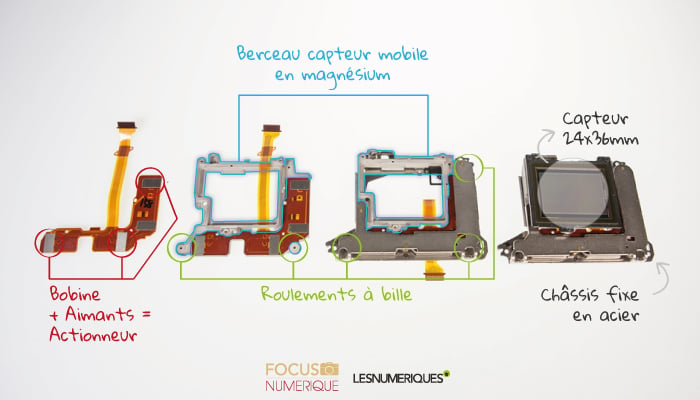
The A7II 5 axis mechanism in pieces. Image courtesy: Lesnumeriques.
Reminder: A7II will ship tomorrow in USA. Preorder it here at Amazon, BHphoto, Adorama, SonyStore.
Lesnumerqiues has been told by Sony engineers how the Sony A7II fixe axis system works. It’s 100% confirmed that lenses with no electronic contact to the A7II will get the 3 axis and not the full 5 axis stabilization.
Sony also explained to Lesnumerique that the Olympus E-m1 5 axis system is not powerful and precise enough for a 4 times larger sensor. The Olympus version has a mechanical spring which “loses its elasticity with age”. Sony’s solution uses coils and magnets which also have the advantage that it uses less energy and is also very quite than the Olympus version (note that Olympus E-M1 stabilization is quite noisy).
In detail Sony’s A7II stabilization mechanism uses three coils and magnets points (in red on the image above) and a ball bearing system (in green on the image above) which is directly inspired by anti-seismic protection devices used on many buildings in Japan! There is no image of the ball bearing system so here is one of those used by the buildings:
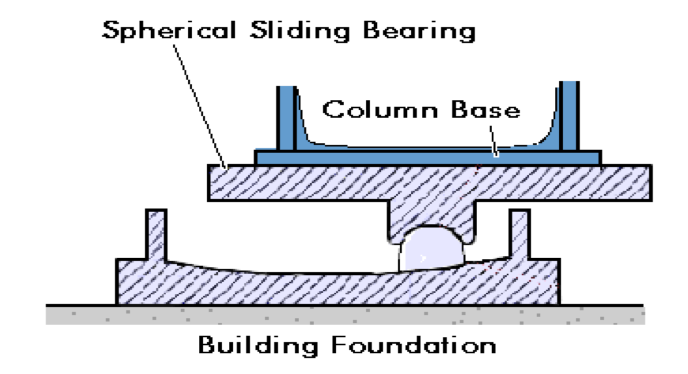
Source mceer.buffalo.edu
I think it gives us a very clear idea of how it works! Now wondering what else those crazy genius Sony engineers have in their mind for the future! Great job guys!
One more thing: Mark Galer extended his 5 axis stabilization how to videos:
USA/Canada preorders:
Sony Alpha a7II (Body Only) for $1,698 at Amazon, BHphoto, Adorama, SonyStore and Sony Store Canada.
Sony Alpha a7II with FE 28-70mm OSS Lens for $1,998 at Amazon, BHphoto, Adorama, SonyStore.
Sony 70-300mm f/4.5-5.6 G SSM II Lens for $1,148 at BHphoto.
EU preorders:
Sony Alpha a7II (Body Only) for 1.799 Euro at Sony Germany, Sony UK, Jessops UK, Sony France, Sony Italy, Sony Spain, Sony Austria, Sony Switzerland, Sony Netherland, Sony Belgium, Sony Portugal, Sony Sweden, Sony Finland, Sony Norway.
Sony Alpha a7II with FE 28-70mm OSS Lens for 2.099 Euro at Amazon Germany, Wex UK, Jessops UK, Verkkokauppa.
Asian/Australia preorders:
Sony A7II at Sony Store Australia and Amazon Japan.
76 Responses
@Admin
On A9 they will use a slightly improved version i guess.
Question Nr.1 remains, when do we hear more detailed stuff from you about it? 😀
Im also wondering, if they will introduce that in A-Mount / A99 II.
Thanks so far
I don’t know if there will be an upgraded version. I keep trying to get specs about the A9. So far my trusted sources know them but as usual cannot tell me anything. They just can confirm or deny what’s wrong or correct 🙁
get better sources then that tell you everything 😉
But as much as I wanna know, I understand Sony that the want to keep it as secret as possible. Not that I’m afraid that Canikon ever moves their lazy ass and will try to take advantage of it, but now there is also a Samsung in the market and they will try everything to copy Sony (even their name NX) if they are successful with something, we’ve seen it all before in another business…
This is understandable (though you deny it). They plugged the leaks. Anyway, a lot of people are waiting for A9, A7m, etc. Me, I hope they will come up with a radio controlled flash. They are an electronic company. What don’t they have that Phottix got???
You should go work for Sony in Japan and become an insider 🙂 Start learning Japanese and think about having a plastic surgery (assuming you are a Caucasian).
“Olympus E-m1 5 axis system is not powerful and precise enough for a 4 times larger sensor.”
The Sony IBIS is a more sophisticated, robust and accurate system. So much for stealing 5 Axis stabilization from Olympus.
Yet it is the Olympus IBIS that is more accurate on video and offers 5 axis on legacy lenses where the Sony system is only 3 axis. Sony had to design a new system as the Olympus system was not available to them. It had to be different to get around the design patent. No one knows how Olympus would adapt their system to use on a larger sensor. Sony won’t have tried adapting it as they would not have been able to use it, so when they say it would not work that is only in theory.
The Olympus system is a spring loaded noisy cludge, that’s barely able to move a postage stamp sized sensor. Sony would never use this POS.
I’m sorry you are wrong about olympus 5 Axis. The Olympus system also works in 3 Axis mode with Legacy Manual focus lenses which cannot give focus distance information back to the camera.
http://www.dpreview.com/forums/post/54883502
Yes, it’s impossible to provide stabilisation for lateral movement along the Z-Y axis without knowing the subject distance and focal length. Focal length can be manually entered, but that’s not practical for distance information.That means either the lens has to provide lens encodinginformation to the camera, or that the camera somehow has to be able to estimate it (and I’m not sure how that’s possible – maybe there’s a way using phase detection and the baseline across the detectors, but it would have to be clever). As far as I know, there’s no such mechanism or why else would distance encoding be in lenses these days.
Interestingly, when you do the geometry on this you find that the adjustment required for any given focal length and displacement is gets rapidly lower with distance. By the time you get to 100 x the focal length it’s relatively insignificant. For example, with a 50mm lens, a subject at 5 metres distance only requires 10 microns of adjustment for every 1mm of lateral camera movement. With a 200mm lens that degree of relative adjustment is required at 20 metres.
So that so-called “three axis” is equivalent to “five axis” stabilisation at infinity, and very nearly so for anything much further away than 100 x focal length. (I think 1mm lateral movement is quite a lot – a yaw movement of a net 1mm at the camera edges would be over half a degree (about the width of the moon) and would require half a millimetre of sensor movement with a 50mm lens, and 2mm with a 200mm lens.
In general, for subjects at any significant distance, yaw and roll are much more important than lateral movements. (For macro it’s the other way around of course).
lol. That is someone making a comment. Show us where it says Olympus have said that.
Well, You wouldn’t have to look for that if you knew how it worked.
Again show us where Olympus have stated it is 3 axis on legacy lenses. The only thing they have stated is it is 5 axis on ALL lenses. Remember this is a different system to Sonys.
Here you go
http://asia.olympus-imaging.com/products/dslr/em1/feature/03/
Text from the above Link
“The in-body 5-axis image stabilization system is equipped which compensates all types of camera shake that typically occurs during shooting (providing 4 steps*1 of compensation). As the stabilization system is built into the body it is effective on all lenses including legacy lenses*2”
*2 Vertical shift cannot be corrected.
The Olympus IBIS is like an old wind up alarm clock using a spring loaded mechanism. The Sony system is totally servo controlled, no comparison. Sorry.
After a few years when that spring loses tension, the sensor will just be rattling around like a loose screw. Junk!
If you knew physics, then you’d know a spring do not loose the tension unless is has been stretched beyond a critical point defined for that exact spring or if the material deteriorates somehow. So Sony can easily design a sustainable solution which they most likely have.
Yes, well, there is a the phenomenon known as “creep”, of which you are evidently unaware.
I don’t know to what extent the material used will exhibit creep.
If you knew your physics, you’d know that even below the critical limit (Tensile Strength), the life span of a spring is limited to a set amount of cycles (of compression and decompression), usually expressed in a Goodman diagram. For most purposes, a lifespan of say 1 million cycles doesn’t pose any real world problems for years to come. But here we’re talking about very fast oscillations that can add up quite fast.
In the car business it’s also well known that springs become softer over time (or eventually break).
Looks like the Sony system doesn’t have a spring…
Also not sure about “a few years”, since Sony’s making new cameras every 6 months 🙂 You’ll replace 2-3 cameras at least in a few years.
Did you read the report though as it does not say what this website has reported “In addition, a mechanical spring loses in theory its elasticity with age”. In theory… as in it could or it might. So in how many years time would that be… they failed to mention that. Even then it’s not a definite. ‘In theory’ coils and magnets points could fail as well.
Simple physics. A bigger sensor takes more effort to achieve the same movements. Ever watched those model aircraft perform stunts, hard to do that on a life-size model. As to the 5 axis, the limiting factor is the lens, if the lens supplies distance information to the body everything works as it should. Olympus’ implementation is exactly the same. You make your choice as to sensor size according to your requirements. There are compromises with each system.
Any proof that Oly uses 5-axis with manual lenses? The system has to know distance to the object to do this.
So we can now have dust, moisture and earthquake proof cameras?
Yes, but not tsunami-proof
What about Fukushima-proof camera?
To be honest, I am amazed by the video quality obtained with the A7II and the IBIS. They look so much more professional compared to other high-end cameras, even ones with stabilized lenses. 5-axis seems to be essential for great handheld videos.
I hope that the Sony RX2 will have IBIS and maintain the very compact size. I might just buy one.
me like Mark Galer’s videos.
G’day mate!
So the A7II is earthquake proof…..but so were the Japanese nuclear powerplants.
Earthquake, not tidal wave.
Not weather sealed.
and also not A-mount Barry, it’s all toys, good night
Which is why you should buy one and have it explode in your face.
According to luminous landscapes it is weather sealed:
http://www.luminous-landscape.com/reviews/cameras/sony_a7_mkii_hands_on.shtml
The camera IS weather sealed.
The nuclear powerplant was not.
You make so many marketing for the SONY A7-series ( 1,2,3,4,5,6,7,8,9…199) and for me
it is a Joke. A funny Joke on the Customers neck and moneybag.Okay.
This camer must and should have INTERN 10bit.
I do not care in this priceclass, waht SONY tells and say. FIRST 10 bit.
It is clear, that the A7-row ends with “ohwahtanorgasmic” 4k intern and7 axxis and and and..
ALL IS READY since 2013,dec…..
so waht Do you think, ADMIN?
how long must i wit till i get the FULL REAL A7, that works, with faaast codec , without
rolling shutter clar and precise in the cam?
THEN, them my worth only for this 1599,-$ will come..
BLINKI BLINKI..out a big fan of your work go on…
I think you are asking for impossible things from Sony. Even though the A7 series are over a year old they still don’t have a competitor in that market – full frame compact mirror-less camera! If they don’t have a competitor than this is the best on offer! Sony are just giving people an option at a very tempting price, well its not only the most compact but the cheapest full frame digital camera on the market!
It looks it just not your product, its like complaining from a Formula 1 car that you cannot attach your caravan to it.
As for the A mount, they’ve just updated the A77 and I am sure there will soon be an update of the A99 as well.
waHt waHt?
Speechdiarrhea…
So with electronic contacts we get five axis. I suppose that includes adapted lenses with e.g. a Metabones adapter?
If the adapted lens has a distance encoder and the adaptor transmits that information to the camera you will get 5-Axis, if not 3-Axis.
A bit of work on the geometry, and it works out that by the time the subject distance is at 100x focal length, then the effects of movement along the X & Y axis (which are the two degrees of freedom lost) start to become insignificant. So if you have a 50mm lens mounted, then anything beyond about 5m becomes relatively unimportant and virtually undetectable at 50m.
Conversely, for those doing macro photography, the “lost axis” are much more important. So if you are into close-up hand-held photos, try and use a lens with distance encoding.
Not on subject but good news, just got email from B&H. A7ii shipped today, UPS scheduled delivery is Monday!!
Great!
Same here
An early christmas gift. 🙂
WHAT!? So disappointed in Sony right now! I pre-ordered within the first hour available in the US directly from Sony and they estimated shipping on the 9th. Then last week it updated to the 10th. then yesterday it updated to tomorrow the 11th. Some customer focus they have over there. 🙁
1st world problems….
Sorry to hear. That really sucks.
Amazon is supposed to ship tomorrow, but looks like it’s gonna happen today: “We’ve started preparing your shipment.” Anyway getting mine before the weekend! 🙂
I’m going to purchase 10,000 A7II sensor modules and install them into the foundation of my house.. Eat that earthquakes!!
Pentax Q IBIS is quite noisy too, despite tiny sensor.
“lenses with no electronic contact to the A7II will get the 3 axis and not the full 5 axis stabilization” That means Canon’s lens mount on A7II through Metabones will get 5 axis stabilization, right?
Since the ibis can be used for video, it should be safe to Use it for long exposures without risking damage (unlike th a-mount ibis).
I read anti semitic. That took a minute.
Me to. Bloody rasists!
Hahaha me to
So Sony copy this, sensor wobble collapse lenses…ohh HULK hear not so many lenses…maybe will introduce sensor-quake-resistant mount soon
+ Gamma ray shields also to protect the Hulk.
https://www.youtube.com/watch?v=Dj26N10Ymlg
OK I see now, 5 axis concerns sensors only, the compensation system is two dimensional. This explains why do they need distance to compute correction.
HULK not gone to uni, just SMAHSH! academy, but understand there is 3 axis only. Sony fgts no too bright
I still don’t get it for the 3 axis stab with legacy lenses instead of 5. It’s not a matter of distance of focus point, or size of the subject. Correct me if I’m wrong, but X and Y movements are purely related to focal length, they are angular only right? It has nothing to do with the scale of the subject, or the focus point… So as long as you manually give the camera the correct focal length, what could be the problem? How does the IBIS from Olympus work with third party lenses : 5 axis or 3 axis?
X and Y movements are not directly linked to focal length, they are directly linked to
magnification ratio, thus how many camera movement related to image movement on sensor.Then people find that for normal to infinite range, focal length (and crop ratio) can determine magnification ratio alone, so we use focal length alone to estimate safe shutter speed. However, in macro photograph, both focal length and focus distance has effect on magnification ratio, camera need both to get magnitude of shaking compensation.
You need much higher shutter speed to get sharp photo handheld for macros than 1/f second shutter speed.
Oh yep yep your right, macro shoot is indeed a good example
For those who do not understand the french terms in the picture: bobine et aimants actioneurs, means coils and magnets to trigger, then roulements a bille are ball bearings, berceau capteur en magnesium means magnesium carrying frame for the sensor, capteur 24×36 is clear, it is the sensor, and chassis fixe en acier is the steel fixed chassis that supports all.
Typical Sony, copying form the Japanese yet again. Can’t they come up with their own innovations?
Lol troll. A company founded in Japan copying the Japanese. 😀
Hardly interesting for photographers, but interesting for gadget seekers. Lovely fights between Olympus toys fans and Sony toys fans.
This is essentially the same at the Pentax SR system
(including voice coil magnets, ball bearings, no springs ets) so if you look
for inspiration and similarities look there. It’s pretty arrogant for Sony to peddle
some ridiculous idea that it’s purely their own inventions inspired by insight
into seismic building design. Yeah right. Anyway, the reason third party lenses
support only 3 axes is that lateral stabilisation requires knowledge of the focal
distance, which third party lenses don’t provide to the camera. This is also the
most likely reason Pentax is only 3 axis as their legacy lenses probably have
limited resolution encoders for focal distance.
Also as long as the linear springs are not overloaded beyond their linear range then they will not degrade in stiffness noticeable over cycle life. So this suposed disadvantage of teh olympus system is BS>
Sorry i meant coil springs not linear springs
I wonder if this revolutionary image stabilizer can help Sony claw back the ONE BILLION dollars they lost in the last fiscal year?
Hmmm…
No, but maybe the overpriced 16-35 Zeiss will.
Uhm…Olympus’ system in the E-M5, M10, M1, and P5 don’t use springs.