







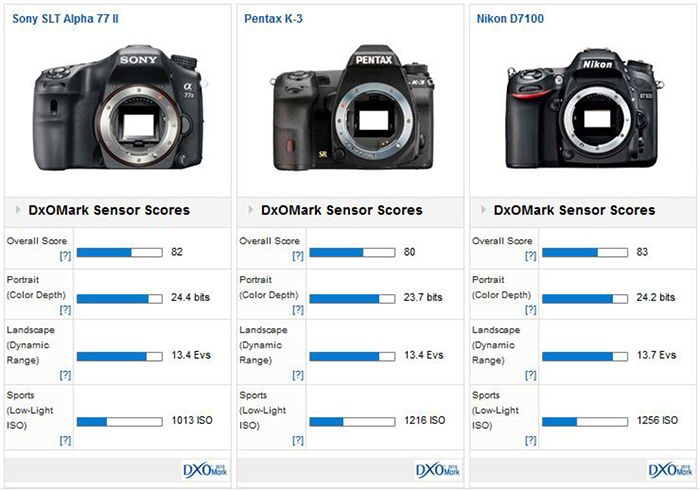
We saw it in the past that the semitransparent mirror did come to a small cost. The A77 and the A99 didn’t manage to match the performance of the other cameras with Sony sensor (although the difference was really minimal). But this seems to have changed. Today DxOmark (Click here) posted the A77II sensor test. The new camera performs four point better than the predecessor and now matches the best APS-C camera int he class, the Sony powered Nikon D7100 and Pentax K-3.
DxO writes:
The slight gains in sensor performance over its predecessor are welcome and place the A77 II on a level with rivals. Whether it’s enough to counter as yet unannounced models from Nikon and Canon, however, only time will tell.
And only Photokina will tell us if the next Full Frame A-mount cameras will have a “flipable” mirror to squeeze out the latest tiny bit of image quality from the class leading Sony sensors!
Sony A77II specs, preorders and shipment date:
Sony A77 body in USA at Amazon (Click here), Adorama (Click here), Sony Store (Click here) and BHphoto (Click here).
Sony A77 with 16-50mm lens at Amazon (Click here), Adorama (Click here), Sony Store (Click here) and BHphoto (Click here).
Sony A77 body in Europe at Sony Germany, Sony UK, Sony France, Sony IT, ES, NL, BE, AT, CH, PT, NO, SE, FI and Wex UK.
Sony A77 in Asia at Digitalrev and Sony Australia.
0 Responses
As DxO is reviewing the A77II, and a lucky few are already getting them, I thought maybe DxO might now be offering A77II lens correction modules. I just checked, they are not.
They release based on their own software update timeline rather than camera releases. They’ve only just in the last month released an update for the Olympus stylus 1, which (according to Amazon UK) has been available to buy since Nov last year. So, you could be waiting a few months.
This is true…it can take DxO forever to add support.
I think DxO’s schedule is driven by market demand and popularity of camera or lens. My memory fails me which Sony camera it was but I recall one camera was supported within days of it becoming available. (I think it was a NEX.) On the other hand, I waited for years until they finally came out with a module for the Sony 300mm f/2.8 lens! Once the do the lens for one body model, the other bodies come quickly.
I never understood why DxO had to make a different set of modules for the A850? The A850 was just slowed down version of the A900. It used the same sensor. For some reason DxO came out with a complete new set of modules for the A850?!
I’m an optimist; I’m hoping the A77II that I ordered the day it was announced, and DxO modules for it, both arrive in just a few more weeks. 🙂
On the A850/A900, I vaguely remember that too. Odd.
I’ve got an a850 and an a900 and the RAW images coming off of the two sensors do in fact produce wildly different results. It might just be variation in the two particular sensors that I’ve got, but I’d hate to have bought two a900’s (at the higher price) only to have found that one of them produced colour as bad as my a850 does! It’s quite shifted towards yellow in the white balance, green in the tint, and its saturation looks different too. In both Lightroom and DxO. And yes, with the same custom white balance number dialed in to both bodies and with the same lens on both cameras. It drives me nuts…
Now that is interesting! If I understand you correctly you are saying you got what you expected from your A900 but the colors on your A850 are different from what you expected and different from your A900.
That’s a bit disappointing; especially for you. I only own the A900 and still think it’s a great camera.
Sony did lower the price when they came out with the A850. I guess changes had to be made?
Pretty much the weak bump I expected on this synthetic test.
All tests are synthetic by definition. This happens to be what’s known as a carefully controlled test with objective measures, not a mere opinion.
The A77II is more of an incremental upgrade.
If you add up all of the bits, and pieces the A77II appears to perform well above its competition, but the differences between models isn’t as great as I had expected.
I’m impressed that it (A77II) has managed to curb stomp its competition, but its not enough for me. I’m not going to upgrade this round.
I’d rather drop the cash on either the Tamron 150-600mm, or Sigma 150mm macro this year.
I’m going to wait to buy the A77III in 2016.
Now within a 1/4 stop of the non-fixed-mirrored competition. What was a minor difference is even smaller.
Not really. The A77II 79 point AF is probably the fastest, on any DSLR, and enough of a reason to upgrade.
I think Fred was saying that the A77II is now within 1/4 stop of it’s competition, and that it’s basically on par with them. Which I agree with. 1/4 stop difference between A77II and Canikon is negligible. So when you factor in all the extra tools and benefits, the A77II is the value-packed winner, and there aren’t really any downsides.
Oops my mistake.
I’m thinking about the whole A77II package in general.
At High Iso, Sony is not good… 1013 vs 1256 Nikon…
er, yeah ok.
Less than a 1/3 stop difference. Probably not so different in real world tests…
Yeah. unfortunately, its about the same difference as the one between the A77 and A77 II, so its pretty much swings and roundabouts for Sony 🙂
I won’t be upgrading, as the difference is so slight for most use cases.
It’s not groundbreaking, but I’m sure the difference is quite noticeable. Combined with the better jpg processor, and the massive focus and buffer upgrades, I am going to buy it. I pre-ordered and got a sweet bundle deal from Sony directly (live chat someone and they’ll help you close the deal). Basically, free 32 gb card, free case, free flash adapter, free warranty upgrade.
Oh and all the little things that are very important, like focus range limiter.
…and the awesome auto-ISO in Manual, about time too, I’ve already tried it last night!
DxO is a pretty one dimensional review that only really measures sensor advances not the 79 point AF speed or accuracy which is the chief reason to upgrade to the A77II.
No – the chief reason is because your A77’s shutter has broken and if you’ve got to buy a new camera, might as well go for the latest model 😉
LMFAO.
Andy your definitely the exception to the rule. Do you have your A77II yet?
He does and so do I. 😉
This is awesome news!
Only rated 1013 iso as expected only minor improvemeent and no inprovement in resolution.
I see very little reason to upgrade from my A77 and will not be doing so…as I have said before though if you dont already own an a77 this is a great camera.
I very much want to upgrade but have decided to wait for the new stacked sensorss.
If as I suspect the next A mount cameras have bayer sensors such as the 36mp sensor used in the a7r I will not buy one no matter how good it is.
Also I believe that by not purchasing any more bayer sensor cameras I will be contrbuting towards forcing Sony to release the new sensor sooner.
I believe bayer sensors are currently obsolete but Sony has not chosen to tell us that yet.
If you own the A77 the A77II is worth the upgrade for the AF gains alone!
If you feel it is worth it than it is worth it to you..there is no right or wrong opinion here.
I will primarily use it with a Tamron 150-600mm.
To the bedt of my knowlege not all the af improvements are comparable with that lens.
Do you have any knowledge how the af on that particular lens compares between the two cameras?
Barry, how do you like your 150-600mm?
I have ordered it in Sony mount therefore am still waiting so this answer is based on test results..not on my own experience.
The lens seems to ouperform any other zoom lens out ther for a long lens.
Some of the very large very expensive prime lenses do perform betterthan this lens.
Value is the key word in every review.
These terms are relatve..considering it is 600mm…
It is lightwight and inexpensive and sharp.
Based on resolution tests..
For C size sensor peak center performance is achieved at f8 across the entire focal length.
For ff where edge performance is more of a factor f11 will give opimum performance corner to corner ..but again f8 is sufficient for peak center performance.
I have purchased a Dotline dl-v9 and consider this the essential accessory for a long lens up to 10 lbs
These lenses are heavy enough that handholding causes muscles in most people to shake.
This device supports 100% of the canera weight on you body allowing easy one hand or even one finger opperation of camera and lens..and it is economical
I have used it on my sigma 50-150 which is similar in size and weight to the tamron.
The one thing I would like would be shorter close focus distance to allow greater maximum magnification. Currently it is about 9′ and 1/5 magnification.
I’m starting to lean – easy for me to say now I don’t have sticker shock on what probably will be a $2,800-$3,000 body – to a FF a99II. What put me over the hump was the following Tony Northrup video which helped clarify the relationship between ISO and crop factors (the “lies” Sony tells converting lenses to 35mm equivalent): https://www.youtube.com/watch?v=6Im4W_9blhY&list=PLBE338967F8DB7F2A.
Obviously, APS-C a-mounts are terrific values and after moving to my a65 from a so-so Lumix super-zoom my photography has dramatically improved. In fact, APS-C is a perfect format for an amateur like myself (explaining my upset over the disappointing a77II upgrade). But FF is the gold standard and I’d expect a cropped image on a 36mp a99II to have as much detail as an a77II while giving me the better ISO my light hungry Tamron 200-500mm (or the 150-600mm) absolutely needs.
BTW, the weak rumors of a Canon Foveon sensor keep rolling out to keep your hopes up: http://www.canonwatch.com/another-weird-rumor-supposed-foveon-like-sensor-canon/.
Sony…and I know this is an exageration…is subjecting us to a form of extortion because they can…
Sony has the next generation technology we all want but is not offering it to us..why…because they can..no one except sigma…and they dont count…is producing a stacked sensor.
Sony can continue to sell us obsolete bayer sensors because we have nothing better to buy.
My solution…dont buy them.
Sony has the new sensor ready to release..if we dont buy any more bayers it will be released soon. If we keep buying bayers it will not be released soon.
If like me you want your stacked sensor wait..do not buy a bayer sensor.
This is what sony is doing to us so there is no reason not for us to do the same.
Every bayer sensor sold is another day we have to wait for the new sensor.
As I said this is a slight exageration to illustrate the principle of MARKET PRESSURE.
I have a ton of thoughts on this but I doubt you want to read a dissertation, especially since we don’t see quite eye-to-eye. I think you’ve built up high expectations on a thin rumor – a rumor that is a few years likely will come to fruition in some form.
I’ve outgrown my a65. I suspect you’re comfortable waiting it out with your better a77 which I fully understand.
I currently have both a65 and a77.
They are both equal I would rather err on the side of waiting since no camera currently available is high enough resolution for me and if I buy the wrong camera I wont be able to buy the one I need when it is available.
Thanks Barry, post a link to some of your shots with the Tamron when you get it. Friend of mine has the Sigma 150-500mm so I will have to take the for a walk at some point.
I don’t see why you think that all the improvements are not compatible with the Tamron. The worst that will happen is that the lens is limited to “just” 61 AF points instead of 79. The faster processor and improved AF algorithms of the A77II is going to leave the A77 in the dust.
When I saw the list of compatable lenses in the manual I assumed that meant that ..like the a99 dual focus it only fast focuses with those but normal focuses with other lenses.
I called Sony support 3x and got 3 different answers to my question of what it can do.
Therefore I am awaiting some sort of test results to be certain.
My other issue of course is that there is only a slight improvement in image quality over the a77 I already have.
I am not in a position to buy a lot of new cameras I need to make my purchases count.
Lastly the fact that newer much higher res cameras are close is a big factor.
I really want theat and do not want to buy the wrong camera then be unable to purchase the one I really want..if you recall I was expectong this camera to be less expensive…I would only buy a bayer sensor camera now if it was both a substantial improvement and very inexpensive.
If Sony actually came out and said officially this is when the stacked sensor will be released we could make an informed decision whether or not to wait.
Without knowing it only makes sense to me to wait as long as it takes.
If camera sales drop substantially because consumers decide to wait it may force Sony to release the new sensor sooner.
It was widely reported that the D7100 uses a Toshiba sensor… This says Sony???
How does Nikon manage to have better overall sensor performance from the same Sony sensor is a big mistery yo me!?
photobyandrei.wordpress.com
Three points:
1. Sony uses semitransparent mirror in front of the sensor on A77 and that will cut small portion of light away. Less light means decreased signal to noise ratio.
2. When testing the A77 either EVF or LCD is constantly on and that generates more heat. More heat means more noise on the sensor. That’s why cameras with optical viewfinder have always a slight edge in long lasting sensors tests.
3. Difference in dynamic range and ISO is less than 1/3 stop. That is something that in real life nobody can’t detect from the random pictures and that’s why the overall difference is only 1 point between Nikon 7100 and Sony A77 II. Absolutely nothing to worry about.
2. that’s urban legend.
Dimitry, have you ever done a comparison or are you just talking out of your a**.
Well, have you?
So your answer is no, my assumption was correct.
The dxomark gives high ISO values to Sony cameras with same IMX071 sensor: NEX-5N: 1079, NEX-C3: 1082, A580 (last Sony DSLR): 1121. Whereas Nikon D5100 got 1183.
The difference between DSLR-mirrorless is smaller than the difference Sony-Nikon.
Where are your tests which supposedly show that mirrorless are noisier?
if some kind of noise has contribution of 1% and it multiplies five times, it’s still 5%. If people say that 1/3 stop is negligible, what we can say about 5%?
I’m always wondering how much samples (of cameras) DXO really tests… They give us numbers with 4 decimals of “precision” regarding ISO but as any electronic engineer knows where are tolerances in any individual component (normal tolerances for electronic components are in the 5 to 20% range…) – so (given only a 10% tolerance) an ISO value of 1000 of one sample can be 950 or 1050 on an other sample of the same camera model… And they give us values “sharp” to the last digit of FOUR…
To be comparable and correct they should test at least 10 or better 20 samples taken of randomly from randomly selected stores…
BTW: just for understanding: even the hp/kW declaration of car engines have a legal tolerance of 10%! So your 200 kW engine may “only” have 190 kW (= 258 PS or hp) or if you’r lucky you may have 210 kW (= 286 PS or hp) – 258 to 286 – what a range… 🙂 🙂 )
yes… but even if dxomark tests only one sample of cameras, it’s still indefinitely better than casual testers who test the same one sample AND BELIEVE in manufacturer’s ISO scale and autoexposure xD
On several of the scores DXOmark state what the tolerances are in terms of what is will be visible.
http://www.dxomark.com/About/Sensor-scores/Sensor-Score-Essentials
In an ideal world several examples would be tested but that’s a costly think to do and, frankly, if people are silly enough to think that a difference of a few percent in the low light ISO numbers are going to be of material distance in the real world, then they have probably already strayed from the path of rational decision making.
As for your contention that normal tolerances for electronic components is in the order of 5 to 20%, that’s hugely misleading. Engineers design electronic systems such that they produce predictable results even when individual components vary considerably. For instance, an power supply might well use components with such variation (or even more in the case of electrolytic capacitors), but, by a judicious use of good engineering principles and a few precision components, it will regulate output to a fraction of a percent. Modern digital cameras are stuffed full of technology which will be designed to cope with faults and variations such as failed or excessively noise sensor photosites. I’d be amazed if the actual performance of camera sensors was anything like the legal tolerance you quote for car engine output (quite what legal regime is that anyway?).
where are your compasons, from your a** ?
Lol. Your assumption might be correct, but why aren’t you asking EcoR1 for his comparisons? Or maybe show us yours? Maybe you too are talking out of…
Within any kind of sensor more heat will generate more noise. It’s a known fact. If DXO-mark can somehow circumvent the problem during the testing with cameras where the sensor is read constantly, I can’t comment on.
The largest by far source of noise is photon shot noise, which is of quantum nature and is completely irrelevant of temperature
Tell me something new. That comment has nothing do to with the matter we were discussing. Yes, different sources have a different contribution to the overall noise, but all of the noise sources add up.
so where are your comparisons?
Photon shot noise is only by far the highest source of noise from mid to high light intensities. That’s important for the SNR in the medium and bright areas, but it’s not what largely determines SNR in dark areas. In the dark areas, the noise floor level is dictated by what is generally called read noise. That means the ultimate DR is effectively dictated by the ratio between the electrons in a saturated photosite and the read noise level. At base ISO it will probably only be important if shadow areas have to be “lifted”, but it’s far more important at so-called “high ISO” levels. In those cases, analogue gain is applied, often supplemented at the highest ISO levels with digital gain. In that case, the sensor readout will saturate long before the electron well, but the read noise will have been amplified. It’s that factor which produces the reduced DR at high ISO.
So you contention that temperature does not matter is wrong. Read noise is most certainly increased at higher temperatures. Indeed, thermionic noise (for a given temperature) is just as inescapable as photon shot noise .
I temperature is so unimportant as you maintain, you might ask yourself why astronomers go to the trouble of cooling their sensors at major observatories (or even some amateurs).
This is exactly correct!
100% Agree, it has been proven on multiple Canon and Nikon OVF vs Live View ISO tests. Sources to EcoR1: Search on google yourself before making such claims.
4. Probably stronger Bayer filter = better color depth = slightly worse high iso
Because they are more worried about their camera sales than the sensor/gadget sales. I don’t know of any other explanations.
It’s very simple actually, the Nikon doesn’t use a fixed mirror.
1. different color mosaic (bayer) filters.
2. better noise reduction (in software of course), everybody except Canon is proven to do NR on their “raws”
Because It’s not the same sensor, Sony vs Toshiba
Sony A6000 got high ISO score of 1347, more than this NIkon D7100. It’s the SLT mirror thing
So a 1/3 stop difference is huge gap to you?
it’s small, but still it’s much larger than differences between Toshiba vs. Sony sensor.
(yes, I know some Toshiba sensors were blamed of strong banding, which DxO doesn’t measure)
so now the mirror takes 20% instead or 25% light. Yeah… huge progress..
How did you calculate this figure?
divide Sony’s high ISO score by Nikon’s, multiply by 100 and subtract it from 100.
And how do you know if the improvement is the sensor or the mirror?
of course you are right, we cannot know, but we have seen Sony and Toshiba-produced Nikon sensors behave similarly in the past.
and i have written how it looks from user’s point of view
Eh? They’re two completely different sensors.
You can’t measure light transmission of the mirror by comparing with the sensor of another camera. Even if the D7100 was using the same sensor, there too many other variables, including the fact that Nikon using different NR algorithms.
of course you’re right, but
1. sensors are the same size
2. differences due different NR is much smaller than amount of light taken by SLT mirror
Well… The gap will increase when we see new models rolling out from the competition. I believe, SLT concept is hurting sales of Sony own cameras while mirrorless get most of the attention due to the great high ISO performance they have compared to their SLT brothers and sisters.
show me actual pictures where you can tell if SLT is hurting performance or not
He can’t
how do you suppose him to show it? Walk with two identical sets of Sony and Nikon gear and operate simultaneously?
if a person earns $$$ with photo, he/she may choose to spend some $$ for even a small improvement
Will write to you with exact or aprox. numbers but I have seen more mirrorless (nex and a7 series) outsell a58, a77 or a99 in my region (Latin America). In fact, I have seen more and more equip. for E mount cameras being offered in my local Sony Store than A mount.
I’m quite sure I’m one of the few people buying A mount stuff at my local store..
Will try to get a side by side comparison of a7 or rx1 vs a99 at high ISO at night to try to explain why people like more Sony mirrorless than SLT. And just by checking DXO, the same sensor in the RX1 outperforms at high ISO compared to a99.
There was a photo on a previous thread of official Sony sales graphs proving that SLT and Mirrorless both are doing very, very well. Better than expected.
If you are talking about the sales in Korea, yeah, they’re doing great there. But Sony mirrorless outperform and sells better than SLT cameras.
well in Korea? I thought Koreans were very patriotic and strongly preferred Samsung.
Yeah but have you seen Samsungs cameras? 😉
The first generation had a lot of fights to handle. Many fainted over the fact that it had an EVF. And a piece of ‘glass’ in the optical path!
Now, noone talks about the EVF anymore. It’s just there. In the same way lesser and lesser really care about the mirror now.
People still care about the end result, but after the first shock most don’t care how the end result is produced.
For my own sake, if this high ISO difference and the image degradation that is equivalent to a skylight filter is the price I have to pay for the AF speed and a useable live view, I pay it happily.
Some people would like the mirror to go away or move away if you know what I mean. Offering people a way to get cleaner high ISO shots is the short term solution to the lower than expected high ISO performance. Back then, people were getting cleaner shots with the NEX-7 compared to a77… And now we see that both RX1 and A7 outperforms the a99.
I’m happy with EVF too, it’s just that the mirror is always in the middle of some problems (no pun intended). Imagine high AF performance from the a77 II with a Mirror-lock up mode that allows let say, first shot, AF-lock then the mirror moves away…or flapping the mirror in 5fps mode and mirror locked in 12fps mode. That way we get cleaner shots and walk away without issues and be done with the SLT vs SLR talk until full mirrorless A mount cameras come in.
I feel sometimes from the comments below that many users have no clue of what they are talking about!
Sony is doing the right thing by counting on and improving the SLT technology.
Yep, most of these people have no idea what they are talking about. “OMG 1200-value is so much bigger than 1000-value. Nikon is doing something magial11!”.
The flipping mirror (which is what Nikon doing) is magial and improves photographer’s reputation in eyes of casual public xD
Flip-flap mirror is ventilating all the noise-particals away ;). But I wonder why that technique is not working for Canon…
You don’t know? Thats because every Canon shooter is holding their camera wrong 🙂
I use my Nikon flipping mirror to get fresh air in hot weather.. Just remove the lens and enjoy the Hawaiian breeze
Now I’m actually curious about whether that might work on a larger format camera…hmm….that would be a novel desk fan. 😉
Nikon isn’t doing anything on this front, because there’s a SONY sensor in both the D7100 and the K3.
So, logically, any differences in the scores will be the result of the SLT mirror.
Also, these people should realize that the A77II absolutely stomps the Canon competition flat. The 70D and old 7D are both very inferior to the A77II. Will this change if/when Canon releases the 7DII? Sure. Technology always marches on, indifferent to our desires.
Add the Canon 6D to the list.
they don’t count on the SLT tech only, they develop on-sensor PDAF too.
as the time goes, they will be able do put more sophisticated things on sensor (which will become BSI) so current SLT tech will be redunant
Wrong,
The SLT PDAF isn’t sitting still, its only going to get faster, and faster, and faster, and faster. Zoom, Zoom. With each successive generation the APS-C SLT is only going to extend that its technological lead over its compact system camera brethern.
The A-Mount is designed to compete with DSLRs not mirror-less. A-Mount users generally couldn’t care about mirror-less like the A6000.
A6000 shows that the gap is closing, despite what delusional people are thinking…
The A77II is showing that gap is once again widening. Zoom Zoom.
So, what’s the problem
The A77II 79 AF speed supposed to be outstanding, its weather-sealed magnesium body is excellent, and the improvements in image quality are great. The wifi is going to be helpful in the studio.
Its simply the best APS-C DSLR available.
You are right, in most cases the people complaining about the “light loss” or other “disadvantages” of the SLT design have not even used this cameras, or are just reading numbers, but have no idea about the real world performance of the cameras. Numbers help marketing, photographers make great images.
Well they also don’t realize that the A77II has the most advanced AF system of any APS-C DSLR to date. A77II, and SAL1650 combo is the best APS-C system you can buy period.
who says it is “the most advanced”?
they could do complete redesign of AF sensors even for the first SLTs. But noone said it was superior to Nikon (except Liveview of course)
I think Dynamic Range, Colour Depth and the AF Speed are far more important than the ISO. I’m not really worried about ISO issues, I have plenty of fast glass, and a full frame (A99) in the bag.
If people are overly concerned about high ISO performance they should immediately upgrade to a full frame camera.
for most of today’s cameras (except Canons) dynamic range, colour depth and ISO are almost the same thing
Fast glass and FF doesn’t help any bit if you’re DOF-limited.
For most cameras, except those of the company which is selling the most. And if people are concerned about low light, they should be going FF, because there are plenty of situations where it would help, DoF issues or not.
only if you shoot flat subjects. or else you’ll have to compensate by increasing f-stop which defeats any benefit gained from sensor size.
in that case, m43 may produce better result than A99 because it doesn’t have SLT mirror
I don’t consider the SLT to be much of an issue. Also, there are plenty of non-flat subjects that would benefit from an FF camera. Not sure why you are trying so hard to put down the advantages of an FF camera. Sure, the advantages are not present in every situation, same like MFT cameras aren’t always much smaller than FF ones nowadays.
it’s not me trying to put down advantages of FF, it’s BRWAT claiming it to be the silver bullet
The ISO score begs to differ….
If your looking for better your going to have to invest in a FF camera. For an APS-C camera this is an outstanding result. Sony managed to have excellent Dynamic Range, and outstanding Colour Depth results which are far more important than the slight difference in ISO.
I have a full frame Sony Camera, and it has a pentaprism….
FWIW, there are lots of Concert Photographers, Astro-photographers and Sports Photographers that would disagree with you on the importance of High ISO vs Dynamic Range and Color Depth…
Well hopefully they have enough common sense to use a full frame in high ISO enviroments.
Yeah Wildlife photographers and Sports Shooters might disagree with that statement as well.
Really? Why?
Well I can’t tell if you’re being flippant or not, but primarily because of the “extra reach” provided by the crop factor on the APS-C sensor. That’s one obvious reason that Sports and wildlife shooters might prefer APS-C over FF…
Take a FF shot, crop out the mdidle and you get the same result as with APS-C. The difference in megapixels will be offset by the difference in ISO.
You cannot make an FF shot out of an APS-C shot, though.
Duott addressed your last comment, so I’ll leave it alone. I’ll just add that every sports pro I know uses FF and half the wildlife shooters I know too, so I was hardly “flippant”.
I use both the A77, and the A99 (and sometimes the A850, and Maxxum 9) depending on the subject, the environment, the available light, and the focal length, and whatever else I require to get the job done. There is no one camera solution to all photographic needs.
And sometime I resort to film when the need arises.
Looking at the A7R DxO numbers, it’s pretty exciting to think of where the combination of IBIS, better fast lens availability, and a ported 36mp sensor will take the a99II!
Your right, the A99II is going to one he!! of a camera.
So in other words, you’re disregarding the discussion below on this topic, and making a blind statement?
No, I’m simply being a realist about the low light capabilities of this camera and the cost/benefits of the SLT technology. ISO performance is a trade off.
Sorry, I didnt mean to sound like a jerk. It’s just that we already discussed this. It was one of those “What’s up with that” comments on a thread already discussing the topic. But yea, its a tradeoff, but one that makes sense to me (and to Sony – and soon Canon as they are investing heavily in SLT).
Given the AF speeds of the new A6000, the SLT is gone after this generation of APS-C cameras anyway. There’s no real sense in getting excited about improvements in a technology that was always just going to be a bridge until Phase Detect AF on the sensor could be developed.
A6000 PDAF doesn’t support any lenses, except those that were made for OSPDAF. If you adapt any alpha lens through LA-EA3, the camera will resort to a slow CDAF.
Just take a look at A99. Its AF-D mode support what, 5 lenses?
Once native f2.8 zooms are available in e-mount it might. Until then I’m sticking with A-mount.
But If you keep reaching for the future, you’ll never be happy. By the time A6000 style on-sensor PDAF matures, it will be obsolete too.
Right now, at this moment, SLT makes sense. Will it in 4 years? I’m sure it wont. Will Mirrorless? That’s anyone’s guess.
We should chase the technology. The A77II is a good, solid product right now. Good build, good image quality, very good features, and good price. So that’s why I bought it.
Oops…That should say “We shouldn’t chase the technology”.
That ISO performance is a sensor-mirror-image processor combo problem.. Obviously
Nex 7 .. 24MP – no mirror – 1016 ISO
A6000 .. 24MP – no mirror – 1347 ISO
A77II .. 24MP – SLT – 1013 ISO
Boinz X processor is doing well with A6000 without theTM..
TM is taking about 1/3 stop of light for the A77II
Nex 7 Boinz processor is not doing well in noise reduction
They’ll probably release updated firmware to correct any problems.
It’s not a problem it’s just how the A77II performs.. Sure an update might improve the performance a little.
But I don’t expect Sony to release a massive update like Fuji did to the X-Pro1
Still the A77II is a good camera with nice improvements over the A77
You mean the update where it went from ‘it can barely focus’ to ‘it can kind of sometimes focus’, that big update? Oh and focus peaking, can’t forget they added focus peaking… Yeah totally hope Sony release an update like that for the A77 II seems like it really needs it 😉
Adding focus peaking on an update is HUGE difference, it’s adding a feature that wasn’t even exist in a camera.
Try reading Sony updates, there are almost the same, all of them.
– improving starting time and general speed of camera operations
– adding support for SAL50 SAL70300 SAL70200.. etc
Fuji is a better company when it comes to commitment to their products
They even released a guide for their update.
http://www.fujifilm.com/support/digital_cameras/software/firmware/x/xpro1/
Uhm… The Bionz X Image Prozessor is just for saving RAW and Converting them to JPEG. Except Noise Reduction it does not have any influence on Noise.
The Sensor Design itself and its A/D-Converter is the only thing that gives advantage in Noise Performance in RAW-Files, completely independend from the Bionz X.
So if you put the Bionz X into the NEX-7 it might be faster or produce better JPEG, but RAW Noise stays the same. You have to change the Sensor.
I remember watching a video on youtube of someone comparing Sony a7 RAW files straight out of camera and after removing all in camera processing using image data converter software.
The image was totally different in sharpness, white balance and noise.
So how would you explain the difference in RAW files between Nikon D800E and A7R ?
Same sensor without AA filter, Nikon having a better ISO result in DXO.
I remember watching a video on youtube of someone comparing Sony a7 RAW files straight out of camera and after removing all in camera processing using image data converter software.
The image was totally different in sharpness, white balance and noise.
So how would you explain the difference in RAW files between Nikon D800E and A7R ?
Same sensor without AA filter, Nikon having a better ISO result in DXO
My explanation is as follows:
DxOMark happens
The difference in high ISO is about a 1/10th of a stop this is insignificant and could be easily explained by a number of causes { minor differences in testing, variations on sensor coatings etc}
The DXO number is pretty useless however for those who bother to look the provide a very comprehensive data set for each tested variant.
Not entirely right.
You forgot that relative to the NEX-7, the A6000 features a *new* sensor with OSPDAF, and more importantly and relevant to this issue, gapless microlenses to increase the effective light-capturing area of each sensel to effect two ends:
1) cure the NEX-7’s magenta shift in the corners (which was caused by too-narrow sensels that could not deal effectively with the very oblique light paths from rangefinder lenses), and…
2) increase the QE, which in turn increases the ISO performance.
The Bionz X of the A6000 and A77II surely helps in other ways… and it is probable that removing the pellicle mirror on the A77II would probably net similar performance to the A6000 (the assumption is that both use the same sensor, sans OSPDAF the modifications for the A6000), but the NEX-7’s relative deficiency in this area is all due to the sensor differences.
anyone confirming on the 1) ?
I think the talk on DPR has confirmed #1. I cannot confirm either way, since I use native E-mount lenses.
some people were complaining about NEX7 with 16/2.8, 18-55 and 10-18 (the latter ones on the wide end, of course). 16-50 probably as well…
Am i the only one who wonders how DxO Mark is able to get 24bit color depth out of an 14bit RAW-File.
Nobody else wondering that this is technically not possible?
“color depth” is summed by all three color channels.
BTW those are “print” results (which dxomark scales to 6 mpx) so it legally can have more bits than RAW files has (if you downsample from 24 mpx to 6 mpx you gain 2 bits)
I thought they all get scaled to 8MP?
pardon, yes, it’s 8 mpx.
You’re apparently the only one who didn’t do a search to self-educate.
The “14-bit” nomenclature you are using refers to PER CHANNEL.
http://www.dxomark.com/About/In-depth-measurements/Measurements/Color-sensitivity
Most instances in the display world uses SUM DEPTH. Surely you remember your display adapter and “24-bit TrueColor” right?
Better displays/adapters these days go 30-bit (10-bit-per-channel) and higher and is sometimes called DeepColor. Medical and scientific imaging devices/conventions use that and sometimes go higher, and oftentimes standard image display/manipulation programs have problems dealing with these files.
The good thing about DXO is, their procedure is completly and well documented. If you’re wondering about something, just read the documentation:
http://www.dxomark.com/About/In-depth-measurements/Measurements/
As others have said, 24-bit color depth is 8-bits per channel (red, green, and blue). Meanwhile, a 14-bit RAW file isn’t 14-bit color depth, but instead is 14-bits per channel (red, green, and blue). This equates to 42-bit if referenced the same way we refer to total color depth like monitors and displays.
I am not sure why the admin negates the cost of the SLT mirror. It’s still there! The problem never was dynamic range or color depth, it was low light capabilities. And the A77ii has not closed the gap in this regard.
Sure it has. The difference between 1013 and 1216 is only 0.2 stops! Previously the difference was 0.5 stops.
Amazing achievement by Sony
No matter whether it is 0.2 or 0.5, it is still a gap.
But you said, “And the A77ii has not closed the gap in this regard.”
Well it clearly has.
Oops!
Troll will be trolls 🙂
Did you actually read what DxO said? You appear to have read something different to me!
TOHA……. he obviously didn’t read it. In the real world (outside of the lab) the A77II is reportedly producing much cleaner JPEGS. Real world ISO 3200 images are much cleaner, and very usable.
Every other reviewer has said “real world ISO performance has doubled”.
Dxo’s narrow range of testing parameters doesn’t do the A77II total justice. I also shoot at base ISO almost all the time and worry little about high end ISO performance. Don’t get me wrong- I’ll take better performance and Sony needs to lead with their SLT technology in this area. However, I think the A77II’s performance in this area is more than acceptable.
Does anyone know how each individual score affects the overall rating?
In my personal opinion, the camera is good. However, the iso performance is a major letdown, Canon and Nikon did not release the a77 competitors yet, so expect them to be better in that term.
For me, I depend on high ISO in many cases, especially in conference photography, which sometimes (Most of the time actually) I suffer from; because of the low lighting conditions.
I am using A77, very satisfied with the performance except the ISO, eventually, nobody is wrong about anything, it is just a matter of desires and needs (which are different from one person to another).
What made you go for the A77 when every review that I have read has mentioned high ISO as being a weakness compared to CaNikon?
“The slight gains in sensor performance over its predecessor are welcome and place the A77 II on a level with rivals”
The OP is referring to his A77 not the II. Everybody and his dog knew about the A77 high ISO in comparison with CaNikon so I was asking why when knowing this the OP chose the A77.
Yes it is a weakness point comparing to CaNikon, but on the other hand there are several advantage points for Sony over them.
FYI I was a Canon user with 60D and 5D with 24-70 f/2.8 lens, I was forced to sell my gear due some financial difficulties. When I wanted to buy a new camera after a while, I did not think about sony at all, I was looking around in Sony’s authorised dealer here and I noticed the A99 and A77, I tested them out and was amazed by the FEATURES available. No camera is perfect.
Here are a small list of key features that made me shift from Canon:-
1- EVF, it is awesome that U can see what U will get.
2- Video performance.
3- Internal image stabilisation.
3- Handling.
4- AF system.
5- Dynamic Range (was sh*t with canon).
6- Price (the price of all my gear with external flash, extra lens and battery) was the same as Canon 6D with lens kit.
and the list goes on and on, never forget the bright future that Sony is trying to achieve.
Note that my friend is using Canon 5D MKIII, and the A77’s performed better in low ISO conditions (personal test), I am happy, never regret shifting from Canon, thats what matter right?
Sorry for the long answer, but this is the shortcut version 😛
Its a sensor review, and not a camera review.
I don’t take DxO results seriously, I’ll make my assessment after seeing reviews from sources in the industry. Not a bunch of geeks in lab coats.
This is the same questionable company that hasn’t managed to review the Sony’s key Alpha lenses like the 135mm f/1.8 Zeiss, 50mm f/1.4mm Zeiss or the the 16-50mm f/2.8.
Actually the A77II should be a much performer in lowlight photography, because it comes with in-body stabilization which allows you to take photos at lower shutter speeds than the other two while using the majority of APS-C prime, and zoom lenses.
Personally I’ll take the wickedly fast 79 point AF and the EFV point over the meagre increase in ISO performance any-day. In the real world the difference between the two is marginal.
Sony IMHO would have hit a home run if they had released a 12-16MP A77II. Time to get real, 12-16MP is more than enough for 98% of photos that are either published online or in print. The last 2 % can be handled with a FF 24-36MP for those making large fine art prints. I am sick of the MP wars.
Sometimes I get moire even with kit lens on 16 mp. And guess what, I don’t want to learn how to remove it in PP, I simply wish it to be gone. Sometimes I have sharp lens on the camera but not enough focal range.
There are very few of drawbacks of having 24 mp on its sensor. The old A77 can already shoot as 12 fps. For E mount vignetting/colorshift is the issue which speaks for lower MP counts but for A mount it’s completely irrelevant.
What is the reason to go with less MP? You want to have 24 fps instead of 12?
It won’t make better high ISO or better DR.
It won’t improve reliabliity.
It won’t make price lower, on the contrary: pixel haters are not so noticeable when it comes to money instead of words, so manufacturers and retailers have to keep price higher to compensate for smaller volume.
>What is the reason to go with less MP?
Faster writing to buffer / sd card, for one.
True, but if you’re constantly filling the buffer, you might do better with working on better timing and using short bursts. I’ve shot sports for two years on the Nikon D600 (also 24 MP) using raw files, and I can count on one hand the number of times I’ve filled the buffer. That’s because I rarely burst for more than 3-4 frames at a time.
Also, get fast SD cards. Sandisk’s 95 MB/s Extreme Pro cards do a pretty good job.
Larger buffer and UHS-II support would solve the problem for “Spray and Pray” type of shooters.
I’m one of them, whenever I take pictures of fast moving action and I regularly bump against the buffer limit.
Ever considered improving your timing skills in the time you spend whining on forums? 🙂
I sit on forums during work downtime. My income, unlike for most people here is i. Software development.
Unlike many people here, I do not hide the fact that i’m an amateur. Also, unlike many people here, I do not have much time to spend perfecting my skills, so for situations like fast action, which i have like once a year, the only option that I have is to spray and pray.
Gotta give you credit for being upfront about the spray and pray thing.
So, a 1D X or a D4s is not on the cards for you?
I enjoy photography, but I don’t enjoy it enough to spend that much on it. Besides, I love EVF, and the only FF A-Mount camera that has it is A99, which is also on the expensive side. I currently own A65, and while the 16-50 is a great lens, the sensor leaves more to be desired, specifically at high ISO.
My original comment wasn’t about me wanting a faster write-to-card speed, in fact I have never complained about it, even though I mentioned that it happens to me during fast action.
It was actually in response to @disqus_QG3QOrA7af:disqus comment about faster write speeds. I was making a point that he, and anyone else who screams less MP, will not gain much by going that route. Instead, I proposed a solution, which would satisfy both High Mpix and spray and pray people. That solution was:
1) Larger Buffer
2) UHS-II support
3) Faster CPU.
All these are achievable and require much less R&D (in that order) than developing a brand new sensor.
My A65 is probably limited by the card interface, so the first step would be to upgrade to A77II or maybe wait for the 2015-2016 refresh.
Sounds similar to me. Strictly amateur (also into software development as a career). I don’t “spray and pray” per se because I don’t shoot at high FPS. However, even pros will tell you shoot a lot of photos.
It’s the primary reason I’m a ‘better’ photographer (didn’t say “good”, trolls) than in the old film days because back then the cost of shooting a lot of pics was prohibitive. So I’d try to get that one great snap and often it wouldn’t turn out as planned. Digital is my savior because given the law of averages I’ll eventually get a keeper. ;^)
a 16mp file isn’t that much smaller than a 24 mp, so the gain is barely noticeable. Its 16mb vs 24mb. With a 256 Mb buffer, that gives you 10 frames with 24mp or 16 frames at 16 mp. If you’re regularly bumping against the buffer limit with 24mp, it will not change with 16mp.
What will change the buffer performance is much better DRAM and a better CPU. Or at the very least more DRAM. There is absolutely no reason for a modern camera to have only 256 megs of RAM. Most smartphones feature well over 2-3GB. 2GB of ram would give you an 85 frame burst. That is one heck of a burst!
So instead of asking for less MP, which is especially a no-no for extreme telephoto photographers, ask Sony for a larger buffer for starters.
Then, ask for a UHS-II card support, which would be a very welcome addition as well…..
SRAM would be far better than DRAM.
Umm, disagree! While yes, it is much faster, its also more expensive and consumes more electricity. 2 things that are critical to camera sales.
It is good for server or specialized applications, where power and money do not pose an issue, but a camera that it tailored to a specific budget, with number of photos per battery already behind competition, i’d say its a huge disadvantage.
The big bottlenecks for raw are buffer size and write speed. I’m guessing cpu has more of an impact on jpeg, given the images have a problem be processed (as opposed to transferred)
CPU also does RAW CA correction. At least I’ve read on dpreview that it does in my A65.
I’m with you. I wish we had just stuck with film. New technology is scary and unnecessary. 35mm Film was good enough for 98% of photos that were either published online or in print, and the last 2% could be handled by medium and large format films. I’m sick of the digitalization wars.
Canvas was good enough for 98% of the time, we should have stuck with oils and canvas. Some say that charcoal and a cave wall is enough, but that’s just silly IMO as you lose the portability.
FWIW, these score are almost identical to the mirrorless NEX-7.
http://www.dxomark.com/Cameras/Sony/NEX-7
I hope Sony gets it rights on the a99MII because Sony is still just “Remixing” cameras again. This release continues to show that. The a77 Sold a lot of copies and overall was marketed well (By the a77 owners) so it looks like Sony said ” Lets keep the name and fix a few of the problems and release the camera again” with image quality that it should have been when the a77 was first released Years ago. No new cameras for me until Sony releases a true a900 replacement or Nikon releases a D400 (Or whatever they will call it / D9300). This “Barely” better stuff has to end. These cameras are fine if you don’t have one but if you already own a a580, a77, a900, a850, etc. There is no real reason to upgrade. Release a Alpha body worthy of an upgrade and sell more copies to current owners Sony!
“There is no real reason to upgrade”
For YOU.
There are several reasons to swap the A77 for the A77II and I just have.
You sound like a Sony rep… The only thing you probably updated to the a77II is your screen name.
How arrogant to assume that because YOU don’t want the added performance of the A77II others also do not.
How “Arrogant” of you to think others will pay the price to “Upgrade” just because you “Upgraded” your screen name to a77II. If having your screen name a camera that isn’t even out to the public yet doesn’t scream Sony Rep then nothing does…
I don’t think, I KNOW. Some A77 users here have it too and I have both the A77 and the A77II in my hands right now. It has been released in the UK for a week now, do keep up.
Oh yeah, Sony Reps get them Early…
Well have a look here then. A SAR user from the UK who got his from the Sony store a few days before me. You are WRONG.
http://www.dyxum.com/dforum/a77ii-very-brief-first-impressions_topic107001.html
I personally know 7 people who upgraded from A77. Normal, average working people. Not Sony reps. Not related to Sony in any way.
The troll is strong with this one =:)
LMAO………
“These cameras are fine if you don’t have one but if you already own a a580, a77, a900, a850, etc. There is no real reason to upgrade.”
That’s true, but do you think you need to upgrade every release cycle? What do you expect the camera makers to do – release a camera that will wash your car for you? If a new buyer is looking at the A77’s that are still on the shelves vs. the new A77II, the improvements on the II are probably enough for most of those buyer to just go for the II. But yeah, as an A77 owner myself, do I see enough to immediately drop more coin on the new model? No, but that’s because the 77 (along with my 99 and 900) is more than enough to keep me happy right now. What’s with this thinking that new cameras are to make just the most recent previous versions seem like garbage, and one has to want to upgrade their camera with every release cycle?
Improvements Suggested for Next generation A7 type cameras:
1. Never, ever, release another camera with nearly as much shutter vibration as the A7r! Try testing the new cameras with long lenses before releasing the camera(s) to market.
2. Get rid of the STUPID raw data lossly compression in the files of the A7 and A7r (and others?). Any camera that aspires to highest image quality and compresses in a lossy fashion the raw files is a sad imitation of what the camera should produce (lossless compression is ok). The A7’s are not sports cameras anyway, so why economize on the file size and quality?
3. Improve autofocus speed
4. Improve electronic viewfinder – much less contrast, less lagtime, larger image is needed; more resolution would be nice.
BTW, I had an A7r but sold it due to some of the factors above, esp #1 and #2.
Im in complete agreement… which camera did you go back to?
I went back to my Canon S95, which is my dark humor substitute for saying that I didn’t replace my a7r – right now I don’t have a ‘real’ camera. I already tried the Nikon D800E before the a7r and I’d prefer not to go back to a DSLR (unless someone makes a gift of the new Pentax medium format about to come out, or unless I win the Lotto). Micro 4/3 doesn’t have the image quality I’m looking for, Fuji trans sensor has some artifacts I don’t like and the resolution is too low (like m4/3), etc. I suppose the forthcoming Sigma quattro might be a temporary placeholder if I somehow don’t mind not being able to shoot with my favorite focal length (35mm equivalent of 35mm) and I forget my experience with the DP2M of painful raw processing and severe shooting shortcomings. Then there is the A7, but it’s it’s “only” 24mp and has the AA filter and the slow autofocus and the raw file lossy compression. You’ve probably seen the rumors of Sony and Fuji digital medium format mirrorless fixed-lens cameras, and a Sony 35mm with a curved sensor. Even if true they probably won’t be out for long time. So, I really don’t know what to do at this point.
You seem to have issues with every system.
But really… which camera are you using right now that’s better than the ones you mentioned?
Why do you even bothers asking to someone that is pretty clear cannot even take photos.
He cannot even use a camera…
Well I’m sure he can take photos and he might even be able to use a camera… I’m just finding his argument, which goes to say that not taking photos is better than taking photos with what’s available, a bit strange 🙂
Love it! You use a S95 and complain about m43 and everything else. I see scores of people having dust on their sensors and still pretending that they absolutely need super high resolution (without ever looking at details). What did they do in the past? Paint pcitures?
The best APS-C in my, and many others’ opinion, are the Fuji X cameras.
But YMMV.
But too slow to AF for me. If I needed good high ISO it’d be a Nikon.
I’ve seen image samples from my friends fuji xt1 .. Damn those raw files are razor sharp and cristal clear.
Apply the NR for any bayer and you’ll get similarly “razor sharp and crystal clear” pic.
Thanks for the info.
I’ll sell all my gear since all I need is an iPhone for photography and lighteoom for sure.
About the same here, although I use the camera sometimes when I need a reach, but mostly the smartphone alone is enough, especially with excellent panorama taking mode of Nexus 5 default camera app.
the main improvement on A77-2 is only on AF, better buffer, and some good features in handling comfort. In jpeg rework, the Bionz X processor is a step forward too. What I would like to see in Sony’s cameras is simply the setting that allows to switch noise reduction totally off. In all their cameras you can chose low noise reduction, I would like to see here an adition that says “off” or “none”.
Read the manual:
High ISO NR Sets noise reduction processing for high-sensitivity shooting.
(Normal/Low/Off)
I can not get disqus to load in Firefox on any of the rumor sites since 3 days, very versatile this commenting area since the sites changed to disqus. I run the comments from the disqus dashboard on their site.
the ISO just like the CPU Ghz, s-l-o-w-ly increase from one to one generation
Bad example.
Ghz has long stopped increasing. If anything, it decreased and stabilized from the Pentium 4 days. At this point its efficiency of the CPU design. Such as number of calculations per clock as well as power consumption efficiency that play a big role.
Smartphone CPUs excluded, since these have been lagging in Ghz race for a long time, due to power restrictions.
According to the DXOMark Camera Sensor Ratings, the Sony A77II gets an 82 (as shown in this post), the same as the Canon 1DX and 6D (also 82), and better than the 5D Mark III (81). Yes, the top Nikon (FX & DX) cameras are higher, but according to the sensor comparisons that are pretty much the most respected in the industry, the A77II can match or beat major full-frame offerings (at least as far as the categories measured). That is quite incredible.
The reason for the apparent low score of the 6D is down to the high base ISO DR of the A77II .From 200 ISO upwards the 6D has better DR and obviously better high ISO. The data provided by DXO is very good and comprehensive the total score however is a bit pointless
http://www.dxomark.com/Cameras/Compare/Side-by-side/Sony-SLT-Alpha-77-II-versus-Nikon-D5300-versus-Canon-EOS-6D___953_919_836#tabs-2
I do get what you mean, especially regarding the high ISO ability. However, I still think that it’s amazing that the A77II is so close to a the top-tier of full-frame Canons…in fact surpassing them at the lowest ISOs. Of course, at high ISOs, the full-frame Canons shine. But I’m glad that DXOMark rated them in various areas, since I often take architectural and landscape shots with lots of light and low ISOs (and not a need for a shallow depth-of-field), so I think that the A77II would in fact suit me better.
Just one thing I’ll ask you (and I’ll probably ask elsewhere, too, for others to chime in), but it shows that the A77II has a higher Dynamic Range, Color Sensitivity, etc, at ISO 50 than ISO 100. I’ve heard that lower (and higher) EXPANDED ISOs actually worsen Dynamic Range, but this isn’t the case here. Does this mean that the ISO 50 is not expanded, but rather normal, and best to use at all times when you want a low ISO and the best image quality?
True, but the data also does not account for banding (or noise patterns in general) from which the Canon suffers more at ISO 200 too and which limits the usable DR by about another stop or so.
Exactly. The A77 (and A77 II) are designed to work best in normal conditions, (ISO 200 and below, which is probably well over 50% of normal prosumer use cases). At those ISOs, the A77 blows everything else out of the water. Although you will get loads of people complaining about high ISO, its actually swings and roundabouts. The A77 is your best choice if you are able to use a flash or tripod, or are in everyday conditions with good decent glass.
Same for video. I’m finding that although my hacked GH2 gives 150Mb/s ‘intra’ AVCHD that in theory allows you to really open up shadow detail in post, I are limited in practice by noise rather than bitrate (even after the GH2 ‘ISO hack’)… shooting video with the A77 at a lowly 28Mbit/s but with DRO and a low contrast filter gives a higher ratio of keepers, as long as you know how to mitigate against the line skipping by stylistically avoiding the need for distant detail, Youve also got one of the two best crop frame video lenses out of the box (A77 16-50mm f2.8 kitlens, the other being the Tokina 11-16 f2.8).
Hope A99II also will have substantial improvement.
The Nikon D5300 with the tweaked 24mp D7100 sensor does a little better. The D7100 uses a Nikon designed Toshiba built sensor not a Sony sensor.
http://www.dxomark.com/Cameras/Compare/Side-by-side/Sony-SLT-Alpha-77-II-versus-Nikon-D5300-versus-Sony-SLT-Alpha-77___953_919_734
It’s still disappointing that an older camera with the D7100 with an older sensor beats it.
Three things:
1) The Sony is a SLT.
2) The performance of all the cams is excellent.
3) Under 99% of shooting conditions you would not determine any difference between the cameras. Put another way: usability and the available lenses should make you choose a particular cam. Sensors are increasingly becoming a commodity (in the m43, APS-C and FF space).
Just my 2 cents.
I have a question. If one (or multiple people) could answer it, that would be great. The charts at DXOMark show that the A77II has a higher Dynamic Range, Color Sensitivity, etc, at ISO 50 than ISO 100. I’ve heard that lower (and higher) EXPANDED ISOs actually worsen Dynamic Range, but this isn’t the case here. Does this mean that ISO 50 is not expanded, but rather a “normal” ISO number, and thus gives even better image quality than ISO 100?
The noise floor is lower at the expanded (lower) ISO’s, which leads to a larger theoretical dynamic range, but in this case also a more limited highlight range for getting past the saturation point of the sensor. Basically you get a shift of the available DR from highlights to shadows in practise.
Although it’s as expected will not exceed A6000, but I still pray for miracle… slight disappointment, but I think I’ll get over it very soon…
How is an APS-C camera that DXOMark ranked equal to an A6000 and higher than a full-frame 5D Mark III be a disappointment? Are you hoping for an APS-C camera that beats a D800E? Personally, I would instead be happy that it earned a score equal to that of a full-frame D3S and higher than the 1DX and 6D. Sure, you can’t push the ISO as high as on the other cameras, but just think of what you get for the money. I’m not trying to get people to buy this. I’m not a Sony spokesperson. But I wonder why everyone seems down on a camera which seems like the absolute best anyone could have hoped it would be, without going into magic/miracle territory.
Cause the forum has plenty of drama queens. Apparently the near perfect A77II isn’t good enough for them.
Although I’m no Canon guy, this is a typical oversimplification. The overall score tells only half the story. Look at the measurement curves to understand that Canon sensors show their potential at higher ISOs. Sony sensors as in Nikon or Sony cameras have higher dynamic range for lower ISOs (for FF cameras the turning point is between 800-1600 ISO, for the A77 its around 300). Thereafter DR is much better for the CANOn 5dIII, S/N is anyway (see ISO scores) and color sensitivity, too. Most pros use a 6D for astrophotography since it is one of the best in this respect. If you want to shoot landscape shots at lower ISO use a D800 or A7r, otherwise Canon is not a bad system after all. But saying it beats (I don’t like these words) 5D or 6D is nonsense. Let’s see what a 7dii will bring to Canon world, I stick with my D610 (Sony sensor) as it gives me the performance I want.
The 7DIII won’t bring anything, Canon’s APS-C sensors are garbage.
Garbage? That’s why Canon sells more DSLR cameras than the others? Don’t tell me…it’s marketing and good advertising. Yeah, right!
No you’re right it’s pure coincidence that the most heavily marketed brand and the brand that’s in your face the moment meet you walk into a camera shop is the biggest selling brand…
LOL
Put a Canon badge on the A77II and Canon togs would jizz in their pants.
Put a Canon badge on the A77II and Canon users would j1zz in their pants.
Look at the specs on the top of the line Canons and compare them to the specs on the top of the line Nikon or Sony…Canon cameras, while very functional and excellent, lean somewhat towards the out of date tech.
Odds are its not going to bring a 24mp sensor or dramatically improved by now live view to the table. I know people get excited about high iso performance but in the real world how often do you go above iso 800?
I always see people saying “…how often do you go above ISO XXX…” I can answer you this “Very often”, particularly shooting indoor wedding reception.
I used to think the same. For landscape shots I usually have a tripod and do longer exposures to stay at lower ISO. If you do weddings, however, lighting is oftentimes bad and flashes are sometimes not allowed. You inevitably need to go to higher ISOs, then.
Many times I see people like you asking “…how often do you go above ISO…” I can answer you “I do”. And mostly are during indoor wedding reception, or church where flash is not allowed or indoor events with poor lighting. I hope you understand that there’re different type of shooting requirement out there beside shooting in daylight.
You are missing the point that Andrew made. All you have demonstrated is that you are an exception, not the norm. The vast majority of images taken are below 800 and it is a loud minority that shout about high ISO, the rest of us are quietly out shooting at 100-400.
Hi Charrick, maybe I should be more specific. I’m referring to the ISO. I’m expecting the score of 1600 for APS-C, is that not reasonable? I don’t expect an APS-C to beat a FF. I realize there’s no such APS-C at that score currently but I do hope for such technology. Other than that, a77II is a fantastic APS-C camera to me. I particulary like the EVF. I do believe there’re enthusiasts out there
have the same expectation as me. Cheers!
From my past experience with A77, I was disappointed with the ISO noise that’s why I sold it.
Now I’m using A99 and A7, to be honest.. I miss the grain in my photos.
it gives your photos the feel of film photography, an organic look when you see the prints.
it’s nice in a way .. look at the bright side
I think I’m lying ..
maybe I miss my A77 that’s all .. just skip this comment
my fren oldies 40D low light pawn my ex-a77;
so my next dreamz camera ISO (DXO test) must exceeding min 2293 (baseline: 5DMK3), have slomo mode 120fps@720p LoL….
get 2 cameras :/
your dream is easy .. try a tougher dream my friend
just for hobby, own 2cam is too luxury for me :p
I don’t own a77 but plan to get the a77II, if the grain noise pattern is something similar to the film type. I’m OK with it. I’ve a200 and the noise pattern is very near to film if process carefully.
Well, I ordered the A77II and it’s on the way to me, I can show you some samples after it arrives.
But I don’t know you Mr.Guest :/
Hahah… Thank you ViRuS X, appreciate it very much. Very soon the sample image will be flooded all over the internet. I’m holding my bullet now to wait for something that can perform at ISO 1600 (a99 can, but out of my budget consideration). Waiting for a maybe budget FF in near future or otherwise I’ll still go for a77II. Thanks again.
you’re welcome Guest, wish you all the best in your decision
congrats on Sony this time even with the SLT design it beats the rivals hands down. I tried it out a few days a go in Ginza Sony plaz , it was super fast and much much better AF-ing camera than my A99v or my D800E was. so I might get this one for action and A7s for lowlight and GH4 for hybrid use, my A7R for on -tripod use. as I see how fast and great AF camera the A6000 is , I am quite sure the next gen A9x series will be a mirrorless and that will really put all D-SLRs into D-SLR camera coffins at Canon camera museum in Tokyo.
I am an a77 owner, and although I am really torn, I’ve preordered the a77ii. I’m still smarting about the loss of integrated GPS, but I guess what sold me is the new AF system which seems like it will do a better job of locking in and holding my precise target in fast moving sports shooting situations. I’m just losing way too many shots to focus errors. (I hope its the camera and not the cameraman.) I am also hoping that it will have better noise performance at equivalent isos than my a77 but I haven’t seen any real proof of that yet. The increased buffer size is a plus but I did not often find the old buffer to be limiting, even for RAW shooting. But if the rumors of an a99ii get firmer I may just cancel the order, save my money, and hold out for the full framer.
As usual, there is a price to pay compared to the (essentially) same sensor in D5300 and A6000 in noise (“high ISO score”), the rest is taken at base ISO anyway even if ti requires a little longer exposure so is not affected.
Very Happy to see ISO scores of a77II .
I find it pretty funny how K-52S is a bit better than K-3 for seemingly a MP problem. Nevertheless, That’s a good step up from the old A77, but I was expecting a bit to the 1100 mark.
D7100 has a toshiba sensor