







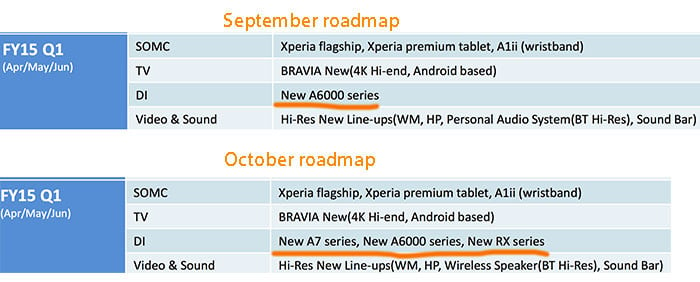
As you can see from the Sony October roadmap leaked by Wikileaks Sony announced all stuff (Z4 smartphone, new 4K TV’s, A7rII, RX cams). But there is one single exception: The new A6000 series camera which we think would have been named A7000. Trusted sources kept saying this was due to release sometimes in April/May but Sony had some kind of issues with the hardware of the camera.
I now got info from Ricoh and Nikon sources:
They told us that Sony developed a new sensor for the A7000. By contract that sensor could be used by other companies six months after the Sony A7000 announcement. The delay of the A7000 release also changed their product roadmap. To use the new Sony APS-C sensor with hybrid autofocus tech they will have to release their camera sometimes in 2016 instead of late 2015.
Let’ hope Sony will announce the A7000 during the next announcement session in September/October!
153 Responses
Sony has not announced A7r II, RX10 II and RX100 IV yet here in Japan. I would not be surprised if the announcement would go along with an A7000.
The A7r II, RX10 II and RX100 IV announcement is a matter of days if not hours…
The A7000 is a matter of months…
Yes, probably.
But the delay here is already 2 weeks and still no shop has any clue even that a A7r II will be released… So I dreamed of a single announcement for everything.
you have no clue what sony will anounce and when….
Sony’s staggered announcements are usual, but they don’t come with any additional items, just a local announcement.
I knew it.
New 30-32 MP BSI sensor to lead the APS-C megapixel race, I guess.
I guess the same 16,6% pixel increase like A7Rii: 28 mp
Sony already announced a new 24MP APS-C sensor a little while ago, so I’m guessing that’ll go in the A7000.
Let’s hope for A7000 BSI APS-C sensor, with better DR and low light capabilities, autofocus is said to be faster than A6000, I really hope it is able to focus with nikon or canon lenses just like the A7R. Maybe internal stabilization ? I really hope for 1/8000 shutter speed too. And give use a better OLED viewfinder too ! Oh and 4K recording internally of course.
IBIS and better EVF are a given.
Let’s hope IBIS is really given for APS-C.
And then let’s hope that all future APS-C bodies get IBIS – no exception.
And then let’s hope, Sony replaces in the A5000 line the toy-hotshoe with their regular-hotshoe. The body should be thick enough with IBIS.
Crossing fingers for Canikon fast AF support! That would solidify my stay with Sony (LA-EA2 isn’t good enough).
Well, aps-c….
I dreamt about a new mount, médium format, 120 mpx, curved sensor, big like an eos 70d, Sony-zeiss ingeneering…
Possible one day?
Possible: yes
Likely: no
Looking forward to an APS-C mini a7rii. Please!
Considering that Ricoh and Nikon have both recently updated their APS-C cameras I call nonsense. Also neither these brands are getting things before Sony’s own cams these days, those days are passed.
thast why he wrote they get the sensor 6 month later… why dont you read before commenting?
This sensor could be used in the D7200, D300 and D5500 replacements starting in 2016 – lets hope so…
I’m amazed if the terms of the contract between Sony and Nikon are not covered by NDA (non-disclosure agreement). For a very good reason: that Nikon users would have less incentive to ever switch bodies if they knew they just have to wait 6 months. These “sources” are definitely putting their jobs at risk.
Really? Those cameras don’t use Sony sensors. The D3300 is a Nikon produced sensor, the D5300 and D7200 are Toshiba sensors.
True doesn’t stop Nikon shopping around and using Sony Sensors in the future for low – mid DX cameras but it is good in away Nikon is using sensors designed in house and from 3rd party supplies like Toshiba and Sony.
Are you sure about that? 🙂
I used to think sensors in D3300 and D5300 are made by Sony. Sensorgen.info says I might be right.
D5200 and D7100 are clearly non-Sony (at least totally different than anything Sony uses) – possibly Toshiba.
D7200 is again a totally new sensor for Nikon in terms of characteristics. Different contrast and colours to what we’ve seen earlier. It seems to be designed to mimic Canon a bit more, but the DR is way to good for Canon production.
Toshiba is an obvious choice (large scale production), but there are other companies that could make it. Aptina was taken over by ON Semiconductor – a company which should be able to beat Sony sensor if they wanted (read: were paid to do it).
Yes, I’m pretty sure about it; the pin-outs aren’t classic Sony, for one. There was a rumor that the D3300 sensor was produced on a Sony fab, but it doesn’t seem to be the Sony design. To my knowledge, Sony hasn’t licensed their 24mp APS sensor yet, though they now show it on their licensable sensor list.
Since I’m deep into D7200 testing at the moment, I don’t really agree with your assertion on contrast and colors. I suspect you’re evaluating a raw converter more than the sensor. The D7200 sensor seems to be better than the last Sony 24mp APS sensor I tested (A6000). Deeper saturation well and lower read noise.
FWIW, sensorgen.info doesn’t actually list the D7200 sensor ;~). That site is a bit out of date. A better source of accurate and current sensor information is Bill Claff’s site: http://home.comcast.net/~NikonD70/Charts/Sensor_Characteristics.htm. His findings tend to correlate very closely with mine.
This whole “Sony is creating six-month exclusivity thing”, if true, would pretty much tend to end Nikon’s close collaboration with Sony Semiconductor, which dates back deep into the 1990’s. Considering that Nikon buys far more Sony Semiconductor APS/FX sensors than Sony Imaging does, that would be Sony shooting themselves in the foot, if true.
Nikon may be closer to Apple in this respect. Apple uses Arm CPU cores and third-party GPUs in the chips that run the iPhone and iPad, but they do the low-level design work themselves, have been at the forefront of changes in the low-level technology (first to 64-bit, for instance), and pretty much fab where they get the best bargain. It’s long been suspected that Nikon has been doing the same thing with sensor designs. They’ve used five fabs that I know of, and if you look closely you’ll find that they were first with binning, first with column ADCs, first with on sensor phase detect, and a whole host of other things.
Even more interesting is that, after the D2 series sensors, the Nikon sensor R&D went curiously silent on the scholarly front (no more published papers or speeches that I can find; they were pretty active up to that point), yet they seem to have continued to be innovating at the sensor level.
As for ON, they appear to have bought Aptina mostly for automotive uses. Everything I hear is that they’re no longer active in stand-alone camera sensor designs.
The real question is one I posed quite some time ago after Sony Semiconductor’s last long-term forecast: is there enough volume in large sensors two and three years out to keep iterating at the levels that have been done before? If the ILC market really collapses down to 4-6m units a year, given Canon/Nikon domination of that market, the Sony large sensor stream won’t have a lot of volume to it unless they can convince Nikon to keep using Sony sensors, and for more products than Nikon currently uses them for.
The price increase on the A7rII (and RX100IV) is a warning shot. The sensor cost in the A7rII went up. Sony needs substantial volume to bring that down. By “substantial volume” I mean A7 and Nikon use simultaneously. A7 use alone isn’t enough to pull the sensor costs back down to where they need to be.
thx for all the infos. (I have been looking for infos on the D7200s sensor manufacturer since a discussion on dpreview about 3 months ago ended like this: either sony or toshiba ^^ )
I agree: If true, Sony has to stop this 6 months exclusive madness!
One question: you got any infos on Pentax’ 24MP sensors? I was off the opinion, they were Sony designs?!
edit: sonysensors in sony and nikon cameras http://www.cloudynights.com/topic/491094-some-recent-image-sensor-trend-mainly-sony-exmor/
I’ll repeat: I’m not able to verify any 24mp APS sensor in an existing camera that is a direct Sony license at the moment.
But there’s much more going on here than at first meets the eye. Because of smartphones and autos, Sony is swamped with sensor demand at the moment. It is possible that some large Sony sensors are being fabbed outside of Sony, and possibly with further changes to work on different equipment. This makes identifying what is and isn’t a Sony sensor design even more difficult. Nikon, however, has been pretty consistent about identifying their own sensors with low-level markings in the silicon itself, as Chipworks has pointed out. The Toshiba sensors Nikon has been using have Toshiba markings, which further clouds things.
It seems to me that there’s a lot of cross pollination that’s gone on in the large sensor business. Some of it has been obvious, such as Sony licensing Nikon/Aptina’s phase detect-on-sensor technology. Some of it appears invisible until you see small differences in very low-level tests that are outside likely sample variation.
A lot of people also forget some very interesting things that weren’t clear at the time. For example, Nikon’s D2x sensor, which had a near 1″ sibling in a Sony non-ILC camera, the R1. Why did Nikon license that tech to Sony, and why was Sony’s use of the tech in such a small sensor size? Seems to me in retrospect we were seeing the eventual emergence of 1″. And who were the first two players in that? Sony (e.g. RX100) and Nikon (Nikon 1). Curiously, though, Sony used Exmor (which has some of its roots in the D2x design), while Nikon used Aptina. And then Aptina licenses back to Sony.
If we go all the way back to the D1, Sony didn’t really want to produce that sensor (a Nikon APS binned design using Sony’s existing smaller sensor technologies). Yet they did. The strange relationship between Nikon Precision and Sony Semiconductor coupled with Nikon Imaging and Sony Imaging has had a lot of permutations and twists along the way. But it seems pretty clear that Nikon has been in Sony’s fabs with their arms up to their elbows quite often for the past two decades.
That’s why I’d say that any move by Sony towards exclusivity on new sensors for any length of time isn’t likely, or would seem to signal a change in the long-term Nikon/Sony relationship that got things to where they are today.
thanks for taking the time and explaining in detail. I appreciate it!
I’m not surprised by Nikon switching to another supplier. If they want to go mirrorless, they need someone who will manufacture their designs (OSPDAF and stuff).
But I’m still surprised. Sony Devices (CMOS manufacturing) had excellent result in 2015. If they don’t make the sensors for latest Nikon DSLRs, is this increase all because of the iPhone deal? 😮
Go back and read this article I wrote: http://www.dslrbodies.com/newsviews/nikon-2014-news/nov-2014-nikon-news-and/more-doom-and-gloom.html. Sony Semiconductor is projecting even more contraction in ILC camera sales than has happened to date.
Yes, phones (and autos) are the reason why their sensor division is doing well and demand is strong.
Thom, your information is pretty outdated.
https://chipworks.secure.force.com/catalog/ProductDetails?sku=NIK-D5300_Pri-Camera&viewState=DetailView&cartID=&g=&parentCategory=&navigationStr=CatalogSearchInc&searchText=D5300%20sensor
It is Sony sensor, and Toshiba did not win sensor design recently.
Given the similarity, d7200 is more close to D5300 sensor
Here’s hoping they add global shutter.
The new RX10 and RX100 have it. The A7R2 can do global shutter in super-35mm mode, so it should be possible on an entire APS-C sensor.
They dont have global shutter! They have a 5x faster readout on the 1″ sensor due to BSI and stacked sensor and 3.5x faster on A7rII due to BSI tech, but its still a rolling shutter.
The 7D can move the shutter-blade across the height of its sensor within 1/500 second.
I wonder how fast the electronic readout-equivalent on A7Rii or the new A7000 is!
???
So?
Rolling shutter isn’t a problem for stills that use the mechanical shutter.
We are talking about the electronic shutter.
It is, because not everyone use cameras for hipster-styled (DigitalRev) street shooting (even if most Sony users do ;p).
Rolling shutter is an issue when shooting fast moving objects (especially while panning). And it’s much easier to notice, because it just stays in the shot and is obvious. Rolling shutter in video is an issue, but not a major one.
I just wanted to say, that a typical mechanic APS-C shutter takes about a 1/500sec. => The mechanical shutter is rolling, too. But it is so fast that it is typical no issue – even with fast moving objects.
If there is no global shutter, but the sensor-readout is fast enough, there should be no problem with rolling-shutter jello effects for 99% of all usecases.
🙁
Bummer.
So when reviewers said rolling shutter was eliminated they were mistaken.
They probably just meant that the rolling shutter effect (jello) was not noticeable. And Sony says it really is greatly reduced due to faster readout. So, still good news 🙂
nonsense…. why people without a clue talkling about things they don´t understand.. 🙁
I hope they can put a APS-C curve sensor into this camera 🙂 It will be another great leap!
Nope won’t debut curved on such a cam – most likely BSI and slight increase in MP – my guess would be they stay around 24 MPixel – but could also switch up to 40 (7680*5120 for easy 4k video out of 4 pixels)
why?? You wont be able to use most if any of the current lenses.
clueless… another one….
The curved sensor is only really likely on a fixed lens camera, for technical reasons.
I am desperate to know if the A6000 upgrade/replacement will have IBIS. It’s the only feature that I’ll upgrade for. I won’t upgrade for better IQ since the A6000 meets my artistic requirements.
People say IBIS is not needed for wide lenses and primes – but I disagree. I find OSS really useful on my SEL1018, and others have said that too. But I really need IBIS to use my collection of manual Nikon lenses.
In the past rumor articles on the next APS-C model, I note there has been a consistent silence on IBIS. Not one inference, I can recall. Ok, that’s fine – it means I’ll keep my A6000 for another cycle, rather than selling so soon.
Sony already knows what’s coming in October from Panasonic and Fuji, it makes more sense to hold back the release as Sony always likes to upstage the competition;)
Maybe that is why we just got a firmware update to the a6000. I suspect we may not see the replacement until maybe before X-mas.
Indeed, the new firmware update is the “proof” that a new model is not near.
I’m sure it will be released before Christmas.
What I heared the cam itself is ready but the sensor is a huge problem. Overheating in 4k (like in the RX100M4) Also the yield is high good enough. The price tag increase in the RX00 and A7R II are mainly due to the bdly yielding and thus higher priced sensor.
They have to get this problem fixed first – nobody want’s to see a 1500$-2000$ price tag A7000
you heard it.. while cleaning toilets i guess….
I can’t
no more
pls
With a deal like this, maybe Sony has done this on purpose?
Just before Christmas is a great time to release a new camera.
Mid New Year is nowhere near as good.
Release their own camera at a great time and force the competition to release at a lousy time.
Overheating sensor?
Can we expect a stacked sensor with incredible readout-speed?
That would be a day 1 preorder for me! 😮
does that also mean A7sii on Oct??
Sorry I misread, it seemed to imply that due to Ricoh and Nikon getting the sensor Sony will have to wait 6 months extra.
At present, Nikon does not use any Sony APS sensor in its lineup except for the Coolpix A, which is discontinued.
I thought the D5500 had a Sony sensor?
Yes, it is sony sensor, Thom’s info is outdated.
Sensors confirmed by tear down:
Camera: Model, size, pixels
Nikon Sensors:
D3100: NC81362A 23.1 x 15.4, 14.2M
D3200: NC81369R 23.2 x 15.4, 24.2M
Toshiba Sensors:
D5200: 5105, 23.5 x 15.6 mm 24.1M
Sony Sensors:
D5300: IMX193, 23.5 x 15.6, 24.2M
=============================================
Also for unconfirmed sensor:
D7100: 23.5 x 15.6 mm, 24.1M
D3300: 23.5 x 15.6 mm, 24.2M
D5500: 23.5 x 15.6 mm, 24.2M
D7200: 23.5 x 15.6 mm, 24.2M
The trend is clear, earlier entry level body use nikon sensors, which is a bit smaller than others.
earlier mid-high model dated 2012 use Toshiba sensors.
From 2013, all nikon aps-c dslr body has same size/pixels count sensors. one of them, D5300 is confirmed sony sensor. Others bear more similarity of sony sensor instead of toshiba sensor, we can assume, rest of 23.5 x 15.6 mm, 24.2M are sony sensors too.
I am done with the waiting. All this months waiting for the April/May +Mid June release and nothing.
This means one thing for me: forget the A6/7XXX and get a cheap refurbished A6000 now with XAVCS codec for my summer holidays. By the time the replacement comes out maybe I could have saved enough to put my hands on an (open-box or cheaper) A7RII for my professional work.
There are two mainframes for camera annoucements: before summer or Xmas, so people can spent their money for the summer vacations or Xmas presents. So if it is not now, it will be much later. And I think I am not the only one who will not be just sitting and waiting for a “release sometimes in 2016 instead of late 2015”.
A6000 is fine camera enjoy it.
You definitely won’t be sorry with an A6000. A7000 will just improve even more on an already impressive camera.
You’re correct. The current a6000 is excellent. I’ll continue using it and waiting for an upgrade. I couldn’t care less about 4K video.
Same here. I’ve been stalking this site 3 times a day for months now, waiting for solid developments for the a7000 (?) model’s release, to no success. This latest news has sealed the deal for me — time to get a used/refurbished a6000 now that XAVC-S has finally arrived (a very clear signal from Sony that a7000 isn’t coming anytime soon).
I also have to think that Sony sat on the XAVC-S firmware update while developing the a7000, and then when they had overheating issues with the prototype a7000 (surprise, surprise from Sony) and the release was consequently delayed a great deal, they realized they’d have to release XAVC-S for a6000. Glad they came to their senses instead of continuing to greedily hold out on us for the sake of up-selling us on the a7000.
Now it’s time to see how great the a6000 really is! Overheating is my only concern whatsoever, aside from the inability to add my own microphone for video. Anyone seen the a6000 overheat during video? And does the XAVC-S codec addition make that better or worse?
I have an a5100 (which shares the same sensor of the a6000, so my comment based in the a5100) and I can without doubt tell you that there is not much difference between AVCHD and XAVC-S to the naked eye. Pixel peeping you can see the highlights are just a little bit better, but honestly, you have to pay attention to that or have a trained eye to notice it. I can see it, my gf can’t 😉 I haven’t done any color grading though. Just some quick comparison tests. For chroma key the results were exactly the same, which is no surprise since the color space is the same at 4-2-0.
Let’s not forget that XAVC-S is still a consumer format and basically a marketing move, and at 50mbps the leap is not much greater. If we could get it at 100- 200mbps (like in the GH4 files), I think we could really see some improvements. But then Sony will cannibalize some of their low-end video equipment I guess. At the end is not about costumers, but margin profits.
Anyway, overall the advantage of the codec compared to AVCHD is smoother playback when editing. I repeat I haven’t done any color grading.
Concerning the heat issue (at least on the a5100) you can record internally up to 15 min or so. The issue is not present when recording externally through the HDMI output.
Could the Nikon and Ricoh sources have this because the sensor delay impacts GR and A cameras? The GRii certainly seemed like something big fell out at the last minute resulting in a very incremental update…
There are valid reasons for using “mirrorless-capable” sensors in SLRs – see Canon’s “Dual Pixel AF” for improved liveview/video capability.
So it could be impacting Nikon or Ricoh’s “traditional” lineups too. Pentax would’ve been due for a new K-singledigit around this fall. K-5, K-5 II, and K-3 were all September/October announcements, and Pentax K-singledigit updates have usually been spaced by either 1 or 2 years.
Dear Sony: delay as much as you need to get it right. Don’t ship any more overheating sensors or shutter shock. Build trust. The tech is awesome. Take time to polish. Oh, and fast glass please.
SAR admin you are like Jon Snow. You know nothing
The replacement is coming in Winter.
Winter is coming! ^^
I believe this website is available and read around the world, so perhaps comparing it to Jon Snow, who will be completely unknown to most, might not be the greatest insult to hurl!
Game of thrones is also available and watched around the world. Also it’s meant as a joke not an insult
Forgive me, I thought you were referring to the news reporter Jon Snow, rather than someone who doesn’t exist.
Indeed, I didn’t even know he didn’t exist until your posts referring to ‘Game of Thrones’ led me to Google it!
LOL, in what way does Jon Snow the news reporter know nothing?!
That is why I was scratching my head. I hadn’t heard of the ‘Jon Snow’ who doesn’t exist, so referred to one who does.
Note to self: You must spend more time reading, or watching, mindless drivel…
Mindless drivel? I guess it’s easy to make that judgement when you apparently haven’t even heard of the show or the characters in it, let alone watched it.
Why would you assume that I wasn’t aware of ‘Game of Thrones’?
I sampled it, found it to be devoid of merit, and left it to others to enjoy. As you will see, though, that was a note to myself…
Do you know how many people watch Game of Thrones?
A lot more than the number of people shooting with Sony cameras.
I have no time to watch it, cause i write hopeless complains on SAR, 43rumors and other rumors.
No idea who Jon Snow is.
hahaha fkn lost it….
Does this mean that Sony and Pentax will not get the 42Mp FF BSI sensor until 6 month after the launch of the A7rII??
APS-C is dead. A-mount is dead. Last APS-C glass was made 2 years ago. It’s only rx series or FE now.
Good the hear it. It means faster and better FE or RX development.
and it´s good that way.
It was short sighted by manufacturers to make APS-C glass only, FX was always APS-C comparable, but not the other way around. Full frame was always going to be the standard, sooner or later. Makes sense for them to wake up, even if a bit late.
APS-C isn’t dead. It’s just pausing.
APS-C is Sonys only way to compete with MFT market. The sensor isn’t so much bigger than FT, and in the worst case you can adapt small MFT-lenses if you can live with vignetting or another crop-mode.
except there no adapter exists and nobody’s going to make one and M43 uses a lot thicker cover glass than E-mount
http://www.amazon.com/dp/B0095OLT6Q/ref=as_sl_pd_tf_lc?tag=micr43rdsphot-20&camp=14573&creative=327641&linkCode=as1&creativeASIN=B0095OLT6Q&adid=11QTN1BDF6KVHCDWHYZT&&ref-refURL=http%3A%2F%2Fm43photo.blogspot.de%2F2013%2F06%2Fusing-micro-four-thirds-lenses-on-sony.html
Even AF-adaption should be possible. With AF there is currently no F->E mount adapter available, but we know it will come. A7Rii made the demand stronger for this.
Same will happen with m43 to E.
BTW: What is this cover glass issue?
I asked metabones (who have knowledge of both protocols)., they said they wouldn’t make m43-E adaptor. Situation for F-E and M43-E isn’t same, F strongly needs better focusing tech while m43 lenses are made for CDAF from the start and could therefore function well even on older NEX bodies. But nobody makes such adaptors.
BTW:
http://www.lensrentals.com/blog/2014/06/the-glass-in-the-path-sensor-stacks-and-adapted-lenses
Okay – and thousands thanks for the links – I never heard this before.
I don’t understand why this makes an effect, but maybe I understand it tomorrow after reading again.
LOL compete with m43? m43 is long time a dead dude in the pool. Sony will be surprised to hear that it has to compete with m43.
It became clear long ago, that smartphones are 99% of what people buy and use in small sensors – m43 are dying out breed. And now aps-c as well.
It’s either rx100 type of portable cameras now or FF like A7RII for real deal IQ. Everything in between is dissapearing very fast and in 2016 – there will be almost no market left for anything else except rx100 type and FF.
m43 is older, there are 2 companies supporting this, and the lens collection is way bigger.
Many people that want a pricey and compact interchangeable-lens system struggle if they should go for m43 or NEX, Fuji or Samsung.
In this group, I guess the biggest market share is m43, followed by NEX, followed by a big gap before the underdogs.
It seems to be so. Actually APS-C is just a “transition” format from the beginning of digital photography when the FF sensors where too expensive to be produced for the masses. As tech advances, the split is clear: FF sensor based on 35mm standarts (for pro/advanced users) or truely digital formats as m4/3 or 1″ (for recreational or pocketable purposes).
APS-C and m4/3 are not so different:
It is only 1.3 crop. (1.24 crop for Canon-APS-C)
But Sony-APS-C you have more or less a digital Super-35mm.
You can re-use that lenses, you have same DoF. You can get a perfect lens synergy for APS-C E-mount and professional Super-35mm Film-cameras.
With m4/3 you can’t.
I think there is no reason to claim m4/3 is a “truely digital” format that will survive, but APS-C is not.
4/3 was built from the ground, Oly-Panny put everything aside and all of it (bayonets, proportions…) was totally new. That’s why it was a “truly” digital format, in that sense.
APS-C was made taking in consideration all the legacy and history of film cameras, as FF digital cameras did aswell. If production of FF sensors have cost same as APS-C sensors at the beginning, APS-C would have simply never existed in the first place.
If you see the market tendencies, APS-C cameras are lost in no man’s land (Nikon seems to have forgotten to upgrade the d300). Most buyers just buy something pocketable (basically cellphones on steroids) for their pictures and advanced users eventually upgrade to FF (specially taking into account that nowadays thanks to Sony one can have a FF A7 for under $1k, which was just beyond imagination 2-3 years ago). If you add to that tons of great and cheap legacy lenses that can be used on mirrorless cameras, the split is clear. It is just a matter of time and production costs.
Agreed.
Except 4/3 is following the tradition of halving something existing.
4/3 sensor diagonal is EXACTLY half length of FF.
M4/3 flange distance is EXACTLY half of 4/3.
There is no intrinsic value to the dimensions corresponding to “35mm standards”. They were just an accident of history. So-called “full” frame is a marketing strategy, based on legacy mounts and lenses – not some Promised Land we’ve finally arrived at, created by the laws of optics. Eventually, digital sensors will arrive at an optimal size, taking into account both performance and form factor (size and weight of camera).
All this talk about FF being “professional” – that’s marketing Kool-Aid.
if the sensor gets small enough you lose control of bokeh due to the short focal lengths involved with huge depth of field and not fast enough to overpower it
Bring out ye dead! You’re hilarious.
Based on the fact that Nikon can use Sony sensors 6 months later I posted projected specs and release times for the 2 new Nikon f mount mirrorleiss cameras to appear 6 months after the Sony version, on Nikon Rumors
Apparently my projections were both very true and very secret, as the comments dissapeared within minutes of posting.
or maybe you are just dellusional….
Your projections are still there. Besides, why would Nikon Rumors care what you posted? Are they controlled by Nikon Corporation?
Interesting you think the Nikon mirrorless will be F-mount. That’s an instant fail in my book. I think a dedicated mirrorless camera has to be built from the ground up with a dedicated short-flange mount, not a DSLR mount designed more than 50 years ago.
What you think it’s irrelevant, what the exiting Nikon users want matters to Nikon.
No doubt, but they should be desperately trying to attract new users too. otherwise they are very short sighted.
A business has no long term future if it cannot grow.
Agree, but they must also focus on keeping the existing users. I’m one of them and I have strong feelings into switching to Sony because Nikon does not satisfies my needs in the video front at all, and keeping both Panasonic and Nikon cameras + lenses is expensive and hard to carry.
If Nikon makes a mirrorless with existing F-mount, it will be a disaster. Pentax learned this lessons with their K-01, and Nikon won’t do the same mistake. They could work with a mirror inside in order to make the body smaller, but that has too many other drawbacks.
If Nikon goes to big-sensor mirrorless it will be similar to Sony or Canon with AF-adapters.
They can make a new mount and an adapter for all the existing lenses. We shall wait and see.
We don’t know whether it will be a disaster. It is just speculation.
collecting new from the front door and losing loyal customer through the back door, does that work?
Focusing on video and neglecting still how does that work ?
Removing feathures and tell it’s better how does that work ?
Sony will find out!
I’ve only seen one case of a manufacturer using a legacy DSLR mount for mirrorless – the Pentax K-01. This camera was a flop partly due to the fact that it wasn’t much smaller than an SLR but was limited to CDAF. The only reason to buy it was superior video performance to anything Pentax would have until months after the K-01 was discontinued.
The Canon EF-M is pretty close, since it’s 90% identical to the EF mount, but it indeed has reduced flange focal distance.
One observation is that, as far as I can tell, ALL mirrorless mounts (except the aforementioned K-mount K-01 used in a total of one camera) are 100% electronic. So any Nikon mirrorless is almost sure to have a new mount that is 100% electronic. (They already have this with the 1 system, but it might not be big enough for FF or APS-C mirrorless?)
Also, these new Sony sensors don’t HAVE to be used in mirrorless devices – they can be combined with a traditional SLR to improve AF in live view mode. See Canon’s “dual pixel AF” SLRs.
So it seems Nikon, after all, is less f*cked than Canon..
I have an unrelated question: I am not knowledgeable in lens design, my question is how can the excellent Contax G lenses be so compact while the FE primes are so large?
Good question…
Does anyone know if Sony is working on developing a higher end kit zoom for APS-C cameras? It would be a shame if the A7000 had a great new sensor and shipped with the current kit zoom. There isn’t really a great choice of zooms right now under $1000 for E mount, and the FE zooms are good but large and expensive relative to the camera.
The 18-105 f4 PZ is pretty good. Well built “G” series (metal, not plastic), parfocal and constant aperture. The only real downside is the focus-by-wire which is a pain in the ass for video, but other than that it is a solid lens… for less thatn 600$
I’d like to see an updated 16-70 ZA asap. The focal length is so great, build and size almost perfect … but IQ is very mediocre (and tends to “quite low” when you consider the price). The biggest bumper is their QA: IQ can be good but most likely is not on your model. At least I tried 3 different models and non didn’t had serious issues, even 2 years after release. I’m stucked with primes for E mount (also EF) for now.
There’s only the 10-18/4 which is a very good zoom. And propably the 70-200/4 but costs a fortune and is to large and heavy for me.
IBIS actually works BETTER for wide-angle lenses according to some tests I recall from 4-5 years ago. (Less sensor shift needed to correct for camera shake). I think it was at around 200-300mm focal length that lens-based OSS started winning in most cases. That said, 500mm with IBIS is better than 500mm with no stabilization – which are the two possibilities for the Tamron and Sigma 150-500/600 long zooms.
I’m confused, what is that september and october roadmap mean?
Spe Q1 have A6000 series
Oct Q1 have A7 RX and another A6000 ?
No, the October roadmap is just an updated version of the September roadmap. It’s the date of creation of the roadmap last year.
I’d like to know some of the “actuals” on this. Like: what percentage of actual buyers will actually ever shoot any 4K video that is actually looked at by another person – other than a bored spouse (“that’s nice, honey”).
Yeah…it’s funny, I said almost that exact same thing when 1080 HD came out. “Nobody has a TV today that can watch it!”
Funny how history always repeats itself.
I think video function is what makes Sony stand out among other companies.
Answer: 90 percent of planet earth in a few years.
Agree.
While I’d be interested in a newer zoom, I’ve found the current 18-50 to be plenty good enough.
No wonder we haven’t seen a Nikon D400 yet!
Exactly!
Does this mean I either would have to purchase the current a6000 or wait till Sep/Oct for the new a6000?
I believe so quite firmly, yes. I’m buying a used/refurbished a6000 soon as a result of these continued delays (and the likely price point of the a6000 successor [a7000?] being twice that cost). Good luck!
The world went nuts over BluRay too… for a while. Every player had to have it, like, NOW, or it was dead in the market. Today, it’s a niche. I don’t own a single BR disc.
You are also looking at an advanced mirrorless camera- you aren’t the average consumer. Bluray became the standard form of media for movies and console games. It was just unfortunately(for the creators of Bluray) caught in limbo between DVD and solid-state storage, the latter of which is infinitely better than it is.
Also, it isn’t about why, it’s about why not!
In this case I think the “why not” is obvious: cramming in this feature has delayed the product – and sales of the sensor – by months.
Because youtube and netflix offer 1080 and beyond streaming. 1080p did conquer just not in a wrapper that came out six years too late.
That’s why I bought the Fuji X T10 as my very first camera now. I was sick of waiting and sick of this rumors which turned out as crap one after another.
Plus, Sony obviously don’t care about their APS-C System too much. There is not even a descent standard zoom. Only a bad kit lens and bad Zeiss labeled lens.
I mean there isn’t even a roadmap. That tells everything about their seriousness. Ok, it’s a fact that most A6000 owners never get beyond their kit lens which makes it somehow totally reasonable that they don’t put much energy in this system.
Thought the A6000 is a good camera with nice ergonomics and nice burst shot 🙂
“Sony obviously don’t care about their APS-C System too much.”
May it’s true,APS format mirrorless had many competitor such as FujiFilm,Samsung and O_O Canon EOS M.but Full Frame make Sony still the one.
Fullframe is only for professionals and tech freaks. Lenses are still huge
Sony’s full frame cameras are limited to 11 x 7 bit lossy files – call it RAW, but it really isn’t. It is very similar to jpeg, but with more bits.
So, the A7rii has potential and very nice features, but as far as output goes, it is not optimal ~ a little better than jpeg, irrespective of what the fanboys think…
they were made for film. Film has no problems with the angle of the rays. a modern digital sensor puts a lot of limitations on the lens design. this is one of them. You may have heard the term “telecentric lens design”.
The retrofocal design for wide angles (instead of the symmetric smaller designs like the biogon) is much larger.
Furthermore the diameter of the FE mount is extremely tight for full frame. Another thing that lens designers need to consider (and which can result in either bigger lenses or a bit worse edge performance)
Q1-2016 and they are 6 months behind, so the sensor is coming “soon”?
Just a bit tired of the monthly pushback. A6000 wit the 2 kit lenses is 777€ now … wanted to wait for the new camera, but 2016 is too far off, while another month or 2 sounds acceptable.
where can you find that pack for 777€? thanks!!
There is a cheap kit zoom or an expensive Zeiss. I’d rather see Sony fill in a few more holes in various focal lengths that they don’t make yet than a third standard zoom. imho Personally I’d like to see more options in wide angle primes below 18mm.
I hate the focus by wire too, but it doesn’t matter when comparing the lenses. They all have it which makes it a dead issue if you want AF. I’m enjoying AF but I’ll never get rid of my legacy glass for when I want to shoot manual focus.
“They all have it…”
Well, yes — all e-mount autofocus lenses are focus-by-wire, I believe, probably by technical necessity… but it’s worth making the distinction that there are several e-mount lenses made by other manufacturers that don’t have autofocus at all and have some great optics, including the Loxia series by Zeiss, though are typically admittedly pricey.
You will notice I qualified my comment that they all have it if you want AF. and I agree with you Loxia are pricey. I still have all my old Contax Zeiss legacy glass and I love working with it.
Sony officially screwed over every single Sony user by delaying this camera. Since I can’t purchase it before my vacation in July this is a major setback for everyone. Good job Sony!!
Yeah, APS-C is dead. That’s why it MASSIVELY outsells full frame.
I am annoyed. I need a camera. I will not wait for the A 6xxx. what alternative do you recommend?
I personally is on the same boat as you and now I am thinking going with RX100M3…
Oh come on, I cannot wait anymore!!
A6000 price is very low right now..
Any rumor?!
I can wait, funny how Nikon uses the same sensors