








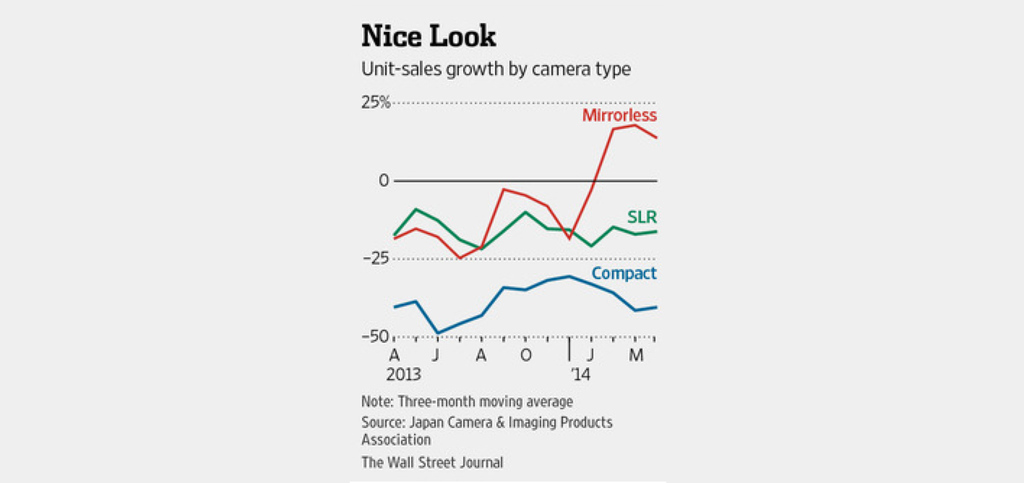
The Wall Street Journal wrote a very negative article against Nikon’s strategy:
The market shows growth in just one category: “mirrorless” cameras. Nikon was among the last of major Japanese makers to release a mirrorless camera, and still offers only a handful of models. The company likely fears cannibalization of its high-end DSLRs, but its strategy seems not to be working. Nikon’s camera division, more than two-thirds of the company, posted a 9% revenue decline for the year through March
What do you think about the Nikon’s strategy?
18 Responses
Nikon’s “mirrorless strategy” looks pretty awesome compared to Canon’s.
Panasonic, Olympus, Fuji, Sony and even Samsung have better mirrorless options than both of the sleeping giants.
Thom Hogan’s made some very valid points about Nikon’s “strategy” that last couple of years. Ultimately, I think Nikon is being too protective of its sacred cow at the expense of long term viability and relevance in the consumer market. The Nikon name still carries quite a bit of cache, but as mirrorless technology closes the capability/feature gap with DSLRs, Nikon and Canon may only be relevant with professionals.
I’ve been a Nikonian since 2002 and now I’ve moved to Sony for landscape: I’m going to sell a bunch of Nikon lenses. I’m still keeping Nikon for birding because Sony doesn’t offer a long tele in E-mount, and autofocusing is not on par yet. But I think it will be in one-two years, and at that point I’ll complete the switch. Too bad: had Nikon offered an APS-C mirrorless camera, I’d still be a Nikon customer. For fear of cannibalising their DSLR segment, they just lost a customer.
The main reason I’ll be going mirrorless some time soon is that I’m coming from Four Thirds, so there’s no other option unless I’m prepared to sell everything I have. And ok, the E-M1 isn’t such a bad choice anyway, and the perspective of being able to cut all that gear somewhat down in size in the long run isn’t too bad either. Since no mirrorless system (except MFT with FT lenses) offers serious telephoto options, though, I’d always buy a Nikon or Canon DSLR or Sony A-Mount camera if I’d have to start again from scratch.
> Since no mirrorless system (except MFT with FT lenses) offers serious telephoto options
Have you tried the 150/2 with µ43 body? I was curious about that combo.
It’s even more pathetic on the ultra-wide side; you can’t even use legacy lenses to make up for it with µ43. SLR systems and full frames have decades of head start there.
But, when the µ43 super-tele primes come, the glass size and extra depth of field will be awesome. When the super-wide primes come, that small flange distance will show up in wider aperture, glass size, and corner performance with all mirrorless systems.
Sony-Zeiss and Fuji have been somewhat more fits-and-starts with their lens line-up, but definitely on track to catch up as well. Once Samyang goes autofocus and Schneider steps in, it’ll be smooth sailing for everyone. (Sigma and Tamron do need to get their act together here.)
I give µ43 two years max to be fully on par. Just a little more for the other leaders.
well 29% growth of nothing is still nothing.
also they are using just japan numbers which atypically aren’t the entire planet last I checked.
I personally like the 1 – and as sensors get better the Nikon 1 will have the smallest and easist to carry kit around – unlike the fuji and sony monsters that will compete with DSLR’s for bulk once you start adding telephoto options.
I’d like to see a mirrorless Nikon Df, with all the advantages of the thinner body size that would come with removing the mirror box. Add a big EVF like the X-T1 or E-M1 and bundle a lens adapter that would pass through all the Nikon lens electronics (and add back the required flange distance to give 100% compatibility with all existing Nikon lenses). Assuming it wouldn’t have video crippled like the current Df, it could be a real competitor for the Sony A7.
Possibility of this happening is about as realistic as USA winning the World Cup.
Is it fair to single out Nikon? How many mirror less bodies and lenses do they have relative to the industry average? They must lead canon, Fuji, Samsung, Pentax, and Ricoh in milc sales.
Why is the WSJ following with bated breath what models are selling in Japan?
Why is the WSJ trying to pretend that mirrorless cameras are a growth segment and the salvation of photography?
Why doesn’t the WSJ report that when it comes to mirrorless, Nikon is #2 in some markets, right behind Sony. Heck, I read even Canon and Samsung are ahead of Olympus, Panasonic, Fuji in some markets.
>Why is the WSJ trying to pretend that mirrorless cameras are a growth segment and the salvation of photography?
Because it’s true! 🙂
Where is Nikon #2? If what you say about mirrorless market share is true, that’s fantastic, actually, since that means Canon and Nikon are taking the mirrorless thing seriously and doing something right. Or, perhaps the others are doing really pathetically in those markets?
Profitable nowhere. That’s some salvation of the industry.
Just another camera like any other camera, except you squint through a little tv instead of a through a pentaprism or porrofinder or frame or rangefinder or viewfinder or groundglass. Everything else about mirrorless cameras are the same. Journalistic industry segmentation by merely one aspect of the entire camera.
That’s not revolutionary. That’s marketing.
I’d like to see a Nikon APS-C mirrorless equivalent of the Sony A6000, equivalent to Nikon’s current D7100, D5300 that can use its current DX lenses. I don’t want to see a new line of Nikon mirrorless lenses. It has to be interchangeable with their current DX and FX lenses with the same F mount.
“If you don’t cannibalize yourself, someone else will”
Steve Jobs
Jobs may have said that, but the phrase was knocking around a lot longer than that.
Well compared to all the mirrorless players Nikon has one rather significant advantage it actually made a profit. Mirrorless despite the never ending hype on these type of forums has been a financial disaster for the imaging divisions of all the big mirrorless players with Sony, Olympus and Panasonic losing money hand over fist. DSLR’s accounted for 81% of all interchangeable cameras sold last year, a market basically owned by Canon and Nikon. Just because mirrorless sales have had a good quarter { no surprises considering the number of new models released } doesn’t mean the sky is falling in.
There has also been a flood of low priced old stock mirrorless cameras hitting the market , in the first quarter of this year mirrorless cameras shipped 80,000 units more than they produced.
You realize the biggest disaster in the Sony/Olympus camps are compact cameras, not mirrorless interchangeable lens. The Oly EM series has been doing excellent and same with Sony E mount like A7, etc. The reason mirrorless is going to win out in the long run is it is cheaper to produce. They can be far more competitive in the long run. Even with massive price cuts they are probably still making some profit. It will get harder and harder for an SLR camera to compete, especially at the very competitive end of the market, in the entry level SLR cameras.
What does it mean that “The Oly EM series has been doing excellent and same with Sony E mount like A7, etc?” These lines have never been profitable for their manufacturers.
What does it mean that “he reason mirrorless is going to win out in the long run ” Is this supposed to be some kind of contest or fight to the death? Why? How is this good for manufacturers or for consumers?
I think that full-frame DSLR market that CaNikon have embraced has hit a solid wall: their imagery is great enough. I can still get really terrific images with a Nikon D3 and D3S. My bosses question, why upgrade to the D4S? The only thing they MIGHT be interested in doing, is ditching the APSC sensor D7000s for the full frame (and 1080p/60) D810. I’ve had my D3 since they first were launched. The downside is a slower frame rate to the Canons and D4/D4S bodies others use. So maybe the cameras are built so well that we are waiting for them to break.
On the mirrorless argument: We have been hoping a full frame mirrorless camera will finally arrive to trash the need for the external after-market loupes. The necessity for add-on gear to shoot clips with a DSLR makes our photo department pine for the Lumix FZ1000 over the D810, and I tossed that nugget right in the face of the Nikon reps as they showed us their latest camera lines. Use Fuji’s hybrid option, or create an interchangeable prism so you can opt for an EVF instead. Because we can’t keep waiting for Nikon when others are already coming up with simple gear that we can toggle between decent stills and nice clips.