








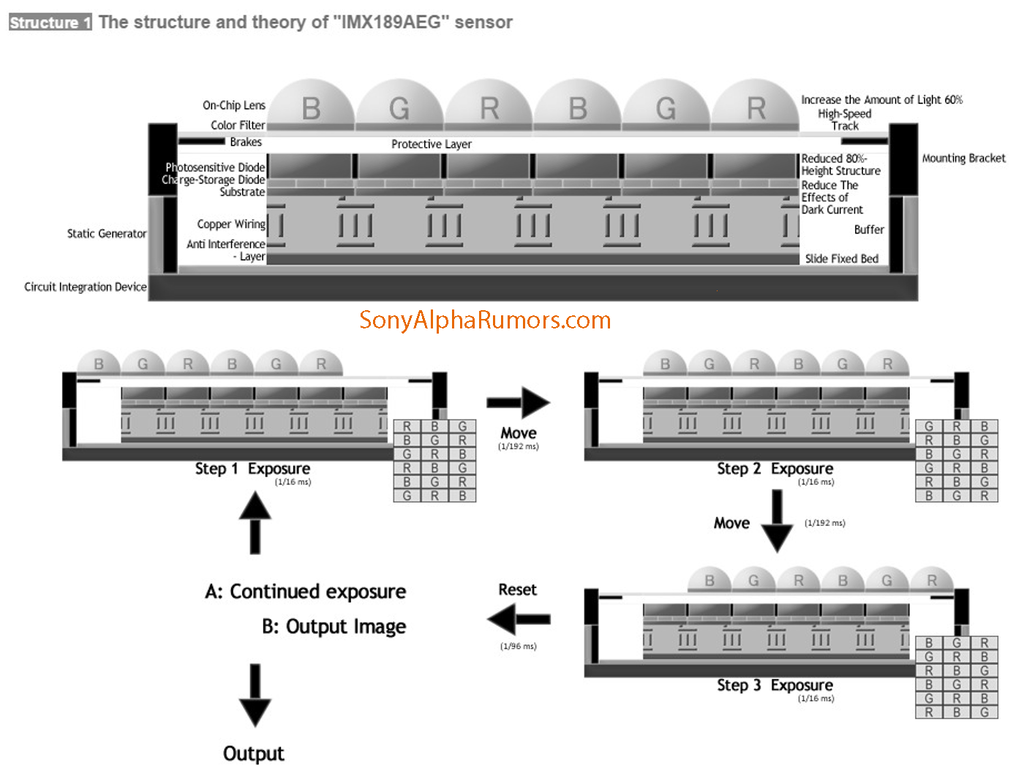
This is the detailed description of the new Sony APCS (Active Pixel Color Sampling) sensor. The first of these new generation sensor will be launched in early 2015 on compact smartphones. Larger sensors for Alpha cameras (and Olympus MFT cameras?) are supposed to be launched after.
The new sensor has an electrified color filter that moves horizontally. It takes three exposure pictures (Red-Green-Blue) and merges them into one. The advantages are:
– One single pixel has 100% full color info (Bayer sensors need more pixels)
– Pixels can be larger compared to current Bayer sensors. This means less noise (or more resolution) possible
– Sensor has also Global shutter with very fast frame rates (16,000 at 2K) and no jello effect
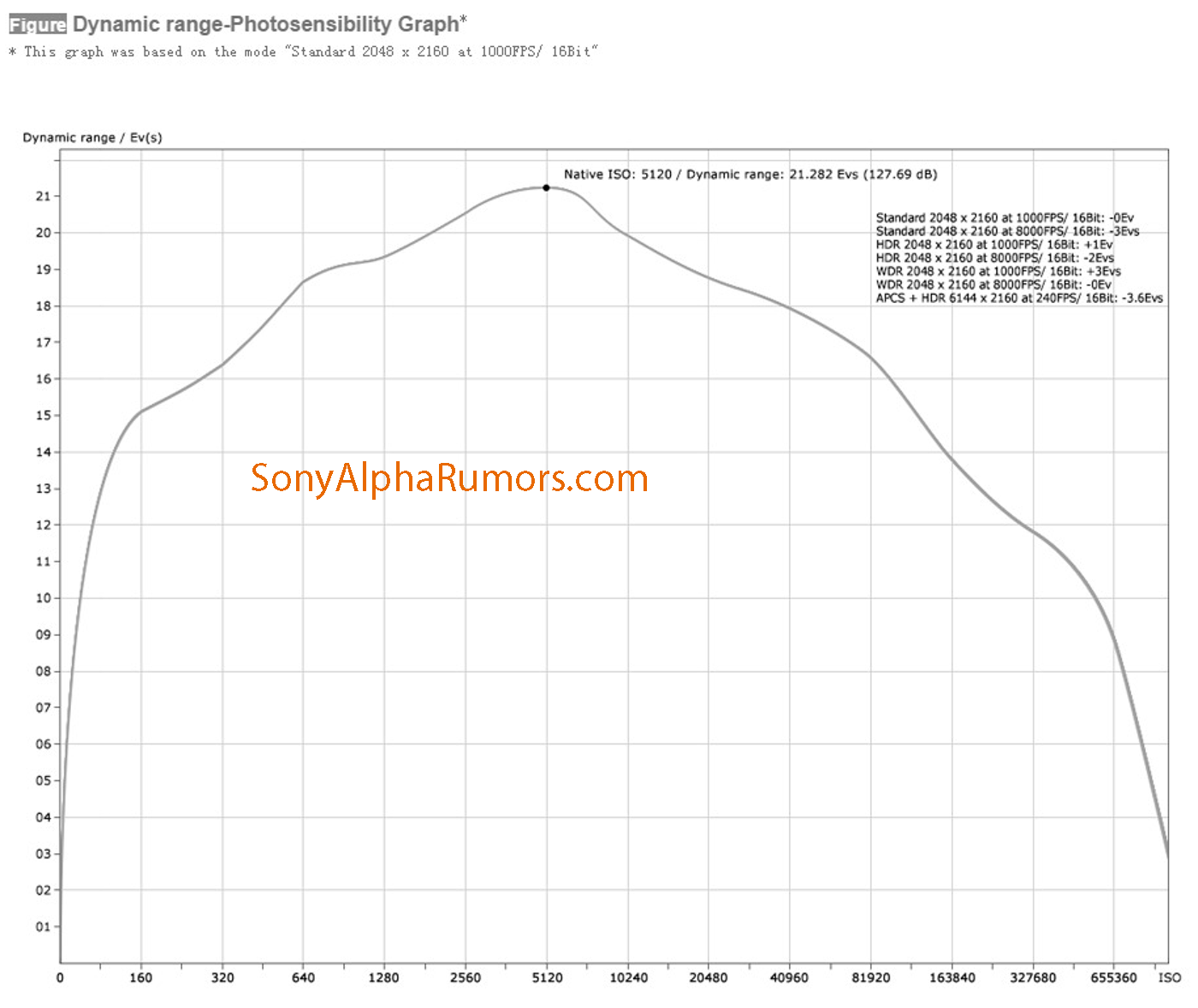
– Very high native sensitivity of around 5,000 ISO!
On paper the only drawback is the triple exposure needed to get the full color information. We don’t know how this will effect long exposure shots or shots on moving subjects!
6 Responses
So, not a Foveon competitor…. 🙁
Interesting. It correspons with “extra resolution sensor” for Olympus, right? It seems that physical resolution will be lower than the output resolution (larger pixels). On the other hand current bayer’s sensor has got lower effective resolution… Where does the hint with Olys come from? It is said only here and not on m43rumors…
I don’t see the real advantage in terms of sensitivity, since you are still getting 1/3rd of the exposure for each primary colour (with the partition made in time rather than space).
It could be great to use primarily as monochrome and have the option to use colour even if it’s not a “native” thing (as the HW movement based AA filter of the K3) though.
This sensor will be curved to. Big bug eyed pixels and a full 180° curvature. 42 axis sensor stabilization. Heated seats and steering wheel. Cup holders.
For real though if it’s better just a little bit. A noticeable bit. It will make obsolete current sensor tech. If it’s twice as good as current sensor tech say by by to Leica camera division and other boutique outfits. Unless they can buy the Sony tech. Competitive technical innovation could be scary in such a competitive market.
it shouldn’t affect long exposure much, the shifting speed of lens layer is about 1/192000s (!) for each colour and it keeps moving untill the exposure end.
Some figures about shifting: (1/192 + 1/192 + 1/96)ms = 1/48000s speed of 1 complete shift
This is what i understand.
This is clever because the “hovering filter” assembly does not HAVE to move during the exposure. The filter array movement is optional. So the filter COULD just stay in one place during the exposure, in which case the sensor defaults to something close to an ordinary red/green/blue Bayer setup. So if there’s some kind of exposures where you don’t have time or otherwise don’t want to move the hovering filter-array, the camera is free to operate at somewhat lower resolution without the filter-jiggling.
The overall idea here is that with the moving filter, you get the most resolution possible out of the largest, highest-dynamic-range pixel-wells. Let’s agree that larger pixel wells can have higher dynamic range. If a Sony A7S has acceptable full-color resolution with 12 million sensor pixel wells of size “1”, then a hovering-filter Sony A8S might have acceptable full-color resolution with 8 million superior-dynamic-range pixel wells of size “1.5”.
It is also fun to speculate on even more complex hovering filter options. Instead of just 3 filters, uou could have a hovering 4-filter red/green/blue/clear setup. Or a 5-filter red/green/blue/clear/infraredCutOff array. Not sure what you would get out of those.
On a more subtle note, in working out these very-high-speed sensor readout mechanisms, Sony is also working towards developing scalable-dynamic-range-with-longer-exposure technology in general. If you can read out a sensor fast enough, then you can have real small pixel wells that you keep reading, clearing and re-exposing a zillion times during a long exposure. Then “shutter speed” becomes something you decide “after the fact”. The futuristic idea is take every scene at 1/10th of a second exposure, and store (with lots of data compression) 100 not-very-different 1/1000th of a second frames. If you really need 1000th of a second shutter speed, use one of the frames to generate the “final” image. If the scene was relatively static, use all 100 stored frames to make one super-dynamic-range (well 6 extra F-stops or so) image representing the 1/10th of a second overall exposure.
Any one of us could experiment with that right now, just take 10 frames of a static scene, each underexposed by a factor of 10, then combine them into an HDR “stack”.
Tip of the hat to Sony for thinking of the long game here.