








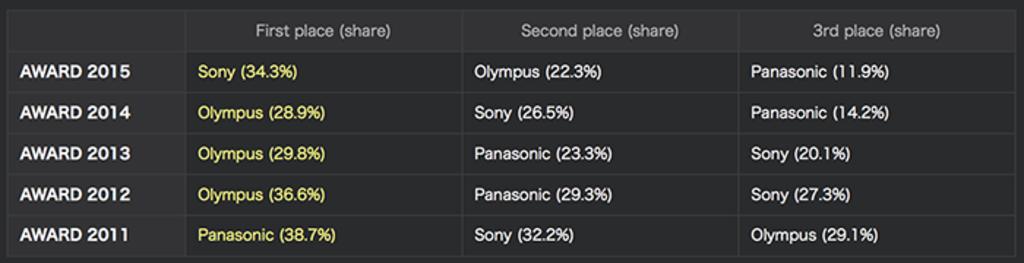
The full 2014 digital camera sales data in Japan has been published by BCNranking. And the new 2015 king is Sony which now holds 34.3% of the market share. Olympus and Panasonic both lost a bit of terrain. The data doesn’t show the rest of companies market shares but if Panasonic keeps falling Fuji and Canon may will kick them out from the top position.
28 Responses
Perhaps time for Panasonic and Olympus to reconsider full frame bodies?
Naah. A new 24mp sensor (definitively possible, see Sony RX100’s quality), and 4K video all over the line (at least for Panasonic) would be more than enough for many buyers to reconsider the quality / size convenience of this system.
indeed, something like a backlit RX100 sensor for m43ds would help. sooner or later they will catch up. organic sensor? combined with the incredible sensor shift from oly this would be an unbeatable combination. I tried the A7r (and will buy it, or the next upcoming body). but it<#s nowhere near the useability of the oly bodies and by far not as nicely layouted and usable as the panasonic gh4 and gx7. not to mention choice of lenses....
Well, A7r still has problems, and the lenses are still arriving (and are quite expensive and big, I would say). I’ll keep on waiting for a while. In the meanwhile I will use my wife’s em5 and my Fuji xm1 😉
They will always loose in resolution compared to APS-C and bigger. They should not try to make a larger FF body, or higher resolution that will ask for bigger and better lenses, but try harder to make the mFT system even more compact. Thats the main strengh of the mFT systems.
Better AF (PDAF pixels), BSI (lower noise, higher quantum efficiency), slimmer cameras (less distance between back of screen and sensor) and so on.
Right, those that need to print/display large resolution images need to look at larger formats. This is photography – that is why in film era those that wanted ultimate resolution were shooting medium format, not 35mm. And those that wanted even more used large format.
Personally, techniques like stitching and features like the high resolution mode of the E-M5II give me all the creative flexibility I need. If I’ll ever need more, I’ll pick a FF camera – I’ll not ask Olympus for a larger format.
The problem with Olympus is that they don’t make sensors and I don’t think there is much fun in them using a FF sensor now. If they’d build a larger format camera, I’d rather wish it had a square sensor so that it can take good advantage of lens designs.
Photography changes, and digital photography changes fast. As there are smaller sensor with better numeric resolution, it is definitively possible to up the number of mp in 43 sensors. 24mp is possible without compromising too much in IQ: either you need it or not as a photographer, this is another subject. But currently, on the market, everybody else has better sensors, and this is something a casual buyer will consider, thus dooming the m43 to the irrelevance, long term.
So: can 43 sensors be equal to apsc sensors? No way. Can they be better than they currently are? Yes. And they should.
Let’s now talk about Panasonic: they could add 4K to all their cameras starting from tomorrow. They don’t want to cannibalize their video division, ok, but this way they are rapidly loosing momentum (and it shows in the graphs). The point is: m43 should be a small convenient system that, despite not being the best sensor IQ wise, is the most versatile and “always with me”, “as much as possible complete” system. If easy to implement technologies (at least for Panasonic) such 4K video are not there, the system feels much less than versatile. Pana cannot keep on arriving second or third everywhere (i.e., if the Sony A7000 arrives before with 4K and other nice features for the rumored prices, it will be very hard to convince new users to buy m43 cameras).
Law of diminishing returns. Look it up please.
Sensor tech will continue to march forward. It has already reached a point where many professional photographers actually do shoot exclusively with a teeny tiny m43’s sensor. Maybe its not up to your standards yet, but give it time and it will likely satisfy well over 95% of photographers needs. For that matter, a 1″ ILC of the future likely will as well. The cellphone destroying the compact camera market should be the first clue of this.
They should reconsider their pricing more carefully, rather than trying to get big profits at first and accept less further down the line, not consider starting from scratch with big equipment that will have a niche in the marketplace.
They might want to consider lower-priced equipment that actually competes with inexpensive dSLRs, rather than trying to convince prospective owners that a camera that looks like their old point-and-shoot can work just as well as a dSLR.
Full Frame is a small, irrelevant niche.
Those are Sony A5100 and A6000 which are killing m43 in the market: cheap and have PDAF. Something neither Pana nor Oly has a response for. Oly is insisting that PDAF is a premium feature. Pana sticking to DFD which has its own bag of problems. All in all, they are both loosing with these short-sighted strategies.
I agree on the AF, though I don’t think the difference between the A6000 and EM-1/GH4 are that great, but the other m43’s cameras are farther behind in this department. At the end of the day, any system you choose is a compromise. An A6000 compromises with a poor lens selection, that once you start buying them, you’ll wish you didn’t sell your DSLR bag since the system size difference is negligible. M43’s compromises on tracking AF and high ISO capability. Full frame compromises the most on size and cost of their optics. There is no true right path to choose universally, there are only good choices based on personal wants and needs.
(Almost) nobody requires a +16MP sensor. To go +24MP is a kind of commercial race being fueled by a few camera manufacturers – to sell newer models – while in reality, most people don’t even understand well what kind of consequences and workflow it takes to make a full exploit of such enhanced resolution. Look f.i. at DxO which lenses are capable to support +16MP, +24MP… +36MP? I doubt that a lot of M43 glass is competent enough to do so since it was never designed for this purpose. People usually only make this request based on what they see…on spec sheets from other manufacturers. Another story is that with the appliance of smaller sensors, most MILC manufacturers have reached the limits. To get the comparable 35mm DOF-competences lenses need to be very fast and the smaller the sensor is, the more difficult it gets. Very fast lenses are big and heavy. On top of that, decreasing the size of bodies and increasing the size of lenses doesn’t improve the grip/hold of this gear either. Here starts a whole new world of custom cases, grips, handles, brackets… making your final assembly only bigger and heavier. M43 has another problem, I hardly ever see mentioned, but it’s still a very uncommon format in photography, these sensors were originally ‘recycled’ from Panasonic’s camcorder world where the 4/3 ratio made sense… until 16/9 and HD came in the arena. If your pictures have to be cropped each time to match the much more standard 2/3 form expectations, this is the wrong system for you. It renders M43 even out of scope as a true DSLR replacement.
HRe: “I doubt that a lot of M43 glass is competent enough to do so”
New 40-150 2.8 PRO resolution outperforms any sensor on ANY camera, is this not “competent enough” for you?
What about EM5 MKII with 40 MP jpeg and 60 MP RAW resolution modes?
Check you stats fool before posting nonsense!
When I take a look at DxO, there is really no spectacular sensor performance for the M43-cameras to be reported – this is just what to expect from a smaller sensor. It is no comparison to the best FF-sensors out there, not coming even near. The 40MP and 60MP sensor modes of the new EM-5 is just a technical ‘trick’, an extrapolation, telling nothing about what it really means in effective resolution vs a native 40 or 60MP sensor (in this case we’re speaking about a medium format resolution, even the new Canons 5D’s don’t get there), neither about lens performance. There are very little commercial lenses on this planet performing better than the Zeiss Otus 55mm D1.4, they can put down an effective resolution of 33MP. Look at the price…I really don’t expect that ANY (commercial) M43 lens will beat that performance. Not even any Nikkor, Canon L, Fuji XF, Tamron, Sigma will do mounted in front of the best FF sensor. That being said, I keep my point that the chase for higher resolutions is ridiculous. To make a full exploit of these resolutions, you’ll need a very credible tripod everywhere, exclude any possible vibration (including the slightest breeze) and do everything by remote-control. With a DSLR, you’ll also need to lock te mirror. Even in the range of the shortest exposure times. I’ve done landscape photography with this kind of cameras and really know where I’m speaking about. Sony & co are just speccing up their gear every 3-6 months to make people rebuy-rebuy-rebuy – the next thing they’re going to let everyone believe is that 50MP is the least resolution to make a good picture. And a lot of GAS-hoppers will be so foolish they’ll sell a 1 or 2 year old A7 at a bargain to get that ‘so much better’ A9.
The MFT sensor performs just as well as a FF sensor if it would be cropped to MFT size. In other words, once you account for the size difference, the performance graphs are pretty much identical. And the way to make for the difference in size is with faster lenses and lower ISO. Which is why Olympus was mentioning these two aspects in their recent interviews.
Also, you can bet that Sony’s sales were driven by the A6000 rather than by the A7 line.
In the end, MFT is a system that will stay around as a puzzle for those that don’t understand equivalence. 🙂
Who cares what anybody really requires? And who cares what an anonymous interweb poster tells consumers what they require?
If consumers demand a spec and competitors offer it, all the ‘education of consumers as to what they really should be wanting’ will fall on deaf ears. What, Olympus will start a new ad campaign (we don’t offer more megapixels because you don’t really need it!).
Consumers will vote with their dollars. Consumers tell the consumer product manufacturers- such as Olympus in this context- what they want. Or, I guess you can just arrogantly ignore that at your own peril; the next shareholders meeting will have camera division execs presenting that the reason our sales are down is because our customers are stupid. That ought to go over well.
the sum of first + second + third place:
2015: 68,5% meaning at least three other companys with less then 11,9% each
2014: 69,6% meaning at least three other companys with less then 14,2% each
2013: 73,2% meaning at least two other companys with less then 20,1% each
2012: 93,2% meaning one other company with 6,8% or more companys totaling 6,8%
2011: 100%
Pana concentrated too much on the GH line (which are niche products) and let the GF and G lines slide (which are are the mass market products).
Sony meanwhile did completely the opposite: they went after the mass market. Pana has nothing like the A5100 (feature-wise) or A6000 (price-wise).
I also think that Panasonic’s DFD, the alternative to OS-PDAF, is mistake in at least short-term. Not only DFD doesn’t work with non-Panasonic lenses, but it is also CPU intensive, making it unusable on smaller/cheaper cameras.
Is this volume in units sold or in yen? Big difference.
More importantly, this is not representative of the MILC market per se, just of the sales made this year. Which means it doesn’t account for system users that have not bought a new camera last year.
That’s true. I didn’t think about it, but in fact my wife owns an em5, and is waiting to upgrade. Last year she didn’t buy anything, because there wasn’t anything really new. OTOH Sony introduced many new system cameras, with new techs. So things may change again in the future, if Olympus introduces some new unique technology
As a Sony owner I think many of us will hold of buying Sony bodies as Sony has a way to go in producing more lenses
MFT on the other hand have lots of good lenses but need to improving bodies to match Sony in tracking AF and MP Although cameras like the Olympus OMD em1/5/10 the Fuji Xt1 and panasonic gh4 and GX7 are very nice cameras.
m4/3 is supposed to be low cost, because of the number of sensors one can get from one silicon wafer but a Sony a6000 is about $650 and it has an APSC sensor (okay I know Sony APSC lenses are weak) but still the Olympus E-M5II is $1099 almost double the price for half the surface area. It’s not a happy picture.
Also the m4/3 has a lot of noise even at native ISO, so has to be scaled down a lot more for the final usable image. With that said I just purchased a used DMC-GF2 (12MP m4/3) camera with G14 14mm lens on ebay for $200 to see if I can live with it.
m43 really needs to try something at this point, anything, Foveon, 3CCD, something, anything…. With the size they picked they need to have their sensor tech way ahead of Sony not just behind it or even at the same place.
I agree with the other poster that not making m43 a more monitor friendly aspect ratio seems a strange decision. It should have been m16/9 not m4/3, but maybe they wanted more efficient use of the image circle.
LOL. You criticize MFT for noise at native ISO and then you go buy a model with the old sensor technology? I can save you the money and tell you that that combination will be decent, but won’t win you over. Better save towards that A6000 if sensor size is important to you.
The 16MP MFT sensor is fine – the size difference is not large enough to allow for some amazing new technology to make its way into MFT but not into APS-C and FF. But it’s also not large enough to lead to a big image quality difference. Just don’t expect to build a competitive system for much less – if you want high image quality you’ll need to spend more on lenses than on bodies. That goes for all systems.
And yes, they did want a more efficient use of the image circle. That leads to smaller lenses, which goes well with the smaller sensor they already picked up. That’s the MFT offer – it’s not for everyone and it’s not meant to – no format is for everyone.
Actually, he does bring up a good point.
The smaller sensor of micro 4/3 should be cheaper to produce. The smaller components should lessen raw material costs. The entire raison d’etre of mirrorless- not the stuff they say in consumer ads, but the real stuff that benefits the manufacturers- should result in greatly reduced production costs: Little tv’s are cheaper than pentaprism and mirror mechanisms; lenses corrected not optically but in software, smaller batteries, and so on all contribute to what should be a much lower cost product for the manufacturers.
Those cost savings have not been passed to the consumer, and in fact DSLRs can be had for less.
The days of 2012 pricing are done, and if micro 4/3 is really going to keep its head above water it needs to start price slashing sooner rather than later. Sony, Fuji, are each carving out their niches; DSLR has long carved theirs out, and Samsung is threatening. Micro 4/3 is slowly losing its unique value proposition. I don’t say this as a good thing. But it needs to present a more attractive price point to welcome net new customers rather than just the current installed base. Sony is doing just that.
Low-end DSLRs benefit from the inertia of new uneducated customers picking them because they are DSLRs. But people interested in MILCs tend to be more technical and want more features than low end MILCs offer. Which is why the MILC market has been moving up in recent years. Olympus, for example, shifted focus from the Pen line to the OM-D line. Fuji has been higher end from the start. Sony is shifting focus to A7 – none of these are moves to compete with lower priced DSLRs.
Sure, there are some mid-range offers, like the Fuji X-E1, Sony A6000, and Olympus E-M10, but they now represent the lower end of MILC product line and to me these are above the low-end DSLRs in terms of features.
Those happy with low end DSLRs will probably disappear in a few years. Even Canon mentioned seeing erosion in this market segment.
In the end the price point is dictated by the market. I find the MFT cameras and lenses to be worth their cost. Perhaps this will change in the future, but for now I don’t see a valid alternative.
Except… smaller refined tech is MORE expensive than their larger counterparts. Case in point… you can get a desktop PC for like $400 that runs circles around a new Macbook Air. Shouldn’t the Macbook Air be cheaper because it uses much less raw materials? Once you realize that there is more to costs than just pure raw materials you will understand why that statement is a shortcut to thinking.
To be fair, this is annualized data, sony’s been trending down over the past 5 months and Olympus upwards.