








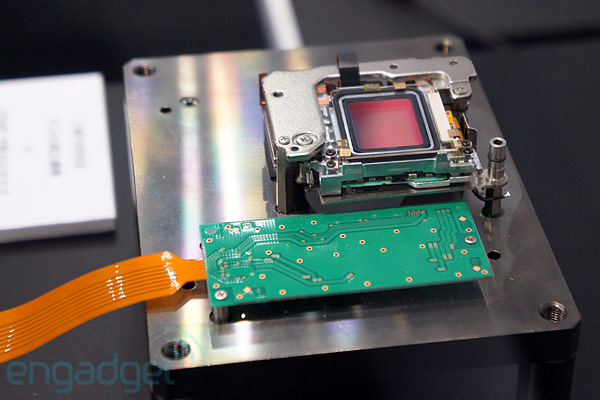
Image of the E-M5 sensor by Engadget
Olympus is going the Canon route and will keep “re-using” the same sensor on the newer generation cameras. The E-M5II will get the same E-M5 sensor without PDAF.
But still, Olympus will add the sensor shift shooting feature that will allow you to take 40 megapixel pictures by combining 8 pictures shot in rapid succession.
6 Responses
i hope they’re hiding something big, otherwise….
big = full frame?
Then it would not be m4/3. The FT/MFT spec calls for the size of sensor it currently has. The lenses don’t illuminate a circle big enough to fill a full-frame (3:2 35mm) sensor. So technically, the lenses are currently full frame for this format.
m4/3 standard does not specify the sensor size at all, it only specify the basic technical requirements like flange distance, mount and minimal image circle size.
You are allowed to make a larger sensor than 17.3x13mm but image circle is required to be about 5mm larger so it covers the IBIS movements and multi-ratio sensors (larger than 17.3x13mm).
Some of the lenses for m43 like Olympus 45mm f/1.8 image circle covers the APS-C sensor.
You can get m4/3 lenses work with Super-35 or Super-16 sensor sizes too!
If you want to make a new sensor for m4/3 camera, you can even make it 1:1 ratio or 3:2 ratio if wanted. While the format name comes that 4:3 ratio is used, it isn’t required.
Otherwise, you’re not going to buy something that you weren’t going to buy anyway?
Being a less common sized and shaped sensor, micro Four-Thirds bodies have to continue with sensors longer than others. This was also the way with Four-Thirds.
Canon uses older types of sensors because they’re falling behind on technology and don’t collaborate in order to keep themselves pure of outside influences.