








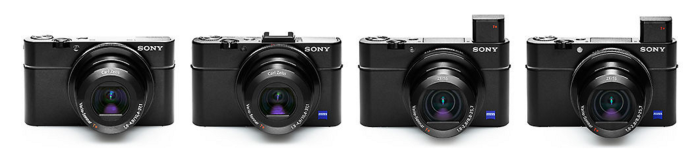
Nikon is likely going to try to compete against the Sony RX series by launching new high-end compact can fixed lens cameras at the CP+ show (End of February). Nikonrumors reports there will be three versions of such cameras (unclear what the sensor size will be). These will be the equivalent focal lengths:
• Wide angle: 18-50mm f/1.8-2.8
• Normal range: 24-80mm f/1.8-2.8
• Superzoom: 24-500mm f/2.8-5.6
I am pretty sure the 24-500mm version has a 1 inch sensor. If it’s APS-C I will become a priest 🙂
32 Responses
Too bad that nobody seems to care these days that aperture is meaningless without either the real focal length or the sensor size.
…lolwat? I don’t really understand what you’re saying.
These lens specs are 35mm equivalents so you know 100% what you’re getting yourself into.
Next thing is depth of field, you could calculate the equivalent; 1inch sensor (if they’re gong to take on the RX range, then it’ll be a 1 inch Sony or Nikon sensor inside) combined with a aperture X and focal range. Not going to calculate that for you 😉
Intriguing proposal of nikon….let’s await he final product.
For sure it wont have 4K recording…but for stills a set of these 3 camera’s would be near unbeatable.
As I wrote above, the hyperlocal distance is also an important factor for the depth of field. If you focus at a close distance DOF is a lot shallower than when your subject is further from your lens. In fact this has more influence than the size of your sensor.
“These lens specs are 35mm equivalents” – no, they’re not. Focal length is, but aperture isn’t. And aperture as an F number, look it up in Wikipedia, is relative aperture – relative to the real focal length. Without seeing the real focal length, it doesn’t say anything about the real, absolute aperture of the lens.
Deleted.
Wow you’re an idiot… YOU CAN CALCULATE THE REAL FOCAL LENGTH!!! If it’s a 1′ Sensor it will have a crop factor of around 2.7, so technically it will be 6.6-18.5mm…
If we knew it is a 1″ sensor, yes, I could, and I know. Too bad the article says “unclear what the sensor size will be”. “Idiot”? You’re throwing rocks in a glasshouse…
Just read man… “…1″ sensor, but some models may have APS-C…” (nikonroumors) so there will definitely be some with a 1″ sensor! and there MAY be APS-C ones (which I personally doubt, as it would defeat the purpose of compact zooms)
None of the three lenses would make sense on a fixed-lens APS-C cameras. Think of what size a 12-35 mm f/1.8-f/2.8 (actual focal length, actual f-stop) lens covering an APS-C sensor would have. It wouldn’t be a compact camera anymore.
Thus if we believe what the rumour says, these have to be 1″ cameras and the APS-C camera is an additional one whose specs are still unknown.
Also IT IS THE REAL APERTURE!! Do you even know how the F-number is calculated??! It is the ratio of focal length to effective aperture diameter… and I am sure this is 1.8-2.8!!
Without the real focal length, you cannot calculate a thing, and you can be as “sure” as you like. And by the way, don’t get your knickers in a twist.
Why don’t you get it… You don’t need to calculate any supposedly “real” f stop number it’s 1.8-2.8!!! Again the aperture value is the ratio of focal length to effective aperture diameter!! THE APERTURE IS A RATIO VALUE there is no “real” and NO 35mm equivalent!!! When the focal length is shorter than the aperture opening will also be smaller, BUT THE RATIO REMAINS THE SAME!!! So 1.8-2.8 is an absolutely valid f stop value, which DOES NOT need to be multiplied by any crop factor…
Of course a large aperture does matter. For example 2.8 is always 2.8, no matter if you are using a pocketcamera or a 4X5 inch plate camera. 1.0 means the lens lets through 100% of the consisting light. 1.4 is 50%, 2.0 is 25% and 2.8 is 12,5% and so on. Focal length, size of film or sensor and (most important) the hyperlocal distance matter as well when it comes to depth of field. But a fast lens is a fast lens and always a joy to use indoors. Hopefully they keep it pocketable and affordable.
You should look up aperture in Wikipedia. For lenses, stated as an F number, it is relative aperture – relative to the focal length. Without knowing the real focal length, we don’t know how large the real, physical aperture is, and while we know something about brightness, we do not know the amount of light that we’ll get through that lens.
Dear Hubertus and other commentators, the numbers we use for apertures are in fact numerators, creating a logarithmic range range: 1/1, 1/?2, 1/2, 1/2?2, 1/4, 1/4?2, 1/8 et cetera. In practice we call them 1.0, 1.4, 2.0, 2.8, 4.0, 5.6, 8.0 and so on. An aperture of 1.4 makes a hole twice as large as 2.0, but half as large as 1.0.
1.0 lets through 100% of the light, 1.4 gives you 50% of the light, 2.0 gives you 25% of the light. The steps between the values are called stops and each stop (or f-stop or full stop) halves or doubles the amount of light, depending in which direction you change the aperture.
There are indeed very fast lenses like the mentioned 0.85 for example that concentrate the incoming beam of light. The light on the film of sensor in that case is brighter than the real light.
Aperture values are universal for any type of lens or sensor. Like a kilo is always a kilo and a meter always a meter. So you can use your DSLR as an exposure meter for your 4X5 field camera if you wanted to.
It is the same with the exposure time. A lot of cameras use numbers like 2, 4, 8, 15, 30, 60, 125, 250. In fact they stand for 1/2, 1/4, 1/8, 1/15, 1/30, 1/60, 1/125 and 1/250 part of a second. It is clear that one time-stop halves or doubles the exposure time and therefore the total amount of light.
The third factor is of course the ISO value, that can also be changed. ISO 200 is twice as fast as ISO 100 but half as slow as ISO 400.
So focal lengths, sensor and films sizes have nothing to do with this holy trinity of photography. Thank God! If you double the time you have to half the ISO value or the aperture (1 stop) to get the same amount of light. If you open up the aperture by two stops you should reduce the ISO value or the exposure time by two stops (or by one stop each). Hopefully I am clear enough. Otherwise try this:
http://www.cambridgeincolour.com/tutorials/camera-exposure.htm
“1.0 lets through 100% of the light” – and that’s where you err. Of what light? All the light in the world? You fail to distinguish between brightness (which is what you indeed are explaining correctly) and amount of light (which is something else, but in itself extremely relevant).
Thanks for your reply.
100% of the excsisting light can be bright sunlight or dim candle light. That’s why we use longer exposures or higher ISO when it gets darker. Once more: an aperture of 1.0 stands for 100% of the existing light. So the light coming out of the lens falling on the sensor is just as bright (or dim) as the light that goes into the lens. An aperture of 1.4 (=?2) means that the brightness of the light that comes into the lens is reduced by 50%. 2.0 means gives 25% and so on. This is not my invention or personal opinion or something, but parameter that we all have to use in physical science. Like grams, millimeters or angles of view.
Please study this triangle of sensitivity, aperture and exposure time seriously because they are the holy trinity of photography.
Another misunderstanding that I notice going on is about the sensor sizes in relation to the depth of field. Many discussions of our fanboys ( I never notice girls) are about the sensor sizes.
(Hopefully we got over the megapixels discussion by now).
Depth of field is influenced by:
1. The size of the sensor (or film)
2. The focal length of the lens
3. The aperture
4. The (hyperfocal) distance to the subject.
You will get shallower depth of field when using: (1) larger sensors or film sizes, (2) longer focal lengths, (3) larger apertures, (4) shorter distances. Number four is by far the most effective if shallow DOF is your game. About the choice of cameras: no digital camera will give you the heavenly bokeh of a 4X5 inch plate camera.*
However with a one inch sensor it is still easy to get sufficient DOF. But the smaller the sensor size, the harder it gets to gain sufficient shallow DOF. Think of the small sensors of smartphones.**
At short distances though you will have plenty of it. The good news when using smaller sensors is that you (generally) can get up much closer than with larger ones. That’s why I probably want one of these Nikons. Wow, that wide angle one! A compact with this wide angle must be a World Premier!
* A 4X5 inch plate camera with a 150mm standard lens at an aperture of f5,6 has the same DOF as a 150mm telephoto lens at an aperture of f5.6 on a DSLR ‘full frame’ or any other format with the same focal length and aperture.
** Most people don’t bother or will never notice when there is an Eiffel Tower growing out of their baseball cap.
You say that the sensor size does not have anything to do with the exposure triangle, but that’s not entirely accurate either, since a smaller sensor has less surface area to collect light.
For example, if you move a 50mm f/1.4 lens (with a large enough image circle) from a full frame camera over to an aps-c camera, it will feed the aps-c sensor slightly less than half the amount of light as the ff sensor, given that the ff sensor has (1.52²) ~2.3 times the surface area of the aps-c sensor. The light intensity per cm² remains the same, but the smaller surface of the aps-c sensor catches only 43% of the light that would hit the ff sensor. M43 sensors likewise collect 1/4 of the light of a ff sensor for a given f stop.
If you put a full frame lens on a camera with a smaller sensor, the intensity of the light (controlled by the aperture) remains the same. You will only use a smaller piece of the image circle. It’s like cropping an image on your computer. If you are using extension tubes you need to correct your exposure values because the light is getting less intense. Then you are in fact using spreading the light over a larger surface.
An adapter ring has a very small influence too, but that’s negligible.
If you put a 50mm f1.4 full frame lens on a M43 camera it will work as a 50mm f1.4 telephoto. It only crops the image.
I’m with Berthold (and maybe that Wizard looking guy Tony which puts together a pretty compelling case) on this one. Where does that extra spill of light go due to the oversized image circle you get from putting a FF lens on a crop sensor? The lens isn’t focusing the light as mentioned above on lenses which achieve better than f/1.0 so a certain % of the image circle is hitting nothing.
I understand a fstop is a value of the lens itself no matter what. I guess the argument could also mention that it’s and image “circle” not rectangle so there will be spill on a FF lens on a FF sensor. Is this taken into account.
Not arguing. Just need a diagram of some sort lol.
Since we know the sensor size, we can easily calculate the actual focal length from the equivalent one.
the given focal lenghts are full frame equivalent, the aperture is given without mentioning the croped sensor. so a aps-c sized camera with that specs would be insane.. too big and too heavy.. with an 1/2.3″ sensor, these specs seems more realistic, but we would get a croped aperture with that. that would give us f10 or something like that. (ff equivalent)
also these 100% consisting light is not quiet true.. there are f0.85 apertures.
I don’t think things will ever change but, it would be good if they started using more t-stops, since f-stop now is so messy.
Too bad that we do know the sensor size (1″). So what was your point again?
Promising specifications! I know some interior architects, real estate agents and building contractors who will immediately buy that fast wide angle version. Hopefully it doesn’t show distortion.
Practically all wide angel- and normal zooms have distortion. Can be fixed in post production.
ALL sound like 1″.
That 18-50 looks nice!
The superzoom can not of course be bigger than 1 inch. For the 2 others I guess it will be the same, altough 4/3 sensor would be possible. After all, the canon G1xII has a 4/3 sensor with a 24-120 f/2-3.9.
1″ sensor is disappointing to me, except in the case of the super zoom. But if it is a BSI or similar next generation sensor, they all could be great. Still, I would prefer a small, FF 40mn fast prime to any of these.
Nikon seldom do this sort of thing well, lets see what sort of fail they bring to the party. my guess would be price, but expect some key feature missing as well
The 24-80 and 24-500 are likely 1″ sensors as they are normally referred in 35mm equivalent. APS-C however, is written as they actually are. Nikon 1′ “18-35mm” UWA lens is 6.7-13mm f/3.5-5.6, so an APS-C with 18-50 (28-74 equiv) f/1.8-2.8 would make most sense and be the RX10 that Sony should have made and closest to the Panasonic LX100.