








Click on the Image to enlarge.
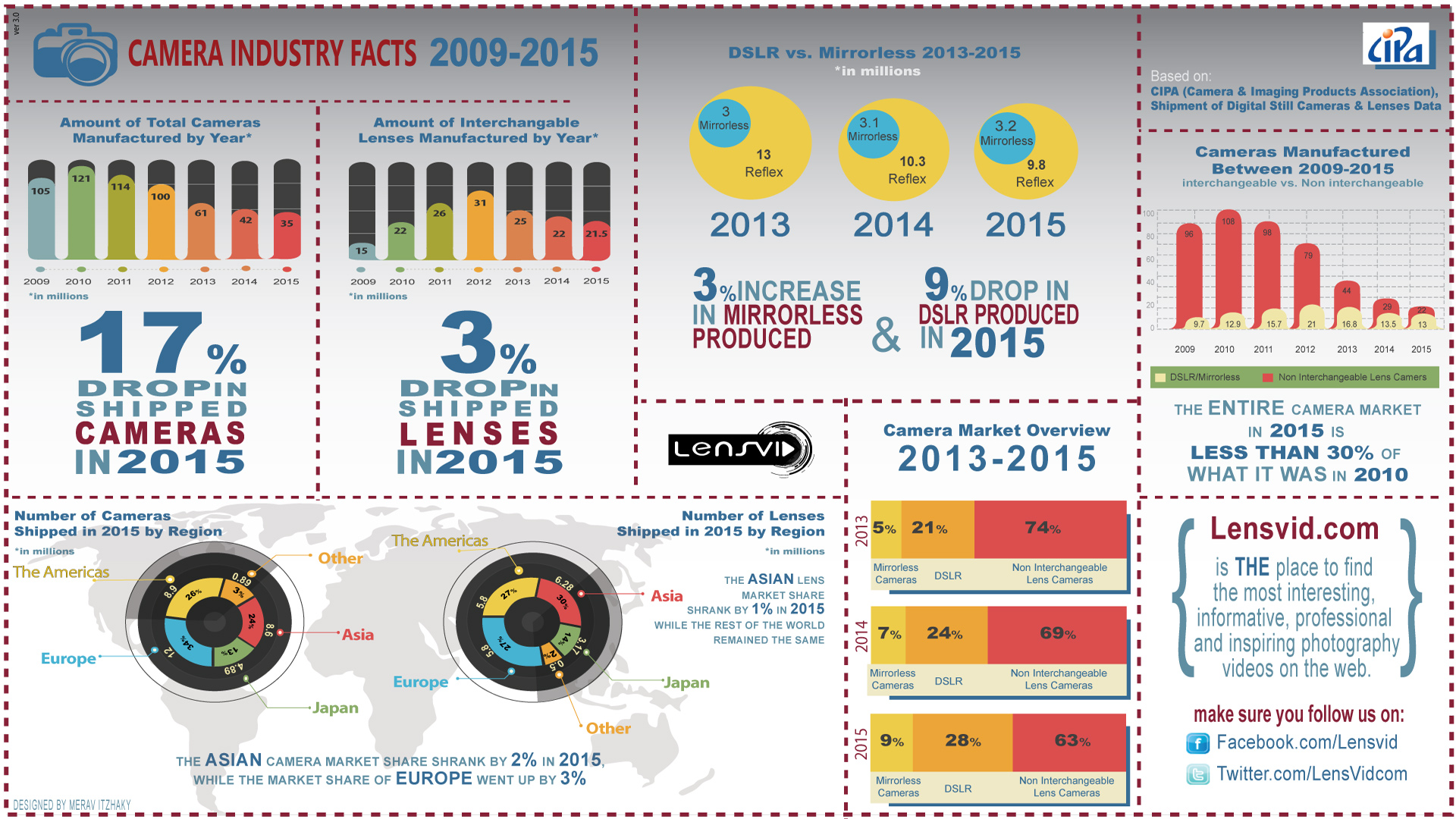
Lensvid created that great Infographic explaining what happened in 2015. Lensvid also says what to expect from 2016:
- 2016 will be a better year for the photography market. With that said, we still expect the total number of cameras sold in 2016 to be below 30 million – or around 15% decrease compared to 2015.
- On the other hand, we expect more DSLR sales in 2016 – with a one digit increase, and more or less the same increase in mirrorless cameras.
- We are predicting that compact cameras will drop below 20 million and may even get close to 15 million (compared to 22 million in 2015).
- Finally, Looking a bit ahead in the next 2 years DSLRs and mirrorless cameras will have a bigger market share than compact cameras, which we are predicting – will become a niche market before the end of this decade.
14 Responses
I wonder what happened in 2012 to spike lens manufacturing?
I’m confused. According to that “Camera Market Overview” Box, from 2013 to 2015:
DSLRs gained 7%
Mirrorless gained 4%
Non-Interchangeable lost 11%
It looks to me like DSLRs are overtaking the market.
But look at the produced number of cameras, there are more produced MILCs then DSLRs when DSLRs are taking over the market then there should be more produced too!
Problem with these numbers is that we do not know what is actually shown here is the market share in millions of dollars, or is it in number of sold cameras? It is obvious that the high end (pro) cameras are making more money, so when this is about the financial market share then it is possible that the high end camera market is making the profit with less cameras sold…. The MILC has more sold units, but less profit, that is why Sony and many others are concentrating on more expensive cameras (A7x series, A6300, PEN F etc.)
Yes, I just posted a question on that site asking for clarification on exactly that point.
Another thing I wonder about is the life-cycle of these purchases: how many MILCs are upgrades to relatively recent MILC purchases? My sense is folks upgrade MILCs more frequently, which could make this data even tougher to understand.
I’ve been through 4 mirrorless cameras myself, but still have my old DSLR, which I never felt the need to upgrade (until now.)
simple example that explains this effect.
and it explains how DSLR sales can absolutely shrnk, while its percentage grows.
sold cameras in total:
in 2013: Mirrorless: 500 DSLR: 2100 P&S: 7400 (total: 10000)
in 2015: Mirrorless: 600 DSLR: 1866 P&S: 4200 (total: 6666)
sold cameras in %
in 2013: Mirrorless: 5% DSLR: 21% P&S: 74% (total: 100%)
in 2015: Mirrorless: 9% DSLR: 28% P&S: 63% (total: 100%)
As LittleCam explained nicely – the total number of DLSRs sold shrank but their percentage out of the total number of ALL cameras manufactured grew over the past several years (compact cameras shrank much more).
The infographics above shows either the numbers of cameras/lenses which were manufactured in a given year or percentages – nothing else (this is what CIPA is giving us – it is just a much more clear way of looking at the statistics they give). You can also watch the video we made on Lensvid – maybe it will be easier to understand.
correct stats show DSLR ´s dominating the market.
so much about mirrorless selling well….
Hello,
mirrorless: 3,0 => 3,1 => 3,2 mill
dslr:13 => 10,3 => 9,8 mill
DSLRs are in a rapid decline over the three last years, while mirrorless has remain more or less constant. The only variable in the mirrorless segment seems to be which manufacturers who split the production…
So within a shrinking camera market, the market share for DSLRs grew the most, and outnumbers mirrorless by 3:1…though that ratio is dwindling. Is that correct?
(Thanks for putting this together; very nice.)
Thanks. Exactly. The ratio is pretty constant over the past 3 years – the changes for both DSLRs and mirrorless are pretty small – the only big change is the number of manufactured compact cameras – but this isn’t a surprise…
droped out of school early eh?
It’s “dropped.”
so DSLR´s are still on te eroll…. dominating the market even more year to year.
No, dslr units manufactured go down for each year. mirrorless increases.