








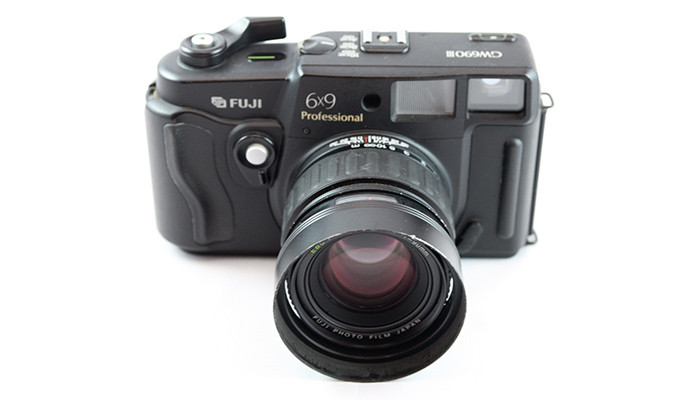
Image on top shows the Fuji GW690III medium format film camera.
In many occasions Fuji stated they do not plan to go Full Frame any time soon. And it seems like they really meant it seriously. But there is one major surprise to report today: Fujirumors.com said Fuji is developing an interchangeable Medium Format system! There is yet no info about possible launch date and specs. But it’s a very intriguing move from Fuji!
If the rumor turns out to be true that Fuji will place themselves a step above the Sony FE and other future Full Frame mirrorless systems from Canon and Nikon. They will therefore play in an own league with virtually zero competition. The real question is if the system will not be too expensive to generate noticeable sales and revenue. So please dear Fuji, make it “affordable” ok?
36 Responses
I’ve said many times in the past, that they just need to make it somewhere in the $3000-$5000 range. Bare bones with A/P/S/M modes, basic AF and metering. Bring the superb IQ they have always been known for and they will get a LOT of people buying their stuff.
$3000 is just not possible considering that the sensor will cost a lot to produce. $5000 will be barely possible and only if they build it like the old GS – i.e. cheap materials. If they do however build it like say the GA645zi and come in around $6000 – $7000 then they will have a hit. Remember folks MF is a niche for Professionals. Even $6000 will be a bargain for MF.
The sensor should not cost more than $1000-$1500 each, so wrap the bare minimum around it. $3000 might be pushing it, but $5000 is very doable IMHO.
It all depends on the volumes they can muster. If the camera helps expand the market AND they can make decent margins then we might see prices in that range. Of course I have already seen $5000 for used 645z’s. 😉
Yeah but they’ve actually got to make money. Going mirrorless would mean lower tolerances and that might save some money over the DSLR design of the Pentax 645Z. But then you’ve got R&D and system development. Factoring in a healthy margin and $5k is pushing it for body only. Lenses will be $2-3k each—especially if they’ve got leaf shutters.
If that happens I’m sure Pentax will answer with a dumbed down cheaper addition to the 645 line. I.E. a version without mirror (but same flange distance and mount), with only CDAF, cheaper shutter and pro consumer oriented features like 4K video. If Fuji have some very nice features they could add GPS astrotracer and Wifi (both are cheap to implement) to tighten the competition.
In other words, I would love more competition and price focus in the MF range (maybe I can afford it one day), but I doubt MF will be a money making machine for Fuji. It will be hard work for the money.
Take an APS-C camera like X-T10. It is all that needed, except sensor costing $1000 instead of $100 (if shutters are in lens, the resulting camera can be even lighter). Add $900 to the price of X-T10, and for $1500 an MF camera would be very popular. And simple to make f/2 primes made specifically for 44×33 sensors (not for real MF which is bigger) would still best whatever MF can offer now (only Leica sells f/2 prime for MF and it is super expensive).
There is imho a niche market for a medium format camera for around 5k
Exactly, but they just don’t understand, the APS-C market is saturated and full of competitors, see the marketshare of Fuji. The medium format is a super niche market and still has a lot of competitors. There’s only one player in the FF mirrorless market, that’s Sony, Fuji just can’t understand. Fuji keeps telling their customers “You don’t need a FF, APS-C is the best balance”. Damn it, I don’t need Fuji tell me what do I need. I used to shoot XT1, now I switched to A7R II and couldn’t be happier.
A Full Frame Fuji would mean the death of the current APS-C system. Each time a manufacturer released a full frame system, it cannibalized the existing APS-C system. It happened for Nikon and Canon (almost no lens development apart from kit lenses) and more recently for Sony.
Reason for that are those camera systems use the same mount for both APS-C and full frame. Fujifilm’s X-mount is to small for a FF sensor and therefore can’t use FF lenses without an adapter and already have a quite extensive lens line-up that doesn’t feel cannibalized in any way, unlike Canon EF(-S), Nikon F and Sony E- and A-mount.
They may know a lot more about their market than you.
They only have so much to invest in new and current projects. Going to a FF camera would mean a huge investment for a me-too product. MF can command much higher margins even on small volumes and moderate prices.
Knowing their market more than me, of course, but it doesn’t mean they will always make the right decision, just like the Kodak used to be, I see Fuji has lost their growing opportunity.
Fuji are following in Pentax footsteps, 5 years later. Pentax halved the MF system camera prices over night and the former small niche expanded rapidly. Pentax MF is the by far biggest contender in the MF class, having huge success with the follow up 645Z too.
I doubt Fuji can dump the prices much further since the sensors are quite expensive and Pentax are playing the price game pretty aggressively.
My thoughts are the same.
I agree. The advantage is that Fuji’s entry would add additional interest and customers to the field. I also think they may have a very attractive pro offering as they already have a stable of great leaf shutter lenses thus offering a great alternative to Pentax’s good line.
That was to be expected, they still have to make money on the fine lens line-up that they’ve developed for APS-C. Of course, They wiseley want to avoid any confrontation with the big three (Sony, Nikon and Canon). This is no surprise, Fuji was one of the key players in medium format and even now they supply lenses to Hasselblad.
Opposite to what is written by our Admin, this is no virgin territory, there’s the Leica S, Pentax 645, Mamiya 645 DF+ that have some advantages like an old lens mount. Perhaps moving to a mirrorless design could set the camera apart, but pros are still not convinced by professional mirrorless cameras and the camera can’t be cheap, that’s for sure.
The biggest downside of mirrorless is AF-speed. People using a MF system are the ones that do not care so much about AF-speed. And with a mirrorless MF system, you can adapt ANY MF-lens. This is a huge bonus! Especially in the MF ecosystems where no giant with a 100+ lens lineup exists.
I think it is wise to have a mirrorless MF system. And as long it does not exist, it is very wise to start it now.
Phase One already has a mirror-less Medium Format line of camera bodies.
What’s wrong with mirror-less auto focus speed? Using lenses for the system, FujiFilm, Panasonic, Olympus, and Sony all have World’s fastest AF speed.
That can be disputed. Phase One made a series of digital backs adaptable to the Alpa technical camera (without AF!) and added some software to make it work with the three (3!) lenses available for the system and put the price for a set with one lens at $47,000,- !
In practise that means it is only available on request by very serious buyers as even sellers of Hasselblad and Phase Ones regular cameras won’t keep such a small in demand hyper expensive camera in stock.
So it’s an extremely niche camera. While using no mirrors one could just as well claim any digital back adapted to any bellows with a lens in front is a new mirrorless camera which is really stretching the definition of mirrorless quite a bit.
Usually what people think is a mirrorless camera is built in one piece with a mount and has no mirror between the lens and the sensor.
All modern digital mirrorless cameras also have AF and EVF and/or LCD for viewing.
By that definition there are yet no mirrorless MF systems. Fujifilm exploring the idea is only natural as they have a lot of experience from MF for film. And being the only manufacturer offering a compact MF system surely looks appealing.
“By that definition there are yet no mirrorless MF systems”: you mean in the digital world. In the analog world there were plenty, including Mamiya 7II system and Fuji’s 6×7.
Of course. Mirrorless only started be used as a description of non DSLR digital cameras, and, should I have added, are ICL cameras with a mount. Sony’s RX series of cameras are therefore not mirrorless cameras as a category (although they have no mirror) but digital compacts.
Cameras made for film never were called mirrorless during the time they were produced.
The exemples you give were by the way defined as rangefinder (Mamiya 7 II) and compact camera (Fujica 6×7 with built in lens and rangefinder) .
Mirrorless simply is bad name for the new digital cameras as many can’t understand the difference between the cameras belonging to the category mirrorless and all other cameras that have no mirrors.
But mirrorless is what is being used although I think CSC, Compact System Camera is a better name.
Well, I mentioned those two because they make sense as a possible template for a future non-reflex MF system camera. The Mamiya II in particular it’s a very interesting option, as at its times it wasn’t much larger of a 35mm reflex, but with a 6×7 format much better in terms of IQ (many considered it an excellent substitute for the the Hasselblad SWC: transportable and top-notch IQ). A modern MF has a smaller sensor format than 6×7, so I expect smaller body and lenses than the Mamiya II system. I can see an excellent and not big Fuji MF system being release relatively soon. I hope it’s not going to be priced much more than the Pentax MF system…
You’re kidding right? None of those cameras’ AF is remotely decent in low light. As far as AF is concerned, the DSLRs are still running in circles around the mirrorless cameras. This is, BTW, one of the reasons my fuji-X group of friends is getting smaller and smaller: for lenses such as the 56 / 1.2 you need good AF (and fast), and in low light the AF is not there yet (any X camera hunts as hell in tricky situations)
It is relatively untouched territory WRT moderate pricing.
Fuji does have a lot of MF experience and a selection of MF lenses with leaf shutters that would imply a camera that MAY be mirrorless AND with leaf shutters. This would be enormously interesting to pros and amateurs interested in OCF.
As for AF speed, I can’t see the criticism as being fair as the fastest ML AF today is plenty fast. And MF is not the camera for sports or BIF despite what some people might want to carp about.
MF would allow Fuji to really have a revolutionary camera that would be a real alternative to the long in tooth competition.
When I read this kind of stuff, the first thing I think is, “my focus plane is going to be measured in microns!” Not, “I’m going to have so much resolution!” Maybe the sensors will be such that you can crank the ISO to kingdom come, though, and I’m sure plenty of folks will love them with appropriate natural or artificial lighting.
I do not believe in this.
Interesting, and it would certainly be a unique product. I’ve been tempted to go down the MF route a few times, but the size of both the kit and the price tag has always put me off. If Fuji can significantly shrink both, they may be on to a winner. Fuji have a surprisingly small market share, perhaps this would help get them closer to Sony (or even up with Olympus/Panasonic at least).
Of course, you’d still have the same losers attacking the system as they do with the Sony A7 cameras, who think that the sole reason to go mirrorless is to have a camera that will fit in your pocket.
Below statement is wrong! Sony has produced MF sensor, a mature business unit such as Sony will weight again the market need and respond accordingly. MF just a very small segment compare to FF. Furthermore, Sony simply to comfort their users if you really want >100MP like Canon future FF, we can do it for you. Really not seeing strong selling point for MF.
” If the rumor turns out to be true that Fuji will place themselves a step above the Sony FE and other future Full Frame mirrorless systems from Canon and Nikon. “
“They will therefore play in an own league with virtually zero competition.”
Except Pentax, Mamiya/Phase One, Hasselblad, Leica. Actually, more competitors than for FF. I am not saying it is not open for disruption, of course, a mirrorless system consisting of f/2 primes (at least for wide end) and f/2.8 zooms, all with leaf shutters and at reasonable prices could be a huge success. Reasonable meaning that the f/2 primes should be cheaper than f/1.4 FF primes of the similar caliber (meaning cheaper than Sigma Art 1.4 primes, and it could be done as f/2 lenses are simpler to make sharp compared to f/1.4).
Yet all the other systems you mention aren’t Mirrorless. I use the Pentax 645Z and find it wonderful, but would kill for a mirrorless akin to the old Fuji 645Zi or Bronica 645RF. Small and mobile with a MF Sensor? Take my money now.
What advantages do “MF” (not really, just 44×33) systems have over FF with f/1.4 lenses now?
– Better system sharpness (counting in the optical side, not just counting pixels)
– Larger viewfinder
But I agree MF need larger aperture numbers to compete with FF in noise, shutter speed and DoF minimizing. MF also suffers from limited lens selection. I hope we will see larger sensors (maybe FF MF) in the future, taking advantage of more of the image circle.
Where do you get the info on MF sharpness comparable to FF tests? DPR has like 2 lenses on 2 MF bodies tested?
Sigma Art stopped down on Canon 5DsR shows aliasing everywhere, new Canon 35/1.4L II is even better – how much more sharpness can you get on a 50mpix sensor? Especially given that optical designs of some of these MF lenses are pretty old…
Now, IQ180 probably has a little more resolution, but it is not a “cheap” Pentax either. 😉
Yes, that is your experience with mirrorless specifically Fuji (who IMO have awful AF), but is not the case with many other brands.
I own a Fuji, but also “played” with the Sony alpha system and the Olympus m43 system (my wife’s cameras). Better AF than Fujis, but hell far from “world’s fastest AF” (puhleeeez). Especially in low-light none of these systems is yet on par with DSLRs.