








This rumor is confirmed by best sources. So do not take it with a grain of salt but as an almost 99% certain fact. The first week of February Olympus will announce the new E-M5 MarkII which will have one new unique feature in the OMD range:
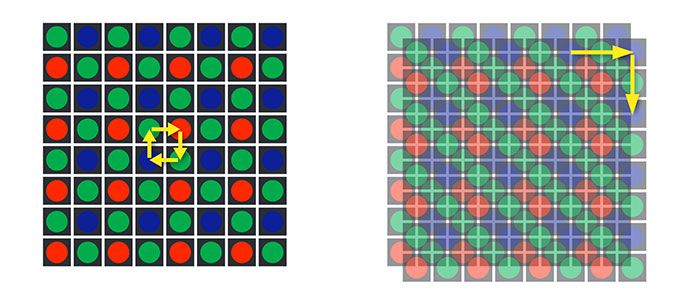
The camera has a 16 Megapixel sensor that can shoot up to 40 Megapixel by shifting the sensor (in up to 8 frames of single shots).
So just like HDR shoots get combined to increase the dynamic range the new Olympus sensor will shift of 1 pixel for every shot and than combine the pictures to increase the resolution. This will work perfectly for landscape pictures a bit less perfectly on fast moving subjects.
For the rest the E-M5II will use the same E-M5 sensor so there is no improvement there 🙁
14 Responses
Ten years ago aprx., (I don’t know exactely the year ) Casio or Ricoh? used this technic to increase resolution..
This is not new: Hasselblad uses it extensively for their 200Mpix cameras http://www.hasselblad.co.uk/products/h-system/h5d-cmos-multi-shot.aspx
Yeah… this “great feature” has been known for years.
Everyone knows how it works and it is very easy to implement (especially in cameras with sensor-shift stabilization). Result? Almost no one uses it.
Lately it was added to a Hasselblad back as a feature useful in.. document photography.
Hasselblad’s implementation is very slow. It’s not like 8x shutter speed. It’s more like 8x shutter speed and an extra second between each…
For action, street or even studio portrait: unusable.
Great for landscape?
Landscape shots are often based on long exposures. So if you have a moving subject, it becomes smudged, but in regular way. So:
1) one exposure: regular, continuous shape.
2) multiple exposures: dots and stripes and other artifacts currently unknown to most photographers. Or just a massive failure of the merging algorithm. 🙂
And what if and object moves out of the frame between exposures? Or if it changes colour? 😀
Generally, I have nothing against adding this kind of features, although they are mostly useless. But making this a key selling point of the new body would simply be ridiculous and unfair to the customer.
And we’ve already seen rumors about “higher resolution”. I even wrote under such a rumor, that I still believe this will be the same sensor (possibly with no OLPF). And so it will be…
You guys have to be kidding me? The difference in IQ when interpolation is removed is well documented and obvious in print. Why would we NOT want this feature?
This is an amazing feature typically reserved for high-end commercial still projects on cameras like Hasselbald’s mull-shot technology. What most people don’t realize is that “sensor shift” is not easy to implement or use for anything except the most demanding stills projects like: creating digital records for artwork, landscapes, architecture, still life, or any commercial project where exceptional resolution and color depth is in demand.
But what really makes this impressive is that now Olympus is no longer limited to 16MP and now has the option of creating high resolution stills without the need of a full frame camera at a fraction of the cost of any other camera with “sensor shift” capability in the most effective, compact kit possible. This is going to seriously open a lot of doors for professionals who already use m43 as their back-up camera or primary camera like a lot of wedding photographers are using.
I’m looking forward to seeing how quickly and effective Olympus’ “sensor shift” works in practice and what new amazing things photographers will do with this new feature.
it’s a simplified version of HDR or multiple exposures. nothing really new to offer. all this marketing crap is not fooling anyone who understands the concept. 40MP? yeah right.
Absolutely NOTHING to do with HDR. Yeah, try to understand both concepts. Completely different.
Not limited to 16MP? If they do gimmicky stuff with 16MP, what’s to stop others from doing it with 24MP or 36MP?
Sprinkling magic fairy dust on 16MP and it’s still 16MP. Olympus really really needs to bust that barrier in 2015, or I fear they will have plateaued… as Fuji appears to be doing. We really need more real and not magical base resolution.
Clever or not, they have to do something as the M4/3 is limited in its development in terms of resolution. They really have to offer something, even if it wont work with moving subjects or the likes. They are currently in a dead end, so they need this sort of boost. I am convinced that Sony will come to their help as it develops sensor technology for FF, eventually it will reach M4/3, but for now, this seems a good way to bring interest to the brand.
I would say the opersite. Its small sensors that are pushing sensor tech ff will always be last to implement new advances such as bsi.
This technology was developed in the 1990’s for Hubble Space Telescope in order to gain more resolution.
Many undersampled frames were taken each with shifting the photo sensor a tiny bit to a different position. These undersampled frames were the “drizzled” on to a new clean canvas one by one to make a higher resolution final photograph. The process in known as Drizzling.
Drizzling would be a good name but I believe that it’s called dithering.
Perhaps they have a better implementation with many years since it was last tried with newer technology.
They are limited by sensor area. But there are some things they could bring to the table such as 4K video + H.265, higher sensitivity sensor (BSI). If they go to higher MP without a higher sensitivity sensor, it’s just going to be noise when you pixel peep. Sony A7(x) all have FF so will perform better with same sensor technology, M4/3 can try going to a smaller body to compete on size or price but not at the cost of losing existing features.
For more information, see “Stacking Images with Drizzle
by Craig Stark”. In this paper there is some background of how to gain more resolution without having to by a new camera and a lens. So this could be accomplished by firmware, if the IBIS is allready in the camera.