








Image on top on courtesy of Personal View (Click here).
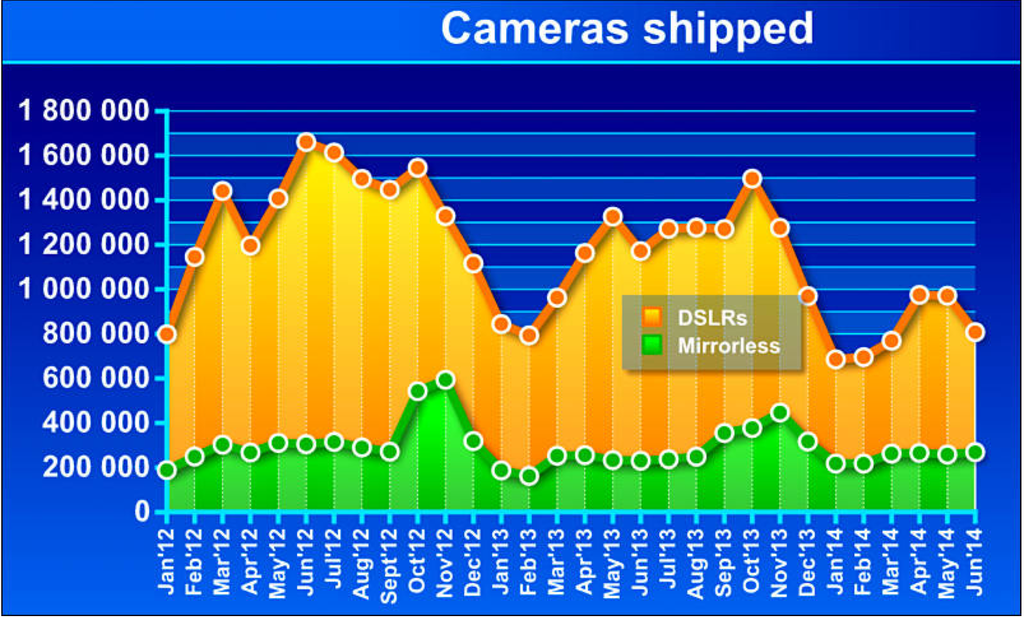
The Japanese agency Cipa (Click here) published the camera worldwide shipments data for the month of June. And Personal View (Click here) ordered the data in many nice graphs. There are a couple of interesting trends:
1) Mirrorless camera shipment from Japanese companies are growing (+9% over the previous month)
2) DSLR shipments are falling (-11% compared with to May).
3) Mirrorless shipments increased in the “not-so-mirrorless-friendly” US (+18%) and European market (+10%).
In short: In these time of crisis the DSLR market is falling dramatically while the Mirrorless market is slowly growing.
14 Responses
There seems to be a drop for DSLRs May-June every year portrayed, while mirrorless is flat for that same pair of months, don’t know what’s significant about those two months.
There doesn’t seem to be any market breakthrough or large upslope for mirrorless for the last three years (other than the usual Black Friday blip typical of consumer toy markets).
The peaks continue to get lower and the troughs get lower. From a long term viability perspective, this is good for no one.
The graphs are not for cameras sold, but cameras shipped. The overstock of DSLRs from the last few years, with distribution channels stuffed, seems to have somewhat abated, with manufacturers cutting back on runs after being burnt too many ties. This doesn’t seem the case as much with mirrorless, where we still have constant price-off offers on mirrorless products over the last several months, in an attempt to clear old stock. Expect fewer shipments in the future as manufacturers rationalize their product mix and start to drop more and more redundant lines.
Hmmm,
you don’t do yourself, or the points you try to make, any favours adding in “Consumer Toy Markets” clearly showing where you allegiance lies whilst demeaning other demographics.
Personally I couldn’t care less who buys what when, but it’s just as easy to read into your Black Friday Blib that Mirrorless buyers are more savvy and buy at opportune times, where DSLR users are more excitable and buy whenever a new model appears.
Both could be wrong of course 😉
J
Standing by my statement, Jethro, there is always a blip just before the Christmas holidays. This has nothing to do with mirrorless or mirrored, it affects both. Nothing to do with allegiance, just going by the numbers, and you’re welcome to buy more product at other times of year to change the spike.
Or maybe you don’t like that they are consumer toys? Can’t help it, they are consumer toys for rich people. 99% of the world’s population would flip at paying $1200 just for a camera body every 18 months. They are consumer products because the overwhelming majority of them are bought by hobbyists for personal enjoyment. They are toys because nobody actually needs it, and our relatives think we are nuts because they can’t see a whit of difference in the output from what we produced five years and five thousand dollars ago.
As I said, I don’t care one way or the other.
Just sounded as though you were being derogatory to one side of the argument which is never a good thing.
If you weren’t then great.
Not sure they are totally toys. I have some great memories I’ll treasure for life from my camera pictures, including pictures of my deceased parents which are obviously invaluable. Not sure that’s a toy.
Based on the given numbers there is hardly nothing that can be said. What can be said for sure is:
There are still mor DSLRs sold then mirrorless (by a factor of 4).
From 2012 the shipment of DSLRs had some very high points and is now on the same level as it was in 2012.
From 2012 the shipment of mirrorless cameras did stay more stable and has ha tiny bid higher now then it was in 2012
All this is kind of strange as more brands came with mirrorless sinse 2012(Canon, Nikon, Kodak, Pentax, Sony with a FF mirrorless and Leica (some came out in 2011, but they starting to count in 2012)
There are many things that makes the shipment of cameras rise or drop, like when new cameras come out they will ship more. When was the last time an important new DSLR came out. New mirrorless come out allmost every month (like the GH4, The A7s, The new Pentax Q etc.)
So the increase of shipments of mirrorless telss us not much, we have to see it over at least a year. When numbers of shipped DSLRs keep on dropping then it is a trent, if not then nothing realy changed.
I do think that in the end DSLRs will dissapear in this kind of charts, but it can take a year or 5 to see a permanent drop.
If I had to read anything in the ebb and flow of figures, it’s that DSLR’s are bough by ardent hobbyists whenever a new model comes out – the blips.
Mirrrorless by average consumers who buy when they need one, making it more random, hence flatter.
One month does not make a quarter, or a year or 3 years. DSLRs slump in June every year. The bigger story is that the regression curves for both markets show lower sales overall. Not a good sign for anyone into photography.
Taking one month as a trend is a mistake.
The March-April data show a jump in DSLR sales while mirrorless was flat. Both seem flat April-May. That means almost nothing, just as the May-June changes taken by themselves do.
Nikon and Canon essentially own the DSLR market with Pentax and Sony both under 10%. The mirrorless market is much smaller than the DSLR market and is contested by Olympus, Sony, Panasonic, Pentax ,Fuji and yes Nikon and Canon . All the big mirrorless players have lost money in their camera divisions often lots and lots of money .With pretty much all of them having to rely on other profitable divisions in their company to cover the losses. If Olympus was only a camera company they would have collapsed years ago, they are now going to merge their money losing imaging division inside a profitable sector to cover the losses up.
Since the E-M5 there have been around 18 mFT mount cameras all with near identical still image quality. That works out at a new camera every 7 weeks or so and that is just mFT. Though for both mirrorless and DSLR I think the selling off of discounted old stock is a major issue
And film used to dominate the market when poor quality, can’t-match-the-IQ-of-film, DLSRs came the market. Mirrorless users have been saying for quite some time now…mirrorless is the future.
Arguably the cross-over period when SLRs trended down into all-but oblivion and popularly priced DSLRs trended up lasted ~3 years.
Mirrorless cameras have had over twice that amount of time to displace DSLRs, yet despite the increasingly desperate predictions the trend is that there is a greater chance that more mirrorless vendors will disappear through simple lack of market viability before DSLRs go away.
Curious why the cries of “mirrorless is the future” are still being made. Who cares? This isn’t a religious war, these are just mass produced luxury consumer products. The market as always will decide.
Yes the transition of SLR to DSLR was rather fast, but was it? The first commercial DSLR was (as far as I know) from Kodak in…. 1991! The first consumer DSLR was the Fuji Finepix S1 Pro in 2000, The first Canon consumer DSLR (the one that made the SLR real a niche market came out in 2003. So it took the DSLR12 years to trend down the SLR, not 3!
Will mirrorless bring the DSLR to a niche market? I think so. Why? Mirrorless is a great system with all the benefits of the DSLR and some great things a DSLR can’t do (like tracking on a face, face recognition etc.) and all that in a small package. Now Sony came with the FF A7 series and cameras with fast AF the mirrorless is getting realy better then DSLRs.
How long will it take from now to mirrorless take over? Well that is hard to predict, I think it will cost between 5-10 years from now. Why so long? It will be hard for many people to switch from DSLR to a mirrorless system. They are used to DSLRs, they have lenses and the main DSLR brands are not making a serious mirrorless camera. And, although it might look different when you look at these forums, but most people buy a camera for a long period of time. I know people who are still working with their Minolta 7d, or Sony A200 cameras, people telling that when they switch it will be to mirrorles, but they wait a few years befor doing so as their cameras are giving them excelent pictures!
Correction, all cameras are mass produced with the exception of Leica, Phase One, Hasselblad, etc.
All cameras are luxury consumer products.
A handful of consumer cameras double as professional cameras like:
Canon 5Dmk3
Canon 1DX
Nikon D810
Nikon D3X
Nikon D4
Olympus E-M1
Panasonic GH4
Fujifilm X-T1
It would be interesting to have a 2nd graph in value comparing the two, both in terms of bodies and in terms of lenses sold.