







Mirrorless vs dSLR
_ _ _
The latest CIPA reports are online. You can download all the statistics at the CIPA site here, or go directly to the excellent summary and graphs made by Dicahub.
The reports confirm (once more) that shipments for all types of cameras are decreasing.
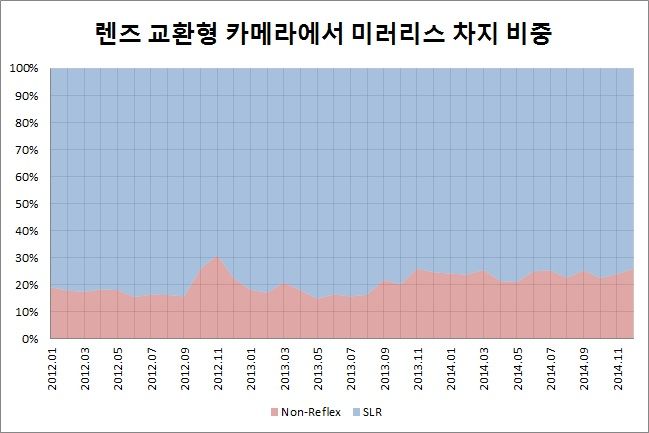
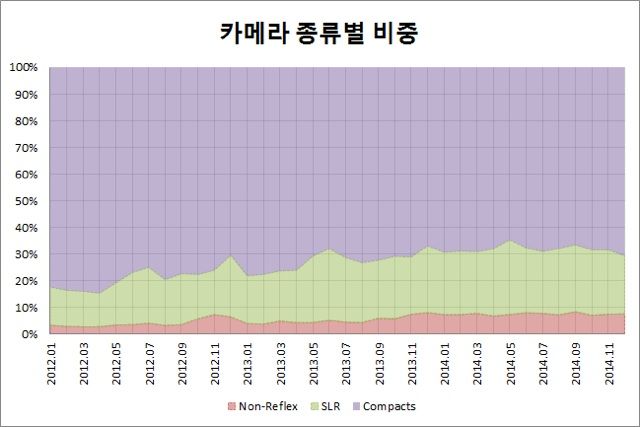
So let’s focus on the little good news for mirrorless shooters: Non-Reflex (*) is increasing when compared to the same month of previous year, while dSLRs decreased. Mirrorless is now at about 25% (until mid 2013 it was mostly under 20%) – see DicaHub graph above.
That’s a positive trend for mirrorless, but still not as positive as some companies expected. In fact, DicaHub reminds us how Panasonic forecasted mirrorless would reach 28% in 2014. Also Samsung’s prediction that mirrorless will sell better than dSLR in 3 years is a bold claim.
(*) Non-Reflex” includes cameras such as so-called mirrorless cameras, compact system cameras, rangefinder cameras with interchangeable lens and interchangeable unit system cameras, and similer cameras.
Mirrorless vs dSLR vs compact camera
Lensvid Video Summary
18 Responses
To summarise Thom Hogan: ‘bigger piece of a smaller pie’. Time to make a difference rather than try to hold onto a dead market.
that’s a good summary 🙂
Seems that in future “real cameras” will become just a small niche for PROs or enthusiasts. It will be interesting to see if mirrorless can take over this niche.
For the big pie, well, companies should start to make smartphones… like Panasonic’s Lumix CM1 smartphone with 1″ sensor.
I think it’s rather simpler than that, and yet more difficult. Camera makers are not generally good at software or services. They can’t make good phones. And the phone market is saturated in the low end, and in the high end. Selling sensors or lenses may be cool.
But otherwise, makers should probably look at the future: a future where they are either dead in the water, or selling a much, much smaller number of cameras to a much smaller group of people.
In that market, what matters? As a company that has made money on an insane boom, what should you do now? Is it important to keep face, or to do something different? It’s beginning to show here: Fujifilm need to drop the low end. Cater to the people that want cameras, not to an illusory market.
Thom says it way better than ever I could. But a year or two ago, I was adamant that Fujifilm are looking at the wrong people to buy their cameras. They are targetting switchers, who will jump to whomever else. They’re not getting their interface down, nor are they making it any easier to take photos.
Thom’s got great essays on the moment he discovered that sharing could be easy. That may be part of it. What is left is probably the journos, the sports togs, the enthusiasts. And, for makers like Fujifilm, the retro-mechanical conceit may carry them a bit further afield; it may not. The vast majority of people have what they need, and have always wanted: the selfie.
http://ohm-image.net/opinion/photophile/2014/12/16/jingle-jingle-selfies-killed-the-digital-cam
And yet sucker companies are investing in it with traditional digital cameras with face-facing screens. It’s the lessening of convolution, the joy of photography.
I got the X-T1 for my wife, thinking she’d like the smaller body than her D5000. She no longer shoots. It’s not that the camera is in any way worse. But, it is harder to shoot with. Even her slim fingers accidentally flip the drive/metering dials, and the battery, which used to last weeks, lasts hours. There are SERIOUS problems to solve that have to do with HOW and WHY a person shoots, and none of them have to do with masturbating the enthusiast’s expectations.
If you can make photography fun AND manage to provide key features, you have a market. But we have a big bowl crowded with players that basically are doing the same thing: making photography more and more complicated and with the one exception of reducing weight, worsening ergonomics.
It’s a bit funny. When I see how over-visited photography-courses, workshops and clubs are in my country, there is seems to be a huge interest from advanced amateurs, fine art-oriented photographers/artists and even professionals. Photography is more popular than ever and I cannot believe that the ‘more interested’ crowd will convert easily to a smartphone-alike approach, whatever sibling it might be (even the Pana & Sony related exercises). I”m far from being a Phillips fan, but I liked their slogan ‘Let’s make things better’. We don’t need managers, but engineers (…an issue in the industry, engineers don’t want to stay engineer but aim to become managers asap). Maybe Fuji is closer to that innovation-kind of model than we think. At least, they dared to do something different. Too chose their own non-market standard direction, be it it was not without flaws. There is a mission for blogs like this, to steer them into a direction that really appeals to the end-user of their products. And I fully agree that the X-A1 and M1/2 are ridiculous, mass consumer-oriented products, but the X-Pro1, X-T1 & X-E2 hold a kind of magic that has potential.
Indeed. As the camera market continues to shrink into more and more of a niche product for enthusiasts, the Leica model of “sell fewer cameras for a lot more money” starts to make a bit of sense. M43 prices continue to go up but so does the quality of product and target market. I just hope we don’t get to the point where only the Leica model makes sense. We may be years away, but it sure feels like the direction we’re headed.
Another +1, Ohm. I think what we see on the camera-market has a lot of similarity too what happened in the car-industry: way too many manufacturers, models and most of all, a massive overproduction. Anticipating too slow to new technologies and economy outlooks, mostly from the industry leaders. Those making the difference have the biggest chance to stay in business.
Make perfect sense to me. It’s not dSLR or mirrorless, it’s dSLR AND mirrorless, at least as long as mirrorless cameras can’t fix there problems.
I’m sure the future will be mirrorless, but I bet in the future MLCs will not be smaller, nor cheaper than the dSLRs today. The lenses and the size of human hands of course are the limiting factor.
If I had to decide for only one system, I would go dSLR too, simply because you can do everything with it, for the price to carry more load. Thank good, I don’t have to limit my self -> first world problem 😀
Interchangeable lens cameras never going to outsell non-interchangeable lens cameras.
Fuji should concentrate on a single small niche instead of trying to dominate the whole market.
Seems to me that’s exactly what they’re doing? Well, the X-M1 etc may be a necessary evil, but certainly no attempt at domination .. or i hope not!
I don’t see Fujifilm trying to dominate a market. They seem to want to go after enthusiasts who enjoy photography using cameras that are more “tactile”.
If only they were more tactile, or direct. They are not. Trenton is right: they should focus. They are not.
Going by the charts, it appears Mirrorless peaked in the fall of 2012, and has never again attained that shipment market share.
At best it’s been bumping along at 25% for the last 5 quarters, and despite everything has been unable to penetrate any further. The recent trend then over those last several quarters is that both mirrorless and DSLR are holding their own. This is a far cry from the interweb prophets who for the last almost 8 years have been proclaiming the death of the DSLR.
Personally, I think the whole idea of mirrorless vs reflex is a false dichotomy. There is no one manufacturer for either. Some manufacturers make both. The cameras are far more alike than they are unalike. The mirrorless vendors themselves (Sony, Olympus, Fuji) are vendors who tried and failed to make it as DSLR vendors.
It’s not mirrorless vs reflex. It’s Sony vs Nikon vs Panasonic vs Fuji vs Olympus vs Canon vs Pentax vs Samsung. Each vendor wants to succeed on its own.
Sony is not content leaving money on the table for Fuji because Fuji is ‘mirrorless,’ and therefore some sort of ally. Samsung is happy to take sales from Olympus, they are not ‘partners’ because they don’t feature reflex viewing. They are competitors, all of them, with each other. Panasonic shareholders don’t make more money when Sony sells more mirrorless cameras. Each mirrorless vendor would be happy to see other mirrorless vendors go away.
They are no pure competitors. Nikon needs Sony for the sensors. So does Fuji. Panasonic, Olympus and Fuji are part of the Four Thirds consortium. Canon is probably working with Sony on the same 50 MP sensor. These are Japanese companies. Although they are all in it for the profit they have a different attitude towards competing unlike US companies who are much more in it for “the kill”.
Sony is a big conglomerate. Nikon needs Sony from the commercial division, not from the consumer product division. That division could still supply sensors to Nikon even if Sony stopped selling cameras today. Nikon outsources many components to other companies, as does Apple, GM, and most other sellers of complex consumer products.
Japanese companies are extremely competitive. Their shareholders demand it. Sony and Panasonic are dropping unprofitable consumer electronics divisions left and right, including TVs and PCs. Toyota goes to extreme lengths to remain number one. Shareholders will not for long tolerate unprofitable divisions, and we see this every day as the big camera companies talk about dropping non-selling compact camera lines.
They are extremely competitive towards companies outside Japan. Within Japan it is very different compared to the western way of doing business. A nice article was written about this different business culture and I tried to dig it up but I can’t seem to find it at the moment :/
Would love to hear about amiable inter-company cooperation between rival consumer product corporations, anywhere. But that’s ok, no need to look it up, it really has nothing to do do with my original post.
Best regards,
I saw the peak on November 2012 and I thought, “that must be the camera I bought then”.
The ship is still sinking. The best that the camera companies can do is rearrange the chairs on the Titanic.