







Last week, SonyAlphaRumors reported that Sony decided to push back again the release of the Sony A7000 (probably to next fall).
So who cares?
Well, there are some speculations (plausible speculations, but no facts, not even rumors), that the Fuji X-PRO2 will sport the same new sensor that Sony is developing for the Sony A7000.
We also know that Fuji (and other companies) can use the latest generation of Sony sensors only 6 months after Sony itself implemented it in one of their cameras. Therefore, every delay of the Sony A7000 could mean that also Fuji has to push back the release of the X-PRO2.
Some fellow X-shooters, like FXF member Mark In Dallas here, think that Sony could have appositely postponed the A7000 to fall 2015, so that Fuji is forced to launch the X-PRO2 only after the important Christmas Holiday season. What do you think about it? Say it here.
In the last days I’ve tried to dig up something more. So I’ve contacted those sources that I think can have an insight into different brands. Well, one source, who was right in the past, answered and said:
A7000 & X-PRO2
1) Until now, it can NOT confirm that the X-PRO2 delay is related to the Sony A7000 delay.
2) The source did NOT confirm that the A7000 sensor will be the same of the X-PRO2.
3) It confirmed that Sony originally planed to launch the A7000 in May 2015 (with a newly designed 24MP sensor).
THE RUMORED SENSOR SPECS
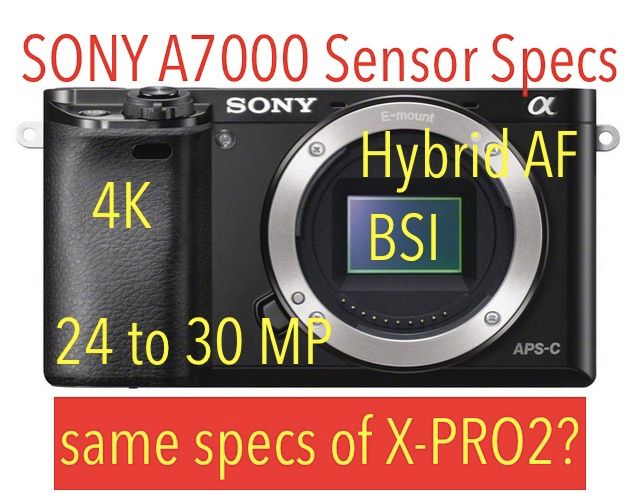
The source also passed me these Sony A7000 sensor specs:
1) BSI (back-illuminated) Sensor
2) 4K capable
3) Sony is now investigating two possibilities: one with 24MP and one around 30 MP
4) Hybrid AF (PDAF + CDAF) covering the whole sensor area
5) XAVC-S recording format and 60p
FIRST THOUGHTS
ad 1) BSI? Yes please!
ad 2) 4K? I personally don’t need it, but it could be a deal breaker for some, so it’s better the X-PRO2 is 4K capable.
ad 3) from 24MP or up to about 30MP? Maybe Sony is thinking to put more MP into the A7000 to challenge the 28 MP of the Samsung NX1. NOTE: It’s rumored that Fuji will keep the X-TRANS CFA
ad 4) Phase Detection Pixels all over the sensor is a must have.
ad 5) XAVC-S recording format is Sony proprietary, so probably nothing for X-PRO2
And here are 3 quick polls… feel free to vote
[poll id=”97″]
[poll id=”96″]
[poll id=”98″]
101 Responses
The big assumption with this posting is that Fuji are intending to use a Sony sensor, and it appears that no one has been able to confirm this.. The delay to the X-Pro2 could be because Fuji are developing their own sensor to be produced by a different fabricator, just as Nikon are using a Toshiba sensor in their D5500.
Also Fuji is using a Toshiba sensor for their 2/3 sensors.
They are already using Sony manufactured sensors for their APS-C line. So the assumption is based on the fact, that they are already using Sony sensors
Or maybe they will make their own Organic sensor with Panasonic?
24/36MP organic sensor will be a revolution, 24/30MP Sony X-Trans will be just a next camera…
Ditto. Correlation does not imply causation.
But it does make for a good rumor ..
fujifacts.com would be quite boring really.
Causality.. and it does. What it doesn’t imply is the direction of the casual relation.
I seem to recall a recent collaboration between Fuji and Panasonic on sensor development… no reason it has to be limited to the organic sensor. Panasonic doesn’t make APS-C cameras, and likely won’t, so it wouldn’t conflict with their own market, whereas making APS-C sensors for Fuji would eat into Sony’s client base by entering that market. I’m not sure how good their sensors are, though.
Please add the option for “I don’t care, as I won’t be buying an X-Pro2” in all three polls. Thanks.
You could simply … not vote 🙂
Two things:
(1) Let’s assume that FUJIFILM does read these posts and look at the polls. Well, by not offering the option for “N/A” the statistic thus generated will be skewed towards those who want an X-Pro2 AND want those particular features. Basics of statistic.
(2) By not given everybody the option to vote and thus resulting in them not voting, the polls are very, well, undemocratic.
Or simply be read as “of those you intend to buy it, the most wanted feature is ….”
Thanks for the training in statistics btw 🙂
Won’t work. Suppose I do want an X-Pro2, but none of those features are on my improvements list?
“I don’t care, as I won’t be buying an X-Pro2”
Suggests you dont want an XPro2
Correct. I was merely pointing out that the statistics from these polls mean nothing, as it doesn’t take into account all those fujirumors readers who (1) don’t care about the X-Pro2, or (2) would buy an X-Pro2 but don’t care about those particular “improvements”. The results thus, as per the current polls, gives an incorrect view of the actually market desire for the X-Pro2 and thus as a means of influencing FUJIFILM it fails.
So it won’t be X-Trans?
Last thing I’ve heard (and published) is that it will be X-TRANS . Current X-TRANS sensors are also manufactured by Sony
Assuming that FUJIFILM holds the patent on the X-TRANS configuration and thus that Sony is simply the manufacturer, how is FUJIFILM actually hobbled by the six month moratorium on the use of new sensors? I mean, without a licence Sony may not manufacture X-TRANS configured sensors for their own use and thus this new sensor will obviously be Bayer configured by Sony for use in their own cameras; whilst at the same time manufacturing X-TRANS configured sensors exclusively for FUJIFILM really won’t impact on their own (Sony’s) cameras.
X-trans is the top half the sensor. Sony is limiting the use of the lower half the sensor.
I know. However, the “top part”, i.e. the colour array, has a significant effect on the overall performance of the whole sensor. The same “bottom part” will perform differently whether it has an X-TRANS, a Bayer or simply a clear “top part”.
Why should Sony, who I assume are limited to a Bayer “top part”, really care if somebody else wants the same “bottom part” with a different “top part”, as this sensor will as a whole perform differently than the Bayer configured sensor in Sony’s own cameras?
To make sure they themselves have maximum profits. Plus, Sony couldn’t fulfill all orders in time. Their production could not satisfy demand after all.
FUJIFILM outsells Sony, thus Sony must hobble FUJIFILM.
Not really, even the good old pal Nikon has to wait. But you could always look from the other side, Sony would use that six month to “test-run” their facilities and figure out if the sensor has any issue.
Nikon probably buys the same Bayer configured sensors as Sony uses in their own cameras, thus “direct” competition and thus not the same situation as providing FUJIFILM with an X-TRANS configured sensor.
Not matter what, Fuji cant outsell Sony as there would be huge price gap. But that does not mean Sony would make an exception for Fuji, while their good business partner is left out.
A lot of people buy cameras depending on the end results. As long as it is BSI, it will make a much better camera. Thus, it is still having impact. Now Sony is the only brand providing those to consumers.
Colour me confused. If this was indeed so that consumers are buying, buying, buying the latest and greatest, then why are heaps of participants of this website constantly complaining about their X-E1 not being kaizened?
Well, anything wrong with that? That’s why we all have a job today. If nobody buys, who would be paying our salaries.
Also, xe1 used to be more expensive than now. It’s nothing wrong that people feel bad about being left out.
“Well, anything wrong with that?” The complaining or the buying? If people stopped complaining and started doing, then the world will be a better place; and if people stopped spending their salaries on the latest whatever, then they’d have more money, then they can by an X-T1 and stop complaining about how their X-E1 isn’t being kaizened and then the world would be a better place, again.
That sounds right either way. But i do understand why all the complaints comes fron. Fuji is so consistent with specs and they keeps saying they are going to improve things etc. nobody really enjoys buying a new camera for a firmware upgrade. I think that’s where a lot of people don’t like android. Many brands simply don’t provide any upgrades after one year.
There no such thing as a “clear top part”, as Sigma uses a different sensor technogy.
You have only Bayer or X-Trans, and Bayer is a standard that exists well before Sony started pruducing sensors (CCD and CMOS).
At the beggining Nikon used Sony pruduced sensors for 6 months before Sony could do it in their own cameras (I’m talking about DSLRs), and it was said Nikon was Sony’s machinery supplier.
Even today the sensors Nikon buys from Sony (just a part of the ones used) are manufactured according to some Nikon specifications, and the same (to a larger or smaler extent) to other camera manufacturers.
Fuji happens to include their own color array and it may be a somewhat different demanda but doesn’t mean Sony sees a reason to give up the competitive advantages of a new sensor or wants to compromisso the relations with other customer cmpanies when there are more sensor manufacturers in the market and some of them trying to conquest/increase their market share.
“There is no such thing as a “clear top part” …” But then how does the sensor in that Leica monochrome camera work?
When you talk about color array it is supposed that monochrome sensors are out of the equation because they are registering luminosity not colors.
And neither do “colour” sensors actually register colour.
Ok, you’re right.
Maybe the naming convention should try to find a better formula to get a more comprehensive description and avoid misunderstandings when we refer to the present “color array”.
Probably something like “grey values array to create three different channels corresponding to the red, green and blue colors on an sensor working according to the RGB color space in order to allow the return of the registered values to produce a color image” could do the job.
Sorry for typo, first paragraph should read:
Maybe the naming convention should try to find a better formula to a comprehensive description and avoid misunderstandings when we use the present “color array”.
“Current X-TRANS sensors are also manufactured by Sony”
Do we have we have incontrovertible proof of this … such as a tear-down? I’m not sure we do.
X-trans is the color filter array, which is a plate on top of the sensor.
I would like IBIS sensor wid PDAF..then all those fancy BSI…more megapixels…etc
Cut out the middleman and buy an Olympus E-M1, as that’s who FUJIFILM has to pay first so they can provide IBIS in a camera for you.
Yes, IBIS gets my vote as well.
very good news!!!
If the A7000 isn’t released until the fall, the X-Pro 2/X-T2 will not be released until at least March, which is a long ways away. If so, they should push up the production of the 120mm macro and the 100-400mm and release them for Christmas.
If it would make the lens smaller, perhaps they should make the telephoto zoom 150 – 400mm or 200 – 400mm.
On another note, as much as people keep arguing about full frame vs APS-C, I find it very difficult to tell the difference when I see photos online. Buy whatever you want. However, irrespective of sensor size or brand, it is obvious that most cameras today are well beyond the skills or abilities of many of the people using them.
Yeah, I’d really enjoy something like a 200-500mm f/5.6~8 lens right now, especially since we have the option of the 50-140mm f/2.8 already.
the 1.4x teleconverter will make the 100-400 an ~140-560mm f/6,x-8 lens. 🙂
thats over 800mm full frame equivalent!
What teleconverter? Yes, there is one on the roadmap, but the problem with that teleconverter is that it’s on the roadmap and not in the shops or in my lensbag.
(BTW, here is no such thing as “full frame equivalent” focal length. One can, possibly argue for a “full frame equivalent” field of view, but that’s just marketing gobbly-gook and actually means nothing.)
Could someone please tell me what the x-trans actually achieves in reality except for screwing up all the fine detail and making it mushy?
Good question… but what really amaze me is that X-Trans2 (X-T1/X-E2/X-100s/X-100T) is in my view the worse Fuji sensor with colour array filter – compared to X-Tans1 (X-E1/X-Pro1/X-100) and to X-Trans with Bayer filter (X-A1/A2) – that creats colours unnatural/artifical and wash out details. Best colours and details brings X-A1 camera with Bayer CAF, these images are beautiful with a bit more noise but colours are natural (a bit pop) and files are easy to work with. If X-Pro2 will share same X-Trans2 CAF, it will brake my heart down because I will have to go for A7000, though I prefer Fuji ergonomics, body design and controls. X-Trans2 has more issues than first Fuji sensors and it’s Fuji marketing and hype only.
It’s a marketing argument, as competition doesn’t need anti-aliasing filter any more and Fuji didn’t solve the X-Trans video moiree problem yet.
This sensor was meant to avoid moiree and does it for still image but vídeo still shows, besides Fuji says a solution can be found without leaving their color array.
Fine detail and color smearing are other questions I am not familiar with as my X100 uses a Bayer sensor.
You need capture one. Adobe software doesn’t give you the best details.
yup, i wondering why the Xtrans sensor , on my XT-1,and my previous XE-1 has always give me a BLOWN HIGHLIGHT, , i never have a problem with my Olympus EM-1, EM-5 which is a smaller sensor than Fuji.
if the BSI- sensor technology, could fix this problem with more DR , i may not have to sell my Fuji system in the near future.
i might’ve gone nuts from looking at too many xtrans photos on flickr but, in general, when i see a well-processed xtrans photo i see both a smoothness, finesse, and contrast to detail that isn’t achieved on bayer version photos. bayer may possess more ‘detail’ which leads to more texture to the image but that texture isn’t necessarily realistic, and can have a gritty/garrulous look to it.
this is only for xtrans images that i think have been well processed, otherwise the vast majority of xtrans images suffer from blurriness, artifacts, halos. Sometimes that smoothness has a nice look to it. nobody ever talks shit about having too many details, generally because we aren’t objectively discussing the realistic-ness of the appearance of detail. but in real life when i look at trees they don’t have nearly the same amount of ‘grit’ that a highly detailed bayer image will show
At this point go on and delay till it is an awesome camera. AND launch the next X100 at the same time; with the same specs 🙂 ….and Hello Kitty SE please. Was also think ing there should be a Special Edition called “The Rico” where a new menu option allows for looking up shooting tips. Select the tip and the camera automatically changes the settings.
While I was drooling for a long time for x100s and then x100t at the end I always reasoned out that my 6D is still good and superior to the fuji. The only thing that was swaying me over for fuji was the compactness and hybrid viewfinder. But I have to say. If the new x200 is launched with this new great sensor this time I will buy if for sure(as long as they don’t price me out with some ridiculous $1500+ price).
I somehow suspect it’s going to be close to the release price of x-pro1, which is $1700 usd. Silver xt1 is still about $1400 usd
I hope you are wrong. X100/s/t was never priced above $1299 (unless I don’t remember something) so I hope they will keep this type of price for the successor. I don’t know if I can justify a $1700 price tag for a fixed lens , APS-C camera. It would really have to have to be super advanced and competitive in the market.
If it’s bsi, I probably could raise my bar a bit. But I don’t like that either.
I think it would price me out. I do have money for it but I just can’t see to spend almost $2k on a fixed lens camera unless it really packs a punch. I mean all the bells and whistles, amazing low light performance, etc. Maybe organic sensor and macro switch like in a Leica Q would do it. 🙂
Oh, i was talking about xpro2. For x100 series, i have no idea.
Xp2, xt2 and x100 would not be upgraded at the same time, i guess. So price might be stable
I doubt that. The X100 line is already quite expensive considering the fact that Fuji sees its non-ILC buyers as second-class customers by not giving them any of the update-love (not even for money). X100 customers won’t buy any more lenses (except maybe the cheap WCL or TCL) and so Fuji seem to believe that FW updates don’t make financial sense. They’re wrong but don’t tell them 😉
You’re right though, the X-Pro line should cost the same as the X100 line when you consider the cost to build it. But that doesn’t mean the X100 line should be priced up, quite the opposite. I doubt Fuji would do that though…
The choice between X-T2 and X-Pro2 should be a choice between form factors and large EVF vs. HVF, not one of price.
If you jumped in, please make sure you read to the bottom.
$1495 would not be out of the question for an improved product (X100). Marketing 101 says that product should move up market and with that price to gain the most margin over time. When you see the price drops on old X100(s) designed to clear out inventory you will know it is on the way. And this level of pricing is not as out of hand as some think. Remember that the X100 line was positioned as a travel, street, photo journalist camera. One that gave the user a Leica type of feel for much less, that and cameras like the RX1 are still $1000 more, so pricing could still be viewed as a good value even at $1495.
Wow…30mp on a 1.5 crop is the same as 67.5MP on FF. (30 x 1.5 x 1.5 = 67.5)
Will BSI work that much better?
4K is great
AF covering the whole sensor is great
Oh boy, there is a lot of “work” here:
1. there is no chance that sony isn’t sure about the design (MP amount) yet. That is probably finished for months now. Guess there are heat problems (typical for 4k-> sensor readout and processor)
2. BSI is just another buzzword. With the pixelpitch of a 24MP, 32MP or whatever APS-C sensor, there is not too much use for it. The improvement we WILL see (and this one is certain) comes from improvements in manufacturing (use chopper instead of aluminum). But a BSI pixel is not really any more efficient than a FSI pixel. You could argue that the angle of light rays could be greater, but most Fuji lenses are image side telecentric, so no real difference there (however it’s important for the crippled sony full frame FE mount)
3. Don’t know, there just has to be more than 2. points 😛
1. Absolutely, that choice has been made long ago.
2. BSI gets more useful the smaller the pixels. So this can make a difference even though it surely won’t revolutionise anything. Also BSI seems to help with read-out speed which obviously would be a very welcome improvement.
3. Absolutely!
I’m gonna order mine custom made without the video recording button!
When shall Sony folk understand, that they are not capable to make cameras? Sony is good in chips but a camera is too complicated for them.
“Some fellow X-shooters, like FXF member Mark In Dallas here, think that Sony could have appositely postponed the A7000 to fall 2015, so that Fuji is forced to launch the X-PRO2 only after the important Christmas Holiday season.”
No. Just no.
This actually could be an indicator that the new sensor is going to be very good.
Any word about native ISO?
I gather BSI sensors allow for more efficient light gathering…
While I am ok with getting a few more megapixels, I would prefer more ISO’s!!!!
In fact efficiency of the cmos itself has Little to do with pixel size.
…but bigger BSI pixels are even better.
Aside from this, any ideas on the actual question?
You could reference A7r2. Actuaaly large pixels is a consequence of high sensitivity due to the structure of pixel. It’s not the reason.
Yeah, no idea what you are talking about. Will I get more ISO’s or not? LOL
You will.
Anyway, pixel size is not why you can have high iso.
OK cool!
Not really bothered about the science to be honest….as long as I get the photo I want.
I only regurgitate what I read on these blogs…and it is almost always said that the size of the pixel effects the light gathering capabilities. Hence the why the 12mp A7s is a low light monster?? Anyway, this was not my question. I only wanted to know if I was going to be able to shoot in the dark with the next generation. While 6400, is good…it’s not really cutting the mustard these days.
To be honest if you are an extreme shooter, a7s mk2 would be a safer bet.
Just compare d7200 and xt1 then you will see pixel size is not important here. The thing with a7s is that it also has a larger sensor and if you are using lens with larger diameter you get more light onto the sensor.
Better still, if you want ultra-low ISO performance AND a camera that can still quickly autofocus and track in low light and has proper performance attributes, skip the Sony A7s camera altogether and get a Nikon D4s … or D3s (prices on D3s’ are falling, and it remains a hall of fame camera to this day).
But for video I think A7s is worth considering.
Yes, if you need video, the Sony is a better solution … if you can put up with the horrible autofocus.
Good news everyone! I found this print out in the glove compartment of my Uncle’s DeLorean:
Dateline 2216: Fuji releases X-Pro2! Now with 24 mpx, the X-Pro2 now has fully 1/4th the number of pixels of every other camera out there. But as the director of Internet rumors, er marketing, er development from Fuji was quoted as saying: “megapixels and sensor size don’t matter because we have a widget you turn that magically makes your pictures even better – fully equivalent in our opinion to a full frame DSLR!” Of course readers at FujiRumors were full of questions:
– so where’s my organic sensor? It’ll have infinite noise reduction
– didn’t Canon just announce 8k video?
– Fuji missed a real opportunity to roll out a full frame camera here – I hear they’re working on a medium format camera – probably based on the Sony one that came out 100 years ago
– It’s impossible to take good photos with the X-Pro2, I haven’t seen it or used it, but it lacks IBIS!
In related news, Adobe announced that Lightroom 127.0.0.0.1 is shipping and has finally resolved the probably of rendering “Green” in photographs. They promise support for an organic sensor in a forthcoming release. Commenting on the release of the X-Pro2, another Fuji representative said “we’re really doubling down on the premium pro qualities of the X line by releasing another 15 models of lower level point and shoot cameras that are styled like our more expensive X-Pro line. Except they don’t look like that anymore, but more like a real camera with a bump in the middle.” Prices start at Dp 1500 with a kit lens.
Why don’t you hop in that DeLorean and go back where you came from.
“didn’t Canon just announce 8k video?”
The problem with your list is thinking Canon even gets to 4K in a DSLR. We all know Canon would NEVER put any pro video in a DSLR…we know they could, but they won’t.
Uhm, 1DC has been out for how long?
The next Fuji flagship really does need phase detect over the entire sensor to stay competitive.
This idea that Sony is delaying camera releases to screw with other manufacturers is just silly.
My own asking-around tells me there is absolutely no correlation between the A7000 and the Pro2, with the Pro2’s sensor already being decided and set in stone. So hey.
Personally, if it is not BSI, X-T1 would be my last Fuji for the next 3 years for sure.
what exactly are you expecting from the BSI? It’s just another buzzword.
The benefits of back illumination are minimal at best. I know it’s all the rage now Sony’s dropped a nice camera with it, but it’s not the first time the technology has been used and it’s never been a ground-breaker. It’s a nice bonus, sure, but not something you want to be basing the purchase of a whole system on. And of course, the moment anybody remembers the whole organic sensor thing, people complete forget about backlit anyway.
That said, I would agree that some form of updated sensor technology is necessary, and simply upping the pixel count isn’t enough for what is meant to be a pro-level camera. I’ve not heard any news on that front myself, but I’ve been told to expect something other than just a pixel increase, so I’m hopeful.
I’ve also been told no more than 24mp on multiple occasions, so I’ve no idea why anybody would think to start throwing a 30mp figure around.
I just want a camera that works better in low light while I don’t want the size of nikon dslr. If sony’s white balance is better I won’t be complaining.
what it really could benefit from is the dual layer sensor tech from RX100mIV that minimizes rolling shutter (not quite global shutter but almost as good as), rendering the mechanical shutter almost obsolete (say it were about 1/125 seconds to read the sensor, that would be enough for most people to be able to almost always use electronic shutter)
The BSI sensor in the A7R II is something like 3.5x faster. This bodes well for a BSI APS-C sensor. The downside though is a more limited bit depth output as a result, traditionally speaking (newer BSI sensors may differ).
Forgetting Fujifilm for just one moment, were I prognosticating, I would bet Sony will make this APS-C sensor 30Mp, if at all possible. Why?
Because they’ve already pushed the A7rII sensor to 42.5Mp with BSI. And because Samsung leads the current APS-C Mp sector with 28Mp. Sony will surely want to top Samsung’s lead.
Back to Fujfilm, if they can do the X-Pro 2 with the following features set, it should sell well:
– 30Mp BSI X-Trans III sensor with 14.5 EVs of DR and one more stop of low noise (e.g. 6400 looks like the current cameras at 3200)
– latest HVF with at least a 3,680,000-dot EVF
– significantly more powerful processor
– bigger buffer
– weather resistant body
– articulating screen
– dual SD card slots
And whatever additional features Fuji is doubtless cooking up for this camera.
I could do with greater dynamic range, clean 12800 ISO and improvements in colour science. It would be weird for these Fujis (which never even had decent video to begin with, ever) to jump right up to 4K when their lack of an AA filter make it horrible for aliasing and moire, though great for photos. And without a proper codec with useful framerates, who cares?
30 MPixels: I could resize it in camera to 15 MPixels, and have less noise and more DR than current XTrans sensor, with (almost) the same resolution: not a bad idea, for me.
Sony had been using a ratio of 1.5 for megapixels (A6000 @ 24 MP x 1.5 = A7r @ 36 MP), which matches the crop ratio. If they stick to this (maybe because of manufacturing benefits), their new sensor APS-C sensor would be 28MP. That is, 28 x 1.5 = 42 MP – as found in the A7rii.
doesn’t make sense. Those are different pixel pitch. If you want to match the pixel size you have to take the crop factor squared (since the sensor is two dimensional and the crop factor one dimensional).
That would put us at: 42/(1.5^2)=18,6MP
The last time we saw that matching were the D7000 (16MP) and the D800 (36MP), which had the exact same pixels (resulting in similar sensor characteristics)
Where does this nonsense come from? ‘We also know that Fuji (and other companies) can use the latest generation of Sony sensors only 6 months after Sony itself implemented it in one of their cameras.’
Ah no? When has the timeline for sensors from Sony ever been 6 months? Sony’s sensors that are open for manufacturer purchase are listed on their website, some sensors are Sony specific, some will eventually be sold to other manufacturers (after about 2 years) and some are open market. Fuji get a customised open market sensor. The updated 24MP sensor Fuji will use its specs are already known, just with a customised CFA.
just put competitive autofocus into that thing and keep the lovely fuji colors (with less noise reduction in high iso, as an option) , please.
then i will be happy, regardless of bsi, 4k or megapixels.
RE: The Poll. If you want 4K then you will also want more MP, and thus to wait. The first question determined the rest of my answers.
Definitely want to see a FF X-TRANS CFA – We have waited many years, but it will also need the higher MP (reconfigured from Bayer) to be realized.
With Samsung’s next punch (in the Camera Dept.) will the NX1 get a big brother – we wait for that too.
Fuji must make a grab at the leading edge, and be bolder with their wonderful ‘traditionalist’ safe place (where they have hid for a couple of years).