







PRE-ORDER
Feel free to support my daily work here on Fujirumors. If you choose to pre-order this lens using one of the shoplinks in this post, FR will get a small commission on it. It won’t cost you a single penny extra on your gear. Thanks in advance to those who decide to support this blog and allow me to keep it running.
Pre-orders: USA: BHphoto / AmazonUS / Adorama / – EUROPE: wexUK / wexDE / PCHstore
_ _ _
REVIEW
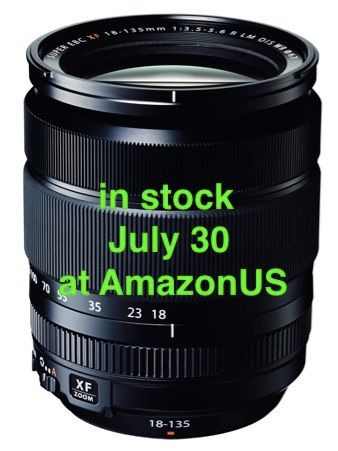
Photographyblog tested the brand new XF 18-135 WR lens. They recommend this lens and conclude that:
“Centre sharpness is very good throughout the zoom range, only requiring the user to stop down by one f-stop the lens to get the best results. Edge sharpness proved to be a little disappointing at the 18mm setting, although it thankfully improves at the other focal lengths.
The maximum apertures of f/3.5-5.6 are on the slow side, although the seven-blade iris diaphragm achieves some appealing bokeh effects none-the-less. Vignetting is practically a non-issue, and chromatic aberrations are only noticeable by their almost complete absence. There is some slight barreling at the 18mm wide-angle focal length, but very little pincushion distortion of note at the 135mm setting.
The Fujifilm XF 18-135mm F3.5-5.6 R LM OIS WR benefits from a fairly fast and pleasingly quiet auto-focus mechanism, generously wide zoom ring and a welcome aperture ring which makes it quick, easy and precise to set this key element of exposure. The lens mount is, thankfully, made of metal and, thanks to an internal focusing (IF) system, the front element and filter thread does not rotate on focus, which is very good news for those using polarisers and ND grads on a regular basis.”
More samples and first impressions at photoxels and danbaileyphoto… and in case you incredibly missed it, make sure to check out also Rico’s first look here.
15 Responses
Is the blurry edge at 18mm, wide open due to out of focus or bad optical quality?
Do you mean on the sharpness test page? If that’s what you call blurry, i wouldn’t dare looking at any other superzoom if i were you. Not to mention the lack of any aberrations in that edge ‘blur’.
yeah, maybe I used the wrong word. Soft edge? Is it because that it’s out of the depth of field?
No it’s the lens. With this much reach the is no way to avoid some field curvature and edge softness. The main thing to look at here is how it is rendered and if it’s bothersome in the image as a whole in practical use. Don’t forget you’re looking at a 100% and there is more to photo’s than that. Also you won’t always be shooting wide-open, and if you do it’s likely meant to isolate a subject in the center.
A little softness like this without any unpleasant aberrations is fine for a superzoom, what you see here is as good as it’s gonna get for any system, so if that isn’t acceptable then it’s not a superzoom you’re looking for. The ‘standard’ kit with a separate tele will be the better alternative and worth the occasional switch.
If you mean the brick walled alley in the sample shots, that’s clearly out of focus 😉
Nice lens, but I’m pinching pennies in anticipation of the 55-140 2.8
I know for many it may not matter but for me the fact the lens is Made in China means I won’t be buying it. One of the big pluses for me is the Made in Japan element of Fuji. In my experience I’ve bought products that have been initially Made in Japan (Lumix G1) and then moved to China, in the Lumix case the tech had moved on, but the build quality fell and was a factor for moving to Fuji (and no coincidence that the GX7 has a higher quality feel again). Every company plugs when something is MIJ, Fuji included write it on the front of their cameras, Canon on their lenses and then get sheepish when they move it to china.
Apart some possible building quality fluctuations (besides the main problem can be quality requirements and control, not location) the real issue is that a company starts selling a product as a Premium Quality and at a High Price, pointing out the incorporation of production costs in Japan as a reason, and some time afterwards they produce them elsewhere and keep the Premium Price advantage as if production costs are the same.
Leica did the same with their T system (APS-C) just a couple of month ago, even without having the high costs at introduction time.
Get the right components and materials, use the right equipments and techniques, train the staff well, implement a demanding quality control system and you will be able to offer the same quality from country A or B, no matter if one o them is Japan or Germany…but don’t justify your price with labour costs there when your choice of production centre is dictated by lower ones, pls…
Darn i hadn’t noticed that. I thought that was only supposed to happen with XC lenses, not the XF range. Oh well, it’s not like the Made In Japan things went completely smooth either though, so anything can happen anyway.
This is the first non pre-production test of this lens. I’m a sucker of image sharpness (OOC). How does this thing compares to other brands within comparable focal range, or better how does it compare (IQ wise) to the fuji 18-55mm by proven evidence (please no theorie or expectations). Maybe to early to tell ?
When you only take image sharpness (OOC) into account, is the price worth it compared to other brand lenses with same focal range ? The latter are much cheaper anyhow.
You do pay a lot for the weather sealing, metal built, and the system as a whole which doesn’t sell by the millions like Canikon does. So yes it’s a premium, but it appears you do get performance in return. Not to mention that the Fuji’s are way more fun to use, and isn’t that the point? 😉
In the end it’s about the whole package, I agree, but for me sharpness parameter is one of the most important ones. So if in the near future more test are published for this zoomlens with the outcome of having very good sharpness relative to its competitors, well then it will be a serious option for me.
Is it on par with the very good 18-55?
Looking at these samples, it’s as good as it’s gonna get with this much zoom range, but less zoom will always be better. Not to mention the 18-55’s big aperture, and stopping down a little. So of course it’s a compromise, as is everything one way or another. If you’re willing to occasionally switch then please do get the 18-55, and then when you do put on a tele it will even go way beyond 135mm. 😉