







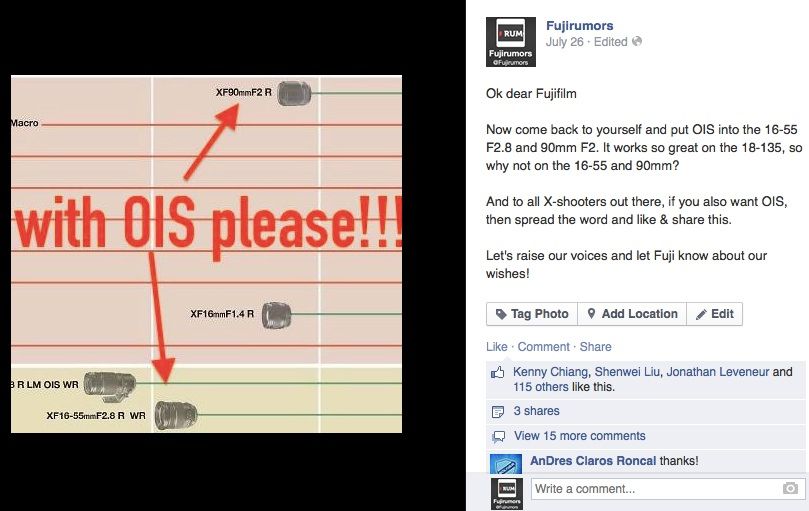
When Fujifilm published its latest roadmap, the big surprises weren’t the new lenses Fuji added (they were all already known since months thanks to the FR-sources), but the fact that apparently the weather resistant XF 16-55F2.8 lens won’t feature the OIS (optical image stabilization) anymore.
I don’t get it. Fujifilm’s marketing is right now explaining us that the OIS in the brand new XF 18-135 is so awesome, that you hardly need a tripod anymore. They show us videos comparing its OIS technology with the one of the Canon’s 18-135 (and the Fujinon wins hands down), with the XF lens taking nice, sharp photos even at 1/4th of a second.
Why should the amazing 5.0 Stop Image Stabilization technology not be included in the XF 16-55mm?
Last week I’ve asked this question over at the FR-facebook page. And most of the X-shooters agreed: no OIS on the 16-55, no buy.
I also wanted Fuji to include the OIS in the 90mm. In this case opinions differ: some say that the 90F2 prime needs OIS too, others want to keep costs, size and weight down and therefore do not want OIS. For example James Kimber, who said: “OIS is a lifesaver for zooms. I like my primes as compact as possible though.”
Personally I’d like to have OIS in both lenses and then switch it on/off according to the situation. But that’s just my humble opinion.
Now, as promised, I’d like to hear your opinion. Make your considerations, feel free to share them in the comments, and finally simply vote the poll: do you want the OIS in these two lenses? Yes or No!
I hope/think that someone in Tokyo will take note of your feedback ;-).
[poll id=”56″]
[poll id=”57″]
123 Responses
Maybe I don’t know enough about the subjects, but what are the drawbacks of fitting a lens with stabilized technology besides price, size and weight?
Those are three crucial points that make or break a lot of people’s decisions to buy a lens… I think this is most likely due to weight as a 24-70mm equivalent with OIS is bound to be heavy, maybe too heavy to balance well with the X-T1.
Battery life, IQ
Battery life, yes, image quality, not really. The technology has been around for a long time and lens designers know how to design with IS. The Leica 42.5 Nocticron is utterly fantastic and has OIS. The canon 70-200/2.8 IS II is probably the best telephoto zoom ever made, the 100/2.8L IS macro is phenomenal. Fuji’s own OIS lenses are excellent optically.
At the very least it limits the possibilities of optical design as OIS has to be factored in, of course that still may work out fine for certain configurations, but it may not always be so simple as i’m guessing is the case here. A lot like Canon’s 24-70mm F2.8L II.
Apparently it was too much of a comprimise so decided not to, assuming the pros who’d buy it would be experienced enough to do without.
Personally i find OIS to be way over-rated in normal lenses, as camera shake is not much of a problem, and if it is the shutter speed is too low for anything with people in it anyway. While high-iso’s just keep getting better.
Besides price, size and weight .. is that not enough !? But yeah like aki has mentioned it’s battery life (when activated) and limits IQ (permanently!).
I try to find No zoom lens with aperture F2.8 wide-angle 16 mm. with OIS.
http://goo.gl/XIaqIa
I have been waiting for the 90 information in a way to decide to go to Fuji. With a 90 f2 instead a f1.4 is no go, never. That is my lens for portrait and at f2 is worthless, at least for me. Disaaaapoinnnted.
Are you factoring in the fact that this is a 135mm equivalent? Canon’s 135mm is also f/2.0.
F2 at FF format. It will, never, give the same result about depth of field and, of coruse unfocus quantity. A 85 1.4 give “almost” the same in APSC that a
135 2 does in FF. A 90 f2 will never approach that.
Then you’re obviously in the wrong place and using the wrong system if you “really” need that look. None of Fuji’s primes match the depth of field of fast primes in FF cameras.
I’m currently using na Asahi SMC Takumar 85/F1.8 on my X-E2, which is comparable to the 90/F2.0 in terms of DOF. It’s a perfect portrait lens imho. Bokeh is already very shallow at 1.8. I don’t think 1.4 would add much value here, except in dim light. But it would make DOF razor-thin. Probably too thin for portrait use. And the lens would be huge, so I’m happy Fujifilm will make it “only” F2.0
…not shallow, I meant deep. DOF is shallow, of course 😉
F1.8 maybe, but F1.4 would be a very different and BIG lens. This one is clearly meant as a compact alternative to large tele lenses, which is exactly what so many (and me) were asking for, and also means No OIS. Honestly at that focal length F2 is plenty, while keeping a decent DoF and wide-open bokeh. To get both eyes in focus you may even use F5.6 anyway, and personally would use it a lot for landscape too.
Of course they might very well do a faster version too some day, but now that they have the fast 56/1.2 already ‘for that’ they’re probably not it a hurry. If anything i’d guess that a true Macro would be first in line, and F2.8.
If you can’t make good images with a 90/2 instead of a 90/1.4, the issue is you, not the lens. There is a difference in a stop of light, but it’s not a make or break, oh my gosh the world is falling difference. (And frankly many people would do well to stop down a bit more…this over blurred world we have now often makes images look crappy because the second eye blends to soup.)
A 90/2 will have the same background blur capabilities as the 56/1.2, so pretty shallow and plenty of blur. I do have a Rokinon 85/1.4 for times I really want to blow out the background, but it’s big enough that I wouldn’t want to carry it daily.
First I do not believe that a 90 1.4 designed for APSC need to be as big as a 85 for FF. Nikkor 85 1.4D is not a big lens and the crop factor can cut in size and weight. And the optical result at f2 will not give that result as if it
was 1.4. But, of course everyone has is needs and taste.
90/2 OIS macro please
Why not a 135mm or 150mm macro ? It would have a longer working distance and a smoother bokeh.
200mm macro was a classic on full frame.
Instead of adding macro to the 90mm, which would make it bulkier and less versatile, wouldn’t it be better to ask Fuji to add a true specialized macro lens to the roadmap ? 🙂
Yes it would be great in the 90
I am in Tokyo and took note of your feedback… but that won’t help much 😀
it’s worth a try … hope they didn’t forget about Kaizen 😉
no for the prime, would make it even bigger and heavier, and primes shouldn´t be big and heavy, especially on a mirrorless camera.
and for the zoom….thats a no for me, too. i tend to use at least 1/125s for people shots to avoid motion blur, so i dont need ois in a short zoom. and you won´t really use any current fuji body for video work either.
Oh, come on! Since when does OIS make a lens SIGNIFICANTLY bigger and heavier? Check the 70-200 2.8 / 4 from Canon / Nikon, the IS/VR vs non-IS/non-VR are the same size and weight. I’d happily carry an extra 50g my lens if it meant it’s usable in a wider range of situations.
The only argument against including the OIS is the price – OIS = an extra 3-400 USD, which is a lot and may take the 90mm f2 over the 1000 threshold, which is something nobody wants 🙂
Long tele already have a big diameter. Medium tele suffer a lot from ois addition.
Look at the sigma 50-150, 150 macro, tamron 90 macro, nikon 105 macro…
What is the point of switching to a mirrorless system if all the lenses are dslr-sized ? Why not buy a pentax k3 instead ?
The 90mm f2 is an opportunity of having a compact tele alternative, smaller than the 55-200, 50-230 and 50-140.
Anyone who chose the fuji X system for its lightweight and compactness can’t consider seriously adding ois to the 90 f2,
Please note that all the ones you described are FF lenses – i.e. must cover a larger circle. That’s why they’re bigger… see the Canon 17-55 2.8 IS which is normal in size for what I’d expect the Fuji to be.
No OIS on the 16-55, no buy!
OIS would be nice for these lenses but it’s no deal breaker for me. It only makes sense in low light situations when you really need long exposure times. And then again there is the risk of motion blur because your subject may have no automatic stabilization 😉
I’m not sure how much OIS compromises IQ, but it definitely makes the lens more expensive and has an effect on battery life. So for me it’s just a nice-to-have feature.
Seen from the mockups the 16-55 (with OIS) is real big, a lot bigger than 18-135.
Paired with the X-T1 the combo looks unbalanced, You get the idea that you need a bigger body ….! Well there are the add-on grips for you could say, but it makes the combo ugly. It needs a X-Pro2 ?
However if Fuji succeeds in lowering the size (not weight which is impossible due to the heavy 2.8 glass) bij omitting the IOS, well I will consider that too.
For Fuji I think they want to make this zoom outstanding to the competition ( APS-C CaNikon/Sigma and MFT Oly 12-40) and have to provide it with IOS.
I’m not in the market for the 16-55/2.8, but am very much interested in the 90/2. And: yes, OIS please! OIS is most useful for longer focal lengths. I don’t see why Fuji’s “OIS is for zooms” rule makes any kind of sense, unless for some kind of technical reason it’s much easier to add OIS to a zoom than to a prime. The fact that the 10-24 has OIS and the 56 doesn’t is already very strange. And the fact that the 18-55mm has OIS while the 56mm doesn’t means that the 56/1.2 is not particularly better for low-light shots of static subjects than the 18-55/2.8-4 is at the (nearly) same focal lengths, which is a rather bizarre outcome in my opinion.
Getting to use slower shutter speeds is one thing, but even more important for me would be to keep the image in the viewfinder stabilized during composition. It’s noticeably jittery when using longer focal length legacy primes on my X-E1, so I don’t expect a Fuji 90mm without OIS would be much different in this regard.
Or, instead of OIS in particular lenses, I would be even happier to have IBIS in the newer bodies, which would work equally well for the already existing as well as the yet-to-be-released non-OIS primes, and also with legacy lenses. I think that might be most economical solution all things considered.
You have a similar situation in the M4/3 world where only Panasonic’s lenses have OIS, and generally only Olympus bodies have IBIS, so if you use Olympus lenses on Panasonic bodies you miss out on any kind of stabilization. But that’s because they’re two separate companies pursuing two separate strategies, and just happen to be compatible with each other. And Panasonic has even acknowledged the undesirability of this situation, and added IBIS to the GX7, even though it’s only useful with Oly lenses!
Fuji doesn’t have any excuse to be divided against itself in this way. They’re one company, not two.
No because ois will make the lenses bigger and drain the battery faster.
No OIS for the 90mm please, or we won’t have any compact medium tele alternative.
16-55mm will be bulky anyway, so OIS or not won’t change a lot.
I would prefer the 90mm with larger aperture (than the predicted f2) instead of OIS, this is a portrait lens, probably most will use it in studio so weight is not an issue (least for me).
The other lens I don’t care about 🙂
The reason why the “OIS” was dropped from the XF16-55/2.8 reference in the new roadmap may be purely marketing in nature, and I would not be surprised if their plan to eventually release a stabilized 16-55 has in fact not changed – they might just have chosen not to mention the OIS function in future lens.
The reasoning is as follows: Fuji has just released the XF 18-135 OIS with top-end image stabilization and need to have their invested R&D and tooling costs paid back as quickly as possible. It is very possible that someone in the company fears that a part of the consumer base will hold its purchase for the even faster 16-55/2.8, especially if it is provided with the same (or better) OIS and WR features. Intentionally removing the OIS mention from the upcoming zoom lens is a way of artificially increasing the technology gap between present and future products (i.e. make the present product more appealing) and thus motivate people to not delay their purchase any further.
I think this is also coherent with the fact that Fuji has pushed the release date for the 16-55 later in their roadmap. They would not have done that if they had not felt that the upcoming fast zoom lens might interfere with the sales and profitability of the present 18-135.
Hold its purchase of the 18-135 for the ‘even faster’ 16-55 ? Eh did you forget about the 18-55 F2.8-4 ? The 18-135 isn’t even relevant to those interested in the 16-55, but the 18-55 might be.
If OIS is in there it’s probably a typo (but note how there are two spaces between R and WR, clearly OIS was cut from there .. seemingly quite purposely). And if it’s not in there i’d guess it would be a size, weight, price and image quality(!) consideration, or even battery life. Just Kaizen.
The 18-55 f/2.8-4 falls in a different category than the 16-55/2.8: It does not have constant aperture, it is not weather resistant, it has a less wide FoV at its shorter end (18mm=76.5° vs 16mm=83.2°), and its design is already more than a years old with an inferior OIS than the 18-135 – in short, it is a “low-cost” consumer-grade lens (but an excellent one nonetheless!), as opposed to the 16-55 which will be clearly a pro-grade product that will have superior features in many departments.
If you check the difference between the first and the second published roadmaps, not only is the introduction of the XF16-55/2.8 delayed into 2015, the release order of the f/2.8 zooms has also been inverted. Now the 50-140/2.8 will be released before the 16-55 instead of after. By its nature, and as opposed to the 16-55/2.8, the longer 50-140/2.8 cannot interfere with the 18-135 sales, the two products complement each others given the large aperture different in the long end of these lenses. Fuji’s marketing department thus had all the reasons to push for theses changes in the new roadmap.
Now, as far as the (apparent) lack of OIS in the XF16-55/2.8 is concerned, I think it would be very stupid of Fuji not to implement this feature in their upcoming lens, especially when Canon already has a stabilized EF18-55/2.8 and is likely to update it soon (Photokina?). Anyway, since Fuji’s roadmaps provide only indications and no firm commitments from the company, I would not be surprised to see further changes in upcoming roadmaps.
You’re saying the 18-135 is closer to the 16-55 (than the 18-55) because it has better OIS and WR, i don’t agree with that at all. And to say about a lens that “its design is already more than a years old” is just madness.
Like it said, i’m sure they have their reasons, and it doesn’t look like they’re doing anything but the best they can, whether we like it or not. Nobody likes delays and comprimises, but they have to be made. The only difference is, Fuji lets us know step by step. And of course they carefully consider what to publish when, and that’s fine by me.
Fuji surely does the best they can, but as all companies, their decisions are primarily directed towards their best interests. Nice thing for us is that in many domains they go beyond what CaNikon offers in the APS-C segment and they don’t leave us (too much) in the dark as far as lenses are concerned – although this is again in their best interest first, since they have to differentiate themselves from CaNicon and Sony.
Oh you’re one of those that considers all charities a selfish act. 😉 Which of course is true, but why should we care, it works.
No, I’m not, and your interpretation of my last message shows that you apparently do. Sure, the Fuji corporation has become a non-profit organization acting solely for the consumer’s benefit 😉
I in fact say the opposite though. Just saying there’s no point finding negative in all the good things they are doing.
The 18-55 is finished, kaput. The 18-135 is the new kit lens and the 18-55 will be discontinued from what I hear. Like they say grain of salt.
Haha! I hear the X-Pro2 will only be available in Ferrari red.
I prefer old Jaguar dark green 🙂
I love those, but maybe a bit too shiny on a Camera. Honestly though i wouldn’t mind it in Olive green a la Leica: http://goo.gl/TbCHGv
Just like The Equalizer’s car. 😀
Nope. The 18-55 is cheaper. Nikon and Canon didn’t get rid of their 18-55 when they had an 18-135 or other 18-* option available.
The Fuji 18-55 is superior in IQ compared to the 18-135. It’s also brighter/faster. Not everybody needs weather sealing (that’s more a marketing flop because in powerful rain everybody can use a rain cover and light rain is not a problem even for non-sealed cameras/lenses)
With a barrel that large, you’d think it would be a no brainer for the 16-55mm to include OIS. Anything less than that is a definite non purchase, and an unforgivable opportunity for Fuji.
What if the omission of OIS on these lenses means that Fuji will jump to sensor-based stabilization with the X-Pro 2? I’m not too sure about the difference in quality but sensor stabilization sure has many other advantages!
It seems like a good strategy IMHO:
– OIS for the consumer zoom lenses which are paired with smaller bodies (= less space for stabilization) and often used as the only lens.
– Sensor-based stabilization for the prosumer/professional bodies where one stabilization system can benefit multiple lenses and especially small primes so you could save quite a bit of money and weight.
Just a thought.
Nice thoughts! Yes, 6 axis IBIS for the X-PRO2 :-).
This would be great but seems difficult. Olympus has sensational IBIS in the Pen EP5 and OMD cameras. But Panasonic’s first attempt in the very Fuji envious GX7 was MUCH less successful (Gordon at CameraLabs has good illustrations). Pulling this off would be a huge coup for the XPro2 and a major differentiator. As “bad” as this might be for my own M43 investment, I hope they do it! 🙂
If OIS is not designed in then I’m not buying either of these
even more important than OIS, the 90mm is Fuji’s best chance for 1:1 macro. pls dun waste the opportunity fuji!
I second that – I’d really like to see a high-quality 90mm 1:1 macro lens from Fuji. Otherwise, I’ll have to fall back on an older manual lens and use an adapter. Proper pro-grade macro and fisheye lenses are the two special glasses that are missing from Fuji’s roadmap in my opinion.
Depends on how you look at it. Rokinon’s 8mm fisheye is available in FX as well as Zeiss’ 50mm 1:1 macro. Even though I love macro, both lenses are really specialty lenses. And Fuji may consider both audiences sufficiently served by third parties for now.
good point – Fuji has certainly sorted out its lens priorities this way.
Absolutely agreed, a 90mm with macro capability is needed more than OIS
I think they don’t have room for it in the 16-55, Canon can’t find room on the 24-70 f 2.8. It’s the f 2.8 makes the back end to big and by the time they put an OIS thats big enough to move it it gains to much girth for the length?
On the APS-C 17-55 2.8 IS USM Canon had enough room for IS.
From what I remember, the argument for not having IS on the 24-70 was always about having IQ concerns (IS does indeed reduce IQ, but then it also allows for sharp pictures in difficult lightning situations).
The poll would be less biased IMO if the second option was split in 2 : “No (that would needlessly increase the price)” and “I don’t care”.
If you don’t care, you should not vote!
But then we won’t have a comparison against the people who don’t care. I agree with him, there should be a third option.
And maybe also “I’m not a optical design professional myself, so don’t have the proper experience to make an educated decision over this” 😉
In an ideal world you would have 4 options : Yes (deal breaker), Yes (Nice to have), No ( Keep price down) and Do not care either way. If the intention is to get Fuji’s attention, that is, but I guess that any design decisions have been taken by now
A lot of people want a good 1:1 macro but I’m afraid the 90 f2 won’t be the one because two things:
-it’s an f2 lens not an f2.8 (all macro lenses are 2.8 or 3.5)
-the ff equiv is 135mm and there are none 135mm macros out there (100, 105, 150, 180, 200 are the common macros on ff)
Fuji is respecting the equivalence when it comes to primes:
23mm is around 35 mm on ff
56mm (that is a awkward focal even in aps-c terms) is around 85mm on ff
Regarding OIS, I think the 2.8 zoom will have it but not the 90 f2. Fuji primes don’t sport OIS. And f2 is a fast lens. But I’m sure that when Fuji will bring the 1:1 tele macro prime it will have the best OIS out there 🙂
http://photobyandrei.wordpress.com/
Just a point of comparison but Nikon does have a 85mm macro lens out there for their APS cameras.
f/3.5
If you use F2 on a 85 or 90mm for macro shots,
you’re doing it wrong. Wouldn’t go below F4.
Considering 90% of macro shots are between f8 and f16 🙂
Not necessarily wrong but that’s another story. 😉
Do you mean you’d rather buy a 90mm f/3.5 macro than a 90mm f/2 non-macro ?
I’m not looking for a macro, in fact i’m selling one (i want what’s on the roadmap). But if i were looking, i would want one that was solely designed for it. A larger aperture can have effect on quality stopped down, or at the very least it costs money, which of course would be way more useful to put into a quality OIS system (also easier to do with a smaller max aperture probably). With macro the tiniest shake can ruin a photo, and the need for use of small apertures mean slower shutter speeds .. so you see the dilemma.
Yes I understand what you mean. I definitely think Fuji should make a dedicated 1:1 macro lens, but separate from the 90mm f/2, which serves an entirely different purpose.
For me a longer focal length would be more suitable for macro.
I was mostly pointing out that there is an APS sized macro at that focal length showing that we don’t have to be too tied into “classic” 35mm focal length equivalents. Let’s live a little and break the rules!
Fuji is not breaking the rules regarding equivalence…
Your poll isn’t really going to give you the full picture, as it only asks if we WANT OIS in those lenses… sure I WANT OIS in the 16-55 f/2.8, but the real question is do I NEED it, or is it a dealbreaker to NOT have it… and that I’m not sure about. I shot with a Canon 24-70/2.8 for years and never felt like I was missing out because I didn’t have IS, mainly because I shoot weddings and events, so pretty wide open and faster shutter speeds. Landscape photographers might have a different answer, but then they have both the stabilized 10-24 AND the 18-55.
I wouldn’t mind having OIS in the 90mm, as it is a lens I’d use for portraits, but also for a little more reach during wedding ceremonies, which are often in very low/poor light. It would be nice to have the assistance of the OIS for those.
^ This!
I’m in the same boat as you. I have the Canon 24-70 f/2.8; I’ve used it for years with no problems during weddings, portraits, etc. Fuji’s 16-55 f/2.8 would simply be business as usual for me. Same with the Fuji 90mm. I can handle no OIS. Yes, it would be nice to have, but certainly not a deal breaker.
The right way, of course, is to have IBIS. No Fuji OIS stabilizes rotation or translation.
I’m not in the market for the 16-55, but I think it would be a huge mistake for it not to have OIS. Yes, it’s a little wider than the 18-55, but for me, f/2.8-4 with OIS is far more useful than constant f/2.8 without OIS, for a general purpose zoom. Especially given the huge size increase the 16-55 appears to have.
As far as the 90/2 goes, I’d like it to have OIS, but it wouldn’t be a dealbreaker. I’ll probably get it regardless. As for making it a macro: I’d be OK with that as long as focus speed and quality at the portrait and distant focus points didn’t suffer. If that compromise has to be made, I’d rather have the 90/2 be a regular portrait lens and them come out with a separate 70 or 90mm f/2.8 1:1 macro.
My two cents:
Stabilizers are a mixed bag.
In lens stabilizers work better than in body stabilizers for specific focal lengths. If you look at the best in body stabilizer available 5 stops is obtainable (with a steady hand) at wide toormal focal lengths but not so for longer focal lengths.
In lens stabilizers are tailor made to the lens specific focal length making them more effective for longer lenses than in body stabilizers.
In lens stabilizers have a down side as well in that the lens will tend to have centering issues (left side to right side difference in sharpness) due to the floating element having a variance in position (even with the stabilizer set to off btw).
With tele lenses the trade off is worth the centering issues because the chance of loss of complete focus when handholding is greater.
On wide to short tele lenses the in lens stabilizers are less necessary due to the shorter focal lengths and the ease of handholding. The centering trade-off is not worth it as much.
This is why Canon and Nikon havent put stabilizers on their 24-70 offerings yet (though i suspect they will due to public pressure in their next offerings).
Is it necessary for either the 90 or 16-55 to have OIS in my opinion no and on the 90 id rather it didn’t.
Btw a note on using stabilizers:
If you are using stabilized lenses and your shutter speed is 1/500 or higher switch off the stabilizer its robbing you of accuity since the floating element is usually out of position because the sampling frequency is less than the 1/500 rate of the shutter speed.
For all the people who are saying image stabilization “isn’t really needed” in this focal length or that: I used to feel the same way until I got an Olympus E-M 5, which stabilizes every lens you put on it. It does make a difference!
My Fuji 35/1.4 and 56/1.2 lenses ought to be at least as good optically as the equivalent 25/1.8 and 45/1.8 Zuikos I have for the E-M 5, and everybody says the sensor in my X-Pro 1 ought to be equal to or better than the E-M 5’s sensor. Yet when shooting side by side under the same conditions, the E-M 5 shots are slightly but noticeably crisper in terms of texture and fine detail in areas such as fabrics, eyelashes, and hair. I have to suspect that image stabilization has something to do with this. Of course, stabilization also is a huge advantage when it’s necessary to shoot hand-held at marginal shutter speeds in the 1/8-1/30 range.
You might have noticed that Canon and Nikon are including stabilization in many of their new lenses, even ones such as wide-angle zooms that might not seem obvious candidates for it. It’s well on its way to becoming a no-brainer, must-have feature that will be conspicuous by its absence, and I think Fuji is nuts for ignoring it.
“Yet when shooting side by side under the same conditions, the E-M 5
shots are slightly but noticeably crisper in terms of texture and fine
detail in areas such as fabrics, eyelashes, and hair.”
Well that could be due to 3 things. JPG, RAW converter, and the MFT DoF. In normal situations there shouldn’t be anything to stabilize that shutter speed doesn’t already handle on it’s own. You can’t go beyond in focus you know.
And as i previously mentioned below: Personally i find OIS to be way over-rated in normal lenses, as camera
shake is not much of a problem, and if it is the shutter speed is too
low for anything with people in it anyway. While high-iso’s just keep
getting better.
Sure there are situations where you could really play with just how far you can go, but overall the vast majority of the shots aren’t bothered by it.
Of course it depends on what kinds of pictures you take, and how you take them. (Leaving aside the armchair theoreticians who like to debate these topics, but don’t take pictures at all!)
But even if I concede that image stabilization is useful in some situations but not in others, the fact remains: If you have it, and don’t want it, you can always turn it off. If you DON’T have it, and want it, you’re stuck. Personally, I’d rather have the choice than NOT have the choice.
Switching the OIS off won’t remove the additional glass. Compared to a non OIS lens, an OIS lens has an additional mobile afocal group and bigger fixed elements around it to compensate for the decentering. Heavier, bulkier, more complex to design and manufacture.
When you make a choice you always give up the other alternative.
Will Fuji shoot its sales in the foot by pitting these two combinations against each other?
1) 16-55mm OIS + 55-200MM OIS, or
2) 18-135mm OIS + Super Telephoto Zoom (OIS?)
Which would you prefer to own?
How would having two really great pairs of lenses to compare, contrast and compete shoot their sales in the foot? Personally, I’m planning to go with the 16-55/2.8 and the 50-140/2.8, but having great options will only boost sales, not shoot them…
Not at all. They are completely different solutions with different uses. The 18-135 provides some additional reach over the kit 18-55 at the expense of cost, weight, and most importantly, aperture. The 16-55 proves a bit wider FOV and constant f/2.8 aperture. The super-tele is something completely different and for a different usage. Users will combine these as needed, depending on their requirements for aperture, reach, cost, etc. BTW, they closely mirror offerings from Canon and other DSLR manufacturers. For me, it’s a clear choice… the existing kit lens and the 120-400 when it *finally* hits the streets. Others more sensitive to constant aperture might opt for the 16-55 instead (OIS issue notwithstanding).
I also posted this on DPR… Take a look at the latest Fuji magazine issue, linked to on this site in the last couple of days or so. Scroll through their lens roadmap until you get to the outline shown as a placeholder for the 16-55. Click on it and you’ll get a description of the lens which includes OIS. I think this is a pretty strong indication that the omission in their roadmap was simply an error on their part. Omitting it for this sort of lens simply makes no sense IMHO.
Well it’s in the name, wouldn’t say it ‘describes’ the OIS. It also ‘still’ claims to be released Winter 2014, while in the ‘new’ roadmap and accompanied press release (in which OIS got removed) it shifted to spring 2015:
http://www.fujifilm.eu/uk/news/article/news/fujifilm-releases-a-new-roadmap-for-x-mount-lenses/
“XF16-55mmF2.8 WR will be available spring 2015”
In the roadmap it has two spaces, and in the press release it doesn’t even have an R. Man they’re really awful at cutting out pieces of text at the last moment.
Yup, very good points. It’s hard to imagine that Fuji is so clueless as to have ignored (or be unaware of) the furor over this issue. It would seem that either a clarification or restatement of that portion of the roadmap would be more than appropriate. At the very least, their Product Marketing folks need to seriously get their act together and resolve these inconsistencies.
The “official” roadmap on fujifilm.com does not display anything (http://www.fujifilm.com/news/n140724.html). If you are right (which I hope) then someone in marketing needs to get the facts straight!!
This is a big sore spot for me with Fuji. They *almost* nailed it with the X-system, but really tripped up by not using on-sensor image stabilization (the same kind that Sony, Pentax, and Olympus use). This technology, which can be licensed from Sony, provides stabilization *of every lens* regardless of whether its a zoom or a prime. Lenses can be designed smaller and will be less prone to electronic failure too.
It’s not too late for Fuji to implement on-sensor image stabilization (and just have it switch off automatically when you connect an OIS lens) but it is, to me, the major missed opportunity they had when designing a new camera system from scratch.
In lens stabilization is superior to on-sensor though.
So says the internets, but does anyone really know this? Rules are there to be broken and times change.
Yes, if you test them you’ll see it’s true. Also, the laws of physics are unchanging, and any likely improvements in on-sensor IS would result from technology that could be implemented in in-lens IS and make a similar improvement.
If taking the OIS out means the 16-55 can have a smaller filter thread, I’m all for it. Weren’t the first prototypes like 77mm? They should make it match the 50-140 at least.
62mm would be nice…
Not having OIS means a smaller lens. Also ois is known to degrade picture quality.
Myth. Look at the sharpest lens offerings from Nikanon. IS zooms in both cases. Yes, $2500 IS zooms but IS zooms nevertheless.
Size and weight are legit concerns.
I don’t know what the relative trade-offs are for in-body stabilization, but I’d be really interested to see that technology in future Fuji bodies. They are teaming up with Panasonic on the organic sensor…why not on IBIS?
The IS on my 17-55 Canon was one of the reasons why I hesitated to go FF for a very long time – no IS on the 24-70 2.8, no buy.
For me, having some optical image stabilization on an everyday zoom is essential. I don’t want to carry a tripod when I’m on a city trip, just in case I wanted to take some photos inside a dim church (just as an example).
So not having a OIS on the 16-55 2.8 would be a showstopper.
For the 90mm, from my point of view OIS isn’t as essential, I would probably mainly use it for portraits in adequate lightning and/or with a tripod anyway.
The newer 24-70 f4L IS has stabilization. 4 stops stabilization and it’s compact. F4 on ff is like f2.5 on Canon aps-c so you could still have more control over the dof. Also the 6d has more than one stop advantage vs. the 70d in iso terms (at least one and a third) so there is no problem with f4 on ff vs. f2,8 on a crop Canon body.
http://photobyandrei.wordpress.com/
The whole future part of the road map for x-series is rather anemic … I would guess that Fuji is working on something else, hopefully a new mount, because its also possible that they focus on some other part of the business which might be good for them … not for us.
Anemic? Two pro-grade, fixed aperture zooms and two primes to fill out the already stellar prime lineup is anemic? And that’s not even counting the super-zoom…. I mean, they haven’t announced any tilt-shifts or fisheyes, but at this point they have all the major bases covered, and in pretty decent time (though I could use that 90mm f/2 right NOW).
OIS is absolutely mandatory for everyone but those who shoot inside studios or plan to carry tripod everywhere. 90mm is a long lens, I think a short prime does not really need an OIS but something as long as 90mm on APS-C def. needs to have OIS. It’ll be useless without one under most circumstances, I can just buy a cheap old manual Nikon lens and get similar results if I HAVE to carry tripod with me
Well, that’s a bit of a hyperbole. I’ve shot with 105mm both on APS and FF cameras without stabilization and it wasn’t useless. Even on film.
I had old Nikon 105mm on my D5100, used it extensively and loved the results but I would not spend $600-900 on a new lens that didn’t have OIS. Longer lenses can give you blurry results while shooting landscapes after say 5pm? I guess when I said most circumstances I should have mentioned I like to shoot after hour landscapes and do a little street photography after Office.
OT:
135mm (90) and street photography,in the same sentence,doesn’t sound good,at all.
And why is that? You can just shoot people from a bit far if you use tele lens, makes taking candid shots that much easier.
Did you take any photographs before the advent of image stabilisation? Were they mostly useless?
Nope, used old legacy lenses, they are brilliant. Not sure why I would want to splurge $900 on something that doesn’t offer OIS when I can get an awesomer/faster legacy lens for $200 (or less).
“It’ll be useless without one under most circumstances”
3 of the nicest portrait lenses I have used have no OIS: Canon 135L F2, Nikon 105mm D.C., Canon EF100mm F2. A 90mm lens on APS is like a 135mm, AF is more important than OIS.
To each his own , i guess. I love manual lenses and don’t miss AF as much as I miss stabilization on tele lenses.
No OIS no buy for me. Really can’t imagine why Fuji would add this so called amazing OIS in their WR superzoom but not in their ‘flagship’ 2.8.
in short +1
I hope they don’t elect to remove this from the 16-55 f/2.8. Yes, eliminating it reduces size and weight a bit (though not nearly as much as some might think), but it also eliminates a significant competitive advantage Fuji has over Nikon and Canon, neither of whom offer this on their 24-70 f/2.8 pro zooms.
Image stabilization does make a difference in many shooting situations and adds shooting flexibility. Olympus’ 5-axis IBIS actually works on all lenses, zooms, primes, or legacy…and it works very well.
I think as time goes on IS will become more commonplace, actually.
I voted OIS on the zoom, and no OIS on the prime.
I’m a Fuji fanboy, but it should be pointed out that the Canon 18-135 is also almost half the price of the XF 18-135. Not exactly a fair comparison.
Fair? Or it shows exactly what you get for paying twice the amount.
Wouldn’t you want to know? 🙂
It’s a good comparison, I just believe the price should also be mentioned. Only saying the XF outperforming the Canon is like saying a $90K sports car outperforms a $50K sports car.
You should give people a little more credit, things aren’t priced the same, that’s the first thing anyone looks for .. it’s no secret. People end up looking at that video because they already are doing research, and it’s not like this video is immediately going to stop them in their tracks. It shows .. the difference .. they were looking for.
With the fast constant 2.8 aperture and the insanely good high-ISO performance on the Fujis, I just don’t think I’d miss OIS that much. I’d happily trade it for other things like a simpler, smaller and more elegantly designed lens. I don’t know that those are direct trade-offs–I’m not an engineer. I’m just saying that there are many things I want more than OIS — especially on a lens that doesn’t go longer than 55mm. I’m just *that good* handheld, I guess…
Don’t care about OIS in the 90mm lens but it would be fantastic if this will get a real 1:1 macro lens
The Zeiss 50mm 1:1 is pretty real. It may not be the focal length you want, though. But there’s almost no chance the 90mm will also be macro.
Maybe the XT2 will have IBIS so they will move to all non-OIS Lenses? JK