







So what do you want first, the bad news or the good news? Let’s start with the bad news.
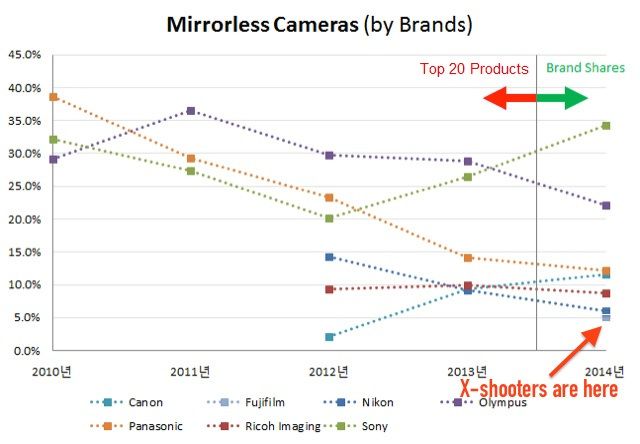
But before we start, just a quick note about the graph. For the first time, BCNRanking decided to base their statistics not only on the Top 20 Products, but they consider the “Brand Shares”. Therefore, in the graph above made by DicaHub, you can see it divided in two parts, the Top 20 Products (until 2013) and the Brand Shares (in 2014)
The Bad
According to the latest BCNRanking, the Fujifilm mirrorless market share is of just 5% (in Japan). Ricoh, Nikon, Canon, Sony, Panasonic and Olympus sell more mirrorless cameras than Fujfilm.
The Good
But let’s put the figures into the proper context. While it’s true that Fujifilm is still the smallest (but coolest 😉 ) CSC system in this ranking, there are signs of hope in 2014. Let’s take a look at the 2 different rankings… and keep always in mind that these numbers are for the Japanese CSC camera market only (which is the biggest mirrorless market, though)!
Also, keep in mind that more market shares doesn’t necessary mean more profits.
THE 2010 to 2014 YEAR RANKING
(see graph above)
Fujifilm didn’t appear at all in the BCNRanking until 2013 included. But now, in 2014, the X-series gained 5% market share. Looking at the evolution starting from 2010, we can see how only Sony, Canon and Fuji are increasing, while Olympus, Panasonic and Nikon are decreasing.
THE 2014 MONTHLY RANKING
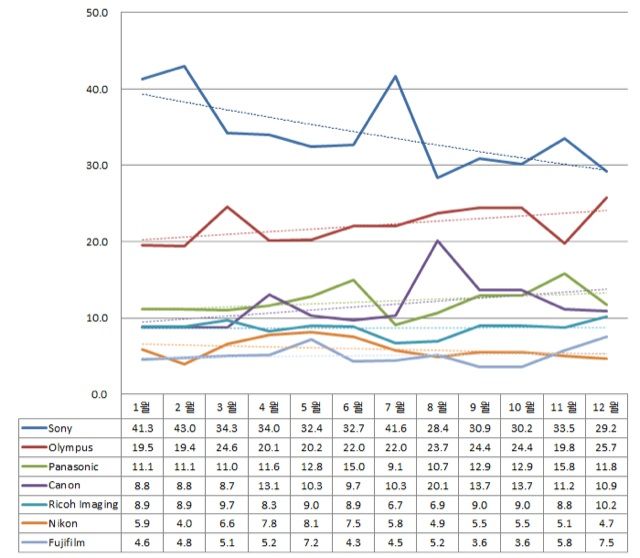
(see graph at the bottom)
If we take a closer look month to month ranking in 2014, we will see different results. In this ranking Olympus, Panasonic, Canon and Fujifilm are increasing, while Sony and Nikon decreasing.
Interesting also to note that Canon said that their goal is to get the biggest mirrorless shares until 2017… so they will soon attack aggressively the CSC market. A Full Frame CSC-Canon is rumored to come… and more. Just check out the CanonWatch rumor section to read more about it.
So these are the statistics… now it’s up to you to make your considerations in the comments.
_ _ _
the 2014 Month to Month ranking
59 Responses
As a long time Mac user who has seen constant anxiety over marketshare, let me just put it out there that marketshare isn’t really important. What matters is that Fuji’s imaging devision is profitable. You can have 99% market share and make no money or 1% and make all the money. If you want a quality products that focus on the needs of enthusiasts, as Fuji does, you’re never going to get massive market share because we represent a tiny fraction of the image taking public. But it doesn’t mean they can’t be a very successful business with great products. The only negative for us is it means prices will always be on the higher side.
true
But maybe in this case profits and market share are associated. I remember a Fuji Manager saying at photokina that “in the last 6 months I have become more optimistic”. So it seems that, with Fuji finally gaining more market shares in 2014, they also were able to make more profits.
That comment makes me wonder what Fuji itself was thinking about the viability of the X-System before the X-T1 debuted. How close were they to killing the whole thing? Maybe they weren’t even considering it but I wonder…
It also makes me wonder about the wisdom of an X-Pro 2. It seems safe to assume that at least some of the X-T1’s success is owed to its form factor. I realize that a great number of people who frequent this site LOVE the rangefinder form factor but if 90% of enthusiasts prefer a DSLR-style body it seems like a waste of resources to develop an X-Pro 2 instead of an X-T2.
Well, using this logic you could also realistically argue that being in cameras period is a waste of resources for Fuji.
Near as I can tell, Fuji is slowly and steadily trying to build cameras for enthusiasts, and is hoping to solidify their reputation in that market, even as snapshooters continue to rely on smartphones from now on.
While this approach may cost Fuji some capital in the short to mid term, if they’re playing the long game they may be hoping to follow Leica’s model … but from a Japanese perspective.
Whole industry is in shakeup right now, so it’s hard to know where the chips are going to land with the various manufacturers. Just to add some perspective, here’s how the big imaging players stack up in terms of assets as of July 2013 (from biggest to smallest) >>
Sony = $160.3B assets
Canon = $45.7B assets
Fujifilm = $32.4B assets
Olympus = $11.6B assets
Nikon = $10.3B assets
Sony is obviously the 800 pound gorilla in the room, but they’re a teetering giant because their diverse electronics industry is getting hammered: the iPod killed the Walkman, the Korean electronic giants have stolen their market in televisions and other consumer electronics products, the Internet is eroding their gaming platform, and their TV and motion picture division is rapidly being disrupted in the same way that is has been for other major studios and broadcasters.
Canon’s imaging division will likely shrink in size, but nonetheless remain a major player. They’re diversified in other areas, so while it will hurt, they will survive.
Fujifilm is heavily diversified, and cameras are only a very small portion of their company, given their involvement in satellites, broadcast equipment, cinema lenses, cosmetics, pharmaceuticals, etc … so financially they can afford to invest in steadily build their imaging division, if that’s what they want. And judging from their official comments in 2011 — that their goal is to become one of the top 3 camera manufacturers in the world — that’s indeed what they want.
Olympus is one of the world’s top players in medical-optical-imaging instruments. Very lucrative business and even if they abandon consumer imaging completely, it’s not going to hurt them all that much. Rumor has it Olympus shareholders want the company to get out of cameras altogether.
What’s perhaps most troubling here is that Nikon — also being the least diversified in terms of product (cameras account for over 80% of their sales) — are the most vulnerable to a severe downturn.
The interesting thing about the Mac analogy is that Apple thrives based on the enormous profitability of the iPhone. Without it, you would be right to worry about the Mac’s long term viability. (I’m not suggesting that Macs are not profitable; only that they are not the reason Apple is a corporate juggernaut.) Perhaps Instax will be Fuji’s “iPhone” though I’m not nearly as confident in the sustainability of this market.
The Mac has been highly profitable for over a decade now, it’s just been eclipsed in overall profitability first by the iPod and then by the iPhone.
Fujifilm does a lot more than only cams..
This probably has to do with the fact that Fujifilm have their strength in the high end market. I suppose the large volumes of mirrorless cameras that are sold are more at the X-A1 level, which is obviously not Fujifilm’s focus. Don’t know about Japan, but if you walk into a professional photo store here in Europe these days, they usually have sections for Canon, Nikon, Fuji, Sony. So unless Canon/Nikon turn everything on its head at CP+ with a mirrorless solution that supports existing lenses, I think Fujifilm should be in much better shape than this graph would suggest.
Also, the chart would likely look vastly different if you looked at lens sales. The largest chunk of the mirrorless market in Japan are entry-level cameras aimed at women, and that demographic obviously does not buy much in terms of lenses, just like their male counterparts mostly stick to the kit lenses with entry-level DSLRs. And even if Canon/Nikon really entered the market now, Fujifilm would still remain the manufacturer with the biggest and best set of dedicated lenses for at least two years. You just don’t buy a mirrorless to put your existing 24-70 f2.8 on it, unless you are just looking for a small backup camera.
With a6000, Sony killed. Compared to that, X-E2 is overpriced and slow with large zoom lenses, E-M10 lacks OSPDAF, the same with Pana GX7, Pentax Q and Nikon 1 are jokes with P&S-class sensors (RX100 killed them all 2.5 years ago), Canon M and M2 are low class only with barely working OSPDAF…
The most surprising here is Olympus, by the mid2013 with E-M1 they already had well-working OSPDAF, why not put it everywhere (in E-M10, E-PL7, E-M5II now)?
I would bet you a beer that 90% or more of the people represented in that graph above have no idea what size sensor is in their camera. Gear nerds are not even remotely representative of your typical camera buyer, or even your typical enthusiast photographer.
you’d lose that bet. People that don’t care what sensor size they have in their camera are happy using their iPhone. The reason to buy anything other than a smartphone is because you care about sensor size.
Nonsense, there are a myriad of reasons for wanting a dedicated camera that have nothing to do with sensor size.
People who do not use phones or superzooms with 1/2.3″ sensors.
Is this market share simple based on the number of CSC bodies sold.
If so that there are some things in Fuji’s favour not taken into account:
1. The best selling Fuji CSCs such as the X-T1 are high end models, with high price tags. Unlike some of the other brands like Nikon, Canon and Pentax.
2. Fuji probably make a lot more on CSC lenses than some of the others, as their buyers are more likely to have several lenses per body.
3. the x100 series is obviously not included, even though it’s obviously a much more expensive and high end camera than many of the cameras that are included.
you got sources for these claims? looking at BCN data as of at least this past week – the only Fuji’s I see there are X-A1’s.
The X system is for people who know what they’re doing, which means that its “mass market share” and “prosumer market share” gonna be totally different.
This is a good point – when I look at this chart as is, my only thought is that Sony won, and I should fear for the continued existence of the Fuji X system.
Sony seems to do well in their camera division. But overall Sony isn’t doing so well financially.
Sony is winning in the short term but they’re competing in a space that is missing a serious entry from Nikon or Canon. I don’t doubt that Canon could be leading the race in a few years if they pull their corporate head out of their arse and release a system that is not limited by a desire to protect their DSLR line.
isn’t it obvious why? Instead of revisiting 1982 Sony are looking forward, built a small full frame camera, several in fact, you have your choice of insane low light capability, insane resolution for half the price of a D810, or IBIS. Meanwhile, what has Fuji done? Same old crappy X-trans 16mp sensor!! It’s really not surprising Sony is kicking Fuji’s butt.
“The X system is for people who know what they’re doing”
LOL, very proud.
So you are suggesting people choose other brands without knowing what they are doing?
The simple truth is, there are always lovers and haters for each brand. When in love you feel you know what you are doing but that feeling is so commonly shared among different markets.
when (almost) everything costs 1000$, fuji is definitely not aimed at mass market and atleast for now wont capture a massive market share. as compared to the daily sub 300$ m43 cam sales and the nex 3 from sony.
but just like apple, when fuji releases a new cam thats a step forward, their older cams can take the spot of the ‘cheaper’ option (just like iphone 4/5) and gain some more market. Just needs time.
If Fuji was less conservative and, in addition to its high-quality APS-C system cameras, developed a full-frame X-Pro-like system camera (with a fast prime 21mm, 50mm, and 85mm at release) with 24 or 36 mps without an AA filter, but with a Bayer sensor (many question, or don’t like, the X-Trans Sensor), they would gain far more market share. That would give customers the choice.
Until they have the organic sensor, they should also introduce a Bayer sensor alternative for their high-end APS-C line (an X-T2 with a Bayer sensor), as that would give the customers the choice between X-Trans or Bayer (neither is optimal, but choice is good ~ and Lightroom/Photoshop users will be comfortable with the system). In addition to my DP Merrills, I use an X-Pro 1 with several lenses (Fuji’s lens lineup is very good, and nearly complete – need a 300 or 400mm, a 1:1 macro, and some tilt-shift lenses), but I have to admit, if I pixel peep, the X-Trans sensor does produce some artifacts ~ thank goodness they aren’t visible at normal view. So, I would consider a Bayer sensor X-Pro 2 without an AA filter.
Now that they have developed the system, give the customers the option between unique (X-Trans) and standard (Bayer) sensor cameras for the APS-C line; and, start developing a high-quality, larger sensor system (either full frame or (even better) medium format). I would be more excited about a medium format system, but it would cost a lot.
I have to admit that if Canon came out with a killer mirrorless system in the near term I would consider dumping my Fuji system and going back. It’s not the lack of full frame for me. First and foremost, it is concern over the quality of X-Trans conversion in the Adobe workflow. But It is also concern about the ability of Fuji to keep up technologically. It is the feeling that my Canon bodies just feel more solid and refined. And, frankly, I have no concern about Canon’s long term viability.
That said, I have not forgotten Canon’s propensity to bilk its customers for every possible dime, providing the very least they can get away with in terms of innovation and upgrades. I do wonder if this isn’t coming back to bite them. They finally seem to be acknowledging the gross inadequacy of their own sensor tech.
In the end, I guess I doubt my own hypothetical. I don’t see Canon trying to compete for the enthusiast market in the same way that Fuji does. But it will be interesting if they do.
Yes, that is the problem ~ there is no definitive choice right now. Fuji has a high-quality APS-C mirrorless system now, but it is hindered by its unique sensor (personally, I have gotten around it to an extent by using the in-camera converter and then minor adjustments in Photoshop/Capture One); Sony has full frame mirrorless cameras that are limited in lens selection and crippled by shutter vibration issues (A7r) and lack of uncompressed RAW files; and Canon/Nikon don’t seem to care about mirrorless cameras at the moment.
If Canon were to introduce a full frame mirrorless system with some high-quality fast primes and no AA filter, I would consider buying one. However, they still seem focused on the same-old, same-old, with ugly modern designs. Personally, I prefer aperture rings on lenses ~ if my EF 70-200mm f/4L had an aperture ring, it would be fantastic on my X-Pro 1.
>crippled by shutter vibration issues (A7r) and lack of uncompressed RAW files;
Have you actually used one of these cameras? The above are things that are incessantly harped about on forums, but in practice, I’ve never had the slightest issue with either.
In-camera conversion, then PS/C1? Sounds like you should ditch digital altogether and switch to large format. You obviously have way too much time to spare.
It takes less than 3-5 minutes…
isn’t that what being an enthusiast is all about. If it were simply a matter of efficiency the D810 or 5DmkIII would be a far better choice.
Using scripting it’s pretty simple and fast, use a mac, it has the ability to script any workflow.
Please pour a magical balm of your infinite wisdom onto warts of my ignorance… how does one script an in-camera conversion using Automator?
The reason that I abandoned Canon years ago to go Nikon was Canon. They could never reconvince me and I found there stuff more and more getting overpriced. On top of that, in most European countries the service org is completely outsourced and having a terrible reputation (I dealt once with them, boy, what a pain). Look how much Canon DSLR owners go over to a (small) brand like Fuji. I don’t fully hear and see the same story from Nikon owners around me. They mostly like their F-stuff for a reason, kept if on often for more than 30 years. I know numerous people that owned a F/F2/F3/… to go D100, D70, D700 and continue the track. And yes, Nikon has made a few mistakes (likely it was not even them, but a subcontractor), but 55 years of lecacy glass, that does count. That’s one reason why I believe more in a Nikon CSC system than in a Canon one.
I wanted to kick-out the Fuji X system quite a few times – for very decent reasons – but I’ve come back, and see: now I’m a very happy, satisfied X-T1 owner. When National Geographics recommends the X-T1 as nr1 travel camera and war photographers like Eric Bouvet use it as their principal tool, who am I to start further discussions. When I see that professionals who worked with anything from Nikon, Canon and Leica, like the X-E2 & X-T1 so much, there must be something special. Revisiting Fuji made me think, pixels don’t make pictures, you do, and in any premium camera on the market since the last 3 years, there are enough of them to make even large prints look perfect. Fuji gallery-size & quality prints look in particular very fine, somehow, for reasons I cannot fully explain. Indeed the current X-series won’t please the eternal pixel-peepers – they should better start saving for a medium format solution after all as no mainstream, affordable camera will ever deliver enough detail for them.
Eric Bouvet uses a 4×5 camera. Maybe the X-T1 as a light meter 🙂
Take a look at this…
http://vimeo.com/89595275
http://audiovisuel-eure-et-loir.fr/la-tempete-ulla-aux-fujifilm-x-e2-et-x-t1/
And he is very serious about Fuji as a report tool. Also in the French magazine Réponses Photo – Hors Serie No 19 – he’s explaining which kind of material he has been using over the years. He went apparently over from Nikon to Canon, from Hasselblad & Leica M to Fuji X. His report on Kiev was made with Fuji X +… a Linhof Technika 4×5. (he seems to own about 5 of this kind of technical cameras)
Very instructive. Thanks for sharing! And you are obviously right. If it is sufficient for this guy it ought to be sufficient for most of the people on this forums…
A storm is coming. A big storm. A perfect storm: one of disruptive technology (smartphones and their convenience), market saturation, IQ sufficiency, and a failure to react fast enough or solve the real problems photographers face (aka not more megapixels).
The Japanese camera industry is about to go through it’s biggest shakeup in over 70 years. Many will collapse. Some will merge. Expect massive attrition. Probably only two or three camera companies/imaging divisions will remain standing in a few years times … and they’re likely to be smaller than they were in the past (think 1970s size).
Or, as Tom Hogan wrote on Thursday, it’s an extinction level event >> http://www.dslrbodies.com/newsviews/panic-is-setting-in.html
One glimmer of good news for Fuji X shooters in Hogan’s piece: “Fujifilm and Ricoh at one level don’t care, as cameras are such a small piece of their overall businesses…”
True.
If I were to look into a crystal ball, Nikon and Canon will survive, but as much smaller entities (particularly Nikon) as I mentioned above. Fuji will continue to carve out their niche amongst serious photographers, I believe. Leica will continue to own the luxury camera market. But I expect Olympus, Panasonic and Sony will all be gone within a decade … though it’s likely Sony will remain manufacturing sensors. (Sony declared bankruptcy last February; the company in its current iteration is dying, and will likely retool with parts supplying being part of their business.)
Ricoh, Pentax, Samsung? No idea what will happen there, though a collapsing market isn’t likely to bode well for a Korean manufacturer trying to get their imaging business off the ground.
Fuji would probably do better staying with 3-4 cams only but making them better and delivering more and better features, eg. AF, DR, configuration, RAW converter, not cheatong with ISO accuracy, fixing smearing, magneta cast and foliage, etc. Who needs bulky X-30 with tiny sensor or Q2 in smartphone era? Give best you can make: one RF styled (with Bayer), X-T1, X-100, and X40 with 1″ sensor + MF with Bayer.
What we can expect from Fuji for the CP+ show next month? Any interesting offer? I am affraid only a few point-and-shot cams and the CP+ show will take up other camera makers.
I love these cameras. Any chance of a full frame? I’d like to buy a full frame. I hate crop
The only way Adobe is going to fully support the X-system is if Fuji increases their market share and the only way Fuji will increase their market share is if Adobe fully supports the X system. There-in lies the problem.
Nooo, there are soooo many great converters out there! People who want to use Adobe are just lazy (at least according to DPR Fuji X forum). So can’t be that. It is just you have to be really special to use Fuji.
You need the to special ability to ignore that the in camera conversion looks better than any of the converters out there.
That’s not true anymore; and has not been for a good while; Silkypix
does a superb job; LR 5.7 has a very good algorithm which can be used by
means of the detail slider pushed to 100% (trick found on the Internet)
Darkatable, Rawtherapee, Iridient ….
No.
My problem is that Lightroom is, IMO, the best DAM available on the market. However, their RAW converter for X-Trans sucks, so there’s a bit of a conundrum, because LR has arguably the best set of built-in editing features overall, and great photo management. While other software like Capture One Pro 8 are arguably better in a number of ways, they still don’t offer as complete a package as LR, and you can arguably get more work done, quicker, in LR.
Even with its gimpy X-Trans RAW converter, it’s still worth considering for a working photographer, and amateurs.
There are other excellent DAM tools available. http://www.idimager.com/WP/?page_id=20
Adobe would first need Fuji to drop the X-Trans sensor. They will when they upgrade beyond 16mp.
That’s not true anymore with LR 5.7 setting the detail slider (if memory serves) to 100% forces LR to use an algorithm very well suited to XTrans.
I’ve not been liking LR for a very long time but Apple forced me into a new direction. Looking at both the RAW-support of Nikon, Fuji and a few other cameras I used in the past – I made the tour of all convertors & image managing tools on the market a few times. Yes, indeed, there is better conversion software than Adobe but when I also put strategy in the equation, it didn’t make sense to look at sidekicks like Iridient, Rawtherapee, Photoninja or Silkypix. For the same reason, I stopped thinking of C1. It’s an excellent tool, but I’m afraid in the longer term they’ll not be able to cope with Adobe’s supremacy in this market. When I compare the extremely crappy LR 4.X support & the current 5.7, I’m no longer complaining. 5.7 is decent, in particular when you take the time to do a bit of tweaking – see http://petebridgwood.com/wp/2014/10/x-trans-sharpening/ – an excellent article to read. The only thing I still find a bit complicated are trees and branches – somehow the result is often looking very artificial.
No chance. If you want 35mm format you’ll want a different brand.
I think the Q2 and A2 are it. Nothing else till later this year.
I believe that’s called a Sony A7.
what a load of crap, Sony didn’t declare bankruptcy at all. sony make the damn sensors that Nikon’s cameras use, and they make very high end video equipment. You’re forgetting that most of the companies you list do a lot more than just little mirrorless cameras. People are always predicting the end of the world like this, just as they have said the same about MSFT for decades. You forget these companies restructure, diversify etc. It wasn’t that long ago that Canon, Nikon, Olympus, Leica etc (and Fuji) made film cameras. Nobody, especially you have any idea about what the photography market will be like in ten years. smartphones will obviously, are obviously, eating the compact camera market, but that’s just a small part of the business. The pros will buy nikon and canon forever. The only way sony will get any of that action, is by making the electronics, just as they have for decades, they make the best sensors, and the imaging pipeline electronics and Canon and Nikon will make use of them so they can focus on what they do best, sell lenses and pro equipment. The hobbyist/enthusiast market will be fought over by the low end DSLR and high end compact cameras (like the fujis). Who will win there nobody knows. My vote goes to the small full frame Sony only because they are trying so many innovative ideas, they have the best low light, the highest resolution, the biggest sensor IBIS etc etc. Maybe it will be fuji with their retro styling and great lenses. It’s impossible to say – consumers are fickle and unpredictable.
Baseless hyperbole and ignorance are poor substitutes for facts. I suggest you do some more research before commenting, e.g. >>
“One of the world’s biggest electronic giants, Sony, declared itself bankrupt today. Speaking in Tokyo a few hours after the filing, Kazuo Hirai said the Sony restructuring plan was ‘tough but fair’. He acknowledged that Sony stakeholders – its parts suppliers, dealers, debt-holders, shareholders, workers and retirees – were making tough sacrifices to keep the company afloat. ‘Building a leaner Sony will come at a cost,’ he said.
Sony is the fourth largest corporation ever to go bankrupt behind the investment bank Lehman Brothers, the telecommunications firm WorldCom, and GM.”
http://www.theguardian.com/business/2014/feb/08/sony-bankruptcy
Bankruptcy, of course, isn’t the same as going out of business; it’s a means to protectively restructure. But it is indicative of a company that is dying, according to many analysts of shifting trends and disruptive technology, including Robert Tercek.
Pride has nothing to do with it, it’s a simple fact. Sad fact sometimes. For example, imagine asking your non-photographer friend to take a photo of you. All else being equal, which camera in his hands would have more chances of capturing the sharp shot, Fuji X or Sony?…
Seriously, when we’re talking of cameras that are smarter than their owners, Sony wins hands down. Fuji is more expert oriented. Perhaps even a little too much by today’s standards.
There is nothing crop about an APS-C sensor… just like there is nothing crop about a full frame sensor with regards to a medium format sensor…
These graphs confirm what we have already seen in other graphs. Sony has taken the lead this year in mirrorless systems and that lead is only going to increase this year with more bodies and lenses planned. M43 is declining although it remains quite big, certainly compared with Fuji. Fuji has its own cozy comfortable niche market but eventually it will be forced to go into larger than APS-C sensors. As long as APS-C remains profitable though it will be reluctant to do so but over time IMO it will economically be forced to do so.
Sony has always had the lead in mirrorless, it hasn’t just taken it this year.
Micro 4/3 has maybe 5 or 7% of the entire interchangeable lens camera market, not really quite big.
Fuji has, what, 1 or 2% of the interchangeable lens camera market, one that is not profitable and not growing, which is not exactly what I’d call either comfortable or cozy.
I’m glad Fuji is still in biz. They seem to do it by those screwy Kitty cameras making a big impact on the bottom line. I don’t care how they do it, the Fuji is an important camera to keep alive. It is the only option for a small cam with a shutter speed dial.
Even if Fuji cam is just break even, the parent company should keep it alive as a service to photography. Much of what we do is not for $, it is for love of freezing time. So it should go for parent Fuji with its offspring.
About half of this project was shot with a Fuji X and some with Leica M240. It was very hard shooting there. It is as dark as an old ‘wet darkroom’ was with the red safety light on.
http://dewallenrld.tumblr.com/
Here is the list of things Fuji needs to develop.
1) FF Fuji R-M 28 to 36 mp organic Leica rangefinder knockoff in the $2500 to $3000 range. If you want to make a few lenses fine If not enuf out there already. What we don’t have is another option to the bloated, sickly priced Leica.
2) Increase the current X sensor to 28 mp organic.
3) A Fuji M43 with shutter speed dial – 24mp organic.
4) A FF 6mp 6 x 6 back for the old film Hasselblad’s in the $2500 range.