






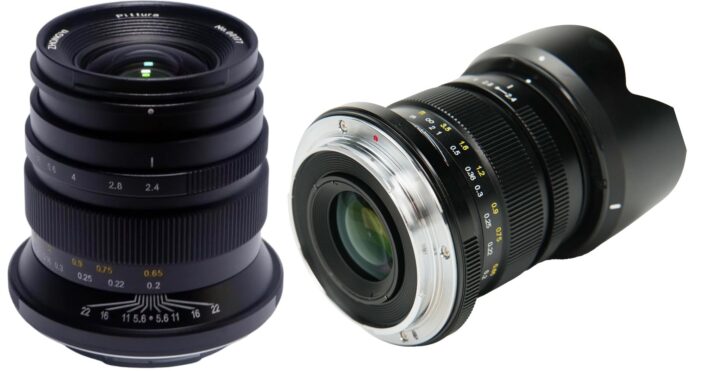


The new firmware for the Zeiss 12mm and 32mm is available here. It adds compatibility with Phase Detection AF.
On the FR-facebook wall Mike shared his first impression of the new firmware: “I have both lenses. For 2.8/12,AF speed is already moderately fast before update. It is a bit faster after update, but not remarkably faster. For 1.8/32,AF speed is a bit slow before update. It is now noticeably faster!”
At BHphoto, AmazonUS and Adorama the Zeiss lenses are still available at the discounted price of $720 for the 32/1.8 and $999 for the 12/2.8
The permanent price drop could indicate that the Touit lenses for Fuji X-mount are not selling well. I’ve heard that Zeiss will focus to produce lenses for FF CSC and DSLRs in the next time… so we shouldn’t be holding our breaths on any new Touit lenses in the near future (except for the 50mm 1:1 macro coming this spring).
and thanks for telling me via FR-facebook of the new firmware, Stefan and Mike.
Zeiss Touit 12mm [shopcountry 13645]
Zeiss Touit 32mm [shopcountry 13646]

37 Responses
No LMO support. Quite disappointing.
Who cares? JPG is anyway for low quality output …
I agree. Would personally never use jpg for those sorts of pictures. But it’s sloppy to not support it. It’s not a knock of chinese copy brand.
another lame raw supremacy reply…
Perhaps if Zeiss hadn’t chosen two of the most boring possible focal length/aperture combinations for their first lenses they may have had more success. I can’t imagine wanting to buy a 32/1.8 when I can get a 35/1.4 that’s first party and good.
The 12/2.8 was kinda tempting but 12… I’ve never been able to reconcile 12mm on APS-C for some reason. Give me 14, I get 21mm. Give me 10 or wider, I get that stretch. 12 seems like they just gave up too soon. If they had made a 10mm prime it would’ve sold so hot.
The 50 macro, though… that’s got a distinctive place in the Fuji system. Since Fuji decided not to make a true 1:1 macro lens, there is a genuine reason to be interested in that lens.
Yep, my sources indicate that warehouses are full of X-Mount Touits. As for the 55 macro: Why would I want to buy one w/o LMO support? Diffraction plays a major role in macro photography, as users tend to stop down quite as bit.
Probably a contrarian — but I happen to love the 12mm. Just enough wider than the 14mm to suit me, and of excellent optical quality.
Yeah, the last 100+ years of macro photography was just awful without LMO 😛
You realize LMO is just selective sharpening right? Basically what DxO Optics Pro does for all the cameras/lenses it supports. Software can not “fix” diffraction, only attempt to compensate for it. And no amount of LMO will double your magnification coming out of the 60mm lens.
The point is, the 50mm is the more unique offering that may get attention from X shooters because no native lens offers 1:1 magnification while the other two lenses are extremely pedestrian compared to the native lenses.
LMO is not selective sharpening. Magnification can also be increased via an adapter ring or an achromatic close-up lens. If you believe there was no useful progress in the past 100+ years of photography, that’s okay, but some of us might disagree. 🙂
See http://en.wikipedia.org/wiki/Deconvolution.
People who actually do macro on a regular basis will continue to do just fine without LMO.
Sadly (or maybe fortunately?), I lack the arrogance to speak for everybody else.
…or AF, for that matter. I doubt that serious macro photographers will choose 50mm as their main lens. Oh, and I double doubt that if they do, they’ll choose Touit )
I know you think you’re being very clever referring to deconvolution, but, that has been a core technique of sharpening far longer than Fuji has offered LMO in its cameras. All we’re getting with LMO is customization of the sharpening in relationship to the diffraction effects for each specific lens, whether solely by deconvolution or by unsharp masking, edge detection, or simple contrast adjustments.
Just like automatic distortion correction, it’s not a new capability, it’s just convenient to have it done on the fly for you.
Well, but it isn’t just any other sharpening, and it isn’t distortion correction. Just because red and green are both colors, they still aren’t the same. LMO is (among other things) deconvolution based on the lens profile, and it results in better IQ. Having a choice between better IQ and less good IQ, I choose the former, especially when it comes free of charge with XF lenses. Of course, I hope that Fuji finds a way to have Adobe and others make use of LMO metadata. As of today, I can’t recommend expensive lenses from a company that takes almost 9 months to update CDAF, almost 6 months to update PDAF and still hasn’t updated the LMO (and doesn’t say if or when it intends to do so).
Here’s the thing that needs further investigation, IMO. Just like any other method of increasing microcontrast, LMO has no way of telling real details from the bokeh artifacts (or lens flare, for that matter). And when you shoot macro, you can get plenty of bokeh even at f/22!…
However, it may be visible even wide open. Sometimes, when I shoot portraits outdoors with 60mm macro, I get pretty hysterical bokeh with LMO ON. Especially in places that have a lot of high contrast and fine details in a background, like winter forest (tree limbs against bright sky). When I turn LMO off, I seldom see this effect (if any).
I think, we need a research “LMO effects on bokeh and lens flare” 🙂
That’s interesting, please post an example to show the difference between hysterical and less hysterical bokeh based on LMO on or off. You can simply develop 2 versions with the built-in RAW converter.
Problem is, I don’t shoot RAW, not anymore. I’ll try to replicate this in a controlled environment though.
Please do so. I’m looking forward to your results.
Will do. On a side note: do you have any news about “high ISO wax skin” problem fix coming? (actually, the question should read “is it coming at all?” – the problem has been known for 6+ months now)
I have no information about this matter. I doubt that Fuji will change existing JPEG engines, as this could alienate customers who like it the way it is. They might revise it in future models, though. Since I don’t expect the release of further new X-Mount cameras in 2014 (although one never knows for sure), the matter may not be that pressing. Of course, there’s always the possibility of adding another NR option to the engine, basically like the LMO on/off thingie.
I can hardly imagine someone being happy with the status quo, if results are THAT hideous (I hope that attaching works)
I am mostly okay with my results, and I know for sure that the Japanese are very proud of their new engine and even went on a worldwide tour to show it off to media people as a distinct Fujifilm advantage. Ironically, here in Germany, many forists seem to be more unhappy with X-E2 skin colors than NR.
Here: http://yadi.sk/d/0NkDMdwCKCmkG
Yep, some people love it like this, some don’t. I am glad that this is Fuji’s problem and not mine. I usually use NR -1 or -2 and sharpening +1 to counter overly enthusiastic skin detail smearing.
Unfortunately, it’s a workflow problem, and as such it’s all mine. If I cannot control it by camera settings, I’ll have to do it in post, which means – back to RAW. Big bummer!
At least LR/ACR now offers the Fuji film simulations.
ACR – yes, but not LR as of yet, AFAIK. And simulations are not as good as in-camera (at least from the comparisons that I’ve seen so far).
Interesting. From what I have seen, I liked the ACR version better.
I don’t have a PS CC, so cannot make any comparisons myself yet; there’s always an “operator factor”. I like my shadows a lot deeper than ACR’s default rendering.
Heck, why not get a Minolta 50 1:1 macro for $50-70 bucks. You don’t need AF for macro and you can save a fortune.
Would be interesting to know which camera was that user who reported about the improvements using. I suppose the biggest improvements should be noticed in the X-E2 and especially the X-T1.
Yes, obviously. The problem with updates like this is that you’d need to have two lenses. Otherwise, it’s hard to compare before/after performance. I image that the number of X-Mount users with two Zeiss Touit 32mm lenses will be rather limited, if non-existent. Basically, one would have to find a dealer with several lenses in stock, or two Touit users meet up before upgrading.
Can we upgrade Zeiss firmware thru Fuji body? I cannot upgrade firmware of my Pana lenses thru Olympus body.
Yes, the upgrade process for these lenses on X system bodies is the same as upgrading the firmware on any Fuji branded X system lens. If you click through the link in the post, you’d see this in the instructions.
As expected, not really “abandonware”, but very close.
I have the 32 touit and the fuji 56mm, I can not compare the two lenses directly on the X-T1, but one thing i can say for sure. The Zeiss does have its own look, contrast and pop, much more than the fuji dare i say that.
the firmware update links just take you to pages of code. I tried option clicking but to save and then tried updating but camera is telling me my updates are up to date. Can someone tell me the latest update numbers please?