







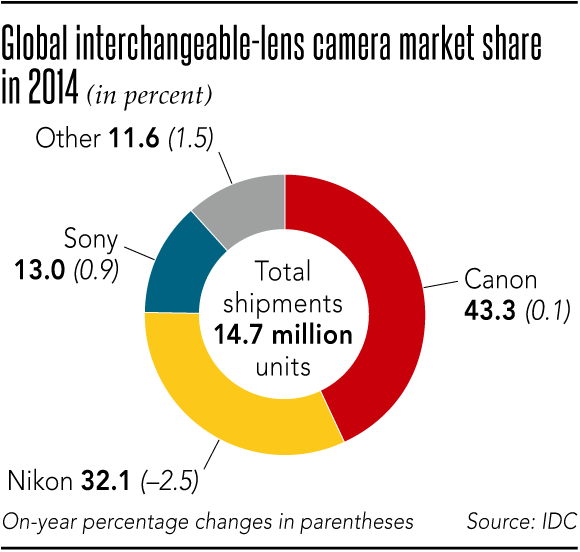
Nikkei Asian Review posted an interesting article about Sony’s mirrorless strategy. It basically says that the A7 series saved Sony’s camera business. Here are some key info:
1) According to one industry group estimate, Germany’s mirrorless camera market is expected to grow about 150% by volume in 2015 compared with 2012, while the U.S. market is seen expanding 80%. Much of this consumer “awakening” to the allure of mirrorless cameras has been attributed to Sony.
2) Sony began developing the Alpha 7 series in 2012 out of fear that the company “could be weeded out,” Executive Vice President Shigeki Ishizuka said (Ishizuka oversees Sony’s imaging products and solutions business)
3) “If we don’t conquer the market for sophisticated amateurs and professionals, we will never become professionals ourselves,” Ishizuka said. He decided to funnel a large chunk of the company’s resources into developing full-frame cameras. “We learned that people won’t buy our products unless we improve our brand,” Ishizuka said.
4) In the two years through October, Sony’s share of the full-frame camera market is estimated to have surged by about 400% in Germany and about 600% in the U.S. Profit margins for Sony’s imaging business are higher than for its TV operations, which only recently returned to the black. The imaging business could become one of the company’s leading electronics operations.
Nikkei also stressed to say that Sony needs to keep improving and gaining market share to keep their business sustainable. It also has to be seen what happens when Nikon and Canon will compete in the FF mirrorless segment. Although I suspect Sony will not have to fear them too much as they Nikon and Canon will need a long time to build up their camera and lens system.
180 Responses
most sony mirrorless user i know use canon glas.
so i guess sony has more problems with lenses then canon would have.
just put an adapter on it and you are good to go and use all your canon glas.
nothing different to the sony shooters i see running around with metabones adapters.
To be honest, most E-mount users I’ve seen during vacations were using the kit lens that came with their camera. The people using Canon glass are mostly people who shoot with the A7x cameras as their are not enough lenses for that one. For the APS e-mount cameras most FL are covered and people can use the native glass and are doing that!
Interesting, though I don’t agree on your conclusion. Nikon or Canon can very well release a polished mirrorless ILC at their first try… and it would sell like hot breads…
One theory I read that sounds quite plausible:
Canon and Nikon don’t produce pro mirrorless so most of their followers think that mirrorless just aren’t pro. They aren’t even looking at them.
If they decided to release a pro mirrorless, they would immediately be compared to the Sonys. And they would have to make the first camera better than Sony because else they 1. admitted that mirrorless can be pro and 2. admitted that the best they can produce is inferior to Sony….
Exactly. We have two examples from both brands, one negative (Canon EOS M) and one positive (Nikon 1). So, Canon missed it, but Nikon was spot on, but just with the wrong product. We’ll see. Of all the major camera brands (I do not count Sigma as a major camera brand), Canon makes still the best lenses for the money, and the usability of their cameras are still class leading. That’s why they still unshakably rule the market.
I wouldn’t call EOS M a failure in terms of sales numbers. Maybe technically it is a failure if you compare it to the Sony counterparts. But despite the fact it is a inferior product compared to Sony’s, it sold remarkably often.
It did because people trusted Canon but were duped. The same people now either think
a, mirrorless is non pro crap (which is what Canon wants)
or
b, that they will not trust Canon again and leave to Sony or some other brand.
Most of them are probs in a, which is sad…
They already had their first tries. Can they do better?
I would like Sony to improve on these points and then I’m sure they’ll succeed in the pro market:
– (much) faster processor in the A7 series
– improve battery (just make a nice grib with one *BIG* li-on battery)
– super telephoto lenses (400mm, 500mm and 600mm)
– improved AF (getting better but still not quite there)
All the rest is fine as it is: Lots of wide/normal lenses available, ability to “go small” (no grip, small lenses) or “go big” (grip + larger lenses), excellent IQ at base and high ISO, eye AF…. love my A7R II despite its flaws 🙂
Good times are ahead. Sony will not rest, and Canon and Nikon have to do a lot to keep up. Hopefully aside from great technology and better functionality it will also lead to more reasonable prices. As we have seen, Sony knows right now they can price cameras at 3000+ because there is no competition.
Keep it up Sony. Listen to your users and you will weed out the likes of Canon and Nikon, eventually.
I think you mistyped something 😉
And that is what exactly?
LMFAO. Read your post.
That is what winter ale does to you.
Sony weeds out… Sony? 😉
Trolling seems not as easy as it looks. LOL
I am sure you are the expert!
No I’m not. I never, I repeat NEVER, said such a stupid thing, that one brand weeds out the other.
If someone makes such a ridiculous mistake in his brand trolling, it is indeed funny, isn’t it?
So, I just laughed and made a joke of it. No big deal.
JUST GIVE US ALL A BREAK, MAN. Did you know that the average life expectancy of an S&P 500 corporation is 40 years? Ever heard of Schumpeter and his creative destruction. Those hanging on to the SLR design will experience just that. It is all a matter of time.
PS Please explain to me where you see a sustainable competitive advantage in the SLR design that outweighs its disadvantage in production cost for example? Canon and Nikon have a strong brand but that will not be enough to stop progress. There are buyers that do not just look at the manufacturer’s name their camera carries and think that if the thing is called a Canon or a Nikon, their photography will be so much better for it.
I would love to see the observations of some accurate and widespread market research to explain these figures, which seem to contradict the current ‘buzz’.
If anyone followed all the hype for the last 12-18 months (let’s face it, everyone who visits here does!) then you’d be forgiven for thinking that Nikon have done nothing in that time and are contemplating announcing the D5 which is the D4 but merely with a different label, while Canon have just released a dinosaur in the 5DR that has technology not much better than Fox Talbot used!
Clearly, the figures (and the abilities of the cameras) do not bear this out.
I’ve stuck with Sony as they have been the best option for me all along and I have no complaints at all. I’m delighted, but the reasons for buying are clearly not the same for most others. If I had to guess, I’d think that many still think a camera has to look and feel a certain way. Add that to the maximum they are prepared to spend and I suspect the Canon Rebel and Nikon D3200 would be top of their list. The A7 is too expensive and the A6000 does not fit in with the preconception, rather it looks like a very bulky smartphone which elicits “I’ve already got a smartphone!”.
I suspect that unless Sony can change these preconceptions, it will prove increasingly difficult to change the status quo.
Ok, I think a couple of things play a role here
1. This chart is from 2014. All the stuff you mentioned happened in 2015. Also since the A7RII I have seen a LOT more people switching to it! This year Sony might have gained another one or two percent. If Sony gets close to 20% and Nikon falls under 30% that’s already scaringly close! Just think about it.
2. This chart includes all the interchangeable cameras. Including the entry level Canons and Nikons all the sheep buy just because those are the brands you should buy. Takes a looooong time to change that.
3. Hmm. ok, I forgot my third point. If I remember I’ll add it 😉
Many pros bought the A7rii as a second system, some switched. But compared to the masses buying cameras, I guess this number is quite small, especially since it is not a cheap camera. For Sony to get close to 20% they need to sell a Million more, not easy in a shrinking market and with a push into premium, unless the market itself drops strongly.
It doesn’t matter that they bought it as second system.
I also read quite some reports that someone bought it as second system and is only using it since then. And thinking about selling that Canikon “first” system or parts thereof.
The chart above is units sold. And I might go as far and say if they buy a Sony as a second system that marks the end of buying Canikon. And of course that “second system” Sony will contribute to that chart. The “first system” Canikon they already had doesn’t.
Of course I exaggerated a little 😉 But I hope you get my point 🙂
Not necessarily. We have a business, too and use Nikon primarily, Sony as a second system. So far Sony is not able to make me sell the Nikon system. We know quit a lot of photographers who are in the same boat. However, I can say that the tendency to go from Nikon to Sony is less urgent due to similar sensor performance.
“…Including the entry level Canons and Nikons all the sheep buy just because those are the brands you should buy…”
That’s basically my point regarding preconceptions; very difficult to educate and change, but I would like to see some accurate market research (does that even exist?) to illustrate the point.
Plus, as you say, the picture may have changed in the interim and I’ll be curious as to what the figures from this year will be!
I agree that there are preconceptions, but I think they have to see with brand recognition and not the shape of the a6000. Actually, it is much closer to what people are used to nowadays with their phones, yet they still buy crappy dim entry-level OVFs. But, hey, it is Canikon!
The buzz is within the Pro and high en Enthusiasts so it won’t show in overall sales figures especially if you’re looking at a period from 1-2 years ago.
This current buzz is likely to trickle down to enthusiast, hobbyists and beginners but it takes time.
What you will see in the figures year on year is Sony’s market share increase slowly and continuously.
The A7RII marks the turn of the tide I reckon.
This is 2014 market shares, before Sony released their A7RII ace.
It would be interesting to see 2015 figures. Judging by the huge interest A7RII generated online, my prediction is:
Sony up from 13% to 23-25%
Nikon down from 32% to 28%
Canon down from 43% to 35-37%
I expect Canon to lose more market share because their lenses can be used with AF on E-mount and many Canon users were tempted to try E-mount system this year.
Also just to point out that the chart above shows numbers of units and does not take in account the price of units sold. I don’t know if this is in Sony favour or not, just saying.
A bit.. a bit too much on those % figures.
I’d say Sony keeps growing, both others keep loosing ground.
A7rII is def an ace, and A7sII is def a worthy upgrade to the A7s and if I was an owner of the first gen cams of either of those, I’d be queuing to get them as well.
But if I was a Canon/Nikon shooter, I’d buy one to test, but I wouldn’t switch. I think brand loyalty is hugely underestimated here. Canon and Nikon are macho brands for many in their heads, and brand matters for them. They would MAYBE get an Olympus and a Fuji (as second cams, of course) but def not a Panasonic or a Sony.
But, Sony is still very new in the game under its own name, and they’ve done really well.
If anything, I suspect we’ll see more Canon migrants than Nikon migrants just due to the ability to leverage Canon glass to varying degrees on E-mount bodies especially the A7II/A7RII. I believe Canon adaptability will improve over time too.
23-35%? Seriously? This would mean selling 1.5-2 Million more cameras (certainly not A7rii). How many photographers are spending 3500 Euros to switch and an other 3000 Euros for lenses? Pros are in the minority compared to usual buyers, I think (do you have numbers, would interest me?). Where is the majority of the revenue coming from? I guess more from an A5000/6000 or A7 but not A7rii.
I think he meant that the a7rII generates interest which will transfer to other Sony products – that is how it worked for the others. However, Canon losing market share is a bit of a one-sided argument, as it can be seen as Sony losing share in lenses.
I didn’t say 23-35%, but 23-25% !!
Secondly, The chart shows numbers of units and not revenue generated, and yes its entry level cameras that generate the majority of these numbers of units sold.
Then, I think that you are underestimating the fact that the digital camera
market is in transition. The number of people talking about and
migrating to mirror-less cameras grows exponentially every year. And
enthusiasts are the first to migrate and are the biggest group of
buyers.
As an indicator for sales I use Amazon Best Sellers
lists, and while in the US there is still some sentiment towards big
flipping “pro-looking” DSLRs, in more forward looking markets like Japan
and Germany
mirror-less cameras have practically reached 50% of system camera sales
and its Sony
dominating these in a big way.
Unfortunately, amazon.de does not have
a system camera category that combines DSLRs and mirror-less, apart
from Digital Cameras as a whole that also includes compacts, but you hit
several A6000 configurations before you see the first DSLR there at
no.26 right now, although it changes every minute:
http://www.amazon.de/gp/bestsellers/photo/571862/ref=zg_bs_unv_ph_2_430662031_1
Then see Nokia lose 50% market share over 4 years, which is over 12% per year, and not one, but 4 years in a row. I am not saying this will happen to Canon or Nikon, but it is possible, if they don’t act fast.
http://i.imgur.com/dWn8XzI.png
In general, the ILC market has much longer product cycles and far more inertia in terms of system investment than mobile did.
Mobile has a bit more in terms of system investment nowadays (app store purchases), but that sort of lock-in didn’t exist back in Nokia’s day and even now, it’s insignificant compared to the sort of gear investment one can have in an ILC system where a lens can often cost as much as (or more than) a body.
I am not fully convinced by this statistics. The market is in transition, but it was so already a few years ago. We know what the future most likely will be, i.e. mirrorless, but the time horizon over which this happens, is unknown. Still DSLRs outsell mirrorless, which have been relatively flat in sales according to various sources, by 3:1, although its death has been predicted more than once much earlier already. Exponential growth is certainly not appropriate here. I am German and besides me and one, two others, I know nobody buying a Sony (and if so, interestingly those are all males). Now you say how many do I know. Well my wife is part in a pretty big network of pro-photographers commenting in facebook etc., discussing cameras, lenses and similar things. And only a minority are thinking of a switch, at least not now. They heard of Sony and some are thinking about supplementing their gear with a mirrorless, but with Sony most are repelled by the high lens prices. As we are in a wedding and portrait community, flash systems are very important, too. So I think full support by the flash companies for Sony (Profoto etc.) would help. Additionally I do my own statistics in my lectures I give at our university. The big engineering classes have between 300-600 students. I ask them every semester for fun about whether they use a camera, own one, want to buy one, know someone buying one, mirrorless, brand of choice, etc. It is a good way to see what future prospective buyers want. Unfortunately the students buying a Sony are rare. Interestingly the brand they know better is Olympus and Panasonic m43 cameras and most still want a Canikon in case they even consider buying. Smartphones is considered good enough and more important. I have a foot in both systems and I like both. So I just wait and react and buy if a good deal emerges. The hints point to a 70-200/2.8 and 135 Batis, these are lenses we want to have. Another interesting side note: a colleague in the art department told me, that the demand for real paintings is increasing drastically. People are so oversaturated with images due to social networks and smartphones, that paintings are considered something real and help to set oneself apart from others.
Little is going to change in 2015, everyone is experiencing drops in number of units sold. Each company will move 1 or 2% up or down, but Sony is not gaining 10% market share in a year. Any gains in E-mount sales are surely offset by cratering A-mount sales.
Sony has held about the same percentage of market share for the last few years. Canon has been in the 40’s and Nikon has been in the 30’s. The rest are left for scraps.
I think that you are underestimating the fact that the digital camera market is in transition. The number of people talking about and migrating to mirror-less cameras grows exponentially every year. And enthusiasts are the first to migrate and are the biggest group of buyers.
As an indicator for sales I use Amazon Best Sellers lists, and while in the US there is still some sentiment towards big flipping “pro-looking” DSLRs, in more forward looking markets like Japan and Germany
mirror-less cameras have practically reached 50% of system camera sales and its Sony
dominating these in a big way.
Unfortunately, amazon.de does not have a system camera category that combines DSLRs and mirror-less, apart from Digital Cameras as a whole that also includes compacts, but you hit several A6000 configurations before you see the first DSLR there at no.26 right now, although it changes every minute:
http://www.amazon.de/gp/bestsellers/photo/571862/ref=zg_bs_unv_ph_2_430662031_1
Then see Nokia lose 50% market share over 4 years, which is over 12% per year, and not one, but 4 years in a row. I a not saying this will happen to Canon or Nikon, but it is possible, if they don’t act fast.
http://i.imgur.com/dWn8XzI.png
I don’t know man, the hot pink Nikon Coolpix at number 6 looks mighty tempting.
At a second look, yeah, maybe Nikon are having a great year.
All these Point&Shoots between places 2 and 7 on its own are outselling everything in the Digital Camera category on Amazon.de, apart from the A6000 kit that’s at place no.1.
Who said P&Ss are dead 🙂
I’m not underestimating anything, what you’re talking about is a sudden shift in the marketplace for Sony to gain 10+% market share, when all the current sales figures show slow declines in the ILC market, and month to month some flat and some gains. DSLR’s still outsell mirrorless 3:1 and that’s not going to take a sudden nosedive in the next year.
Cherrypicking small markets with larger mirrorless penetration is irrelevant to the overall picture. So is smartphone OS numbers, its completely different. Sony had 17% of the market in 2010, so 13% today is really nothing to brag about, as the numbers in the chart show, they barely maintained what they had the previous year.
Next year it’ll be pretty close to the same as it is this year, just fewer units shipped over, just like it was last year, and the year before and so on.
Of course my figures are a prediction, I might not hit Sony going up 10%, but would hit the Canon and Nikon going down 4-6%. At least I am looking at the right indicators, not historical data.
I bet you would have said the same thing for Nokia market share if you looked at it in 2008 – “It will stay flat, I doubt Apple or Samsung will gain anything significant in the smartphone market, look at last year’s figures.”
Yeah, right, tell this to Nokia now.
Nobody cares about Nokia and its not a valid comparison. There’s no iPhone revolution coming in the ILC world for Sony, likely just an A7mkIII in the next few months and someday an APS-c successor to the A6000. That’s not going to add an extra million to Sony’s sales or erode Canon’s market share – especially with a 5dmkIV coming (5d3 is still an Amazon top seller after three years) and a 80d. Historical data shows trends, you can choose to ignore, but the monthly/yearly sales figures don’t jive with your predictions.
As CIPA sales show, worldwide mirrorless and DSLR’s are flat from last year, Sony will gain little – if any – market share this year. Top number is units produced or shipped, non-reflex is mirrorless. This tells you the story, not Amazon sales rankings.
I can’t read fancy numbers. Give it to me straight doc. Is Amount about to die?
I don’t agree.
You don’t tell the market, you have to listen to it.
Amazon is showing you what’s happening in the market right now.
Your CIPA tables show us the history, which is just that – history. It is a lagging indicator – it shows what happened in the market once a period has ended, it does not show you future figures.
Amazon on the other hand, at least shows you what’s happening at the moment, so if you follow it regularly can expect the figures to come in the next CIPA table at the end of this year.
Amazon is only one retailer. All it shows is what people are buying from them, and they’re buying more Canon and Nikon. Your argument makes no sense.
Amazon is only one retailer, but it is huge and accounts for a large part of this market.
Here is another retailer, the guys at CameraStoreTV (Canada) have seen exactly the same thing and talk about it in their video about 5th-6th minute
https://www.youtube.com/watch?v=DtTPCAn6kU8
You contradict your own statements with Amazon, looking at the US – the largest camera market in the world – and mirrorless is completely crushed by dslr’s, the A6000 and EM10 are the only ones in the top 30. You’re cherrypicking small territories to make some convoluted point. Best Buy – the worlds largest electronics retailer – also has a bunch of DSLR’s and the A6000 as the lone mirrorless. Walmart – another electronics retailing giant that sells almost as much as Amazon despite far fewer offerings has no mirrorless in its top sellers. All your “up to the moment” rankings show is that mirrorless is getting trounced by DSLR’s, something CIPA stats show as well. This is going nowhere. I’m out.
Cheers.
Chris, I’m not going to spend my time trying to convince you into one thing or another. Believe what you want, just keep in mind that in order to see something reported by CIPA, you would have seen it change an year earlier. It is backward looking information, it’s reported with a huge delay and the market changes much faster than this.
Listen to the CameraStoreTV vid that I posted before, they’ve noticed the same thing in Canada, people getting rid of DSLRs.
And by the way the US is not the largest camera market !!!
According to your favourite CIPA Europe is largest with 32%, Asia (without Japan) and Americas are second with 26% each.
https://www.youtube.com/watch?v=DtTPCAn6kU8
It is worth mentioning what happened in 2015:
1. It is actually Sony’s competitors in the cheap entry level cameras that ate a lot of the market that used to belong to blockbuster cameras such as the Canon Rebel.
2. Though we are proud of the A7 line, a lot of A6000 are being sold.
3. It is true that as the A7 line becomes better, it increasingly gobbles more and more mid to high level markets, such as even photography and enthusiasts with some dough.
4. People are excited at new and even not-existing-yet e-mount models. Lens and accessory manufacturers catch that wind and produce more and more of those, to keep up with the demand.
5. The problem with Nikon and Canon is that unless they pull some major camera magic, they are through. It is not only Sony’s current models that are really good, but also their future models that will be rather easy to produce. The A99 replacement will probably be seriously good, the A9 will entice more serious photographers to go e-mount, the A7000 will boost APS-C. As you can see each model will not only be an improvement on the one that came before, but also a possible market share grabber.
6. Those complaining on the A7’s prices will find the previous models keep on selling and of course you can always get used or refurbished cameras for serious cheap.
It will not be an exponential growth in product improvement. So far they needed improvement to catch up and are mostly there. But it is not necessarily so, that this will continue as it is. Interestingly, already a few years ago people spoke of the last nail in the coffin for Canikon. This was repeated every year since and still Sony’s share didn’t increase much. We don’t know for sure what is happening and when.
Simply brand recognition, that’s what canikon are consuming atm instead of inovating.
To be honest, a D810 and D750 are great cameras, the latter allows one to go very light using primes, too. Not being able to use these professionally should cause concern in the capabilities of the photographer, not the gear. It is innovative enough for many. I use both, Sony and Nikon, and still like to use DSLRs. So it is not only brand recognition, but also the fact that those cameras deliver when needed and used.
Also, Canon has all of the components in place for a great mirrorless system now. I’ve been hearing good things about the M3.
If anything, Canon’s Dual-Pixel AF may be more advanced than Sony’s OSPDAF. Canon has just been marketing that as a video feature instead of a mirrorless feature. Not sure exactly where HCAF III stands – it looks like Dual-Pixel sensors except only a limited number of sites instead of all pixels (similar to Sony’s <400 OSPDAF sites).
Their "legacy" mount is already fully electronic, so that allows Canon to easily leverage their existing lens lineup for mirrorless. EF-M adapters are just a contact passthrough already.
Canon is way ahead of Sony in terms of lens design/production infrastructure.
Canon lags in sensor performance but their market share is still huge despite that.
My understanding of the dual-pixel tech is, that it can already be used with the newer lenses with good performance. Improve it and update the lens compartment further and it is an easy step to just get rid of the mirror if desired (and the newer lenses are quite good, to be honest). So, why not milking the cow as long as possible? If however a completely new mount and technology were used, I don’t know if this would pay off.
From what I’ve read, I think dual-pixel AF may be more capable than Sony’s OSPDAF, but not entirely sure. The thing is, since EVERY SINGLE PIXEL is an AF site, it’s expensive and thus reserved primarily for Canon’s Cine bodies (which are all already mirrorless!).
Canon’s Hybrid CMOS AF III seems identical to DPAF except with only some pixels being AF sites – similar to Sony’s OSPDAF.
And you are right – these technologies work with most of Canon’s existing EF/EF-S lens lineup. As a result, Canon mirrorless cameras (like the M3) have a complete selection of adapted glass that suffers ZERO loss in functionality. (EF/EF-S and EF-M are 100% identical in terms of lens control interfaces.)
1. That would be which company? In terms of entry-level cameras Sony is one of the cheapest.
2. Precisely.
5. Still too much mind share that will keep them alive. IF they manage to pull off something interesting, which the EOS-M, Nikon 1 and Nikon Df certainly aren’t.
1, 2, 3, 4, 5
I just felt like counting numbers. Ignore this post.
Interestingly enough, I thought about what it would be like if Sony was first in volume sales. That would mean that you see Sony cameras often on the streets, at tourist attractions, etc.
But THEN Canon or Nikon would be the new underdog hispster brands, because of their “heritage” and vintage SLR design which “brings you the world unadulterated through the simple reflections of a prism finder. You actually see as if you look through a glass window. Do you remember that?”
Good! I want to get rid of my vintage, heritage Canon lenses as I got rid of nikon, but at hipster prices of possible… Although I’ll wait until Sony shows that 24-70 2.8 and a 70-200…
Sony A7 series wins the retro/hipster niche because they have that pentaprism viewfinder on top!
” If we don’t conquer the market for sophisticated amateurs and profesionsls, we will not become profesionals ourselves.”
They need a pro level E moint body
And long lenses that actually fast focus on E mount for woldlife and sports.
No, Barry. You got all that wrong.
They need YOU!
Ishazuka’s own words….you will have to argue with him.
It will come 🙂
Judging from what I see, all a7 cameras are pro-level.
Pro level cameras in amatuar consumer bodies.
Sony needs a pro level body.
AFAIK Sony had 17% of the DSLR market at one point. Who knows how much market share they could get if they properly marketed and developed the SLT system?? It combines the best from both worlds, mirrorless and DSLR, but Sony made it look like it combines the worst, and gave up after the first try.
>If we don’t conquer the market for sophisticated amateurs and professionals
You won’t with the current A7x. Make proper A9 – big, 12Mp, f/2.8 zooms, proper flash system, then maybe you’ll get some of the userbase back that you lost to Nikon.
>We learned that people won’t buy our products unless we improve our brand,”
Well you lost a lot of trust with your frustrating A-Mount policy.
>It also has to be seen what happens when Nikon and Canon will compete in the FF mirrorless segment
Canon and Nikon have so far shown no inclination to do so. Sony aren’t competing with Canikon, they were too afraid to do it – so they have carved out a niche for themselves where they have no competition. But the DSLR market has been lost. Even if A99II comes with the most amazing specs, I doubt a lot of people would buy it in what feels like a system Sony doesn’t care about.
Source for 17%? SLT has drawbacks of both mirrorless and DSLR.
http://www.photoclubalpha.com/2008/09/10/alpha-900-launch-press-conference-part-1/
SLT does combine EVF, live view etc. + PDAF, lens system etc. But Sony never marketed it properly, or at all for that matter.
European market share though, not global.
Also combines DSLR size and worse ISO(low light performance)
why 12 Mp? Why not go straight for 6 Mp?
12-16Mp is a good balance for writing speed, buffer, processing, storage, and at the same time gives room for cropping and allows for great low-light video. And the best A7SII sensor is already here, no need to develop anything new, just put this sensor and your best AF system in one body FFS!!! and you get the ultimate reportage camera!
Not 12Mp in a video body and 399 points in a 42Mp monstrosity… *facepalm*
6 Mp also gives room for cropping and allows for even greater low-light video etc. and so on.
I doubt Sony would develop a 6Mp sensor, but they have the 12Mp.
The SLT cameras are great, but have their drawbacks. The major drawback is the size. The cameras must be as thick as any A-mount camera. The other reason the SLT did not make it in the end is the fact that they came to late to the party. The biggest part of the photographers who wanted a DSLR had decided to go for Canon or NIkon, all other brands failed with their DSLR sales, even when they had great technology or heritage.
Sony was smart enough to see the problems in the DSLR/SLT market and started an other branch on their camera tree, the mirrorless branch. And, although it is hard for them to do so, they are now the third ILC seller in the world. The market share of mirrorless is growing slowly, the share of Sony in mirrorless is large, so in the end Sony might win a lot by this strategy.
Canon and Nikon have a lot to catch up to. Remember that when they start with a mirrorless FF camera they both have to create a new mount, they both have to create new lenses and they both have to change their marketing strategy (from mirrorless is stupid to mirrorless is great) all will take a long time. It is very well possible that both are to late to the party and both might go the same way as Sony SLT cameras did go….
They could just use the same mount and accept a penalty in thickness or use it for ergonomic reasons. I would welcome that. Additionally, I didn’t see a mirrorless is stupid marketing campaign. They have mirrorless offerings,too, it would oppose their own product line.
>Remember that when they start with a mirrorless FF camera they both have to create a new mount
If, not when. They don’t HAVE to go with FF mirrorless at all. This has been a niche product so far, and they can opt to just ignore that niche where they don’t have an advantage.
If Sony decides to release a DSLR-quality mirrorless and lenses and make their system compete directly with Canikon…… but Sony haven’t yet done it either.
>The major drawback is the size
That’s just one group of users. For others one of the main drawbacks of mirrorless is that they are too small.
That “niche” product has been the bulk of their profits and led to massive increases in market share for them.
Things that A-mount COMPLETELY AND TOTALLY FAILED to do.
Edit: Whoops you were talking about Canikon.
Canon sort-of screwed up with EF-M as I don’t think it has the diameter for FF. They could potentially do another EF-M variant that is mechanically different for FF mirrorless. The nice thing about EF already being fully electronic is they don’t really have to do anything significant to create a new mirrorless FF mount that has near 100% compatibility with their existing lens lineup.
Canon has already had signs of prepping for mirrorless in their DSLR lineups with their video/liveview AF improvements (Dual-Pixel AF and Hybrid CMOS AF III – I believe HCAF III is very similar to Sony’s OSPDAF and DPAF may actually be more advanced since I think it uses EVERY pixel as an OSPDAF site.) – they’ve got all they need in place to do a relatively painless entry into mirrorless.
Nikon isn’t so well off with their outdated mount from the 1950s.
Remember, Sony killed A-Mount, not customers.
Increase in market share? They had 17% in 2008, now only 13% in 2015 with all the E-Mounts.
These are numbers for 2014, and in units shipped, not total sales volume. Figures for 2015 will probably be better for Sony.
In a sense, Sony made a wrong bet with the SLT – neither tech nor the world was ready for it. It got the reputation of worst of the both worlds, instead of other way around it should have been.
Also Apple has ~ 13 % market share in smart phone business. Still it’s devouring 94% of all profit. And in the end that is all that matters. Market share is like number of shots to goal and profit is number of actual goals.
Now if we come back to Sony. They are trying to capture the most profitable customers with their current camera line up – we can call that as “Apple strategy”. With A-mount that would have never happened as they couldn’t differentiate themselves enough from Canon and Nikon. But with the mirrorless E-mount they have a better chance to do so.
They will properly never have have a huge market share, but as I explained earlier, it’s not even necessary. It could be even part of Sony’s branding strategy that time of the cheap entry-level models is over. They could position themselves only for experienced amateurs and pros i.e for people that are going to shoot with more than a kit lens.
I don’t see how this correlates with the current FE system. “It’s dumbed down, but look, it’s smaller!” seems far away from “premium” product for “experienced amateurs and pros”.
>Canon sort-of screwed up with EF-M as I don’t think it has the diameter for FF
E-mount: 46.1mm
EF-M: 47mm
Now that is interesting.
Indeed. If Canon really itself claims, the diameter is not wide enough for FF, then Sigma’s statement that it is hard to construct FF lenses for E-mount makes sense, too. And it would maybe explain why E-mount FF lenses are so expensive.
And yet virtually any lens made can be used on an e-mount camera with a simple adaptor.
if you accept extra 25mm lens-length
Interesting… I could have sworn I’d read that it was smaller.
In this case, there’s nothing preventing Canon from releasing an FF mirrorless. (Although – do any of their FF bodies have OSPDAF, or is that only in their APS-C sensors so far?)
Either way, they’ve got a mount that would be suitable for FF mirrorless based on the numbers you’ve provided (unless there’s some other weird barrier not indicated by those simple numbers), they’ve got the OSPDAF technology with Dual-Pixel AF, and if they did this, they would also get 100% compatibility with existing EF lenses.
Word!
Sony a33 is smaller than Sony a7II. Could have put FF sensor inside that years ago.
Besides, size is NOT a drawback… it is an opinion that not everyone shares with you.
Have you seen the A33, A35, A55 cameras they were the same size as the A7 series and same weight too!
The A33, A55, A37 are the same size as the A7 series and same weight Sony could have made a mirrorless A mount small without as much effort as e-mount!
Canon does NOT have to create a new mount. EF-M mount is perfect for FF mirrorless. Better than Sony’s E-mount.
17% according to whom? The highest number I’ve ever heard was 15% and the context was that Sony was expecting to hit it (and only for ILC).
And people will not continue to purchase Sony cameras if their repair and maintenance service remains as horrible as it’s become. Worst of all the majors.
It depends on country. Here in Russia Nikon service is the worst of all the majors.
That is very clear, in countries where labour is “expensive” the repair and maintenance services are sub-contracted without any commitments wrt quality, turnaround, price, etc… from Sony. The weird thing is that Sony takes no responsibility whatsoever for collecting, packing, shipping, etc… the camera. The way things are organised is so frightening that I went to buy the spare parts and fixed my damaged A7r2 by myself…
I am actually quite happy with Sony service in this part of Europe so far. Shutter and aperture mechanics/electronics change on A850 in just over 1 week, including shipping. Internal cleaning and calibration of SAL70200G in less than two weeks. Fast, no questions asked exchange of FE 55/1.8 with a scratch on one of the internal lens elements.
Aha! So they are still repairing the A850 huh.
They did 6 months ago, not sure about now. If the shutter on mine died again, I would probably not bother repairing it. Would most likely get another A7rII or A7II for backup. Hopefully there will be A9 soon to become my main camera with dual card slots and better AF 🙂
different from region to region, here all suck at the same level
Where I live in Bulgaria Sony service is top notch and my primary reason to shoot Sony
Looking at those numbers- I don’t get how A mount is alive. I don’t get it. Must be propped up from FE mount.
I don’t know what they could do next year to continue the tidal wave. I sense the new FF bodies every 6 months is over. More lenses? Guess so. A new flash system would be nice.
I don’t see Nikon and Canon doing nothing as some here like to quickly assume. Anyone shooting weddings I know is using a D750 and they love it. Even casual photographers rav about it. Gotta like those big cameras. With such a small market share, another FF mirror less competitor could really tip the boat for Sony.
There is still one major technical advance to be made in sensor department. Global electronic shutter, or at least rolling shutter which is faster than today’s mechanical shutters. Sony seems to be actively working in that direction, optimizing read-out speeds via stacked DRAM, copper interconnect and other tricks.
Whoever makes this first, will have huge potential advantage over competition – faster flash sync, infinite shutter life, faster frame rates, better video, better durability with no moving parts – and Sony seems to be ahead of others in this.
A-mount has a slightly larger user base than either Fuji’ or Olympus. It survives because we tend to spend more money on its higher end cameras (A77II or A99).
Plus we generally spend more money on lenses than camera bodies. Over the last year I only spent 2k on a-mount body (A99), but I easily spent over 8k in lenses (24-70, 16-35, 70-200, 135mm) and this year I’m planning to spend another 3k (24mm, 50mm).
Ishizuka confirms the writing on the wall.
Sony has been struggling with two things, brand recognition and lens lock-in.
Sony is cracking brand recognition, as the A7-series mk2 is the most exciting development in photography this year.
The second thing they have to crack is lens lock-in. To do so, I think they need class-leading fast zooms at competitive prices. That’ll be a challenge.
I don’t doubt Sony/Zeiss has the ability to produce class-leading glasses; the hard part is to be at competitive price. Sony usually label their lenses at a bit/a lot higher price than Canon/Nikon’s counter part, with better optical performance or not.
For e-mount, Sony has a couple of primes that are staggering. Both in performance and price. The zooms have been staggering in price but not performance. That’s their challenge.
Sony has no choice but to sell lenses at higher prices. They do not have a large user base and therefore cannot benefit from the economies of scale Canon and Nikon reap from shifting more units.
On another post you have been claiming Sony is not # 3 and disputing my claim Sony is #3.
Here is documentation that Sony is indeed #3 and in fact is ahead of all others combined.
Do you still dispute my claim ?
I’ve never claimed Sony wasn’t number 3 in recent years.
In the post you are referring to, I was talking about a statement made by a Sony executive in approximately 2009 (go back and look). This is market share in 2014.
Sorry Barry, this post just makes you look stupid. You were so eager to win an argument, you completely forgot what I originally said.
I hope you’re man enough to at least admit the error in your accusation here.
I have no intention of discussing thr same topic forever, and you are unwilling or unable to document your claim.
Please do not continue to follow me to other forums to discuss a topic that I have finished discussing.
Are you really that dense?
1) I’m talking about your assertion I said Sony wasn’t number 3 in this very thread.
2) YOU chased ME from another thread and brought up our previous conversation to make this erroneous claim, and ask that I admit you were right.
3) Like I said, you have no honour. You clearly misremembered our previous conversation, but don’t have balls to admit you were wrong.
I call BS…
Had Sony installed the 36mp sensor inside a99… INSTEAD OF GIVING IT TO NIKON… IN THREE CAMERAS NOW… they would have much greater attention from pros years ago. And where the pros go, the enthusiasts pay attention…
CaNikon both would have been stuck in 20-24mp world years behind… And Sony would have gotten just as much attention putting 36mp inside tiny a33 size body too. Still Sony pros are left without current sensor tech. Still!
Sony gave best tech to competitors, and abandoned most loved features like iISO hot shoe, killing strobists (the most pro-centric of their buyers). Sony refused to implement pro services. They didn’t need EMount for that.
EMount (not 7 series FF) was conceived from the beginning. My ZA24-70/2.8 has cutout at bottom to allow mounting upon LAEA4 adapter. There is no other reason for that cutout. The lens would not mount otherwise.
SONY… Better get that fly-wire focusing refined. It’s difficult/impossible to work with for critical pro focus needs. Better provide tactile options to turn off acceleration. Should have options for long/short throw… Make FW update to fix it.
SONY… Better stop that ridiculous viewfinder flashing for stills. No reason that aperture should stop down before shot. Cameras don’t use it during video… so why must stills mode suffer EVF flashing brighter/darker during stills focusing? Stop it now.
SONY… Better fix the inability to adjust exposure after focus lock. Even in manual mode, aperture and shutter speed cannot be adjusted after focus lock. Stupid… No other camera prevents exposure adjustment after focus lock. Must let go of button, adjust, then reacquire focus. Absurd shooting dynamics.
The list is long for how far Sony needs to mature. I suggest CaNikon will provide pro mirrorless before Sony gets a clue. Surely CaNikon are aware of the trends and reacting to market pressure too. Sony FAD… is just that.
Pros dont run after MPs. They need a full system and one that’s not a joke.
Oh dear Clyde……same old talking points, ones that none under 50 give a damn about, really!
hmm. while a7 has done alot, lets remmber that extreme focus on mirrorless has gutted A mount sales and made existing customers feel like second class citizens, and killed it for new customers.
so alternative reality with the equivilent investment in A mount, or lol, some investment, might not be as successful, but it wouldnt be the disaster hes making out.
imo they should of done a 70-80% fe to a mount ratio, which if you consider the shared tech and limited revisions needed to a mount bodies, would be very easy to do.
that would of kept a mount relivent and wouldnt of really effected fe much. would it really matter if a7 ii was a couple of months late? nope.
probably looking at 10% market share loss or extreme danger of losing, straight away with their choice.
The FE is gutting Nikon and Canon sales. I doubt its even effected a-mount sales. Most a-mount users are content with our current cameras. The majority of us are probably spending money on the Sony’s Zeiss lenses than camera bodies.
I really don’t see any reason to upgrade my A99 yet. I haven’t had any customers kicking down the doors for 4K video or 42mp photos yet. When they do, I’ll consider it (cost benefit), but I’d rather spend money on lenses.
I’d be interested to see the numbers… I went A to E and haven’t regretted it (if anything, I’m finding photography more fun now)
I am still interested in 1 information:
How are the sales of A6000/5100 compared to A7 series?
My interpretation of this says, that Sony does not expect the A6000 sold so well, if there would be no A7 lineup.
According to this, it massively exceeded expectations http://www.sonyalpharumors.com/sr4-a77ii-and-a7-series-sales/
The question really is- how the hellll is Pentax holding on?
Consider that today’s market is probably 10 or 20 fold what market used to be in the 90ies, so even 1% is not a bad chunk to have for a small company
Sony and Canon are just huge profit hungry monsters
So why on Earth Sony’s 17% share in DSLR was not considered good enough and they had to kill the line and switch to mirrorless?..
They keep telling it wasn’t profitable, but Pentax is profitable enough to release a new Full Frame in the spring, while A-mount is not??..
That must have been at time of a900. Unfortunately they made a99 and their market shrunk to 5% and even Pentax came ahead at one point. So they are not lying A mount has collapsed long before a7 came about.
Sony’s was never 17%, the a-mount share peaked at 13% in 2008.
The a-mount sales never collapsed, they just weren’t able to capitalize on the massive expansion of the DSLR market between 2008 to 2010. The original a-mount DSLRs were minolta designs that were expensive to produce.
Sony sells more DSLR bodies today than they did in 2008. The A99 actually outsold the A900 in its first six months of sales.
a-mount was at 17% share in europe. global it was less.
Is this at the time when the imprint on cameras read Minolta and Maxxum 7 was the big thing?
Also keep in mind that in the last decade or slightly longer Pentax was sold twice, first to Hoya, then to Ricoh (without the medical business part), so maybe they are not profitable after all.
I bet even Fuji has a bigger share than Pentax. Dumbest move ever was announcing a FF OVER A YEAR before it comes out. Now who the heck is going to buy your APSC gear?
Yes, I also think this was strategically a very poor move. Now they have to revive, populate and maintain their FF K-mount lens line, while DSLRs are losing ground to mirror-less. And if they transition to a mirror-less system with shorter flange distance few years from now, this revived lens line-up will not be usable (at least will not be native)
Creating a brand-new FF DSLR system in a world where mirrorless fans claim the death of DSLR and mirrorless revolution is indeed interesting and proves that not everything is so black & white.
Sigma is also releasing their brand-new Art lenses for DSLR, not mirrorless, and they come in K-mount.
Thing is, Sigma’s got access to a huge existing market of DSLR owners so it’s a no-brainer for them to put their resources into that market at this point (rather than developing a whole new line of lenses for FE). What surprises is that they’re not making much effort with the APSC mirrorless market, which I’d have thought would be more than big enough to get them interested now.
same with Tamron which do nothing for Sony e-mount except one hyper zoom. Their 17-50/2.8 with LA-EA2 works great, so why not sell it natively?
Considering Sony’s interest in Tamron, their e-mount lineup is a joke…
Agreed. Just crazy. Pentax make by far the most pleasant camera to shoot with, don’t quite hit the mark on AF (for DSLR), but nail it on everything else. Pentax make the best APS-C out there with the K-3. I was waiting for the new FF and the since delayed 70-200/2.8, which appears equally as much a PR disaster.
I don’t think Pentax is a safe bet any longer. Would never surprise me that come the Spring the FF gets delayed again at which point it’s curtains and I suspect at some point the K-mount will be lost.
One look at Pentax’s “teaser site” tells me all I need to know that this will likely be a marketing flop (again!) Now is probably a good time to sell off the Pentax kit, very sadly.
I’m not confident on E-mount either. Whilst it’s a winner Sony will keep it going but with lens and body prices as they are this is one hell of a lot of money to risk on a mount that could be killed off on a whim.
Nikon F mount or Canon EF mount are the safe bets. My choice would be Nikon and may well become so with the trinity of Nikkor f/2.8 zooms and 35mm and 85mm primes. It’s all anyone really needs in any case.
People were already stopping purchases of their APS-C gear and moving to other manufacturers.
(Myself included…)
The K10D was a value leader, it offered SO much more for the money than the competition (Canon’s competition in its price range had no spot metering, for example – WTF?). This was enough to offset the risk of Pentax being a smaller system. (The fact that they’re still using the same mount they’ve used for decades helps them in SLRs, but cripples them for mirrorless.) Newer Pentax bodies – not so much of a value leader.
They seem to be going for a niche with their lower prices MF camera. I’m. It sure about that full frame 135 body.
Pentax who? Ah, you mean Ricoh?!
Don’t worry, they made half a billion profit last business year (luckily for them, not all with cameras). In the same time Sony lost one billion. Oh, and Sony lost money in six out of the last seven years.
For realz? I’ve have to look into this.
This is very old data. Companies are reporting dramatic changes on per quarter basis. For example Canon started shift away from photography. Olympus had turned to profit and look much bolder as of September/October
Canon has the most to lose from the shrinking DSLR market. Most of the people who are flocking to mirror-less are Canon users.
Probably true, plenty of stills photographers I know shifted to Nikon because of sensors, while many videographers replaced 5D3 with A7s.
Especially when you factor in how poorly Canon’s mirrorless options stack up against the a6000 and a5100…
It’s a surprise nobody seems eager to compete in the full frame mirrorless market except for Leica. It’s not like they don’t know what’s happening. If Canon is turning away from photography – why don’t Nikon get ready to compete? (Maybe they are.) Sooner or later, most professionals are going to switch to mirrorless. And after that, all the rest of the market will follow. It might take a while, but some day it will happen. What happens if Nikon isn’t ready then?
The magic thing here is sensor design. If that was easy and cheap, everyone would have their own full frame camera line. Sony seems to be few generations ahead of everyone else on the industry at sensor design.
Almost anyone can create optical design for a lens nowadays – ray tracking softwares have revolutionized the design work in that field. But creating a truly remarkable sensors like the ones in A7s and A7r mII – that is setting the companies apart.
Yes, Sony is the new Kodak.
lol reminds me of Miyazaki’s soon to come 35/1.4 that’s almost totally designed by hand, whose MTF reminds me of a more than half century old triplet.
Canon is turning away from photography? News to me.
Sony- if you want to keep up the momentum do the following:
1) Stop coming out with lines of lenses. How about at least one COMPLETE line of primes. I don’t care what bird Zeiss wants to name the line after- just give us some uniformity.
2) A few new lenses for E mount would be nice. Heck I don’t even shoot E mount but I bet those APSC shooters would be happy with ANYTHING at this point.
3) I might be over the whole dual card slot thing. I’m not over touchscreens though. Get that menu fixed and add a touch screen. Your menu’s suck. Oh, and happy holidays Sony.
That “lines of lenses” thing is really Zeiss, not Sony.
Sony only has 3 lines of FE lenses – consumer, G (ie Sony designed high end) and Zeiss (Sony designed with Zeiss branding). Zeiss has the Loxia (MF) and Batis (AF) for FE, but the point of an mount is precisely that other companies can make lenses for it…
The bird lenses are by Zeiss not Sony.
I’m waiting for them to release the new Guinea Fowl line of lenses. All .95’s.
Normal strategy with any camera company is of making cheaper bodies and expensive lenses. And even the markups on lenses are way higher than the bodies. And with those lenses they lock in people into the pool.
Sony created E-mount with short flange distance which lead to adapters, which in turn brought in the Canon users. But question is how many of those Canon users sold their lenses and bought E-mount ones. They have got a new toy, with an inexpensive adapter. If Canon comes with a better camera, these all switchers will move back to Canon as they will still have the glass. Just need to invest into a body.
So as i see it currently Sony’s strategy is to milk the market with expensive bodies with higher markups. With these E-mount cameras there would always be a story why these guys are not converting their gear to E-mount completely (usual one is no f2.8 lenses), and Sony will sell them while they can and then go back into hibernation and perhaps come back with another mount.
Compared to comparable full frame bodies, Sony cameras are not marked up any higher in fact they are cheaper.
The a7 may be the least expensive full frame body available. The 5d3 was released at $3600 – the a99 at $2800. The 5ds is $3400, the Nikon d800e is $3300 and the a7r2 is $3100. The a77-2 is one of the best bargains around.
Comparable Sony lenses, in the other hand, tend to be more expensive.
Point no 1) is quite good. It seems Sony has been jumping between the lens lines, trying to plug gaps for a while now. All a bit confusing. But they do have som great lenses in each line. Maybe they should just consolidate them with some unified branding for a, e and ef. And weed out the poor performance/price ones.
I don’t doubt the importance of e-mount to the bottom line of Sony’s Digital Imaging Division, but I also think its present path is unsustainable. There has to be a limited supply of customers willing to pay $3200.00 a pop for a camera with high potential image quality but limited functionality, and I am guessing that the market for those customers is approaching the saturation point.
As for a-mount, the presumed stagnation of the line is Sony’s own fault. It needs to give potential customers a reason to buy its product, and show commitment to the line, neither of which it has done as of late. (Recent announcements reflect that Sony is in the process of rectifying that situation.)
I don’t speak for anyone but myself, but I will continue to use my a-mount lenses with my a-mount cameras until something better comes along from Sony that fills my needs better and allows me to use my a-mount lenses natively. I don’t particularly care if it has a mirror or not as long as it can function according to my needs. If Sony does not produce such a camera by the time that I feel compelled to make a change, Nikon and Canon, the current leaders in that range, can have my business until Sony wins me back.
Exactly. Sony is at fault for A-mount stagnation. They were developing a nice lineup but simply gave up. They only needed to release some cheaper lenses, release several fullframe bodies with clear differences and push their move into professionals by releasing Sony PRO Imaging Support.
Cheaper lenses are needed because not everyone is keen on spending 3000USD on a 70-200/2.8G, while most people don’t have issue spending 1400USD on a smaller and cheaper 70-200/4G.
Several bodies with clear differences because not everyone need 24Mpx. Some people enjoy 36Mpx for landscapes, others 12Mpx for low light, etc.
And Many professionals weren’t keen on buying Sony products because of lack of proper support.
If they did all I just said for both A-mount and E-mount, history would have been different.
Have you shot the A7rII?
No. My needs require a camera that can muster more than 5 fps. Thus, objectively, the a7rii does not meet my requirements. Shooting with it won’t prove otherwise. No camera that slow suffices.
Same here. I might pick up an A7II but I can’t seem to gather enough enthusiasm for it. Here’s how it goes:
1) It’s small but if I want small Fuji or Olympus are much better choices. If you want small don’t shoot FF. NEX looks like A mount right now. Choose a company that supports its users.
2) HIgh priced lenses that don’t command the premium. Outside of the loxia and 55mm 1.8- almost all of the lenses now are relying on in in camera correction. Even the new 85mm 1.8 has a substantial amount of pin cushion distortion- it’s a 1.8 and it’s 1200.00 bucks. I really have thought about buying this lens but alas- I’m not all that impressed thus far. Not for 1200.00. Maybe that’ll change after I rent it. Here’s hoping.
3) The best bang for buck just also happens to have some of the best performance right now. Tamrom 15-30mm, 35mm 1.8 and Sigma Art. Canon is putting out some really impressive glass.
4) DSLR’s have never been more affordable, have such a large established support system of accessories (especially better flash from Canikon) and the lens selection- who needs adapters? Nikon’s mount goes so far back I need glasses to see the back of the F’n train.
I still think FE needs another two years.
”I suspect Sony will not have to fear them too much as they Nikon and Canon will need a long time to build up their camera and lens system.”
What if Canon and Nikon approach for their mirrorless cameras is to use current SLR bodies and lenses?
No need to wait for ”mirrorless” lineup. Since most Fullframe lenses will be big anyways (FE Macro 90mm G bigger than Tamrom 90mm Macro for SLR, FE 24-240 bigger than Tamron 28-300 for DSLR, FE 70-200/4 G bigger than Canon 70-200/4 for SLR and FE 35/1.4 bigger than Sigma 35/1.4 for SLR and almost as large as ZA 135/1.8) Canon could save tons of development time and cost if they are able to solve AF limitations found on current mirrorless cameras and if they get their hands on an excelent sensor capable of competing against Sony and just use current lenses and body form factor…
Current lenses are made for cameras with long flange focal distance. It won’t allow to make cameras much more compact than DSLR’s. Look at Pentax k-01, mirrorless made for DSLR lenses. It was as big as DSLR
And why on earth, mirrorless has to be compact? People don’t care too much if the camera is compact or not (many people are using big f2.8 zoom lenses on their a7-series anyways). They care about performance, and Sony is delivering performance.
Compactness is the original selling point for mirrorless cameras. For me and for many others.
As the technology matures, I’m sure that SLR-sized mirrorless cameras could sell, i.e. replace some of the mirrored cameras.
But today, I think the main attraction to reporters, filmers and wedding photographers is the small package with big imaging power.
Thing is – there are only certain lens types that CAN be compact. Medium/slow speed wide-angles for example.
Which means that Canon can produce some “compact” lenses for those focal length/speed ranges where they can achieve compactness, while using their existing lenses to fill in “gaps” in the mirrorless lineup and also serve as the exclusive choice for areas where lens physics simply prevents compactness.
I disagree on making a K-01 style “mirrorless for legacy SLR without adapters” – that’s a dumb idea. But Canon already has the right idea with EF-M – it’s much shorter, but adapting fullsize EF/EF-S glass only requires a mechanical adapter with contact passthrough. The electronic aspects of EF-M (pinout, voltages, protocols) are 100% identical to EF/EF-S and as a result, EF to EF-M adapters are simply contact passthroughs, about as complex as an AF extension tube for Sony E-mount is.
Nikon is screwed with their outdated legacy mount with mechanical interfaces, just like Sony has been screwed with Minolta’s A-mount. A-mount is only two years older than EF, but those two years made a huge difference – EF was, to my knowledge, the first 100% electronic mount which means Canon didn’t have to change anything significant in the mount for mirrorless.
“EF was, to my knowledge, the first 100% electronic mount ” Not true, the Minolta V mount was 100% electronic, released July 1996, and so was the Canon IX mount released shortly after that .
Are you a Timelord? Since they’re the only people for whom 1996 could come before 1987…
The only reason why Canon and Nikon have the largest market shares is becuase in every Walmart, Sams Club, Target, Best Buy, etc you can buy a T5i or a D3200 w/ an 18-55mm kit lens.
And for the 90% of the people who buy either of those cameras that is all they will ever buy.
If your point is that Canon and Nikon don’t also dominate the market for pros and serious amateurs, you will have to back that up with some hard data. Otherwise, we will have to agree to disagree.
Nope we are talking volume only. But, if you look at the numbers Sony is doing very well considering how long the A7 series has been out in comparison to Canon / and Nikon cameras, weather professional or not. It goes to show how many have jumped ship to Sony.