







[shoplink 38429 ebay]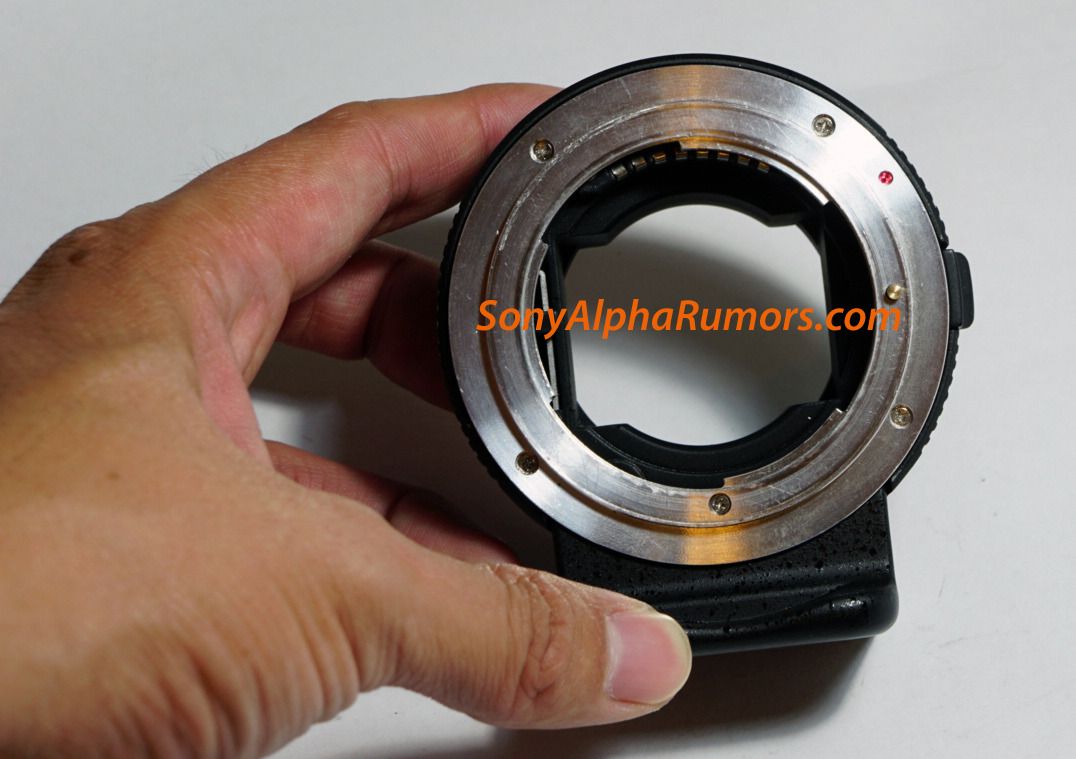 [/shoplink]
The developer team of the new [shoplink 38429 ebay]Commlite Nikon G to Sony E-mount autofocus adapter[/shoplink] sent me those two new test videos.
They are still improving the performance and fixing the noise issue. The final version should be ready by end of this year and go on sale on [shoplink 38429 ebay]eBay (like their other adapters)[/shoplink]. Price is yet not clear but it should be about the same as their [shoplink 38430 ebay]Canon EF lenses on Sony E-mount autofocus adapter (Click here)[/shoplink].
33 Responses
Those guys should watch the demo video posted yesterday about the Contax-E mount adapter.
If I have to judge the quality of the adapters by the quality of the demo videos, I think this will be shit and the Contax adapter willl be great …
Where is the video of the Contax adapter focusing at night?
Yes yes… I’m sorry but despite the night, the lamp gives a harsh and contrasted light. And the autofocus seems to choose its spots itself. Give me a spot af-s and af-c test in a real soft light (event, concert) and we can talk…
Yes because concerts are usually lit by small soft boxes?
I was thinking mostly about events, weddings, because this is what I do. But in concert you have a lot of different lights, you can find anything and its opposite. I’m not sure that this unique had light is really representative of anything that an event photographer would shoot…
Not bad. Still a few generations away from fast AF with Nikon/Canon lenses, but it’s a good start. Maybe by the time the a7 mV comes out.
Without a comparison done under identical conditions it’s impossible to say. DPReview had a technical article where they found the A7R II actually beat DSLRs in AF tests under low light, in large part because its hybrid AF system can exploit faster lenses. (Due to the way PAF modules work on DSLRs, they don’t properly exploit anything beyond f2.8, and even then with specific AF points (often it’s lower). Also, the AF was more accurate under low light.
It would have been nice to have some exposure information so we could have judged how low the light really was. As it is, it is still rather amazing it does work.
Beat under certain initial conditions. Use an 2.8 or F4 zoom changes things. Nevertheless, so far at weddings I didn’t encounter situations where my DSLRs failed. My A7ii did, however. But the A7rii should be better than the A7ii.
The A7R II is meant to be a great deal better. We’ll see.
But as you say, it needs fast lenses to beat the DSLRs.
It doesn’t have anything to do with the camera, it is an adapter limitation.
That ratcheting or chattering sound from the AF system doesn’t sound too healthy…
That’s why I say sensor Z-shift is needed xD
To save chattering sounds on Nikon lenses mounted to A series cameras?
I think it’s more likely that the very low light levels are causing relatively long intervals for reading off the sensor to collect enough photons and that’s causing the “jerky” response.
Yes xD
it’s more likely it repositions lens several times instead of one
would be great to have also the same kind of test with another camera than A7RII … A6000 ?
No there is no point in testing this with an A6000 or any other camera other than the A7rII.
None of the other cameras gets fast AF with this adapter. You are restricted to CDAF which is extremely slow.
Ok, I got you, thks. For my understanding, why it is a specificity of the A7RII ? Is it firmware-related ? number of collimators .. ? Can we image, this Fast AF (PDAF) could be deployed on others models ?
I honestly don’t know. It may be the 399 PDAF points but that allows fast with Sony A mount lenses and even Canon and now Nikon lenses.
Other cameras like the A7 II and A6000 don’t benefit from these adapters. AF is slow. 🙁
yes … but even with less points .. would be great to have PDAF on A7II or A6XXX with this adapter.
Mr Sony … if you read us 🙂
Of course it would be awesome !!! 😀
But I think its not possible else Sony would have at least updated the cameras to support their A mount lenses without the need for the mirrored LAEA4 adapter.
Good performance for a mark-1 prototype.
Any word on if this thing will report focal length on Nikon zooms in a way that can be used by Sony IBIS? Canon zooms are doing that, right?
I would hope so, but that would require Nikon zooms to the focal length encoded. Interestingly all A-mount zooms were focal length encoded, even before the advent of IBIS on the original Minolta DSLRs appeared, so there must have been a reason why it was required in the film era (perhaps for automatically choosing the appropriate shutter speed or some aspect of exposure control). In any event, I assume that Nikon zooms will still have focal length encoding even though they’ve never had IBIS.
Minolta introduced lens and distance information for their ADI flash system. It is just coincidence that this is used for IBIS. Sony still sells a few old Minolta designs without the encoders( such as the SAL20mm and 16mm fisheye), so check before you buy.
OK. I had an old Sigma zoom, bought pre-digital period, which broke and I took it apart. The distance encoding (which was detected using a few copper pads on the inside of part of the zoom barrel) was very coarse with large steps. I note that more modern zooms have far finer encoding levels (easy to see using EXIF data), and that has presumably come about due to the demands of IBIS. Something with a 30% error margin might not matter on flash exposure on film, but its a bit more serious with IBIS.
I guess with minolta/sony lenses the give-away if they have distance encoding is the number of pads. Distance encoded lenses require 8 pads.
In any event, the issue was about Nikon zooms and whether they are all distance encoded. I suspect all reasonably recent ones will, if only to support EXIF data (but I’d guess that it’s needed for flash too since you can’t use TTL flash metering bouncing pre-flashes off the surface of a digital sensor as you could with emulsions).
What the heck are they doing? The camera is set to 13 seconds exposure time with f1.8 at ISO 100. These cameras with settings effect on (live view simulation) will be absolutely balls at AF in this scenario. Seems people really have no clue how to work these and no wonder there are always ‘experts’ who have played around with them for 10 minutes in a shop saying ‘AF was slow and EVF was laggy’. The fact that it could AF like it did was a massive achievement, with the sensor starved of light like that, it should perform quite impressively when someone who has some kind of clue what they are doing gets it in hand.
yes, very faulty demonstration…
The exposure setting (12s at f1.8) is simply a result of it being set to ISO 100 in very low light. It will have precisely no effect whatsover on the AF capability. Whilst framing the image and feeding either the EVF or the screen, the sensor will be optimised to whatever works best for that purpose and it will not have anything to do with the ISO level that’s used when the photo is taken. The reason the display is laggy is simply the mode it has to run in to work at all in low light (it’s certainly not 13s laggy). The emulation of exposure setting on the screen in “liveview” is simply the best it can do to represent what the final image will look like (of course, if a 13s ISO 100 image photo was taken it would look vastly better due to the much higher DR than live-view will manage; or it would if tripod mounted).
So that 13s is irrelevant. The low light is what matters, and it’s amazing it works at all.
Well said Steve the sole point of the video is to demonstrate AF performance in low light
AF IS affected by the exposure settings you use on these cameras, not like a DSLR.
NO! The display is laggy because settings effect / live view is emulating the final shot, the readout speed of the sensor is very very low and as such so too is the AF. you are right it does not read out at 13 seconds but it does slow right down. Using settings that are actually closer to the shot you could take in that scenario or turning settings effect off will improve the AF performance regardless of lens.
You at least need to expose shorter than 1/20th of a second to get anything near a video feed. That would mean that the sensor either needs to be set somewhere around iso12800 or 25600 or the iso100 signal has to be boosted by 7-8 stops in software
Do you remember how much talk there was that OSPDAF will never work good in low light because of… um physics?