







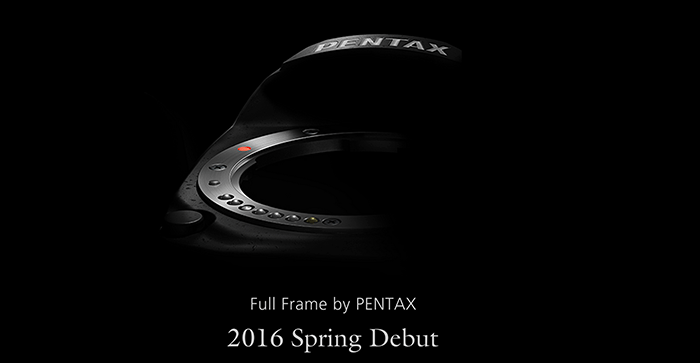
Today Pentax released the official teaser for their new upcoming FF camera. It’s highly likely the camera will feature a Sony FF sensor although it’s not clear if it will use the 36MP or the new 42MP sensor from the A7rII. A very interesting info is that the camera will feature a High Resolution shooting mode according to the reliable source Thistanaka.
As I reported in a previous post:
The same high resolution shooting mode feature is already used by their brand new K-3II:
The K-3 II is the first camera in the PENTAX line to incorporate Pixel Shift Resolution® for capturing still life subjects with ultra-high resolving power. Pixel shift technology uses the camera’s in-body Shake Reduction mechanism to move the image sensor at single pixel increments, capture 4 separate images, which are subsequently combined into a single high definition image. Benefits include higher resolving power, reduced false color and improved overall image quality of non-moving subjects.
If Pentax can use Sony sensor and their on sensor stabilization for high-resolution mode…than Sony should do this too! As Diglloyd reported such a feature on the A7rII could generate 144MP raw files of your…dead cat 🙂
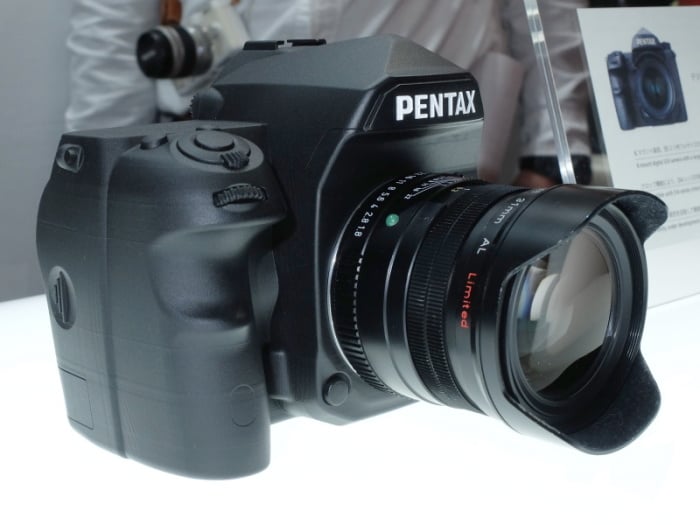
Image of the Pentax FF prototype at CP+ (Source: DC.watch).
182 Responses
Sony betray their A-Mount Base.
This will be the best FF DSLR. And it won’t be enough.
But where are the lenses ??? 😀
There are already 10 FA lenses (some available, some announced) and quite a few of the DA ones will supposedly cover FF.
You need to buy the 645z lenses 😉
Personally, I don’t understand this move from Pentax, in a shrinking DSLR market.
Me neither. Who is gonna buy a completely new fullframe DSLR system with only a few lenses (at release), from Pentax of all companies.
Pentax has some of the more ‘rabid’ fans who will post almost anywhere to promote Pentax.
This will satisfy the loyal Pentax fans but I can’t see this bringing any Canon or Nikon shooter over to Pentax.
Of the holy trinity of lenses (24-70mm, 70-200mm, 16-35) Pentax has just ONE of them.
These are bread and butter lenses for any system.
Maybe Tamron and Sigma could fill the gap?
Almost all new lenses from Tamron and Sigma are avoiding Pentax.
Even Tokina whose designs Pentax uses in some of their lenses even today – 16-50mm f2.8, 50-135mm f2.8 has stopped making their new lenses for Pentax.
Unless Pentax changes something radically I don’t see Sigma and Tamron coming back to making lenses for Pentax.
erhhh… they will add Pentax mounts to the lenses if Pentax has a full frame camera.
Thats very optimistic and honestly I would like Pentax to succeed.
In fact my first camera was to be the K100D but alas it was not available in my country so I settled for Sony.
But Sigma and Tamron have missed a lot of lenses for the more popular Sony mount and kept them for Canon and Nikon mount only.
Hmm. Tamron and Sigma are not avoiding Pentax, they just released their lenses for Pentax and SONY A-MOUNT with normally a 6-8 months delay.
Tokina never make any lens in the Digital era for the Pentax mount as they have an agreement with Pentax.
Right, there is less lens selection in Pentax mount thant CaNikon, but it’s about the same as the A-Mount and it’s at least enough for most users.
On a strictly product and business point of view, you are right. It’s too late for Pentax, they should have rather go full frame mirrorless now.
Using the Sony sensor in a mirrorless body with the Pentax approach (something pretty unique in mirrorless) : rugged body, ergonomicly minded body handling much better with F/2.8 zoom, larger battery and faster AF and FPS. But I fear that Pentax doesn’t have the money to develop this kind of breakthrough.
But on the user point of view. Many are looking for a FF camera, offering rugged body, fast and more reliable AF in lowlight and better battery life than what mirrorless can today offer.
If Pentax can put out the new FF camera at price point similar the the Nikon D610 or Canon 6D, it’s a very good value for new FF users.
I won’t consider another mirrorless camera, especially full frame, until the autofocus and general operation is as quick as a DSLR.
Brendon is right about rabid Pentax fans. But there’s a reason the users of these cameras love them. My own shift to Sony A7 series after using Pentax for so long has been a painful one.
Agreed. If I were on the fence now for a new FF system, I would either go with D750/D810 + Nikon 1.8G lenses (+70-200/2.8) or Sony. Having a complete Nikon system already, I complement it with Sony now. The A7rii + Batis lenses + 55 convinced me (doesn’t mean I don’t use the Nikon anymore. I like the responsiveness and handling at events).
You guys can read? Right? Check the list of lenses available for Pentax and see how many choices you get. Plus for now the best combination is Pentax with the Sigma Art lenses. Beat that with a full frame sensor and the sensor shift for full colour.
Why buy into a totally new DSLR system if we know that there will be a shift to mirrorless and knowing that Canikon shares 75% of the full market and even more in the DSLR market, which shrinks 15-20% a year? Pentax is niche here, for me. I have the Art lenses. Why would Pentax have an advantage to a similar Nikon sensor with the same lenses or A7rii with Zeiss lenses, other than pixel shift (which I don’t need and 99% in my opinion won’t use, too, unless you want huge landscape prints and don’t mind incredibly large files )? The sensor will soon be available with other brands, too. And lenses need to be bought, a big investment which I would make only if I could be sure that it is future proof. Maybe I underestimate Pentax, but I personally don’t believe it.
Why do anything? Look up the design and features in Pentax, take a peek at the Pentax K3II… you will then get some idea as to why, especially for landscapes.
Doesn’t excite me personally.
ok.
The image quality Pentax will get from the sensor will make a few people sit up and take note. Combined of course with expected excellent ergonomics it might just be enough to persuade them to try it out.
I was talking to Ming Thein about this. He reckons if Pentax get the 42mp sensor and make pixel-shift work with it, it’ll leave some medium format systems in the dust.
Are you trying to be funny? Or are just ignorant?
Here is the full list of currently available FULL FRAME lenses in the Pentax mount:
Pentax D FA 100mm F2.8 Macro100mmF/2.849mm1XPentax KFull-Frame345g67.5 x 81.3mm
Pentax D FA 50mm F2.8 Macro50mmF/2.849mm1XPentax KFull-Frame265g67.5 x 60mm
Pentax D FA Macro 100mm F2.8 WR100mmF/2.849mm1XPentax KFull-Frame350g65 x 80.5mm
Pentax FA 31mm F1.8 Limited31mmF/1.858mm0.16XPentax KFull-Frame345g66 x 68.5mm
Pentax FA 43mm F1.9 Limited43mmF/1.949mm0.12XPentax KFull-Frame156g63.5 x 28mm
Pentax FA 50mm F1.450mmF/1.449mm0.15XPentax KFull-Frame220g65 x 37mm
Pentax FA 77mm F1.8 Limited77mmF/1.849mm0.14XPentax KFull-Frame270g63.5 x 48.5mm
Pentax HD D FA 150-450mm F/4.5-5.6 ED DC AW150 – 450mmF/4.5 – 5.686mm0.22XPentax KFull-Frame2000g95 x 242mm
Pentax HD D FA* 70-200mm F/2.8 ED DC AW70 – 200mmF/2.8None0.13XPentax KFull-Frame1755g92 x 203mm
Samyang 135mm F/2 ED UMC135mmF/277mmPentax KFull-Frame830g82 x 148mm
Samyang 14mm F/2.8 IF ED UMC Asph14mmF/2.8NonePentax KFull-Frame573g94 x 87mm
Samyang 24mm F/1.4 ED AS UMC24mmF/1.477mmPentax KFull-Frame680g97 x 83mm
Samyang 35mm F/1.4 AS UMC35mmF/1.477mmPentax KFull-Frame660g111 x 83mm
Samyang 50mm F/1.4 AS UMC50mmF/1.477mmPentax KFull-Frame510g82 x 73mm
Samyang 50mm T/1.5 VDSLR AS UMC50mmF/1.577mmPentax KFull-Frame545g82 x 73mm
Samyang 85mm F/1.4 IF MC Asph85mmF/1.472mmPentax KFull-Frame513g78 x 72mm
Samyang T-S 24mm F/3.5 ED AS UMC24mmF/3.582mmPentax KFull-Frame680g113 x 86mm
Sigma 100-300mm F4 EX DG APO HSM100 – 300mmF/482mm0.2XPentax KFull-Frame1480g93 x 224mm
Sigma 105mm F2.8 EX DG Macro105mmF/2.858mm1XPentax KFull-Frame450g74 x 95mm
Sigma 12-24mm F4.5-5.6 EX DG ASP HSM12 – 24mmF/4.5 – 5.6None0.14XPentax KFull-Frame600g88 x 103mm
Sigma 120-300mm F/2.8 EX DG OS APO HSM120 – 300mmF/2.8105mm0.125XPentax KFull-Frame2950g115 x 289mm
Sigma 120-400mm F4.5-5.6 DG APO OS HSM120 – 400mmF/4.5 – 5.677mm0.24XPentax KFull-Frame1750g93 x 204mm
Sigma 150-500mm F5-6.3 APO DG OS HSM150 – 500mmF/5 – 6.386mm0.19XPentax KFull-Frame1910g96 x 252mm
Sigma 150mm F/2.8 EX DG OS HSM APO Macro150mmF/2.872mm1XPentax KFull-Frame895g80 x 150mm
Sigma 15mm F2.8 EX DG Diagonal Fisheye15mmF/2.8None0.26XPentax KFull-Frame330g74 x 71mm
Sigma 20mm F1.8 EX DG ASP RF20mmF/1.882mm0.25XPentax KFull-Frame520g89 x 87mm
Sigma 24-70mm F2.8 EX DG Macro24 – 70mmF/2.882mm0.26XPentax KFull-Frame700g89 x 116mm
Sigma 24-70mm F2.8 IF EX DG HSM24 – 70mmF/2.882mm0.18XPentax KFull-Frame790g87 x 95mm
Sigma 24mm F1.8 EX DG ASP Macro24mmF/1.877mm0.37XPentax KFull-Frame485g83 x 80mm
Sigma 28-300mm F3.5-6.3 DG Macro28 – 300mmF/3.5 – 6.362mm0.33XPentax KFull-Frame460g74 x 84mm
Sigma 28mm F1.8 EX DG ASP Macro28mmF/1.877mm0.34XPentax KFull-Frame480g84 x 80mm
Sigma 300mm F2.8 EX APO DG HSM300mmF/2.8None0.13XPentax KFull-Frame2400g119 x 214mm
Sigma 35mm F/1.4 DG HSM35mmF/1.467mm0.19XPentax KFull-Frame665g77 x 94mm
Sigma 50-500mm F4.5-6.3 APO DG OS HSM50 – 500mmF/4.5 – 6.395mm0.32XPentax KFull-Frame1970g105 x 219mm
Sigma 500mm F4.5 EX DG APO HSM500mmF/4.5None0.13XPentax KFull-Frame3100g123 x 350mm
Sigma 50mm F1.4 EX DG HSM50mmF/1.477mm0.13XPentax KFull-Frame505g85 x 68mm
Sigma 50mm F2.8 EX DG Macro50mmF/2.855mm1XPentax KFull-Frame320g72 x 64mm
Sigma 70-200mm F2.8 EX DG APO Macro HSM II70 – 200mmF/2.877mm0.28XPentax KFull-Frame1370g87 x 185mm
Sigma 70-200mm F2.8 EX DG OS HSM70 – 200mmF/2.877mm0.12XPentax KFull-Frame1370g87 x 198mm
Sigma 70-300mm F4-5.6 APO DG Macro70 – 300mmF/4 – 5.658mm0.5XPentax KFull-Frame530g77 x 120mm
Sigma 70-300mm F4-5.6 DG Macro70 – 300mmF/4 – 5.658mm0.5XPentax KFull-Frame530g77 x 120mm
Sigma 70-300mm F4-5.6 DG OS70 – 300mmF/4 – 5.662mm0.25XPentax KFull-Frame610g77 x 127mm
Sigma 70mm F2.8 EX DG Macro70mmF/2.862mm1XPentax KFull-Frame525g76 x 95mm
Sigma 85mm F1.4 EX DG HSM85mmF/1.477mm0.12XPentax KFull-Frame725g87 x 88mm
Tamron Di 70-300mm F/4-5.6 LD70 – 300mmF/4 – 5.662mm0.5XPentax KFull-Frame458g77 x 117mm
Tamron Di AF 28-200 F/3.8-5.6 XR28 – 200mmF/3.8 – 5.662mm0.25XPentax KFull-Frame354g71 x 75mm
Tamron Di AF 28-300 F/3.5-6.3 XR28 – 300mmF/3.5 – 6.362mm0.34XPentax KFull-Frame420g73 x 84mm
Tamron Di SP AF 28-75mm F/2.8 XR28 – 75mmF/2.867mm0.25XPentax KFull-Frame510g73 x 92mm
Tamron Di SP AF 70-200mm F/2.870 – 200mmF/2.877mm0.33XPentax KFull-Frame1150g90 x 194mm
Tamron Di SP AF 90mm F/2.8 MACRO90mmF/2.855mm1XPentax KFull-Frame
Boss
http://www.neocamera.com/list_lenses.php?mount=pentax&sort=flm
Awwwwh shame, it doesn’t handle Canon or Nikon Lenses very well…..;-)
Probably does 😛 Plus it has or will get the full Sigma Art line.
But the native lens lineup is not that great to my eyes and many designs are plasticky, without weather/dust sealing (which kind of contradicts Pentax’ rugged camera bodies). I also dislike the sometimes odd focal lengths.
This is arguable about some of the native lineup. However, you can always go with the Sigma Art lineup on the Pentax, so far 35mm, 50mm… and soon 24mm… the Holy Trinity, at least to me. The rest will come later… and if the Art lenses are not good enough, I really do not know what to say.
Yep, Sigma saves the day.
Wow I am impressed you went out of your way to make a list ! But honestly I was being more funny than serious which is why I used a smiley. But your list doesn’t have any serious lenses which will convince any Canon or Nikon guy to switch. Which makes this camera a very niche product and I feel the only people who would be interested in this camera will be existing Pentax users which isn’t a very large base.
It has the Sigma Art line. I use it as an example because you cannot argue with their quality… but there are other some very fine Pentax lenses too 🙂
… and it is reassuring to hear this was not serious, the list was from a link I posted below that got split by the other replies.
Well, they obviously need more newly developed lenses. But how many lenses is enough?
Since a massive part of Pentax user are action photographer who needs rugged body, a set of Tamron new zoom line and 1 or 2 Sigma Art or FA limited prime is more than enough for me: 15-30mm, 24-70mm, 70-200mm and 35, 50 and 100.
That body looks really huge. Should be a very robust.
What? It looks like one of the smallest (if not the smallest) FF DSLR to me. Only a little bit taller than the K3.
it´s a dead system..
Well, sleeping cats. I can barely get my cats to hold still for one shot, never mind four.
An FF version of Ricoh GR could be interesting. With E or M mount.
+1 — i have the gr and love it to bits! 100% flexible and so fun to shoot, the iq is top notch, very special rendering (esp. b&w). just wish it were ff and had a zoom lens, but that’d make it larger…
Yessssssssssss.
Deja Vu… That Pentax FF prototype … reminds me of … A900!
Sony can we please also have pixel shift
If, as reported, the high resolution mode moves the sensor 1 pixel at a time, it is not going to increase overall resolution. For instance, a 42MP picture would remain a 42MP picture. However, what it would do is produce improved fidelity in that all colours will be sampled at all locations. So instead of having 42MP with one colour channel at each location, there will be 42MP with 3 colour channels at each location (with the G channel being, in effect, a single bit deeper as there will be two samples; note that it’s because of the bayer 2×2 matrix that it requires 4 moves to produce full colour sampling at each location).
Note that this will require very accurate image stabilisation as to take 4 exposures at each location would require compensating for the tiniest movement of the camera.
For scenes where photos can be taken fast enough for movement not to make a difference, this will produce Foveon like result. In some circumstances this will even beat Foveon, say at ISO above 200 and low light.
However, Foveon will retain its true colour crown for situations where there is movement 🙂
It’s very true that this approach is only useful in very particular conditions, and that the ideal is a sensor that produces three colour channels at every point.
However, the Foveon approach, which relies on the fact that higher energy photons (i.e. those from the blue end of the spectrum) are more efficiently absorbed than lower energy photons (from the red end of the spectrum). What this means is that “red end” photons tend to penetrate further into silicon before “blue end” photons with a distribution inbetween. The problem is that this is a statistical distribution and in the Foveon sensor, which has the blue, green and red channel sensors at increasing depths, there is necessarily a very large amount of “pollution” of each channel with the “wrong colour” photons. It’s what’s called poor colour channel discrimination. It is possible to compensate for this using statistical techniques, but this sort of common-mode correction comes at a cost, and that is it only works well with strong signals (that is lots of photons detected). Once you get to higher ISOs the approach breaks down, which is when you start getting those awful artefacts you see with high(ish) ISO images off of a Foveon sensor. Unfortunately the shortcoming is inherent to the physics of the sensor. It’s not really possible to see how it could be greatly improved because, when all is said and done, it’s inherent in the statistical distribution of absorption of different energy photons in silicon.
Some other approach is really required, and one that can produce colour separation without throwing away photons (as any colour filter does). It points towards a prismatic approach, but I’ve not idea if there are viable designs around. Certainly there have been speculative patents, but none that seem to have progressed to working prototypes – at least not that seem to have been published.
nb. some video cameras have used multiple sensors with prismatic separation, but I can’t see that approach working on a still camera where the aim would surely be to be able to use existing lenses and mounts. It is also extremely bulky.
There can be compromise between 3x color splitter and CFA, I made a post on dyxum about that
And color splitter isn’t more bulky than any D800-like design, but there will be problems with shutter and PDAF
3 times colour splitting reduces the available light by a factor of 3… i.e. about 1.5 stops… so similar problem with sensitivity as Foveon.
Nope, you’re not getting it. in color splitters, each sensor receives as many light as bayer sensor
Really… so how? Colour spliiter? Or what exactly?
I was talking about splitting light in 3, having 3 sensors, each with one colour filter over it instead of the current Bayer array. You could make the pixels BSI and bigger to compensate for the splitting of light.
Colour splitters work by splitting the beam into separate colour channels (a prism is probably the best known way of doing it). In contrast a colour filter just absorbs the “wrong colour” photons and they are lost.
As hinted at, there are colour video cameras that split the light prismatically sending the three coloured images to three different sensors. Early colour TV cameras worked that way and it was also quite common among some video cameras although largely displaced by single sensor systems with filter arrays. The three sensor approach becomes increasingly difficult with higher resolution as it requires exquisitely accurate alignment which is very expensive.
One other problem is that it’s bulky and expensive to do it that way (imagine fitting three FF sensors into a body).
The ideal is to have the colour separation occur at each pixel on the sensor.
I have written this idea here before: alignment is not a problem. Etch a known pattern of dots into a filter window and then use this pattern to align images between sensors. I’d be more worried about accurate colour splitting.
Yes, the rest of it would result in a big camera, but I would sitll buy it.
That’s absolutely not the case. The reason is that ALL the light from those split channels gets to the sensor and can be absorbed to produce a signal. With the filtered approach you only get green channel information from half the image area and just one quarter in each of the red and blue channels (albeit it’s not quite that simple – the filter spectral profiles actually overlap to some extent, in part to mimic what happens in eye’s retina as the cones responsible for colour perception also have overlapping spectral profiles). In fact it’s worth noting that the technology of photography is specifically tuned to mimic the human eye. Other animals with different numbers of colour channels (some have two, some four and even five) will find the way colour is captured and rendered would look a little odd to their eyes.
So the sensor would get to process all the light. That green channel would (on average) be twice as strong as on the bayer pattern when measured across the sensor and 4 times as strong for each of the red and blue channels. (Note that, as mentioned above, it’s not quite that much due to the overlap in the spectral profile of the filters).
Current Bayer sensors already beat Foveon, esp since you can have 36-42 mp FF sensor.
Beat in what exactly?
Why would it be game changing? Many people happy with 24 mp bayer, and don’t ever want 42 mp full-color (which would be only marginally better than 42 mp bayer)
Only marginally better? LOL 15 megapixel Foveon was matching the Nikon D800E in sharpness and exceeding in colour microntrast… so a 42 MP full colour will match about a 80 MP Bayer or more.
No. 42 mp full color ~ 64 mp bayer on real-life samples
… and you know this HOW? Like I said, the 15 MP full colour Foveon (APSC) was matching and in some aspects exceeding the full frame Nikon.
So, what is a CORRECT estimate from this for a full colour *FULL FRAME* 42 MP?
It would be a great deal better. It would mean an APS-C sensor has the potential to perform (in low light) better than a bayer pattern FF sensor. It would also eliminate colour moire patterns (as seen in some of the D810 test shots on that test I linked too).
So if we can have an APS-C camera with better performance than an FF, who could knock that? Alternatively, you could gain a stop or more performance at the same size and get much more faithful rendition of detail in coloured areas (again, see those examples). That a Pentax APS-C camera can match, or even exceed a D810 in many areas is extremely impressive,
(Note that for DR on APS-C to match the FF, it would require each colour channel at each pixel location to have a full well capacity approaching that of the single channel ones we get at the moment).
If you’re going to use the word “resolution,” then your contention is incorrect. Four single pixel shifted images combined would have higher measured resolution than Bayer, simply because some of Bayer’s “resolution” is interpolated and incorrect. Technically, the pixel-shifted image would look like it has increased acuity to most people. Beyond that, it would have less noise.
Having used the Olympus version, it’s an interesting tradeoff: the shift mode really requires static subjects, but it does produce better images of same.
I was using resolution purely in terms of the number of pixels (which ought to have been clear from the context). I realise it’s imprecise, but then any use of the word resolution requires some qualification as to how it is measured. The term resolution is commonly used in terms of the number of pixels a camera offers. There is not single usage of the term, and I wasn’t referring to acuity as such.
You will see I talk about interpolation on the second half of that posting. I’m aware of the issues it causes and what that does to the sharpness and detail in the image. It is particularly important in the detail in areas which are of broadly the same colour (which can easily be seen from the images on the link). It is less critical in the black-on-white contrast areas.
In any event, that loss of detail in areas of similar colour is the bayer (and other) filter pattern’s dirty little secret. Getting rid of the need for colour filtration without the shortcomings of the Foveon approach is one of those wholly grails of sensor design along there with things like the global shutter.
Of course, just the fact that several exposures are being combined will lead to a reduction in noise on its own. Stack 4 exposures and it will reduce noise, simply because the SNR is better. You have, after all, collected 4 times as many photons. Even though there’s more noise to, it doesn’t outweigh the benefit. But that’s a by-the-by. The most critical point is that it eliminates the need for interpolation to fill in those gaps in the colour channels.
Olympus uses half-pixel shifts, as far as I know. This requires using better lenses and staying at lower f-stops for making full use of it.
They use half and full shifts (eight images). The full shifts give better acuity and noise, the half shifts increase resolution.
The Pentax high resolution sensor shift doesn’t increase the nominal linear resolution, but it massively increases the image information. The Imaging Resource comparison showed that the 24mp K-3 II held it’s own against the Nikon D8xx. Regardless of whether it is 36mp or 42mp this would produce incredibly detailed images, well above what a bayer filtered camera of that linear resolution could create.I think potentially sensor shift has got massive potential for natural light macro photography, where the subject has to be perfectly still for a conventional exposure. I’m surprised that Sony hasn’t come up with their own version, because their IBIS should facilitate it. With a high resolution shift mode, the A7r II could probably outresolve most MF cameras.
Personally I think it is best implement by not increasing the nominal linear resolution, and creating none bayer filtered type images. I’d eventually expect most cameras with IBIS to eventually have it, as it’s effectively a free lunch type feature. There’s plenty of photography which involves photographing still subject, and where resolution is important.
What happened to the RX1m2 rumours?
Any news on that front?
Hoping to hear something like an A7rII but in RX1 form factor with the same or improved lens.
If Pentax launch an A-Mount adapter to K-Mount will be my next purchase.
Given that they both have the same flange distance I’m not sure how you would do that.
Harpy to be wrong.
Technically I know, but I can not dream?
Sony should just let them release the camera with an A mount. Day one purchase.
The company name “Pentax” is now hopelessly out of date. Don’t know anything else about them except that they use this funky flip away mirror technology.
Have you ever try a Pentax K-3 ? I would pick it before any other DSLR with APS-C sensor. Their biggest problem now are money to advertise their stuff, but it’s good stuff. If there is no A99ii I will pick a Pentax FF without hesitation.
I think you’re definitely getting a Pentax FF then…
Pentaxrumors!
it’s OK, just 10 years late.
Finally I can show my friends my FA31mm silver lens
Well the most iconic pics where taken before that time. Unfortunalty now adays there are to many wonabys with thick wallets showcasing latest gear
DSLR in 2016? Is it an antique show?
Even Ricoh/Pentax will make better use of Sony sensors than Sony now.
No doubt, it will be a full-size camera with weather-sealing, cross-type / double cross PDAF, fast burst rate, big buffer, fast operation, big battery and proper lenses.
Sony… will pump out another ‘but but it’s compact’ A7x.
I expect it to be a dream camera, despite the ugly design. But I don’t like the Pentax lens lineup. There is much work to do.
Sony’s sensors, Pentax’ cameras. Nikon’s industrial design. Canon’s lens lineup. Imagine if they would come together seamlessly. But this is just a dream. 🙁
The A7 is an ugly design since it looks like a brick! The Pentax mock up looks like the Sony A900!
A900 was much prettier
Agreed. The A850/A900 is the only really good Minolta design.
Come again?
We may argue if the A7 is ugly or not, but the fact that something looks like a brick does not make it necessarily bad or good design. There are outstanding industrial designs that look like a brick.
A7 is ugly- it really is. Now the mock up above needs trim around the grip and a few other bits to offset the upper deck layout, etc.
+1,
This will be the camera that I buy if there is no more A-mount!
very exciting. They hey days are back of multiple brands competition and innovating. IT’s like everything is waing up again after a 10 year hiatus. I guess it will either have something similar to the a7 II or the a7r II.
I think what is going on with Pentax is that if their crop sensor users want to step up, the 645z system is way too big of a leap. The users jump to Canon/Nikon/Sony. Probably looking to fill the gap. Now, if Pentax wanted to really turn heads, Make the Medium Format system priced like a 5ds. Plus, the cost to produce a FF vs crop camera is pretty much about the same.
I’m looking forward to see how the camera performs. I hope it is a good one.
if cost to produce aps-c and ff is same why there are sub-$300 aps-c cameras but no FF?
Market segment. Obviously there is R&D, etc..however, do you think manufacturing the 5DSR cost ($6200 US) cost more to produce the 5diii ($2400)? Let’s say Toyota produces a mid size car and sells $25,000, The lexus version of vehicle that sells for $45,000 in reality only has approx $5000 added cost to manufacturer (nicer features, technology). They are built on same assembly line together.
I think with 50 mp sensors they end with much higher defective ration than with 22 mp sensors.
So why no manufacturer would occupy niche of $300 FF cameras? would sell like hotcakes.
Would they? First I’d say that manufacturing an FF camera with a $300 price point might be very difficult. The sensor is inherently over twice the price of the APS-C one, just in terms of the surface area being 2.25x higher (so fewer sensors per wafer). To that must be added that wafers are circular whilst sensors are rectangular. The fill factor is lower as sensors get larger, as they don’t fit as well. More wasted space (bigger wafers help of course). So I suspect the reduction in units per wafer is even higher than the 2.25:1 ratio. Then there’s the factor you mention. A larger sensor is statistically more likely to have a default thus the yield is further reduced.
In short, even excluding the smaller volume (and hence the number of units over which fixed costs must be recovered) an FF sensor is almost certainly several times the price of an APS-C.
A few other things have to be scaled up of course, most obviously the shutter but also IBIS (if it has it), and if it’s a DSLR, the mirror mechanism and OVF.
However, even though this would be significant, it’s clearly not enough to explain the cost difference between an FF and APS-C body. However, the biggest barrier of all is surely that of the cost of lenses. For digital sensors to produce good results requires high quality lenses and those are much more expensive for FF than cropped frames (for equal FoV and maximum f-stop). The sort of budget FF lenses that were available in the film era simply won’t do on an FF digital camera. You might as well stick to the smaller form factor and have a better quality lens for the money.
It’s not as if there aren’t some FF bodies around that are comparable in price to top-end APS-C. It’s just that I suspect if you are that dedicated to quality then you will be prepared to pay a premium on both lenses and bodies. If you are paying $1,000+ for a lens, then maybe a $2,000+ body doesn’t look so ridiculous.
Where do you get those numbers from? Or, are you just throwing random stuff around? A bigger sensor costs more and is the most expensive part of a camera. Of course, the added cost will rarely be proportional to the increase in price, as the manufacturer must also take care of the demand.
You have huge amounts of fixed costs. How much they contribute to the final retail price depends on how many cameras they can sell. If APS-C cameras wouldn’t be produced anymore, we would see cheap full frame cameras for the masses. Like it was back in the 35mm film days when every camera was full frame. Before the Leica was invented, there were even cheap medium format cameras for the masses.
But thats just theory. We will see what happens.
Film is easy to manufacture in big chunks, but digital sensors are not.
Yes, you are right, but the variable costs per unit, while not the same, are in a similar range (FF vs APSC sensors). That’s what the OP was trying to say, but ignoring the huge impact of the fixed costs.
I think everyone below has read too much into what I was saying. Sure R&D, etc has additional burden. However, at the end of the day, even with R&D, etc, the 5ds does NOT cost that much more to produce than a 5diii. If pentax already has a system set up to produce crop cameras, it’s not a giant leap to produce FF within that system.
I’ve was a manufacturing executive for over 20 years in the auto industry before becoming a full time photographer. This is normal for most industries. Many factors are involved..R&D, advertising, manufacturing location, shipping, materials. The sensor technology does not COST Canon $1200 per unit more than the 5diii. Probably $100 or less. When I was with GM a Cadillac (Escalade) version of the Chevy SUV (tahoe), back in early 2000’s, only had $2500 (approx) more cost associated per vehicle. Yet the truck sold for more than $25,000 over the Chevy. Same assembly line, mostly same components. $2500 included finer leather, different exterior front and rear panels, handles, suspension, etc. Now the Cadillac had its own “program” for advertising, etc…chevy had its own as well.
If it’s A-mount, I’m buying it
You will not be buying it.
I still don’t believe it. Something will happen, world war, zombie apocalypse, meteorite impact, but there will be no pentax FF camera
42 Mp is out of the question. This is not 42 vs 36.
The real question is: Will this be 36 Mp, or 24 Mp?
… and 24 MP full frame camera with a good sensor and very good features is somehow bad to you? Say for low light and dynamic range? Why exactly?
Where did I say 24 Mp was bad?
ok. I am now actually hoping this is a 24 MP BSI full frame 🙂
Still think you are describing a D750. The only things that would make the Pentax FF a better choice would be a lower price and more FPS…
Or, and maybe that superb pixel-shift mode and IBIS stab system.
Why is it out of the question?
Price points such as 2000 USD has been thrown around. Only delusional Pentax fans believe their Pentax will take a loss per sold device for their sake.
Second consideration: Does Sony have enough 42 Mp sensors for themselves?
Place yourself in Sony’s image sensor division’s shoes. Who would you rather sell your limited 42 Mp sensor to, your own sister division? Or Pentax?
The first point I concede, but you forget that Sony has done just that with Nikon before the A7R series came around.
That is true about the 36 Mp sensor. But Sony has proven with the A7S that their own camera division now has higher priority to some of their sensors.
But that is also exactly why I say the 36 Mp sensor and the 24 Mp sensor are the two contenders. They are sensors that are available to 3rd party partners.
Sony is going to sell their sensor to everyone they can. Because that is business. The 36mp sensor is so old by now, that Pentax would be very dumb to pay for it.
First of all, can you answer why Sony has not sold the A7S sensor to anyone but themselves yet?
Second of all. That 36 Mp sensor is responsible for the D810 which everybody loves. Pentax should feel privileged to even have access to it.
If you think Pentax is in a position to be picky and choosy, then you’re out of touch with the situation they are in.
“First of all, can you answer why Sony has not sold the A7S sensor to anyone but themselves yet?”
Nobody in photo market especially interested in 12mpix FF like it’s 2007? And video market is covered by proper formatted (8.3mpix) sensors?
Nice guess, but it was a trick question. DPreview has an article/interview with a Sony executive who explicitly said the A7S sensor is exclusively for Sony cameras.
If you believe everything a company executives are telling you, I have a bridge to sell you…
Although he might have been right on that one – there is no market for such sensor in 2015 outside of Sony itself.
You’re clearly wrong about this one too. The 1DX / 1DC exists. Nikon has the D3 / D3S / D4 / D4S. The market clearly exists for these companies.
On that note, you must be wrong about the Sony executive as well. When the thing they say aligns with reality, then he’s probably not selling you a bridge, he is just being factually correct.
Does Sony have enough 42 Mp sensors for themselves?
Yes. Not like A7RII is out of stock or anything.
It used to be out of stock in many places, waiting lists up to several weeks. When we approach holiday season, there might be stock issues again.
The yields by the time this camera is in production will be more than sufficient for Sony to be able to satisfy Pentax orders.
I wouldn’t be so sure about that. Full Frame BSI is really difficult to manufacture. I think it’s bad idea to assume they have full control over the process and design, when they are the only company in the world who is barely even capable of this type of chip. It’s uncharted territory.
A third consideration for you. Would Sony earn more money on a wafer full of healthy smartphone sensors? Or would they make more money on making a boatload of faulty Full Frame BSI sensors, and selling the functional ones to Pentax?
Keep in mind the Pentax camera is projected to be really cheap for a FF DSLR, so they might not be paying Sony as generously for those sensors as you think.
Also keep in mind Sony has capacity problems, they can’t produce enough smartphone sensors as is, they are expending their fabs massively more than ever(for smartphone sensors), indicating the smartphone sensor business if far more profitable.
While the smartphone sensors certainly bring in much more revenue, large sensors are almost certainly more profitable per sensor. I do not doubt the difficulty in production, but the yields will certainly ramp up by next year in which time selling them to Pentax (who will probably not be ordering the type of quantity like Nikon or Canon) would be a good way to offset R&D for this sensor. Additionally, this camera body will offer little in the way of competition for Sony bodies (particularly if they are dropping a-mount bodies).
You did not put 2 and 2 together. Sony had capacity problems in 2012, they build a new fab, later they still have capacity problems, and outright buy fabs from existing foundry competitors, in 2015, they have even more capacity problems and builds yet another billion dollar class fab.
Look at the larger picture, they have capacity problems. This means they have to use their existing capacity on smartphone sensors. Why? Because they are more profitable per wafer.
You do not waste your capacity on Pentax when you have capacity problems.
The A7Rii serves as a Halo product. The market leader.
They do not have to depend on Pentax to make back money, when they can get even more money from a smartphone wafer.
Please think about this more carefully. Sony does not owe Pentax anything. Sony does not need to undermine its own A7Rii, it does not need to undermine its own Halo product to satisfy Pentax fanboys.
Nor does Sony need to withhold a7rII sensors to satisfy Sony fanboys will outsized senses of entitlement who will feel less special if another camera uses the same “film.” I wrote that if/when the yields become better (from the same fans) they can sell these sensors down the road next year. By then, demand for the a7rII will be satisfied and the Pentax production run will probably not be particularly outsized anyway.
You’re talking with your feelings now, I have no use of this.
You’re wrong because Sony actually does benefit from having their fanboys gaining the upper hand in internet fanboy wars. Cold fact, no feelings.
You’re wrong because Sony actually does benefit from the bragging rights of having the “top” camera with the “top” sensor. Cold hard fact, no feelings.
You are clearly wrong and you can’t see this. You don’t understand what a Halo product is. You don’t understand Halo products don’t have to pay for themselves. And you don’t understand that Sony’s image sensor division is making a killing on smartphone wafers.
And I wrote that Smartphone sensors are the reason Sony is building more Billion dollar fabs. You clearly do not understand what a “capacity issue” is. Let me explain to you that Sony’s production capaticy is limited.
What does this mean? This means their smartphone sensor product is incredibly profitable to them, but they can’t produce enough.
This means for every wafer where they make A7Rii sensors instead of smartphone sensors, they will lose money.
Getting less money is a bad thing compared to getting more money.
You fail to seem to grasp a number of things. One is the difference between revenue and profit. I will not explain this basic tenet to you, you can use google. A sale of an a7r2 sensor earns a great deal more profit than a mobile sensor. Sony will not reveal the numbers to casual onlookers like you or I as to how many cell phone sensors would need to be sold to equal the profit of an a7r2 sensor.
Two – I am talking about exploiting the fab(s) currently in use for maximum profit not taking away resources from mobile sensor production. Do you expect them to continually convert the a7r2 sensor fab to mobile sensors and then back again when they need another a7r2 production run? Of course not, this fab will always be dedicated to full frame sensor production. This sensor is going to be used for quite some time. The a7r3 will almost certainly use the same sensor. Between these releases, Sony could exploit production by selling to 3rd parties.
Three – You fail to grasp the difference between a fact and an opinion.
” You’re talking with your feelings now, I have no use of this.You’re wrong because Sony actually does benefit from having their fanboys gaining the upper hand in internet fanboy wars. Cold fact, no feelings. ”
While I agree that I had given you my opinion, you should be aware that your above quote is entirely a value statement (100% opinion). There is nothing factual in the above statement. A fact is the following: The sun rose at 6:38 am today. An opinion is: Sony benefits from fanboys having an upperhand. Not only is this an idiotic opinion, you did not even back it up with any supporting arguments to bolster this ridiculous claim. You did betray yourself as a Sony fanboy who does not really want to discuss Sony profit strategies but someone who merely seeks to illogically defend their silly hopes of owning a camera that has a sensor unique to it in the false assumption that it will make photos taken with said camera unique.
Which leads me to four – it is the photographer (with his/her vision and skills) that crafts special photographs not a sensor in a box.
All the more reason for Pentax to not need the A7Rii sensor. I don’t even know why you put up this as argument.
There are a number of unknowns here that are a burden to you. The fact that Sony has not disclosed this info is all the more a burden on your argument. You don’t know how many healthy A7Rii sensors that come out healthy in a single wafer, for all you know that number could be anywhere from 10 to 55.
Do you know how many iPhone 5 sensors can come out of a wafer? up to 3994. Put the math together.
In the best case scenario for you, the production is flawless, then you get 1 A7Rii sensor for each 72 smartphone sensors.
In a worst case scenario where the sensor is a bleeding edge, first of its kind, and difficult to manufacture, you could end up with as little as 10 functional A7Rii sensor per wafer. In that situation, you could get 399 smartphone sensors for each A7Rii sensor you manage to produce.
The selling price of an A7Rii sensor is only a single factor among multiple factors in this equation. The production cost of a single A7Rii can be anywhere from 72-399 smaller smartphone sensors.
So your A7Rii sensor would need to sell for 72-399 times as much money as a Smartphone sensor, to be profitable.
To illustrate what a ridiculous situation you’re in, lets take 300 as example. If Sony can sell a Smartphone sensor for 5 dollars, they would need to ask 1500 dollars from Pentax for each A7Rii sensor, just to not lose money compared to selling batches of smartphone sensors…
That was to give you a perspective of the situation. Keep in mind I was being nice to you in this comparison and I pretended that simple smaller sensors need a manufacturing process as expensive as the world’s most sophisticated Full Frame sensor. Reality won’t be as kind to you as that, reality has an additional factor going against your argument. The bleeding edge manufacturing that is required to produce an A7Rii wafer, is far more expensive than the process required to produce a simpler, cheaper smartphone wafer.
Do you understand now the ridiculousness of your standpoint?
You’re displaying a massive amount of ignorance here. For your information, fabs are partitioned into multiple production lines. These lines are retooled to output different products all the time. You’re simply Wrong on this one. Wafer batches are made to order, months in advance.
The A7Rii is a halo product. Its main purpose is to show off the technological prowess of the camera/sensor maker, placing them on the map compared to its competitors, and make the enthusiast market excited and hyped for more while they put it on the top pedestal.
This is not idiotic. It’s incredibly sound strategy to have what is perceived as the best sensor and the best camera exclusively in your own product line. The market’s perception of a company goes hand in hand with how its enthusiasts spreads the word onto their colleagues and the rest of the internet. This is just how the world works
This notion is quite ridiculous. Just like billions of other people on the planet, I don’t even own a A7Rii, hence the capabilities of the A7Rii is not unique to me in any sense or meaning.
My bet is you don’t even realise how ridiculous you are.
Well, it seems I must have hit a nerve considering how quickly you put out that essay.
” I don’t even know why you put up this as argument.”
You believe that Sony needs keep certain sensors for Sony only products. That has been at the core of all your arguments – the one I think would be a poor strategy. Sensor exclusivity to alpha cameras is both unnecessary and a poor business decision. Hence the above.
“There are a number of unknowns here that are a burden to you. The fact that Sony has not disclosed this info is all the more a burden on your argument. ”
I agree. All of these unknowns are a burden to your arguments as well. You arguing with a vast array of far more wishful assumptions. It is a fact that Sony has not disclosed these particulars to me. Have they disclosed them to you?
I have been present at recent analyst meetings for Intel, Cymer, and Ultratech but unfortunately not Sony. Have you? Otherwise, please cite your sources for all of the assumptions you are throwing around as supporting evidence so they are not viewed as worthless.
“If Sony can sell a Smartphone sensor for 5 dollars, they would need to ask 1500 dollars from Pentax for each A7Rii sensor, just to not lose money compared to selling batches of smartphone sensors…”
$5 for a cell phone sensor is optimistic, $1500 minimum to be profitable on a full frame sensor sounds overblown. Tell me, why would Sony bother producing anything but cell phone sensors based on your logic?
I would wager that cell phone sensor margins are razor thin and the slightest hiccup in forecasting and orders could result in a heavy quarterly loss. There is also more competition and a lower barrier to entry for cell phone sensor production. Sony’s Tomoyuki Suzuki said the following:
“When it comes to semiconductors, if you can’t make use of production capacity you quickly end up with a loss. So if you want to avoid that volatility the important thing is to have good balance with several customers.”
The mobile market is far more volatile. The diversification that comes with selling mobile, 1″, maps-c, full frame & MF brings Sony a good balance.
“The bleeding edge manufacturing that is required to produce an A7Rii wafer, is far more expensive than the process required to produce a simpler, cheaper smartphone wafer.”
I agree, this is precisely why Sony needs to maximize it’s R&D and engineering efforts to sell off all inventory not needed for alpha cameras to 3rd parties thereby bringing down the costs for Sony, increasing ROI and improving the efficiency and scale of production.
” You’re simply Wrong on this one. Wafer batches are made to order, months in advance.”
I could very well be wrong on this one, but considering the quantity and variety of full frame sensors that Sony produces (and the aforementioned specialization of BSI sensor production) it may very well be safe to assume that Sony has dedicated large sensor production line(s) (aps-c, full frame & MF) that have nothing to do with mobile phone sensor lines.
“The A7Rii is a halo product…”
Disagreed. The Sony strategy, which has worked quite well, has been to produce top class sensors, sell these to a variety of customers and also integrate them into their own products since they have the cost of R&D and production spread out and paid for by their camera partners / competitors. Moving from a camera producer who happens to build sensors (like Canon) would be a bad strategy. The a7r2 may be a halo product but not because of the sensor. If it is a halo product it is thanks to the adaptability of the e-mount, the new IBIS system, the maturation of the a7 line and the advanced features taken as a whole. The image quality improvement over the d810 is not enough for switching but all of the preceding benefits which I mentioned are.
Now look you’ve made me write an essay too. It was fun debating this topic, but I have to rest my case here. You’re welcome to reply but that’s enough time on this topic for me.
Plain wrong. I don’t believe they need to, I believe it will be advantageous for them to do so.
Sony believes this as well by the way. I can link you to this interview here: http://www.dpreview.com/articles/0661793352/photokina-2014-sony-interview-we-still-need-to-create-more-lenses
“When we make sensors we put them in several categories. [At any given time] one category of sensors is reserved purely for Sony cameras – we don’t sell them to other companies. Like the sensor in the A7S. But once we’ve enjoyed this advantage we might sell them on later, after some time has passed. This is the second category.”
So Sony apparently agrees with me. They’re not going to sell the A7S sensor until they have something else superior to it.
So far, the pattern is the same for the A7Rii sensor, which is an even bigger halo product than the A7S sensor.
I don’t know what universe you live in, but in this reality it’s never a poor business decision to have the top product in the top pedestal among other things.
And unnecessary does not equal bad. Yes, this advantage is technically not necessary for their survival, but it’s not bad to keep the advantage. It is an advantage for Sony to have the top camera with the top sensor. When you enter the realm of reality, you may realize this.
No it is not because, in this reality where you do not live, smaller sensors on a wafer will result in higher yield.
It takes a few errors to destroy a single iPhone 5 sensor, but said same amount of error can destroy a Full Frame sensor as well.
The first factor going against you, is that a few errors will destroy a disproportional far bigger area in a Full Frame wafer than in a smartphone wafer. 20 errors can destroy 20 out of 55 Full Frame sensors, those same 20 error would destroy 20 our of almost 4000 smartphone sensors.
The second factor going against you, is the bleeding edge process used by the A7Rii sensor is more immature and far more prone to errors than normal.
Both these factors weigh to my argument, and they are a burden to your argument.
Furthermore, the bleeding edge process to manufacture the A7Rii sensor itself is more expensive as well. That is a 3rd factor to burden your argument.
These factors are not wishful, they are reality when you produce bleeding edge microchips.
This one is pure gold. First you’re displaying complete ignorance about the enthusiast camera market. The bulk of the profit comes from the overpriced Full Frame lenses, not the bodies.
If Sony wants to sell a lot of Full Frame E-mount lenses, they will be better off to have the best camera bodies. Hence Sony produces other things than just Smartphone sensors.
Secondly, It doesn’t matter if you think this is optimistic or overblown, it was to give you a perspective. It could have been 2 dollars vs 600 dollars and the point would still be the same.
You are correct when you say the smartphone market has more competition. But the margins are not razor thin as you want to imply.
The margins are healthy enough that Sony has expanded fabs for Billions of dollars since 2010. You do not invest billions into a market that gives such risky razor thin margins. So you’re most likely wrong about this.
What makes you correct is the indirect implication that Sony only has 1 competitor in the current Full Frame sensor market, and that is Canon’s 50 Mp sensor. You are correct that Smartphone market has higher competition, but this is against your argument, because Sony has full control over the Full Frame sensor market at this point, unlike the Sensor market.
Canon will never give away its 50Mp sensor to its rival Nikon, nor will they give it away to Pentax. That means Sony has full control over how it wishes to forcefeed Nikon and Pentax.
You’re taking his statement out of context.
He is talking specifically about their smartphone partners, like Apple, Samsung, Xiaomi, etc.
In the correct context, he is saying “Of course we will meet the requirements of our top customer[Apple,Samsung], but we are expanding capacity with orders from Chinese smartphone makers in mind”
This has nothing to do with Pentax.
The mobile market is a monstrosity that keeps growing with no end in sight, it’s volatile in the good way, so please don’t use this in negative connotation.
No. The return of their high end investment is already paid for by the booming Smartphone sensor sales.
Sony will not maximise anything by cutting down on their Smartphone production to satisfy Pentax. They will only hurt themselves by removing the Halo effect from their A7Rii.
That’s because you are indeed very wrong on this one, it would seem that all your trips to visit Intel, Cymer and Ultratech has taught you nothing.
No company is insane enough to lock their Billion dollar fabs into dedicated production of a shrinking low volume market like the Full Frame camera market.
The quantity and variety of their Full Frame production is ridiculously small. You simply do not waste billion dollar high tech fabs on this, you mix up multiple production lines, and this includes smartphone sensors which also features the same BSI manufacturing.
You’re also wrong to think BSI is a specialisation for Full Frame, it was actually made for Smartphone sensors first and foremost.
Except, this move killed the A-mount Camera sales. This move bolstered Nikon, and killed the A-mount.
You are simply out of reason.
The objective of your argument is to kill the A7Rii camera, destroy its sales and have its sensor go to Sony’s competitors.
I welcome your white flag and capitulation, because quite frankly, you’ve cornered yourself by making wrong arguments and and straight up falsehoods one after another.
Moving on from the the subject that I rested my case on but re a-mount death (I do not have time to address your many inconsistent, erroneous or incorrectly interpreted statements prior to your closing):
Sony’s sensor strategy did not kill the a-mount. You could not be more wrong. Sharing the a99 sensor with the RX1,a7 or selling it to Nikon (d600) did not kill the a-mount.
Sony’s lack of marketing, nebulous commitment statements with no new releases and clear transition from a to e mount is what is dooming the a-mount. Sony clearly wants consumers to purchase an e-mount body over an a-mount body. Not having unique-to-the-camera sensors in a-mount has nothing whatsoever to do with it. If you believe profiting from sensor sales is dooming the a-mount, well…I don’t need to make an ad hominem attack on your IQ if that is the case.
You’re simply deaf to reasoning. You don’t understand that having every bit of competitive advantages is a positive thing that adds up.
The A7Rii having the best sensor, is a positive advantage in its favour. Even a 5 year old could understand this. When you are in a cut throat market like this, your camera needs all the advantages it can have its grasp on.
At this point you must be borderline trolling anyway. Only insane people would give away the competitive edge the A7Rii has, to their competitors.
The other way around. You’ve been giving out false facts in this entire discussion, everything from believing billion dollar fabs are dedicated to low volume products, to being clueless of the main revenue of the FF camera market.
1 – You ignored my focused response to your ridiculous assertion as to why a-mount is dying because you realize your reasoning was absurd.
2 – I have stated before that the advantages of the 2nd gen a7 e-mount camera line is ibis, adaptability, evf, etc. and not a sensor part. Selling the sensor to Pentax gives away zero competitive advantage particularly if Sony chooses not to compete in the dSLR space anymore with a-mount SLT cameras. At this point, even if Sony does release an a99-2, it will basically be for existing a-mount users not switchers.
By going back to your original line of false logic that Sony needs to reserve the a7r2 sensor not because of production problems or opportunity cost but because it makes the a7r2 special you once again put the Sony fanboy on display.
A camera is greater than the sum of its parts and modern sensors are so damn good that they are becoming the least interesting thing about these cameras. If you cannot take a quality photo with a large camera sensor produced within the last 4 years blame user error / lack of skill not the sensor.
Sony selling sensors is good for the company bottom line as well as alpha users who benefit from the reduced sensor costs thanks to scale and greater r&d investment flow.
3 – Try reading what I wrote before choking to respond. You accuse me of trolling when you clearly seek to argue without understanding what you are arguing against, a tenet of the troll’s philosophy.
Your “focused” response was just an opinion:”I swear it was the lack of marketing“.
Because I’m actually consistent in my reasoning, unlike you who forget your own words: “a camera is the sum of its parts”. The sum of the A-mount cameras’ parts were not competitive enough for them to survive.
Why were they not competitive enough? They didn’t have enough competitive edges, that’s all there is to it. If you remove a competitive advantage from your camera, you will lessen its attraction in the market.
IBIS, Pentax/Olympus already have that.
Adaptability, is just a question about flange distance, Olympus and Fujifilm has that too.
EVF, Olympus and Fujifilm have that too, and nothing is stopping Pentax from getting EVF either.
These traits are not unique to the E-mount cameras.
What is unique is: The A7S sensor, and the A7Rii sensor.
Those are the features that set Sony’s cameras apart from the competition.
These two sensors are so ridiculously important for Sony to keep their competitive edge, you would have to live in a different reality to not realise this.
And your idea that the A7Rii is not a DSLR competitor is completely absurd. The A7Rii was build to eat into the DSLR market.
Almost every reviewer online agrees to this, they are seeing it as a serious contender against traditional DSLRs.
Actually all of these reasons are valid.
Production problems on bleeding edge microchips are the reason why they typically are so expensive. And producing these expensive sensors comes at the cost of producing the more profitable Smartphone sensors. And Sony needs their cameras to be special, otherwise they can’t stand against the other two established giants.
Too imprecise. Sony selling smartphone sensors and FF E-mount lenses, are what is good for the company’s bottom line.
Their sensor division is thriving, booming and expanding billion dollar fabs for the smartphone sensors, not a dying company like Pentax.
Selling E-mount lenses is what make their Full Frame business profitable, not selling small batches of Full Frame sensors to Nikon.
These arguments above are the reason why you make absolutely 0 sense.
And yet you desperately want precisely the A7Rii sensor into the Pentax model.
Don’t you see you’re full of hypocrisy?
You are sooooo darn desperate that you resort to falsehoods in your arguments, just for the slight glimmer of hope the Pentax camera can get this very specific sensor.
Not the D800 sensor, that one isn’t good enough for you.
Not the A7 sensor, that one also isn’t good enough for you.
You want that A7Rii sensor on that Pentax, despite your hypocrite preaching above, about it being the least interesting part about these cameras.
And that’s all your arguments boil down to: Falsehoods and hypocrisy.
You argument is all about removing advantages from the A7Rii and have it killed off as fast as possible.
I do not own a Pentax camera, I own Sony and Canon cameras – I will gain no personal benefit from Pentax purchasing Sony sensors. You say I’m desperate yet you are the person who continues to write essays (um…no day job?), misquote me out of context and personally attack me. If you believe I am desperate for Pentax to use this sensor you are a far greater fool than I originally estimated you to be.
Perhaps English is not your primary language (based on your syntax) so perhaps you do not know what a hypocrite is. You state that I am a hypocrite for consistently stating a camera is greater than the sum of its parts when I refer to what makes the a7 bodies so good. I maintain this position. You are oddly desperate to feel correct and superior when stubbornly arguing with everyone and anyone (based on your replies to basically anyone on here). I also maintain that Pentax can utilize this sensor – not that it should. I cannot speak to Pentax’s strategy. I said it could be good business for Sony. Sony can determine the appropriate price to offset any proposed opportunity costs (that you assume). Pentax can decide if it is a worthwhile investment and if they choose to build it out it will NOT affect Sony sales not one iota.
You know that the camera market is segmented into different spaces such as mirrorless (by both Sony and analysts). You are being a pedantic @ss by criticizing me for stating Sony is not competing in the dSLR space and bringing up the a7r2. Sony dslr/slt cameras have had only a single camera update in years. Sony currently is not competing in this space as per the generally accepted definitions. Sony is not competing in medium format either even though someone consider MF may choose an a7r2. Get it?
——
I am confident that you desperately desire to have the final word on this because speaking last and loudest means that you must be correct, right? Go for it, loser.
“The real question is: Will this be 36 Mp, or 24 Mp?”
I am afraid you are right, and Pentax will suffer huge losses from this affair. Slightly used D800 goes for $1300 on ebay, D600 at $800… try to compete.
with E mount please.
mirror-less or DOA, Canon and Nikon FF dslr are enough!
E-Mount would be damn interesting ^^
E-mount with adapter that would allow full interoperability (including AF) with Nikon and Canon lenses. In one swoop, Pentax will have the greatest selection of lenses.
Yawn
Coffee?
It’s absolutely categorically NOT FE mount.
Yes. Like Canon. And Nikon. And Hasselblad. And Mamiya. And Sony A-mount. And… Yawn…
I mostly shoot Sony but through work I bought a Pentax earlier this year for photography in bad weather. Yes, Pentax is considered an outsider like Sony, but I think the outsiders try harder with more innovative products.
If this is true (no particular reason to doubt), it is a very odd move unless Pentax can do some very clever things behind the scene.
People have been questioning Sony’s use of FF, but they have now established a reasonable market share. Pentax has shrunk to almost nothing, so it is a conundrum how they will make money on this.
I’m a great fan of Pentax history (my first SLR, way back in 1977, was a Pentax MX!), but I can only see this ending in tears, despite my hopes to the contrary.
It is a big worry for K-mount users with much invested in K-mount lenses. It would be a real shame if Pentax disappeared because the quality really is second to none.
That’s OVF has .79 magnification written all over it. Oh yeah………..
Pentax actually made the best aps-c camera on the market with the K-3ii. Pentax offer the best value on the market. They offer pixel shift, IBIS, Sony sensor, Rugged body and very good AF.
Their biggest problems is their lenses selection although Tamron (15-30, 24-70 and 70-200 are impressive!) and Sigma offer very good alternative.
If they can make a sporty full frame, 8-10fps, excellent HD video, at a fair price, it could be a very nice alternative for press, wildlife and sports photographer, who still needs bigger lens, bigger body and longer battery life.
Biggest problem is marketing. They absolutely suck at it and their lens prices are all over the place…and ridiculous. They jacked the prices of some of their lenses up 100 percent in the past two years.
When Nikon finally went FF they told no one. It was a smart move since they were so adamant about APSC digital for a long time. By telling consumers they are producing a FF- who the F would continue to invest in their APSC line as a current Pentax user? That’s who the FF is going to appeal to anyway. You’ve just divided your market way to early. Now here we are- the camera was suppose to be released late this year. They should have said nothing and waiting a month before its release to help protect their own struggling line.
I totally agree, Pentax is a small company, acting like a small company.. Although, I think I know what happen: everyone was so excited in the Pentax little marketing department that they couldn’t keep for them a little longer the first very good news they had since so many times… !
Is it too late for Pentax to jump in FF DSLR? Yes
Did they killed K-3ii sales? Yes
The best move would have been to go completely new with a FF mirrorless new mount. But did they have the money to do so? I frankly don’t think.
I still think it could be a less expensive option for someone looking for a very good dslr.
Losing the K-mount would be the end of Pentax.
Yes and No, it really depends on how many money Ricoh is ready to put into a new mirrorless system. The K-Mount is not the future for sure.
Take Fuji, they were out of the DSLR business for a while after their D300 clone. But now they are doing well with their new X-mount and by staying real with their identity.
So, Pentax can do it, but they have to be way more agressive in their strategy and $$ development , but sticking with their soul of Rugged and fast body.
It would be okay if there was a K-mount adapter for the mirrorless without impact on performance. But for Pentax their present user base would completely disappear if they dumped the K-mount. Ideally if they made an E-mount with K-mount adapter, that would be just super. Especially for me.
“The best move would have been to go completely new with a FF mirrorless new mount.”
Mirrorless – yes (for stabilization of viewfinder and AF sensor inputs alone), another mount – no: short flange distance makes no sense for FF with present color sensor technology (with color filters in front of pixels), AND Pentax cannot afford to alienate their whole present userbase and create a whole new lens lineup.
Well, the K-mount isn’t the future in the same way the Nikon F and Canon EF mount aren’t the future.
I think Pentax was stuck– because if they are using Sony’s sensor then they don’t have the ability to go mirrorless with the lenses they have, unless the PD on the 42mp sensor can really be depended on entirely to focus their glass? I don’t know much about the mechanics of the K-mount, but going mirrorless sounds unlikely with their current lenses.
OSPDAF is perfectly able to focus all PDAF-oriented lenses, as evidenced by E-M1 and now A7r2. And it is the only real way to go, especially with resolutions rising (meaning that for CDAF you have to read and process more and more information which is overwhelming already, or skip even more of the sensor surface reducing low-light AF performance).
k-01 failed mainly because it did not have OSPDAF.
and no EVF. DSLR-sized camera without advantages of DSLR
SO many people are shooting their rebels with rear screen, and even more with their smartphones I guess that the camera (as all Pens etc) was made for them. But it got terrible reviews even in its “viewfinderless” class.
What’s wrong with short flange distance?
18mm on 44mm-diameter image circle (like on FE cameras) creates EXTREME angles of light if the rear element is placed at flange (and often they can be placed INSIDE of the mount if needed). Part of the light coming at angle this extreme comes through one color filter but then hits the sensel assigned to another, creating color shift. Part of the light at this angle is reflected from glass stack or hits circuitry between sensels, creating extra vignetting (especially on FSI sensors, creating the need for expensive BSI even on large sensors where it does not usually makes any sense).
It even limits how convex the rear element can be (otherwise light coming from one side of the lens cannot reach the opposite corner of the sensor), limiting its optical power and thus creating the need for extra elements or more expensive glass.
Also, close rear element limits how close the lens can focus.
All this problems are solved by moving rear element farther from the sensor – in effect adding the flange to each lens, instead of having it once in the body (see Sony 35/2.8 vs Canon 40/2.8 pancake for example). And it will not even increase the total depth of the body compared to A7II etc – because its maximum depth is determined by EVF cap and large grip (necessary for large FF lenses), not by mount.
Moreover, in long flange mirrorless (like Canon, Nikon and Pentax should make with their traditional mounts), the extra space can be used for rear-mounted filters – I’d like to see in-body polarizer/variable-ND, eliminating the need in such filters for each lens (and with proliferation of video, especially 24fps, ND is a must for daytime shooting).
SEL55F18 has rear element very close to sensor yet it does not produce colorshift, so you’re misunderstanding what causes colorshift: not close rear element, but close exit pupil.BSI sensors are the future, there is no point in designing mount to appeal to old sensors.
>otherwise light coming from one side of the lens cannot reach the opposite corner of the sensor
it doesn’t need to.
>and often they can be placed INSIDE of the mount if needed
doing so requires thicker rear lens caps, so it does not save space
>Also, close rear element limits how close the lens can focus.
???
Focusing close always can be accomplished by moving lens *away* from sensor.
>All this problems are solved by moving rear element farther from the sensor
move it away and you have a camera with weaknesses of both mirrorless and DSLR and no advantages.
> the extra space can be used for rear-mounted filters
i am for that too!
but it can be done with e-mount as well, there are e-mount videocams with ND, you don’t need extra 30 mm to stick filter in.
btw e-mount is indeed not very good for FF because it’s narrow DIAMETER (usable diameter smaller than FF diagonal)
The last refracting surface is the rear surface of the rear element. Of course 55/1.8, being that long, does not benefit from close flange distance either. But even wide lenses which usually benefit from shorter flange do not all that much when it is TOO short for the image circle. What’s the point?
It’s not like all converging power of lens is in its rear element or aperture is located at rear element.
55/1.8 does benefit from short flange distance in that is has rear element which influences field curvature with little effect on other aberrations. E mount isn’t too short, Leicas are ~27 mm and frequently rear elements hang out from the lens mount
I think Dmitry is correct on this one. Have a look at this:
http://i.imgur.com/wB9loNP.jpg
(you need to reload the website to see the image)
This is the RX1R lens, a fixed lens. Sony moved that lens as close to the sensor as possible.
This definitely has benefits, because everybody was raving at how good it was, and it’s a Top 8 lens on DXOmark.
I bet RX1R also has special microlens array, specifically for its only lens.
The grip looks very nice. I hope Sony comes with a better grip than a7rii ‘s
I’ve had Pentax since the K-5, then the IIs (in my opinion the best shooters camera) and then the K-3. Also the FA Limited primes, 31/43/77mm, the DA 15/4, K 50/1.2, DFA 100mm Macro. Some others, can’t remember now, also M42’s like the Tair-11A, Carl Zeiss Jena’s . . .
It’s just such a pleasant experience shooting those cameras. Been waiting for the full frame for years and have to wonder whether this is real, because it seems to get pushed back A LOT!
Got an A7r with 35/1.4 Distagon, 55/1.8 Sonnar, 70-200/4 G etc. Although these can take stunning images I just can’t find the enthusiasm to take the gear out and shoot for fun like I do with the Pentax kit. It’s okay for work (recording civil engineering project works) but I rarely use it for pleasure.
Really looking forward to the Pentax, hopefully it will be a stunner just like their APS-C K-series.
a7R was too half-baked, see how the II is much better? Though it’ll probably be the III that’s the final product.
At the price I can’t take a risk on the A7rII. Got way too much gear and I’m never in the right place at the right time to get the damned stuff on ebay.
Hopefully Pentax will cooperate with Sony and this product will have A-mount with official A to K mount adapter (that is fully functional) included in the box.
Oh it’s time to wake up? Nah, let me dream on
Sorry cat won’t stay still.
A dead cat will
Sony SUUUUCCCCCCKKKKKKSSSSSS!!!!!
Give best sensor to everyone but AMount loyalists that made it profitable to buy Minolta in the first place. You SUCK sOnY!!!
Nikon gets three D800 versions of best sensor.
EMount gets two versions of best sensor.
Pentax gets at least one version of best sensor.
At least SIX (count em’) SIX competing mounts (all requiring new batts, chargers, accessories, adapters)… SIX competing mounts get my own brands best sensor.
EVERYONE except AMount?!?!?!?!?!?!?
hAtE sOnY with a passion…. Hate them hate them hate them.
a99 body, mount, VG, two cards, full LCD movement outperform them all…
WHERE IS MY A99II Sony? Where is it?
I doubt that is the case, but here’s a theory I heard a lot in the last months:
Since the flange distance of A-mount and K-mount are basically the same, and that Pentax is already using Sony’s sensor and have similar IBIS system. Pentax could have split development cost with Sony for its first ever FF dslr. Sony then gets most of his new (and last) A-mount FF camera the A99ii from a partnership with Pentax.
An A99ii using processor from A7rII and Sony’s newest sensor and using Pentax knowledge on DSLR making would be an excellent option for Sony.
Pentax did a lot of that kind of partnership before with :
– Samsung (sensors of the K7 and older pentax dslr from Samsung while Samsung dslr using pentax body and K-mount)
– Sigma (17-70mm and 50-200mm zoom lens coming from the partnership)
– Tokina and Hoya (10-17mm, 12-24mm, 16-50mm and 50-135mm)
– Nikon (Joint development on AF module)
– Kyocera (on chip)
Very interesting. That would be a really good move for both of them (I would think). Gives some life to the a99 II release, which I still think will happen. Nice analysis M. Sauvage.
(Hopefully Pentax borrows a Sony product designer to finalize the body for their FF DSLR, because it looks like a failed design from circa 2003.)
There’s a lot of competition here. I think a big medium format MILC with Sony sensor, IBIS, and dedicated adapters for Pentax, Hassy, and Mamiya MF lenses, at a price not too much higher than FF MILCs, would put Pentax in a unique position to garner a larger share of the professional market and would enable them to sell more of their excellent MF lenses. Performance could nearly match FF while IQ would soar, and users with excellent legacy MF lenses would find a new playground.
This is the A mount that will never show up!
Muahaha. Pentax was hinting at September release, and they have released… another promise, LONG IN THE FUTURE. 😉
Maybe they had to hastily redesign the camera with 42mpix sensor after Canon and Sony releases, 36mpix is so 2012…
Very exciting camera. It’s like an A900II. Too bad it’s not A-mount.
Agreed, that pentaprism hump looks very similar to the a850/a900. Hopefully Sony will release an a99ii at some point. Not everyone is willing to accept a smaller body and needing an adapter to use the lenses we already have, I’m certainly not. It negates the supposed benefits of a mirrorless camera. Oh well I guess only time will tell what Sony has up its sleeve. My theory is either A mount is done or and I’m hoping this theory is the right one, maybe Sony is going to release an amazing A mount camera with the new a7rii sensor and better autofocus then the a99. Until then I’ll enjoy my a77ii and hope they release the 14 bit RAW upgrade to it as well.
sony should do 12 mp is a7sII with hi res mode
that ‘s killer feature combine between Sensitivity and Resolution
Great idea
So you are saying the 5ds sensor cost canon $1200 more to produce than the 5d3? I don’t have Canon numbers..but I know manufacturing and business (auto exec for over 20 years). I say the sensor in the 5ds cost Canon about $100 extra…if that. A BMW does not cost “THAT” much more than a normal car to produce. Look at the Hasselblad version of the Sony a99……..the 5ds has it’s own internal program within Canon that has to be paid for.