







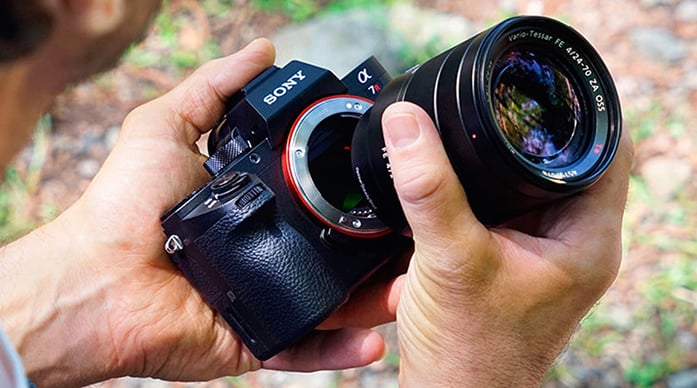
First a heads-up: The Sony A7rII and the new RX cameras are now available for preorder in USA and in Europe. So check out the updated preorder list here:
In USA:
A7rII at Amazon, BHphoto, Adorama, Uniquephoto.
RX10m2 at Amazon, BHphoto, Adorama, Uniquephoto.
RX100m4 at Amazon, BHphoto, Adorama, Uniquephoto.
In Europe at:
A7rII at Sony DE, FR, IT, ES, NL, BE, CH, AT, SE, FI, NO, PT. Wex UK.
RX100m4 at DE, FR, IT, ES, NL, BE, CH, AT, SE, FI, NO, PT. Wex UK.
RX10m2 at DE, FR, IT, ES, NL, BE, CH, AT, SE, FI, NO, PT. Wex UK.
—-
Mirrorlessons interviewed the Sony Europe Product Managers Y. Hori and R. Noguchi. And here are some of the key info they shared:
1) Image stabilization: The A7r II image stabilisation unit itself is more advanced and complicated than the one used on the A7II. This because it has almost double the number of pixels of the A7II. That said the A7rII has same 4.5 step compensation as the A7II.
2) A-mount future: Sony answered that yes they are still developing the DSLT line and: “SLT cameras still offers some advantages like longer batter life, better grip, and whole functionally is still like DSLRs. We believe customers are still there and that they will love these DSLT cameras.”
3) Uncompressed RAW: Mr Hori simply says: “I’ve heard of this request. If there is a high demand, we can consider developing it in the future.”
4) A7sII: When asked if we can expect to see a new A7sII Mr. Hori answer is: “I hope so. *laughs* Of course I cannot comment but you can imagine, before today, the people wanted in-body stabilisation for the A7r. That was the most frequent feedback from the consumers. So we made this A7r II with even higher resolution. But I cannot comment on future products.”
To sum up: I really do hope Sony will at last announce a new A99II sometimes in September to give the A-mount line a proper “revival”. And on the E-mount front I guess no SAR reader has any single doubt there will be a new A7sII within 6-9 months from now 🙂
224 Responses
So how exactly do we communicate that there IS a demand for lossless raw files?
Waiting patiently for A99 mark II
Me too.
Not gonna happen.
I guess we’ll just have to get used to that there will be no new A-mounts anymore
of course Sony won’t admit it until very last time, but no one can blame them for doing so.
A9 = a-mount
There is high demand, just look at how many Maxes want uncompressed raw.
A previous interview indicated we will see uncompressed raw soon, but this interview does not seem to indicate that.
And what about a7000?
they know full well, it’s just the usual corporate response.
Hope you’re right, Bo Dez…guess I’m just use to Canon’s response to its fan base. 😉
We don’t want uncompressed raw, we want lossless compressed raw!!!
It’s annoying how often this simple feature is misrepresented!
It needs extra effort doing lossless compression and decompression. Doesn’t benefit much.
It’s more complex than that — it takes more computational effort to perform the compression, but the result is lesser data bandwidth required (and buffer size required) for the resultant image. So there a benefits and disadvantages. What people are asking for is an option.
Having said that, I personally haven’t seen any downsides to the compression.
downside of lossy compression ?
Yup, I haven’t seen any downsides to the 11+7bit compression scheme. It’s a bit of a non-issue for me. The lack of EFC and the fact that I can’t fully turn off the LCD are bigger issues for me with my a7R 🙂
I am glad you don’t need it.
Look at the raw comparisons from DP Review – A7R vs Nikon 810 – same sensor – obvious quality differences
There’s a lot more than just lossy compression that can account for that as there is a lot of other things that happen to the analog signal even before it is digitized and compressed (lossy or otherwise). Based on the analysis of 11+7 I’d wager that it’s more likely that what Nikon do better is the ADC portion of the chain (logic, shielding, boosting etc.).
Absolutely – totally a mystery why the interviewers and sony engineers didn’t recognize this… We just want what is already in cameras like the Nikon 810 which use Sony sensors… Outside of the lack of dual cards its the last step to a camera a professional Canon shooter might want to shift to Sony.
battery life and grip an advantage of SLT? What the heck, maybe they should just engineer there e-mount camera’s to also inclode these improvements and than totally focus on this system?
They have nothing more to say about A mount. Seems like Sony is repeating history again as seen in MiniDisc, UMD, Memory Sticks, etc~ They will forget what they have been doing when they found a new toy…
A-Mount still has a more reliable and faster AF than e-mount with a-mount lens.
That’s true and I just can’t see a good system went abandon…
Well, he is not about to say that SLT has native system AF speed advantage over even what A7rII has to offer. It was just announced and he will not bash a brand new product. So he makes do with first thing that comes to mind.
The real question for me is why Sony ever went down the e-mount road in the first place. Maybe to create a second tier, less expensive line to generate greater sales volume, but once you start asking $3200 per unit you are going to lose many potential customers. You also risk canibalizing sales in one line for the other. I’m glad to see more confirmation that a new FF SLT is coming and it’s going to be fantastic with all the bells and whistles Sony can pack in, but after watching the announcement of the latest e mount you know that the a99 replacement is going to be aimed at pros and be really, really pricey.
I believe it has to do with the style Sony manages products. Look at all their previous product history, they abandon the predecessor once they found a new replacement for it and they kept finding new successors. MiniDIsc to NetMD, UMD to just Vita. They awarded themselves the Guinea Pig Award since they only have the passion for new stuff…
I think Sony does have a history of cutting and running when they are getting beat by the competition. Good bottom line strategy but bad for brand loyalty. I was concerned a couple years back that they might give up on still imaging and leave the field to Nikon and Canon but they seem to have regained their footing. People who pan SLT are mostly people who don’t work with SLT. The advantages way outweigh the disadvantages and no doubt Sony is going to make it even better.
Let’s hope both mount can have equal attention and have cross compatibility road map planned out.
when German made perfect rangefinder cameras back in the film age. Japanese manufacturers were at first copying rangefinders, but later they realize SLR is a better way because its easy for them to develop something not too good yet.
so think about the fact that Canon and Nikon already make DSLRs good enough. why bother make another one?selling CMOS to nikon and pentax would be a better option. Full frame mirror less on the other hand, is a whole new continent with no competitors at all.
Perhaps. It sounds completely logical. But why e-mount? Why not make all of your lens interchangeable cameras natively compatible with your already established line of lenses? Adapters are expensive crutches because Sony did not and still does not have a full line of e-mount lenses ready to go. I have to believe that that has had a negative impact on e-mount sales. In the meantime Sony’s attention appears to have been diverted from a- mount in order to launch e-mount. Not only have they risked alienating loyal a-mount customers, but entering customers, particularly those looking at pro level cameras, see no developments in a-mount to attract them. They might go e-mount (i.e. cannibilization) or, more likely, they might go to Canon or Nikon.
Sony tried A mount. And failed with traditional DSLR’s.
Then they launched the A33 & A55 alongside the NEX-3 and NEX-5, to see what the market wanted.
The market chose E mount. While the SLT’s wildly outsold the earlier A2/3/5×0 line, the NEX in turn outsold the SLT’s. Sony let us choose and we did.
I don’t honestly thing there’s much risk of cannibalising sales – as a rule a-mount just doesn’t generate the interest for potential customers that e-mount does.
Really? And what exactly are you basing that conclusory statement on? Personal opinions are not facts. I will say this . . . The amount of effort Sony put into marketing the a77M2 was a complete joke. With the marketing effort they are putting in on the a7, they better get some buzz. In any event, for Sony, interest is nice, but profit is better. Professional level a mounts are likely to sell in smaller numbers but greater profit per unit. I’m not sure we will see sales figures for the new a7 but at $3200 I think Sony may have outpriced it’s market.
it’s not outpriced… it’s the first FF BSI sensor on the market. with good high ISO and DR unlike canon’s 50 mp camera. earlier a7 were cheaper because they utilized old sensor from d600/d800. price will go down, for sure.
The price has to come down if (as I believe) the market is not there for it at that price.
Because Sony’s consumer line was a disaster until the A33/A55 and the low-end NEX bodies outsold the A3x/A5x by a large margin, which is why they in turn disappeared.
The meat in any line is the low/mid-range consumer line. Sure Sony didn’t push the A77mII much, but the reality is that by the time it showed up the A mount line was pretty much restricted to the limited number of dedicated serious shooters already in the system.
The A7 line however has picked up a large amount of converters, especially Canon shooters who work on tripods and want a modern sensor. Lossy compression or not, an A7r still beats a 5D3 silly for IQ and, aside from absolute resolution, will do the same to the 5Ds.
Sony’s spending its time chasing what users actually want, as dictated by their spending.
I would really like to see anything which shows that Canon users are converting to Sony in significant numbers. I very much doubt it. From what I have seen, Canon users are very loyal. I would think that Sony would have a better shot at new entrants. I’m just not sure how many new entrants are going to plunk down $3200 for an a7 no matter how good it is. It’s still something of a novelty camera with a limited set of available lenses. In other words do users really want the a7? Only time will tell.
And what makes you think a-mount was a big commercial success?
I see more Pentax cameras on the street than a-mount. However I see a lot of Nexes out there and recently even some Sony a7 with tourists.
How many people are switching from Canon or Nikon to pro-level a-mount? If Sony thought the a-mount had the potential to sell as well as you suggest, don’t you think we’d at have seen equivalents to the a7s and a7r? As for the the a7r ii’s price, it’s significantly cheaper than the 5ds r and, going by the initial reviews, is a much better camera.
Probably none . . . but I never suggested that was happening either. The question is a non sequitur. You are trying to convince me that established Canon users are going to abandon the Canon line to buy a7s in significant numbers and you are going to fail. They are emotionally invested in the Canon brand and financially invested in Canon lenses. Using an adaptor is a non-starter. Wasted money, performance sacrifices and added bulk. Sony will produce a new a Mount. It will excel in areas that the a7 doesn’t and it will sell well amongst a mount users and perhaps some newer entrants who are not highly price sensitive because it’s going to be pricey.
Then who is buying them?
Good question. Not me. Maybe you? Did you/will you abandon a Canon 5D?
Andrew, your ignoring the built-in customer base that has existed since Sony bought Minolta’s camera business to begin with. There are literally tens of thousands of photographers already invested in that system and many will keep buying as long as Sony keeps selling. The only recent sales shortage is due to less releases from Sony as they both move the low end consumer side of A-mount to E-mount and as they refine the A-mount line-up to better support their Pro A-mount customers. Very few of these are ex-Canon, but more so Minolta and even original Sony customers invested in the system who grew into professional photographers.
E-mount is now Sony’s consumer mass market cameras and will certainly has greater sales volume potential simply because Sony carved out a new market with that line-up that is not duplicated by any other camera company at present, and secondly, because customers can adapt the lenses they already own. It’s essentially became a trojan horse for acquisition of new customers.
Will A-mount be developed continuously? Only the market will determine that, and it’s silly to speculate until we see what Sony releases for A-mount photographers this fall. As long as A-mount photographers keep buying, Sony has no reason to stop supporting them.
I don’t think we’ll see a “Pro” A9 E-mount camera until they have native F2.8 zooms. It would be silly for Sony to even consider releasing something like that at present.
Sony’s next 9-series camera will absolutely be A-mount, and targeted at professionals.
Because the e-mount allows for more compact interchangeable lens cameras, think Nex-3 and Nex-5 and it can be cheaper for the lower end, as the E-mount doesn’t have the feature to mechanically drive the lenses. So you can sell and use the E-Mount lenses for the whole range from high to low end. It’s just more versatile, covers a larger product range.
Lossless “ifs” and “maybes.” Is this a marketing team not communicating with the engineers issue?
It would be great if Sony would setup an Idea Pond where we could submit and vote on things we’d like them to focus on. When I read comments like “Mr Hori simply says: “I’ve heard of this request. If there is a high demand, we can consider developing it in the future.””, all I can think of is who is Sony really listening to? My guess is they are listening only to folks at trade shows and their retailers, so they are missing a hugh part of their audience.
I’d love to see Sony implement something like this:
http://ideascale.com/
This way all of us could submit and vote on ideas, and we’d be able to see what others think as well.
So you think that Sony doesn’t monitor SAR?
It might be any one of us…
It might be Andrea…
Andrea~!!! Tell us to truth~!!!
Ha, might be me, but until you start voting on ideas…NO SOUP FOR YOU, COME BACK 1 YEAR!!!!
NOOOOOooooooo~~~!!!! You can’t do that to me~! 0_0
I need my soup with some garlic bread side dishes……
You missed the point and have probably never used a solution like IdeaScale, IdeaGlow, or any similar sites. Also, neither of us can say if Sony monitors SAR, so again, your point is irrelevant.
Our community of users probably have a great number of things they’d like to see. But other than the occasional “I wish Sony would do x” ,Sony can’t seriously gauge how many users agree that a given suggestion or comment has any weight behind it.
With a system like IdeaScale, users can vote an idea up/down, comment on an idea, and give Sony a true picture of whether an idea is in high demand, or just something one person wants. I speak from experience where I’ve used these platforms. They really work for both the manufacturer and user community.
And you think Sony has no way of gathering feedback?
Corporate marketing and product execs say things like this (“if there is a high demand…”) when they have no interest in a particular feature request. It’s a good blow-off because we have no way of knowing how many other users are asking for the same thing. They can go on like this forever, pretending to be surprised by the question and promising to keep listening.
That exists already – community.sony.com
Nope, not the same. That is just a discussion forum.
The demand for lossless RAW is more important and has bigger voices requesting it than the demand you immediately complied with by getting rid of the Minolta hot shoe. You please many professionals and enthusiasts who want to take more advantage of the already great Sony sensors that, unfortunately, are hindered by the lossy RAW algorithm employed.
This is not about not having the current RAW algorithm in the cameras, but about having the choice of lossless RAW.
I am pretty sure Sony said they ARE working on lossless RAW in previous interview.
http://www.imaging-resource.com/news/2015/06/16/sony-qa-the-must-have-sensor-tech-of-the-future
Someone’s not keeping to the line. Sony needs a Malcolm Tucker…
https://www.youtube.com/watch?v=0MSScBIopM8
That picture is…quite frankly…sexy as helll.
As far as A mount…they have once agian made vague ambiguous hints the in not way indicate they will actually built a new A mount camera…these comments were intended to make people believe in A mount but completely avoid actually cmmiting to build an A mount camera….still developing slt…just means they retain the technology to do so. It makes no indication of any intention to actually build one.
As for A7Sii…he definitely gives the impression we will see one.
I am most interested in future higher res sensors, and that topic was not addressed.
In the news today….
Thoughsands more secret Sony documents were just realeased by wikee leaks.
I wonder what that might tell us about future Sony cameras and lenses?
To be fair that’s exactly what they were doing before the a77ii was released…
Back then E mount was nowhere near able to replace A mount.
With the new A7Rii they believe E mount is finally ready…but they cannot tell people that and have them switch brands, so they string them along in hopes that they will eventually decide to buy E mount.
If you actually examine the wording of thier claims to fully support A mount ot os obvious that this newst generation of E mount cameras fulfills thier claims that they would do so.
At no point since the a77ii has Sony actually said it will release a new A mount or SLT camera.
Well I personally stopped any further investment in Sony gear ( wishlist hold around 10’k $) until September 2015 after that …
A good question is what for FF Camera comes from Sony within 6-9 Months? I think not a HIghRes Mid- End 2016 and not a a7s before early 2016. Comes nothing or a surprise?
I believe, though of corse am guessing, Sony are fully aware of the lossy raw issue. The problem being if they release it, the camera will be a lot slower and people will be turned off because the only other option is reduced file quality. It’s the lesser noticeable of the two evils. It will get the point where they have to do something but I don’t believe it will be until they have a new processor.
My thoughts were along those lines as well, but not that the operation of the camera would be slower, rather, that the measurebating specs of buffer size, burst lenght (in shots) and burst speed will suffer.
The thing is, is not that the current RAW files are bad, becuase they are not, but they are a bit far from being best, and thats the issue. Give the choice of best lossless to those who need it and keep the current lossy good to those who don’t.
I agree.
One big point about the current lossy RAW format is, that it is really bad. Within the 16 pixels there are 11 bits for brightest and 11 bits for the darkest pixel. Even if all other pixels can be completely modelled without information-loss in 7 bits because the range from bright to dark is small, there are always 2 pixels out of 16 where you lose 3 bits of accuracy.
There are so many options how to make the lossy format better quality and even smaller. And this with less complexity in the algorithm.
compression to 11 bits doesn’t lose any meaningful infortmation, cause highlights contain a lot of photon shot noise. when it does to 7 bits in block with high contrast, it does lose meaningful information
The proof of the pudding is in the eating. If it tastes bad, it is bad.
They could alway have options for CRAW and LRAW to keep a faster option available.
To do a lossless compression instead of lossy compression does not consume significantly much more computing power – if it is done serial for the complete picutre.
The Sony lossy compression can be parallelized because there is constant memory required for a block of 16 pixels. That would be the only reason why a lossy compression could be faster than a lossless one. (in my opinion)
lossless compression is inherently much higher in compute requirements unless a dedicated ASIC or on-die compression engine is used. There’s a reason why it took a long time to show up anywhere.
Compression is NOT done serially. It’s done on the full data set of the image. This is a requirement for the current set of lossy algorithms in order to minimize data loss.
Uncompressed however is easy as long as the camera has the RAM/bandwidth to support it.
Oh, a99II will come 🙂
Thank you for sharing 🙂
Finally, someone have ask Sony about the future of a-mount camera.
It exactly what we want to hear about 😛
“We are still continuing to produce these A-mount cameras.”
So (video-priority) A7sII will be 4K 60FPS?
They can probably make it BSI as well and up the ISO from 500K to like 1M-2M, and increase dynamic range further ;p
Do a vote on lossless raw, help this along, only real flaw left in their product line, maybe add ability to turn of noise reduction completly (if not already available, not sure) and add pixel shift mode for full colour capture ,
IQ is a concern to your customers Sony…
Is it worth setting up a petition? I’m not hugely worried if we don’t get it, but it can’t hurt to have it.
There is already one
https://www.change.org/p/kazuo-hirai-enable-uncompressed-or-lossless-compression-raw-files-on-the-a7-cameras-and-future-f-e-mount-cameras
The lukewarm reply suggests to me that they see this as a feature with no impact on sales, and aren’t going to implement it no matter how many requests they actually get. In other words we’re wasting our breath.
As Sony just updated an A mount 24-70 SSM II, there’s no way they will abandon A mount system camera.
Unless the update was just to improve its functionality on the A7rII and future A7’s with the new AF system. LAEA3 +SSM = the f2.8 zoom E-mount users have been asking for. My prediction? This is how they quietly let the A-mount die. Of course they’re going to say its still under development, but new bodies/lenses tell the real story – and its been quiet on that front outside of a few refreshes for quite some time. the ZA 50/1.4 is the last completely new lens – and that lens is now two years old. The bulk of CaNikon sales are entry level APS-c and Sony has nothing competitive, the A58 is more than 2 years old. Its plain as day, don’t know why so many can’t see it.
Sony entry level APSC has been moved to A6000 😉
???? it’s A3500. rivals cheap canikons in price
You guys are too much. Conspiracy theories abound. Look, we are talking about product cycles here. I don’t know about you, but I don’t want my camera to be replaced by a newer model every year. Believe this . . . the a99 replacement is in development and will be here soon enough.
I have a hard time believing that Sony is making any sort of profit off A-mount bodies. All of the growth for them is E-mount. Its not a conspiracy theory at all, its economics and Sony is shedding everything that’s not profitable. Its a sunk cost to keep producing old stuff. Time will tell.
This theory had happened with A77 before and then suddenly Sony released A77mII, then 70-200 SSM II. Now the updated version 28-70 SSM II will out soon. I don’t ever think a big cooperation as Sony releases/updates something to support the products and kill it. They’re just slow and you all will see.
We’ll see. Abandoning the largest income generator in the segment – entry level APS-c — cameras that need more frequent updates compared to pro models costing 5-6x as much is the most telling sign. The lens refreshes are minor. New lenses like a 24-105 that many have been asking for, or a decent 35/1.4 would be an actual sign of support.
Bits trickle out, but nothing more and nothing significant. I hope I’m wrong. But to me they’re just stringing people along.
The a mount is not “old.” It’s simply a different form factor and in the current models SLT instead of mirrorless. You’ll see some of the same recent a7 developments in the next a99 along with some others not found in the a7s and it won’t be “old” anymore. There is a market waiting for it and it will sell well. Will the new a7 be profitable at $3200? Is there a market for it? Only time will tell.
why would you refuse frequent updates, except for money reasons?
Partly money and partly because I don’t want to have a perfectly adequate camera for a short time which has been outdated by a newer version every year. I feel the same way about cars. So I am selfishly happy that there is no RX2 yet.
“longer batter life, better grip, and whole functionally is still like DSLRs”- I cannot see one convincing reason here. Sony can definitely make a bigger E mount body that uses NP-FM500H battery. To be honest I could possibly stick an NEX-5 into an A700 body and make the connections for the battery and shutter button – so there are two of three arguments busted.
“whole functionally is still like DSLRs” is this a good or a bad thing? If there was E mount camera in the A700 body what would be unlike DSLR or rather DSLT?
Actually I would be all for a DSLR from Sony like A900 II. I just do not get the idea of A99 II – the first time round this was complete failure – why are they repeating it?
Looking at history – A900/A700 was success and many loved it. A7 is success and many love these cameras. A99 was failure. Why are not Sony learning from experience? Make A900 ii please.
Because dedicated PDAF in DSLR/SLT is still far better than OSPDAF in e-mount especially in less than optimal lighting condition.
Like a900 had ospdaf?
Personally, I prefer EVF more than OVF.
Because it can display a real time histogram in the finder, also showing zebra pattern is very useful for ETTR.
EVF is the only reason why I stay in Sony camp.
If I want OVF, why not get a D810 or D750.
It is not that difficult to imagine hybrid View Finder like Fuji X100 that can do optical with digital overlay or full digital at a press of a button.
Best is if Sony can do DSLR that can work well with the mirror up.
Just get rid of the SLT disaster.
You see a jpg histogram and zebras based on it. It is unfortunately not very accurate unless you have an UniWB white balance. I am equally accurate with in view finder metering and choice of appropriate settings (highlight weighted, spot or matrix). No big deal in a pro dslr or with shooting experience. What I don’t get with DSLRs is in VW review or magnification, for example. Especially magnification is quite handy in some circumstances.
with sony’s brand new a3000/a3500, you don’t get review in EVF too, compulsory DSLR emulation…
Same goes for raw file. A700 had cooked raw files all hated it. Sony fixed it in v4 of the firmware and all were happy . a7 now is the same thing.
A direct mounting of lenses in the long run is always far more preferential than some expensive adapter.
You know this whole “Longer Battery Life” chant is really
over blown in my experience. I was so worked up over this I took 5 batteries
with me to Disney World for my A7II yet after 5 full days in the park I had
only every used 2 a day. I even bought a double charger plus the Sony charger
and always figured I could charge 1 in camera! I even took a separate power
strip and never used it. My day at Animal Kingdom I shot over 900 pictures on 1
Battery! Now granted I keep the camera in Airplane mode and turn off remote
control and have my power save set to 2 minutes. What is a real battery chewer
is Pre-AF which was turned on by default and I found my battery life went up
measurably when I turned this off. I have since added the battery grip but it
was not really for battery life but rather for ergonomics as my pinky was
uncomfortable dangling 🙂 and I do like the ergonomics of the button placement when shooting in portrait mode.
So I have to wonder if Sony is listing worse case scenario for
battery life as I have seen much better than advertised with my settings and
usage. I do have a fair bit of usage on this A7II as my shutter count shows to
be a bit over 10,000 so I can only go by what I have seen and experienced and
yes my A850 does get better performance but hey, the batteries are small and don’t weigh much so carry two after all they are pretty easy to change. 🙂
When i’m playing with A7R now, i don’t switch it off and let it go into sleep mode and just replace battery when it gets flat that way. Sony have addressed the general speed of new version 🙂 which is great because I get very impatient waiting for new shots to render to display and to take another shot after.
Kai was joking about early adopters of A7R but to me its still the smallest lightest 35mm sensor camera (and thus my ideal compact camera too without thinking too much about it) befitting of m mount and other small great lenses, and the stats speak for themselves over any issues. The image quality at not so high ISO is immaculate, so I don’t really feel bad having built a lens system already around and based upon it as it befits why I bought into A7 system perfectly, rather, I feel extremely privileged and our quality is now leading all.
Who changes lenses like that?!
Hahaha, you make my day~
Someone who enjoys cleaning dust off their sensor.
If you make a built-in LAEA3 mount with A7R2 sensor in an A mount -style body, what category would that be?
It would be an ILCA, like the ILCA-77m2
But it will not have the mirror
ILCA just means A-Mount, so it would be correct.
I mean using an FE camera configuration (like any A7 series) but instead of accepting E mount but has a built in LA-EA3 adapter that accept A mount with the built like an A99. Thus it is like a A7 series with a fixed LAEA3 but looks like an A99
That’s what I said, since it would only accept A-mount lenses it would be an A-mount camera, thus ILCA-XY. Removing the SLT mirror doesn’t make it E-mount.
Haha, you’re right. Well it is like an A mount camera but only uses the OSPADF rather than the SLT mirror~ or Sony should have made the next A99 with flip up mirror options
Actually…… ironically, the OSPDAF makes native A-mount irrelevant, but it would be an interesting feature for live view in a traditional dSLR.
With or without SLT mirror, A-mount is an EVF/LCD device. For the end user, it makes no difference whether you use SLT or good OSPDAF.
But imagine you stuck the A7rii OSPDAF in a Canon or Nikon dSLR. Truly 100% usable live view — So the user could still choose between a traditional OVF approach, or a totally usable live view. Could even use a hybrid viewfinder, to give the user all 3 choices:
Optical viewfinder — still best for tracking action
EVF or
Live view
Yeah, it will be a selling point for a mount if they include those options~
I don’t get what you said. if it won’t have A99 controls or LCD, why?
Hahaha, it is hard to explain. Imagine an A7R2 shaped like a A99 or something similar but only takes A mount lenses rather than FE lenses.
…. rx2!!
RX1s and a RX2
,,That was the most frequent feedback from the consumers. So we made this A7r II”
Hello Mr. Y. Hori and R. Noguchi,
You want our feedback to build a new a7sII, here is it:
My Feedback List for the a7sII:
The most important ISO 819200
The second important a fast shutter with 1/32000
Eliminate the purple light in High Iso’s
Eliminate the Blue Light distortion problem
Global Shutter
More Dynamic Range
My feedback for lens:
A FF E Mount Lens with f 0,65- f 0,75 and 30mm- 40mm
A FF E Mount Lens with Zoom up to 400mm
A nice Time for you Mr. Y. Hori and R. Noguchi
I hope you won’t take pictures @ [1/32000 & ISO 819200] 🙂
the higher the number, the better the picture
sony should produce f/128 lenses for this purpose
Yes, high speed or ,,frozen” pictures 🙂
Why not to use some high speed strobes to freeze the water http://www.koloskov.com/Water/ ?
Well because the water freeze is only one from my ideas, I will do with so highest camera settings. For this and that gives alternative possibility for realizations, but not for others from my ideas. I can only betray- I need very fast shutters in very dark environments, without additional light. I think my a7sII wishes gives photographers to do new creative things.
The water experiment is one of my ideas. I delete this photo here, but this is still display.
I has more ideas where I can’t use a strobe or a floodlight
f0.65 lens and iso 819.200?
Do you want to capture images inside a bear’s butt? 🙂
And no skills. Full auto mode
Yes maybe that rumor isn’t officially dead, but it’s starting to smell a bit ‘off’ isn’t it? Let’s learn from this experience and remember that the fact that a name shows up on some marketing guy’s old PowerPoint presentation means absolutely nothing.
Still no mention of the RX2… I’ve been waiting for that ‘fixed’ RX1 for 2 years but now I’ll jump ship. Sorry Sony, Leica Q here I come.
https://www.youtube.com/watch?v=nuHfVn_cfHU
My thoughts exactly.
Do they teach this in humanities for taxpayers money?
political school I guess, for validation or something
what was the aim of this video and where is it from? Why is it with green background?
A7 = RX2.
We all knew all along New A-Mount cameras would come despite the teasing on this site… BUT, I think Sony should stay away from a camera named A99ii. They should “start over” with not just a better A-mount camera, but also a better name for it like maybe A-1 or something. I think this will help make a statement and really help sales because It seems like the Canikon camp are much more hungry for other options than they were when the A99 came out and the years before.
“If there is a high demand, we can consider developing it in the future.” = We don’t give a f**k of it now.
How about a snap on case for any A7 camera that gives it the plastic shell of an a99 camera. Add the a-mount adapter, and then you make the a mounters happy. Then the rest of us can just snap off the case and have a lean a7 body.
I had that same thought. Unfortunately, it would still have the same small A7 battery.
In 2015 Sony released FE mount = 3 new camera before the end of the year
APS-C E mount = 0 for now
A mount =….. We don’t know yet
Even if Sony is for a large public, seems to me they are working mainly for pro shooter and shoot and go ones ( with mobile phones using their sensor as camera)
BSI , IBIS , leveling gauge, better DR, better low light performance and keeping same color depth are the main characteristic of future A6xxx Sony may add in it
There’s been 1 E mount camera of any sort so far in 2015, the A7rII. A second is expected. Of the last 4 bodies for E mount, 2 have been FE (A7II, A7rII) and 2 have been E (QX1, A5100).
The next announcement is expected to be E (rumoured A7000), with only one other FE body expected before years end.
Whats missing is not new E bodies but new E lenses. When was the last notable E lens release?
A7sII requires the least amount of additions.
A7sII with same sensor and IBIS (that functions mechanically during video) + internal 4K and it will sell very well. I’ll order one immediately.
Oly’s IBIS works well in video because their lenses have much spare image circle. With FF E-mount, it is not so.
also you probably want a new sensor, which is much harder to develop than adding already existing components
Did you read what I wrote before you replied?
Very exciting camera. Let’s see how many shots it will be able to capture before the battery runs dry with this new load of data, AF speed and processor. 130-150? Nice features and technology – too small of a body. Put it into a99, beef up the battery and sell a ton of these.
Different strokes for different folks. I love the size the the A7R. When hiking around I like a light/small camera. When walking around the city same. Only time I could careless would be in the studio or weddings and I don’t do that type of photography. I would rather them invest a little more into the battery tech then increase the body size.
You are absolutely right. a7 is not meant for heavy use. My videographer friend carries a battery in a pocket that feeds his a7s when he works. He only has about an hour of operation with a built in battery. Not good for weddings at all.
By a7 I presume you mean the whole line up of Sonys 35mm sensor cameras with short flange distance.
Videographers use a whole system including a rig which could include external battery, but for stills I don’t see battery life as
the final say on making small cameras which are still most functional, you pause between shoots long enough to switch one and for no longer than switching a lens with regards for settings, esp now the cameras function faster too.
Better to not even have to swap to a video camera by using A7Rii with same lenses for light cinema purposes with fast distribution after shooting?
What I would like to see from ANY manufacturer of camera systems is a lens capable of great image quality over a greater range in the one lens without changes or compromise. With such a lens, say 21-105mm 2.8 or 24-135mm 2.8 or a longer ranged cine sony zoom beyond 28mm at wide end, you could shoot in restricted spaces without losing good composition at any time which is surely the primary function of sub 35mm lenses anyway, and reach any other framings easily, the main purpose of longer lenses in this situation, without swapping at an inconvenient point between TWO heavy lenses across that point.
That way you can assure cinematic storyboard variety of shots and according necessity of changing situation and with full concentration,
thereafter keep a few light batteries handy to swap but still light on ground with just one main lens not several kilograms of glass you have to swap around the mid range just to explore composition on the go.
Its the shots that get stored and limitations of shooting applying to those and not the bother of swapping a battery, which in the case of the battery add on is a fair amount of time to allow swapping safely in a lull of the action. The small batteries in future will be more powerful and this system ready for them much like smart phones now.
I don’t have smart phone but as a photographer I love and all but require a small main system camera and small system of lenses if possible, in fact due to the short total range and limited speed of zooms I seem stuck with primes and vintage zooms for a while yet for ideal shooting, and using those to have weather sealing and AF.
I’m the guy who suggested most all the particular functionality on the new A7Rii last year, and own an A7R btw, and am VERY pleased with the outline for the new A7Rii!
I hope that aperture rings and smooth responsive manual focus on system lenses can return now that other requirements have begun to be met and serious use prices established as these are all but essential for utility over other matters, what more suitable differentiator for the ultimate camera system?
I am interested in the new Panasonic G7 for video and curious how the colour quality will stack up between these two cameras 🙂
Batteries weigh next to nothing and generics are cheap. Buy 10 and throw them in your bag.
You can take a break in the studio sometimes, but not when an important moment happens. Where’s our first kiss (I do weddings and events for a living), asks the client? “I was changing batteries and the 2 I put were already dead so it took me a little longer to find the one with juice” – is not going to cut it. I have a pro demand, amateurs or travelers will be extremely happy with a7 cameras. Even a900 delivered 660-810 shots per battery. Compare to competitors 1500-1700 shots per charge. I use 2 cameras at events – both last all day. Swapping Sony batteries so often can be a pain.
Get the grip and a couple extra battery trays already loaded with fully charged batteries, takes a few seconds to change. Turn off the LCD, don’t chimp, and turn off the camera when you’re not using it. I shot 1,000 frames at a 6-hour conference with my A6000/A7s combo and burned a total of 3 batteries. Not as good as a DSLR, but youi’re not swapping batteries every 15 minutes either.
If that doesn’t work for you, then stick with a DSLR, something has to give with small cameras.
Thanks for the tip. I find 5Dmk3 to be the perfect size and wish there wad a tilt screen some times and it was a bit lighter with 70-200 attached.
So even the great speed is now a compromise according to you, Chris has missed the fact your entire point relies wholly on an unbridled flood of unsubstantiated personal ideas of yours as an ex user about the new line up with no interest at all in them. Sony cameras are doing quite well as it is too Sergei, without your ironic marketing advice.
Next you will be justifying the competition as ‘dinosaurs’.
Sony does need a higher-capacity battery sitting in between the tiny one currently used in all E-mount bodies and the big one in the A mount bodies.
The A7 battery today is just too small to be acceptable for certain uses. It’s fine for landscape shooting or architectural work, where carrying a few extra’s is workable since you can swap between scenes, but for any sort of event/action work it’s so small that constant battery swaps will get in the way of working.
The working battery life on the A7II today is around half that of other mirrorless cameras. The battery is already around 20% lower in capacity than the comparable Olympus or Fuji batteries and the A7 series is inherently higher in draw due to the larger sensor and higher processing power requirements. That’s a problem for Sony, who has been very good about maintaining battery compatibility (an off-the-wall solution would be to support the NP-FM500H in a new vertical grip, with a tray for the NP-FW50)
triangular!
This is a square prism battery shape that might use the front grip for extra space, i’m sorry it lacks accurate scale, I left my crayons at work!
My response would be: and exactly how are we to express that demand so that Sony actually hears it?
We’re sort of in the usual position with the Japanese and feature requests: (a) they either know about the demand for it and have been ignoring it; or (b) they are so disconnected from their best customers (and savvy Internet/media reviewers) that they don’t know what it is they want. Both of those are a problem.
Thing is… Sony users believe they don’t really need it…
Newer photographers will not even know what you’re talking about..
It’s current Canon and Nikon enthusiasts who see it as a problem with Sony… And to be honest, having shot both systems, I do believe it is very very difficult to see any difference. Not denying that there may be some perceptible difference in some examples, but I don’t honestly believe it is driving the buying decision of many people.
I’ve seen on forums, many Nikon users claiming it’s the reason they won’t consider Sony… but if Sony made the chance, they would just find other reasons.
Difference can be subtle but it is big bucks people paying. It is uncomfortable to pay for something like this, just like paying $2800 USD for A99 today.
Nikon users themselves went over the compression issue again and again since not all Nikon bodies offer uncompressed raw. For reference:http://www.nx101.com/12vs14.html
Let’s admit that Sony is using 11+7 bit, which is more aggressive than 12bit compression. It is quite uncomfortable for a camera this expensive, especially for those who intended to get the best gear in the beginning.
I’ll fully admit that Sony should offer the true 14 bit. And I don’t understand why they fail to.
I just don’t know how many sales it is realistically costing them.
My 2 cents is that they don’t want to get a faster processor in the bodies at this time. It is a good way to cut costs and stay focused. Sony has been updating hardware around the CMOS very quickly these years. And now what they have is great. In the next few years, they might start working to improve the rest of the body. Hopefully a FE 24-70/2.8 would come out soon.
I am one that will not buy one without 14-bit lossless file format. If they add that, I will likely get one, assuming it isn’t crippled in other ways.
Its not about Sony’s “Sales” its about what the customers want!
You sound like a Sony Rep.
How many sales? I don’t know, either. However, I do know this: Sony has an 11% market share against Nikon’s 34%. I’m pretty sure that Sony wants some of Nikon’s customers. Savvy Nikon customers know that we’ve got better data output from the same Sony sensors in our cameras, especially at the D7200 and above level. Thus, we Nikon users are immediately given a reason to pause and reconsider a decision to move to Sony by a simple data depth/precision decision that doesn’t even have to be there. Generally, you want to remove barriers in your product, not leave them in.
I definitely would not buy one without 14 bit lossless file format. While Sony is very innovative, they are clueless in some ways.
If you’re going to make what you call a high-end product at a high-end price, it seems wrong to then compromise it with lowest-common-denominator choices.
Bandwidth’s a bitch. So the natural tendency on the part of the electronics firms (of all kinds) has been to figure out how to compress data so it uses less bandwidth. This has led to what I call perceptual-based methodologies. We got it first in music, with Sony’s MiniDisc, amongst others. The general philosophy is “if most people can’t see it or hear it, then it’s okay to remove.”
The problem is this: for high-end source creators, this is a complete fail. The reason is that our works go through progressive re-compressions before they get to the audience. This is very easy to see with television, for instance. In some cases, things are being recompressed three and four times before it gets to your TV set, and if you TV set is a 4K set getting a 1080P signal, the data is going to have to be reinterpreted yet again.
If you start with compromised material, all the reinterpretations downstream will make it more compromised. At some point, people will see it.
And yes, this applies to stills, too. I just encountered an example of it the other day, where by the time a published PDF file was compressed for file size the original image was clearly compromised.
Now if Sony wants to use 11-bit lossy compression in an A5000, I don’t really have any complaints about that. But in an A7rII at US$3200? Yes, I want better. Moreover, the fact that Sony would put compromised data in their highest end products makes me wonder whether they understand the high-end market, or they just want to sell more expensive cameras to low-end consumers. Neither of those seem like winning strategies to me.
I want touch screen, nothing else.
Nice to hear an intent do continue A-mount, but I just don’t see more than 1 or 2 more models, at most.
IF they can now achieve full lens compatibility without the SLT mirror… then what really is the point of continuing?
Battery life is only longer because they have a bigger battery… Grip is bigger, ergonomics are “dSLR-like” — But all that can be done with a native E-mount.
Why not just do an “A9” with native E-mount (but LA-EA5 adapter bundled), with a bigger battery, bigger grip, dSLR-ergonomics, dual card slots, etc..
The sole reason for the SLT mirror was to do phase-detect AF. If you no longer need the mirror for it, then why sacrifice light loss for it? Why have a mount that *only* takes A-mount lenses, when you can do a mount that takes A and E mount lenses?
I doubt they really even know for certainty themselves, what they plan to do with A-mount. But I would be very surprised if they keep churning out A-mount cameras a year or 2 from now. I wouldn’t be shocked to see 1 or 2 more cameras, but I would suspect they would be the last.
Once on-sensor phase detect can truly fully drive those old A-mount legacy lenses, what’s the point?
I thought there may be some advantages for video if you take out the mirror. One could slide ND filters in for example. Perhaps as time goes by Sony can find other innovative ways to use the gap.
I would believe classic DSLR with hybrid view finder is too an interesting prospect.
Sony won’t be the one to suddenly bring back a traditional mirror..
But I could see CaNikon offering 2 versions of a similar camera, some day in the future:
Imagine 2 choices: Canon 9DM(irrorless) and Canon 9D(hybrid)
The 9DM — is akin to an advanced A3000. dSLR body, but EVF, OSPDAF, etc..
The 9DH has the same body, but it has a mirror which can be locked up, giving the user the choice of OVF or EVF. The 9DH would cost a whole lot more than the 9DM.
that’s fine Adam, but what about mirrorless A mount? A mount doesn’t have to be mirrored. In any case, I doubt that only one more product cycle will be needed to get OSPDAF to equal what a dedicated off chip solution can do, esp. in low light, and therefore I suspect we have at least one, probably two SLT cameras (one FF and one APS-C) before a mirrorless Amount body appears.
What would be the point? Once A-mount is mirrorless…. Why not just stick an E-mount on it, so that it can take both lenses?
Yes, A-mount bodies do carry some advantages — But why not take that A-mount body, but stick an E-mount on it. Make it a slightly thinner A-body/E-mount, so that when you add an LA-EA5 adapter, it simply becomes the same size and ergonomics as a traditional A-mount.
Perhaps. But I for one given a choice between A mount native mount and E mount adapted would choose the former. Has to be cheaper as well, and since the E mount body isn’t really designed around the adapter (other way around) there are bound to be compromises in handling. I rather like the A mount body shell, so I would vote no.
Again, what if you kept the A-mount body shell, but literally just changed the mount on the front of the camera? (and the sensor placement within the camera).
And what if the LA-EA5 adapter really did provide 100% of lens functionality?
At which point, the adapter is like a teleconverter — No significant drawbacks except that you are always risking damaging the mount by adding more stuff to it. But not exactly a massive risk with a well built mount.
Patience, young Luke, patience!
You’ll be pleasantly surprised!
And that’s the point. They removed the most important screws from the mount, the vertical once, which bear the bigger part of the load and give the stability. Minolta was’t that dull when they engineered the mount.
I guess now they use glue to hold the mount together.
True, one way or the other. If you make the current A7RII larger and put larger batteries, ergonomics and dual-sd-slot to it, they’d call it a A99II. Either be it native A mount (because there’s no need for smaller lenses on a much bigger body) or E mount (because there’s no need for a mirror and you can have the best of both world; BUT ONLY if they manage to make AF as fast as with A mount).
I expect a new A99II at around autumn. Sony always said they will release A mount cameras on a longer release cycle and innovate on E mount. A mount will also be their flagship camera. So I expect the rumored 50 MP sensor with A77II-like AF. I have doubts if they can include E mount with this version (concerning AF performance). The A7RII is the first hybrid mount camera and I think it still needs some more revisions. In 2018 we will have a excellent “Sony” mount camera, both in a compact form factor or in a DSLR-like one, and you can decide, which lens makes more sense to you. Until than, we’ll see improvements in every A7’s revision.
Continue A-mount?
“We can’t comment on future products but we are still continuing to produce these A-mount cameras.”
Produce can mean anything, for example, we just continue selling them. Could mean, be happy they still sell the A99.
I think the A77II was that last camera. Just look at the hype of the A7rII compared to the A77II. The A7rII is everywhere, all the blogs and sites are talking about it. The A77II didn’t move the needle at all. Once it ships there will be a flurry of A7rII samples and reviews, the A77II, not so much. Even Sony shills like Brian Smith barely noticed the new A77, all the focus is the A7 line. All the new lenses, bodies and marketing are focused on one thing – FF mirrorless.
First of all Brian Smith does a different kind of shooting so that is not a camera that would fit his usage.. Part of this is the general obsession with easy numbers like Megapixels and ISO.. so if the sensor didn’t change it mush be the same camera. Canon does that to people all the time.. The A77 got more notice but lots of people saw A77I with 24 MP and assumed Sony pulled a Canon. Plus its for a mount that maybe 10% of the over all market owns. A7rII is a camera that appears to cover mounts that 80% of the market owns and has lots of new tech..
Chris, can you read? Sony just said again that it isn’t.
The main problem is mirrorless OSPDAF still not good enough for sport shooter.
Before mirrorless’s AF can catch up 1Dx/D4s, SLT design is still superior, IMO.
SLT allow the camera to keep tracking the object even when the shutter is closed and the new SLT design from Sony patent can completely eliminate the blackout & slideshow effect of EVF.
A99 has a relatively poor high ISO compare to new e-mount camera because it use a old sensor.
According to DXO, the high ISO difference between A77ii & A6000 is less than 1/3stop,
no one will notice the difference between ISO 100 & ISO 125.
The difference between ISO 1600 & ISO 2000 is also very small, no one will notice the difference after NR by PP, unless shooting test chart, view unprocessed RAW at 100% & compare it side by side.
We don’t know if SLT af is still better…
According to dpreview, subject tracking is better on the a6000 than the a77iii.
And who knows how well the a7rii will really do.
Half stop may not be huge, but why have it if unnecessary?
Unfortunately once good light starts to wane, A6000 loses its perceived AF advantage over the A77ii. It’s a tough call one has to make.
Either way you look at it, this is an exciting time for development of Sony cameras. Lens catalog still remains a sticking point for E-mount, and expanding that lineup is an expensive and time consuming venture for Sony. By opening up lenses on A-mount (and others) they make those new bodies a lot more attractive to new buyers in a big hurry.
AF is the least of the issues. Try shooting a full soccer match, hand-held with a 70-200/2.8 mounted to an A6000! It’s painful even thinking about it.
I have seen you say that.. but I am not sure how much longer that will be true. In anything close to normal light the A6000 (old tech) does very well. One of the issues has been sensor size. But when you throw 400 small PD sensors at the problem odds are its just firmware (or process or microcode) to gang them and get the same effect as a large sensor (they do this with telescopes all the time now) I love my A77m2 and agree the light lost at ISO 3200 and below is a not issue, but the less light there is the more value that missing light has.. And keep in mind that on an SLT the PD sensor only gets 1/3 of the light. On a sensor based PD it might be smaller, but it gets 100% of the light. My guess based on how fast Sony is moving in just 14 months, is that the On Sensor PD will do everything needed of it in one more product cycle. Then the Sony sports shooter can choose from A-mount, E-mount, Nikkor, Canon EF etc
Yes, I agree that OSPDAF has improve quickly recently.
But I just want to clarify that OSPDAF does not get 100% of light as well.
According to chipworks, the OSPDAF are behind the green color filter of sensor, which means it is only sensitive the particular spectrum of light, approx. 1/3 light if RGB are at equal amount.
More worst in order calculate the phase difference, each AF pixel has to be half masked, means it further reduce 50% of light.
Quote from Imaging-resource:
Question I’d always had about on-chip phase-detect focusing, in that the image sensor pixels are quite small, and have to be read out quickly (meaning must have a short exposure time), to have a responsive AF system. The phase-detect pixels are also shaded, to “see” only light rays coming from one side or the other, so they’re only getting half as much light as normal image-forming ones. Under low-light conditions, both factors result in a small focus signal with lots of noise on it.
It gets 3 times more light to start than traditional DSLRsor SLTs both of which only send 30% of the light to the PD sensor… At that point I I assume there is some kind of band pass filter for the PD sensors too since trying to do precise focusing of the full visual range can be a bit problematic, Green is a good place on sensor for TWO reasons.. There are redundant green sensors so you can work around using a green once in a while as a PD sensor. But I know that at least on one of the Olympus patents I think. They were putting the PD in between the pixels where 4 pixels would meet. So not sure this green pixel design is universal.. Green is also in the middle between Red and Blue ends of the spectrum so a good place to calculate focus since the focus point is slightly different per light frequency..Also as Sensor pixels and lenses increase in precision.. for PD to work it needs to have smaller pixels too..keep precision with the camera precision and then the variations we see where MFA is needed become more and more an issue.
Keep in mind the same arguments being used here about size are the same ones we used for more MP on the camera.. heck I as a MP scoffer for a long time so I know they can make things better. The who PD system size and mirror wise is 30 years old.. one would assume the ability to read from smaller precision areas has advanced.. So when I see the A7rII using a third party adapter developed 2 years ago.(with only a FW update). AF a Canon lens at practically the same speed as the Canon would.. I am not at all sold that give the same F-stop with more data points to use in determining focus that on sensor is that far at all behind off sensor anymore. at F3.5 in very low light in my lilving room, my A6000 is hitting focus in about .5 seconds maybe less.. Put an F2.8 in even a Highschool Gym and I bet generation of tech on the new A7rII sensor might just nail that AF too. If not the next generation will.
Why not try it at F8 and bump up the ISO? Since these cameras are Low light monsters. I’m keen to know what would happen
It’s not even just the AF system. It’s ergonomics and form factor.
E-mount was designed on the foundation of high image quality from a small form factor to appeal to the iPhone generation. It clearly wasn’t designed to be lugged around with a 500/4 or even a 70-200/2.8.
Making a bulkier, DSLR-sized E-mount camera, as others on this forum have suggested, doesn’t make sense either.
If a Sony photographer wants a full sized camera, they should buy an A-mount camera. That’s what it’s there for.
Your guess is as good as anybody’s. To really know what will happen to A-mount we would need some Sony inside info.
While I myself uttered the thought (which is not the same as I support the idea) that Sony could produce an A99 type of camera with E-mount and dedicated A-mount adapter that seamlessly attach to the camera, not making the camera looking clumsy like the A7 and current LA-EA adapters, the question is if we really can achive full lens compatibility with all lenses?
Will the adapter work with screwdrive lenses? If not a big majority of A-mount users will feel screwed if Sony stop making A-mount cameras and only offer E-mount cameras with A-mount adapters.
Sony themselves in an inteview acknowledged that using a better AF module than the one used in the LA-EA4 would need more space and make the adapter even bigger and more clumsy. Adding support for screwdrive lenses in a LA-EA5 adapter would make it same size as the current LA-EA4 adapter.
The big problem is that compared to A99 the extra E-mount in an A9 + adapter solution takes upp so much space that it can’t be made as small and ergonomic and ,if SLT is still needed for screwdrive lenses, with as good AF.
I think it is too early yet to say what will happen. First we have to see if the technical hurdles I mentioned can be solved. I still think we will see an A99II in September as updating it won’t cost much with most of the the development already done for A77II.
This doesn’t make any sense. Why bother making a larger E-mount camera when you already have a better selection of lenses in A-mount? IF the body is that big, did you consider that it will be even bulkier than the native body with the adapter added on? Also, did you consider the problem of fitting the adapter on the body with the battery grip? Sure you could make the battery grip taller, but then, again, it will be even bigger than the native A-mount body.
E-mount is not the be-all of photography, nor does it meet the needs of sports/press/reportage photographers.
Sony has two systems simply because they found they could carve out a new market for high end compact ILCs. It was never designed as a replacement for a full sized professional system.
But you’re comparing new brand E-mount cameras to the aging A99 and A77II.
E-mount was born out of Sony’s dream to make amazing image quality more portable, and also to better support video which is why the mount is shared on Pro Sony video cameras like FS700, FS7 and the like.
E-mount was never intended to be a work horse for sports/press photographers who regularly lug around 300/2.8, 500/4, 70-200/2.8 and the like.
On the other hand, SLT was born out of Sony’s dream to offer FULL TIME Continuous AF with FULL TIME Live View. To date, it’s the ONLY camera system to offer those features simultaneously because the SLT system means the dedicated PDAF module never is obstructed from the light. EVERY single A-mount update since A99 has been to optimize the system for sports/press/reportage photography, so it’s no mystery what direction the new A-mount cameras will take.
Sony can be just as innovative with SLT cameras, and what we will see is
less redundancy, and greater differences in features between the two systems so that the product lines better target their customers.
I think it’s great to shoot with a system that has so many options, and don’t understand your continued fear and frustration with Sony continuing to support A-mount. It’s not going to interfere with E-mount users in the slightest, and will continue to provide more options for them via adapters.
After all, this is SONY who also engineers and sells pro-video and consumer video, mobile phones, video games, televisions, home audio, portable audio, headphones, storage media and so on.
If there’s anyone who can support two lens mounts, it’s SONY.
I reckon that what people really want is compressed raw that leaves the full details in tact, i.e. they want lossless compression.
Uncompressed raw will perhaps give faster files disposal but the resulting bulk will eat up space and bandwidth whereas lossless compression might require more processing. What you gain on the swings you lose on the roundabouts.
Most of the talk of Compressed RAW is due to a real lack of understanding about how we get images from RAW. To get an image you have a pixel, it has 14 bits of one color, to create and RGB pixel that is 8 bits of each color software looks at all the near by pixels and calculates (and this is not a set formula, different software does it better or not as good, though by now all do it well enough). This is true of TIFF also which still turns a R or B or G pixel into a higher bit RGB pixel. Adn each of those pixels has some random level of noise to it, so uncompressed RAW is like demanding your accountant calculate your taxes owed down to the 10th of a penny even though there is no way to pay in a 10th of penny. There is NO WAY to get an image from RAW without loss. Period end of story. So no reason to be carring around 100MB files on the new sensors. Everyone will want it until they find out the REAL cost with modern sensors. A6000/A77m2 with 40-50MB files A7R 5Ds with Files nearing 80-100MB
The only problem with Sony RAW compression is that is does not deal with dramatic shifts in intensity well that happen over a single pixel width. AA filters and Low MP counts prevented this from happening. But now with AA filters going and more pixels etc. In very rare situations there is a jagged artifact along this change line. You can bring it out by over processing images like star trails.. But I have seen it in a real shot, of a bright sunny day construction site where you had bare wood door frame and totally unlit interior, something that finishing the building would have fixed. But it was there. They need to fix the compression to detect that and do it differently or leave areas uncompressed as needed. IF they did that there would be no more problem.
The problem with Sony’s RAW compression is that they only store 11 bits of information per pixel in the RAW file, making the interpolation losses of the Bayer algorithm worse. There’s quite reproducible issues in converting certain sorts of images, including posterization in skies on high dynamic range scenes. Not only does this cost DR overall compared to an uncompressed or lossless compressed file, but it can make images that are within the DR that an 11-bit file is capable of reproducing unusable because of the lossy compression used to go from 14bit sensor output to the 11bit raw file.
This is purely a cop-out on Sony’s part to allow the use of lower performance, lower power processors. It’s been more than 5 years since we’ve had ready access to embedded processors capable of handling 14bit lossless compressed RAW files with acceptable speed. Sony needs to either start using a dedicated ASIC for lossless compression or move to a more capable processor.
There’s zero issue with large RAW files in today’s world of $30 32GB SD cards and 16GB+ RAM PC’s with 4TB drives.
Frankly, I think Sony’s doing this more as a battery-saving measure than anything. That said, they need to quit using the tiny NEX batteries in the A7 line and switch to a higher-capacity battery. Save the bitty battery for the smaller Ax000 line and the RX1,
First of all.. Lets talk size.. You left out BANDWIDTH in your (No Problem Talk) While the tech is moving forward double the size double the bandwith needed to record it, move it to the machine and most importantly do a full cloud back and restore so you don’t lose your lifes work when a pipe breaks upstairs and takes out both of your RAID drives etc. Sure there is space for the file if you want to spend the money to store it, but it slows down everything. As of right now IF I change back up providers my total image / data files take about 3 weeks to transmit. So there is a cost to larger files.
Lets talk about this again.. There is an 11 Bit R bit that makes up its B bue value and Green value based on a math calculation form near by bots.. LOSE and Compression. Then for 90% of users the image goes into a JPG which then takes the Three 11 bit values (range 2048 values) and turns them into 8 bits (256) levels.
But the fun part is WHAT device are you going to put this out on.. 256^3 = 16 million colors.. That is close to the human eyes ability to detect any difference if you put a larger block of one color next to it and one that is one bit different next to it. And if you move them a few MM away the eye has no clue. Then find me a printer that can image with accuracy that color with not shift etc. Etc Etc. From the light hitting the front of your lens to how you finally get the image Light coming though:
Optics> encoded with noise from an At2D converter to> RAW>Debayering>Image File Creation> Color management and correction> output << Factory Printer Profiles that are an AVERAGE of the variation over INK and PAPER Lots that also change based on age and humidity.. etc etc etc. In the ENTIRE process of light hitting lens to image on Paper, Sony’s compressions (which mimicks the light response of the eye) is the least of your worries. (Monitor Output doesn’t even matter as 99% of your image consumers NEVER even color balanced their monitors so they never see the colors you labored to get right)
And in the end it comes down to this (same argument for noise in ISO 800-3200 on modern sensors) IF the value of your image was ruined by the noise or the fact that you only have 11 bits of color data.. THEN THE PHOTO IS A FAILURE.. NOT ONE OF THE GREAT PHOTO WE CARE ABOUT CAME DOWN TO NOISE/GRAIN IN THE SHADOWS OR 11BIT vs 14BIT RAW DATA.. Now got take some photos vs analyzing numbers.. honestly it doesn’t matter and even when Sony RAW has a rare artifact. Photoshop can fix that too. vs Film The people upset over compressed RAW.. would just be balls of panicked putty in the corner at the idea of how a negative could be changes by 1-2 seconds more time in the developer or the stop bath having 1% more PH then expected.. You would melt in panic at the loss in the process that was photography for the previous century..
So basically, do you want to pay $2800 USD for an A99 today? If Sony lowers price by 1/4 I think people will stop complaining. Some of these negative comments are from people want to love Sony but could not accept its drawback. Nikon has RAW compression and I don’t believe it’s acceptable for everyone either. What we want from Sony is merely a switch to turn compression off.
A99 is not $2800 so have no idea what you are talking about its about $1998 or less.. I don’t shoot FF at this time.. But the honest truth is that people are upset about compressed RAW because they know the sensor can encode 14 bits. no clue if there is a level of precision with the noise to where that would be useful.. but they feel left out and because people run numbers and get upset. The amount of effort and money needed to remove all the other places your image will suffer change/ loss is prohibitive.. so they don’t do it.. but doesn’t stop them from complaining about RAW compression.. The fun part will be when it happens and we can compare the images and no one can tell the difference. When Sony had uncompressed RAW on 12 MP cameras we did that.. No difference.. Sony if it does it, will divert $$ from real improvements to feed loud numbers geeks.. fix the artifacts yes.. spend time making uncompressed raw.. its all a number game for numbers people with cameras, not photographers.
A99 used to be $2800 when first introduced.
For the compression, you might not need it, but why buy this high performance FE body if performance doesn’t matter?
Well said.
All one has to do to see the impact of Sony’s raw handling is look at a comparison of the Nikon 810 from Raw and the Sony A7R from Raw in the DP review website – both have the same sensor but the Raw results identically exposed are much cleaner detail wise than the Sony. I work with Canon and Sony and As much as I love the Sony it’s clear that Raw recovery from the Sony is inferior to Canon’s.
Japanese marketing is historically much more hierarchical – with lots of layers in their distribution chain – so they prioritize feedback from the distributors. I plan to make my point to B&H and may cancel my preorder unless Sony makes some commitment to correct this issue for THIS camera.
Of course we all want a true, lossless RAW. Sheesh. That and it’s cousin 10 bit 422 video.
Wow….A-mount is not dead?!?
I thought we buried it already.
Is it a zombie then?
Alpha pronounce /’ælfə/. AELFA. It will be back.
With Schwarzenegger voice 🙂
Mmmmmm braaaiiinnn
All it takes is to slap on a Amount on A7RII with bigger body with weather sealing and call it A99II.
Except I’d only do 5 fps, have a much slower AF system and no chance in Hades of living up to the strict requirements of professional DSLR users (Speed, Speed, Speed).
if Sony A6xxx is not a APS-C sized version of A7R II with 24 Mpx (even if it will be bigger than A6000) i will wait one more year before purchasing A7R II…
LOL
If the standard we are going by is what we’ve seen as the measure of commercial success, I have never seen anyone with an e-mount outside of a camera store. Maybe you travel in different circles than I do. Anyway. I’m not sure why it is so important to e mount users to proclaim commercial success and hope for a mount death, but apparently it is.
Brian, I actually know a lot of photographers working with E-mount cameras in NY, but of course, these are portrait/wedding & landscape photographers mainly. The ones who shoot any sports still keep their Canon 1Dx for obvious reasons.
I suspect we will see Sony increasingly differentiate between the E-mount & A-mount cameras by feature set.
Since every A-mount update since A99 has been designed to better support the needs of sports/press/reportage photographers through faster, weather sealed lenses, and the development of the new AF system first implemented in A77II — Sony isn’t exactly hiding the future direction of A-mount.
Ironically, A-mount could actually grow with a 1Dx-type competitor from professional photographers who already bought into E-mount, love the EVF and want a full sized body to pair with long lenses for sports/press/reportage work. I know a lot of Canon photographers who are looking for that option so they can dump their Canon system entirely.
Yes, I know somebody must be buying, even if I haven’t seen them. And I have nothing against e-mount, or a7s per se. I have no doubt they are great cameras . . . just not for me. I guess I am being a bit cheeky, but the know-it-alls on this forum who keep espousing their own personal opinions as fact . . . particularly those who predict the death of a mount based on the crazy notion that I (and people like me) are going to run out and buy an a7 and an adaptor in order to continue on as a Sony shooter . . . are getting tiresome. Maybe some will . . . I don’t know. But I won’t, and that’s my only measuring stick.. As you said, the a7 may be good at some things but a-mount cameras are good at others. My needs right now just happen to be in the “others” category. Good for me if the a7 is helping to keep the still imaging component of Sony’s business alive.
Oh I’m with you buddy! The idea of trying to shoot handheld with A7RII with a 70-200/2.8, let alone my 300/2.8 is painful to even think about.
Did you not read the whole interview? He also says:
“SLT cameras still offers some advantages like longer batter life,
better grip, and whole functionally is still like DSLRs. We believe
customers are still there and that they will love these DSLT cameras.”
“They will love…” is future tense. There are new SLT cameras coming.