







Tech freaks will enjoy to read those new and complicated Sony sensor patents. You will see all kind of new tech!
http://www.freepatentsonline.com/20150123227.pdf
http://www.freepatentsonline.com/20150123228.pdf
http://www.freepatentsonline.com/20150123234.pdf
http://www.freepatentsonline.com/20150123179.pdf
http://www.freepatentsonline.com/9025056.pdf
http://www.freepatentsonline.com/20150115385.pdf
This one looks more like a mantra:

21 Responses
What does it mean ?
The links all go to blank pages with no additional info.
Not sure just what the funtion of these patents are for, probably either dealing with angle of incedence or some new sort of autofocus pixel…..but once again it seems like Sony is just patenting anything and everything they can think of ..to do with sensors…just to make it more difficult for anyone else to build a sensor without infringing on some random idea that Sony patented just for that purpose.
It is unlikely that Sony has any intention of ever developing these concepts,
Info You: The links worked for me.
Agreed, and IMO it is highly unlikely that fixed lens curved sensor cameras will ever fly. The money is in selling lenses…business decisions will prevail over advancing technology.
Can somebody tell what a microlens is and how it works? Thanks in advance.
Not to be snarky (or an ass), I just performed searching in google, yahoo, and bling and came up with lots of sources to answer your question “microlens”. I suggest that you do the same.
That first one looks like it is related to Sensor Shift tech which may be used in the upcoming cameras for the Hi-Res mode. Mind you, I’m no engineer!
The second image might be about a eye sensor or something about IBIS.
Starting on page 37 of the supplied pdf, going on for 17 pages, it is all explained.
http://en.wikipedia.org/wiki/Microlens
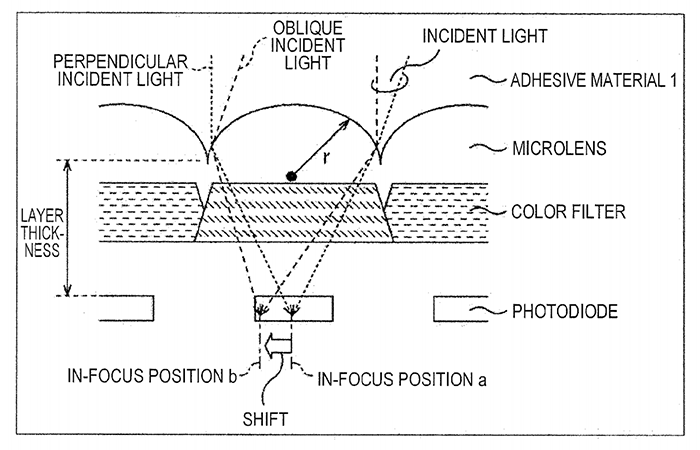
Their names are quite explanatory. These are micro lenses placed on the surface of the sensor above every pixel to correct the incidence of rays of light that come trough the lens to avoid a steep hiting angle.
With this correction every photodiodes manage to catch the more light’s information as possible especially in the corner of the sensor where the angle of rays of light are the most critical.
The 1st pdf is about micro lens,
reduce microlens gap & distance design & two layers microlens design.
The 2nd pdf is about back illuminated sensor.
The others pdf I am still reading it 🙂
Read all the pdf, then you know what the figure mean 😛
The first is about gapless microlens for a bsi sensor utilzing multiple layers for a thinner profile…I think
One of the pdfs descrbes wiring to inprove signal strength.
Another describes a complex reflective layer behind a bsi sensor to increase sensitivity.
One of the pdfs describes a ROLLING SHUTTER, not a global shutter, that apparently takes multiple exposures simultaneously. This is also specifically for a BSI sensor.
We have all been wondering how Sony can achieve a multi exposure high resolution mode that will work handheld?
Perhaps taking multiple simultaneous exposures is the answer.
Note that the microlens is multilayer and accentric
The wiring is multilayer and accentric.
And the rolling shutter makes multiple simultaneous exposures.
I have just picked out a few bits and pieces, but perhaps these things all have to do with a better multiple exposure high resolution mode?
Strange as it may seem I suspect that the combination of these patents and illustrations is to achieve a multiple exposure high resolutionn mode but 4 exposures would occur simultaneously via a rolling shutter.
A gapless 4 layer microlens would channel the light to 4 differrent locaions on the same pixel..
A comlex refletive layer below the BSI pixels will concentrate and intensify the light to the 4 differrent areas on each pixel, then 4 sets of wires would collect 4 differrent signals from the same pixel.
In simpler terms…this would produce 4x the number of megapixel…without reducing the pixel size and without reducing the lowlight sensetivity.
This would be a new type of Backside Illuminated sensor, With a new type of Rolling Shutter that exposes 4 exposures at the same time….resulting in 4x the megapixels of a conventional sensor!!!
I am not certain I am correct, can anyone verify that or offer a differrent explaination?
Whats the benefit? You can always use high resolution sensor and downsample for having less noise.
and, If they are under one color filter, all those 4 pixels have single channel signal, so no 4x color information anyway.
Bayer interpolates the signal based on the sourounding channels and invents information for the other colors. Therefore it creates 3 colors even though only one color channel is actually present.
This system …if my interpretation is correct?…will create 4x as many pixels while maintaining the same 4x larger pixel.
The result would be 2 full stops higher iso and substantially reduced cost than producing a sensor with 4x the actual pixels.
The advantage over simply shifting the pixels would be twofold
First this would allow use of the high res mode handheld, and secondly by providing an independent mode of achieving this high res pixel shift /like effect the image stabilization system could continue to do what it was desighned for…stabilize the image…while the exposure is taking place.
If the image stabilization system is used to provide the pixel shift it is unlikely that it could simultaneously do its job as an image stabilizer.
I think this shows Sony’s endeavor to create the best mirrorless camera.
Dafuk am i looking at?
Elsewhere in this post I have suggested a possible interpretation of these patents…I believe however that Sony has absolutely no current intention to develope this technology, but rather that by filing these patents Sony believes they have made it impossible for competitors like Canon or Nikon who do not currently use IBIS to develope thier own pixel shift/high res system.
Yep just increasing Sony’s dominance of the image sensor market
Did you mean mandala (en.wikipedia.org/wiki/Mandala) instead of “mantra”? This could have been your spellchecker interfering.