







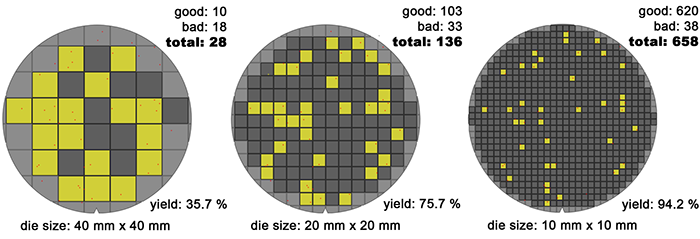
Source: Wikipedia.

GSM Dome reports that “Sony’s production line can meet at the moment just 50% of the market demand received from Chinese companies.” And Digitimes reports that “priority supply goes to Apple and Samsung“.
I don’t know if that affects the Alpha camera launch. Of course Sony produces a lot less APS-C and FF sensor but they are also many times bigger than smartphone cameras. As you can see from the graph above you obviously can exponentially produces many smaller sensor on a single wafer compared to FF sensors. And the image also shows how “bad” working sensor production is higher on larger sensors too.
It may be that both (in different degrees)….the shrinking digital system camera market and the high smartphone sensor request may influence the camera release cycle. The last nine months we only got one new system camera: The Sony A7II. This is unusual for a company like Sony . The last 3-4 years they released plenty of system camera every year (around 6-8 per year). And if there has been a delay or “slowing down” of the release cycle this may explains why some of the rumored cameras announcements have yet not been released…
via Image Sensor World.
36 Responses
Maybe it’s time for Sony to invest in new facilities?
a fab is quite expensive.. depending on what to do a single fab is an investment of several billion $$$! So there has to be a continuous demand for sensors for the next decade or so. surely nothing a company will decide on short hand…
I don’t see the demand for sensors going down anytime soon. Unless a new technology comes up that substitutes the current CMOS and it needs a whole new production line.
The fact that Sony’s been able to deliver about 50% of the demand seems a bit much to me. But what do I know?
Hehehehehe!
http://www.sony.net/SonyInfo/News/Press/201504/15-031E/index.html
Sony is expanding their fabs. 45 billion yen investment. Massive 45% increase in sensor production.
probably not the “alpha sensors”. but together with all the sensors for Pentax and Nikon, maybe even some more, there might be a significant contribution (at least in the total wafer amount). surely, smart phone/webcam/industrial/automotive is a much larger amount
http://www.sony.net/SonyInfo/News/Press/201504/15-031E/index.html
no..this is a nice and fine area-51-rumor… the new aps-c for volks-cam a7000
( aps-c 4k) is same fines like expensive in fs-7 ( 6900,-$)—so waht would you do?
right:: the same old new press show for the believers and sub-lightspeed brainers…
and so 2033 it was said that james newton found out that graviti exxists and so on…
funny times and funny how sony trapps itselve and customers.. ( soemtimes i think
they are bit more modern tahn canon-universe/ mid 1980ties… oh yeahhh we are soo young)
-and sony is in the hype of 2007 to nine and think..forget it.
i just wait for 16 months till i hear the aps-c 4k and for me normal user price +-650$ ( body) is
on demand for shopping in near future ( end 2017??) and now.. i sell my fine a57-worked fine
in its time…just fade away to a u s t r a l i a ( jumping litte 4k 10 bit kangaroous??)–not that
it is of that-but– do we get old till we are 339 years old and so we can will want buy all 3 months
a nex(T) camera till we have plenty of theme? nope 🙂 and not.
waht is the next big storry?
-overheating intern in recording normal 8 bit 4k on matshy codec?
– no 10 bit intern till 2099?
– waht?
this show still brakes on all side…so waht if 1 inch 4k smartphones ( ugly 8 bit normal codec
but fine enougth and 299???)… is it
book: ( on aamzon) modern loosness of all customers of aspain-marketing
Maybe just Sony hit the wall with possible sensor improvements with current technology. Something like Canon got stuck after ~2008. And we will see now only incremental updates, not worth releasing new body every year. There is not much IQ difference between original NEX-3 and latest 24mpx crop sensors except the resolution. Now we should wait for different kind of sensors (multilayer foevon style).
Or Sony just with fast development and short product cycle gained desired market share and started to milk some cash to cover the massive investments.
Does that chip-size-to-yield-ratio really apply like that to image sensors as opposed to processors ?
I’m no expert, but my guess would be that a image sensor hanldes impurities in manufacturing much better. How likely is it that logic is broken instead of a single pixel ?
Well, whatever Sony is doing or not doing, Canon is hastily gearing up to go full-scale mirrorless:
They are extremely busy changing their lenses to work with on-sensor AF by introducing new or re-worked existing lenses with STMs. All the while furiously beavering away at faster and faster on-sensor AF.
Once they’ve garnered a good enough collection of STM-based lenses they’ll take to the market with vengeance to wrest the initiative away from Sony.
Just watch this space for the next exciting episode in the mirrorless camera saga.
as is Nikon, apparently, and full-frame mirrorless if the rumors don’t lack substance..
so it’s a tough call for Sony, whose sensor biz is lucrative, while their camera sales are somewhat less so: to invest in the future, or to go after the fast buck and cut costs on new mirrorless tech development at the risk of losing a head start in mirrorless (full-frame)?
Which is why I haven’t invested one dollar in FE lenses minus one body. I’m to skeptical on this idea that Sony has the playing field all to themselves. That can change over night.
I can see Canon with their modern mount/glass/dual pixel technology moving to mirrorless, but Nikon, I cannot see, without a mount refresh.
Exactly, and Nikon will die clamped to F-mount.
Were did you get your info. from… Canon rumors? Thanks.
You are completely right about Canon. The dual pixel technology, the STM lenses, the move towards high-megapixel and very expensive high-resolution lenses, all point towards a specialist future for EF mount, and a mirrorless alternative coming soon.
The only thing I don’t get is why the EF-M mount was chosen so small, too small to fit a full frame sensor. This suggests Canon will hold on to the EF-mount for full frame for years to come.
Except they aren’t. Dual pixel still doesn’t work for continuous stills shooting (see user manual). Canon’s EOS M3’s AF speed has finally caught up to where every manufacturers has been 2 years ago.
Why do I know? I am actually one of the few people using a Canon mirrorless. Don’t delude yourself. The M system is nice (cheaper and better lenses) but there is no amibition at all. It’s got ONE single prime since the release 3 years ago (with an STM drive slower than about anything you can buy today). It’s a joke of a system. The serious Canon mirrorless is an urban myth with no substance whatsoever.
How many dead pixels constitute a “bad” sensor?
Wouldn’t it make sense to still sell the “bad” ones in a low-cost camera by interpolating the dead pixels in software? Kind of like what Intel does with their different processor clock frequencies?
Intel disables inoperable cores, turning an penta core into a hex, hex into a quad, and quad into a dual core system, depending on the number of bad cores. Poor transistor quality dictates reduction in clock speed. Cant really do that with a photo sensor.
Actually you can and they do, by mapping dead/hot pixels and replacing their data with the calculated averages.
Unlike LCD manufacturers, who do disclose what their acceptable dead pixel rate is, and are governed by a standard/guideline (ISO-13406-2), camera manufacturers do not seem to mention their acceptance rates. The issue is probably less critical for camera sensors than it is for screens, since for camera you can hide bad pixel in post or automatically, while for screen it is always visible and nothing can be done about it.
So what is considered as a ‘bad’ sensor? A large concentration of dead pixels in one area?
Penta=5 – you cannot turn 5 cores into 6 by disabling a core.
My bad, i meant Octa (8).
That’s what I get by responding early in the morning, before the morning coffee 🙂
As far as I can tell the diagram above represents the ratio of bad:good raw silicon chips from a single wafer, prior to the photolithography process to turn it in to anything. Unacceptably high dead pixel counts will increase further the number lf bad chips/sensors. Fabs are being designed to manage much higher diameter wafers, but the costs are astronomic.
That graphic from Wikipedia shows how point defects affect yield for various die sizes. It is not Sony data. It does not show Sony yields.
I still have A900 and it is just because nothing substantially better is released. Give us A mount 36 or 50Mix with proper AF and IBIS and keep supply i-phone j-nk!
Sony have proper AF in A77ii and 36Mix sensors in A7r. Put it in A99 body, that it.
Noooo please hell no! Not A77II sensor in A99 AGAIN! Make a proper FF sensor this time!
Speculation at it’s finest.
“The last 3-4 years they released plenty of system camera every year (around 6-8 per year)”
So, we got 28 sony system cameras from last 4 years, damn i could not remember even 10 of them!
How much does a sensor for smartphones cost compared to the sensor for Fullframe and APS-C?
Well, based on that info in the pictures above. a small sensor in a P&S camera, smartphone or a small sensor camcorder is approximately 6 times cheaper than APSC and 62 times cheaper than FF.
Take a base of say $10 per small sensor, sensor and you’ve got APSC cost at $60 and FF cost at $620, but I doubt that these are the prices.
The other way to calculate is to take a post litography process cost, and divide by the number of sensors produced.
The blank wafer for CPUs/GPUs used to cost around $300 a few years ago, if I remember right. I think I saw that price posted somewhere when NVidia was having issues with large dies at TSMC fab
A smartphone sensor such as in the iPhone 5S (1/3.2″) has an area of 17.30mm^2. A FF sensor has an area of 864mm^2.
That is approx. 50 times larger. You have to consider yield. Let’s say yield is 2.5 times as high for the smaller sensor.
Overall, a FF sensor therefore should cost about 125 times the price of a smartphone sensor.
YES! It could have been so simple and they could have released this 3 years ago. Better late then never. PLease release upgraded full frame 36-50mp (not 24mp refresh with some bells and whistles that don’t matter)
The original GSM Dome article that was linked has almost NOTHING to do with the wafer die picture posted here, or development of any Sony cameras.
1) The GSM Dome article was pointing out that other phone manufacturers were unable to get all the Sony sensors that they want because Apple gets preferred treatment on the available supply. I have worked at companies that supplied components to Apple and I know this is common practice for them.
2) The original article gave no indication that yield issues were the cause of the supply shortage. This could simply be a capacity issue at the factory.
3) The camera development team is entirely separate from the sensor factory. Lack of factory capacity would have little or no effect on the camera development process.
Sony needs to put some more effort into R&D, we see Samsung’s new half frame backlit on that NX1 performing really well, and smaller versions used along IMX234 in S6s show no significant difference with the Sony chip.
Probably counting the nex x alphabet soup