







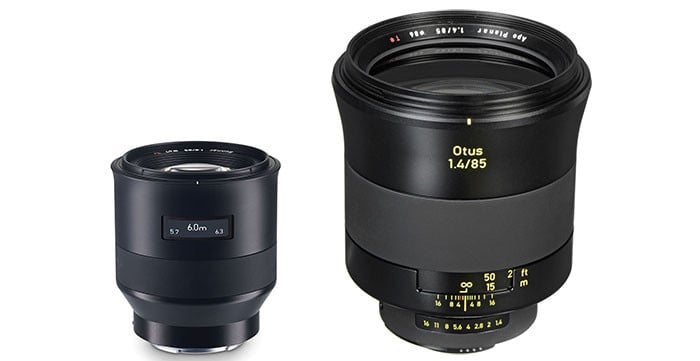
So, what’s the optical performance difference between the $4,490 85mm f/1.4 Zeiss Otus and the $1,199 85mm f/1.8 Zeiss Batis? Almost none! Just check out the comparison between the two MTF graph (Click to enlarge).
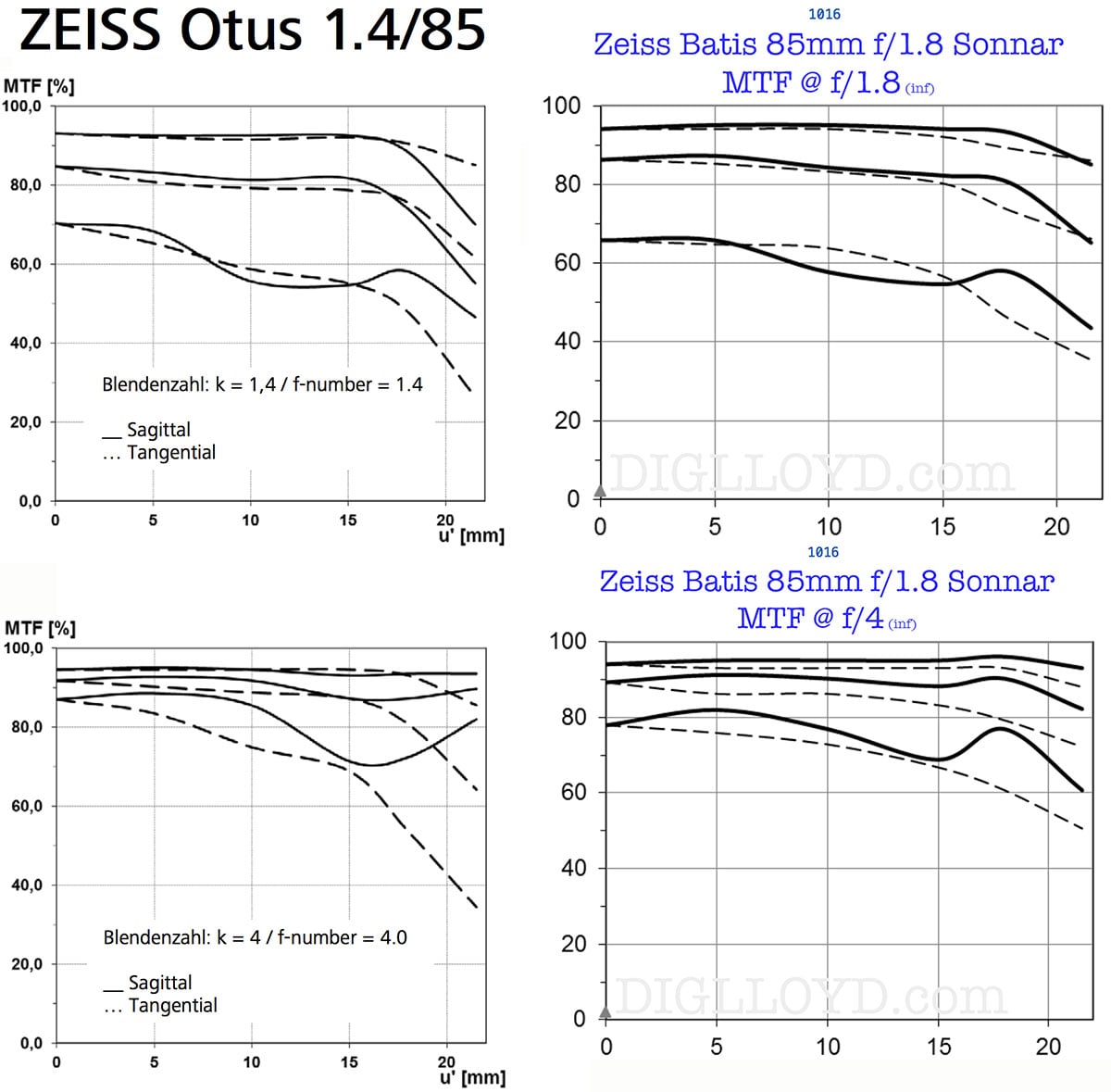
While the MTF performance is very close the Zeiss Otus still has the advantage of being faster (f/1.4 vs f/1.8) and it has less distortion. See the MTF and Distortion files here:
Zeiss Otus at Zeiss.de
Zeiss Batis at Diglloyd.
As our reader Seeky stated it relly looks like the 85mm Batis is a sort of mini-Otus!
Both lenses are now available for preorder in USA and Europe (UK/Germany)
Zeiss Batis 85mm f/1.8 lens in US at Adorama, Bhphoto. In Eu at Amazon DE, WexUK. In Asia at Digitalrev.
Zeiss Batis 25mm f/2.0 lens at Adorama, Bhphoto. In EU at Amazon DE, WexUK. In Asia at Digitalrev.
Lens shade for 85mm at Adorama, Bhphoto.
Lens shade for 25mm at Adorama, Bhphoto.
158 Responses
Now we only need a 135mm and a telephoto, the FE lens range is impressive for a young system !
Well yes, a great 15mm prime too !
Personally I’d like a cheap telephoto zoom (Sony branded, variable aperture). I can’t bring myself to drop nearly £250 on an la-ea4 for my £50 beercan…
Why not? The BC is lovely on the A7/S. Plus there are plenty of other great lenses to use with it.
There’s just so much more to optical performance than the MTF, aberrations (such as axial colour, coma, SA), distortion, bokeh etc.
It’s sensationalist to declare there’s almost no difference in optical performance between the two lenses because the MTF charts are similar!
Zeiss didn’t just spend the extra $3300 on yellow ink!
Of course I talk about the MFT only. Distortion is much worse on Batis 🙁
It is not only distortion. Please keep in mind that the Otus is an APO Design but Batis is not. This makes a huge difference on high contrast details where the Batis will show typical yellow/magenta edges but the Otus will correct for this!
The Batis has to offer-up a clean image and nice OOF background rendering @ f/2 as does the 85L. However, we (or you) do not know what this lens will reveal yet. The FE 1.8/55 is superb in comparison to the OTUS 55, we’ve no reason to doubt the Batis 85 yet unless we’re being an OTUS fanyboy!
Fanboy is a person without real arguments try to prove something thats not true to favor its own interests, even if it has no reason for it.
Your point……………. OTUS is supposed to be an 85 portrait lens no.
Theres no portrait lens, you do what you want with it, these names are gimmicks just because this field of view and characteristcs of it are good for portrait. Do you have any lens written on it: “only for portrait”?
You are just saying no sense because you want to make it seems better than it is, when its not. You could make the better use of each lens in each situation, but the real purpose here for zeiss is to make a benchmark in technical performance, and thats why their lenses are very expensive. Technical performance and usability is made of better materials and better quality control, that makes the product generaly more expensive.
“My own house is better than yours because is the way i like it…” Ok? But we are not discussing what you like more, but what they are trying to achieve with this lens. And what they are trying to achieve? Optical perfection with a reduced size and weight. Thats not hard to understand it is?
No, I think you are looking at “a portrait lens” and putting your own spin on it. Zeiss designed this “Batis 85mm” as a short telephoto for PORTRAITS on the A7 platform, end of story. The OTUS lenses designed by Zeiss where an exercise in “technical perfection” hense you won’t find them in the average working photographers bag, too big, too restrictive, too limiting in daily operation.
Go look in your average working pro’s bag, you’ll probably find a 5D3, and a 50L underneath a battered 24-70. You’re talking to the hobbyist crowd, not the working photographers with this line of reasoning reference the OTUS.
Thats probably why medium format “portrait” lenses are sharp?
You are one in a million, there are many diferent people with diferent usages. “End of story” in your mind. If know what Zeiss is you will know what the pursuit of them, and is written all over the place: optical perfection. If they wanted to compete in the mainstream market they would do what you say. They never meant to as Leica neither. They make engeneering art. If you will use it as it intended this is another story.
In your worl ferrari would never exist Neither Zeiss…
Google “Hasselblad 110/2” and get back to me, it’s not that it’s sharp that makes it one of the most highly regarded portrait lenses ever manufactured. Stop digging!
Oh man you simply don’t get it. Sorry this is simply dumb to continue. I tryied, even speaking in another language, thats too much effort for nothing. Its like an atheist trying to convince an religous person. Even though i believe in god. Bye.
Hey, you have a Ferrari, and an OTUS, good for you. Neither buys you any street cred in the real world (you understand the difference right).
“I’don’t have neither”, i just understand whats the purpose of their existence and you don’t…
The problem with you is that you are searching for magic in the real world. Lens baby for you! 😉
I could tell (based purely on you irrational arguments) thanks for the clarification. LOL.
Irrational for your narrow mind.
Stop digging!
No sir, i don’t obbey orders from people like you ;D
Horses and water comes to mind………
And that won’t matter a jot if its got the right look for portraits. With A/F and the most accurate A/F on an A7 series camera, this could well be a stunning addition to the line and actually prove to be the missing link for many professional people shooters! Many of us gave up 85L’s when leaving Canon behind, that’s the standard we should be comparing the Batis 85 to, not the OTUS 85 landscaper hobbyist lens.
The OTUS 85 about as useless a modern portrait lens as we’ve seen in a long time. Its a superb lens for middling landscapers and well-healed amateurs who’s goal is technical perfection.
This is the same as saying that a ferrari is a useless car for the roads.
You can always go back in sharpness in processing not the other way around.
They talk about character of the lens, this is for people who depends one the lens. A lens that has no character provides freedom for the photographer to include it afterwards.
A better car analogy would be a Porsche, it can, and is often used as a daily driver. A Ferrari is, and always will be a useless daly commuter.
What we, daily “photography” drivers, need from a 85mm portrait lens are:
1. Stellar optical performance @ f/2
2. Natural soft looking OOF background blur
3. Minimal color fringing
4. Good A/F performance (yes, people shooters use A/F)
5. Small light rig, no huge bodies or lenses
Throw in a good FF body with accurate A/F, thanks Sony.
That’s it. You can keep the OTUS. Flapping mirrors et al.
Nope, this is what you are searching some people have diferent need than yours…
And useless is diferent than not perfect.
You can use a ferrari in the streets, is just not best use case for it. If you don’t need don’t buy it, just simple as that. There are many other lenses that can offer you what you want already.
OK, I’m talking to deaf ears with 20-20 vision.
Or maybe you are the deaf…
Want to hear just what you want.
Now you are being as silly as you analogies……….
At the very least, apply the in camera distortion correction to the raw files. We already have the ability to turn it off and on in camera. With all these “fix it in software peopel” it’s the same mind set of shooting an imagine with the mindset of “oh I’ll fix if in PS”
The whole idea is to increase productivity not slow people down with one more task to deal with when editing.
Lens profiles are nice and all, but if your using ever so slightly older software, you don’t have those new profiles, forcing you to spend more cash on updating something just to gain a profile. I know many professional photographers, I work for them as well. Most hate changing/updating software.
If your paying 1200 dollars or more for a lens you shouldn’t be relying on freaking software to correct it.
Btw I agree with what you have said.
Hi Kelly – Often I’ll do the LR SW correction and instantly dislike it over the uncorrected RAW, especially when shooting fast primes. One thing Sony are stellar for is in-camera SW correction on the video footage, that makes the FE 4/16-35 actually usable for video (unlike my Canon 16-35L).
I can see that being good for video, but not in photo.. thats what i am saying. For video its quiet handy, less time in post production.
Uncorrectable, for the most part in video post for mortal humans too!
I use to be a Canon shooter… shot video as well here in Vietnam. But i switched over to Sony for a more compact solution, especially going into remote places or small villages.. people are less threatened by a small camera. You put a 5DIII and a 35mm 1.4 in the face verses a A7ii and a 55 1.8 or 35 2.8 and you get a different reaction
So your saying that the distortion/pin cushion correction is a pain in the butt in post for video as well?
Yes, my Canon 16-35L was unusable for video. The FE 4/16-35 (plus its excellent OSS) is in a different league with Sony’s in camera corrections. I agree completely about the reaction we get from subjects with these smaller cameras!
sure, I’ve used the 16-35 for music videos as well.. great lens. my point is i wish they would apply the lens corrections to the raw files for still images as well. I have not shot much video yet with the Sony.. but I’m assuming from what you are saying.. that the lens corrections are applied to the video during shooting and stay that way… meaning you don’t have to reapply them in post.
Yep, video corrections in-camera, that plus OSS make my little Sony way more useful than the old L. However, the old 16-35L, for stills, wide-open at 16mm had a cool look you don’t see on the Sony.
I have to agree..
It is useless on the roads. It does the same thing as significantly cheaper cars, but with less comfort and more expenses.
Of course there is much more, but at the same time it is heavily diminishing returns. I simply do not see what type of work would require spending these extra 3300 dollars.
Nothing sensationalist there.
Smaller aperture and no mirror box allow to get same quality as less price, esp. for primes, it should have happened.
I don’t think you gain that much from the shorter registration distance with an 85mm lens. Anyway my point was that sharpness might be the same, but that does not sum up “optical performance”, distortion is 15 times greater in magnitude with the Batis for starters. The the Otus is very nearly apochromatic, which I doubt is the case for the Batis, then there coma, lateral CA etc. So to sum up saying “look at these MTF charts, these lenses have the same optical performance” is pure sensationalism.
Everything about the Otus design is based on the philosophy of relaxing the optics and correcting aberrations through a greater number of larger elements. The idea that you can match this for a quarter of the size and price just by taking out the mirror box is pure fantasy.
You’re the guy who writes fantasies here, and has fetish for heavy lenses
Actually I prefer lightweight lenses. But I live in the real world, where sadly mirrorless cameras haven’t quite delivered on the promise of being the rangefinder of the digital era, ray angle dependency of digital sensors rules out most of the smaller symmetrical rangefinder lens designs, and we’re left with lenses that have very modest savings in terms of size and weight compared to DSLR lenses.
Go and look up the sizes and weights and compare them with DSLR lenses if you think of this isn’t true. These are facts, not opinions you can dispute.
The possibility to achieve compact designs is there, provided you’re willing to accept a very high price and modest maximum aperture (Sony/Zeiss 35mm f/2.8) or a lack of correction (Sony 28mm f/2.0 – little correction for barrel distortion, longitudinal and lateral CA etc.)
If you want correction and a large aperture then you end up with the Sony/Zeiss 35mm f/1.4 – a large, heavy lens.
The lens in question is not f/1.4 but f/1.8, versus f/1.4.
The weight of 1.4 vs 1.8 if they were singlet lenses would be (1.8/1.4)^4 = 2.73 times more.
What? A flat singlet would be (1.8/1.4) ^ 2 = 1.65 times more massive and a spherical one would be (1.8/1.4) ^ 3 = 2.13 times as massive. A generic converging lens would be somewhere between the two, but much closer to a power of 2 than 3, and certainly not 4.
If you scale everything linearly, FL increases, but f-stop stays constant. Thickness of singlet with thin edges and constant curvature is O(r^2)
Very true but an MTF graph tells a lot more than just resolution. The fact that the tangential and Sagital lines are about as close on both graphs suggests that there will be very few color/contrast aberrations. That suggests not only sharpness but smooth transitions in the out of focus areas. True the exact quality and character of the bokeh isn’t fully captured (nor I believe is the coma) but since Zeiss uses measured MTF graphs these are very helpful. And the admin did mention the out-of-this-world distortion.
Admin, why not have the picture of the Otus lens on the left hand side to line up with its MTF?
lower sharpness in the center, the same in corners.
Given the strong distortion correction needed with Batis 85mm, I wonder what the MTF looks like after correction.
And the 85mm batis has OSS!!! OSS rules, great for nightshot, video, liveview and no overheat issue like IBIS.
What I want to know is where these MTF graphs are pre or post distortion correction? Yes they look close (and I don’t think it’s a deal breaker) but correction that much distortion is always going to rob corner resolution.
On a portrait lens, I’d rather have zero fringing @ f/2 than perfectly sharp corners @ f/8.
It’s pincussion distortion, so your corners will be sharp, but your center resolution will suffer…
In my understanding, during barrel correction, the corners are stretched, however during pincussion, the center is stretched.
Thanks Stan!
Your right Stan. I wasn’t considering the type of distortion.
And how much is this lens? A thousand dollars!? THAT’S BARGAIN OF THE CENTURY!
I really hope for some image samples soon, those we ve got arent sharper than average 80’s lens.
80s lenses huh? So you’re talking about Hasselblad lenses? Or perhaps you mean Rodenstock or Schneider optics? Maybe you mean Nikkor Ultra Micro lenses for industrial use? I guess you could be referring to the phenomenal Nikkor large format lenses? Or the equally excellent Fujinon glass?
My point being, lenses in the 80s were pretty damn good, if you had the scratch. (Same as today.)
I think he meant lenses in the 80ish focal length, not in the 80s period 😀
My point is, they are better today.
Every lens and camera better bed very good indeed! Only pros snd eager amatueres will buy cameras any more. All others use their phones.
I guess Leica will be not only the first 35 mm but also the last. Only the fittest survive.
i’m quite impressed with the results, but the original OTUS is another league, APO lenses.
Technical perfection is the main objective of a quality brand. For me lens character is marketing name to lens distortion.
Google “PETZVEL portraits.” Now go look at the other 666 billion non-descript-boring-as-shit-portraits out there.
Everything has its place, even your OTUS, we’re talking about an 85mm PORTRAIT lens here though, not a “clinical scientific optic” like we’d find bolted to a telescope. There’s a reason why Canon’s 85L is widely regarded as one of the best portrait lenses money can buy.
“There’s a reason why Canon’s 85L is widely regarded as one of the best portrait lenses money can buy.” Substitute “was” for “is” in that sentence. The Otus is the best portrait lens available, the Canon has been surpassed by the Otis by a significant margin.
So on a day long gig, shooting wide-open (other-wise what the point of an OTUS) you’re nailing the eyes in every shot that matters manual focussing that TWO AND A HALF POUND OTUS on that Nikon? I didn’t think so…………
Again, self-referential. I bought an Otus 85 for my brother, he uses it on his Canon all day, every day, and absolutely loves it.
Then again he is 6’1/260lbs, so he might have more strength than you do.
I agree. I prefer the Nikon 58g over the boring/clinical Otus look. Its great for products and landscape where critical sharpness are desired, in portraits I prefer a little character. Less work in post smoothing skin too, nobody wants to see pores in portraits.
Yep, that lens has a cool look! Plus, I think the more we get beyond “the technical” the more we start to appreciate the aesthetic/magic of an image…..
“aesthetic/magic” is a personal opinion for it you can grab any lens that you feel good with it.
That’s why photography is part of the “visual ARTS” and not a hard science.
Yes, every use case has a diferent need, in this case people who are looking at these Zeiss lenses are not looking for it. You will probably prefer the Loxia 85 if it comes…
Are those two lenses accurate size?
no.
According to the sharpness of Batis85, it is in the league of Zm85 but Zm’s distortion is much better than Batis.
For sharpness Batis is better than most of 85’s in the wide open but not even close to Otus’s in every aperture.
Let’s wait for the performance of lateral and longitudinal CA, which might be the most difference to OTUS85.
Bokeh in samples from Zeiss official seems not impress me than Otus85 did.
…1199$ for a 85mm F1.8 Zeiss labled Sony glass. Thats so funny. Do they really want to sell lenses?! The lens might be not bad, but you get a really good EF 85mm F1.8 for around 370$. this is rediculous. OSS? The A7II shows us all the future of FE, so why we should pay twice?…
It isn’t Sony glass.
Good point about OSS on the Batis 85mm. I’m told, but haven’t used the A7ll, that OSS in conjunction with IBIS offers certain advantages though.
As to the Batis 85mm, its the A/F that’s really enticing, adapted lenses on an A7 can be problematic, and to be completely honest, the A7’s can be “quirky” even with their native glass. KISS for me.
These are Original Zeiss lenses. And not Sony Zeiss.
It isn’t Zeiss labled Sony glass. Touit, Batis and Loxia are native Zeiss
…Than Sony has a real Problem. This won’t work. You have to build your own lenses for normal prizes. They need affordable leneses, a stupid 50mm F1.8 for around 1000$, a 85mm F1.8 for 1200$, how should this work? Cheap cameras with adapted glass, can not be the solution for the future, neither 1000$ for F1.8 lenses. How much should we pay for future F1.4 lenses? 2,5K!? Just because something is from a german comany, it’s not worth 3,5x the prize of a comparable Japan lens… .
Wrong thought process Benjamin, this lens is for people like me who are used to paying >2000 US for a Canon 85L. We’ve been jumping up & down for this lens, at this price it is a bargain for us!
Before there are this supa dupa high quality lenses, Sony should really make some more afforable bread and butter stuff.
I am talking about something like the SEL50f18 for FF with other focal length for ~500 bucks. They can leave away OSS now, to keep prices down.
Maybe, who knows what market they were trying to hit.
They made really good FE28/2. I think We’ll see more non-Zeiss/G quality glass
No, it’s not a god lens. I own it
The f1.4 is around the price of the Canon. The f1.8 lenses you mention are a bad joke. Troll harder.
So, it’s aperture exclusively that defines the price?
EF is older design for yesterdays sensors and film. We are coming up on 50 MP sensors and its a wasted to buy a 50 MP sensor camera and put a $300 lens on it. http://www.dxomark.com/Lenses/Compare/Side-by-side/Canon-EF85mm-f-1.8-USM-on-Canon-EOS-1Ds-Mark-III-versus-Zeiss-Carl-Zeiss-Apo-Planar-T-Star-Otus-85mm-F14-ZF2-Nikon-on-Nikon-D800___241_436_1384_792
Be fair and look at comparisons with the same camera used.
800E: http://www.dxomark.com/Lenses/Compare/Side-by-side/Zeiss-Carl-Zeiss-Apo-Planar-T-Star-Otus-85mm-F14-ZF2-Nikon-on-Nikon-D800E-versus-Nikon-AF-S-NIKKOR-85mm-F18G-on-Nikon-D800E___1384_814_823_814
5Diii: http://www.dxomark.com/Lenses/Compare/Side-by-side/Canon-EF85mm-f-1.8-USM-on-Canon-EOS-5D-Mark-III-versus-Zeiss-Carl-Zeiss-Apo-Planar-T-Star-Otus-85mm-F14-ZE-Canon-on-Canon-EOS-5D-Mark-III___241_795_1383_795
The EF 85/1.8 is nearly 25 years old. How prepared for modern high res sensors do you think it is?
question for anyone: are there any pros or cons to leaving distortion correction enabled in camera settings? would it overprocess an image when unnecessary? i recently turned it on as i think it was off by default and havent really noticed any difference.
It would not “overprocess”, but would rather “fix” distortion, chromatic abberation and vignetting As per specific lens profile. In turn each would result in the following:
Distortion: if the lens has heavy native distortion, you will see a loss of resolution in corners as a result of barrel correction and in the center(my understanding) as a result of pincussion correction.
Chromatic abberation: Dont know of any downsides here
Vignetting: The heavier the vignetting is in corners, the more gain camera will apply in the corner for a particular lens. More gain in the corners = more noise in the corners.
If you are using any non-native lens, there are no in-camera profies available, so the inage will be left as is.
Note that all this is usually only for JPEG files. If you are shooting RAW, then some Sony cameras apply only Chromatic abberation correction in RAW
thanks for the reply. actually what i was trying to specifically ask is if the lens has little to no distortion, which is what i meant by when unnecessary, does it just leave the image alone, but i think you answered me by implying it only corrects issues when they are there.
It corrects as per profile, so if your lens has 3% barrel, it will correct that much. If it’s 1% pincussion, again it will correct that much. Even if you have 0.0000005% distortion, it will correct it.
It will not do anything extra and it will also not do anything if the profile doesn’t exist. Sony has to make lens profiles on a per-lens model basis for distortion correction to work.
ok gotcha. thanks again!
Yes, distortion correction surely can cut *SOME* sharpness from your image.
The Canon 85mm 1.8 is around $350. The FE 85mm 1.8 is $1,200. Until the price of FE lenses can get in line with what’s available to Canikon users this mount will continue to be far behind. Sony is far too dependent on Zeiss and their very expensive lenses to try and fill out their lens lineup.
Stop down Otis to 1.8 and then we’ll talk of sharpness. Many lenses can perform well at lower arpeture values, none can even come close at 1.4. Batis surely isnt it, especially considering the heavy pincussion distortion.
In just 40 comments this lens is:
Superb
Total rubbish
Hugely overpriced
An absolute bargain
At least a match for an Otus
Leagues behind the Otus
Too sharp for portraits
Perfect for portraits
…and on and on and on!
I’m curious as to how many commenting have a real need for such a lens (and I’m not talking about those buying one simply because they have the spare cash). It certainly looks like a real ‘gearhead’ discussion…all MTF charts and no pictures!
80% what I do is portaiture. While I own the 70-200/4, it doesnt cut the mustard for compressing the background. However, im also looking to manual focus lenses such as the fd 85 1.2 L and the C/Y zeiss 85mm f/1.4.
My comment wasn’t aimed at portrait photographers, but rather the fussy comments made, especially when there is so little in the way of pictures to judge this lens adequately.
Your reply has puzzled me though, so perhaps you might enlighten me.
If you do take a lot of pictures and most are portraits, is there a particular reason you have for buying into the Sony E mount? I would have thought an A99 (if you like Sony) and the excellent portrait lenses already available would be most sensible. Otherwise take the Nikon route, or even Pentax 645z.
Buying any camera only makes sense if it serves the required purpose. I can understand accepting certain limitations if you only come across them occasionally, but if it is the bulk of your work surely it would make life too hard, wouldn’t it?
Becuase I shoot a lot on location, and want to travel light. I considered the a99, but I also like the form factor and portibility of the emount.
Are you sure you mean ‘doesn’t cut the mustard for compressing the background’?
Yes and of course 1.8 is better at low light. And im sure its sharper than the 70-200
Obviously the ones that say that it is too overpriced for what it delivers, will not buy it
So the takeaway is trust your own judgment, make your own evaluation and test it out yourself.
The cheap Canon doesn’t hold a candle to this lens, unless your only criterion are FL and f-ratio.
After this one and a smaller Loxia, I expect a $500 APS-C 851.8 with decent sharpness. That one will be for me.
It’s not going to happen. There is no company which ever produced an APS-C 85mm lens, except Samsung (It’s 85mm lens is as big is a FF lens). It is a classic 35mm equivalent portrait lens, and it seems that 50mm on APS-C is generally considered to be the solution. If you want that, I think you should take a look at Fuji which seems to be bringing out a 90mm f2 in the future.
then sony please give us a 90mm f2 apsc e-mount lens please
I am interested in buying it. But the Nikon 85/1.8g is a great performer on the D810 for 400 Euros. The difference may be measurable, but will it be seen in real life images? For 1200Euros it really needs to shine and provide s.th. special (aside from the nice OLED display).
But then the D810 is more expensive than the a7r; and that is the part of the system that you will be replacing at some point.
This is basically the problem is folks go strictly by price. If it cost this much it should do this or that. Price is relative folks either you have the need or you don’t. I’m a Pro of 40 years and I been all over the charts with medium format and spending 40k just for a back. Lenses up to 8000 dollars and I have bought a lot in that range. Try Leica out for size 1200 is really like buying a bag of peanuts to Leica users. Get over the price think more about your needs. If you think it’s too much maybe you have the wrong system to begin with or maybe your just not experienced enough for these types of systems. Nothing wrong with that as we all have diffrent needs or wants. The point is as a Pro or even a serious hobbyist we think first about our needs than you deal with costs versus what a lens will do for you or not. Trust me the differences sometimes between a certain set of lenses is very minimal and sometimes things don’t make sense.
Here is the basic problem today with lens design compared to yesteryear and we need to understand the market. The call for smaller , lighter, cheaper lenses is all well and good but with that lens designers face serious cost issues as to the design. Yesteryear they went big and fast and size did not maytter much nor did price. In those cases they can build more freely and have lenses that where optimized for the cameras. Today this need causes a major problem and given cost, size, weight concerns not to mention the market they are targeting something has to give to do that. Modern lens design is relying far more on software corrections to accomplish these goals. So outside a lens line like Otus where the goal is ultimate performance and everything else be damned you won’t see lower cost lenses corrected entirely by the lens alone, designers can cheat the costs size and weight by one leaving the distortion to whatever it comes out too and fix by software.
Now using lens profiles and fixing distortion is the best way to get around those issues. So going forward you will see a lot more lenses that will need software corrections . Look squarely at the new 28mm F2 at a bargain price of 450 dollars it’s a classic example of new lens design but needs software to correct for the distortion. We are not going to get around this if cost, size and weight are primary design goals. It’s just that simple. You want ultimate performance than lenses will be bigger, heavier and more costly. That market is drying up fast.
Btw I’m buying the 85 as far as distortion, yes slightly heavy I agree but honestly the corrections via software will have very little effect on quality of file. Also not every image you shoot will even need corrections as you may not see much of a issue. Of course some types of shooting will, right off the bat straight vertical lines you will see it. People depending on subject distance may or may not need a corrections. Obviously closer shots of faces will as it will look more distorted. These are just new facts of lens design. Every system has these same lens design limitations in the new era. Bottom line you want fast lenses with all the corrections built in than you will pay top dollar for it. You want small, cheaper with less weight than you will depend on lens software corrections.
Your post is contradictory and therefore confusing.
First you say you are a Leica guy and regularly spend $8k on lenses, and yet you won’t go the extra few bucks to get the Otus rather than the Batis.
Then after acknowledging that the newly-designed Otus has ultimate performance, you go on to state that “Every system has these same lens design limitations in the new era (distortion).”
Your first post was good, but this one fell off the rails a bit. You are clearly a Batis-type of poster–a bit of software correction applied to your posts, and the distortion will be corrected, I’m sure.
I hope these are straight off the lens performance and not in-camera correction. Even then, I might be ok with it, given the reputation of the Touits. As for cost. I am ok with it. Hopefully, it will drive the complainers back to m43. I don’t understand how people buy a $2k+ FF camera and then complain about lens prices. If you’re opposed to the price, there are many historical lens you can adapt to it. I’m happy with the price if the performance is there. I’m sure the price will drop if the demand is not there, but given this is FE, I’m pretty sure the demand will be there.
I do a lot of events and some personal (portraiture, street) stuff. Still using an old Canon 5DII.
This Batis 85 and (what you say about) a7rII make me want to try something different.
Bravo Sony.
Difference is f1.8 vs f1.4. xD
I doubt its “hardware” corrected anywhere near Otus. And yea, that does make difference..
OK, we’ve got a mini-Otus, now how about a mini-Batis for APS-C?
touit
Or, you know, any new APS-C lenses at all.
I would buy the Otus if my left biceps weren’t so weak and girly. Balancing that hat huge hunk of glass on my left hand will leave me real sore after just a couple of hours.
I’ve never been a pro and I find these prices a bit jaw-dropping. I see so much attention paid to, and excitement about, ‘fast’ lenses with apertures like 1.8 and 1.4 – yet I’ve never had a need for them. On the rare occasion I’ve done a portrait, I didn’t go bigger than f4, because the DOF gets too thin. And with today’s sensors and high ISO numbers, I just can’t imagine needing that light-gathering power.
So – you guys who go for these huge, high-performing lenses – when do you really need them? Are you shooting street scenes at night? Portraits by candlelight? Sports, at very high shutter speeds? My question is serious, not sarcastic. I’d like to know who uses f1.4 on a frequent basis and will pay thousands to get it.
Creative possibilities, i guess, is the main reason. i rarely use by the way.
Not much shallow if you have a good distance from the subject. DOF for a7 for an 85/1.4 stopped at 1.4 at 3m is about 10cm which might be good enough for portrait.
Well, many f1.4 lenses don’t even cost thousands. Most brands produce 50mm f1.4 lenses around 300-400 bucks.
Besides that, there are a couple of reasons to get a fast lens and shoot it close to or at wide open:
1) If you want to stop movement. You’ll be needing a high shutterspeed which in low light conditions may only be possible by opening up the lens. Even in the era of good high ISO performance, there are often situations where the light levels are very low and a fast lens is the only option to get an image which is usable. (of course, usable depends on your definition of it).
2) If you want to separate the subject from everything else. Especially wider lenses need to be fast to get decent subject isolation. Slower and longer lenses can obtain a similar level of subject isolation, but it is impossible to get similar framing and composition with accompanying subject isolation compared to faster, wider lenses. Slower and longer lenses may be sufficient in good light, but in low light it is very difficult to shoot those lenses since they need much faster shutter speeds to combat camera shake (without IS).
In the end, it depends on your style; some like portraits with the whole face in focus, others may be satisfied with sharp eyes only. With an 85 f1.4 or f1.8, you have both options. With a slower comparable lens, the latter becomes difficult.
These pics would never turn out the way they did with something slower than the f/1.4 I used at those moments. I’m a semi-pro, and I think the prices for the new Batis lenses are competitive. I even get the feeling Zeiss has been cutting a couple of corners to be able to sell them at this price. A little more plastic in the design, a little bit more software correction than we normally see from Zeiss is my guess. Both is okay by me as long as the images turn out the way I want them. Skate shot – A7S, ISO 2000, 1/100s, Rollei Carl Zeiss Planar 85mm f/1.4 @ f/1.4. Car shot – A7R, ISO 100, 1/250s, Contax Carl Zeiss Planar 50mm f/1.4 @ f/1.4 (and freezing -30C as a sidenote).
I definitely get the second one. I’ve never done much with thin DOF. Probably because I never shoot people. With macro subjects I go the opposite direction – focus stacking.
You don’t get the skate pic? Well, what I personally like about it is the multi layered depth. Look at the pillars, the hanging shoes, the curved concrete bowls, the guys. There is so much more than shooting a pic with shallow depth, and a pic that is hyperfocal. And for that particular place, at that particular distance, only f/1.4 was able to get that amount of dof I wanted, one that made the parts step away from focus in many fine steps. If you can’t see that, I understand why you don’t see the need for certain lenses.
Well I didn’t say I didn’t get the first one, just that the second one really made the point. In the first one, I’m with you to some extent, it just doesn’t jump out at me.
We use our lenses wide open 90% of the time for portraits and on events (lets us separate the subject at larger object distances and keeps ISO low). For close-up portraits f 1.4 is probably not needed. But do the same for subjects farther away, this makes a big difference.
We don’t need them, we want them!
I shoot nearly 90% of the time at f1.4 as evident in my portfolio. It’s not all about low light shooting or sports.
Prices for Zeiss lenses are dead-on. I do NOT see them being high what so ever for quality you are getting.
If you are working pro-photographer you must be on same page with me on this subject.
I buy lenses or rent lenses as business goes on and whatever my assignment requires.
I did have even in one occasion lens being custom built in Switzerland for one project only. If you have client trough ad agency where you are paid 12-15 000.00 USD per pop this will be no brainer.
Therefore, buy your self “step ladder” long enough to reach the roof. You do not need a “crane” if you are hobby photographer on budget.
As simple as that …
So this lens only for professional with “12-15 000.00 USD per pop”. You are one of them i guess.
Well then, Sony still does not have E lens for normal photographers. Well done.
“Read my lips …” liedetector, … many people if they skip their financial priorities can buy Ferrari ENZO how ever do they really have money for this car maintenance (?) Oil change running around $1500.00 or new windshield running for $600.00 etc, etc …? I do not thing so …
And so same is similar in photography. If I buy Leica S for $25000.00 and then start to complain, that lens I really want will cost me $12000.00 USD I will definitely qualify my self in to category of morons.
Therefore for you “lie detector”, resign from idea that German firm Zeiss will produce some “like Made In China” knock offs because people like you are cheep with luck of understanding where quality of lenses for serious photographers endure.
P.s. I am NOT rich nor famous. I am just one of many working photographers who does NOT have money to be wasted. Therefore I buy fine optics and it happen, that Zeiss is one of them.
So, with that rant, how exactly you can disprove what i had to say? Amuse me.
I will repeat, if you miss it: Sony still does not have E lens for normal photographers. should i add “decent” in it too? “read my lips” indeed.
Yeah i know right? “12-15 000.00 USD per pop” professionals out there would buy Sony E system, and coupe wit 85mm 1.8 lens for their professional work. You nailed it ;).
Oh BTW. the Nikon 85mm 1.8g is anything but “Chinese knock offs”. I don’t think anyone can possibly “waste money” with that lens. For some reason i think you will miss the point again.
It seems like, that you don’t get it …
No i don’t get your rationale, that is for sure.
“donkey” indeed.
“For some reason I think you will miss the point again.” Errrrrrrrrrrrrrrr, possibly because your English is so bad and incomprehensible, incoherent and at best non-sensical. Get Mummy to edit please! Suppose you’ll be refused internet access now for another week if Mummy catches you ‘ranting again’!
This butthurt dummy is following me around because i kick his *ss so hard. LOL!
Poooooooooooooooooof!!!!!!!! Gone again.
No, i was clear with what i meant. I said average 80`s lens, not the best 80`s lenses which guy before you so devotedly listed. Still, modern Zeiss at this price must overperform 30 years old Fujinon.
And i was talking about image samples posted earlier on this site, which are only ones we have until now. And those pics are not sharper even than Samyang 85 1.4. I dont say that MTF lies, i say that we dont have representative samples yet.
1200$ for a stabilized AF Zeiss is really great. Plus the 25 would be awesome to add too. Bummer there’s no aperture ring like the FE 35/1.4 has. It really has grown on me. This would make these lenses perfect.
Ordered 7- one for each day of the week.
So the Otis is metal and the Batis is plastic…still says something about what Zeiss thinks about these materials lol
That they seek to keep high optical performance but externally differentiate between lens A and Lens B for which they want to charge 4 times more.
At least the differentiation is this way and not the other way around;)
Yes, I think most users would prefer a lens with great optics and plastic barrel than poor optics and metal barrel.
A sharp & reasonably-priced APS-C 85mm f/1.8 with AF & OSS. I don’t care what you call it, just give it to me! 🙂
It won’t be much smaller or cheaper than FF one.
Two critical differences. The Batis loses 20% of its MTF and 90% of discrete color values because it only fits on a Sony and doesn’t fit on a Nikon.
And better hand/eye coordination focusing at @ f/1.4 – Post a link to his work so we can pick up some tips and thanks for the great advice!
EXACTLY
It still works, but it can’t achieve the best performance. so its not useless.
For each situation has better choice.
The problem here is understanding to who this lenses are made for. What public type?
People who buys Zeiss lenses, that has kind of obssession for performance to make the best out of their sensors.
This people pays a lot of money because they know how to take advantage of its strenghts. Sony should already have launched its second grade quality 85mm for the more money concious people.
Zeiss and Leica has a public thats why they can produce such a lens with such a price tag, they know that will sell for their public.
Hahahahahahahahaha