







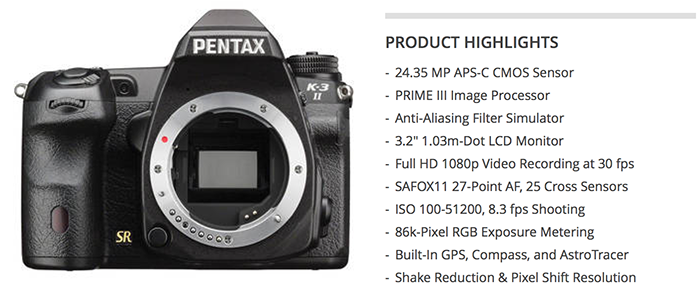
Pentax announced a new K-3II camera featuring the Sony 24MP sensor inside. And they also add one feature I hope Sony will add on the current A7II and all future on sensor stabilized Sony cameras: Pixel Shift Resolution mode. Pentax writes:
The K-3 II is the first camera in the PENTAX line to incorporate Pixel Shift Resolution® for capturing still life subjects with ultra-high resolving power. Pixel shift technology uses the camera’s in-body Shake Reduction mechanism to move the image sensor at single pixel increments, capture 4 separate images, which are subsequently combined into a single high definition image. Benefits include higher resolving power, reduced false color and improved overall image quality of non-moving subjects.
Please Sony…copy such good features! 🙂
81 Responses
let’s wait up the results, how this tech works, it could be just a “geige” – marketing move, without real achievement. Although I could imagine, theoretically the idea is good.
Results are impressive, on em5 mark2. This feature is limited by the fact that you need a tripod and no vibrations at all are allowed, as well as moving objects in the scene.
It’s great for still life and products photography.
with a tripod and no vibrations at all I’m gonna get stunning results on many cameras without this feature
Marco said it works like intended (sharper higher res images for studio or landscape). Sounds good to me.
But what are you trying to say? I have no idea.
If “Pixel Shift” works only with “a tripod and no vibrations at all” only in studio, what is is worth for real photo lovers, which are supposed to live with the cam outside the studio?
“Real photo lovers”? So if I love to take still life photos, or some macro, I am not a “real photo lover”?
It’s the first iteration of this kind, after Hasselblad, available to photographers, I don’t see why we should bash it.
Actually the sensor moves 1 pixel up, down, left and right, and half a pixel to the diagonals: unless you have a really fast electronic shutter (along with strong enough parts moving the sensor), I don’t see how you can ask for that feature to be done handheld.
Olympus is working on that, I don’t know if Sony will have or use this tech.
It’s like IBIS: it doesn’t freeze subjects, but help you in critical situations. Like ABS on cars, or safety belts: you don’t like/need them until you need them.
I apologize if I abuse you, of course studio and macro guys are very respected photo folk, the sole of the earth. What I meant: most of us walk around/wedding/party/occasion shooters.
Of course, this tech has also future, which one, we will see :))
There’s no need to “rank” photographers. I have always a camera with me, I usually take pictures at jazz concerts and in theaters, so until now I haven’t used this high res option except to try it out of curiosity.
If I need a huge amount of details I use my dp2quattro and dp3quattro, with all their quirks.
If I feel nostalgic I use my Nikon35ti with some Ilford or Kodak Tri-X.
Or as today, I go out like a “hipster” with an old Polaroid SX-70 and a RicoGR, just in case.
As you see, it’s almost an obsession. 🙂
Oh nooooooooo. Please don’t call me a hipster!!! (I’m a Ricoh GR addict)
It is obsession. Good one :)))
Now you sound alot more sane. LOL. But seriously, there is absolutely no reason to bash that high res mode. It’s a welcomed option for some. And if you don’t like it, you don’t have to use it.
Thank you for clarification. Now that we know that studio and landscape photographers are no real photo lovers, I can tell you that this feature most likely makes sense for them. The fact you don’t get it changes nothing.
Who says that you have to be a real photo lover (in the eyes of some uber photo lover), in order to find a feature like this pixel shift high res mode useful?
He’s probably thinking about the very time consuming process of photo stitching. That in my book is not comparable since it’s so slow to do .. during and after the shoot.
Sure, but this is just the first iteration of this tech, and the nice thing is that even with a smaller m43 sensor you can capture a high detailed image.
It’s not a must have option, but it’s good to have it.
In some quick “tests” I did, these high res images are on paar of those taken with a dp2Quattro.
No, you can’t. this feature act like a foveon sensor, giving each pixels the real color, no color interpolation like on bayer sensor. In the case of Olympus, you have extra resolution too.
It’s interesting that two makers that use Sony sensors have implemented this. I wonder if Sony got access to the patents out of the Hasselblad rebadge agreements.
And while Sony are copying functions, please copy the AstroTracer function, I would like to have that a lot more than Pixel Shift Resolution.
Ricoh/Pentax: Just wait a minute until the disastrous mirrorflapping issue wih the K3 is OFFICIALLY resolved! Up to now it is not even officially recognized by Ricoh.
great k-3 i buy
That is some ugly camera if I ever saw one
–
That ist true. In early film days they had brilliant industrial design, but nowadays their cameras are indeed very ugly. To be fair, they are not the worst, Sonyblad and Minolta AF cameras were even uglier.
But from the usability and value-for-money viewpoint, Pentax is still one of the best camera makers on the planet. Add exceptional weather sealing, ruggedness and DNG RAW support and you have one of the coolest brands camera land, despite the ugliness.
Do you think it would be cooler having Minolta printed on the body instead of Sony?
I personally don’t care. But I think it’s not very smart to ditch a valuable, well introduced brand name, just because you acquired a company. The Minolta name had higher value in the camera market than Sony. So, I guess, many think Minolta is cooler, especially in the consumer market. It seems that Ricoh is a little smarter. 😉
They couldn’t keep the name, as they didn’t buy the company. Minolta still exists. Nothing smart about Pentax.
Imagine the name would be “Sony-Minolta”, like “Sony-Ericsson”.
This sounds like a coorporation between 2 companies. In my mind it sounds further more, that the DI departetment of Sony is something just to speculate with and try and maybe throw away if there is no economic success, as they did with Ericsson. Just leaving the brand name “Minolta”, nobody would get aware, that this almost bankrupt company has been saved by an electronic-giant.
In my opinion Sony is a well know brand with high quality consumer products – there is nothing wrong by having just “Sony” as name.
Hey I think my K30 is beautiful!
LOL @ Sonyblad 🙂
Digital rev reviewed omd sensor shift and said it was crap
If Kai says it’s crap, then its crap for sure.
+1
*hehehe*
That sort of reminds the yesteryear Sony A-mount – pushing cameras with innovative features at very competitive prices, yet on overall scale of things no one really notices or cares.
Sorry, I have to disagree. Pentax reminds me on everything else but Sony.
Nothing can beat large sensors and high end lenses. You can hunt for pixels or gadgets, but if you want top quality results, you’ll always end up with the good old film, FF or larger. But for most of us a Fujifilm X is perfect enough! How ever, built in AstroTracer might be vey usefull for some.
This is absoluteley false. You can’t expect top quality results from the tiny (35mm) FF or the little bit larger digital MF (which is way smaller than “real” film MF). Even the small 4×5 inch is a compromise. So, you may continue talking sh*t about your tiny little toy FF gadgets, but that doesn’t change the fact that real quality starts at 8×10 inch.
Word of advice: Think a little (that means use the tiny litte grey cells inside your head, if there any) before writing such bullsh*t in public and I promise you it will be less nonsense and that at least some will respect you and take your words serious.
I think you’re on the wrong site Wave Dancer.
Hehe…
what is astrotracer?
Dunno. Just found this:
http://www.ricoh-imaging.co.jp/english/products/o-gps1/astrotracer.html
Astrotracer is a feature that use IBIS to move the sensor according to the movement of the stars. You can do long exposure without startrails.
Full HD at 30 fps. Wow. This is 2015, right?
On ricoh web site, they say Full HD(1920×1080, 60i/50i/30p/25p/24p)
The Ricoh execs admit they don’t care for video mode just like the aging Pentax user base. Canon also admits to a 1080p future limit on their DSLRs so they could make big money on the C100-C500 Cinema line.
“…aging Pentax user base…” LOL
Thank you for another well informed comment.
To me the K-3ii seems very tempting. This camera with A7s like low light performance and sharp (full sensor readout) video (1080p would be enough for me) is all I could ever dream of.
But Pentax video is crap 🙁
Stills are class leading though, pixel shift look very promising:
http://www.ricoh-imaging.co.jp/english/products/k-3-2/ex/img/bod_mainImg_01.JPG
I am a big fan of higher resolution.
But this feature requires multiple exposures and therefore is only suited to tripod shots of non-moving subjects.
A real high resolution sensor would be much more practical and usefull.
The use of Exmor R…bsi…instead of Exmor would make achieving that goal substantially easier.
While bsi has minor advantages for current larger sensors it has much greater advantages for smaller higher pixel density sensors, and for new/future higher resolution apsc and ff sensors.
Samsung is using a 28mp apsc bsi sensor, and as a result the NX1 is the current top rated apsc camera. This sensor far outperforms any 24mp apsc sensor made by Sony.
“the NX1 is the current top rated apsc camera. This sensor far outperforms any 24mp apsc sensor made by Sony.”
What are you talking about?
http://www.dxomark.com/Cameras/Compare/Side-by-side/Nikon-D7200-versus-Samsung-NX1-versus-Sony-A6000___1020_976_942
As a “big fan of higher resolution”, what you said is surely true for you. But with todays computing power, bus speeds, storage speeds, application (LR, PS) speeds, for most of us it is not practical to handle 50 or 100 MB RAW files on a daily basis.
This might change in a few years, but today, Lightroom and SD-CARDs are slow enough to make handling 24 mpix files a pain in the a*s. So, to be honest, I like the idea of having moderate resolution for general purpose and a high res option for special studio, architecture or landscape needs.
I would not buy a 50mpix camera even if it would be the same price as lower resolutions.
Your logic is totally flawed.
If you never want higher res neithr option is for you, you will never buy either, and the existance of this cameta for those that want it does you no harm.
If you occasionall want high res a high res camera can be set at a lower than max res and maxed out only when you need it…without the limitations imposed by pixel shift.
I didn’t say that I never want high res. I said I like the idea of an high res option. Thats all. Your thoughts may be valid too, but I can’t see the mentioned “totally flawed logic” in my words.
And thanks for your advice. I will think about purchasing a Canon 5Dsr and will use it in low res mode. Really nice tip. 😉
Please point me to a camera that has the capability to lower the resolution in RAW?
I surely don’t know of one. It’s a JPEG only feature.
Pretty sure both canon and Nikon have this feature, Its called raw small or medium etc. Work much the same way that Sony raw format is slightly compressed.
imagine you a have an electronic global shutter.
And you can take 4 images, each 1/8000 sec.
So you could get a 4 times higher-resolution image within 1/2000 sec – handholdable!
You cannot use this feature handheld no matter how good you are
Maybe in a few years you can?
And you can not read and understand what is written
Electronic global shutter. Now that’d be nice. While I could care less for stills having that feature, in video it would have been awesome!
Bringing all possibilites to the next level!
-no rolling shutter in video!
-100% silent for stills and improving image quality because there is no shutter shake at all.
-further weight & cost reduction, because there is nothing mechanical in the body, except IBIS
A real high-res Bayer sensor throws out 2/3 of the light that travels through the lens. with 72+ MP sensors and lenses able to resolve that much, sure you can have better results.
The real improvement from that system will come from the Olympus E-M 1 II , upcoming camera, the rumour about this one is that with the new 20MP Sony 4/3 sensor, this camera can do this Pixel shift thing like the E-M5 II but without tripod !!! as long as the picture is taken above 1/60sec !!!!! Oly fans say that camera will be called “the game changer ” ? what do you think ?
Time for BSI 64 MP sensors…
The only game changer is electronic global shutter.
They took out the mechanical mirror, now they need to take out the mechanical shutter.
Agreed 100%.
Just take a look here, and maybe you will want this upcoming OLYMPUS camera instead of anything else !!!!!
http://www.43rumors.com/olympus-shows-a-new-3d-stacked-16mp-global-shutter-sensor-with-2mpixel-10000fps-mode/
Oh please let it be a RX10 II or RX20 with 4K. Pretty please!!!
Oh please let it be a RX1 II with absolutely top notch specs. Let it be so amazingly awsome that every RX1 owner wants to trow his old slow RX1 out of the window. Then I will hopefully get my RX1 for less than 1K on ebay. :DDD
Pentax already re-used the IBIS in order to have a AA-filter simulation. High-res mode is just the next logical step.
What? Pentax doing more with Sony’s own sensor? Nah…..
Why not? Olympus also does!
Turn on your sarcasm meter 😉
Hmm.. I will have to see some images. Is it worth upgrading my K-3 to this when you can just use photoshop stitching? That is my question.
There are samples on Ricoh’s website
The first 2 are using pixel shift:
http://www.ricoh-imaging.co.jp/english/products/k-3-2/ex/
Resolution is still 24MP, but there’s no interpolation, 2 greens are averaged and there’s a blue and red for each pixel (that’s why 4 exposures are required, every pixel is made from a unique RGBG group). In the end you have 72 million subpixels and 24 million full RGB pixels.
I checked it out thanks for the info 🙂 Some beautiful images!
You own the K-3 huh. Well then, I’ve had my eye on that sexy beast. So let’s here it. Can you compare it to the A77II per chance?
Well I would say the biggest difference for me is the interface. The way the controls are laid out on K-3 you feel like you can operate all the controls in the dark and the GUI is very intuitive. The IBIS on the K-3 is not as great as on the A7II or Olympus E-P5 but it works very well especially at wider focal lengths. Maybe a stop less of stabilization than A7II. The bright 100% view OVF of the K-3 has the advantage when making bird in flight shots and fast action but the A7II has the advantage of tilting screen, focus peaking, and manual focus zoom assist for perfecting your focus. If you like using Manual focus lenses the A7II is for you. With its short register distance you can adapt virtually any lens. With the K-3 register distance you can only adapt M42 , Nikon F, Olympus OM, and a few others as Pentax register distance is one of the longest.
When shooting out on the street I mostly use the inconspicuous A7II often leaving the K-3 at home due to it’s size, but for nature shooting K-3 is the one I go to. The K-3 has faster FPS and it’s buffer is excellent, besting other SLR’s in the same price range. I recommend both cameras but if I had to choose A7II is the one I would go with. 🙂
K3 = real camera, A77 II = walkman that takes pictures
I bet this camera ends up being worth every glorious penny.
Lol you count pennies, you broke. And please stop thinkingaboutcocks
My arch nemesis returns!