







[shoplink 35820 ebay]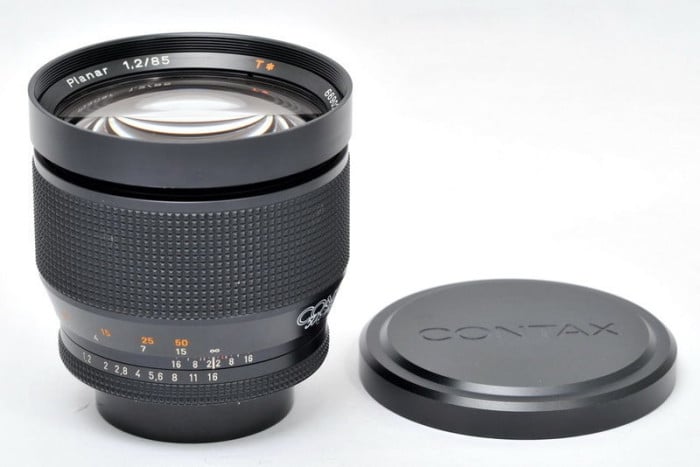 [/shoplink]
The same source who shared the correct Zeiss Batis lens specs back in January also told me that Sony had a Zeiss 85mm f/1.2 lens prototype. Sony decided to not launch it because it was way to big to be used on the FE cameras.
Zeiss made once such a lens for the Contax system. The Zeiss Planar 85mm 1.2 which now sells for [shoplink 35820 ebay]more than $3,000 used on eBay (Click here)[/shoplink]. Just to say that the lens would not only have been big…but also rather expensive.
Zeiss Batis preorder in USA and Europe (UK/Germany)
Zeiss Batis 85mm f/1.8 lens in US at Adorama, Bhphoto. In Eu at Amazon DE, WexUK. In Asia at Digitalrev.
Zeiss Batis 25mm f/2.0 lens at Adorama, Bhphoto. In EU at Amazon DE, WexUK. In Asia at Digitalrev.
Lens shade for 85mm at Adorama, Bhphoto.
Lens shade for 25mm at Adorama, Bhphoto.
172 Responses
Common sense prevailed.
Yes, because if you’ll be shooting with this lens twice a month, you should buy another $2500 camera and the lens you wanted to use (just to be the “right balance”).
I really don’t understand this “camera is small, all lenses need to be small” logic…
I agree, lenses don’t have to be small just because the body is, but then a lot of people don’t really understand or have the need for ultra-thin DOF either.
Given the choice, I suspect the vast majority would go for the smaller, lighter and cheaper f/1.8 option.
Yes, let them have 1.8 option. And yes, if your marketing thinks it would be too expensive to make it and it wouldn’t sale enough, then don’t make it.
But if you won’t make it just because it’s “too big for the camera”, then something is extremely wrong with this world
No, it’s not too big…
http://j.mp/1F5JEx4
With lenses:
http://j.mp/1AF3OH5
It’s not too big, but it is a bit fatter than most lenses.
It just weighs 2.4 times more than a 3x zoom and costs almost twice as much.
the canon 85/1.2 was on also also. That lens weighs 1kg!
here’s the corrected link : http://j.mp/1F5JDZZ
I imagine they had some other considerations too. Price, for example. I’d dare to say that everyone will prefer a smaller and lighter camera for the situations when they carry it (that’s most shooting scenarios). For studio use, you don’t really need that speed anyway.
I really don’t see the need for a 1.2 aperture with today’s sensors. It would be an extremely niche use (feel free to disagree with examples), which would drive the price of an already expensive to make product even higher. It would be a completely nonsensical endeavour, especially as the first portrait lens in the lineup.
Doesn’t Sony read the comments to here? Apparently it’s fud to say that fast lenses are large and heavy cos, you know, mirrorless…
Wow, that was a stupid decision.
For real, Sony should just give a big and a small 85, just like they gave us a big and a small 35. Aren’t they contradicting themselves?
Possibly, but an 85/1.2 will weigh a lot more than a 35/1.4.
Which means that it would fall off from e-mount, but won’t fall off from a-mount…
I didn’t say that. Just pointing out that a 35/1.4 cannot necessarily be compared to an 85/1.2. The weight difference alone between the two may dictate the difference between one lens making it to market and the other being dumped at prototype stage.
True, but that doesn’t matter. People shoot +1 kg lenses on DSLRs all the time. It’s just about time Sony gives us the A9 and enable the comfortable use of larger lenses.
But the point of the E-mount is lighter lenses. I’m glad personally they stuck with the 85mm 1.8 Zeiss design. As long as it performs well wide open, it’d be the best.
No, that is very narrow thinking. The point is not the lighter and smaller lenses. The point is possibility to have them.
There certainly will be larger cameras in E-mount, and there will be larger lenses too. If the smaller system size was the only design goal for the system, there would never been FF sensors in E-mount, since you can achieve roughly same image quality, DoF and similar lens size on a smaller sensor, with brighter lens designed for smaller image circle (the path m4/3 follows).
I’d say it is a much more narrow thinking to make a lens that almost nobody would buy.
Buy an A99. Or a battery grip.
The A99 doesn’t take the light lenses like 35 and 55 Zeiss.
For non-pro use (me) the A7 is a lot more affordable, light weight and compact.
Where these 1kg lenses are most often high-performance zooms.
They can easily make a 1.4. Nothing contradicting. An 1.2 would be the stupid decision here.
Should’ve made it… have a halo product and then a compact second lens. That was dumb :/
Sony still can. Zeiss makes the 85mm f1.8 Batis, but nothing stops Sony from making their own 85mm. Though I highly doubt they will make it a f1.2. I think an f1.4 is much more probable since they can be made smaller and cheaper.
This lens is not too big for A-Mount!
Yep, we’d love to have one. Even though maybe only 1% of A-Mount owners would buy it.
what???!?!?!?!?! TOO BIG????? SERIOUSLY???? THEY’RE IDIOTS OR WHAT?! O_O Goood dammit…
So, in Sony’s mind, there is a category of lenses that are ‘too big’ to use on FE?
Maybe the 35mm f/1.4 was an odd duck out and Sony are still going for “narrow aperture FE, wide aperture A Mount”?
No, it just means that Sony dumped the 85/1.2. It doesn’t mean we won’t see an 85/1.4, for instance.
Will we see an FE 70-200 f/2.8? 70-400mm?
They can’t make a full-featured system if there’s a strict limit on size
Who said there WAS a strict limit on size? Maybe Sony felt the 85mm was just too big and heavy for that particular lens category and at that particular time.
There is nothing to stop Sony doing larger lenses AND larger bodies in E-mount. I think it’s an inevitability.
I’m sure there is a category of lenses Sony considers to be too big, or more importantly too heavy. However the limit is probably a bit above the 35mm f/1.4.
Canon’s 85mm f/1.2 is over 1Kg and having used it on the A7R it wasn’t at all comfortable given the size of the grip (even with cradling the lens with the left hand, it still felt too heavy in general).
In comparison the 35mm f/1.4 is only 630g, just over half the weight of the Canon 85 plus adapter. This is in line with the Canon 100L macro that I’ve adapted, which felt OK for weight.
So I’m not surprised they decided against it if the prototype was anything like the Canon lens. But that doesn’t mean we wont see more f/1.4 lenses around the same weight as the 35mm.
My Canon 85 f/1.2L isn’t perfectly balanced, but it is ok with the battery grip.
That said, a larger A9 would be more appropriate for the 35mm f/1.4 and heavier/larger lenses. I would prefer such a body for the 70-200mm.
This shows an important disadvantage of the full-frame sensor. I’m happy that the FF fans get their gear for less money every year, but I hope that APS-C and 4/3 is not crushed by the FF mania. For 95% of the pictures even of advances photographers, they are sufficient.
It’s not that the lens is too big.
The Emount cameras are simply too small for the pro grade user this type of lens is attractive to. I can barely fit my fingers around a7II grip with Metabones EF adapter. The adapter ridges bite into my knuckles. Forget about using gloves.
I hate Emount ergonomics. So easy to press the wrong button at the wrong time. And adding vertical grip causes my palm to fire the second shutter release, or lock AE with half press. Such a clumsy system to use compared to Amount. But what should we expect from an electronics company trying to make a toy camera act like a pro kit. Can’t get there from here. Amount refined ergonomics over two decades. There is a big difference, on many levels.
It was probably the price and estimated units sold that froze that project. Too bad, though, they need more signature lenses in their line-up, like 85/1.2 is for Canon, or 135/1.8 is for A-mount, or 12-24/2.8 was for Nikon. Lenses so good, unique and useful that for a while they trump everything in their respective use fields.
Isn’t the 55/1.8 like that? Or is its focal length too mundane?
It is incredible for what it is, but that focal length and aperture probably are bit too mundane. If Batis 85/1.8 performs on par with that, that couple would make a great studio and available light portrait set, however.
Have to ask, the Contax (645 lens) on an E-Mount would still give an FF field of view?
No, FF sensor is roughly half the size of 645 medium format, so the image would be cropped, giving equivalent focal length of around double of that.
Great, so a 120mm Contax 645 lens would give a field of view of 240mm then?
Sort of, but those lenses probably do not have enough resolution to be very good for FF crops of 24+Mpix, which would translate to ~100Mpix when their full image circle is used on medium format.
120mm is 120mm. A 120mm medium format lens will show the same field of view on a full frame camera as any other 120mm lens would on a full frame camera. The fact that it’s medium format simply means that the image circle is bigger than the sensor, and there is wasted light around the edges. 120mm on 645 is a wider field of view than 120mm on 24×36.
A 120mm medium format lens will show the same field of view on a full frame camera as any other 120mm lens would on a full frame camera
VS
120mm on 645 is a wider field of view than 120mm on 24×36
Which is it then? Yes the focal length is the same, but since FF is smaller, field of view will be narrower, or “equivalent focal length” will be longer.
It’s both:
1: Any 120mm on full frame is going to give exactly the same field of view as any other 120mm on full frame, regardless of whether the lens was originally designed for full frame, medium format, or large format.
2. Any medium format lens will have a wider field of view on medium format than it will on full frame.
The sensor or film size the lens was designed for determines how large an image circle the lens will cast. The focal length determines the magnification of objects cast onto the focal plane.
Yes, but that’s exactly what I originally said. I was not talking about real focal length, but 35mm equivalent, which just like field of view is a function of focal length and frame size.
So on a FF sensor, what “field of view” equivalent will it have?
Pretty sure lenses are labeled in 35mm terms.
a 23mm on a Fuji x100 (for example) doesn’t give a 23mm field of view, but that of a 35mm.
Thats what I said, 23mm is 23 on FF. Not “23mm” on APSC
No, they’re not. Most if not all lenses are labeled with actual focal length, with an optional “35mm equiv.” addition. Don’t spread misinformation if you’re clueless.
Yes, and what would an 18mm APSC lens give you? 18mm FOV in on a 35mm sensor with heavy vignetting. It only becomes 35mm equiv if you are not using a 35mm sensor. So am 18mm on APSC is equiv to 28 on FF. Same goes the other way around. An 85mm on MF is equiv to 58mm on FF(or whatever the conversion factor), but mount it on FF and its an 85mm lens with an 85mm FOV… sure, not entire image circle is used, but who cares?
Correct a Field of view for a Medium format camera is a 80mm lens for a 35mm camera its a 50mm. The equal pretty much the same Field of View.
Frankly many years ago they did us a deservice by using MM for lens destinations they should have used Field of View its far more accurate and less confusing between different systems.
Thats exactly what I just said. 100mm lens on a FF body is 100mm, 100mm on Medium format is much wider.
Good god people, with their comments:
A medium format lens will give you the focal length labeled on the lens with a 135 sensor. Focal length = focal length. Put a 645 80mm lens on an A7, and guess what you get? A 80mm lens (that’s a bit wee big compared to your 135 lenses).
For as many claims from “experts” in these comments, there’s an equal amount of idiocy with basic fundamentals of photography.
Yes, but the expert you forgot to mention that on A7 you would only get portion of the image, if you shot the same subject at the same distance, hence the term “equivalent focal length”.
You can’t be that stupid.
You get a 135 portion of a 645 image circle on a medium format 80mm lens. Yep. Do you know what that would look like on a 135 A7? 80mm FOV in 135 terms.
Dennis, please calm down. I think Mr. Neopulse asked a decent question. We are here to learn as well rather than brow beat someone with a lesser knowledge base. You didn’t always know what you do now, were you stupid then?
Agree with you Dennis. The stunning lack of basic understanding in this thread is astonishing!!
I often think the “full frame equivalence” chatter does waaaay more harm than it helps. A 50mm is a 50mm is a 50mm. The lens doesn’t change!!!! Just your FoV changes as you switch it from one body to another.
I know right? People flock and harp on m4/3 or APS-C sized sensors and crop factors, but when faced with a medium format lens to full frame sensor: brains melt.
There’s always the c/y zeiss 85 f1.4 that is selling on ebay between $600-$800
I have no problem using the Canon EF 85mm f1.2 L II on my A7. Sony has it’s head way too far up the consumer market’s a#%!
1.2 is much larger than 1.4 and doesn’t bring any additional benefit. Sharpness at 1.2 is usually fairly low, and general performance is in line with a 1.4 lens. The extra 0.5 stop in subject to background separation (bokeh), would not be obvious enough to warrant a much larger lens and a higher price tag.
The light transmission is a tiny bit better (1.4T vs 1.6T), but Vignetting and Chromatic Abberation are worse.
Just compare the Canon 85/1.2 vs Sony Zeiss 85/1.4(A-Mount). The A-Mount 85 Is smaller, sharpness is roughly the same, although Canon is a tiny bit sharper in the center and worse in corners, while Sony Zeiss has a flat sharpness across the frame. Prices are within 15% of each other. But Vignetting is a bit better and Chromatic Abberation control is much better in the Zeiss.
So there is really no advantage in 1.2 vs 1.4. There is however a very large difference between a 1.2 and 1.8 though.
they make the 70-200mm F4 – and that is not so big ? my biggest gripe is that Sony is primarily just producing G branded and Zeiss branded lenses – of course G and Zeiss are fine – but there just are not many lenses that are just Sony branded for those who do not have $1000 for every lens they make for the FE mount – like a 50mm F1.8 or a 35mm F1.8 for sub $600 –
So there still remains a technical dilemma of making smaller FF lenses – while they can make ultra small processors and electronics 🙂 but when it comes to glass no cigar – so hopefully the new forecasted Organic sensors will be so much better – but then the issue Bokeh even if they can improve the smaller sensors to be as good in low light as FF –
That’s also how they treated A-mount full frame for years: Premium lenses only. They are actually doing a bit better with FE mount, the 28/2 is reasonably priced.
But look how they treated A-mount full frame: Only 6 lenses under $1,000… Only 1 zoom for under $1,000, and no SSM lenses for under $1,000. So the only “cheap” lenses they offered to A-mount full frame, were a few old Minolta-designed screw drive primes, for the most part. (Not that they are bad lenses).
They offer friendly priced options for APS-C — E-mount and A-mount. (In comparison, Nikon offers around 25 full frame lenses under $1,000, including 11 with SWM and 3 SWM zooms).
Maybe they will finally change philosophy as they are trying to sell E-mount full frame to “regular” shooters… but their strategy has always been that “APS-C gets value lenses, full frame gets only premium lenses).
There were 12 FF Sony lenses under $1000 at the time (not 6), of which 4 our now discontinued:
16mm
20mm
24-105mm
28mm
28-75mm
50mm f/1.4
50mm macro
70-300mm ssm
75-300mm
85mm
100mm macro
500mm
4 of those were zoomlenses (not 1), currently still 2 available. One of those was with SSM.
But yes, they have made it clear that the A mount and specifically FF is now mostly targeted at the higher end of their market, which makes sense, seeing that the race to the bottom can no longer bring profits for Sony in that segment.
“At the time?” We are talking about NOW. In terms of NOW, I did not include the original 70-300SSM, because I believe it will be removed once they run out of inventory, plus calling is “under $1,000” is just barely technically true (it is $999.99, so it does meet the parameters by 1 penny, technically). I don’t expect them to continue offering both the 70-300SSM and 70-300SSM2, but you are technically correct — IF they continue to offer both, then by 1 penny, they will have a second zoom lens under $1,000.
As you yourself have admitted.. they discontinued the cheaper zoom lenses — the 75-300 and the 24-105. (At least the 75-300 isn’t listed on their website). Meaning their only full frame zooms under $100 are the $900 28-75, and the $999 70-300 (IF it is continued). I see I failed to include the 16mm prime.. for $999.99. Yes, it meets my threshold by 1 penny.
Conversely, using Nikon as the example, they offer 5 full frame zoom lenses for $750 or less, 3 of which are modern SWM lenses.
The cheapest Nikon SWM lens is $219. The cheapest full frame A-mount SSM lens is the $999.99 70-300, which is likely being discontinued in favor of the 70-300SSM2 for $1150.
I see your confusion.. I said they have been treating A-mount this way for years… which somehow you took to mean, since the initial launch of A-mount. I was talking about the direction of A-mount lenses, for the last several years. When was the last time Sony introduced a new A-mount full frame lens that was under $1,000?
I believe it was the 85/2.8 in 2010… So in the last 5 years, I believe they have only introduced a single full frame lens under $1,000. While discontinuing cheaper lenses like the 24-105.
Strange how they have such (relatively) cheap bodies, yet no lenses to match them at that price point. :-/
I agree – I suspect that A mount will eventually be phased out as EVFs get better and better and a call for smaller bodies continues and when the smaller sensors get better in low light etc – They have a nice 35 and 50mm F1.8 Sony branded for E-mount – so why not for FE-mount ?? Their trick has been to focus on keeping the body price low but make it up on Zeiss branded senses – yes most are good but in many cases not quite worth the big price tag – my findings is that the 55mm F1.8 is really the best for the money of the Zeiss branded lenses – yes some might be better but then at a much higher price –
It is also disappointing how Sigma and Tamron have not made any commitment to FE – Sigma made 2 decent primes for E-mount and a decent 18-200mm F3.5-5.6 zoom but they just where OK – but of course cheaper – for some reason thee lenses did not get much notice so maybe that is why Sigma just said no more
For that price, I’ll prefer the 1.4 variant for 600$. I love the bouquet of my Contax Planar 85/1.4 and 1.4 to 1.2 is (for me) not worth 2400$.
I sure as hell, would have bought it.
Riiiight, so instead of a 1.2 they go on and make a 1.8. Talk about contrasting ends of the spectrum. What happened to a good old 1.4?
At least they didn’t do f/2?
True. Or could have been a 2.8. Although thats the one i’d welcome. Would be nice to have a 35 and 85 as a starter package, that is good quality and doesnt break the bank.
or they could go for 85mm f5.6. it should be pretty small.
Nonsense comment. That 85/1.8 Batis is made by Zeiss, the article talks about Sony.
Read Again…
“The same source who shared the correct Zeiss Batis lens specs back in January also told me that Sony had a Zeiss 85mm f/1.2 lens prototype.”
“a Zeiss 85mm f/1.2 lens prototype.”
“a Zeiss 85”
“Zeiss”
Don’t think I can narrow it down for you any further.
Zeiss Batis is similar to Zeiss Loxia. Its designed by Zeiss.
Sony Zeiss lenses are designed and built by Sony with a Zeiss badge and Zeiss’ T* coating. They ARE different.
A Sony-Zeiss 85/1.2 is completely different to a Zeiss Batis 85/1.8.
So Canon remains alone with a still currently produced 85mm f/1.2
Another issue that hasn’t been touched upon with lenses faster than f/1.4 is the exponential increase of transmission losses at the sensor level, especially with pixel densities still going up. DXOmark did some measurements many years ago, showing that those f/1.2 lenses actually have about as much usable light as an f/1.4 lens on sensors with ever increasing pixel densities (the latter having a negative impact too apparently), mostly due to the nature of oblique light rays.
The cameras compensate under the hood for those losses with extra signal boost, so you won’t see it in your shutterspeeds. But the gains in low light (in terms of lower noise) are therefore practically zero (around 0.1 EV IIRC), only some benefits in terms of shallower DOF options.
Big difference between “light-loss” & “image look” where photography is concerned. Canon’s 85L @ f/1.2 has a unique “look” to it, if you can actually hit your mark with the focus @ f/1.2 on a portrait handheld.
I have shot with it and I doubt that look is due to the marginally (1/3 EV) larger aperture, since the pictures do not look that much different when shot at f/1.4 with the same lens. The look has a lot more to do with the optical formula.
+1
If it was the arpeture, then Mitakon 0.95 lenses on APSC would produce exactly the same results.
People/portrait & lifestyle imaging is where both the Canon 50L & 85L excel, they truly offer a unique look. But it has to be seen in your own eyes.
Personally, I’m loving the FE 1.8/55, its probably my finest lens to date, but when I look back over old work on the two Canon L’s, there is a difference, but without a keen eye and something to compare with, you’d likely look right past it.
The optical formula of ZEISS glass is harsh IMHO, aperture for aperture. Canon have a nicer/softer feel to their L glass, the Canon 24-70 f/2.8 ll has a far nicer look/feel to it than my FE 4/24-70, the ZEISS is actually sharper center frame, but it just looks too harsh where background fall-off is concerned for lifestyle photography. Again, nothing that cannot be tamed in post.
Smoother bokeh and sharpness are usually (not always) two competing design constraints. Just look at the current Canon 70-200mm f/2.8 which is mighty sharp, but had to trade the much smoother bokeh from the previous version as a compromise.
Both the Canon 50 and 85 L aren’t too sharp below f/1.8 (especially soft corners) compared to some of the competing lenses either.
The Canon 85L has a completely different personality < f/2 and beyond f/4 its critically sharp. In contrast, the 50L looks the same throughout its range, soft. Reference the Canon 70-200 ll, I actually prefer the little Sony FE 4/70-200, much less vignetting mid-range and so light by comparison.
Super-nice optic, but I rarely moved mine off f/2. It was simply too tough to hit the eyes consistently with the near useless M/F screen in the 5D3. Never tried it on the A7R though where focusing, by comparison is a breeze.
And what disadvantage is that? The size? f/1.8 APSC lens will do everything and will be the same size as f/2.5 FF lens. You’d have to push the FF sensor +1 stop, so even noise will be the same.
A lens like f/1.2 is a halo lens, designed to show off the system and push boundaries. APSC f/0.95 would be equivalent to that lens. Just look at the size of those…
No, the size would not be the same, as the image circle is smaller.
I definitely want one 85mm 1.2!
There are people who choose a mirrorless system NOT just for size!
Contrast Focus works perfectly well with extra large aperture lenses. Sony should realize that and show the advantage!
A/F on the A7 platform is hands down more accurate than my 5D3 where large aperture close focus is concerned. That, plus the “Setting Effect ON” option takes any lens focus-shift issues right out of the equation for life-style photography.
CAF is inherently more accurate than PAF, even if the latter is faster.
Looks that way, moving stuff is a different story all said & done. But as a “focusing aid” I’ll take the on-chip method any day.
Can you explain about
“”Setting Effect ON” option takes any lens focus-shift issues right out of the equation for life-style photography.”
Setting Effect OFF: wide-open viewfinder image as per DSLR, lens is focused at maximum aperture no matter what f-stop you are shooting at.
Setting Effect ON: the viewfinder image and A/F operate at whatever lens aperture you are set to, so no focus shift, but the A/F may be a little slower or less ready to lock-on in poorer light.
Take the Canon 50 f/1.2, if you focus it on a DSLR, it’s always focused at the lenses maximum aperture of f/1.2 but if your aperture is set to f/2 there can be a little shift in focus as the lens is stopped down to make the exposure. That’s called “focus-shift.”
It appears that Sony is testing an high resolution mode (60MP) for the A7R II.
After a year with it, I’m starting to have a bit of buyer’s regret with the A7. I love the image quality, but the lenses are just too damn big. I considered getting the 35mm/1.4 the other day, but that thing is a monster. Even the 55mm/1.8 (right now my only native FE lens) is big for what it is compared to other mirrorless equivalents.
That being said, the Batis lenses look reasonably compact, as does the 28mm/2.0. I may just have to get the 35mm/2.8 and rely on my all-manual Voigtlander 35mm/1.2 for low light work that requires 35mm and sub-f/2 aperture.
I tried selling mine- twice I got stiffed on ebay with non paying buyers. Now after the price drop it’s pretty much worthless on the used market. It works well with lenses that aren’t fast- but there are just to many compromises and work arounds with bigger lenses, adapters and A mount glass. I don’t really regret it, but I do think my money would have done better elsewhere at the present moment until FE matures and we get more affordable native options.
And not to mention being severely ISO limited on M43 or 1/2 frame sensors by comparison
Are you comparing a Sony 55/1.8 to another mirrorless 35/1.2(APSC)? or to another 55/1.8(APSC)? Cause you have to match the focal length and the added sensor sensitivity, so that bokeh, FOV and noise are the same. A 35/2.8 in FF would give about the same results as 24mm F2.0 on APSC sensor and 18mm/1.4 in MFT sensor. Now if you compare all those lenses, you’d realize that they are roughly the same size.
As for 55/1.8, good luck finding a 38/1.2 APSC or a 28/0.95 MFT.
I’m comparing the 55/1.8 specifically to the Fuji 35mm/1.4, which is a 53mm/2.1 in FF terms, which is close enough to the 55/1.8 that I wouldn’t be too bothered by the 1/3 stop difference.
And they are fairly close in size. Diameter is the same. Sony is 15mm longer (54 vs 70). Its not that much difference to complain about, in my view at least. Sony is heavier though, but there’s also a question of performance.
If it was the size of SAL50F14z while keeping a 1.8 arpeture, then i’d agree with you.
15mm means the 55/1.8 is 25% larger, and that difference increases significantly with the lens hoods on, which I always try to use in daylight.
And don’t forget to throw a pocket full of batteries into that equation (satire alert:-)
LOL. Don’t go there. It’s a can full of worms. When it explodes, people start defending their purchase of E-Mount by machine-gun testing their cameras 🙂
B&H have a few D-Tap adaptors, I have one, works lovely on all the range. You should see my D-Tap battery, it’d power a PRIUS, shuts up all those people who complain about the piddly batteries. LOL
Sony should make the grip use a different battery though, give it a battery like you find in a proper grip rather that the body batteries, that’d go a long way to alleviating the issue.
I’m in the process of making my own for my A65. Unfortunately B&H, or anyone else for that matter, doesn’t carry M class dummy battery adapters. Shooting stills is not an issue for me. Shooting movies is a very big issue.
M class? Explain. If you’re referring to getting the converter/electronics out of the camera, so it doesn’t interfere with high ISO’s when shooting motion, I have one! Look on newsshooter.com for some recently introduced power adaptors, see what you think.
M Class = FM500H battery, and all others with letter M in the model number. That’s what A-Mount uses. I see a bunch that fit into a battery socket for E-Mount(W Class), but none for A-Mount. So I have to make my own.
I bought a cheap AC power adapter online, that supports A-Mount cameras. Have chopped the cable off, and will buy a 7.4v Li-Ion battery pack, or two, at around 5amps each, plus a charger.
Ah, with you now. We’ve seen issues with poorly shielded D-Tap adaptors causing interference with the pre-amps etc. Better off with a straight dummy, length of wire then the electronics in a separate box away from the camera on the A7S. The more you know……….the more you wish you didn’t.
Interesting. Is that when feeding off AC supply or DC battery? 60Hz noise off AC is understandable, and is a headache to eliminate, but i’d be surprised if a battery would cause such an issue.
With a regular D-Tap video battery, it’s the A7S when shooting at high sensitivity that’s showing it up. It’s not the battery, but the poorly shielded components in some dummy plugs. Don’t know more than that.
LOL
Are you also factoring in working distances, they make a huge difference on say a head and shoulder portrait. That’s where the longer glass typically gives you the nod.
Working distance is roughly the same between a 55 FF and a 35 APSC
Well, lets hope all the CA and other optical nasties are as well corrected on the stop & a half faster wide too. Nothing in the optical design game is free.
No doubt. But in tests, at least from what I’ve seen on SLRGear, they are roughly the same, with Fuji losing out in corners wide open, but being sharper in the center(perfect for portraits i’d say).
Edit: One huge advantage in FF that is rarely mentioned is the availability of much higher resolution sensors, such as A7r and a low light monster, which is A7s. That point is something that can’t be matched by APSC, with 24mpix for almost every camera and MFT, with 14mpix in every camera
I’d like to field test the FUJI, loved their XPAN, they can certainly engineer nice kit. I often wonder what the working differences (speed of use) are between the Sony A7, FUJI & Olympus. Always was a fan of Olympus too, good solid engineering. The A7 (mark 1) still feels like a prototype to my, a little slow & buggy.
An issue I have with smaller formats, I rarely find any lens < 24mm appealing, especially when shot beyond 10 feet.
As far as the 55mm 1.8 – there is NO mirrorless full-frame equivalent with AF.
@Locke42:disqus If you’re not taking advantage of the better implemented video & audio capabilities of the A7 I could your point.
@disqus_VcqK2NKYmu:disqus I’m not using the A7’s video at all. I thought I would, but then I realized that I just don’t shoot much video, and when I do, it’s all casual stuff. My RX100m2 does just fine for that.
Looking back to my stills only days, the 5D3 was a breeze for the most part, it just works for stills. But when I started in with motion, then audio I realized it wasn’t such a good choice. The A7 platform is a good compromise for stills/motion/audio – 33/33/33.
Methinks you misunderstood.
I think the 55 1.8 is tiny.
This is tiny: http://www.sonyalpharumors.com/new-voigtlander-heliar-40mm-f2-8-e-mount-lens-tested/
You showed me a comletely different lens qt 2.8.
You want a f1.4?
https://www.youtube.com/watch?v=oBOWZsHMIuU
That is small 🙂
And they’re manual lens, its obviously going to be smaller.
AF/MF has little effect on lens size, those VM lenses of longer FLs are not any lighter than AF lenses. It’s only likes of VM40/1.4 and VM35/1.4 are small.
AF-motor and electronic is built outside of the light path. E.g. in a ring around your lens. So an AF lens has a bigger diameter but the same length. And it is the length, that matters when mounted on a cam 🙂
As I said: these voigtlaenders are tiny and small. The Sony 55/1.8 is not.
What other mirrorless “equivalents”? There’s nothing equivalent to FF in the mirrorless world. big sensor = big lenses.
The main advantages of a big sensor are shallow DOF and better low light.
The Fuji XF35mm/1.4 has a slightly deeper DOF (f/2.1 instead of f/1.8), but also has a 2/3 stop advantage in light gathering. So it’s an almost exact match to the 55mm/1.8.
Yes. but you do understand that larger sensor will result in larger lens. do you?
Yes, but my point is that the advantages of having a larger sensor have been mostly outweighed by the fact that FE lenses are either (a) slow or (b) big.
But if you knew that because of the larger sensor you’ll have larger lenses, why are you complaining? you had all the facts before you bought the camera and now you’re complaining that the lenses are too big.
even Fujifilm APS-C sensor has mostly large lenses. if you want to compromise IQ and have a light camera, you should have got a micro 4/3 system.
Because I had thought that the reduction of the flange distance would result in smaller but still fast lens designs becoming available, especially wide angle primes, which I prefer. Considering the size of Leica lenses I didn’t think this an unreasonable assumption, since the short flange distance was often cited as one of the main reasons why M-mount lenses are so small.
There are several reasons why lenses aren’t as small as Leica. Autofocus is one key reason (look at the change of lens sizes from pre-AF SLR lenses to modern lenses; and secondly, digital sensors don’t cope as well as film with light coming in at an oblique angle.
To be honest, I think the A7 system should be understood as a much smaller version of a full-frame SLR, providing the same performance etc. It is fantastic in that regard. I find it disappointing that Sony feels a need to keep it as a ‘compact’ system to the extent that they don’t produce lenses like an 85mm f/1.2. The key thing we need is choice – so that people can choose to make a small system, or go for something that does genuinely compete against the 5D, D700 etc.
First, of course I know that AF plays a part in making lenses bigger. That being said, there is still a HELL of a lot more glass in the Zeiss FE 35mm/1.4 than in a Leica or Voigtlander 35mm/1.4 (as the owner of a Voigtlander 35mm/1.2, I can attest to this).
Second, light coming in at an oblique angle doesn’t appear to be a problem for Leica,
I for one am happy they shot for 1.8. Maybe we’ll even get better performance stopped down because of it. a
What are you talking about? The 85/1.8 is a Zeiss Batis lens, the article talks about Sony. Sony still has to announce it’s Sony Zeiss 85. It could also be f/1.4.
If anything, this rumor gives me hope that Sony is also considering a 50/1.2.
Open your eyes wider, put on glasses, and read again…
“The same source who shared the correct Zeiss Batis lens specs back in January also told me that Sony had a Zeiss 85mm f/1.2 lens prototype.”
…or also giving up on one because of the size
See! All you people whining about lens size.
“I want a 135mm 1.4 AF with OSS but it has fullfill the promise of mirrorless blah,blah,blah…”
I actually do want a 135mm 1.4 AF.
Sure! Me too.
“fulfill the promise”
That one…
When I buy a prime lens I don’t care about its size, I care about what it can give to me in terms of quality, AF AND first of all THE LIGHT! Because photography is all about the LIGHT. If I wanted to get 85mm f1.8 I’d got for damn Fuji or Olympus. Stupid decision to refuse f1.2 because it’s TOO BIG… Good light lens gotta be big!!!
When I buy a prime lens I don’t care about its size, I care about what it can give to me in terms of quality, AF AND first of all THE LIGHT! Because photography is all about the LIGHT. If I wanted to get 85mm f1.8 I’d got for damn Fuji or Olympus. Stupid decision to refuse f1.2 because it’s TOO BIG… Good light lens gotta be big!!!
Exactly.
For me, the only reason I’m currently considering the E-Mount system is because there’s now a top quality, modern, autofocusing 35mm f1.4 lens for it that doesn’t exist for the A-Mount.
Lens size tradeoffs are part of professional photography.
If they released an 85mm F1.2 and a 50mm F1.2 (or better yet a 50mm F1.0) with direct drive SSM autofocus like the new 35mm F1.4, and great build quality like the new 35mm F1.4, (and an aperture ring for good measure), I’d sell my A-Mount F1.4 Zeiss 85mm and 50mm Planars and move to the E-Mount system!
Interesting. Maybe I’m missing something here. I have a serious addiction to speed but to be quite frank- I can’t tell the difference between 1.4 and 1.8. Also, after comparing the 50mm 1.4 zeiss and 55mm 1.8 I found the 55 to be sharper- albeit marginally but still. I’d go for the sharper lens next time around instead of the extra .5 stops. I do want that speed master 50mm .95 though. Damn, to many options.
I’m not chasing sharpness these days. I’m trying to create images that are beautiful and have great background separation. It’s a way of remaining competitive with all the wedding photographers who have started shooting 120 film on 645 bodies with either the contax 80mm f2 or the mamiya 80mm f1.9 and who are getting all the features on blogs like http://weddingsparrow.co.uk http://stylemepretty.com http://www.oncewed.com etc… the list goes on.
Personally, I don’t ever want to shoot film again. But I’d kill for either a medium format system that had a standard lens that rivalled either of those two listed above and could shoot a reasonable enough amount of frames per second that I could also shoot in a reportage style. Or… a 50mm standard lens for A-Mount or E-Mount with an f1.0 or f1.1 or f1.2 aperture and excellent distortion control and the same (or similar) size of circles of confusion towards the corners as is has in the centre. I find that even the fastest 50mm lenses get busy bokeh in the corners that pulls the eye towards the corner of the frame. Medium format standard primes (around 80mm) don’t seem to do that. I’m not the technical term for why that is? Is it field curvature? Anyhow. I’d like that look in an autofocus digital system. Be it a medium format fixed lens camera, or an excellent lens for a full frame 35mm sensor based camera.
It’s not about only sharpness I think. It’s more about DOF and bokeh quality. If it’s a good optics you can always make it sharper just increasing an aperture a little bit, but you can’t decrease an aperture if lower than it’s physically limited. So it’s always great to have that option
damn. wanted to say
“lower if it’s physically limited”
True, the same here.
I chose Sony back in the days because of their amazing 135mm f1.8 which I think is still the best portrait lens under 2k$ so far. But now I’m looking more and more often to what Canon can offer in future. Because yeah – color picking and some other features like in body stabilization are the nice features for sure, but there is no rare good optics for e-mount at all. A mount has 135mm f1.8 and some really good f1.4s, but even there – there is no optics like Canon 85mm f1.2 or Canon 200mm f1.8 which are expensive for sure, but they can provide a unique image style for professional who need it. I’m with Sony for about 7 years, but now I started thinking that it’s too casual, it doesn’t provide any unique solutions for pros.
Me too man. I’ve been shooting A-Mount since 2006 with the a100, and I love my 50mm f1.4 planar and 85mm f1.4 planar. Sharpness-wise, I know they’re great performers, and they’re much better than the lenses that most photographers are using. But clients can’t see sharpness when they view your portfolio on the web. The kind of sharpness that pixel peeping photographers lust after can be faked on the web with software sharpening. Clients just get a sense of the feel of your photos. And a portrait shot with an f1.2 aperture will always resonate positively with a viewer who’s a potential client. It flatters people and backgrounds in a way that people can’t put their finger on. They just know they like it.
Totally agreed.
Sorry a little off topic: based on DXO mark, Sony FE 28-70 has better sharpness than FE 16-35 at 28 and 35 for f/8.
http://www.dxomark.com/Lenses/Compare/Side-by-side/Sony-FE-28-70mm-F35-56-OSS-on-Sony-A7R-versus-Sony-FE-Carl-Zeiss-Vario-Tessar-T-STAR-16-35mm-F4-ZA-OSS-on-Sony-A7R___1244_917_1467_917
So I suppose the kit lens would be a better option for landscape at 28mm and 35mm (not caring about distortion assuming we could correct for that).
Am I missing anythings?
Landscape shooting on a zoom is fraught with problems. As you’ve pointed out, the numbers show this lens is better than that at this aperture and focal length when tested at a particular distance yada-yada……….
KISS, buy a couple decent primes, get to know their characteristics at the apertures and distances you’re interested in shooting and have at it. I’d use my FE 2.8/35 all day and everyday for general landscapes @ f/8 – f/11 and never be unhappy. It offers no surprises.
My FE 4/24-70 however, is somewhat schizophrenic, too many variables throughout the zoom range – YMMV though. Numbers tell you very little about how a lens performs real-world, they’re OK for reference.
I’d do that if I have good cash in future. But I just stick to kit lens and 55 for now.
You have the FE 1.8/55 then give stitching a go with it. LR has a new stitching feature that works from RAW files!
Look at the uniformity graphs/maps in the DXO results. The Zeiss shows good results wide open here, while the 28-75 needs to be stopped down at least 1 to 2 stops to equal it. Their Mpix (perceptual sharpness) results are compared that the optimal (best) settings only.
But for landscapes f/8 is good. To me 16-35 offers the wide range (16-28) to justify its purchase as opposed to the kit lens for landscapes.
In that case, you didn’t miss anything. 😉
Graphs tell you just a part of the story. My Minolta 28-135mm is a very sharp lens. But it is an old optic and the contrast is no match for even my 18-55mm kit lens even though at times sharpness wise both are very good.
For something like landscapes I would never use my Minolta 28-135mm but it makes a good portrait lens.
You are missing photos. Graphs tell nothing about rendering, color & style.
If you don’t care about size, get Canon 5D + EF 85mm f/1.2L II USM
f/1.2 is too close to f/1.8. Why don’t they make f/0.95 like Mitakon and Leica do?
I would like to see a Z-shift sensor with with about 10mm moving space for fast AF.
So you can adapt ANY lens, having AF and IBIS and you can work with cheap lenses like OTUS.