







Back on the 24th of July (I remember the date, because I worte that specific article while sitting at the back of a rented car between 2 hyperactive kids during my holidays in Tuscany… believe me, a real challange to write it 😉 ), Fujifilm updated the lens roadmap, and, amongst the others, they told us that the XF 16-55mmF2.8 release had been pushed back to spring 2015… and it will be without “OIS”.
Now we have some more information about this lens, shared at the latest issue of the Fujifilm X-magazine (and spotted by attentive FR-reader Dan R Smedra – thanks for sharing at the FR facebook page)
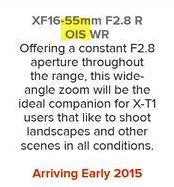
First: we now have a slightly more precise indication of the release of the XF16-55… it will come “early 2015” (so I’d exclude May/June, and guess it will come around March)
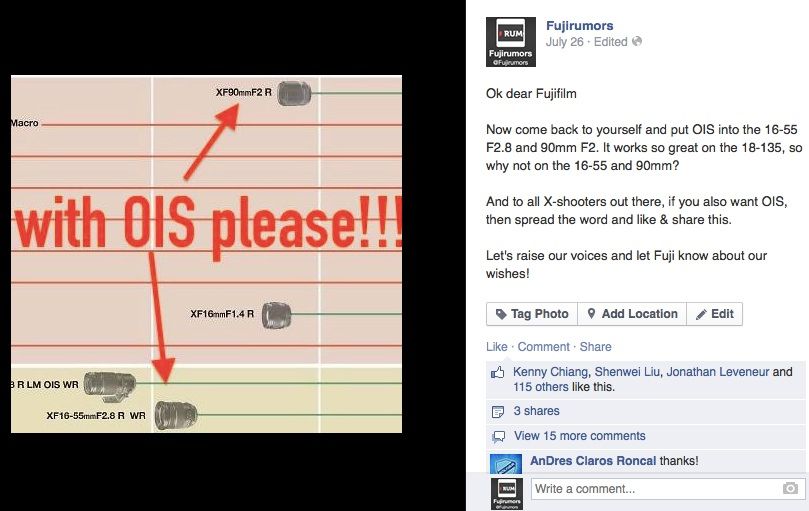
Second: As you might or might not know, the latest official stamtent from Fujifilm (made in September at photokina) confirms, that the XF 16-55mmF2.8 will NOT feature an optical image stabilization (OIS), because of weight/IQ reasons. Many X-shooters were astonished by this news, especially since Fujifilm is right now explaining us that the 5 stop OIS in the XF 18-135 WR lens and 50-140 f/2.8 lens works miracles (and apparently it really does)! I’ve launched various polls here on FR and shared posts on facebook… and it’s pretty clear that the majority of X-shooters do want OIS.
Now, I don’t know if it’s just a typo or if Fuji changed plans, but according to the latest edition of Fuji’s official X-magazine, the XF 16-55 will feature OIS (and come early 2015, as said before). I really hope that this is not just a typo.
stay tuned
 Facebook, google+, RSS-feed and twitter
[poll id=”63″]
[poll id=”64″]
66 Responses
Hear the gasp? That’s me, preparing to hold my breath 🙂
Trenton, I’d rather you keep breathing; Even though I don’t always agree with you, if you passed by lack of breathing whilst waiting for Fuji to make their collective mind up, I’ll feel sad nevertheless. 🙂
No worries, most of us hardcore Fuji users grew gills long time ago.
pfffeeew (sigh of relief)
I hope that’s true!!! Especially after the first reviews of the 50-140: if Fuji can make a really really good 16-55 lens with OIS and WR, I sure won’t need anything else while traveling 🙂
I’ll check if they also changed (again) the tag on the mock-up in the Tokyo showroom.
and don’t forget, let me know if something changed at the mock-up shown at the tokyo showroom 😉
Frankly, there are good reasons for not putting OIS into certain types of lenses. Such as size/weight, price and image quality. For some lenses, it also would only be moderately effective, especially for short focal lengths.
For these types of scenarios, it makes much more sense to do image stabilization in the camera on the sensor level, similar to what Pentax have been doing for a long time. The added benefit is that this kind of stabilization can be used with all sorts of adapted lenses as well. We would be getting the best of both worlds – Fuji’s insanely amazing optical in-lens stabilization (clearly superior to sensor-shift-based solution) for those lenses where it makes sense, and in-body stabilization for the rest.
So instead of asking them to make those particular lenses bigger, heavier, more expensive and optically inferior, I think we should be asking that they add in-body stabilization to their cameras.
Image quality in XF 50-140mm is damn good, even with OIS. Why not the same thing for XF 16-55mm ?
You’re much more likely to get motion blur at lowish shutter speeds on a long zoom than on a standard 16-55mm lens. It would be nice to have OIS on the 16-55 though, but I’m skeptical given how close the lens must be to release, adding OIS surely requires a fairly major redesign?
They already did it on other lenses, this great claimed 5-stop OIS. I would sacrifice the size/weight factor for a powerful, complete, hi-tech lens. But as I’ve said before, I can live without the OIS and still be happy with it. I only have prime lenses and I really don’t know what OIS means on a Fuji X camera, yet. There is life without OIS, indeed.
With a lens thats F 2.8 all the way the lens’s in the back have to be vary big and that makes for little room for OIS and is short to start with. The 18-55 F 2.8-4 works with OIS as the Variable speed of the lens give them room.
Read the 3rd paragraph about Canons 24-70 F 2.8 not having IS. What thats worth 0
http://www.dpreview.com/lensreviews/canon-ef-24-70mm-f-2-8l-ii-usm
well, look at the tamron 24-70 2.8. It sports image stabilization and performs on par with the canikon counterparts and 16-55 2.8 in aps-c is more simmilar to 24-80 f4 which isn’t complicated at all. (though I shouldn’t start this discussion:)) So just look at the canon 17-55 2.8 or sigma 17-50 2.8, all having IS.
I would sacrifice the size/weight factor for a powerful, complete, hi-tech lens.
We will see if it has it or not. I rather it had OIS but can live without it isn’t a game changer. Sharp all the way thru the f stops will be more important.
Yes! Fujifilm, please make it super sharp like a prime lens, so I’ll leave home my XF 18mm and XF35mm. An X-Pro2 + XF 16-55mm F2.8 would be a killer combination!
Happy with my XT-1 Be interesting what the XPro-2 will bring to the table. I do find I love the t’s finder much easier to see and frame with old eye’s but do like the looks of XPro1 better. An combo of the two would be nice?
The performance of the X-T1 / X100T inside the new X-Pro2 (with the look, shape, color and size of the X-Pro1) and it’s a winner!
I completely agree about in-body stabilization – every camera should have that. And if you have a stabilized lens, the camera should recognize that, and let you pick in the menus which one you want it to use. Olympus, Sony, and Pentax have been able to carve out (or at least maintain) decent market shares, and one of the reasons has been the in-body stabilization advantage. Fuji could do the same, and make their lineup even more compelling.
That said, it is certainly not impossible to design a good stabilized, mid-range, f/2.8 zoom for APS-C sensors. Look at the Sigma 17-55 f/2.8 OS, which is optically very good, even though it predates the “Art” / “Global Vision” lenses. Look at the Canon 17-55 f/2.8 IS lens. Look at the Tamrom 17-50 f/2.8 VC lens. Look at Fuji’s own 18-55, which is not far off in terms of f/stops. Etc.
I hope this fantastic lens will come with OIS. It will be my first XF zoom lens! After seeing the size/weight of the new XF 50-140mm F2.8 (and the upcoming XF 140-400mm + XF 90mm), I really don’t care about size/weight of this XF 16-55mm F2.8, as long as it packs all the tech and performance of Fujinon X lenses.
I’ll buy it with OIS but will not buy it without OIS. My reasoning is that the current 18-55mm is optically very good, but the OIS is poor. Two additional mm on the short end is not inducement enough to buy nor is one f-stop on the long end, without the outstanding new OIS. Great OIS will make it worth the upgrade.
I just don’t see the value in it as an upgrade if they don’t include OIS.
But, having said all that, I think it is a typo and OIS will not be included.
If they aren’t including ois, the least they can do is make the filters the same size as the 10-24 and 50-140. Either that or make it astonishingly cheap & high quality. I think i could live without ois in a wide-normal for the most part
Astonishingly cheap – never. I can live without OIS, too.
Amen to that, I wish they would standardise on filter sizes across their lenses. All the smallish lenses should be 52mm (18, 35, 27, 60) and then 62mm for all their ‘high end’ primes so 14, 16, 23, 56, 90 and mid range zooms, then 72mm on everything else.
What I learn from this is you better wait half a year before buying a Fuji lens.
56mm f1.2 is another example. For me the APD version suits me better, but I already have the 56mm.
Actually I’m waiting for the 35mm f1.4 Mark II (faster focussing).
If you don’t have the 35mm you’re missing on an otherwise excellent lens in the meantime; That’s always the big question – I am currently hesitating between an X-T1 now (still time before Christmas :)) and a possible future X-T2; That seems fairly remote with the upcoming massive firmware update.
i hope it is a typo because that would probably mean there is no IBIS coming anytime soon, ie xp2/xt2. and und i’d much rather have that…
I genuinely don’t believe that IBIS is coming anytime soon anyway
Where did you get the idea IBIS was even a remote possibility on Fuji X? Since the 18-55 came out it seemed certain to me it will never happen, and apparently in lens OIS is better anyway.
FUJI can do both IBIS and OIS just like Sony A7II.
IBIS mostly appeals to the old/adapted lens crowd. There’s no former in XF bayonet, and for the latter, there’s Sony and MFT.
Fuji, on the other hand, got probably the best OIS on the market, bar none (judging by their Techno-Stabi binoculars).
The more interesting potential application for an IBIS system is using sensor shift to capture more megapixels like the new Olympus E-M5II is rumoured to. Could be a good stop-gap if they can’t get a new sensor soon enough.
Yet another lazy panorama mode? Thanks, but no, thanks.
I think you’re missing the potential of it if you think it’s something you could quickly reproduce in Photoshop. You read the sensor, then move it a half pixels distance left/right/up/down and read it again each time, then combine the data from each read to increase your resolution. It’s a genius idea if it can be pulled off well.
You’ll have to keep the shutter open while your sensor performs its dancing routine. So most likely it will be implemented only for electronic shutter… hence no moving subjects in the frame. It’s an ingenious marketing idea.
Still good enough for architecture, landscape and other not moving subjects.
Both landscape and architecture are usually shot in RAW.
Now, ask yourself one question…
well you’ve got a point there 🙂
IBIS isn’t coming and neither is ISIS, or her cousin spice. They are on tour in the Congo attempting to just get out alive!
???
This looks like a Christmas present !
First with OIS, then without, now OIS again. Thanks FUJI for listening to us.
Now hope they succeeded in making the lens less large then in the first mockup (length not larger than the 18-135mm).
Take it with the well known grain of salt.
you don’t need stabilization on a wide/normal lens. even with the cropped sensor it’s still a wide/normal lens
It depends what you’re doing. If you’re in low light and your subject isn’t moving, the OIS is quite a useful feature.
a good friend of mine, living in Australia does a lot of Birding. His favourite kit is either a D2Hs (4mp) or a D800 (36mp) with a MF Nikon 400mm + TC 1.5 he hand holds 90% of his bird in flight shots and he has a keeper rate beyond anything I’ve seen; me, one of the reasons I went into Fuji was because the 18-55 has IS – my hands do shake slightly can’t help it; and I now have a much better keeper rate than with my old Nikon kit;
This says that there are no hard and fast rules some people will benefit, some won’t- I never bought the Nikon 17-55 2.8 as it is IS (VR) less
I love the fact that people who have no purpose at all (or actually can’t) for taking a good photograph are bitching if there is or isn’t OIS on this lens before even ever getting their hands on the copy that does come out. It’s amazing that it’s like if two formula 1 drivers we’re asked the question…”if you get into this car it is the most tecnhically advanced in speed, safety, and performance”. “But this other car we produced, we weren’t able to put the safety features into it and there is a 50/50 chance you could die…but it goes 1.5 seconds faster around any track” 10 of 10 drivers would choose the faster car! If your lens has no OIS and your photos are 10 of 10 times going to be in focus and are sharper than the version of OIS which you will get 8 out of 10 frames in focus and just a little less sharp there would still be those that would bitch and say…I will deal with the 2 OOF shots and sharpness!
“I love the fact that ……”.
Do You ?
For me, the sad fact is I am shaker now than when I was younger. Couple that with dropping down from a large full frame camera/sensor (Nikon D4) to a crop APS-C sensor and a small camera, and I am having a difficult time getting 10 out of 10 sharp images.
So it does matter for me. It is to the point that I will consider the Sony A7II for my professional stock work, if Fuji does not put OIS in the 16-55mm.
Not the best analogy. OIS has a real photographic purpose. It’s more like saying, we can build you a car with features that will be 3 seconds slower in the dry, but 12 seconds faster in the wet. Do you want those features? The answer will depend on track conditions. Same with OIS
Oops, meant for Ross above
It does matter (a lot) when you are shooting in low light at slow shutter speeds as not only will sharpness be improved, you will also get better image quality in general because OIS enables you to shoot at lower ISO’s.
Agreed. This question just begs to be asked “does anyone use a tripod?” They really do work for eliminating camera shake.
Not photojournalists and wedding photographers, the type of photographers that this lens is squarely aimed at.
Dear Fuji, please make an X100T with a 35mm f/2 lens that will accept the TCL and WCL. Thank you in advance.
HA!!! Burp…
You can already pre-order at a Belgium store. Price will be around € 1149,= (1049 with a € 100,= cash-back until 15-01-2015)
http://www.artencraft.be/nl/fuji-xf-16-55mm-f28—voor-x-serie-211524
The canon FF equivalent of this lens is probably the 24-70 f2.8 which is very expensive but it does not have IS and is a popular lens. Does IS/VR/OS make the lens a lot bigger? If so this may influence me in that I value small lenses for my Fuji kit as, for me, it is a travel camera. Like some of the posters below I shake more than I used to and so OS is attractive to me as a feature. I shall have to wait and see what this lens is like in reality and test for myself.
Canon’s cousin of this lens would be a 17-55/2.8 IS, which happens to be a stabilized one.
One word: typo.
Not coming.
Count me as one of those that voted for >1200$. I hope this lens is expensive and made not to look like an old SLR lens, but to act like one. I hope (but know it won’t) feature real helicoids for full-time manual focus override and less reliance on things electrical contacts, i.e., real aperture ring with slaved blades.
But that won’t happen.
So, I’m hoping that Fujifilm focus on the premium market, on long-term customers, and make their stuff to match that market. Capturing flip-flippers with spec alone is a poor choice. In the long run, flip-floppers will run to any system that shoots faster, has better (name your benchmark) performance, etc. Long-term customers invest because a system is good, because it is easy to handle, a joy to use, and because the company offers long-term, far-reaching design that thinks years in advance to HOW and WHY a camera is used, not HOW to get more customers.
But I’m not in yet. I’ll buy a zoom from FUjifilm in a few years when I know their mount is still around and supported, and well respected.
“I hope this lens is expensive” “customers invest because a system is good”.
Expensive doesn’t mean good.
I fully agree. The original Nikon F system was build to live a lifetime. They still are marvelous tools, optically+mechanically designed and engineered in a way that even Leica can’t do anymore. Fuji X is compared to this – as most other systems – just a consumable, made to stay two years in a bag and than start an early eBay career, being replaced by a newer model promising once over again the best of the best specs and features. Something’s wrong, this is not the Fujifilm gear we’ve known in the past. Like Nikon isn’t Nikon anymore, and Canon isn’t Canon. Something got lost in the 80s and 90s, when the overly plastic started making its way in the camera landscape. In the second wave of the last 10 yrs, ‘the all electronic one’, we really have lost a lot. Most of all the sense that a product should be conceived to last. I’m sure that the concern to develop a longterm, legacy system hasn’t even played in the brains of the new wave of product designers that made this system. Reason why it can never be 35mm. Reason why there is FW even in the lenses. Dear Ohm, spot on it.
Now samsung has a 16-50mm f/2-2.8 ED OIS lens. How can Fuji not compete with Samsung and churn out a better lens?
My price point is both arbitrary and pointless. If you look at pro zooms, the Nikon and Canon counterparts are around 20% less than the 70-200 compliments. That would put the Fuji at between $1200 and $1300 USD if they use a similar cost:retail model.
My particular price point would sit nicely around $500, but, you know, never happen!
Sadly, I think this is a typo….Fuji would have done very well to have put OIS in the 16-55 f/2.8 and OIS in the 90 f/2
I have a Canon kit. I have the 24-70 2.8. Canon came out with a better version, the 24-70 2.8 II but it does not include “IS”, Canon’s version of OIS. If Fuji put OIS in the 16-55 2.8 that would be one more reason for me to completely dump my Canon gear. Even if Fuji put OIS in the 16-55 2.8 it would be smaller and lighter than Canon’s 24-70 2.8 II.
I think the only conclusion you can draw us that Fuji was thinking about OIS during the development stage and maybe haven’t made the final decision (not likely). In any case, just a few weeks ago I was at any event where Fuji marketing and Fujiguys was present with the lens roadmap that still showed OIS on the 16-55mm. I figured it was just an older roadmap that they forgot to change. Who knows. Offcially, they are still saying no OIS.