







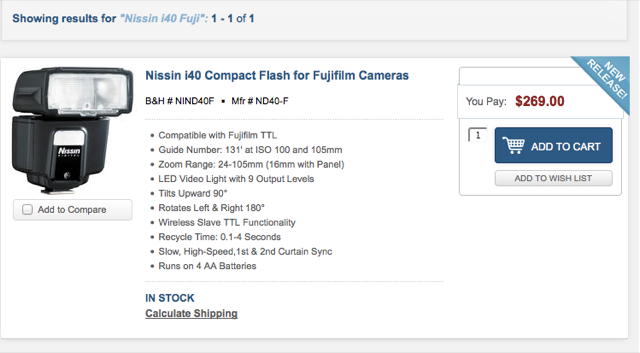
FR-reader Sascha shared 2 days ago the following comment on FR: “Go get the nissin i40 flash,turn it to manual, hold test button for three seconds, watch the lamp next to the m for manual go on and off. You just turned on high speed sync. Even though fuji claims to not support hss it works just fine up to 1/4000!!! I tested it!! You just have to find out what shutter speed you need first. Then turn on flash put the right dial on the speed you need, aim and shoot… Done!”
Also wimarys talks about the “Nissin Trick”, and shows you how to enable sync speeds up to 1/4000 on your x-series camera using the Nissin i40.
- Turn the i40 to manual mode
- Press and hold test button for three seconds
- Watch the lamp next to the m for manual go on and off. You just turned on high speed sync!
- Turn on flash put the right dial on the speed you need
- HSS works up to 1/4000
Or, as photomadd says: “To activate the HSS you need do is turn the flash to manual, press and hold the test button for 3 seconds, which if you don’t know (as I didn’t!) is the power LED. After 3 seconds the LED next to the manual control will flash. Unfortunately you are now not in TTL mode so it will only sync with the manual flash controls, but that is good enough.”
Thanks Vadim and Travis for the links
39 Responses
Unfortunately it has small GN.
A small GN at 1/4000 is worth 16 flashes at 1/250… It suddenly becomes an awesome little flash with tremendous power.
A bonus trick would be to use it at very low power to light up slaves that don’t have HSS functionality.
The Fuji 20 flash at under 100$ when on sale with a canon TTL chord on the x100s with the ND on out powers mid day sun by about 1 stop. High Speed Sync is where the cool kids go to party.
Hi Victor, I was excited at your suggestion and tried slaving my YongNuo 560-III to the Nissin in HSS. The YongNuo fired but it didn’t sync with the frame in both 1/180 nor 1/1000.
This trick comes directly from me! Sorry, exactly my words.. See comment on rumors about a new pankake etc. look out for Sascha…
Updated the post… missed your comment, sorry. Next time drop me an email to be sure I don’t miss such good news 😉 Thanks Sascha
Between 3 and 4… Lets name it 3b: First you will have to find out what shutterspeed you need. To do so, the flash needs to be turned off. Then press the shutter button of your x cam half way down (A or P mode) and remember the shutter speed thats displayed. Now turn on the flash on again. (The flash stays in hss mode. To leave hss mode you will have to press the testbutton again for three secs.) after the flash is on again, shift your cam to S or M mode and use the dial on the cam to set the right shuttertime. Aim and shoot.. Thats it!
Any x-cam? This work with the fuji x-e1? Or only with the x100 serie
I bought one from WEX just before Christmas it failed to work at all after about 8 flashes. I have since discovered that early versions of a new Nissin flash are well known to break whichever camera they are for. When will Nissin learn ? I sent mine back for a refund and will never buy another Nissin again, I will wait for the new Fuji flash.
Does sync speed of 1/4000 works on x-e1?
Fortunately it’s compact.
Does one of you guys know if the Zoom Range is FF equiv. ? I’m trying to find out. Wondering if it can be used with the upcoming 90mm.. Thanks
It works! I’m able to synchronize with any shutter speed in my X-E2. Pity that we can only use Manual mode but even this is great having in mind that it is thanks to Nission only and main limits comes from Fuji.
If this really works then why wasn’t HSS listed as an official feature?
It works! So who cares about the listing…
It does not work in TTL mode yet. Maybe they want to fix this first.
It was for a long time before it’s release already mentioned it was going to have HSS. That’s why many were pre-ordering it’s release because Fuji is seriously lacking in the strobist department. I don’t get why they call it a “trick” clearly this is just a way to activate it. Probably saw it in the manual whoever decided to post this.
It wasn’t in the manual. At least I didn’t see it and I explicitly looked for HSS.
It says it in the specs on rumor websites like this one prior to it’s release. If you took 10 secs to browse it on popular camera retailers like Adorama and B&H it mentions it on the main page.
It’s still not in the manual unless the terminology is different. It was discussed in comments as well. Also, it takes more than 10 seconds, but I don’t want to rain on your parade.
Nonetheless you got me there, it is indeed listed, which is highly suspect given its not in the manual and the title of this article….
It’s very messed up that it isn’t mentioned in the manual the HSS function. It can even do up to 1/20,000th the flash (obviouslu on super low power). But yeah, the 10 secs thing wasn’t literal, but it mentions it. It’s a great flash. I know I will buy most likely 2 of these.
For the next firmware release news 🙂
No enough room for battery. Small size comes with a sacrifice. Otherwise the weight and spaced saved will be filled by batteries.
What are you talking about not enough room for batteries? It holds 4 AA batteries. Just like the Nikon and Canon flagship flashes. They made it fit amazingly.
I actually did not verify that. Thank you for pointing out.
The only bad thing in my opinion is that it lacks the PC sync port and external battery port. Which isn’t bad, just use inexpensive hotshoe triggers and you’ll be fine. Like Cactus v6 or Phottix ones.
When it’s in HSS mode flash losses its effective power.
Triggering the flashes without HSS functionality won’t do any good. In fact it will result in a bright thin line on top of the image at best. Also, the GN of the flash is lower in HSS mode, and the higher the shutter speed the lower it gets.
You might want to skim through this article about HSS:
http://www.bobatkins.com/photography/technical/canon_speedite_high_speed_sync.html
Yes. That’s 35mm eq 24-105. But don’t worry. Even though it will work at 105 instead of 135 you won’t see any practical difference.
Has anyone tried this with a XT1? Or does this only work with leaf shutters?
Leaf shutters DON’T NEED HSS – that’s the whole point of leaf shutters. You can shoot at any shutter speed limited only by flash duration + aperture (with leaf shutters max shutter speed varies depending on aperture).
HSS only makes sense for focal plane shutters, and even then, it’s usefulness is limited due to significantly reduced and sometimes inconsistent power output and enormous drain on your batteries.
With the x100 series, you don’t need HSS, it has a leaf shutter. HSS comes with a LOT of compromises, the main being enormous power draw and loss of output power. With the x100 and it’s real shutter speed, you can get normal sync work between 1/600-1/4000 (depending on aperture) and flash duration. This is similar to how medium format cameras work.
You confuse the x100’s sync capabilities with HSS. The x100 does NOT enter HSS mode to sync at 1/600 (at F/2, higher with narrower apertures) – this is a property of its leaf shutter. This is way way better than HSS, because with HSS you get a significant power loss, more inconsistent output, etc.
Nice! Though I’m not sure how useful it is on such a small flash. HSS comes with some serious compromises. Unlike leaf shutter cameras like the x100 series, HSS suffers from significant power loss, inconsistent output and tremendous power draw on batteries.
It might work if the light is close enough to the subject, but to use it to kill ambient light, especially bright daylight, you’d need half a dozen of these small flashes (for full body shots), especially if you’re using light modifiers. A 2-3pm full body environmental portrait with subject lit by flash through a large softbox needs 3 sb-900/910 caliber flashes.
The more obvious and elegant solution is using ND filters instead. With all the compromises HSS comes with, it makes more sense, especially with small, battery powered flash units.
For great many couch photographers, HSS is just as important as FF.
On a serious note, I have to warn against using the variable density ND filters; try before you buy. Some of them (notably Singh-Ray) are incompatible with X-Trans.
Thanks for the advice – those variable ND filters are quite pricey. I got a 9 stop B+W, mostly for long exposures (77mm). Right now I’m happy with the x100t and the built in 3-stop filter.
Fixing rear-curtain sync and even TTL (in some tricky situations) is more important than HSS. If I buy another Fuji camera, I would invest in a couple of ND filters, maybe a 3 and a 6 stop one.
Has somebody already checked what the guide number is in HSS mode at various shutter speeds? If the power is spread efficiently there should not be that much off a difference between HSS or ND-filters.
I thought ND-filters only help you to keep the aperture open because they reduce your flash power just as much as the ambient light.
Flashhavoc has some tests I think. What I wrote above is based on my experience.
For X-T1 owners with the new electronic shutter option, is there still a need for HSS?
Well yes, because you can’t use flash at all while using the electronic shutter.