







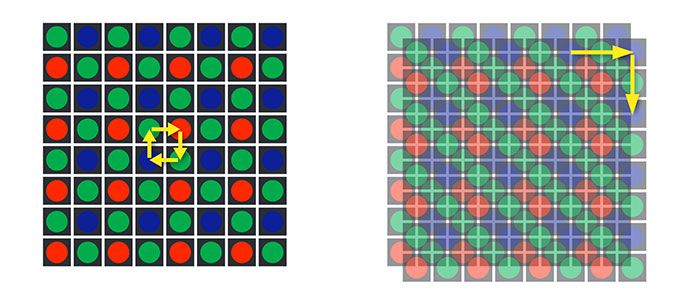
Now that we now Sony will use the 5 axis system on future E-Mount camera it’s interesting to read what has been reported on MirrorlessRumors. Olympus will launch a new E-M5II camera in February. And by shifting the sensor with the stabilization system it “can shoot up to 40 Megapixel by shifting the sensor (in up to 8 frames of single shots)”.
What you usually do when shooting HDR (combine multiple images at different exposures) you do with the Resolution (combine multiple images at different shifted sensor locations).
Of course this works fine when shooting still objects. Must be a bit of a mess on fast-moving stuff. But it’s interesting that the on sensor stabilization could also bring us that kind of “unexpected” benefit!
0 Responses
@Admin
Wouldn’t that match with the patent few weeks ago?
Patent says 4 movements.
4*12MP = 48MP
That would match the numbers you are providing really close!
With an insane ISO performance!
My calculation:
A9 = A7s + A7 II
Maybe the pixels are 12MP*3 = 36mp?
That’s what I am trying to understand. If the A9 has a similar tech!
Im 90% convinced it will works that way.
As i provided the story with the photographer that had an prototype.
He said it will have an similar ISO performance like the A7s and saying that math is involved.
Sony and Oly are denying to work together, but i guess they just shared ideas.
They dont share tech, patents and workers, so they can still deny.
Increasing resolution by moving the sensor is an idea that has been around for ages (Hasselblad were first to bring it to market, I believe).
Likewise with 5-axis stabilisation. The fact that Sony implemented a 5-axis IBIS doesn’t indicate in any way they are “sharing ideas”, Olympus cameras have been out on shelves with that feature for years!
As far as I can see, Hasselblad just introduced the technology this year. And Minolta cameras had stabilization way before that. Just saying.
Actually Hasselblad released the first digital back with this technology in 2009, but the same or similar approaches have been used in scientific cameras for much longer.
Minolta never developed a 5-axis stabilisation system.
are you delete my post?
At the same time, it means that bayer sensor is not dead as we expected!
More and more it looks like there will be no foveon alike sensor!
Well you could do a foveon setup where each position is a color + contrast
Exactly! It is not for no reason (other than shake reduction) they incorporated the shake mechanism. It would be fabulous if the 12mp sensor is used for this! Then the current price of the A7s is justified.
Looks great
@SAR_Admin:disqus is that you mark my post to be spam?
@Admin Are you delete my post?
@Admin Are y|ou re|moved my posts?
no. Have you posted something that didn’t pop up here?
Looks the disgus false mark my messages to s|pam
Ok. Approved your comments. DOn’t know why they were into the spam folder. Let me know if you have issues in future. You can also contact me via email!
Are you delete my posts?
Maybe this would be the solution for Canon to catch up the mega pixel race… but then they don’t have IBIS to be based on and so Sony could leap ahead again.
Get real, Canon doesn’t need to catch up anything, it’s number 1 camera manufacturer in the world, no matter how technologically retarded it is.
And it will share the faith of Kodak….
The faith of Kodak? Personally, I don’t have much faith left in Kodak. lol
Technologically retarded? They have the best autofocus, the only dual pixel sensor, the best lenses. It will be years before Sony, Olympus and the other toy factories catch up – if they ever catch up at all, pending bankruptcy.
I do agree with you that Canon is not retarded, they do make great cameras.
But Sony, Olympus, etc. are not toy factories at all. When Canon and Nikon don’t come with some great mirrorless cameras then it can be them who get in finacial problems…
Doubtful. They keep out of mirrorless bandwagon because every company investing there is loosing money. It’s a huge R&D money sink with little profits coming out. Until that changes – they have absolutely no reason to make a serious offensive on that market. And when it does – they can just buy techs from near-bankrupt companies like Olympus desperate to finally get some cash injection.
I seriously doubt that Sony is losing money with mirrorless. Also, Canon didn’t keep out, they have the lamest entry. But, I agree, that given the mindshare they own, they can allow themselves to wait and sell mature technologies such as DSLRs to make money. Same as they are selling the same sensor over and over.
Seriously doubt it? It’s not up for debate; the numbers are readily available. The imaging divisions of Sony, Fuji, Olympus, and Panasonic are all losing money. Only Canon, Nikon, and Leica are profitable right now.
And they will keep doing that until their technology is so outdated it will result in no new customers, lack of sales and financial collapse. Brilliant!
That’s all very true.
Unfortunately, mirrorless is also the future, so it’s a bit of a chicken & egg scenario: mirrorless is losing money, but if Canon and Nikon got serious about mirrorless cameas, then it would move the needle more significantly in that direction … and consumers would follow.
It’s gonna happen eventually, it’s just a question of when.
IMHO Canon makes some really really great lenses. They also have THE biggest lens selection. Of course also autofocus. If they now would bring out a high density sensor, professional and enthusiast Canon users would flock to upgrade their cams..
At least Nikon has good third party sensors.
Otherwise, low weight camera, high density, high iso, live view, EVF, total adaptability with manual focus lenses, IBIS.. Sony is leaping forward and I bet Canon users are testing the water with a little Nex or A7 in the meantime as a secondary/weekend cam..
Actually, if you include legacy Ai and AiS lenses, Nikon has the largest selection of native lenses of any system in the world.
The best lenses? Yeah, no. And, sure, they do have some well-developed technologies, but they are hardly as innovative as Sony or Olympus.
The dual pixel sensor didn’t work out very well, inferior image quality and focusing errors. Canon is stagnating technologically, you can’t deny that.
Best autofocus? Nope.
Sensor tech is 5 years old.
Best lenses? Not hardly.
Canon does not need to catch up anything. Canon is moving slow but firmly. In the next 24 months that mirrorless camera will be there and it will be the only serious A7 competitor. It will no doubt be a fantastic camera.
It is Nikon that should be shaking in its shoes, because I have no doubt Sony will replace Nikon as the #2 camera brand. Nikon is just a long string of failures the couple of years. Nikon 1, then the D600 oil spot debacle, then the Df joke.
Olympus is indeed a toy company (coming from an owner of 3 Olympus cameras). They are not playing this game seriously and show absolutely no plan of how to get out of this slump.
Sony has never been profitable in the still camera business, even years after taking over Minolta.
Nikon is profitable, year after year.
That’s some shaking in its shoes and legacy of failure Sony would love to have. And please hurry, as Sony is being forced to jetison one set of mainstream consumer lines after another because of unprofitability, from Vaio to televisions.
Nikon isn’t doing well now and Sony just got profitable. We’ll see how this goes though.
Nikon’s imaging division is profitable (even though those profits are less than they used to be). Sony’s imaging division is not. Fact.
Sony is dying. Fact.
Everybody here forgets that Canon already has a mirrorless entry and it is hardly “fantastic”. Though, I certainly would like to see something great when they decide to finally get serious about it.
Who knows what Canon is working on. My guess is that they will introduce a serious mirrorless system soon. So will Nikon.
Nikon has definitely made some missteps the past 24 months, but you have to evaluate them on the last 60+ years, not the last 24 months (which is far to small a snapshot). They’re still profitable, even as all the mirrorless manufacturers continue to lose money … and Sony can’t possibly catch them in sales revenue with a model like that. On top of which, Sony as a whole is a dying company.
As to Olympus, they’re hardly a toy company. The OM cameras blow the Sony A7 series out of the water in usability and lens selection … and Olympus’ medical division is enormous and hugely profitable.
something like Sinar digital back microshifting sensor.. shoul be this one
http://www.sinar.ch/en/category/products/digital-backs/sinarback-exact/ ?
“Sony take a look” ?
1. This tech looks an awful lot like the APCS that Sony just patented.
2. This tech was probably developed in collaboration with Sony.
but
3. I sincerely hope this gimmicky technology is not on the A9.
I am honestly starting to think that Sony had a great little team developing the A7 series, and once it picked up more steam than expected, all the old farts from the A-mount team were moved over to the A7 development which means we’re going to see a lot of nonsense features on what used to be a great, focused project.
I do not agree. I do not think your speculation is as bad as Zeiss rehashing the ZM lenses as Loxia.
Irrelevant. Zeiss is a German company with (as most German companies) a tremendous amount of focus.
The problem with Japanese and Korean companies is once the old farts roll in (both engineer and management) everything goes down the shitter.
That seems irrelevant. Zeiss is a German company and is extremely focused (as most German companies).
The problem at most Japanese and Korean tech companies is that once the old farts (engineer or management) roll in, everything gets broken. Sony managed to break away from this rhythm with the A7. Lets see how long this run lasts…
What is the problem with the Loxias?
you mean like the IBIS??? Damn them old A mount farts…giving us such a nonsense feature…:D
Of course IBIS is a gimmick.
because Mike said so…
Your opinion is wrong. IBIS is a gimmick unless you like to shoot motionless objects, in which case a tripod provides sharper results anyway.
Tripods are always better, but not always possible/practical.
Exactly, IBIS fills up the small gap between motionless scenes and not having a tripod with you. It is a backup solution and not a core feature.
It’s not just motionless scenes, have you ever shot with a lens longer than 50mm perchance?
Also have you ever tried manually focusing a longer lens at 10x magnification? Without sensor stabilisation it’s very difficult.
IBIS in a highly portable camera like the A7 range is a huge deal, massively extending the range of conditions under which you can shoot handheld, and the lenses you can focus manually. It’s not a gimmick.
Knowing that I can get keepers at 1/20 for night time street photography makes a world of difference. A tripod has been known to draw a bit of attention under these circumstances…
yes, but on the other side, it makes a decent defence weapon 😀 (hope I will never have to use it that way)
Agreed… Lens without IS and long focal is painfull. I vomit most of the time using a legacy 200mm on my APS-C camera…
becauses Mikes priorities = universal priorities…
Mike doesnt shoot video = nobody should care about video stabilization
and Mike likes to lug tripod with him all the time=everybody should like to have 2 kilos of aluminium on their back all the time
And your empty ad hominem attacks continue. Do you even shoot video? IBIS is absolutely terrible for video.
If you want to shoot a sharp landscape scene (= motionless subject) then a tripod is a must.
Mike suggests that no video stabilization > IBIS video stabilization
furthermore Mike assumes that motionless scenes are limited to vast landscapes=we should define it as a fact
And Mike is a troll.
The rumour that was posted on this site over the so-called APCS sensor never mentioned a patent. There were many reasons that rumour was a hoax given the unfeasible technical specifications and that it was originally claimed to be for a camera phones despite being almost twice as large as any sensor used for such a purpose.
At least this mechanism is credible.
So this is the delusional scenario you created in your head?
Nice idea, it will only work with realy static objects, not great when there is some movement in the subject. In fact is is only handy for architecture as all other pictures will have moovement (like moving leafs in the wind, people etc.
could it be possible to select under our choice “foveon mode” or “bayer mode” ?
LOL… why would Sony need it when they offer 24 mp and 36 mp sensors?
ISO performance like A7s?
Imagine 48MP with ISO/noise like A7s, that could other blow out of water…
It won’t… RAW files from 12 mp may have somewhat higher SNR than 36 mp files, but when you’re doing math to combine several 12 mp => 36 mp you’ll get amounts of noise far exceeding those of native 36 mp sensor image of same total exposure.
this gimmick works with static objects anyway, so tripod + here you are.
multi-exposure methods are used in astronomy imaging, but only because there’s athmospheric turbulence
Combining shorter exposures, yes, you’ll get more noise. But since you’re limited to static scenes with this approach you might as well combine longer exposures which will lead to reduced noise.
I wouldn’t be too excited about this on a 12MP sensor, but if they implemented it on a future 36MP body to potentially produce 144MP images that would be cool, at least for landscape and product photographers!
144 mp which is only sharp in the center and DOF/diffraction problems make it unusable with even sharpest lenses….
You think 36MP is the limit of usable resolution? It’s much higher than that. A 36MP Bayer sensor is in the worst case (detail in only 1 colour channel) only 9 megapixels anyway!
Even if it were the limit, there are many benefits to oversampling.
Hasselblad’s implementation of this idea in the H4D-200MS doesn’t appear to be hamstrung with sharpness/DOF/diffraction problems.
I’ve never seen anyone shooting this worst case IRL.
so where are 200 mp files as sharp as 36 mp FF?
If you shoot anything but skies and flat objects, sure you’ll be troubled with DOF problems.
It comes up in parts of images quite regularly, e.g. flowers. It also happens a lot a gigs where you have very strong coloured lighting, i.e. pure red or pure blue are not uncommon.
Hasselblad used to have a load of 200MP samples on their site, it doesn’t seem to be working now but when I last looked I didn’t see any DOF problems.
http://www.hasselblad.co.uk/promotions/h4d-200ms.aspx
You might not be able to realise the full resolution a multi-shot system is capable of, but that doesn’t mean it wont be better than 36MP!
Dmitry, Astrophotographers do use mult shots to reduce noise, but not to enhance resolution. And they do use it too to reduce atmospheric turbulence, the end result will be a picture with the same resolution only more details, it is more like a very special kind of IS….
Thios option is enhancing resolution. Use is very limited…
On the contrary.
Firstly, 36 MP files from a sensor of the same size and efficiency have worse per-pixel noise than 12 MP, but not necessarily worse per-image noise. If both images are scaled to the same output size, overall image quality will be similar. For small output sizes, the downscaling of the large files will dampen their noise to roughly the level of the 12 MP file, and for large output sizes, the detail loss because of the small resolution of the 12 MP file will roughly equal the detail loss of the higher noise level of the 36 MP sensor. By the way, that’s just about what you’ll see when you compare A7S and A7R, except for the highest ISO settings, where the A7S has an advantage, because everything in it has been opimized for it.
Secondly, if you combine several 12 MP exposures to one 36 MP exposure, noise will be much less than in one normal 36 MP image, because the camera has several times the amount of light to work with.
on the contrary, you seem to be unable to read: I’ve said for SAME TOTAL EXPOSURE.
if you can combine several exposures with 12 mp sensor, you can do the same with 36 mp sensor.
super-resolution intrinsically makes SNR much worse, you don’t know it because you never did the math.
Sorry, my bad – I probably did read too quickly, and I probably didn’t expect someone to propose the truism that n combined large-sensor images are better than n combined small-sensor images as some kind of intelligent insight here. While all of that still doesn’t substantiate the claim that “super-resolution instrinsically makes SNR much worse”. For one, much worse than what? And could you give a hint as to what that “math” may exactly be?
Given that you’d be using a tripod anyway, why would you need the a7s’ iso performance?
hah and you need natural light or some very clever flash sync and you want to shoot any movement at all it needs to be shot high speed…
Product shots, still life arrangements, architecture. I guess that’s all, nothing else comes to my mind.
Landscapes?
It might help a little, but moving leafs in the wind, walking people other movements? No not realy a big advantage I think in the end.
Depends on the speed, right? I don’t know about the technology in detail. If it were possible to take photos in 1/2400s separation, you effectively would have taken everything within 8/2400s = 1/300s. Fuji has 1/32000s electronically now, so maybe it could be applicable to a larger range of cases.
Do you realy think that a consumer camera can take pictures with 1/2400s seperation? Can you show me one camera that can do that? No this feature will only work with a camera on a steady tripod. Any movement in the camera or in the object will distroy the end result…
I know. Was just saying if it where possible to take pictures at that rate it would work for movement, too. We have cameras here going to 10000 images/second, but you easily are in the 100k$ range for those.
It would mean everything needs to be at super high exposures, which means a lot of light, freezing everything beyond natural looking. Unless they come up with some very clever software I don’t see this working in any practical way. If this gives you layered raw and you can adjust some parameters later, otherwise you need extremely fast camera processors. Or end up with something as horrible as the Lytro camera.
Movement is movement as far as the subject is concerned. No way they will ever get this working for movement. This is wishful thinking.
We can shoot 1/8000 s today but can only do this 14 times per second on a 1DX (for illustration). Do the math and don’t forget to consider the time between shots.
For a fast moving subject (sports), this won’t work period.
For a walker, same thing. Constant motion.
I would anticipate a blurred result or soft result.
Anything that moves even slightly, say blades of grass, leaves,etc would be a real mess.
@SAR_Admin any informations about a ibis stabilized a6100 or a7000?
Typical uneducated photo enthuasist:
36 mp sensor discussed == no, no no lens ever will resolve it
12 mp sensor gimmick discussed = yes, it will also to deliver 40 mp pictures clean as 12 mp and we don’t need lenses to resolve 40 mp, only 12 mp….
Enlighten us!
This is similar to Hasselblad 50 mp sensor that becomes 200mp with 6 exposures.But here 16mp becomes 40mp with 8 exposures.
Hassys method is proprietary..which may be why olympus has to use more exposures .
If Sony could do something like this but it is only usefull for nonmoving subjects with a tripod.
We have no idea what Sony R&D have done with that approach.
Lets see how they overcome that issue with moving subjects.
As far as we know only Olympus will do this.
Sony, Canon and Apple got patents for identical technologies, only each does it in a slightly different way.
We don’t *know* if Olympus will do this, we only have a *rumor*.
What we do *know* for sure is that Hasselblad is doing it already. Since 2011 for that matter.
Olympus don’t have to use 8 exposures, nor is there any great mystery (or patented technology) in the Hasselblad approach.
There are many different ways you can do this, you can move the sensor 1 pixel four times to capture R,G,G,B values at each site, you can move the sensor 0.5 pixels and demosaic the result, you can move the sensor diagonally 0.5 pixels in each direction, and then 1 pixel in every direction (which is I think what Hasselblad do) or you can move the sensor 0.5 pixel and 1 pixel in every direction, which provides the greatest luminance and chrominance detail.
the Equation is simple; for static objects with a deep depth of field desired, M43 equals to any bigger format at base ISO; a macro heaven !
Any bigger format? LOL. M43 is a match for compact cameras, sold at silly prices.
You are right, the above comment is related to situations for maximum DOF (small is an advantage) at ultra high resolution (large is an advantage).
Besides, this camera works like a static scanner…
RX100 has even higher pixel density at better quality if you need that.
And you can do better again with a 20mp smartphone. Who wants uncool shallow depth of field when you can vomit an instgram filter onto your photos?
I understand your sarcasm, but an m4/3 sensor is not much of an advantage for shallow depth of field over the 1″ RX100 sensor.
We were talking about situations when high pixel density and depth of filed are required i.e. OOF areas as little as possible.
In those case you buy a FF camera. APSC is not a great advantage over 43 sensors either, especially if you take existing lenses into consideration.
It’s significant enough. Especially if you take existing lenses into account.
It’s about 2/3rds of a stop. Existing lenses notwithstanding. You have to move to “full frame” to see a significant performance gain over m4/3. That is fact.
Small is not an advantage when it comes to the sensor and DoF.
@SAR_Admin:disqus is this a rumor? http://www.cnbeta.com/articles/352061.htm
YAY!
omg the pic is so fake. A prime lens should only has one ring for focus.
http://static.cnbetacdn.com/article/2014/1205/d8cd806ad87d817.png
The body is so fat on that thing there is surely no way it would clear the finger hold, especially on the A7 II.
Aperture ring?
Not sure what it is but sure looks good and heavy! 🙂
It’s certainly a rumor, that’s for sure. However I highly highly doubt it’s true (125mm filter, anyone?)
It would be ultimate milky way and aurora lens, but it is obviously fake. It would be too expensive and too specialized to make any sense with current state of E-mount products.
T1? so that would make it F0.85 on a 12mm? Funny! Would be even funnier if it was true!
notsonyalpharumors.com
m4/3 sensors have been at their maximum resolving potential for several years and several camera makers whose systems are based on these are turning to gimmicks to compete with larger sensors.
In Oly case here this is just a marketing tool, the E-M5 II will be sold as “up to” 40MP camera.
“maximum resolving potential” why? The RX100 resolves more.
I expect pixel count from straight from the 4/3 sensor to go up soon.
Plus: Hasselblad use this “gimmick” of multiple exposures. Sure it’s useful only with static subjects, and on a tripod, but in some cases it could be very cool
If you look at the m4/3 cameras for the last 2-3 years they are all stuck at 16-18MP, with some being lower. There are just technical limits to current technology, like computer CPU’s frequencies that kept doubling every 18 months for decades and then got stuck at 2.4-2.8 GHz and they started increasing CPU cores.
For the 1″ sensor in RX100, I guess that Sony just has better manufacturing technology and managed to get some 30% better result from current technology, managing 20Mp in 1″ sensor (2.7 multiplier), while the m4/3 sensors (2.0 multiplier) have 2-4Mp lower resolution.
I see a lot of confidence in your statements but with no knowledge to back it up.
No prob, you don’t have to apologise.
so it needs 4 time to expose plus the time to shift?
You will obviously also need a steady tripod and most importantly – subject that doesn’t move. Otherwise you’ll see shadows and/or loss of sharpness all over the place.
Still life photographers will love this. I’m one. Sign me up.
Sure. Same with people doing product photography or – to a degree – macro.
All I wanted to highlight is that the usefulness of that feature is by far lower than some people imagine. It’s something that you can use only with a very specific type of photographs.
I guess my view is all skewed. I only take that sort of photo to which this technology is suited, so I’m all ears. Although, long-flange cameras like m43, NEX, X, etc., aren’t as useful as MF cameras for still life. Still, getting ~40MP from an inexpensive small sensor camera would be great for stuff shot for cheap shoots.
you can have it already with stitched panoramas.
people already publish gigapixel panoramas.
It’s not the same as stitched panoramas. It takes the 8 images that have been shifted very slightly each time and interpolates them.
A pano doesn’t do anything to increase color data quality, you’re just connecting stills together for larger dimensions.
I’m tired and mildly hungover so apologies if my words are not good -_-
Check the comment below. Xam is right. Stitched panos are neither as accurate, nor as repeatable. And they are taken under completely different circumstances, not to mention, take much, much longer to complete.
ok, almost the same as you make a photo merge but shifting the sensor instead of the camera.
isn’t this an amazing deal?
is this something like multi shot digital backs?
Olympussy if you know what i’m saying
haha yeah… no fullframe, no deal!
Yea, might have to reconsider the future of my M4/3 gear. Same sensor too what a disappointing update. Looks like they have reached a plateau in sensor tech.
Similar to what hasselblad did with their multi-shot backs.
This functionality is similar to in-camera hdr. Any use cases where people are happy with that they should also be happy with this.
In fact it is not. The shift between pictures is very small to accomplish the given results, for HDR you take 3 pictures and in post you can manipulate them in a way that the pictures are as good over one and an other as possible, a little loss of resolution is no problem. With the resolution enhance technology used here every movement (even when you take a breath in the picture) will make the end result worse then when you took one picture.
If their resolution enhancement algorithm assumes that the only shift is caused by the sensor shift, then yes. But I think they are not that dense and they would align the images (as I would think they would with HDR) before merging them… there have been post-processing applications that do this with manually shot images for quite awhile. What you need is not small shift but lack of pixel alignment between images so that you are not recapturing the same information.
It looks like Sony picked a very good strategy in this market (I don’t know if they did it knowingly or just by chance).
Initially I thought they are over-investing themselves in APCS and FF for their new interchangeable (E) mount, as both sensor sizes require huge and heavy glass and expensive sensors, while if they based their new mirror-less system around 1″ (like Nikon 1) or m4/3 (Oly, Pana) and APCS for top models they would be even more competitive on price and more compact/portable.
However, it looks like smaller sensors are reaching their peak performance with current technology, and Sony are very well placed strategically to advance in interchangeable camera markets developing their APSC and FF ones, while the 1″ sensor has a big role to play in compact cameras.
I know the sensor is not everything in a camera, but sensor size is an important decision when designing a system, because the expensive optics of the whole system are later based on this decision.
Is this really much different than stitching together a bunch of images? A more accurate and quicker method?
Not sure it’s necessarily quicker or more accurate.
Can someone explain the math here? If it moves the sensor 8 times one pixel, the increase in spatial resolution will only be in the kilopixels. Definitely not megapixels.
But if you move the sensor half a pixel, you have twice as many pixel locations, so you’ve doubled the number of sampling positions, it’s not quite the same as doubling the number of megapixels but hopefully you can see where the resolution increase comes from.
Incidentally if you did move the sensor 1 pixel, then you’re massively increasing colour resolution, as where you previously might only have had a red value at a certain location, you would now have a red value and a green value.
Wondering if we can use strobes in sensor shift mode or if it might cause sync issues and possibly frequency issues when using fluorescent lighting…
I’m not sure how it supposed to work handheld, because of the size of one photosite is pretty much nothing compared to the camera movement between the shots. Sony cameras have high ISO noise reduction mode, that’s doing the same by combining up to 6 shots together without any sensor movement, and it works very well, but the final result is JPEG only (quite understandable). On a tripod it may work great though, similar to the 200Mpx Hasselblad (50×4).
I guess you will need a very high end quick recycle time studio strobe just to keep up with the needed 8 shots~
Why can’t we just shift the senor ourselves via hand tremors?
Exactly my thoughts….Sony unveiled the exact same thing couple months back…they just did not mention that they will use the IBIS for that….
isn’t it very similar to a supposedly developed APCS sensor by Sony?
Yawn the death convulsions…
m43 is downsyndrome child of cameradom…