







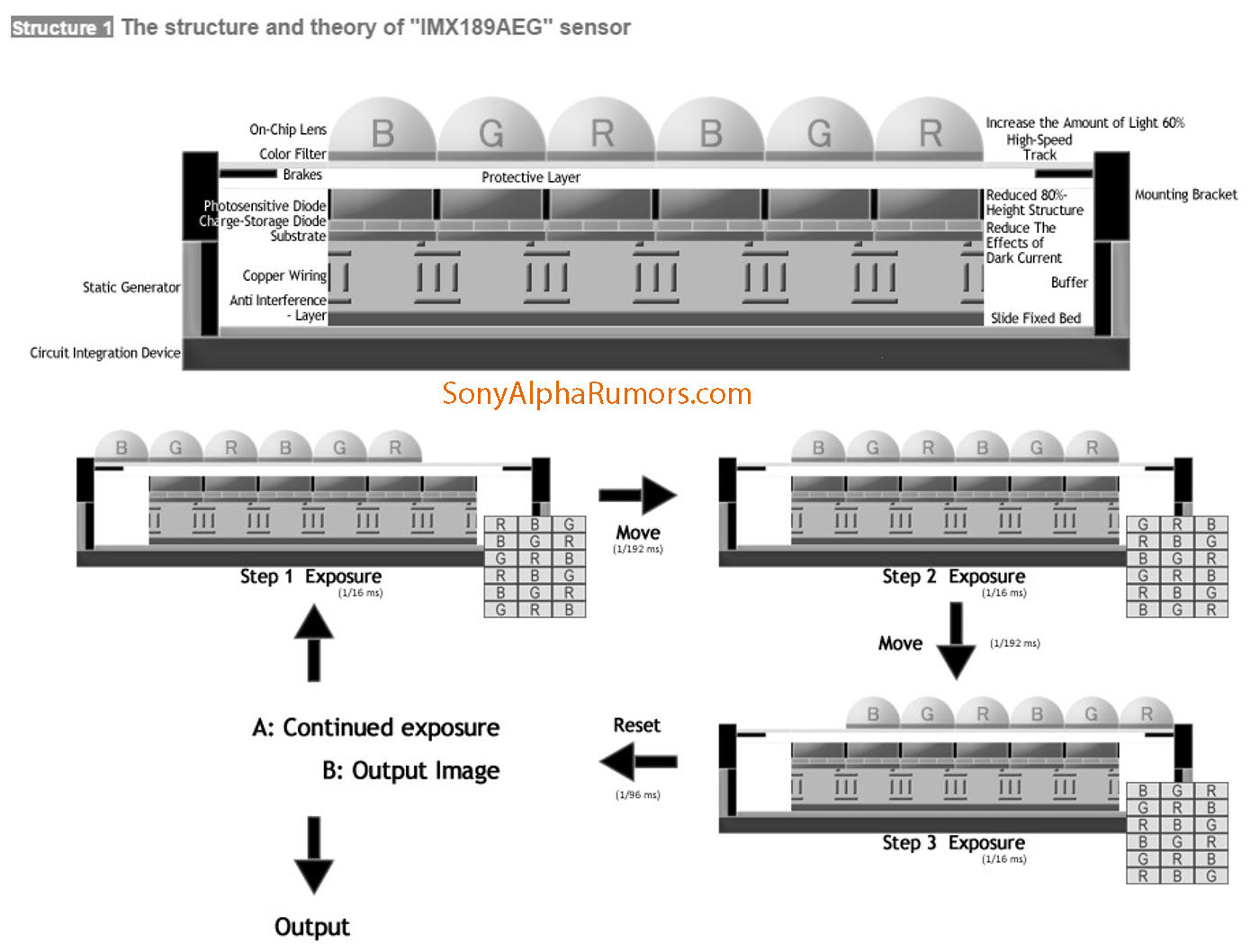
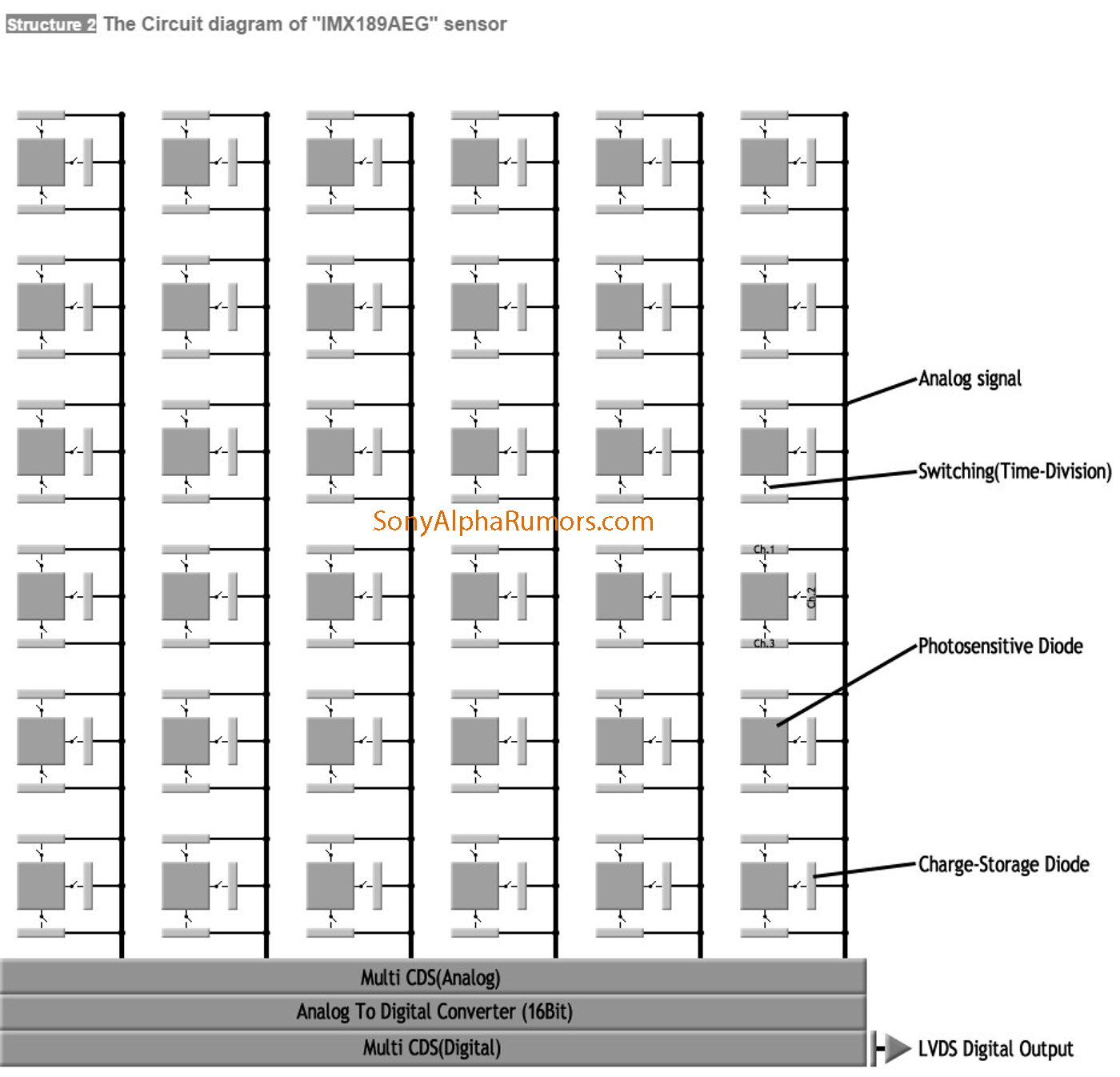
It’s Saturday and I actually had the plan to go out with my family. But an anonymous source just sent me those images (via Cnbeta.com) I have to post straight away 🙂 Tech freaks will be happy to see the details of the world first Sony APCS (active pixel color sampling) sensor! The full document can be download here. Be kind note 🙂 If that news is helpful for you link back to SAR when reposting, retweet it and like it on facebook. Thanks!
Like I told you a couple of days ago this is a 1.5inch sensor likely to be introduced in early 2015 in some video cam. The Sony sensor has the world first sensor capable of capturing the full color spectrum info in one single pixel. Sigmas Foveon sensor used on DP cameras uses three layered RGB pixel ordered vertically but the new Sony sensor has just one single layer. The sensor is also capable of Global Shutter and 2K recording at crazy 16,000 frames per second.
Today I got those detailed graphs showing how the sensor works. “Structure 1” shows how there is a color filter on top of the sensor that moves horizontally. There are three different exposures for each color (Red-Green-Blue). It’s basically a “color HDR” picture instead of a “dynamic range HDR” picture 🙂
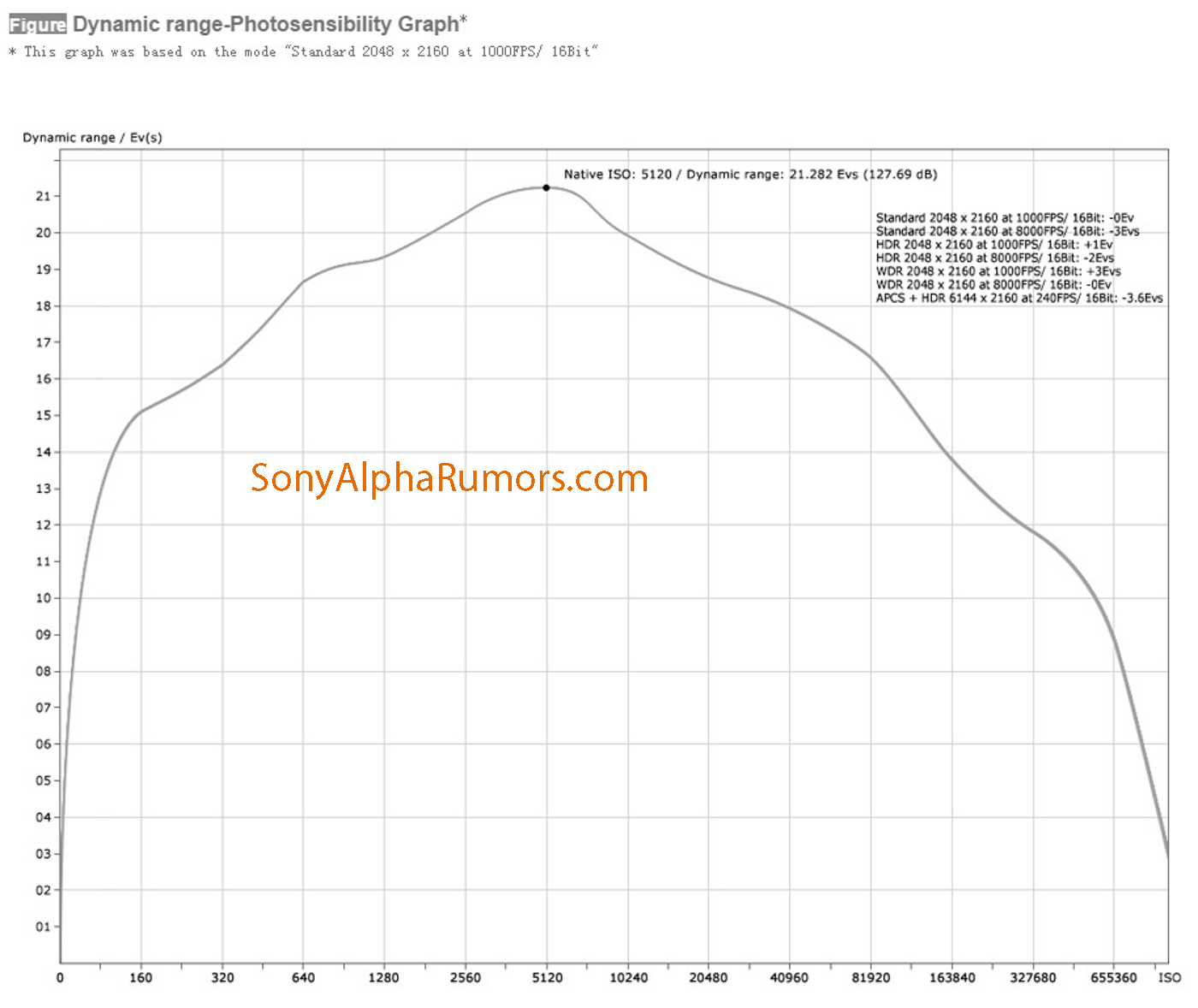
The sensor has a native ISO of 5120 and an impressive dynamic range of 127,69DB at that setting.
On paper that’s a hell of a sensor! Having the full color info in one a single pixel allows to have larger pixel compared to modern RGB Bayer sensors (which means less noise or higher resolution possible at same noise level). It also doesn’t need an Anti Aliasing filter anymore (increases per pixel sharpness and gets rid of moirè issues). Global Shutter is also an amazing feature (faster frames per second, no more jello effects). The only question is how this triple exposure time will work on moving subjects and long exposure shots. But I guess Sony knows well how to overcome this. Now I am curious to read the comments of SAR experts on this! Comment here or on our new SonyAlphaForum!
It’s likely that future Alpha Camera will use that kind of sensor too! Stay tuned on SonyAlphaRumors because there is really an amazing amount of rumors to come!
To not miss any of the (I promise you) damn exciting rumors follow SAR here:
RSS feed: http://www.sonyalpharumors.com/feed/
Facebook: https://www.facebook.com/sonyalpharumors
Twitter: https://twitter.com/SonyAlphaRumors
GooglePlus: https://plus.google.com/104216500156717934391/posts
And if you have some “rumor” to share just send me an anonymous messages here:
[contact-form-7 id=”14822″ title=”Share”]
Reminder (SR = Sonyrumor):
SR1=probably fake rumor
SR2=rumor from unknown sources
SR3=50% chance it is correct
SR4=rumor from known sources
SR5=almost certainly correct!
Hot: The full Black Friday deals can be seen on at that Amazon US page (Click here to see the long list).
0 Responses
So, do we get high speed movement IN the sensor to shift the RGB filter in tree different precise positions. I just do not believe that.
It’s like IBIS but much much much much much much much much faster
I’ve made some calculations on acceleration rates and power consumption making a few assumptions. For 16,000 fps (at least 2 movements per frame) and a 5 micron thick assembly, then the numbers that come out are, to put it mildly, rather high.
And an interesting calculation it was but your assumptions were all wrong making the result invalid. Amateur hour continues.
And what are your “valid” assumptions? You are an amateurish critic and better not to raise your voice here.
Which assumptions are wrong? A purely vibrating filter will cause a continuous variation of the mix of colours. I suppose you might sample every site many times per frame and sort it out statistically, but the processing involved would be incredible as every site would have to be sampled and go through an ADC process many tens of thousands of times a second.
Very interesting and one has but to wonder if this process would scale to bigger sensors, APS-C or even FF. The only thing missing now is Canon using Sony sensors and we could all be a happy family. Once again Sony innovates and Canon stagnates.
Cannon has specifically and recently stated that they will not use Sony sensors for thier higher end cameras.
Admin has stated that Nikon will not be using the new Sony sensor for a long time.
Once again the biggest question is will the new camera be fully compatable..via adaptors and including high speed AF…with Canikon glass?
Almost as senseless as Thomas Edison refusing to switch over to alternating current because Tesla invented the technology.
I doubt the terms high speed focus and adapters will ever go together.
The only thing which scares me about this is, given the 7r vibration issues, moving to a sensor which is perpetually vibrating, scares me. This may be unreasonable. I don’t know. But right now, I love the 7r…but don’t feel as if I can trust it.
So, in theory, this would allow for photosites to be 3-4 times bigger than with Traditional Bayer design Therefore allowing for better light sensitivity.
However, color information for each color (Red, Green & Blue) will be reduced by 1/3 since each Color channel will also receive 1/3 less light than the traditional Bayer design. Therefore, reducing sensitivity again…
So, net net, the advantages would cancel out. Maybe this design allows for some advantages, but it wont be “Revolutionary” for sure… But again, I am not an expert…
What’s revolutionary is the Dynamic Range Chart… Am I reading this right? It mentions 5120 ISO with Dynamic Range of 21 Stops!!!
As per DXO, the A6000 has 12.3 EV at ISO 100. This APCS sensor is pushing 21 EV at ISO 5120???!!! That’s sure as heck Revolutionary, I must say!!!
Yeap, I am just worried is this true?
About the color information loss, I am not so sure about that, because it use
1/192ms to switch the shutter.
and (base on chart), at iso 320.000 is as good DR as A6000 at iso 100.
It stays above 14EV between iso100-150.000. Truly an achievement.
21 EV is nearly just as good as human eye, which was estimated to be arround 24 EV just wow I guess when mass production starts we will soon have sensor that outperform human’s eyes dynamic range…
The bigger the photosites the further the filter will have to travel. I wonder if this scales up easily from cellphone size sensors to aps-c and beyond.
Maybe I understand the trick about 2/3 time loss for each pixel(R/G/B), because the camera is not used to collecting how much photons entered in each pixel, but testing the
speed of photons entered the photon, so each pixel lost 2/3 of time, but it’s also lost 2/3 of photons that entered to that pixel, so we didn’t lowering down the precision of the [photon count/time], and for each pixel, we tested [Red photon count/time], [Green photon count/time], [Blue photon count/time], in a very short time, that’s about [1/192+1/192+1/96+(1/16)*3]ms, that’s a very short time, so we can make sure the [photon count/time] is vary little time to time, that’s also the reason why sony make a so huge FPS machine, because without such as big fps frames, we can not test the photon speed precision enough.
It’s more about the sensor. This is just an odd (but logical) way of bumping up resolution. instead of having 3 small diodes each sampling one color and adding together the info later, we have one big diode collecting 3x the light, but because we want full RGB we collect red for 1/3 of the exposure, green for 1/3 of the exposure and blue for 1/3 of the exposure. So in the end, in both cases, we have the same shutter time, same amount of catched photons and 1 RGB pixel
No !
OK
You are overlooking the fact that the filter oscillation is only used to sample the color. The larger pixels are exposed essentially continuously. Light recovery should be very good. Algorithms comparing light intensity during each filter pass would be used to determine the compound color. Brilliant. Go Sony Go!
You mean the filter moves, let’s say 300 times before the end of exposure. So it goes: 1. Red 2. Green 3. Blue 4. Red 5. Green … 300. Blue
We still filter 2/3 of the light, we still throw away 2/3 of the photons. How do we know what red is like in cycle 2 and 3? Sure we can add polynomial interpolation (guess the intensity based on cycle 1 and 4) to each color curve to fix the missing info, but that would mean the sensor is read out 300 times. We add noise 300 times too?
No !
Dude, your reasoning skills are beyond imagination.
It’s hard to reason with you when you show that you don’t understand the basics.
Read the comments again.
The bigger issue here is that Sony is done as a company. Aside from the Playstation (and even that is beginning to succumb to online/tablet solutions), their entire consumer electronics operation is losing money (particularly to the Korean giants). That includes imaging.
Meanwhile, sensor sales are a very low-margin product.
Most experts agree that Sony as we know it today is dead and will soon be nothing more than a parts supplier.
Alright so what do you suggest? We shall all move to Canikon who don’t even make their own parts but just build a body around Sony’s and Koreans parts?
Not sure if that’s a question or a statement.
If the former, then yes.
If the latter, then your statement is only partially accurate. Canon and Nikon do, indeed, make their own parts (as much as any camera manufacturer does), Nikon does use Sony sensors for a number of their DSLRs (though in several cases Nikon heavily tweaks them in-house), and I have no idea what your point is re Korea.
Nikon and Canon will shortly enter mirrorless in a serious way (I’d estimate within 24 months). They have to, not just because competitors are, but because jettisoning the mechanical mirror box will save a lot of complexity, and thus money, over time.
Sony build terrific sensors, no one in their right mind would deny that. But IMO their cameras leave a lot to be desired in ergonomics, build quality, lens choices, and system capability and longevity.
That lack of historical commitment to their camera systems, coupled with the overall health of the company, are reasons why I personally would not invest in Sony camera gear.
Others may see things differently, and that’s fine.
This is an interesting solution compared to the Foveon simultaneous reading. What I can’t figure out is how this works with exposure of any length. Let’s say it takes 1/1000th of a second (random number but it has to be very very fast) for the filter to move horizontally and collect the information for all three channels, what happens for exposures that are longer than that? Does the filter keep moving back and forth for the entire duration of the exposure? If not than all exposures will occur at the same speed and we will only be able to change aperture and iso to adjust for different brightness conditions? Will an electronic ND filter of some kind be needed?
This could change radically the way we do photography.
It actually mentioned this in the diagram. Each exposure will be for 1/16 millisecond. This means 1/16000 of a second. Then the Color Filter shifts which takes 1/192 ms or 1/192000 of a second. Then the 2nd exposure happens for color 2 again for 1/16000 second. This again repeats for the 3rd. Then goes back to the first color… etc…
So, basically, the color filter would be vibrating throughout the duration of the exposure thereby exposing each of the 3 colors equally.
Nice. Thanks for the explanation.Then nothing changes on the photographer’s end.
The interesting part I would like to know is the lifetime of such a constantly vibrating/moving thing.
It’s only vibrating during image capture which is usually a very short interval. How long does a vibrating doorbell last, many decades I would guess because I’ve never seen one fail.
The comparison is inappropriate, imo. Look at the scale, tolerances, speed and accuracy required for the sensor compared to the doorbell. It takes a lot of time to wear out the materials in the latter case, precision is not the top priority.
It’s clearly a video chip (notice the 4K/2K stuff?). That means the filter/microlens layer will be constantly moving as long as you are shooting.
Correct !
Where/when I can buy it? 🙂
Looks like fit for some technical camera. The sensor is not for consumer or pro photo cameras for sure.
Why do you say that?
Wrong !
Completely agree!
Not a phone or tablet for 2 main reasons: the ISO is way to high and will need ND filter and will make the setup too big to fit a small device. Second, simply the cost. No one want to spend crazy amount of money in a phone with a 2 years lifespan.
Not a photo camera because of the aspect ratio of the sensor and its “low resolution”. Also, the reduced sensor size means a that almost will be in focus on your picture. A picture camera with a 16/9 ratio and small sensor size is it something we want?
In the video world, there is a move for large sensor video camera since few years and I don’t see a competitor here as the sensor is relatively small.
But all major video brand always produce “camcorder” camera with small sensor for news gathering and corporate job and they may have candidate for a high end one. (may)
More realistically, I think it’s a competitor for Phantom camera (high speed video recording)
The price tag on this market is high and there is no competition (almost)
Sony may first release one high speed camera with high price to be able, many years later to include a variant of this technology in a more affordable camera. And maybe at this time, it will be a picture camera.
So, yes, to me, this particular sensor size if for high speed video camera, the technology may be adapted later to the photo world.
While the rest of the world was working on foveon like sensors..Sony was apparently one step ahead and compressing the technology to a single layer.
This eliminates most of the problems inherrent in layering the pixels…but does if course introduce a few other issues.
Since the filters are physically moving rather than electronic durabilty is an issue..as the moving parts can wear out or fail.
The description says it can shoot 16,000 fps.
Does each normal exposure contain a single r, g and b exposure ore multiple 16,000 frame rate exposures?
Single exposure would generate a motion induced color fringing for rapidly moving subjects. Rapid cycling exposures would resolve that problem.
This does seem like a huge step ahead in sensor tech.
The biggest question for me is not so much about the sensor/camera which I expect to be spectacular..but about compatability.
Whether you currently use A mount glass or Canikon glass..or someting else…It is in the consumers best interest if they are fully compatable, including high speed focus..via adapters
Consumers could…and would…buy this camera plus an adapter now..and gradually purchase native glass over time….this would be an easy choice and Canikon users would stampede to the stores to buy one.
Lack of this full compatabilty however would be extremely problematic as it would require a total instant transition…at great cost…
Admin..can you ask your sources about compatabilty as this is currenty the biggest unanswered question and will have the biggest impact on whether Sony succesfully challenges Canikon.
You’re asking it to be E mount?
I am not asking for it to be E mount…It will be E mount.
Here we are again. The core question is the moving RGB filter. I do not believe that there are materials that can be physically and precisely moved 16’000 times to three different positions. Maybe someone could comment on that?
Here we are again. Random internet Joe thinks he outsmarted entire Sony R&D.
Hulk the destroyer. Better explain that the lesser people can understand. Nobody is blaming Sony for progress and its achievements. But still some are interested to understand the details. Thanks!
The most likely technology used to achieve this is the same as in ICVR or In Camera Vibration Reduction. The actuator is an electrostrictive material which expands and contracts in response to a voltage applied. The process is fast and durable.
And here I thought 1.5″ sensors were tiny. What was Sony thinking.
Obviously you don’t have a clue, ever hear of proof of concept prototypes. Amazing how every moron with a keyboard becomes a design expert while typing on a blog.
It’s a rumour, not an official Sony announcement. If you can find the Sony press release, then you have a point. Otherwise we are dealing with a potential hoax.
The specs say it will do that…I too do not know how the filters will precisely physically move that fast..and not wear out very quickly…hopefully we will find out.
If this camera shoots 16,000 fps that is mot 16,000 filter movents but rather 48,000 filter movements/second
32,000 movement per second if alternate frames are reversed (if they are not, and it goes back to the starting point, then that would be 48,000, but a rather silly way of doing it).
R g b g r g b g r g b g r
Extra g exposures
Why would you do two G exposures? In any event, the news item only shows one (with two moves). Admittedly it says reset, but in coming up with just two moves (which is what the posting diagram shows), I was being generous.
What experiments have you run to prove out your theory? (rhetorical) Let me guess, none.
I am not an engineer. Nevertheless this is very interesting to me. So I spent some time on the net to find out a material that could withstand such acceleration/movement over a longer period of time (5 years, how about a camera that would last so long?). I did not find anything. Therefore my question. If you are a Sony believer, why are you interested in this tech and ask questions at all. Sony certainly will not provide secrets. Therefore my speculation, that we will see some kind non-physical RGB filter, some kind of light splitting waves or whatever. But this forum seems to be more a place to annoy people rather than to give factual answers.
It’s rather more than 16,000 per second. There are 4 locations, so that’s 48,000 per second involving 32,000 movements (the next frame can repeat the process in reverse).
Anyway, it all seems rather unlikely to me.
That’s USELESS.
Need to get rid of AA filter? Just make the pixels smaller.
If it at least gave an option to change between e.g. RGGB and CMYG filters…
Sony should have given an option to use IBIS for such microadjustments in A-mount cameras.
“CMYG filters” You’re a clown, thanks for the great laugh 😀
Nikon Coolpix 950 uses CMYG filter array, for example.
You’re the clown, though, because you found mention of something YOU have never heard of, didn’t even bother to look it up and instead just assumed it doesn’t exists, and insulted him for making a valid point.
Native ISO@5120 with 21Ev dynamic range? and even ISO@320000 has DR around 11.8Ev?
Based on this chart the iso is always 5120…oth ether iso settings just trunkate the dynamic range but add nothing to it.
When using this camera iso would be best left at 5120 iso even if it results in over or under exposure.
The big question about all is, how fast will it be implemented in normal camera’s ?? early next year or at the end of that year or just never, in other words will it even come at all in A or E mount camera’s ? what do you think ? thanks
The original rumour said this was an electronic filter, whilst this one envisages some form or sliding filter/microlens arrangement. As it clearly has to be very thin, and to work at 16,000 frames per second with (at least) two moves for each (presumably alternate frames can just reverse the moves), then that’s 32,000 moves per second, or a little over 30 microseconds for each. In that time, it’s necessary to have moved the filter array and then hold it in position. Presumably the first has to be done very fast as no exposure can take place during the actual move. So moving the whole filter array in perhaps 6 microseconds or less? Even assuming that the filter assembly moves over the narrower width of the photosites (about 5 microns), then that’s pretty impressive rate of acceleration and deceleration.
If I’ve got my physics right, using the formula S = 1/2 x A x T^2 and assuming half that the first half of the move (2.5 microseconds) it accelerates evenly over 2.5 microns and during the second 2.5 microseconds it decelerates, then I get acceleration/deceleration rates of about 8 x 10^5 meters/sec^2, or about 80,000g. That’s quite some achievement, especially as the filter seems to edge mounted and is necessarily thin. The forces will be enormous for something so thin. Admittedly it goes down a lot if the movement time is extended (at 10 microseconds it’s about 20,000g), but to do so greatly cuts down the time available for making the exposure.
To look at the forces involved, if this array assembly weighed 1mg (which would mean an average thickness of about 5 microns – modest as it includes the micro-lenses), then to accelerate 1mg at 8 x 10^5 m/sec^2 requires a force of 800 Newtons, which is rather a lot for something so fragile.
It’s also possible to do some power calculations. The force of 800N operates over 5 microns, but it has to do it 32,000 every second. As energy used is force x distance, that comes out at 800 x 32,000 x 5 x 10^-6, which comes out to 128 Joules/second which is, of course, 128 watts.
As mentioned, this can be cut dramatically by altering the transition time to 10 microseconds (which would come down to 32watts for sensor movement), but still a very large number.
Personally I don’t see how a frame rate of 16,000fps could be achieved with a mechanism like this. The numbers just don’t seem feasible.
nb. for anybody repeating the calculations (it’s very possible I’ve made a mistake), then be careful with the units. Also, for those that think you can reduce power by actually accelerating and decelerating faster, you can’t. It makes things worse.
Now that is an explanation! Thanks! See my answers below to some of the Sony believers. I hope Sony will tell us the secret sauce of this new kind of filter soon.
There is an error in my calculations, but it doesn’t change the fundamentals.
Rubbish.
Thanks for your well considered response. You’ve clearly thought deeply about this. However, just out of mild interest, what are the objections to the analysis? I’ve thought of one error (which halves the power requirement), but clearly you know better how this might work. Care to illuminate us?
Depends on how you define framerate. For stills, you’ll need 3 movements or 3 pixel samplings per still image which basically cuts the frame rate back to 16000/3=5333 fps.
However, I doubt it can do that in still mode. It says when recording 2K. When recording in 2K, I doubt it is doing the active pixel color sampling but just scans the sensor 16000 times per second.
I’m not sure why you think three samples involves three moves. Only two are required. A second exposure could just do the same thing in reverse.
However, if what you are suggesting is that the 16,000 frames per second is 16,000 colour samples per second, then I can see what you are talking about. But that’s not what the article seems to claim.
Incidentally, there’s a mistake in my calculations in that the deceleration would be passive, so I think the power consumption would be half what I came up with. But it’s still a lot of power. Also this thing would surely produce an audible high pitched noise. Very annoying.
The oscillation used to drive the filter array is most likely designed around the natural frequency of the electrostrictive actuator used to drive the process, totally invalidating your calculation.
Of course there’s the possibility of a resonant frequency, but how does that help? That just means the filter array is no constant motion save for the two extremes where it will come to an instantaneous stop before reversing. Just how will this system work if the filter array is always moving?
As you say, your maths is a little wrong, but I agree entirely with the thinking.
My first consideration was how it would deal with the ‘unwanted’ light. Any light passing through the filter when not perfectly aligned would create spurious signals and totally destroy the correct colour separation.
It ‘may’ be possible, but I think it is a technical challenge too far. Even if the forces involved aren’t quite of the order you imagined, I bet the heat produced would be proportionately overpowering!
You say the forces are wrong, but that’s not where I think I made a mistake. That was thinking that there was energy expended in the deceleration phase. Of course, that’s a “braking phase” so it’s essentially just absorbing the kinetic energy that the filter/microlens array (as shown) has build up. So the power dissipated is half what I calculated.
However, the forces are, I think, accurate with the assumptions I made. I’ve yet to see anybody rework them. Of course, the acceleration could be a bit lower and the braking phase shorter, but that would just lead to lower forces at in the fomer and higher in the latter. It simply doesn’t sound feasible.
As far as leaking light is concerned, the photosite would either have to be reset and read between each movement phase or, alternatively, read before and after each movement (to get a delta). The latter would surely not be a good way to do it.
As it stands, the posting feels like a hoax, but lots of people are treating it as if it’s a product announcement. If there is substance to all this, then there’s clearly a lot more to it than this item.
I didn’t say the forces were wrong, I was agreeing with the point where you indicated you calculated incorrectly!
I also agree that this is likely a hoax, possibly based on a once-touted idea. Even if there is a trace of truth in it, I don’t like the idea of trying to synchronise the read phase with the movement! Nor the prospect of the heat generated by such movement. That would be one toasty sensor!!
Regarding each new sensor, Sony Alpha Rumor site publishes such unbelievable bull..t.
But It wa always promise of some fantastic superpuper ISO of 1000000+.
Now no one is going to trust this kind of info even for a second.
Thus the Sony marketing department decided to pack this bull..t to the cover of unvelieveable Dynamic Range. Which is essentially the same, but not that much exploited in the past. So this kind of lie will be easier trusted.
But each extra one EV increase means 2 times higher sensitivity, thus plus 10 EV means need for 2*2*2*2*2*2*2*2*2*2 = 1024 times higher sensitivity sensor.
Well done, Marketing guy. Go ahead. I need 102000 times higher sensitivity sensor. NOW!
We already have a superpuper ISO of 1000000+, it’s in the Sony A7S.
You might have 100000000 ISO at any camera. Just for fun of seeng such a digits on the screen. The only problem: the signal will not be seen. Everything will be just noise.
Measurements of DXOMark shows the signal/noise ratio graph for the ISO increase. And at most 3702 ISO is yet more or less usable at A7S.
Sad truth is that sensor sensitivity in 10 years increased just in about 2 times. And the major leap forward was jump to the CMOS. After this the sensitivity increased in negligible amount each year. Nothing to say seriously. And manufacturers was trying to fool by redusing the color reproduction quality – via use less and less quality color filters. The champ is Canon, not far Nikon. And nowadays Sony with it’s poorest ever in color reproduction precision sensor – at A7S.
In shadow noise, the advances made are far greater than a single stop, rather several stops. That’s where the A7S also kills competition (more than a stop improvement at higher ISO’s compared to the second best) and makes it far mor usable in terms of output in low light, especially light that is typically short in the blue spectrum. You’re just talking about noise in midtones and highlights, typically affected by shot noise, but much less the limiting factor in low light shooting than shadow (read) noise.
As for color precision, DXO measured decent values for the A7S (metamerism index), which hints at poor profiling in certain converters instead.
We all know that the advertized range of ISO has become inflated and academic in comparison to realistically useful ISO. However, this sensor is likely to reach an ISO of approximately four times that of present sensors, based simply on the larger, uncompromised pixels.
That is applicable for the supermicrosite sensors, in mobile devices. Where the part of the sensor utilized by the supplementary circuits. Situation becomes even worse when the Global Shutter is attempted – the extra circuitry utilized almost all the sensor, leaving the photodiods virtually no place.
Partially the problem is addressed in BSI-CMOS sensors, where most of the circuitry hidden.
The normal APS-C / FF sensors have the photosites that much bigger already than the circuitry that the increase or decrease of their sizes by 4 time simply will not be noticed. Does not give any visible result. At all.
Funny thing you may see it 24mp A7 has poorer sensitivity by half a stop then 35mp A7R
“… that the increase or decrease of their sizes by 4 time simply will not be noticed …”
Wrong !
A conventional Global Shutter is a separate issue with serious complications.
However, For most applications a Global Shutter is not required.
Additionally, this new Sony sensor might lend itself to a new kind of Global Shutter.
Agreed. That said giving us 7s performance with a 7r sized image would be very useful.
After Sony explored on the SLT mechanism on body, now Sony have demonstrated another great innovation on its sensor. Cannot wait for CP+, cannot wait for Sony knocking out Canikon! 😀
I actually feel sorry for Canon, they’re going to try and show something at CP+ and Sony is going to crash the party. Just when Canon thought they were about to start getting ready to put something that could even remotely compete with Exmor, they’re already obsolete. They haven’t even released their goods yet and they’re already obsolete.
Hell yeah! the game is pretty over now since A7 series came out from Sony. this is getting more serious when all these are done. Sound like no one can really compete with Sony either price-to-price or performances comparison. What are left from Canikon users will be their lenses gear that still can be will work with metabone adopted to Sony world 😀
Admin, who are you gonna full telling you have a family? 12 years old don’t have families, unless you meant your mom and your dad? Or that’s how crazy things in Europe right now?
A sustained frame rate of 16000 fps would be an unbelievable increase in the data transfer rate. Not sure where that spec came from but I suspect the source of this rumor saw a top shutter speed of 1/16000 and mistakenly thought that meant it could shoot video at 16000 fps.
lol come on lol seriously???
– a 1/450 exposure shot to only 1/48 recording ligth time and further divided by 3 filters, thats 1/400 wasted only in moving filters, its the dumbest idea ever!!! it may work for static work much like that hassebald novelty
– half billion ISO with 12 EV DR, i will believe it when i see it, is the a7s close to that number? cause they had almost the same pixel size
– 2048×2160 at 1000fps, thats like 100 times faster than current technology, is that even theorical possible with 16bit???
– how will sony put a sensor of this size in a smartphone, the sensor its bigger than a 4/3, close to aps-c size, it will never fit in a Z4
you are an idiot
its the other way around, 1/450 exposure will get a 1/400 real exposure and 1/48 wasted in movement, actually a 1/130 for each color
the question its how much of a signal can you get from 1/16000 no matter if the pixel is large it will had very few photons at that high speed and in lower speeds the subject or camera movement will make the 3 colors from an opbject not ending in the same pixel, canceling the purpose of this sensor technology
Do either of you realize that 1/48th is over nine times longer than 1/450th?
They’re saying 1/192ms per movement, so 1/96th of a millisecond total for movement, or 1/96000 seconds of movement time per exposure. This means, if your exposure is 1/450th you get .74ms per color of exposure, and about 2.2ms of total exposure. In this case, total exposure time is over 200 times longer than total movement time.
I do agree, though, that this sounds like rather a large sensor to put in a phone.
I can’t imagine how they would fit a 1.5″ sensor into a cell phone.
Seems like it would be used instead in something like an RX200 / RX20?
Didn’t Panasonic just put an 1″ sensor inside a smartphone?
Yes, the CM1. As far as I know, that’s the biggest sensor to be put into a cell phone. 2 things to note about that:
1) it has a protruding lens
2) I’m not 100% but my guess is they put a “1-inch *type*’ sensor in the phone… which (oddly) doesn’t actually measure one inch (instead it’s only .6 inches diagonally)
So… a true 1.5″ sensor in a cell phone could require a lens that protrudes fairly far. That makes me think the sensor is more likely for an RX200… or possibly a cell phone with interchangeable lenses or that uses a QX-like lens mount.
To me, a 1.5” sensor means that Sony has something ‘new’ (and possibly weird) in the works 😀
SONY MICROSOFT SURFACE PRO PHONE 5
Hhmm….. so, this 1.5″ is 50% bigger than an 1″ sensor, is it?
I’m sorry, I’m getting confused with so many sensor sizes nowadays :p
(and sometimes I misread things like 1/1.3″ [which is most smartphones today]) and 1.5″)
But I’ve taken your point. I only had thought that this 1.5″ was smaller than the 1″ sensor.
It is a 1.5-inch class sensor about 1 in in diagonal (23.8mm). So larger than the Sony 1-inch class sensors and slightly larger than the m4/3 sensor but slightly smaller than the APS-C sensor. It has a 1.8X crop factor.
As far as exposure times, the 1/16,000 second exposure is to do a single sample, which could be treated similar to a regular Bayer image. The full exposure would be 3/16 + 2/192 + 1/96ms or 0.2083ms or 1/4800 seconds. So to get the full resolution color image shot you would be limited to about 1/4000 second. Although the fps listed for HD are very high up to 8000 fps the frame rate for 6K is a more reasonable 240 fps.
Probably many modes of operation possible, but in practice it might be more limited. Given a sensor for almost super 35 sensor size and the dynamic range and fps and global shutter, I do not expect this to be in any camera less than $50,000 any time soon.
Base ISO 5210:3 and folk is still asking for IBIS!
I’m not an engineer nor I understand much of it but…. aren’t those (impressive) specs on the theoretical side? Stating how the sensor would/could perform in a best-case scenario, without taking into consideration anything else like: sensor filter(s), all the other mechanical/electronic stuff that goes into the camera, processing power, storage speed and things like that?
Please take into consideration that the GRAPH is shows. Which is pretend to be MEASURED, not calculated. A lot of other “trustably looking” measurements also shown.
.
But it is also obvious that the Graph figures is clear LIE. An it is also clear that the surrounding “measurements” are less clear but still deliberate LIE.
So there is no point to believe or discuss the technical drawings.
As the whole document is just a deliberate LIE.
.
Anyway the viable explanation of the source of the extra sensitivity is simply missing.
The “bigger sensor” is just not an explanation.
In video mode it will generate a nice amount of heat.
There are 2 moves and 3 exposures in the sequence. I wonder what is the percentage of time that we have exposure vs move. If move is half the time than effective ISO is halved no?
I hope this does not turn out to be the next pellicle mirror idea
3 moves and 3 exposures but the exposures are 1/16ms three times and the moves 1/192 twice and 1/96 once, so the ratio is about 9 times the exposure to move times.
I’m guessing the move is negligible since it can capture 16,000 frames per second
I don’t understand how it could be so much better than curent sensors: there is still a RGB flter. each pixel is bigger, but still capturing one colour at a time. This replace surface division by time division: each “pixel” is 3 times bigger, but work only 1/3 of the time… so you need 3 time loger exposure, right? so i understand it’s not better than current sensor in term of light captured by surface and by time.
before: 3 (not exactly, but let’s simplify) pixels, each capture one colour
after: 1 big pixel, capturing colours one by one: 3 time more ligth per pixel could reduce exposure time by 3, but for only one colour… sohave to wait 3 times more to get 3 colours…. at the end, you still need the same exposure time to capture an amount of light equivalent of a traditionnal sensor.
The sensor reading is very fast. it will still be faster than any conventional image sensor.
Just read the 1/16 ms (miliseconds) and 1/192 ms speed. That’s really really fast!
I think you hit the nail on the head. 1/4000 is exactly 0,000250 seconds, so assuming these speeds (exposure/shutter) are fully equivalent to each other, this new sensor would be perfectly “on time” for a 1/4000 shot. It would be too slow for 1/8000 shots, but if Sony is preparing for such a big shift in sensor technology, I would assume they will have considered this problem by now and are trying to fix it or find ways around it.
I forget one fact. Fast shutter speeds aren’t an issue.
Because this is fast light.
Even if a sensor capture the light slower than the shutter speed. You have got still the whole image captured without light loss. 😀
Problematic could it be if you really want to capture high frames per seconds (picture series) with a mechanical shutter.
Maybe Sony have got a workaround, where 1/8000 seconds shutter speed in series mode isn’t anymare an issue.
(Please take care, the whole discussion is here theoretically, we don’t know the producs, the image sensor, we don’t know if it’s really true or just like an April April fool…)
I went back and looked at the specs in the original post about this sensor. One thing that jumps out is that they are claiming a sensor with a 2052×2166 grid of photosites is going to shoot 4K video at 6144×2160. How is the vertical resolution 3 times the resolution of the actual sensor? Maybe they are multiplying by 3 on the basis that this sensor would have the same resolution as a bayer sensor after demosaicing.
The specs state the sensor can record 16000 fps at 2048×1080. Assuming 8 bits per pixel that would require a serial output rate of 283000 Mbps. The spec sheet says the output rate is 576 Mbps. Video is compressed so the bandwidth is less than a series of still photos but not by a factor of 500. These numbers do not add up.
Is a 4.8 MP sensor with a moving color filter going to have better resolution than a 15MP sensor with a fixed filter? Is it going to collect more light and therefore provide more dynamic range and less noise? No and No.
This sensor sounds like a big steaming pile of marketing to me. A moving color filter sounds like an expensive and less reliable alternative to a higher resolution Bayer sensor. If it is real and Sony went to the expense of developing it there must be some advantage but I think this is going to end up like the Foveon sensors. Something that sounds great on paper, works well in some specialized applications but in general offers no advantage over Bayer sensors.
BTW, I saw a couple of comments about a square aspect ratio. The individual pixels are 2×1 so this sensor is approximately 16:9.
Because the sensor itself could use a mix of the full pixel read out and the RGB-pattern itself like bayer interpolation. You move the whole sensor RGB-pattern in this sensor for image capturing and use the full pixel read out…
See the sheet with the rgb-pattern movements.
So you could nearly get same information like any conventional Bayer pattern sensor.
Easy mathematics.
What advantage would that offer over a 15MP Bayer sensor? Unless there is a an advantage adding a moving part is a bad idea. Not just any moving part either. In order for this to work the color filter is going to have to go from a dead stop, move 5 um with high precision and stop in less than .1ms. And do so reliably tens of thousands of times a second for as long as the sensor is in use.
Advantage is that you get rid of the bayer interpolation and have got much more color sensitive with higher dynamic range and better noise performance compared to conventional bayer interpolation pattern sensor.
Because you read just RGB the whole time to each pixel out and not divided one Pixel for Red and the other pixel for Blue and the other one pixel only for Green. The whole GBRG etc. bayer interpolation decreases the whole effective resolution. A 24 mp or 36 mp camera with bayer interpolation isn’t a real 24 mp or 36 mp camera.
But if you use this mix of full pixel RGB coulor read out per pixel plus the rgb-pattern movement during image capturing, you will get much more information than any conventional bayer interpolation pattern sensor.
http://en.wikipedia.org/wiki/Bayer_filter
Looking at Foveon sensors getting rid of the interpolation means a 5MP sensor like this would have about the same resolution as 10MP Bayer sensor. But the Bayer sensor would not require an additional moving part.
There will not be an increase in dynamic range or noise performance compared to a 15MP Bayer sensor. This design trades increased photocell size for shorter exposure times. For each RGB pixel the Bayer sensor would have a photocell that is 1/3 the size being exposed for 3 times as long. The total light collected for each color is the same. Without more light being collected there is no reason to assume dynamic range or noise performance will be improved.
A faveon sensor is stacked in 3 layers vertically. So you have got light/electron loss and worse noise / high iso performance.
There will be an increase of whole data information, because you have got one pixel read out with full RGB informations.
No interpolation through bayer pattern = more informations per pixel.
Plus using the information of the rgb-pattern image with movement = > much more data.
So much more dynamic range because of the plus of data.
Yes, each pixel will have full RGB information. But that information will be from 1/3 the exposure time so there will be no increase in dynamic range or noise performance. Those aspects of sensor performance are determined by sensor efficiency and size. A moving color filter does not improve either of those.
Doing away with moire is about the only advantage I see for this sensor. Maybe that is a big problem with video but for those of us that shoot mostly stills it is not a big issue even on cameras without a AA filter. The aspect ratio and specs suggest this sensor was designed with video in mind. As someone that does not shoot video I will defer to those that do on whether or not moire is a big enough problem with video to justify a new sensor.
Exposure time isn’t = dynamic range. 😉 Light is light in different wavelenghts.
I understand there is no significant light loss. I also understand there is no light gain. If there is no gain there is no reason to expect increased dynamic range or noise performance. Without more light hitting the sensor why do you expect better DR and noise performance? If there is no performance increase why add an additional moving part?
Ignoring slight differences in fill fraction/QE, you get the same amount of light whether you capture colour side by side or sequentially in time, and thus you get the same DR/noise.
You do get slightly better resolution (equivalent to a Bayer sensor with twice as many pixels). So to approximately mach a 5MP RGB sensor you need a 10MP Bayer sensor, so this is not exactly groundbreaking.. yet.
Er… I thought Photongraph’s explanation is already the simplest and most sensible (without the benefit of knowing much more source info) among some of the insightful discussions posited here.
You mean you need us to explain to you the problems with Bayer filters?
Loss of 2/3 of the resolution (effectively, mathematically speaking)? Moire? Noise? Loss of detail?
Folks like you keep harping about the addition of a moving part in the form of the RGB micro-lens filter. Moving it a miniscule 1 pixel distance can easily be done with noiseless ultra high speed piezo-electric motors or any such similar proven & mature tech.
But crucially this allows the complete elimination of a Massive MECHANICAL moving part called the shutter curtain, which causes noise, vibration and is susceptible to wear and tear (thus needing regular expensive and time consuming visits and downtime to the service centre for replacement).
Pros like us would give an arm and leg for a Global Shutter with effectively unlimited shutter counts. It also opens up the possibility of flash sync at all shutter speeds effectively akin to a leaf shutter?!).
Look, I know that the details are not there but anybody with any basic understanding of photography cannot fail to deny the real plausibility of what is being suggested here.
I think tour criticism is healthy: do not automatically accept something new as better just because it’s different. However, you go a bit overboard: you’re getting into quite distrustful negative territory about something you have never seen in action yet.
Let’s wait to see how this new sensor performs in real life. I’m also skeptical about a moving sensor… but that doesn’t imply Sony hasn’t figured out a way to make it work. All I’m saying is, we shouldn’t flat out reject new technology just because it seems implausible. If we always did that, Bayer wouldn’t exist.
At this point improvements in a sensor with silicon photocells and a RGB color filter are going to be incremental, not revolutionary. The burden of proof is on those making the claims about huge performance increases. This sensor having 21 EV of dynamic range at ISO 5000 is as likely as a pill that lets you lose weight while eating as much as you want and never exercising. It may be possible in theory but is so close to impossible it is better to assume it is not possible until proven to be true. If anyone is letting this rumor influence their purchasing decisions they are making a mistake.
A spec sheet for engineers is going to measure things differently than DXO would. Much differently in many cases. While I was blaming Sony’s marketing department for most of the hype I should have been blaming the photo rumors community. Both the rumor site administrators and those of us that fan the flames here in the forums and comment sections.
Bear in mind that this is a rumour, and not a product announcement. People seem to be losing sight of that fact.
so i wil get a sTONEOLD F5 2k for 1000 ,-??
yes yes yes yes SONY i will take the old horse…i do it …yes…
1. perhaps, it will not be a 1.5″ sensor but rather an equivalent of 1.5″ in IQ that is roughly 1/3 of a 1.5″ sensor size, and also curved. That’s how they will be able to easily fit it into a smartphone.
2. If it’s basically a color HDR sensor bracketing each color in turns then it will not work with moving objects similar to the current dynamic range HDR sensors unless all of RGB are exposed simultaneously with the same shutter speed which is not the way this sensor works.
3. it seems that global shutter is used for RGB bracketing, so there will be no moving parts, no mechanical shutter, so no worries about vibration and durability/lifespan.
Another improbability about this rumour. It states over 21 EV of dynamic range. That would seem to be 6 stops better than any other still camera. That’s into HDR territory. Such things are possible but, as far as I know, only by combining the output from different exposures. Even a sensor with absolutely huge photosites would require extremely low read noise at base ISO. The A7S can manage low read noise at high ISOs, but not at base and gets nowhere near these levels.
There’s no standard for measuring DR, so depending on how they’ve decided to do it they can claim pretty any number you want!
In which case they are obliged to state how they measure it. The only real areas of debate are where the noise floor is defined (and the most usual one is where the noise and signal levels are equal) and the output resolution.
So whilst it’s possible to use a different basis, it’s simply not OK to claim just any old number. In any event, it’s extremely difficult to think of any basis that 21 EV can be claimed.
I’ve seen manufacturers quote the bit depth as the dynamic range before so anything’s possible 🙂
This camera uses multiple exposures to create a colour image, my guess is that it does more than one exposure per colour at different durations/sensitivities in order to get wide dynamic range.
The curious thing is that the DR peaks in the middle of the sensitivity spectrum not at lowest ISO like most sensors.
On a linear scale (which RAW data is essentially), the bit depth does essentially dictate the maximum bit range simply because the least significant bit reflects the lower variation that can be expressed. So on a linear scale, it’s not possible to represent more than 16EV. (Down-scaled it’s possible to get more, essentially because combining lots of values allows “sub bit” resolution to be achieved).
However, that’s only true for linear scales. Encoding systems which use non-linear intensity, like JPEGs and compressed video can achieve higher DR than their bit depth. This may be connected with the non-base ISO issue. The A7S supports s-log2, which applies a gamma curve and is shot at ISO3200 to give optimal DR. So there is a precedence for non-base ISO having the maximum DR, but only from processed output. What’s happening down at the RAW level is no different. That it’s called ISO 3200 is, I think, rather misleading. It’s just an artifact of the way the gamma curve is applied.
nb. I have never seen a DR-ISO graph remotely like the one on this rumour item.
Since they essentially take 16 000 fps, an exposure of 1/100 s is essentially a HDR where the shortest exposure is 1/160 (in reality even shorter because there is some dead time in between the separate readings) or 7.3 stops shorter than the full exposure. If each ‘base’ exposure has a DR of 14 EV that gives you 21 EV. And for longer exposure times, that DR just gets bigger.
if 16,000 fps its for real, and a big if on that
i wonder if it will be the defacto speed?
if the camera will function at that speed continuasly, sensor always chunking fullframes at 16,000fps, then for long exposures shots they will had this cycle several times, adding photons from each cycle, maybe thats why they had 3 analog converters
”In the Hand-held Twilight and Anti Motion Blur shooting modes, the
DSC-RX100 II takes six shots in a rapid sequence, typically at a high
sensitivity setting and a (relatively) fast shutter speed, and then
combines them into a single image that has somewhat less noise than a
single shot taken at the same ISO and exposure settings”
could sony would do the same at sensor level?
there would not be fast acelerating or desacelerating at each photo, the filter will be always running at certaind speed, much like vibrating in harmony, switch(time-division) are there then to capture the signal at certain time, in harmony between the filter moving, a cylce repeating all the time as the camera its on
maybe thats why it will be in a compact camera, everything must be in perfect match, a certain pixel size that allow usefull reads from that fast speed, with resolution matching current standars in video that mean a unique size sensor, the low pixel count to be able of process that mount of data quickly
aptina could read at least 1000fps in their nikon j1 sensor tech, with also a 16,000 electronic shutter, since sony cross licensed their tech a few years ago, this sensor could use some of that tech, some other company already was using sensor shift technology to get read af AA filter, maybe thats why sony wont make on body IS in E mount, they know they were already working on a sensor that will read all pixels continuasly fast to create images
i just dust off my old j1 to take 1/16000 shots, at f4 you already need ISO 1600 to get proper exposure at sun ligth, maybe thats why we see ISO 5210 with 22EV, maybe this sensor will always run at ISO 5210, 1/16000, always running at peak sensor performance
IF sony really can read full frames at 1/16000
IF they can move/vibrate that filter continuasly at better precision that a swiss clock
IF moving that filter dont cause camera shake
we may see photos with color fidelity and dinamic range we had not seen in digital days, not even in film days, it truly will be a before and after
it could send mirrors, in body stabilization, ovf, dedicated AF sensors, and many tech directly to the graveyard
Is there any revealed patents supporting this?
Something seems wrong here. It’s hard to imagine a technology that would allow a physical filter to move and remain accurate at that scale.
tell that to Hasselblad. They have been using pixel shift for years to produce high quality full colour data images in their medium format cameras. Hasselblads technique is a tried and tested method in production today.
Hasselblad shift the entire sensor, which is much easier to do.
Looks like all my cameras are about to be made obsolete. Good, nothing like upgrading once every six months. I like to keep my gear expensive, fresh and cutting edge. That way I can impress my friends while taking zero actual pictures.
that’s the spirit!
I impress the girls with my big pnus
This hits close to home. There most definitely is a causal relationship between chronic upgrading and actual productivity. I have found this to be true in photography/filmmaking, as well as music production. Been wrestling with this devil for a couple years now…
It’s a hoax.
The nonsensical numbers, terrible graphics, meaningless graphs and numerous typographical errors all point to that.
BTW, hoaxer Pregius is the Sony trademark for their global shutter sensors (not Exmor or Exmor R).
I hope you are right, this would be a terrible way to get color information.
A temprature variation would misalign the color filter not to mention what woud happen if the filter would touch the sensor
Agreed. The more you analyse this, the less sense it makes. It’s not helped because admin got super-enthusiastic over the whole thing. A case of wanting to believe rather than applying a bit of due diligence.
There’s enough stuff to go on after all. Among the suspicious elements
1) a sensor rumoured to go in a phone yet it’s got a longer diagonal than MFT
2) a brand new “active colour sampling” technology which has never been hinted at before and of dubious merit
3) a ridiculously high 2K frame rate, especially unbelievable given the design requires multiple pixel samples per frame
4) a second rumour that contradicts the first in that it uses a physically moving filter and not an electronically swiched one
5) the filter (and microlens) array in the second rumour would have to move implausibly fast and require lots of power. It’s also difficult to see how something so thin would remain stable under the required acceleration rates
6) A ridiculously high DR some 6 stops or so better than anything else seen (and this was rumoured for a phone?)
7) a DR-ISO curve which bears no resemblance to anything ever seen before.
8) a colour sampling system that would probably be worse than a bayer filter in that it will absorb just as much light and lose even more during the filter movement phase (at least if it was an electronic switch, that might not matter).
9) a global shutter system on a CMOS system that not only does not have a DR penalty (like unlike any others out there), but actually allows previously unheard of levels. (At least outside the scientific/military area – I’m perfectly happy to believe that cryogenically cooled specialist CCDs with very large photosites might do better, but that’s hardly the stuff of a phone sensor.
There are other issue too, but these will do as a start…
Damn, you have been busy!!! hahaha. I think I fell asleep after number 4. We’ll just take your word for it.
I assume from what I understood that if there wasn’t any movement, this sensor would be something similar to what we currently have (requiring interpolation). This could be a workarround for long exposure shots or super-fast ones.
If this is real I will kill myself. I will do it anyway, because of unrequited love, but this is one more reason to do it.
hahahaha
Hoping this is true. All the advantages of full colour without the IQ destroying features of Bayer, but with all the advantages of a single layer; excellent low light performance. Hasselblad does something similar on their medium format cameras.
here is an example of the Hasselblad pixel shifting, different but also similar, trying to achieve the same result
http://www.dpreview.com/articles/4410648565/hasselblad-unveils-pixel-shifting-200mp-h5d-200c-ms
Hasselblad shifts the entire Bayer sensor to achieve higher resolution using relatively large pixels. Similar in that they uses large pixels but very different in that they use an ordinary Bayer sensor. The new Sony approach is much more advanced.
The main effective difference is that this Sony sensor shifts thing in about 0.01 ms (1/100 000 s) whereas the Hasselblad sensor takes much longer (I don’t know the precise number but I think it is several milliseconds which effectively requires static subjects, whereas the Sony sensor probably would be fine for most moving subjects.
Actually, the only thing they have in common is that something moves.
Hasselblad moves the entire Bayer-filter-sensor assembly, and requires several exposures. The method lends itself primarily for very high resolution studio photography.
Sony makes one normal exposure during which the color filter array moves across the pixel array, allowing mathematical determination of the compound color. A great concept.
Both systems take an image of every point in the scene sequentially with different colour filters and thus get an RGB value for every pixel. (The Hasselblad can also move by less than a pixel for even more resolution.)
The camera shutter in the Sony system makes only one exposure. Individual pixel luminosity values is the result of the entire exposure. Color interpretation, however, is a result of sampling pixel voltages at three occasions during the single exposure.
The Hasselblad has to make several exposures.
“It also doesn’t need an Anti Aliasing filter anymore (increases per pixel sharpness and gets rid of moirè issues).”
Well, kinda-sorta, but not really. Aliasing effects will still be present with any digital sampling, and this does nothing to change that. The techniques used to mitigate the effects of aliasing might change, but aliasing is still there. Anti-aliasing is not a substitute for higher resolution, and higher resolution is not a substitute for anti-aliasing.
I found the technical drawings humorous – I believe some adolescent is enjoying the joke of this fake rumor. FYI – Piezoelectric MEMS devices can have nm resolution – so, yes someone can build a piezoelectric actuator along the X and Y directions to bully a fragile sheet of micro lenses and filters. However, those type of devices don’t require brakes to stop motion, the crystal just stops expanding after the voltage is applied. Also, the micro lenses and filters need to be created on something, they could be created on an intermediate SI substrate, but now, that substrate is filtering some light for no good reason. Plus there are a few other suspect/humorous items from cursory review of this. When I see the patent for the manufacturing process, then I’ll believe it. Otherwise, I’ll have to trust that material science and physics will stay consistent and that poor technical drawing skills all add up to show this is just a joke.
About the same here. And this could be the beginning of the end of SAR since we also saw the “F*#% again” title of this rumor. Huge loss of goodwill.
Canon Canon
they’re our brand
if they can’t do it
no one can!!
Sony introduce this in a7000 for a 600$ 🙂
On paper that’s just laughable.
OK… Am I right in saying the simple math does not add up? Look at the time it takes to do one exposure, little over 3/16 of a ms that is ~1/5000th of a sec. How could you get to 16,000 FPS at a top exposure speed of 1/5000th?
It is 1/16 + 1/192 + 1/16 + 1/192 + 1/16 + 1/96 + X, when X=0 (processing time), that is 0.2083333333 ms or 4.8 FPS. A closer reading of the Charts shows it also claims that you can get 36,000 FPS if you use it in HDR Mode 7, 1366×720.
For reference 1/16000 = 0.0000625 seconds or 0.0625 ms.
In the “Dynamic Range ‘Photosensibility’ Chart” there are numbers provided for FPS of up to 8000, so someone is holding the line on purporting such a high speed.
I calculate that to take one Shot, in monochrome (without moving the Filter Array) at 1366×720 and 36,000 FPS you are moving 4,425,840,000 Bytes per second. It must be a non-sustained rate or there is something not readily evident either to us or the Author of the Spec. Sheet.
It also seems a bit fishy that there is no date, URL, or even “NDA” written anywhere.
I’m saying it again.
This is fake.
Don’t get too excited guys.
I have a prototype in my studio. It’s just amazing!
Can you tell me about the low ISO effect in privately