







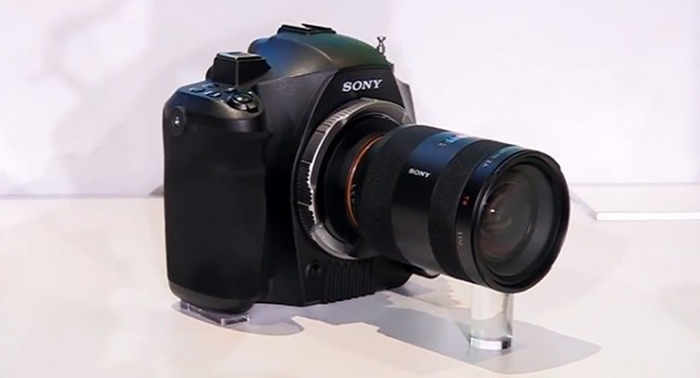
A second source added some more info about the Sony 8K camera prototype rumor we posted last week (article here):
Interesting reading about that 8k camera you said was shown at the BBC, since I probably saw the same thing.
It was in a DSLR body (I assume a99, I don’t use Sony still cameras), but it had a grip (not integrated like a D4/1Dx) not built in, so either your source was mistaken or there’s at least 2 different prototypes out there).
Nothing to add from a technical standpoint, but really but it about Sony telling us “consider moving to Sony today because in 18-24 months you’ll be wishing your team were already comfortable with it”, strongly suggesting we’d have 8k gear available for Rio 2016mi
Such a camera could be interesting for photographic use too. Instead of taking single pictures during a wildlife or model shooting you can just record 8K all the time and in post production choose the best 33 megapixel stills from a single 8K frame!
0 Responses
bye A-mount~
No interest, it’s only for pro people, even 4K is not standard yet, we need other things now, llike low entry A-mount camera, better then the A58 anyway.
16 mpx grabs???
32 mpx grabs no?
8K is currently defined as 7680×4320 so that would be 33.1776 megapixels
Yeah, 32 as aproximation, but you are right.
Admin, if the sensor is a global shutter one, it will allow you to get 32 mpx stills, other than that for wildlife with fast action it will introce some video artifacts and this will probably jpegs.
It’s wildly unlikely. An 8K FF sensor would require 4 times the resolution of the A7S (as it has 4 times the pixels) if it is to be capable of full sampling, rather than using interpolation. So that’s a 48MP pixel sensor, or thereabouts. That, in itself, is not a major problem. However, what will be is the required data rate. To produce 8K video without “line skipping” and interpolation, it would need to read data off the sensor chip at four times the rate of the A7S. Such a high rate, even if it could be achieved, would cause extremely serious heat issues.
Then, if the idea that the same principle could be used across the entire 4:3 aspect ratio sensor, it gets worse again as that would add another 30% or so to the data rate. So that’s now 5 x the data rate of the A7S. Remember this is at 30fps (above that frame rate, the A7S has to “line skip”).
Also, even if all this could be achieved, then you can expect serious problems with rolling shutter, so pick your subjects wisely.
You also have to ask, where is the market for 8K in this sort of camera? Even 4K is a rarity in this market, and there’s precious little in the way of software support for 8K. At least in the sort of market a camera like this would be aimed at.
When 8K comes out, I expect to see it in professional video cameras aimed at the feature film industry and the like, not a prosumer camera.
(One thing to note is that a 48MP FF sensor would hold out the hope for 4K video without having to use colour sub-sampling. However, the issues over sensor read data rate would be just the same).
Of course, it’s pure BS. But in 2016, nobody will remember this “rumor”, so everything is fine I guess.
Before I would expect them to go down this rabbit hole I would expect them to produce a foven type sensor for 4K which would be an improvement in resolution and more useful than 8K.
I doubt we’ll see a Foveon sensor as such. Whilst it is very good at avoiding some colur artifacts produced by the the filter matrix on a “traditional” sensor, it has a major shortcoming. The problem is that colour separation between the layers is poor which means there’s a lot of “pollution” between the channels. In consequence, a great deal of potential colour differentiation is lost and aggressive processing has to be done to restore the separation through common-mode rejection. What this means is that when, for instance, the amount of blue light increases markedly it will also cause a substantial increase in the signals on the red and, especially, the green channel. This can be compensated for, but only at the cost of greatly increased noise at higher ISOs, especially in the blue channel.
Unfortunately these issues are inherent as, basically, the Foveon sensor relies on the greater penetration of longer (red end) photons vs the shorter (blue end ones). However, this is a statistical distribution, not one of “hard” boundaries. “Traditional” bayer (and other) pattern sensors also have spectral overlap between channels, but it can be carefully optimised by use of appropriate filter dyes and density. This can’t be done with Foveon.
However, this doesn’t mean that there aren’t other potential designs around for “stacked” sensors (there are some patents), but so far no company has been able to come up with a workable one. If/when they do, it will sweep the market and other companies will have to licence it. However, this is not the case with Foveon. It’s inherent shortcomings probably means it will never become ubiquitous.
OK.
Two hot (cold?) shoes and an antenna! Who cares about 8K?
I have a pair of old shoes that I no longer wear, I can send them to you if you need.
They are a bit cold during the winter, but not too bad
I have many shoes (footwear) and they are all warm and comfortable. Hotshoe and Coldshoe are photography related. Google it.
In the gizmo shown, they both appear to be made of metal.
You must be fun at parties 😐
Did you buy the 10-18 f/4 OSS (blitzangebot) using the recent link from the Admin?
I did.
I like oranges too.
I thought it is clear I am trying to make a joke
This is normal for video camera, a hot shoe for the Sony special items, the cold shoe to hold other things like viewfinders/microphones, The antenna is a distance marker. Your camera probably has a line on the body showing the sensor location, pro video cameras sometimes have antenna like things that a measuring tape can be attached to. This is an old prototype seen for a few years at shows.
Something the RX1 could have used.
Live view, EVF and such obviate the need for markers, one would think.
33mp, not 16. 7680×4320
This.
It will be considerably higher on an FF as that has a 3:2 aspect ratio whilst an 8K frame is 16:9. Further, just as there’s a cinematic 4K, which is “wider” than the TV version there are other versions of 8K (like 8192 × 4320 or even 10080 × 4320).
However, there’s an easier way to do the calculation. The A7S is an FF camera optimised for 4K, so one optimised for 8K will presumably be approximately four times the number of pixels of the A7S.
Andrea,
Speaking of future Sony cameras in development….any info on the new 4k RX20 yet? I’ll be happy with even just an SR1 tidbit right now. 🙁
Also any info on RX100M4 and possibly A5500/6500 with 4K and Sony Z3X smartphone with 1″ sensor? Or I will have to switch to Panasonic LX100 and CM1?
4K is like HD, a stop gap to 8K (FHD).
8K is like 4K, a stop gap to 16k (FHD).
16K is like 8K, a stop gap to 32K (FHD).
32K is like 16K, a stop gap to 64K (FHD).
64K is like 32K, a stop gap to 128K (FHD).
128k is like 64k, a stop gap to INFINITE resolution. Ok, you can’t continue now.
To sum up: after the Megapixel Race and the High ISO Race, the next race will be High Resolution Video Race.
Unlike the MP race, video has to be to some kind of standard due to distribution, it normally makes leaps in big-ish jumps.
Well, I understand nothing about video or broadcasting, but my guess is that ONE of the reasons they are rushing the Resolution Race is to make today’s recordings more ‘future proof’.
So, within, maybe, 10 years, when 4k monitors and TVs are a common thing, we won’t be stuck with an ugly ‘low rez’ recording.
(like when you try to watch a DVD on a Full HD display)
you forgot the (F**KHD)
My Commodore had 128K back in 80s.
Errr yeah maybe, eventually bit probably not. 4K is ~8MP, 8K ~32MP, 16K is ~128MP, 32K ~512MP. Broadcasters and technology are already aiming for 8Kand 4K standards, with 8K being the ‘superior’ format and 4K being the in between. Yes eventually maybe, but higher resolutions have been around a LONG time before 1080 was ‘replaced’ and still hasn’t been. But 8K is more likely to be replaced by a completely different shift than 16K or 32K.
Only one problem with that… Local cable doesn’t even have the bandwidth to give me all the channels they send out in 1080p, a good number are 720 and only a few really are 1080… So if they went to 4K just how many channels would they be delivering? Very few, the only folks that want to push this are movie studios because they know it will make copying and distributing their content much more difficult and force you back to the movie theater for the best quality. But in the end does anyone really care? I don’t see 4K TV sets flying off the walls.
People said the same thing about 1080p in that most broadcast is 720, but it’s still pretty rare to find a 720 TV these days.
yes… but even more annoying is that many of the 720 shows they broadcast actually look better on my older 720 TV than on the 1080… for some reason once you start showing lower end content than your TV was made for the quality starts to suffer beyond the simple drop you would expect from going 1080 to 720.
NES never looked better than on a big ol’ tube TV from the 80’s.
There are no credible rumors for beginning of 2015 but are on 2016 !?
Admin, you shared a video some months ago (NAB2014) about a Sony rep telling the interviewer that they cancelled the project and they decided to offer the a7S instead.
The idea is that production teams should buy cameras because they will be obsolete? Do this so you can get used to the camera? Um, ok.
A 1080p or 4K with global shutter and full sensor readout would be far more useful and interesting.
Amen
Don’t forget that you would need very high FPS, or many frames will be blurry !
If you watch a cinema movie frame by frame, it gets often very blurry,
it is actually required in order to have smooth motion.
exactly my thoughts!
minipixels.net | Automotive Photography
Well you need a high shutter speed, it already has a (relatively) high fps. Movies are shot around 1/50th of a second to provide natural blur.
4k,8k,16k …1080p is good enough even 720p what’s good in a higher resolution…
hmm…. 1080p in a movie theater eh?
Such a thing will happen…eventually…but this won’t be it!
Also, I will say it again, the real issue now is not resolution, it is data handling and storage. When you get to 8k the problems become mammoth, whether that is even within the camera (a lot of power to run the powerful processing, the heat produced, and the humongous memory card!), or every stage from then on.
Imagine trying to store your 250, 500, 1000gb (and beyond) video clips on the cloud…
Oh, and as to picking still frames out, it’s hard enough going through 1,000 shots from a big wedding. To sift through 8 or 10 hours worth to get the good pictures is the stuff of nightmares, let alone that video is an entirely different discipline, so the end result would not be ideal and always landscape (unless you’re the average Youtuber with a mobile phone who doesn’t ever remember to turn the damn thing through 90′!)
Let’s do some math(s)!
At an event I might shoot 1000 50MB RAW shots. = 50GB total
If I switch to pressing record and taking a 10 second 4K video, (100Mbps x 10 sec = 125MB clip). 1000 clips would be 125GB. More, but not much more
But if my 10 second clip replaces my rattling off just 3 RAW images click-click-click, then I’m only shooting 333 clips = 42GB = Less!
Ok, it may not be fair to compare RAW with compressed video, in terms of file quality. But my point is, if you once shot 1000 images, you might now shoot 333 clips, which would be a very manageable 42GB.
So 4K would be manageable file volumes with today’s workflow.
8K would come in, lets assume x4 the file size, at 168GB for those 333 clips. Three 64GB SDXC cards would do.
And this assumes no improvement in video codecs, i.e. 4K @100Mbps, 8K @400Mbps. We’ve just seen H.265 on the first consumer video capable camera from Samsung. This could cut data rates to 20-25% current size, for the same quality. Put another way, 4K files the size of today’s 1080p files.
Nobody who takes high quality still photos is going to be happy with the inevitably heavily compressed video frames, especially if you are shooting RAW. For that matter, why on earth are you comparing RAW with compressed video anyway? The correct comparison is with JPEGs (and then at the higher camera compression rates).
Frame captures will also exhibit horrible rolling shutter artefacts on some subjects unless, magically, they manage to implement a global shutter on top of quadrupling the data rates of an A7S.
Of course, a movie file will still be much smaller than the equivalent number of JPEGs, as it can make use of inter-frame compression mechanisms, but then you end up shooting even more frames that you have to wade through to pick the optimal one. This sort of machine-gun photography might mean you don’t miss a moment, but you’ll spend a great deal longer working through them until you find the optimal one.
I’m no expert, but I think your figures are off.
Using a calcualtor available on-line (http://www.hdslr-cinema.com/tools/) it shows the 10000 seconds of video you mention to be 1.3TB! Pretty much what I would expect.
Take that to 8k and it gets a whole lot worse.
As to video codecs, certainly improvements will come, but whether that will be at acceptable quality is open to debate. Indeed, people still argue over the losses caused through Jpeg.
I’m not saying it can’t be addressed, but to repeat myself for the zillionth time, the issue is storing and handling such quantities of data. When we can download or upload a 3 hour movie in about ten seconds I’ll change my tune.
=32mp stills from 8k video! ..we are not ready I am still saving for a 512mb SD card
lol 512Mb, is that even half a second of 8K video?
Stared at a Samsung 4k 50in this week- I’m impressed. Can 8K really offer anything over 4K? Doesn’t the law of diminishing returns apply here.
Even with a 50 inch 4K unit you are going to have to sit within about 8 feet to perceive any difference (for 20:20 vision). That’s at the limit of visual acuity (some can do a bit better than 20/20, but even then, how closely do people look at moving images?).
With 8K, you’d need a simply enormous screen (or site ridiculously close).
However, that’s not the full story. It’s often highly desirable to capture things like images or sound at higher resolution than they will be viewed. That allows much more latitude in post-processing. In image processing, it might simply be the ability to crop. However, there’s a multitude of other grading and processing that can be done, and higher resolution files are much more tolerant of being bashed about that way than those taken at the final output resolution.
Audio studios have been at this for a long time. There’s plenty of reason to capture sound using over-sampling and greater bit depths. However, when it comes to listening to them CD quality exceeds the capability of the human ear. (The reason some CDs sound awful is because of poor capture or bad production in the studio, not because of shortcomings in the media). The same is will be true for 4K video. Unless you can afford a 3 metre screen and sit not much more than 2 metres from it, you’ll see no benefit (and even then, it will be marginal).
Understood. I see a very noticeable difference with 4k and the cost on large screens are coming down already. I definitely plan on getting into 4k recording, but not until next year. No sense until I have the screen.
This is exactly why Gone Girl was shot at 6K.
“But we capture everything in 6K, frame for 5K with a 2.40 frame line,” he explains. “This gives us extra room to stabilize and reposition should we need to, and then we down-res it for the 4K and 2K releases.” – Jeff Cronenweth, ASC, who lensed Fight Club, The Social Network and The Girl with the Dragon Tattoo.
http://www.hdvideopro.com/film-and-tv/feature-films/where-is-she.html#.VFPEdVZBm2R
The reason most filmmakers shoot at these high res (4K 8K) is for the post production benefits (cropping, stabilising, smooth moves, all without loss of detail). After which they output usually in 2K. The majority of folks these days still watch at 1080p or less so no point outputting even in 4K for the moment.
FOOLS
Well, finally there will be a proper replacement for Super 35mm motion picture film (estimated to have an equivalent resolution of 8 to 10k). In some ways, digital cinema was a step back. Shortsighted filmmakers like George Lucas have probably come to regret originating big budget productions (such as “Attack of the Clones”) at a paltry 2k resolution for the minor inconvenience of having to telecine. Though perhaps some movies do not deserve good archivability and are best left forgotten…
The best Super 35mm film has a maximum resolution of 3K and 13 DR stops (KODAK VISION3). All 4K cameras already surpass film in resolution terms, but not all in DR front. The big IMAX film format may be in that equivalent 6-8K territory though.
I’ve heard 3.5k for pristine 35 and 9 to 10k for Imax.
I’ve personalty scanned films and although I’m a big fan of the film look, resolution wise it’s not very great. I may be wrong about the big IMAX films, bit super 35mm certainly does’t resolve more than a real 3K resolution (don’t get me wrong, native 3K cameras actually resolve a 2K resolution).
8K equals 33 Mpixels, not 16.
It’s in everyone’s best interest to stock up on whatever they like. A-mount, E-mount or other brands. Because in the next 5 years, the industry will go through transition. If you chase it, you’ll waste a lot of money. We dont know what will come out on top…Mirrorless….DSLR….SLT…who knows. And there wont be significantly better cameras until the sensors go through a revolution to something different.
I’m buying a bunch of A-mount stuff for redundancy and I plan on using it for 5-6 years so I can see where the industry goes and then buy into whatever stable mount/company exists then.
But .. will it fit in my pocket?
Re: shooting 8K (or any resolution video, really) instead of shooting stills.
We (creative studio in Chicago) deal with a lot of frame pulls from Arris/Reds, etc. The resolution is not the limiting factor, the shutter speeds are. If you’re looking at a 180º shutter that equates to 1/48 shutter speeds per frame. Motion blur is a big issue. Simply not feasible, especially for sports.
You simply increase shutter speed and in essence take the video with the purpose of extracting stills. It’s like getting a still camera with insanely high frame rate.
Also, there are already use cases online where pro’s have tried out extracting stills from 4k video. It works. Well.
Still extraction from video works very well! 8K will be more than enough for almost any application, video or still related.
That’s only feasible with a global shutter with moving subjects or else it will be prone to horrible rolling shutter artifacts. So add that to the need to achieve several times the data rate of the A7S.
Also, on those few CMOS sensors where a global shutter is available, compromises are required on dynamic range as more of the silicon space has to be given over to a temporary store,
But then the video itself starts to look bad, becoming choppy and losing the smooth motion blur that adds to the cinematic look.
Here’s a great video (at the bottom) demonstrating the effect. http://luispower2013.wordpress.com/2013/03/12/the-180-degree-rule/
For motion work, motion blur is generally desirable because it improves the final product. And the opposite is generally true for stills.
As I mentioned above, we have dealt with pros pulling frames from those cameras. Regularly. On national campaigns. For print work the results are, at best, passable. I’m not saying we won’t get there, and I’m not saying it won’t be soon. I’m just saying that it’s not the panacea that people tend to think it is.
I misunderstood your point at first, so feel free to disregard my previous reply to you. You’re right, if you used this wight he purpose of ONLY pulling stills, you could use higher shutter speeds at the expense of video quality.
My response was colored by our experience, which was clients to save money by shooting only once with the intent of using the media for both broadcast and print.
You need high frame rate (slow motion) or a short shutter angle, or a combination of both to deal with the motion blur. 120 FPS (180º shutter) is 1/240 of a second. A 45º shutter is 1/192 of a second. 240 FPS with a 45º shutter is 1/960.
I understand. Generally, though, higher frame rates come at the cost of lower resolutions, defeating the purpose of shooting 8k video to begin with. Sure, I could shoot 2k or 1080P at 120FPS, but 1/240 is still too slow for fast-moving sports, and at that point the resolution wouldn’t justify shooting video to begin with. It’s a tradeoff. I’m working off the assumption that, at most, 8K will be at 60P. And I could be very wrong, we’ll see when (if) this thing ships.
People talk about the Magazine Covers shot with RED cameras http://www.red.com/shot-on-red/photography Most of these are Video for Stills shoots, not Broadcast Television. This has Little or Nothing to do with Real World situations.
There is a lot of HYPE involved with selling people thins they don’t need. Rumor sites do Hype in overdrive 😉
Right, see my reply below. It comes down to assumptions. My experience has been clients trying to save money by shooting for video AND print simultaneously, which doesn’t work. Using one of these with a high shutter speed solely for the purpose of print is definitely feasible. My focus was narrow and I failed to specify that initially.
Sebastian , I think that it depends very much on the intended use
http://mirrorlessphototips.com/making-a-60-inch-print-from-a-lumix-gh4/
Gee, it looks like a NON-Moving posed shot. Let’s see the same size print of a FAST Moving Athlete. Or a FAST Moving Child.
Is that one of those supersonic kids that retards say are too fast for their cameras
Well that would depend on your frame rate you’re shooting at.
Good point though. Another issue in still pulls from video in shooting sports and action could be rolling shutter…
Where is the coming soon E-mount rumors?
sorry e-mount is dead. viva a-mount lol
Wasn’t there something mentioned here about something for early 2015? Will we be hearing about that soon?
Admin,
Isn’t a 8K frame 30MP+ instead of 16MP?
10080 × 4320(21:9)(43.5) megapixels8192 × 4320~(17:9)(35.4) megapixels7680 × 4320(16:9)(33.2) megapixels8192 × 5120(16:10)(41.9) megapixels8192 × 8192(1:1)(67.1) megapixels
You are right, 8K is abut 33 Mpixels.
well 8K its ridicously, not human will ever be able to resolve that kind of resolution at any size screen or distance view, manufacters are pushing it, high ppi screens, like in cell phones, because then people can see dead pixels, so they can sell all glass they produce with many dead pixels that people cant see.
by the way, those thinking about 32K, thats just imposible, a full frame sensor will never had this resolution, it would need pixel smaller that the wave length of ligth, also 16K should have in a full frame sensor pixels the size of nikon CX sensor, yeah, the system mirrorless system with less resolving power of all, with 16K difraction will limit resolution at 4K levels, 16K and 32K will never happend, 8K should not happend but it will.
“Nothing is impossible but”, “Never say never”, Full Frame is a step, Medium Format and Big Format exists and 32k in medium format is achivable.
But i think that more than 8k will be only for specialties. 8k standard will have rec 2020 space thats not the complete color spcetrum, so theres space for a new tech that will achieve it.
“Nothing is impossible”, “Never say never”, Full Frame is a step, Medium Format and Big Format exists and 32k in medium format is achivable.
But i think that more than 8k will be only for specialties. 8k standard will have rec 2020 space thats not the complete color spcetrum, so theres space for a new tech that will achieve it.
For TV larger than 65 inch 8K is recommended. An 84 inch 4K is nice but the pixels are too big. The future of big TV-s is clearly 8K!
Here we go. Another Einstein predicting yet another “the future of” nonsense. Yaaaaaawn. Come on, let hear the other buzzwords/phrases. “Innovative” anyone?
What a stupid comment!
Using worn out phrases and buzzwords is stupid.
Stop polluting the net with your nonsense!
You think I didn’t recognize you, you are the same person who infests all the rumor sites with nonsense!
Yep! There’s only one person does all this “infesting”. Me lol!
I think you have that the wrong way round for normal human vision at normal viewing distance 4k has no visible advantage under 65″. So just to have any advantage from 4K you need a 65″ upwards screen .
To visually be aware of the pixels being “too big ” on an 85″ screen you would need to be standing immediately in front of the screen holding a magnifying glass . Or alternately you could be Superman and have way beyond normal human vision.
http://s3.carltonbale.com/resolution_chart.png
The link below includes a viewing distance calculator :
http://referencehometheater.com/2013/commentary/4k-calculator/
Those are only charts, I personally use an 49 inch 4K TV as a PC monitor and it’s great! Over 55 inches even a 4K TV you can see pixels. Both LG and sharp already showed 8K TV prototypes. 8K is great for larger screens because you don’t see the pixels pixels and there is no problem watching lower resolution content on them. I agree that not everybody wants or needs a large screen, but I for instance do!
The theory that you don’t see a difference between a FHD screen and a 4K one from a certain distance is a lie, there is a distinct image from a 4K TV with a 4K content on it, the colors just come to life so much better than on FHD TV with a FHD film running on it. This is from real life observation, not charts.
You may well see a difference in color contrast or whatever but it is physically humanly impossible to detect a difference in resolving power once you move to a certain distance. Ironically enough nobody knows , knows a lot more about it than you.
Your statements are borderline retarded “Those are only charts” charts based on normal human vision. Even if you were in the small group of humans with the best possible vision you need to be within 5 feet of a 55″ display to get the full benefit of 4k. 8k TV for normal home use is idiotic to gain the full benefit of an 8K TV you need to be standing 6 feet from a 200inch display. You cannot cheat this human vision even the most elite level of human vision can only resolve so much
Heck even my clients which don’t really understand the differences between 4K, FD etc always prefer the 4K TV with 4K material instead of a FHD TV with FHD material viewed from a 3 m distance. I don’t care about your charts real life tells another story. Go get yourself a good 4K TV and then we can discus some more.
” those thinking about 32K, thats just impossible, a full frame sensor will never had this resolution, it would need pixel smaller that the wave length of light”
Could you please explain ?
Because the Sony HX-60 has already 20 Mpix on a 1/2,3″ sensor ! Which, with the same pixel density, represent more than 600 Mpx on a sensor full-frame sized.
See this article (in french, but no need to translate the charts) : http://www.lesnumeriques.com/50-mpx-60-mpx-65-mpx-pour-2015-qui-dit-mieux-n36266.html
Is this a joke? Sony cant make a66 or sony a99 mk2. Sony doesnt have even a 4k camera. Soby does not have lens.
Listen to me you skeptics, If you would have experience with 8×10 camera then you will understand what resolution aka detail in image is all about. Since you are shooting with small fingernail size sensors I am NOT surprised very much about your blindness.
Camera manufactures are simply catching-up with new technology what was introduced in film a century ago …
P.s. You can take donkey to University of Sorbonne, you will never come back home with horse.
There is nothing wrong with using technology to catch up.
The first car could only go at 10km/h compared to a horse that could do 50hm/h.
Does that mean we should not of pursued with cars?
With advance in technology in the distant future, you might be able to get a fingernail size sensor with more resolution than 8X10 film.
why is it so BIGGGG….
I wouldn’t be surprised if the next wave in home theatres is VR–the Samsung device coming out by the end of the year is just the opening shot. If fanboys and cineastes start watching movies through those devices on planes, in bed, etc. then 8k or even higher rez down the line would be a spectacular way to go.
Let´s jump 4K and wait for 8K instead…. 😀
Rubbish! This is a very false story and has no basis in fact. Sony has absolutely no professional much less prosumer hybrid camera or even $200,000 cinema camera that can shoot 8K video. In fact there is no industry standard for storing, transferring or displaying 8K video content. To give you an idea of the bandwidth and computing power required for 8K digital cinema, you would require 71.66 Gbits/s to transfer RAW 36bit (RGB) 8K video. Even at 10bit per pixel color, you would still require close to 50 Gbits/sec. There is no current or in-design-stage display cable that can even handle RGB 8K video connection from computer to monitor.
The only company that has 8K capture and display hardware is Japan’s NHK and they design/contract out their custom cameras, links and display hardware themselves since there are no off-the-shelf parts that handle 8K.
Red is doing 6K right now, why would 8k be such a fantasy in two years?
On another parallel note. The 6K Red is a very expensive camera only deep pocketed filmmakers or studios can afford. I’d be very surprised if Sony offers a 8K camera at the price point of the current a99 model. I’m speculating that this 8K sony will be much in line with the price of the Canon 1DC.
I would be surprised too if the price point at under 5 figures. The quote did not mention pricing though – only form factor (probably based on the random prototype from NAB 2013). This could simply be the successor to the F55, which is in the same pricing bracket as the RED camera.
Except this lying Admin’s post is not about an F55 class cinema camera that costs over $50K but a supposed 8K *Alpha* DSLR style consumer/prosumer camera.
Christopher, do you realize that 6K is much less bandwidth than 8K? 8K video is ~ 32 Megapixels per frame. 4K is “only” 8 megapixels and 5K (like new Apple retina iMac) is “only” ~ 15 megapixels. To put it in perspective, a 100% displayed 12 megapixel still image from the Sony A7s only fills up 3/4qtrs of the 5K screen of an Apple retina iMac and about a quarter of a hypothetical 8K monitor.
I repeat that there is absolutely no off-the-shelf available consumer or professional hardware to record RAW 8K video, absolutely no standard monitor cables to connect RGB 8K display to a computer or multimedia device and definitely no video card in existence that would support it. How could SONY be planning to sell consumer/prosumer 8K camera when the customers have absolutely no way to record or display it?
The only end-to-end 8K capture,process and display system that even exists is in the hands of Japan’s NHK and it only exists because NHK designed them itself and contracted out the manufacture of these custom hardware in order to get experience with 8K end-to-end and come up with technical specifications and proposals that can become standards to help the industry slowly move to 8K in the next ten years.
And here is Admin lying about SONY having a *consumer* 8K DSLR when they don’t even have a single large sensor consumer still/video camera that can even record highly compressed 4K video. The much touted Sony A7s is a very low resolution still camera that cannot even record (ie, compress and stream out) 4K video and has to rely on a $2K outboard device to record the highly chroma sampled 4K video from its last generation HDMI 1.4 port.
On the other hand, Samsung & Panasonic have multiple large sensor based still/video cameras that can compress and record Ultra HD and Academy 4K (Samsung) video straight to the internal SD cards of their cameras. Sony has absolutely none! And you’re now talking about SONY having products that can record 8K?? BS!
And btw, the planned compression codec for 8K is HEVC H.265 and only Samsung has a camera that records in that next generation codec – the amazing NX1 .
Sony has absolutely no camera, consumer, prosumer, professional or commercial that supports H.265.
The interesting thing about the camera body in this photo is the unusual looking lens mount. Could this be the long-rumored “universal” A- and E-mount camera?
This is going to be huge for action and sports photography. Imagine just taking a video of the moment and pulling it out on stills. (considering you can track and keep it in focus)
I’m speculating this is going to be a high end camera at the price point of – at the very least – the Canon 1DC. I don’t think Sony is going to release an 8K camera at the price point of the current a99, it simply does not make business sense. 8K will be in their high end cinema camera line first before trickling down to the consumer models.