







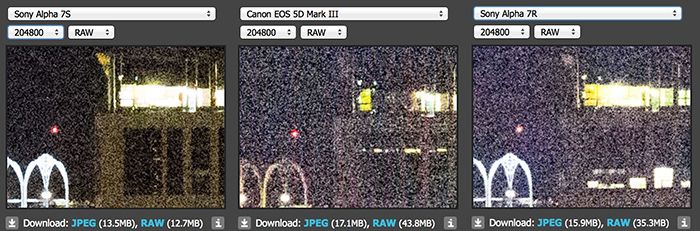
Dpreview (Click here) posted a Sony A7S vs. A7R vs. Canon EOS 5D III shootout. Their conclusions are:
– At ISO 204,800 and beyond the A7s has up to a 2 EV advantage
– At Moderately high ISO performance the A7s has up to a 1 EV advantage in shadows
– No difference between the cameras at low ISO.
At the end their conclusion is:
The Sony A7S enables the use of incredibly high ISOs, including some unavailable to most cameras. When shooting at incredibly low light levels, the A7S will most likely give you significantly better results than any camera that does not natively shoot at these ISOs. There are also some advantages to be had over the higher native ISOs of the cameras we tested: we see the A7S overtake the A7R in normalized shadow noise performance at ISOs above 6400 in our tests. At more moderately high ISOs (6400 and below) as well as in brighter regions of images – where image quality is determined primarily by how much total light is captured – the normalized ISO performance of the A7S will be similar to that of full-frame cameras of its generation.
The A7s manual can be downloaded at support.sony-asia.com.edgesuite.net/consumer/IM/4537940111.pdf.
Sony A7s preorder in USA/CA at Amazon, Adorama, BHphoto, Sony USA, Sony Canada.
Sony A7s EU pages: Sony DE, UK, ES, FR, IT, NL, BE, AT, CH, SE, NO, FI, PL. And Wex UK.
0 Responses
1st blood!
Still the idiot.
y so much hate
Are you his mother?
don’t think, so. But the tw@t here is you
Aww daddy is here too to defend his “special” son.
i forgive you, you failed in your religion. may Jesus bless your entire life.
Just stop being a tw@t with this first idiocy. It’s lame.
Wahhh … Troll.. :S
Well, then. According to this…1 stop difference between downsampled a7r and a7s as far as I can see.
well, I would say a tiny stop then, in native resolution we get about just under 2 stops difference. 7S performs at 12500 iso about the same as 7R at 3200 iso, but just for iso sensitivity, resolution can here be discussed once more, and both cameras start noising at 3200 ISO anway. The question is how far can we go with good noise rework software. I could clean 7S pictures up to 80000 ISO without any problem ending by an IQ similar to my old 5 mpix Coolpix. Is that what we look and pay 2500$ for. I leave to anyone to decide that himself. For some works, the camera is real great, but not for all, in many works I definitely seek a better resolution. So, one more big step forward in sensitivity and one big step back in time in resolution. I do no video, so for me it makes not much sense in some way.
lol at the same output size/ detail and noise level the A7r and A7s are almost identical at 12800 ISO . The extra detail of the A7r allows for a lot more flexibility in NR/processing
Not in the shadows, as can clearly be seen in the comparision you show.
The difference between the shots is microscopic way under half a stop and nowhere near the two stops suggested by Shamael.These are 100% crops and there is no print size or display of the { full image } that would possibly show such a small difference. Only the overly optimistic Sony fanboy could claim such a ridiculous 2 stop advantage at this ISO.
Well, my comment was only directed at your answer. I will not argue how many stops difference it is, just that it is a visiable difference in the shadows that is not microscopic.
If your exemple photo is just a small crop and not the full image then the differences as you say may be difficult to spot in an ordinary size print.
However with a scene where the shadow areas are dominating the whole picture, typically when high ISO is needed, the differences will be clearly visiable even in small prints.
On the other hand the well lit parts in the photo exemple look a tiny bit better with the A7R because of its resolution advantage.
This is in line with other test comparisions with high versus low resolution sensors. A test with a Nikon D3s/DF with 16 MP versus Nikon D800/E with 36 MP would give a similar result.
No, the A7S at ISO 12,800 most certainly is *not* the same as the A7R at ISO 3200. See attached image. You can’t give a camera 4x less light and then expect it to perform just as well as the camera that received 4x more light. Unless the sensors are *drastically* different in terms of efficiency/performance.
The interesting thing that a bench test won’t relieve is “how far” you can take each file in post before it falls apart and banding appears. On my 5D3’s banding in the shadows was a PITA, on the A7R it’s better by at least 2 stops. “IF” on the A7S we get another two stops of “banding free” leeway when pushing in post then this is huge for high speed B&W work.
True. Well said.
How meaningless is that ?
Comparing the high level settings of the A7S with cameras not natively shooting these levels by modifying competitors images downsampled and recalculated with an algorithm no one can exactly reconstruct and judging it afterwards.
Secondly – is just my impression, or do the comparable images look like being exposed slightly different?
+1
Very meaningful… people who know how sensors work know exactly what to do. Nothing new here.
You just mentioned 1% of community from websites like this or dPreview. Remaining 99% will use it for nothing else than a bargaining rights / trolling.
Some cameras are slightly more sensitive than others at the same physical exposure settings.
I’ve looked through the results and in my opinion there is very little difference between all 3 cameras at ISO 6400 and below.
I think they should also add images that are up sampled to A7R resolution for a fair comparison.
Doesn’t make sense to up-sample… if you need 36MPs up-sampling a 12MP image doesn’t serve any purpose. If 12MPs is all you need, down-ressing the 36MP shot evens the playing field for the a7r in a fair way.
When you down sample, you are throwing away data. That does not make a fair comparison. You can clearly see more detail in the full A7R images than the down sampled 12MP versions.
No… you’re comparing it to a 12MP sensor image because you can live with 12MPs. It’s no secret that a 36MP sensor is capable of more resolution than a 12MP one. What’s there to keep side by side and see?
If it’s just the maximum resolution you want to compare, then compare at the base ISO.
No I want to compare them at 36mp and I want to compare them at higher ISO. When you upsample 12mp to 36mp you don’t throw anything away but the converse is not true. Therefore it’s a fairer comparison.
You can certainly compare that way but they look so different why bother comparing.
How about a video quality comparison between the three?
I can’t really see the point of the Sony A7s except for lab experiments. Sony makes too many sensors and randomly puts them in mismatched bodies. The low pixel count cameras with full-frame sensors are made for a a reason. They have very fast autofocus, very high frame rate, large buffers, etc. Sony A7s doesn’t have those. For video, at this pixel count it should have a global shutter or inbuilt 4K recording but it does not.
well do i see the point, 12 megapixel sensor allow you to shoot 4k without have to crop and in the end sacrifice the sensor area. And the lowcount megapixel allow the sensor to do full read out in full hd video without generating too much heat, which other DSLR fullframe/aps-c sensor do fullreadout today? I am still waiting for the review and I hope it’s crispy as it gets when downsampling from 4k footage.
60 frame raw buffer, faster focus in low light. Why ‘should it’ have 4K recording on board? Why ‘should it’ have a global shutter?
5fps with a clicketty clack shutter in the continuous shoot mode. You said you have tried it. You should know better. 🙂
Do you mean the completely silent shutter? Or the better damped EFCS shutter?
Both are not applicable in the continuous shooting mode, AFAIK. The mechanical shutter clacks twice just like in the A7r or the A7.
Still don’t understand why everyone is all up in arms about this shutter. My FM2 and F3T had way louder shutters and no one ever gave me crap at a wedding… and that was back when I might have been one of 4 or 5 SLR cameras at a wedding. Today EVERYONE brings their damn camera and the shutter sound is rarely coming from MINE. No one cares about the shutter. Even street photographers know it’s simply no big deal. And if you need that kind of discretion then you really aren’t moving and the silent shutter suffices just fine. OR you’re using it in video and picking the 8mp image out of the frame pile later.
My F2 was even louder! The point is did it (vibrations) affect results?
Handheld, no, much like the A7r. But I can guarantee that there were tripod images that the answer was yes, from time to time. We used to show people how badly shutter vibration could be seen by setting self timers on various film cameras, setting them on the counter top, and seeing which whole cameras moved more when the shutter fired. No one talked about shutter vibration affecting images much because you got a new sensor everytime the film moved. However I can state with a pretty celestial amount of certainty that there were plenty of film cameras in which the shutter caused vibration.
Also the ECFS can be active in continuous on both the A7s and A7 so there is still less fear for people who believe in ghosts that can’t somehow be deleted, that the image may be affected.
Yes, I checked on the A7 and the EFCS is still active in the continuos (unlike the NEX models). Clarification is appreciated and is substantiated as well. 🙂
I wasn’t going to lie about that, mate.
To put a global shutter on a CMOS sensor would, whatever the number of pixels, inevitably degrade the image quality as it requires more of the silicon surface to be devoted to storing the temporary charge which would rather negate the aim of optimising video low-light performance.
Stop bringing reason to this website. It’s against the rules.
Well, well, well…A7r + A7 + GH4 (for 4k). 🙂
http://www.43rumors.com/ft4-gh4-firmware-upgrade-will-add-gamma-log-and-dave-dugdale-leaves-canon-for-the-gh4/
The GH-4 will get even a boost via FW update!
With its puny sensor I will pass.
You display the sensor or the results? 😉
Physics state that no matter what you do to that M4:3 sensor it will never touch what the A7s sensor can do. There are no algorithms that can fake 4.5x the surface area in video or even 4x the surface area in stills… nor are there any algorithms that can fake the difference in pixel size and sensitivity. The GH4 will never, ever match the A7s in output. It is literally unable. That is the real world for that camera. It’s an amazing tool but people need to stop thinking it’s the holy grail that Panasonic certainly hopes you believe it to be.
If you even know how to check out the video quality of a camera. Gh4 video sucks big time. You tell blindfolded it’s from Gh4. Crisp and Shitty DR. Did you even watch the A7s 4k video by Den Lennee? The was the best video quality I’ve ever laid my eyes on, It blows Red and Alexa out of the water for a fraction of the price and size. Good luck with your career. You look like you need all that luck.
If you even know how to check out the video quality of a camera. Gh4
video sucks big time. You tell blindfolded it’s from Gh4. Crisp and crappy DR. Did you even watch the A7s 4k video by Den Lennee? The was
the best video quality I’ve ever laid my eyes on, It blows Red and Alexa
out of the water for a fraction of the price and size. Good luck with
your career. You look like you need all that luck.
Thank you for the blessings! 🙂 There is more to a camera than a sensor. 🙂
You are welcome. Is the video quality a consideration in your scheme of things?
There IS, I agree. Which is why the sensor in the A7s gets a cpu to match and which is also why the GH4 will remain at a disadvantage overall: the cpu works with what it’s given. Faking more information (though that is exactly what the GH4 does when it loses nearly a full third of its surface area to shoot @ 16:9 while also skipping and binning) than it sees will only result in flaws down the road, no matter how optimized it may seem.
Personally I can’t stand the A7s vs GH4 beef. Either you need the DR and ISO and depth of field or you don’t. That’s why both cameras can easily be on the set at the same time. They’ll each serve their purpose but in still photography the GH4 stands no chance against any of Sony’s full frame product while in video it will certainly do very well thanks to its optimization but there will come a time when contrast and lighting will make the A7s the clear winner simply due to grading and tonality.
So mature.
Your career is based on your skill, connections and luck, not on sensor size or DR.
I was waiting for that kind of test before deciding between A7s or A7r.
Regarding those results ,for someone like me oriented still images rather than video,there are little or no reasons to choose A7s over A7r .
In my esperience of shooting low light concerts , a reasonnably clean 6400 ISO coupled with a my legacy FL 1.2 55mm is all that i need and the A7R provides it at nearly the same level than the A7s with excellent crop possiblility and at a much lower price.
Better to use a 85 1.8 than use a 55 1.2 and cropping to get the same FOV.
As soon as you crop an image the noise across the frame also increases (snr drops).
Cropping with an a7r is a benefit in the low isos.
Wait what? By what mechanism does the SNR drop because you crop the image?
The same way an APS-C sensor has a lower overall snr.
Surely you don’t think people made long lenses just for bragging rights? 🙂
An APS-C sensor has a lower SNR because there are more pixels in a smaller place and you lose more of your photons to the support geometry on the sensor. Cropping the result of a frame doesn’t change the SNR it changes the amount of information recorded.
You’re not comparing correctly. A 55/1.2 lens on FF cropped to get a 85 FOV is as good as a 55/1.2 on APS-C.
You have talked about a few different concepts here. If you use the centre crop of an image circle via post cropping or cropping with a smaller sensor you get the same result which was exactly my point. Cropping doesn’t change the SNR it changes the signal and the noise in unison. You get the same SNR if you look at one pixel or all the pixels. Sensors with lower pixel counts tend to have better SNR figures because they don’t lose as much light. Do you agree with this?
Do you think I wouldn’t know that angle? 🙂
The issue is there’s no point in comparing 100% crops. Hence the emphasis on the whole frame
Whatever you are trying to say you are not getting your point across. Sorry.
Lol… drawing at straws to find some fault are you? Do you really think I out of all people wouldn’t understand how noise works? 😀
Which part of “better to use a 85 1.8 than use a 55 1.2 and cropping to get the same FOV” do you find so difficult to understand?
Ego to spare I see (whomever you are). I disputed your statement that cropping changes the SNR.
So how many more pixels does the average 16mp APS sensor have per area compared to 36mp FF? Why are 16mp APS sensors rated below 36mp FF sensors?
It’s an interesting case because a 36MP ff and a 16MP crop have pretty similar pixel densities so the SNR per pixel will be roughly the same. A full frame sensor is going to capture more information because it has more of these similar SNR pixels. (assuming you’ve got a big enough image circle)
Cropping doesn’t, of course, change the SNR at the photosite level, but if you are comparing downsizing from a larger size to cropping, then it most certainly does make a difference.
However, that’s only if you use the same exposure setting of course. Use a 55mm 1.2 and crop vs an 85mm 1.8 (wide open) downsampled at the same shutter speed (but necessary higher ISO) and, of course, the total number of photons that went to make up the output image is roughly similar so you’d expect IQ to be similar.
Very rough-and-ready, but in many ways what matters most is the light gathering power of the lens over the area of the sensor that you will use to produce the output image. So, in dim light where shutter speed is constrained, the cropped image on a faster lens can be of similar IQ to a downsampled one from a slower, longer focal length lens because, to a large part, to use the latter requires a higher ISO for the same shutter speed.
There is a little problem in that it’s been shown that ultra-fast lenses are often not a good match to digital sensors in that they often don’t give the speed-up that’s expected. Some have put this down to fundamental issues regarding the f stop of the microlenses on the sensor.
I agree with you. I’m only debating the “As soon as you crop an image the noise across the frame also increases (snr drops).” which is categorically untrue because it is so incredibly vague.
No it’s not “better” ,you won t get the same image using a 85mm instead of a cropped 55mm. Perspective lines simply won ‘t be the same.
Not mentioning the huge gap between f1.2 and f1.8 in low light.
Firthermore , cropping is most of the time minimal as a consequence of getting an image straight or changing the ratio rather than severly cutting to isolate a interresting part of the image.
losing 15-20% of the image because of getting an ilmage straight on a 12MP sensor is not the same deal than on a 36 MP.
Perspective lines won’t be the same? ROFL
I think you’ve missed it entirely.
Perspective is not the same on a 55 and on a 85 , only facts .
Meaning i use a 55 for the framing and the perspective it produces.
Meaning also and again “better” in that context is pointless.
ROFL as you wish , and beware not hitting your head too hard.
It will be the same once 55mm image was cropped to match 85mm FOV. This is the direct consequence of the fundamental fact light linear spread
Start from the top… 55 vs what? Which format?
“No it’s not “better” ,you won t get the same image using a 85mm instead
of a cropped 55mm. Perspective lines simply won ‘t be the same.”
It’s amazing how often this particular error gets made (and there’s loads of stuff on the Internet which gets it wrong) . Perspective is fundamentally a product of the distance of the camera from the subject. It has absolutely nothing to so with focal length of the lens as such.
http://photography-on-the.net/forum/showthread.php?t=672913
The reason why a photographer might choose (say) an 85mm lens for a portrait is simply that, at a distance than gives a slightly flattering flattening effect to the facial features, a subject comes close to filling the frame thereby maximising image quality. However, if the photographer chose to use a 50mm lens from exactly the same position and crop down to the 85mm FoV, the perspective would be exactly the same. (Note that if you wanted identical DoF, you’d have to use a bigger aperture on the 50mm lens).
Of course the reason that people think that focal length controls perspective is that there’s a natural instinct to frame the image to the sensor. So if you want that 50mm lens to have a similar subject “fill factor” in the frame, you move close and that does change the perspective of course. The “big nose” effect of the WA lens is simply that the photographer is close to the subject.
All, of course, for normal lenses that are designed to respect original perspective, not fish-eyes, perspective control etc.
Thanks for the input , very instructive.Eh, we learn everyday .
Shhepish eh? Appreciate the owning up. Cheers
I agree on all accounts here except of the field of hyperfocal compression which is absolutely real and different between lenses of differing focal lengths and can in fact change the overall perspective of an image, Distance from the subject makes a difference as well but the fact remains: that background and foreground will move together or apart depending on the focal length and that will change visual perspective all day.
This is the correct answer.
You need to read that whole thread, because compression of space and the relationship of the different planes within an image (focal point, background, foreground) will render in entirely different ways with different focal lengths. These aspects are just as important to mention.
I have gone through it, and the thread does meander into other areas, like changing the distance to keep the framing of the main subject the same with different focal lengths, which will, of course, change perspective. However, that’s the point. It’s the distance that matters as far as perspective is concerned. There are also discussions on DoF and blur, but that’s not the point at issue either.
The original point at contention was that it was argued that using a crop from a WA lens will not give the same perspective (apparent relationship between objects with distance) as that from a lens with a longer focal length. That’s not true (give or take a few minor lens distortions).
Look at this from Luminous landscape, where the same subject is shot from the same distance with two different focal length lenses. They then take a crop of the wider angle to obtain the same framing as the telephoto view and the perspective is identical.
http://www.luminous-landscape.com/essays/changing-perspective.shtml
The more reviews I see about A7s vs A7r, the more I think the one biggest pro of the s over the r is the silent shutter vs bomb shutter…
That is too steep a price for that “silent shutter”. It should be common place in all usable cameras and should not be an “option”. The “largest manufacturer” of imaging sensors have a long way to go when it comes to making versatile cameras. Lot to learn from their sensor customers.
Sony made sure that it had plenty of reasons for video pros to dislike it. Remember…Sony Pro Broadcast group does not want to lose even one of their high paying customers over the A7s
Not for me. A noisy shutter sucks to be sure and shooting the a6000 withi its near silent and smooth “Snickt” (like the sound of wolverines claws), versus the very jarring a7 shutter which feels worse then mirror slap, isn’t the most salutory experience to be sure but I can deal with it if it gives me the shot.
I miss so many shots with the a7 and its abysmal low light autofocus.. Yes it it nice to have fast AF (which it doesn’t have except in opptimum light), but I can live withiout it. However dead innaccurate AF while giving me a confirmation of AF in low light is totally aweful. The EVF gains up so much you cannot even tell whether it has nailed focus so litterally you have to manually check each shot.
This is my experience of shooting a wedding with the a7 and a6000. I have shot 3 so far.
A7: Ok got the shot, check it (F*@&-sake out of focus). Reshoot. Ok got the shot, check it (F*@&-sake out of focus). Reshoot. Ok got the shot, check it.. OOF still. Reshoot. Check ok. Great! Got it! Next shot. OMFG HVL-F60M Flash overheating again!!! It just over heated.
And that literally is just shooting a few family portraits indoors at the reception.
The camera is literally useless in low light. Even if you are a manual focus user the gain up on the EVF means you will never know if you got eyes sharp until you check it. The little orange AF light does almost nothing to help the camera to lock focus and merely ruins video and alerts your subject that you are trying to take a picture. Then they move away and you have to stop them and explain why you have to retake their picture and please pose again, etc (Meanwhile Grandma with her point and shoot has actually already nailed the shot and moved on)
That is my experience. Shoot-reshoot-reshoot-reshoot-nailed it! Flash overheat (and I am talking iso 800 and higher to intentionally take it easy on flash. You like to bounce?? Do not use sony flashes!)
The camera is aweful in low light. So much so that I literally have to sell it and use the a6000 with its terrible form factor (for pro shooting that is. It is fine for general photography)
a6000 experience?: Shoot-nailed it, shoot-nailed it. Shoot -nailed it. Flash overheat.. Jesus not again. Ok, I am shooting a fast prime. Maybe I can just turn this flash off while it is overheated and shoot ambient (Nope, good as it is this sensor will not produce ambient light images of pro quality at iso 3200 and higher. It needs light.)
None the less because it can actually focus I am going to use this camera over the a7 for my professional work. All in all I have been seriorusly regretting selling my alpha system (though the pellicle ruined low light images and the flashes still overheated just the same)
The a7s promises to give me better AF in low light and THAT is the sole reason I am going to buy this camera. If it still flails I will sell out of sony line completely. I am sick of prototypes with cams that have broken AF, and “professional” flashes that are anything but pro.
I may come back when the a99 II comes out. but then It is one more goddam switch of all my glass. Why did sony need to create two mounting systems? Just so they could sell adapaters? That are useless because either they introduced a light sapping pellicale mirror with a minimum number of points AF system or the passiive one which kills the AF speed and accurancy on the alpha glass.
I just don’t know. It is 2014. We have over a 100 years of camera heritage and Sony is producing products which litterally do not work for rigourous photography. Sadly I love evf, etc. And I invested in FE glass after selling all my alpha gear.
Please a7s. Please actually be able to focus in low light and without false focus lock.
The flashes I will dump on ebay and try for thirs party. Hell 50$ youngno’s are better then this sh!te
You are really paying for the absence of line-skipping in video and everything else associated with pro-video (the modest still-set gains are simply gravy). In SLOG, with a base ISO of 3200 this could be a useful camera for a video-pro who understands “subtle” grading. We will see large gains in low-light performance “in video mode via SLOG” when video is shot & graded by a trained operator.
For a multi-media pro who shoots video & stills in difficult/low/challenging light the A7S is the better camera.
S-Log recorded to a 10k it codec works nicely. There is plenty of steps to work with when is stretched back out to a ‘normal’ grade. However, doing t house that in the 8bit it world? Yikes….that’s a bit sketchy. When you curve it back and add the contrast back in…be read for color banding.
It’s pretty well what you’d expect from the DxOmark DR results. At equalised output size, not significant difference until you get to 6400 and beyond. However, by the time you get to 12,800 and above, the image quality is degraded so that the range of uses you can put the images to is limited. Fair enough for some specialist uses where it’s more important to get an image than the quality (such as reporters?), but probably not much use for things like wedding photos in gloomy churches where you might not want to go above even 1600. In that case, there seems little advantage to the A7S.
The real advantage of the A7S is for video. It can’t be stated often enough.
nb. I’ve read on a forum elsewhere that when operating in fully electronic shutter mode the ADCs are switched to 10 bits, which is going to have a considerable impact on dynamic range. Anybody had confirmation of that? It seems credible as 10 bit ADC would allow for a faster read rate. It also raises a question over whether higher frame rate video is also 10 bit ADC.
Check out http://www.jeffascough.com for some cool grainy B&W wedding work. I’d like to see his take on the A7S for how he shoots.
It looks very stylish indeed, but you can always add noise in post-processing if you want to. It doesn’t need to be in the original image. I’ve not doubt the A7S might be useful, but I have my doubts that for the vast majority of photographers the ultra-low light abilities are that important.
Agreed, low light is niche, this is a niche product for sure.
It makes you wonder if Ascough’s effect was originally added to mask noise and related crud? But the effect is lovely non the less!
I’ve been fudging grain effects ever since ditching film, I just don’t care for that smooth digital look. With Canon my issue was always shadow banding, Sony are better (D800 too) and we get an extra 2 stops of leeway. The A7S makes me wonder what the actual “improvements” (if any) we’ll see here, that interests me.
With the A7R I can realistically expose at 6400 & 12800 and still get a nice looking B&W after dropping a Tri-X grain over it, that effectively neutralizes the digital noise. If the A7S betters the A7R here I’m happy.
Horses for courses, some of the debate over this camera are rather juvenile, the bench tests are for sure. Reminds me of that CD versus Vinyl debate that’s usually carried on by tone deaf males………..(:-)
There’s certainly a lot of trivial brand X vs brand Y bashing with people quoting numbers that they’ve
On noise, it all rather depends on its nature. A lot of the chroma noise on digital used to be very nasty indeed and visually very intrusive. It was wildly different to what you saw with film. I can’t help but think that you are almost compelled to add noise artificially rather than just use what comes out of the camera if you want it to be acceptable. Yet another artifice of the digital age.
nb. B&W conversion from colour is a whole new ballgame. For what people might think is straightforwards, it’s not. Increasingly digital photography becomes creating, not capturing an image and there are so many variables in conversion it’s a good example. And that’s before you start playing around with adding noise.
12 bits raw in silent shooting mode instead of normal 14. From the manual
I am going to be switching from Canon to Sony immediately after these results. I got a big job coming up to take the noisiest, most out of focus, and worst color renditioning frames as possible. I think this sony will foot the bill though I can probably use any other sony camera. Great price too, what a bargain!
I highly doubt you’re a Canon user. Even if you are, you probably have a rebel with a battery grip for the looks. People with decent Canons don’t have issues with other people’s cameras.
Your therapist prescribed you some meds – take those. Also go and see your eye doctor, you are in desperate need of a new prescription. Based on the facts – which you simply can not comprehend – the grainiest pictures are being delivered by the Canon, so if grain and colour noise is what you are after, you can keep your Canon and be happy.
oh I get it..he’s trying to be funny……good try troll. good try.
Your rear end seems to be hurting you a lot, may I recommend you a Coccyx cushion?
If you want the noisiest, most out of focus, and worst color renditioning frames as possible your choice from this group would be the Canon 5DM3. So keep what you have and be happy, ignorance is bliss.
nwimu, troll. Ignore.
Then why on earth aren’t you using Ilford SFX and shooting in black and white? That’ll give you all the grain you seek, your skill will take care of the lack of focusing, and there’ll be about zero color rendition. Problem solved.
Canon launch end of this year (maybe in August 2014) camera(s) with a new sensor technology
Look to my post from today above and see the video difference to the sony a7s
Now, please take this amazing sensor and put it into an SLT camera
The A7S comparison of video to the 5D mkIII was insulted for being “unfair” and “out of focus” and blahblahblah as well…
Then you guys say it’s “too expensive”. Compared to what? It’s the only full-frame sensor offering as many video features as it does, coupled with 4k output (the only of its kind), and it’s still cheaper than 70% of full-frame bodies available.
Why do you guys even come to this site?
Camera bodies are expensive. Not sensors. What can the A7S offer other than that 1 stop advantage after ISO 12800? Nothing. Even the 5 years old Canon 7D is far superior in every department. Just have a look at build quality, handling, AF, weather sealing and pretty much everything a body has to offer.
The 7R actually shows less noise under ISO 1600 than the A7S does. ISO3200 – 12800 is about the same and why would you go higher? It will be unusable any way. Yes it will be less unusable, but who cares? unusable is still unusable. I tell you why people say this is overpriced:
It is a 12MP point and shoot with an IQ of an entry level FF that has a stop advantage when it comes to pixel peeping at a sensitivity no sane person would ever use.
except that 7d’s video is suck and 5d mIII need ML to get the best of it.
The 7D has RAW. The Sony has 50Mb/s XAVC-S. Feature wise the Canon is better. The only reason you may find the Sony better is because it’s a 5 years old APS-C sensor vs a brand new FF sensor.
RAW for how long again? 40 secs at 24 fps, much less even at higher framerates.
Anyone who wants good quality for grading, will be shooting uncompressed through an external recorder on the A7S. A cropped APS-C crop can’t stand a chance agains full readout of a FF.
The 7D may get RAW from a ML firmware sure… but it will be unusable in any real situation given the fact it only works in shorts bursts.
The 7D doesn’t have good video quality either regardless and it’s horrible prone to moiré.
Even if the A7s would be used with an Atomos recorder, fortunes will be saved on using SSD or even regular 2.5″ HDDs for storage. I’d love to get some properly shot (not these stupid high iso tests) footage in ProRes to test out from the Atomos.
Saying that the 7D can do better video than the A7s is a bit of a bonkers statement Mr Troll.
No moire, no burst
http://vimeo.com/73835410 (by Seth Pascale)
Never said it’s better for video. I said it has a better body and better features (14 bit RAW > external recorder > XAVC-S). The only reason the A7S is getting praised is the sensor. Everything else is bad. Heck, even the sensor’s performance is worse under ISO 1600 than what you can get for the same amount of money.
Sony A77M2 (or A6000 if not an SLT) AF motor + 12 fps burst + A7S sensor + 4K internal + 4K RAW external + rugged body = epic win
But no… Sony gives tech in small chunks so we will pay $3000 many many times. It’s a ripoff. For this amount of money they could make a killer camera with all the tech Sony has on the table and still profit, but hey, people still buy it even if it’s a POS body with only the sensor being changed compared to the $650 A6000.
It really seems that you simply have not really operated an A7 type body. The dramatics, absolutes and lack of any perception of subtlety aren’t helping you here
Dramatics?
Without drama, my friend, photography is just as flat as your reasoning.
Perhaps you also need to understand both the difference between equipment and photography and the definition of “reasoning.” Your core position is completely absurd “Every camera is wildly better than the A7s in every way but the sensor for high ISO”. We’ll disregard the “no sane person would use X” argument you make, as we all recognize how this logical fallacy works.
So, to the initial, indefensible position you take. Sure, you make a few cogent points along the way – but the central point fails. Having extensively used a 7D and a number of bodies based on that sensor, the ease of accurately focusing at f/2 or wider (essentially true for most EVF cameras), the shadow noise at even base ISOs (esp the red channel), dynamic range, spatial frequency of noise, flexibility of button and control layout are all fairly easy wins for any A7x camera.
I would argue, having shot Canon SLRs for enough time, that the form factor, control layout, ability to use short-flange/focal distance lenses, and EVF are all substantial wins in the A7x camp for me. I’d be a fool to say these make any camera objectively better or worse, though.
These, however, are enough to suggest that the central point of your “better in every other way” argument fails.
I feel, overall, that all these words amount to little, and rather should draw a picture, in crayon, to illustrate the concept. If only there were enough time.
>used a 7D and a number of bodies based on that sensor
We are talking about the body, not the sensor (everything that is in the body excluding the sensor).
>We’ll disregard the “no sane person would use X” argument you make, as we all recognize how this logical fallacy works.
Why? How does it work? What do you mean by “we”? Please enlighten me, instead of throwing empty words at me.
>So, to the initial, indefensible position you take. Sure, you make a few cogent points along the way – but the central point fails
Empty words again.
>the shadow noise at even base ISOs (esp the red channel)
And? Who said the 7D’s sensor is better? No one. We all know it’s an old APS-C sensor with grainy images. Canon boosts the red btw, that’s why they look worse than on the Sonys.
>dynamic range, spatial frequency of noise, flexibility of button and control layout are all fairly easy wins for any A7x camera
Spatial, flexibility, layout… You’re trying hard to sound scientific, aren’t you? IQ wise A7S > 7D. No one said otherwise.
You don’t even understand what we are talking about, yet you keep telling me how wrong I am. I’m talking about the camera being crippled, but selling for the same price. I mentioned the 7D because Canon did nothing to hold it back, they loaded everything they got and made a beast of a camera. The A7S is obviously not for sport shooters, thus comparing the two is rather silly. Sony is doing the same that they were doing a few years ago for smartphones. For reasons beyond my knowledge they failed to put a full package down to the table, even though they are one of the biggest innovators when it comes to consumer (meaning “buyable”, not “amateur” here) electronics. It seems like they were in some kind of a hurry or if they didn’t have enough money and had to release one of the prototypes as a final product to cover the costs of development.. Sony seems to be insecure about both their body and lens lineup and even less sure about pricing. Believe me, there was a reason we weren’t given the A7S’s price for a very very long time. A strong and healthy company who knows what they are doing would never do such a thing. In a year we will probably see a A7S Mark II with vastly increased speed and 4K internal.
In a year we may get a A8s, and in a couple of years A9s
On “pixel-peep-level” and/or commercial/professional use I would partly agree.
Until now I have been mostly using my A99 with the 50 and 85 Zeiss.
I am often photographing on familiy events, company events or metal concerts of my niche where I have been in need of higher ISO settings (images needed for intranet, photobooks and prints up to max. 8×12″)
For such usage 6400 was no problem, and depending on objects on the frame even 25600 was usable. Sure a lot of detail is gone after denoising – but who cares at such use cases.
Since a couple of weeks I own the A7R, and tested it for the same settings and it is almost as good as the A99.
Considering the statement, that the A7S seems to be two stops ahead of the pack, I would assume that for such cases 51200 and even 102400 can be used – always on the condition that raws are being carefully handled.
Regarding overpriced in general:
My motto still is “If you can’t afford it, don’t buy it and stop whining”.
I would love to own an Aston Martin. Yes it is overpriced, but I can’t afford it, so I shut up. 🙂
Regarding the A7S blamed to be overpriced:
Until now most criticism comes from pure photographing point of view.
As SteveGJ mentioned below – the A7S biggest advantage are and will be its video capabilities.
Now some will repeat the “but you need a 2k$ external recorder”.
True, but fact of the matter is that you will need some more equipment if you aim to capture pro video (rig, mic, etc.). And by the way – the pro 5D2/3 videographers I know are using such kind of equipment, but they don’t have 4k Vvideo option…
PRECISELY. applause for DirkB. People who truly shoot video know that the camera body is merely the beginning. The external recorder is not seen as an “option,” it is seen as REQUIRED.
The A7 sells for $1500, this sells for twice as much. Difference? Lower resolution, no PDAF and software copy pasted from the AX100.
I can’t afford many things, yet I keep my mouth shut. Personally I’ve always wanted a Bugatti, but never bought one for obvious reasons. Sony wants profit, that’s understandable, but giving less while asking for more than what would make sense, just because it’s the low light king and people with trees that grow money in their garden will buy it anyway points to a company I do not wish to support.
A troll is comparing a crop sensor with a FF sensor! Very amusing indeed!
Canon fanboys are jealous of a7s that they had to come at Sar and troll…
You make me laugh, thanks
You are welcome 😉
I can’t believe how many people replies to a guy with trollface for an avatar. TOP LEL 10/10 WOULD ARGUE ABOUT CAMERAS I DONT EVEN OWN
As we can all see, a 36mp sensor has FAR more resolution and detail than a lowly 12mp sensor. If you can’t see that than you need glasses.
Lol 😉
You deserve a gold “captain obvious” award
Oooooh weee. This is probably the most controversial camera that has landed into the industry in years.
A7s….love it and buy it…or hate it and blast away all you can about it.
Camera people are hilarious!
is this the TITANIC?
No difference between cameras at low ISO. Thanks for saving me money dpreview. I can now pass go, collect my 200 dollars and not go to jail.
I admire Sony inovation, but who are the people shooting videos at exreme ISO like 204,800 ?!?
Pure marketing…
http://photobyandrei.wordpress.com/
I think 3200- 12,800 are what will make people excited. The crazy marketing numbers are cool – but it’s that “too high and ISO for my current camera, but quite nice on this one” area that will help sell these.
Relatively trouble-free ISO 6400 would be quite nice if it’s real. These DPR tests are pretty lousy, so the jury is still out.
I mean it gives some situations for a sensitive camera.with high ISOs:
Videos from light-shunning animals in the Forrest at night
astronomical videos
Videos from Fireflys
sport videos or others in the night with fast shutter speeds
Night videos with high deep of field (F10 or more)
But yes it is marketing from sony to offer a camera with ISO 409000- real available are only ISO 102000, the picture quality above is ugly….
To the Old EOS 5D Mark 3 is the a7s better . But the new Sensor from Canon is much better in very Lowlight 0,01 Lux as the Sensor in the Sony a7s.
The video comparison clearly proves that the a7s already bumps to her borders where the Canon NewSensor Tech can still take up without any problems:
(both admissions situations are nearly identically, but Sony a7s needs in addition for this a F1 objective and 1/4 sec. Shutter and the a7s picture quality in this situation are ugly)
–
–
Sony a7s – firefly 2014 Sanpoka Niigata Japan V2 (F1 + down to 1/4 sec.! ISO up to 409000)
http://www.youtube.com/watch?v=Jd_k3ylesdw
–
–
Canon NewSensor Yaeyama-Hime Fireflies (ca. F4 + ca.1/50sec.! ISO ?)
http://www.youtube.com/watch?v=-MW58xsRO5Y
–
Conclusion: The new Canon Sensor is much better than the Sony a7s in very Lowlight situations!
–
–
Comparing apples and oranges. One could also wonder why in this age, a company so heavily invested in video like Canon, trying to highlight the quality of new sensor, would post a video at a whopping 360p and with so much compression arfifacts besides the obvious NR, that it’s hard to verify it being real to begin with.
Canon has been working on improved sensors for about a decade now. We’re patiently waiting.
The Youtube compression is in both videos the same and the canon sensor has still less noise. Also the video is obvious brighter.
Worthless comparaison, don’t compare the A7S with a prototype super sensor that won’t available for quite some time. Both Sony and Canon will milk customers for quite a few years before we have such things.
I believe sony has his own super low light sensor ready too, just like canon but they just don’t talk about it they don’t want to ridiculize their latest A7S.
Sony ridiculize there sensor itself. Sony advertise the ISO 409000 to much. And when the photographer want to use it in very low light- Its noising. On the german website from sony is a flash picture with a sliding controller. So the user ca see the picture from ISO 100 up to 409000. I wonder- the picture has in ISO 409000 no noise. I read in the fine print:,, The picture is partly a simulation”….. When Sony offer camera for this high price it is trickery to advertise a ISO 409000 so much and the camera has in reality only usable ISO 102000. The difference to the a7r is 1,5 Stops not more….
I want to buy this a7s but I wait few month, time will tell canon has a better sensor for lowlight ready or not.
I do agree that 409600 ISO is a pretty stupid number… But at least 25600 ISO / 51200 ISO are very usable maybe even 102400 so that not too bad ^^ 409K iso is just for fun I guess.
And hopefully like the latest news says Canon will release their new sensor with very high IQ to force sony to show us real innovation cuz A7S isn’t much of innovation, it’s a very good camera imo, but it’s nowhere superior to the A7R in term of IQ, it’s just a different camera.
Maybe it’s me, but I swear I can’t tell much of a difference at 1600 ISO between the A7S or A7R. I still see noise on ALL of them after 800. We’re not talking about major differences here. 1600 ISO isn’t like 400 or below. This camera is clearly aimed at VIDEO…anything else and I think your throwing your money away.
People who like to shoot in low light where tripods are a no go, might disagree. Especially in shadows, typically dominant or at least prominent in low light and with light sources short in the blue spectrum (typical for indoor light), you can see quite a difference starting at ISO 1600, with an expanding gap as you move up the scale further.
For years, many have spent hundreds extra to gain less than a stop (faster glass) or little over a stop (from APS-C to FF.
To me it seems the A7R is better than the A7S from 100 to 1600 ISO no doubt, but only thanks to the resolution power the A7R. But at 3200 ISO, A7S already has a better dynamique, it’s clearly visible on some dark roof, yet the resolution monster makes me think the A7R is still a bit better for most of us, but from 6400 ISO and above, the A7S is quite better on rendering darkness.
I think A7S doesn’t only suits better for movie lovers, but it would be great for friends and familly pictures, since it has a good low light AF and most of the time there’s no need of 36 or even 24mpix.
Btw Its DxO scores states that its dynamique and it’s color deepness isn’t as good as one would expect yet it’s still better than any Canon camera, So it’s already excellent, Oh and yes Canon fanboys hate me, you probably hate DxO too I guess. However as soon as you compare them at 800 ISO, A7S is just as good as D610/D800/A7R for dynamique range and color sensitivity and is better at 1600ISO and outperform them at 3200ISO and more.
Hmm but i’d buy neither the A7R or the A7S I’d prefer a better 24mpix A7 with the a6000 AF, it would be perfect
Summary
All three are completely unuseable at ISO 200k
Newsflash – new camera is better than older ones. Shocking indeed.
was that really worth your time to post that, you doughnut?
Why are you ashamed of your own name?
This comparison convinced me to cancel my pre-order for the a7S and instead purchase the a7R. I really wanted to believe all the hype, but as many others have pointed out, the difference is so minimal at high ISO compared to the 7R and at low ISO triple the megapixels and huge dynamic range are an enormous advantage. The 7s is a semi-pro video camera first and foremost, and as a photographer it’s just not something I need.